This video provides a sobering reality check on human ambition by distinguishing between magnetic boundaries and the true gravitational scale of our solar system. It effectively humbles our technological progress against the daunting, multi-millennial timeline required to reach the Oort cloud.
Install our extension to search inside any video instantly.
How Long Would It REALLY Take to Escape the Solar System?Added:
Right now, a spacecraft launched in 1977 is hurtling away from us at 38,000 mph.
It has been flying for almost 5 decades, and it has not even started leaving the solar system. Voyager 1 hasn't yet started its journey through the ought cloud, which will take 30,000 years.
Today, we trace the real road out, past the helopor, across frozen comet graveyards, through bubbles of plasma, toward a wall of light itself. If wonder like this keeps you up at night, hit subscribe. Strap in. The solar system is far bigger than they told you.
Look at any classroom poster of the planets. Eight neat little balls in a tidy row, all squished together with the sun glowing at one end. That picture is a lie. A beautiful, useful, comforting lie that fits on a single page. The real solar system would not fit in a building. It would not fit in a city. It would barely fit in a country. Try this.
Shrink Earth down to the size of a peppercorn. On that scale, the star at our center becomes a beach ball about 8 in wide. Now walk 26 paces away from that beach ball. There sits your peppercorn. Keep going. Mars, the next planet out, sits 40 paces past the beach ball. Jupiter, two football fields away.
Saturn waits four football fields out.
To reach Neptune on this scale, you would need to walk for 10 minutes, more than half a mile from where you started.
and the next nearest star, you would have to fly to Tokyo from New York to plant it on the map. That is the truth nobody puts on a poster. There is nothing in space, almost nothing. The space between worlds is so empty, so absurdly vast that if you shrunk the entire solar system down to fit on a kitchen table, the planets themselves would be smaller than dust grains. You could vacuum the whole thing up and never know it was there. This is why every spacecraft we have ever sent moves in slow motion. Voyager 1, the fastest probe leaving us, has been flying since the 70s. It crosses about 3 and a half astronomical units every year. An astronomical unit is the distance from us to the star that warms us, about 93 million miles. So, Voyager covers roughly 325 million m. Sounds like a lot. It is barely a crawl out there.
After almost 49 years of constant flight, Voyager 1 sits about 173 astronomical units away, 16 billion miles. To grasp that number, picture a single grain of sand. Now, picture an entire beach. The grain is everything humans have ever built that left this planet. The beach is just our own backyard. And here is where the story gets uncomfortable. Most people think the solar system ends somewhere around Pluto. Pluto sits at about 40 astronomical units. Past Pluto, the maps usually go blank. Empty. Done. Roll the credits. That blank space is the trick.
The ctographers gave up because nobody wanted to draw what comes next. The real edge of our home is not at 40 units. It is not at 122. It is not even close. The true outer boundary, where our central star finally loses its grip on icy debris, may sit 100,000 astronomical units out. Some scientists push that number even further. So when someone asks how long it takes to escape the solar system, they're usually thinking of a trip across town. The actual answer is closer to a trip across continents.
Except the continents are made of vacuum and the road is measured in centuries.
The first wall stands much closer to home, though. Before any spacecraft can chase Voyager toward those distant edges, it has to fight its way through something thin, invisible, and absolutely brutal. something we live inside every second of every day. The first obstacle to escaping the solar system is not space. It is the air right above your head. Look up. The sky looks soft, blue, harmless. A bird flies through it. Clouds drift across it. From the ground, the atmosphere feels like a gentle blanket. to a rocket trying to leave. It is a wall of crushing resistance, screaming heat, and grinding friction that has destroyed more machines than any other force in spaceflight history. The problem is mass. Air has weight. A column of atmosphere stretching from your shoulders to the edge of space presses down on you with about 15 lb of force per square in. You do not feel it because you grew up inside it, but a rocket trying to punch through that column at thousands of miles feels every ounce. The air resists, it heats up. It pushes back so hard that the nose cone of a launching rocket can glow red within minutes. This is why almost every booster you have ever seen tilts sideways shortly after liftoff. Going straight up is not the goal. Going sideways is a rocket needs to climb just high enough to escape the thickest layers, then turn 90° and start sprinting parallel to the surface. The real fight is not gaining altitude. The real fight is gaining horizontal speed, fast enough to fall around the planet instead of back into it. That is what an orbit really is. People imagine astronauts floating in space, weightless because gravity disappears up there.
False. At the height of the space station, gravity still pulls with about 90% of the strength you feel right now.
The astronauts are not free of gravity.
They are falling constantly. They just happen to be moving sideways so fast that the curve of their fall matches the curve of the planet beneath them. They miss the ground forever. To pull off that trick, a spacecraft must hit roughly 17,500 mph.
That is 23 times faster than a passenger jet at cruising altitude, 20 times faster than a rifle bullet. To reach that speed in the few minutes between liftoff in the edge of the atmosphere, a rocket has to burn fuel at a rate that defies imagination. The first stage of the Saturn 5, the rocket that sent humans to the moon, drank 15 tons of fuel every single second for 2 and 1/2 minutes. 15 tons per second. And that monster only got the spacecraft into low Earth orbit before the upper stages took over. Even after reaching orbit, the air is not done with you. At 300 m up, where the space station floats, there are still scattered air molecules. Not many, just enough to nibble at the station's speed, dragging it slowly downward year after year. Without occasional reboosts, the entire structure would spiral back into the lower atmosphere and burn up.
So, the first wall is not really a wall.
It is a sticky, draining trap that costs more energy to escape than most people realize. And here is the cruel part.
Getting into low orbit, the place where every astronaut has ever flown, every satellite has ever spun, is barely the beginning. It is by some calculations only halfway to anywhere worth going.
The next number is the one that decides whether a spacecraft ever comes home or breaks the chain entirely. There is a magic number for every world in the universe. A speed. Hit it and you break free forever. Miss it and you fall back no matter how high you climbed. That number is called escape velocity. For our planet, it is 25,000 mph, roughly 7 miles every second, 11 km/s if you prefer the metric side. To put that in human terms, if you could fire a cannonball straight up at that speed, ignoring air resistance, it would never come down. It would slow forever as it climbed, but never quite stop. Earth's gravity would chase it for billions of years and still lose the race. That is the line. Below it, you are a prisoner.
Above it, you're a traveler. Here is the strange part. Escape velocity does not depend on what you are. A pebble, a person, a battleship. All of them need the same speed to break free. Mass cancels out. Only the planet you're leaving and your distance from its center matter. Throw a feather at 25,000 mph and it escapes the same way a steel beam would. The universe does not care what you're made of. It only cares how fast you're moving. But there is a catch hidden in that number, and it is the reason space travel is so brutal. Escape velocity is measured from the surface.
The higher you climb before you start sprinting, the lower the bar drops. At the height of the space station, you only need about 24,000 mph to escape.
Climb a little higher, the requirement drops a little more. By the time you reach the orbit of the moon, the speed you need to break free of our planet falls below 3,000 mph. From the orbit of Mars, it is barely a whisper. This is why every interplanetary mission stages its journey. Get into low orbit first, coast for a while, then fire the engines again in the right direction at the right moment, and ride the lower escape requirement out into the dark. Trying to leave Earth in one continuous burn from the launch pad would waste so much fuel that no rocket could carry it. Now scale this up to the entire solar system.
There is an escape velocity from our central star, too. And it changes wildly depending on where you're standing. From our planet's orbit, you would need to be moving about 94,000 mph to break free of the stars grip and never come back. From the orbit of Jupiter, that number drops to about 30,000. From where Voyager 1 sits today, around 173 astronomical units out, the escape velocity has plummeted to roughly 8,200 mph.
That is why Voyager, despite moving slower than many bullets, will absolutely escape. It is already past the point where the central star can pull it back. But hitting these speeds in the first place is the nightmare. To accelerate a single pound of payload to escape velocity from the surface, you need an astonishing amount of energy.
And every pound of fuel you carry to provide that energy is itself a pound of payload that needs to be accelerated.
The fuel needs fuel. The fuel for that fuel needs fuel. This rabbit hole has a name. Engineers call it the tyranny of the rocket equation. And it is why 90% of every rocket ever built has been almost nothing but propellant with a tiny payload riding on top hoping to survive. Look at a photograph of the Saturn 5 on the launch pad. 363 ft tall, taller than the Statue of Liberty, heavier than an aircraft carrier on its launch day. Now look at the tiny capsule perched on top. The one that actually carried three astronauts to the moon.
That capsule weighed about 13,000 lb.
The full rocket weighed 6 and a half million. Do the math. The astronauts and their command module made up about 2/10en of 1% of the entire stack. The rest, almost all of it, was fuel with just enough metal wrapped around the fuel to keep it from spilling out. This is the brutal truth of chemical propulsion. To lift one lb of useful payload off the surface and send it toward the moon, engineers had to burn roughly 500 lb of fuel, 500 to 1.
Imagine filling your car with 500 gall of gas every time you wanted to drive one gallons worth of distance. Nobody would tolerate it on a highway. In space, we have no choice. The reason is simple and merciless. A rocket lifts itself by throwing mass downward. Burn fuel, blast it out the back, and the rocket gets pushed forward by Newton's third law. Every action has an equal and opposite reaction, but the fuel has to be carried up before it can be burned.
The fuel near the bottom of the tank has to lift the fuel above it. That higher fuel has to lift the fuel above that and so on all the way to the top where the actual mission sits like a cherry on a skyscraper of explosives. This stacking effect creates a punishing curve. Want to go a little faster? You need exponentially more fuel. Want to go twice as fast? You need vastly more than twice the fuel because that extra fuel has to be lifted too. There is a ceiling baked into the chemistry itself. The best chemical engines we have ever built can squeeze about 4 1/2 km/s of exhaust velocity out of their nozzles. That is a hard physical limit. You cannot bargain with it. You cannot bribe atoms to react faster than they want to. This is why every rocket on Earth looks roughly the same. Long, thin tube, tapered nose, enormous tanks, tiny payload.
We have not chosen this design because it is pretty. We have chosen it because it is the only shape that survives the math. Here is something almost nobody mentions though. Once a rocket reaches low orbit, it has used up most of its fuel just fighting through the atmosphere and reaching 17,500 mph sideways. To go anywhere else, the moon, Mars, the outer worlds, and it needs another big burn need another tank, another stage. That is why interplanetary missions almost always launch with a small upper stage that fires after orbit, not before. And that is also why getting to the next planet feels so different from getting to low orbit. The first part is a fight against the atmosphere and gravity. The second part is mostly coasting, drifting on momentum, sometimes for years. That coasting phase begins at a place humans have actually visited. A place close enough to see with the naked eye every clear night. A place that by the standards of what comes later is practically next door and yet still takes 3 days to reach. Step outside tonight, look up. There it is. 239,000 m away on average, give or take. Close enough to see craters with a backyard telescope. Close enough that radio signals between us and any astronaut up there take only about a second and a half to travel. By cosmic standards, the moon is sitting on our doorstep. By human standards, getting there is still one of the hardest things our species has ever pulled off. The Apollo missions took roughly 3 days each way. Three full days of flight just to cross a quarter of a million miles. That sounds slow. It is slow. The astronauts were not exactly racing. After the upper stage of the Saturn 5 finished its job, the Apollo spacecraft was coasting at about 24,000 mph at the start of the trip. Sounds blistering, but space has no shortcuts.
As the craft climbed away from our planet, it slowed down dramatically.
Earth's gravity was pulling backward the whole way. By the time Apollo neared the moon, it had slowed to about 2,000 mph.
Then the moon's own gravity took over and started pulling them in. This pattern, fast at the start, slow in the middle, fast again at the end, is how almost every space journey actually works. Spacecraft do not fly in straight lines at constant speeds. They climb out of one gravity well, coast across the gap, and fall into the next one. The whole flight is a long, careful balancing act between two competing poles. Could we go faster? Technically, yes. A spacecraft on a more aggressive trajectory could reach the moon in a single day. But faster means more fuel burned at departure. It also means more fuel burned at arrival to slow down.
Otherwise, you would scream past the moon at thousands of miles and never stop. Apollo planners chose 3 days because the trajectory was efficient, the timing forgiving, and the fuel budget realistic. There is also a strange unmanned record worth knowing.
The fastest probe to reach the moon was actually New Horizons in 2006. It blew past lunar distance in just 9 hours. Why so fast? Because it was never trying to stop. New Horizons was on a one-way sprint to Pluto and beyond. It used the moon as a yard stick on the way out, not a destination. If you do not need to break, the trip becomes much shorter.
That single detail, the difference between flying past something and stopping at something, changes everything about deep space travel.
Stopping is expensive. Stopping requires fuel that you have to carry the whole way. Flying past is cheap. Flying past is how the Voyagers did their entire grand tour of the outer worlds. Now, think about what the moon means in the bigger picture. It is the only place beyond our planet that any human has ever set foot. 12 people. All of them men. All of them between 1969 and 1972.
Not one human has stepped onto another world in over 50 years. Every other destination you've ever heard about, Mars, Europa, Titan, has only ever been visited by robots. And those robots, even traveling toward the most reachable planet beyond the moon, face a journey so long and so unforgiving that the timing of the launch itself can mean the difference between a 2,000-day trip and a wait of two more years for another chance. Mars is supposed to be easy. It is the closest planet to us in many ways. similar day length, solid ground, a thin atmosphere, polar ice caps, even seasons. Every science fiction story about colonizing space tends to start there. Surely getting to Mars cannot be that hard. It is brutally hard. Brutal in ways that have nothing to do with the planet itself and everything to do with the geometry of moving between two worlds that refuse to sit still. The closest Mars ever gets to us is about 34 million miles. The farthest around 250 million. The difference matters because both planets are moving constantly in different orbits at different speeds.
Our world races around the central star once every 365 days. Mars takes nearly 687. They line up favorably only once every 26 months. Miss the launch window and you wait 2 years, two full years before the planets align again in a way that lets a spacecraft actually reach the destination without burning fuel it does not have. NASA has missed launch windows before. Each miss costs hundreds of millions of dollars and erases years of work. When the window opens, the most efficient path is something called a Homeman transfer. Picture an oval-shaped racetrack that touches our planet's orbit on one side and the Martian orbit on the other. The spacecraft fires its engines once near our world, drifts along the oval for the entire trip, and arrives at Mars on the far end. No constant thrust, no course corrections beyond minor tweaks, just a long, lonely coast through empty blackness. That coast takes between 6 and 9 months, half a year to a year, one way. The Curiosity rover took 253 days. Perseverance took 203 days. The fastest crude mission ever proposed using current rocket technology would still need around 6 months minimum. And that is just the trip out.
Once a spacecraft arrives, it has to slow down. The deceleration phase is its own nightmare, slamming into the Martian atmosphere at 12,000 mph while trying to deploy parachutes, fire retro rockets, and stick a landing on a surface millions of miles from any rescue.
Engineers call this part the 7 minutes of terror, and the name is not marketing. Roughly half of all Mars landing attempts in history have failed.
For humans, the picture gets darker. A round trip with current chemical propulsion would last about 3 years total. 6 months out, 18 months on the surface waiting for the planets to realign. Then 6 months back, 3 years of cosmic radiation, 3 years of muscle wasting in low gravity, 3 years of psychological isolation farther from any help than any human has ever been. Here is the truth almost nobody states clearly. Chemical rockets, the kind we have used for every space mission in history, are nearly tapped out.
Engineers have squeezed as much performance as physics allows from the chemistry of burning hydrogen with oxygen or kerosene with oxygen or methane with oxygen. The maximum exhaust velocity hits around 4 1/2 km/s. No clever new fuel mix is going to break that ceiling. The molecules themselves refuse. This is the wall that has shaped every mission ever flown beyond low orbit. And it is the reason a single trick using the gravity of the giant outer worlds became the most important breakthrough in deep space travel since the invention of the rocket itself. In the early 1960s, a young mathematician at NASA named Michael Minovich was running calculations on a borrowed computer when he stumbled into something nobody fully believed at first. By flying a spacecraft close to a massive planet, you could steal a tiny piece of that planet's orbital energy and use it to fling the spacecraft outward at speeds no rocket could ever provide. The trick is called a gravity assist, sometimes a slingshot maneuver. The physics behind it is so counterintuitive that experienced engineers needed years to fully accept it. From the planet's reference frame, nothing odd happens.
The spacecraft swings around the giant world and leaves at the same speed it arrived. Energy looks conserved, but from the central stars reference frame, the spacecraft picks up an enormous boost. The planet has effectively given a piggyback ride to the smaller object.
And because the planet weighs so unimaginably more than the spacecraft, the planet barely notices the energy loss, a whisper for the giant, a hurricane for the visitor. A successful flyby of Jupiter can add tens of thousands of miles per hour to a spacecraft's velocity. That is more speed than any rocket on the launch pad could realistically deliver to a deep space probe. Free fuel in a sense.
Energy gathered from the swirling motion of the worlds themselves. This trick made the outer solar system reachable.
Before gravity assists, sending a probe to Saturn was a fantasy. The fuel required to fly directly there. slow down and stop was beyond anything humans could build. After gravity assist, suddenly Saturn was on the table. So was Uranus. So was Neptune. So was the dark beyond. The Voyager missions in the late 1970s used this trick more brilliantly than any spacecraft before or since.
Voyager 2 alone performed gravity assists at Jupiter, then Saturn, then Uranus, then Neptune. Four giant worlds, one continuous chain. Each flyby bent the trajectory and added speed for the next leg. Without those four assists, Voyager 2 would never have reached Neptune at all. With them, it crossed the entire planetary region in just 12 years. Even Voyager 1, which only swung past Jupiter and Saturn, owes its current escape from the central star to those two encounters. After its Saturn flyby, Voyager 1 was moving fast enough that nothing in the solar system could stop it. It became a runaway. Today, it is the most distant human-made object in the universe, hurtling outward at about 38,000 mph relative to the star. And most of that speed came from Jupiter and Saturn, not from its launch rocket.
There is a price, though. Gravity assists demand exact timing. The planets must be positioned correctly. The spacecraft must approach at the right angle, the right altitude, the right velocity. Miss any of those by too much and the maneuver fails. Worse, the planetary alignment that lets a single spacecraft chain four giant worlds together. The configuration that made Voyager 2's Grand Tour possible happens roughly once every 176 years. The next opportunity will not come around again until the late 2150s. Anyone alive today will not see another mission like Voyager 2. The window slammed shut decades ago and will not reopen for generations. That single fact is why two specific spacecraft launched within 16 days of each other in 1977 are still leading every effort to escape the solar system and probably will be for centuries.
The summer of 1977 was strange in every way. A heat wave gripped the eastern coast. Star Wars had just opened in theaters. Disco was peaking. And in a clean room at the Jet Propulsion Laboratory in California, engineers were carefully bolting together two identical spacecraft that would outlive everyone working on them. Voyager 2 launched first on August 20th. Voyager 1 followed on September 5th. The order is confusing because the names refer to which one would reach Jupiter first, not which one left the pad first. Voyager 1 took a faster, shorter route. Voyager 2 took the long road that would let it visit four worlds instead of two. The mission was originally called Mariner Jupiter Saturn. NASA renamed it Voyager because the engineers and scientists involved suspected correctly that these two probes were going to do something far more ambitious than the budget allowed them to admit. Here is the secret that drove the whole project.
In the late 1960s, a graduate student noticed that the four giant outer worlds, Jupiter, Saturn, Uranus, and Neptune, would line up in a specific ark during the late 1970s and early 1980s. A spacecraft launched at exactly the right moment could use each planet's gravity to slingshot toward the next one. Four flybys for the price of one launch. The next time this alignment would repeat about 176 years later. If the launch window of 1977 was missed, the opportunity would not return until the year 2,153 or so. Multiple human lifetimes. Entire civilizations could rise and fall before another chance like this came around.
Congress was reluctant to fund the mission. NASA was rebuilding after Apollo. The country was tired and broke.
The space agency officially proposed only a Jupiter and Saturn mission to keep cost down, but the engineers quietly built spacecraft capable of reaching all four giants if the budget could be stretched later. They did not tell Congress this in plain language.
They just made sure the hardware could survive long enough to do more. It worked. Voyager 1 reached Jupiter in March 1979, then Saturn in November 1980. After Saturn, it shot out of the planetary plane at high speed, heading for the empty north. Voyager 2 took the longer path. Jupiter in 79, Saturn in 81, Uranus in 86, Neptune in 89. 12 years to cross the visible solar system, sending back the first close-up photographs of worlds humans had only ever seen as pale dots through telescopes. Both probes carried something else, too. A goldplated record. Sounds from Earth, a baby crying, a heartbeat, music from across human history, greetings in 55 languages, a message in a bottle thrown into a cosmic ocean so vast that the bottle might never reach another shore.
The probability of any other intelligence ever finding a Voyager spacecraft is essentially zero. But the act of including the record said something about who we were when we sent them. Today, both Voyagers are still flying. Their plutonium power sources are slowly fading. By around the early 2030s, the last instruments will go dark. The spacecraft themselves will keep going silent for billions of years.
The first thing they passed beyond Neptune was a region scientists had only theorized about until the 1990s. A frozen graveyard full of icy ruins stretching outward for tens of billions of miles. Neptune is the last big world.
Past Neptune, the maps used to go blank.
Then in 1992, astronomers discovered that the blank zone was not empty at all. It was packed with debris. The Kyper belt begins at about 30 astronomical units from the central star, right around Neptune's orbit. It stretches outward to roughly 50 astronomical units. Inside that ring of space drift hundreds of thousands of icy bodies, chunks of frozen water, methane, ammonia, and rock left over from the formation of the solar system 4 billion years ago. Pluto lives here. So does Aerys. So does makemake. So does Hormier. So do at least a thousand other objects we have already cataloged with millions more probably waiting to be found. These are not planets in the traditional sense. They are leftovers, crumbs, building blocks that never got incorporated into the bigger worlds during the chaos of solar system formation. Picture an enormous flat disc surrounding the central star. much wider than the inner planetary region, but populated by ghostly objects rather than spectacular ones. Most of these worlds are dark. They reflect very little light. Many are colored a deep red from billions of years of cosmic radiation cooking the simple molecules on their surfaces into something stranger and richer. Telescopes on Earth strain to see them. Even the largest only show up as shifting points of light against the background stars. The Kyper belt is not solid. Despite holding so many objects, the volume of space involved is so absurd that the average distance between any two large Kyper belt bodies is millions of miles. A spacecraft passing through has almost no chance of hitting anything. The Voyagers crossed the entire region without seeing a single object up close. New Horizons, the probe that visited Pluto in 2015, only managed to fly past one additional Kyper belt body, a small reddish lump nicknamed Aricoth. by months of careful planning and a very lucky alignment.
This is the texture of the outer solar system. Vast emptiness sprinkled with frozen relics, all moving in slow, lazy orbits that take centuries to complete a single lap around the central star.
Pluto takes 248 years to circle once.
Some of the more distant Kyper belt objects take a thousand years or more.
What is happening down there in the cold? Nothing dramatic by human standards. Temperatures hover around -370° F. The central star from Pluto's surface looks like a particularly bright star itself, too small to show as a disc, just a point of light brighter than anything else in the sky. There would be no warmth on your skin. The light would barely cast a shadow. A noon day at Pluto is dimmer than twilight on Earth.
And yet Pluto has weather. thin nitrogen winds, frost cycles, glaciers of nitrogen ice flowing across plains, mountains made of water ice harder than steel at those temperatures. New Horizons revealed all of this in 2015, shocking scientists who had expected a dead cratered ball. But Pluto is only the beginning. There is one more strange feature of this region, a sudden unexplained edge. A place where the Kyper belt simply stops much sooner than anyone predicted. as if something out there cleared the space. How far is Pluto really? Numbers do not communicate it well. Try this instead. When light leaves the central star, it reaches us in 8 minutes and 20 seconds. That same beam of light keeps going. It blasts past Mars in another 4 minutes. It reaches Jupiter in a total of 43 minutes from where it started. It crosses Saturn at the 80-minute mark, Uranus at 2 hours and 40 minutes, Neptune at 4 hours and 10 minutes. To reach Pluto's average orbital distance, that beam of light needs about 5 1/2 hours. 5 1/2 hours.
And that is at the speed of light.
300,000 km/s, the absolute fastest anything in the universe is allowed to move. Light, the cosmic speed champion, takes most of a working day just to crawl from the central star out to Pluto. And Pluto is not even close to the edge of anything important. It is barely past the inner Kyper belt. Now imagine traveling that distance with a spacecraft. New Horizons took 9 and 1/2 years to reach Pluto. Despite launching as the fastest probe ever sent from our planet, it hit a record-breaking 36,000 mph at separation. After a Jupiter gravity assist, it was screaming outward faster than any human-made object ever launched. 9 and 1/2 years. Compare that to the Apollo missions. 3 days to the moon. Pluto's roughly 900 times farther than the moon. New Horizons made the trip in about 1100 times the duration of an Apollo flight. The numbers track.
Distance and time scale up together when speed stays similar.
Once New Horizons arrived, it did not stop. It could not stop. To stop at Pluto would have required an enormous fuel reserve to slow the spacecraft from 30,000 mph to something closer to Pluto's orbital speed. That fuel would have had to be carried the entire 9 and 1/2year journey, multiplying the launch mass beyond what any rocket of the era could lift. So, New Horizons screamed past in a single afternoon, capturing thousands of photographs in a few hours of frantic work, then continued onward into the deeper Kyper belt. The flyby was so fast that the entire encounter, closest approach, science gathering departure, lasted less than a single day. after waiting 9 and a half years to arrive. The team at the control center had decades of preparation riding on a window of hours. This pattern is why almost every deep space mission you have ever heard of was a flyby rather than a landing. Stopping is expensive in fuel, in time, in risk. Flying past is the cheap way to see something far. The Voyagers flew past Jupiter, Saturn, Uranus, and Neptune. They stopped at none of them. New Horizons flew past Pluto and Aricoth. It stopped at neither. Communications work the same way as light. A radio signal from New Horizons today, sitting in the deeper Kyper belt, takes about 7 and 1/2 hours to reach our planet. Send a command and you wait 15 hours for any acknowledgement. Real-time control is impossible. Every decision has to be planned in advance, encoded into the spacecraft's memory, executed automatically. Now extend this picture outward. Past the Kyper belt, the next major boundary is not made of rock or ice. It is made of plasma, a wall of charged particles flowing outward from the central star, slowing suddenly when they slam into something even thinner.
The gas and dust between the stars themselves. The central star is not just a ball of light. It is a fountain. Every second, more than a million tons of charged particles blast outward from its surface in all directions. protons, electrons, helium nuclei, all torn loose from the stars atmosphere and flung into space at speeds approaching 1 million miles hour. This stream is called the solar wind. It is invisible. It is constant. It has been blowing for 4 1/2 billion years and shows no sign of stopping. Right now, particles from this wind are striking our planet's magnetic field, causing the auroras at the poles.
The wind is the reason comets have tails. Those tails always point away from the central star because the wind pushes the dust and gas backward. The solar wind fills a vast bubble around our entire planetary system. That bubble has a name, the heliosphere. Inside the heliosphere, every world, every moon, every chunk of debris is bathed in particles streaming outward from the star. Outside the heliosphere lies something different, something foreign.
The thin cold gas of interstellar space.
These two environments meet. And the place where they meet is dramatic. About 94 astronomical units from the central star, the solar wind hits a wall. Not a literal wall, but a region where its outward speed suddenly drops. The wind has been blowing at 1 million mph for billions of miles. Then in a relatively narrow zone, it slows to about 300,000 mph and turns turbulent, hot, compressed. This is the termination shock, the first true boundary of the heliosphere. Voyager 1 crossed the termination shock in December 2004.
Voyager 2 crossed it in August 2007.
Both spacecraft confirmed something theorists had predicted decades earlier, that the wind does not slowly fade out into the cosmic background, but instead piles up against an invisible barrier like water building up in front of a moving boat. The reason this happens is a tugofwar. Inside the bubble, the wind dominates, pushing outward. Outside, the gas of interstellar space pushes inward.
Somewhere in between, the two forces balance and the wind has to slow down.
The exact location varies. Solar activity changes the wind strength on an 11-year cycle, which means the termination shock breathes in and out, expanding when the star is active and contracting when it is quiet. Past the shock lies a strange region called the helioath. The wind here is slower, hotter, and turbulent. Particles bounce around chaotically. Magnetic fields tangle in unexpected directions. The Voyagers spent years crossing this region, sending back data that overturned multiple theories about how the heliosphere actually behaves.
Temperatures in the helio sheath climb to surprising levels. The particles are sparse, far fewer per cubic foot than in any vacuum chamber on the planet, but the ones that exist move fast. Sometimes the temperature reading climbs to 100,000 Kelvin or more. The spacecraft does not melt because there are simply not enough particles to transfer significant heat. The plasma is hot but thin. Beyond the helio sheath waits the true edge, the boundary that separates everything ever touched by our central star from the unimaginable vastness beyond. The place where one bubble ends and the rest of the universe begins.
Picture our central star as a ship sailing through the galaxy. As it moves, it does not glide through empty space.
It plows through the thin gas that fills the regions between stars. About one atom per cm, mostly hydrogen, mostly cold, drifting along with the rotation of the Milky Way around the moving star, the solar wind creates a giant teardrop-shaped bubble pointed in front where the star pushes against the interstellar medium stretched behind where the wind trails off in a long tail like a comet's. This entire structure is the heliosphere and it is gigantic. The leading edge of the heliosphere, the nose, the front of the bubble, sits about 120 astronomical units from the central star. The trailing edge, the tail, may extend thousands of astronomical units behind. Some models suggest the tail stretches so far that it loses coherence and dissolves into the galactic background long before it ends. Why does this bubble matter?
Because it shields everything inside it from the worst of the galaxy. Cosmic rays, high energy particles flung across the galaxy by exploding stars and other violent events, stream constantly through interstellar space. Some of these particles carry energy thousands of times higher than anything produced by any particle accelerator we have ever built. They would shred biological cells, scramble computer chips, slowly cook anything not heavily shielded. The heliosphere blocks roughly 75% of these incoming cosmic rays. Inside the bubble, the radiation environment is comparatively mild. Outside, it is brutal. Astronauts who someday travel beyond the helopor, assuming any ever do, will need shielding far heavier than any current spacecraft carries. The bubble that protects us is invisible, intangible, and absolutely critical. The heliosphere is also dynamic. It pulses.
The 11-year solar cycle, which causes the central star to swing between active and quiet phases, makes the bubble expand and contract. During solar maximum, the wind blows stronger and the bubble pushes outward. During solar minimum, the wind weakens and the boundary contracts. Voyager 2 crossed during a different phase of the solar cycle than Voyager 1, but both crossings happened at almost the same distance, about 121 astronomical units. That coincidence surprised scientists who had expected the boundary to shift much more between the two events. The shape of the heliosphere is still debated. Some models show a clean teardrop. Others suggest the bubble may be more cross-shaped with two loes instead of a single trailing tail. The interstellar boundary explorer satellite launched in 2008 has been mapping the heliosphere's shape from inside by detecting particles that bounce back across the boundary.
The data keeps producing surprises.
There is a strange feature called the IBEX ribbon. A bright stripe of energetic neutral atoms encircling the heliosphere along an unexpected arc.
Nobody fully understands why the ribbon exists. The leading theory suggests it forms where the local interstellar magnetic field bends around the heliosphere most tightly, but the details remain murky. Inside the bubble, our entire planetary system rides along.
every planet, every moon, every probe ever launched. All of it sealed inside this enormous protective shell of plasma until in 2012, one of those probes punched through the wall and confirmed that the universe outside the bubble was not what anyone had quite predicted.
August 25th, 2012, a spacecraft launched in the year Disco peaked. A probe older than most of the engineers monitoring it slipped silently through the most distant boundary humans have ever measured. Voyager 1 shot through the helop on August 25th, 2012 at 121.6 astronomical units, about four times Neptune's distance. For 35 years, the spacecraft had been flying outward. For 35 years, every particle striking its instruments had carried the signature of the central star, the solar wind, blowing past at hundreds of thousands of miles hour. Then, gradually, that wind faded. The familiar storm of charged particles thinned. New particles with different signatures began arriving from outside. The transition was not announced with a dramatic drum roll.
Voyager 1's plasma instrument had failed back in 1980. So the team could not directly measure the wind's collapse.
Instead, they had to piece the story together from indirect clues. Cosmic rays from outside the solar system suddenly intensified. That meant the protective bubble shield was thinning.
Particles from the central star once dominant vanished from the readings. The magnetic field however refused to behave as expected. Theory had predicted that crossing the helopor would flip the magnetic field direction. The field inside the bubble points one way dictated by the central star. The field outside points another way dictated by the galactic environment. At the boundary, the two should meet at an angle and a crossing should show a clear shift. Voyager 1 saw no such shift. The magnetic field stayed almost exactly the same after the crossing as it had been before. This strange result delayed the official announcement for over a year.
Scientists argued. Some claimed the spacecraft had crossed. Others insisted it had not. The dispute became one of the most heated debates in planetary science for nearly 13 months. The deciding evidence came from an unexpected source. Voyager 1's plasma wave subsystem detected oscillations in the surrounding plasma. Vibrations that reveal the density of charged particles around the spacecraft. Inside the heliosphere, the plasma is thin with very few electrons per cubic foot.
Outside, in the local interstellar medium, the density is roughly 40 times higher. When Voyager 1's instruments showed that exact density jump, the case was closed. NASA officially confirmed the crossing in September 2013. 13 months after the actual event, the first human-made object had reached the interstellar medium and the space between the stars, what does it look like out there? Almost nothing. The interstellar gas is so thin that there are only about a tenth of an atom per cm on average. The temperature, technically measured at 6,000 Kelvin or so, means individual particles move fast but cannot transfer meaningful heat. The magnetic field is faint. The density of starlight is barely different from inside the bubble. Visually, an astronaut crossing the boundary would notice nothing at all. The stars would shine the same. The blackness between them would look identical. Only the instruments could tell the difference.
And the instruments told a story that scientists are still working to fully understand. The crossing also raised an awkward question. If Voyager 1 had left the heliosphere, had it left the solar system. The answer, surprisingly, was no. Not even close. Between 2004 and 2012, Voyager 1 traveled through one of the strangest environments any spacecraft has ever encountered. Not the Helopor itself, but the region just inside it, a turbulent transitional zone scientist was still arguing about decades later. After crossing the termination shock in December 2004, the probe entered the helio sheath. Here, the solar wind moved slowly and chaotically. Particles bounced in unexpected directions. Magnetic fields twisted. The prob's data confused researchers for years. Models predicted certain patterns. Voyager saw different ones. Then around 2010, something new began to happen. The solar wind around the spacecraft started to stagnate. The outward radial flow that had defined the heliosphere for billions of miles essentially stopped. The wind was no longer blowing past the probe in any clear direction. It just sat there churning slowly, neither flowing outward nor flowing inward. This stagnation region surprised everyone. It had not been clearly predicted by any model. The wind seemed to be piling up against an invisible wall, unable to push any farther. Voyager spent two more years drifting through this strange dead zone before finally breaking through. In late July 2012, the readings began shifting rapidly. Cosmic rays, the high energy particles from outside the bubble, suddenly increased dramatically. Solar particles plummeted. The spacecraft was clearly approaching the boundary. Then on August 25th, both signals changed sharply at the same time. The cosmic ray rate jumped to interstellar levels and stayed there. The solar particle rate collapsed by a factor of more than 500.
The spacecraft had crossed, yet the magnetic field puzzle persisted. The expected change in field direction never came. For months afterward, scientists wondered if Voyager had really crossed or if it had merely entered some intermediate region. The plasma density measurement in early 2013 finally settled it. The probe was in the local interstellar medium. What does the local interstellar medium feel like to a spacecraft? Cold and quiet by comparison to anything closer to home. The plasma is thin but cold and dense relative to the helio sheath. The magnetic field is steady. Cosmic rays arrive from all directions instead of mostly from the front. The 11-year solar cycle no longer modulates the readings because the spacecraft is no longer fully connected to the central stars magnetic environment. There is something poetic in the data. Voyager 1, after 35 years of riding the solar wind, was suddenly drifting in the gentle current of the galaxy itself. The same current that has been flowing through the Milky Way for billions of years. The same current that brushes past every star, every nebula, every distant world. The probe is currently moving through a region called the local interstellar cloud. A thin pocket of hydrogen and helium that our entire planetary system happens to be passing through right now. We have been inside this cloud for tens of thousands of years. We will probably exit it in another few thousand years, drifting into the slightly different conditions of the next region. Voyager 1 will exit it long before us. Of course, the probe is moving outward at 38,000 mph relative to the central star. The cloud itself is barely moving. Over the next several thousand years, the spacecraft will leave the local cloud entirely, plunging into regions of interstellar space we know almost nothing about. But 6 years before Voyager 1 made its messy crossing, its twin took a different path. And what that twin saw was almost too clean to be real. November the 5th, 2018, 6 years and 2 months after Voyager 1 punched through the helop, its twin reached the same boundary. Voyager 2 was slightly more than 11 billion miles from Earth when it crossed. The two spacecraft were not flying in the same direction. Voyager 1 had headed roughly north of the planetary plane, climbing out at a steep angle. Voyager 2 had taken a southern route, dipping below the plane after its Neptune flyby. By the time of the second crossing, the two probes were so far apart that they had essentially become independent observers of the same boundary from completely different angles. The differences in their crossings were stunning. Although it took Voyager 1 about 28 days to cross the heloples after leaving the heliosphere, it took Voyager 2 less than a day to do so. 28 days versus less than 24 hours. Same boundary, same physics, wildly different experiences. Why?
Voyager 2 had a working plasma instrument. The same kind of sensor that had failed on its twin in 1980 was still functioning 38 years after launch on the second probe. That single instrument made the second crossing one of the cleanest measurements in planetary science. The team did not have to argue about whether the spacecraft had crossed. The plasma data showed an unmistakable jump. Solar wind density collapsed. Interstellar plasma density rose. Within hours, the readings had stabilized in their new state. There was also a structural difference. Voyager 1, before its crossing, had spent years drifting through the strange stagnation region where the solar wind sat motionless. Voyager 2 saw no such region. Instead, it passed through what scientists call a transition zone, a layer where the wind's strength gradually changed in the right way without ever fully stagnating. Then, it hit a boundary layer just inside the helop where cosmic rays from outside started leaking through increasing numbers. Then, it crossed cleanly into interstellar space. No drama, no prolonged confusion. The cleanliness of the second crossing offered scientists their best look yet at the helopaus's structure. The boundary appears to be relatively thin in some places and thicker in others. Solar activity affects it. Local conditions in the surrounding interstellar medium affect it, too. Voyager 1 may have crossed during a period when the boundary was unusually messy. Voyager 2 caught the same boundary in a calmer state. There was one more surprise. Both spacecraft crossed the helop at almost the same distance from the central star, about 121 astronomical units for Voyager 1 and 119 for Voyager 2. Despite the 6-year gap, despite the different solar cycle conditions, despite the entirely different directions of approach, the boundary sat at almost the same place.
That coincidence puzzled researchers.
The heliosphere is supposed to breathe with the solar cycle, expanding when the wind is strong and contracting when it is weak. If both probes crossed at nearly the same distance during very different solar conditions, either the breathing is much less dramatic than predicted or the boundary moves in more complicated ways than current models capture. Today, both Voyagers continue to send back data from interstellar space. They are the only two humanmade objects ever to operate beyond the helopor. Their power is fading.
By the early 2030s, both will go silent, ending the only direct link humans have ever had to the universe outside our protective bubble. Until then, every bite of data they send is something nothing else has ever measured. Here is something most people get wrong about interstellar space. They think of it as a destination, a faraway place that humans might someday reach if our technology improves enough. a foreign country waiting at the end of an impossible journey. Interstellar space is not somewhere else. Most of our solar system is already inside it. Voyager 1 crossed the helopor at 121 astronomical units. That sounds far and it is. But the gravitational reach of our central star, the region where its pull dominates over the pull of other stars, extends much, much farther. Some estimates put the edge of that gravitational reach at 100,000 astronomical units. Others stretch it to 200,000.
Either way, the helopause is barely a thousandth of the way to the true edge.
What does this mean? It means there is a vast region between the helop at 120 astronomical units and the gravitational edge at perhaps 100,000. that is technically interstellar space because the solar wind cannot reach it but is still gravitationally part of our solar system because the central stars gravity still binds objects there into orbits.
The or cloud lives in this strange inbetween region. The icy bodies of the cloud are gravitationally bound to our central star. They orbit slowly taking millions of years to complete a single circuit but they sit far outside the heliosphere. They are bathed in interstellar gas and cosmic rays and the influence of nearby stars. They exist in interstellar space while remaining members of our solar system. This double identity confuses almost everyone, including some scientists. When the news announced in 2013 that Voyager 1 had entered interstellar space, many headlines proclaimed that the probe had left the solar system. It had not. It had left the heliosphere. it would continue traveling for another 30,000 years before truly clearing our central stars gravitational influence. The confusion happens because we have two different definitions of solar system running side by side. One definition is plasma based, the heliosphere, the bubble of solar wind. Cross that boundary and you have left the heliosphere. The other definition is gravity- based, the region where our stars pull dominates. Cross that boundary hundreds of times farther out and you have truly escaped. Voyager 1 has only done the first. The second remains thousands of generations away.
There is something deeply strange about realizing that the space immediately above the ought cloud is technically the same kind of space that fills the gaps between stars. Interstellar space is not a wall we have to break through. It is not a barrier. It is the default condition of almost all the volume in the galaxy. Every star sits inside its own bubble of stellar wind. And around that bubble in every direction lies the same thin cold magnetic gas that extends to the next star. Our planetary system is a tiny pocket of warmth and density inside this enormous emptiness. Beyond about 120 astronomical units, the warmth is mostly gone. Beyond 100,000, the gravitational pool is gone, too. What remains is the galaxy itself, indifferent and ancient, with our central star reduced to just another point of light among hundreds of billions. But before any spacecraft ever reaches that gravitational edge, it has to cross something even stranger.
Something that should be packed with material by every prediction, but turns out to be almost completely empty for reasons no one can fully explain. Every news headline in 2013 got it wrong.
Voyager leaves solar system. First human-made object reaches interstellar space. Voyager says goodbye to the sun.
Beautiful headlines. Dramatic, easy to understand. Almost completely false.
Voyager 1 crossed the helop in 2012.
That much is true. But the helopause is not the edge of the solar system. It is the edge of the heliosphere, the bubble of solar wind. The actual gravitational reach of our central star extends roughly a thousand times farther out than the helopor. Let those numbers settle for a moment. A thousand times.
If the helopause is at 120 astronomical units, the gravitational edge may be at 100,000 or more. Voyager 1, after almost 49 years of constant flight, sits at about 173 astronomical units. By the gravity-based definition of the solar system, it has covered less than 2/10 of 1% of the total distance to the edge.
This is the most counterintuitive fact in space science. People imagine that the helopause is the wall at the end of the solar system and that Voyager has passed beyond it like a ship sailing through a harbor mouth. The reality is closer to a swimmer climbing out of a pool and the pool is sitting inside a stadium that goes on for miles. Leaving the pool is not leaving the stadium. The gravitational reach of our central star is bounded by something called the hill sphere. It is the region of space where the stars pull on a passing object exceeds the pull of any neighboring star. Inside the hillphere, our star wins. Outside it, gravity from other stars takes over. The exact size of our hillphere depends on the distance to the nearest neighboring stars, but most estimates put it somewhere around 150,000 astronomical units. That is roughly 2 and 1/2 lighty years about halfway to the next star. This is also roughly where the outer edge of the ought cloud is thought to sit. Not by coincidence. The or cloud exists exactly in the region where our stars gravity is just barely strong enough to hold on to loose icy debris. Push the debris any farther out and other stars steal it away. So the cloud forms a vast tenuous shell at the very limit of our central stars grip. For Voyager to truly leave the solar system, it would need to cross all of that. Past the helopor, past the inner edge of the orc cloud at perhaps 1,000 astronomical units, through the cloud itself, which extends from there outward by tens of thousands of astronomical units, past the outer edge, beyond the hillphere. At Voyager's current speed, this journey takes approximately 30,000 years. That is not a typo. Three followed by four zeros.
Voyager 1, the most successful long-distance spacecraft in history, will need 300 centuries to truly escape the gravitational influence of our central star. By the time it does, our species will likely have changed beyond recognition. Civilizations will have risen and fallen many times. The continents will have shifted measurably.
Glaciers will have advanced and retreated. And the probe itself, long dead electronically, its plutonium power source ran out in the early 2030s. After that, no signals, no instruments, just a dark hunk of metal drifting onward, carrying its golden record into the deep with no one alive on board to know how far it has come. The next milestone, the one that begins this final generations long crossing, is the inner edge of the cloud. And reaching it will take Voyager another 300 years from this very moment.
Around 50 astronomical units from the central star, something unexpected happens. The Kyper belt simply ends.
This should not be possible. Astronomers expected the belt to taper off gradually with fewer and fewer objects as distance increased. Instead, the count drops off a cliff. At 45 astronomical units, the belt is densely populated. At 50, the population collapses. Past 55, almost nothing has been found at all. A massive empty zone stretches outward from there with only a handful of scattered objects detected before reaching the inner ought cloud thousands of astronomical units beyond. The astronomers who first noticed this gave it a name, the Kyper Cliff. It is one of the great unsolved mysteries of our planetary system, and the explanations all sound a little unsettling. One theory says the cliff is real because there really is nothing out there. The protolanetary disc that formed our planets simply ran out of material around 50 astronomical units.
The early central stars heat and radiation pushed lighter materials outward to a certain distance. And beyond that, the density of available debris dropped so low that no significant population of bodies ever formed. Another theory is more dramatic.
Something cleared the region. A massive body, possibly a rogue planet captured during the chaos of solar system formation, possibly something even stranger, swept through the outer Kyper belt billions of years ago, and either ejected the original population or absorbed it. Some researchers have proposed that an undiscovered planet, sometimes called Planet 9, may still be lurking out there in highly elliptical orbit, occasionally disturbing the orbits of objects that wander too close.
Evidence for Planet 9 remains circumstantial. Several distant Kyper belt objects have orbits that cluster strangely as if they were being shepherded by an unseen mass. Whether that mass exists and what it might be is still actively debated. A third possibility is observational bias. Maybe the cliff is not as steep as it looks.
Maybe the objects beyond 50 astronomical units are simply too small and too dark for current telescopes to detect. As survey technology improves, faint distant bodies do keep turning up. The cliff has softened slightly with each new generation of telescope. Whatever the cause, the Kyper cliff marks a real transition. Past it, the solar system becomes radically empty. From 50 astronomical units to roughly 2,000 astronomical units, there is essentially nothing. A void of more than a thousand times the distance from us to the central star, populated by perhaps a few hundred known bodies in total. Voyager 1 has been traveling through this void for the last several decades. Voyager 2 is doing the same on a different trajectory. The void is so empty that the spacecraft will almost certainly never see another object up close again.
Not before their power runs out. Not before they go silent forever. The Voyagers crossed the entire Kyper belt without imaging a single body in the dense inner zone. And now they're flying through a region where dense is replaced by absent. This is the loneliest part of any journey out of the solar system. The planets are behind. The Kyper belt is behind. The helopaus is behind. Ahead for thousands of astronomical units lies almost nothing until the first faint members of the next great structure begin to appear. And reaching even the closest of those objects requires three more centuries of constant flight at 38,000 mph. It will take about 300 years for Voyager 1 to reach the inner edge of the or cloud. Read that sentence twice.
The probe has been flying for almost half a century already, faster than any object humans have ever sent toward the outer dark. And it still has 30 decades of travel ahead before it even touches the first whisper of the next great region.
300 years. To put that in human terms, when Voyager 1 finally reaches the inner cloud, the world that launched it will have changed beyond recognition. 300 years ago from today, the United States did not exist. Electricity was a curiosity. Most of what we now consider modern was unimaginable. By the time the probe crosses that boundary, our descendants, if any, are still tracking it, will be as distant from us as we are from the early 1700s.
What waits there? A faint inner shell of icy debris. The inner edge of the ought cloud is thought to be located between 2,000 and 5,000 astronomical units from the sun. The exact distance is not known precisely because no one has ever directly observed an ought cloud object.
Every theory about the cloud comes from indirect evidence, mostly from the orbits of long period comets that occasionally fall inward, dragged by the gravity of passing stars or galactic tides. The inner ought cloud, sometimes called the hills cloud after the astronomer who proposed it, is thought to be denser than the outer region, discshaped rather than spherical. Tens of billions of frozen objects, possibly hundreds of billions, orbiting in lazy paths that take tens of thousands of years to complete a single circuit. Each object is small, most probably no more than a few miles across, made mostly of water ice mixed with rock and frozen gases. Each object is far from the next.
The volume of space involved is so vast that even with hundreds of billions of bodies, the average distance between any two of them would be measured in millions of miles. Light from the central star by the time it reaches the inner or cloud has dimmed to almost nothing.
From a body 2,000 astronomical units out, the central star would look like a particularly bright dot. Brighter than any other star in the sky, but providing essentially no warmth and casting almost no shadow. The cosmic background, the dim glow of distant galaxies, and the faint hiss of cosmic radiation would be louder in the data than the local star.
The temperature out there approaches absolute zero. Surfaces hover around 4 Kelvin, barely above the coldest theoretical limit. At those temperatures, gases freeze solid.
Hydrogen does not flow. Even the slow chemistry of radiationdriven reactions essentially stops. The objects of the inner cloud have been sitting in this state for 4 1/2 billion years, almost completely unchanged since they were flung out there by the gravity of the young giant planets. When Voyager 1 finally reaches this region in the year 2325 or thereabouts, it will not see any of these objects. The prob's cameras were turned off in 1990 to save power.
Even if they were still functioning, the Ort cloud is so sparse that the probability of passing close enough to any single object to image it is essentially zero. Voyager will simply drift through, unaware of the dark, frozen worlds hanging in the void around it. And the inner edge is just the beginning. The outer edge waits much, much farther out, far enough that the cloud itself may stretch nearly halfway to the next star. The outer ought cloud is the largest structure gravitationally connected to our central star. It is also the strangest, a spherical shell of icy bodies, thinly scattered, surrounding our entire planetary system in every direction at distances that defy easy comprehension. How far out does it go? Estimates vary wildly. The ought cloud is theorized to be a cloud of billions of icy planet surrounding the sun at distances ranging from 2,00 to 200,000 astronomical units or 0.03 to 3.2 light years. 200,000 astronomical units. 3 lightyear nearly halfway to the closest neighboring star system which sits at about 4.2 lighty years. If you could fly out from the central star at the speed of light, you would reach the outer edge of the or cloud in about 3 years. Light, the cosmic speed champion, takes three full years to cross from our central star to the outermost icy debris that still belongs to our solar system.
3 years for the fastest thing in the universe. For Voyager 1, traveling at 38,000 mph, the same trip takes 30,000 years. The outer ought cloud is so far out that the gravitational influence of other stars rivals the pull of our own.
Objects in this region are barely held in place. A passing star a few light years away can disturb their orbits, sometimes dragging them into the inner solar system as long period comets, sometimes flinging them out into interstellar space entirely. Galactic tides, the gentle pull from the broader mass of the Milky Way also affect these objects, slowly reshaping their orbits over hundreds of millions of years. This is why the ought cloud matters even though we have never seen it directly.
Every long period comet that passes through the inner solar system is thought to come from this region. Comets like Hail Bop, which dazzled the night sky in 1997, comets that take tens of thousands of years to complete a single orbit. Each one is a messenger from the outer edge, briefly tumbling inward before vanishing back into the dark for another long cycle or being torn apart by the heat of approaching the central star. The total mass of the ought cloud is estimated to be a few times the mass of Earth spread across billions of objects. Most are probably tiny kilome scale ice chunks. Some may be larger, dwarf planet sized. A handful might rival the size of Pluto. We have detected only a few candidate objects so far, including a body called Sednner, which has the most distant known orbit of any object in our solar system.
Sednner's orbit takes it out to nearly 1,000 astronomical units at its farthest point. And even Sednner is only a member of the inner reaches of this vast outer structure. The probability of Voyager 1 ever encountering any ought cloud object during its passage is essentially zero.
The volume of space involved is so absurd that even with billions of objects scattered through it. The average separation between any two is on the order of millions of miles. A spacecraft passing through is overwhelmingly likely to see nothing at all. The cloud is also the reason the time scale of leaving the solar system is so brutal. To truly escape, a spacecraft has to cross all of it. Past the inner edge, through the bulk of the population, past the outer boundary where galactic gravity finally takes over. Only then has the spacecraft truly left. That total journey for Voyager takes a number that sounds almost mythological. 30,000 years. That is the answer. Not 300, not 3,000. 300 centuries. It is estimated that the spacecraft will take nearly 30,000 years to pass beyond the outer edge of the or cloud, which lies at approximately 100,000 astronomical units from the sun.
Try to feel that number. 30,000 years ago, the most advanced human technology was the spear, stone tools, cave paintings. The wheel had not been invented. Agriculture had not been invented. Writing would not exist for another 25 millennia. Every great civilization in human history, Suma, Egypt, Greece, Rome, China, the Mer, the modern industrial age, fits comfortably inside the time voyer one still needs to truly leave our solar system. This is the staggering truth that almost no popular description captures. The probe that humans launched in the era of disco. The probe that crossed the heloporid celebration in 2012. The probe that has already traveled farther than any object we have ever sent. That probe still has more than 999 parts of its journey ahead. Voyager 1 is currently at 173 astronomical units. The outer edge of the ought cloud is at roughly 100,000 astronomical units. The probe has covered less than 2/10 of 1% of the distance to the true exit. Almost everything is still ahead. And here is the crulest part. By the early 2030s, both Voyagers will go silent. Their plutonium power sources slowly fading by 4 W per year will drop below the threshold needed to operate any instruments. The radio transmitters will shut down. The spacecraft will continue flying, but they will be deaf, blind, and mute. No more signals, no more data.
The longest active mission in human history will end while the spacecraft are barely past the front porch of the solar system. For the next 30,000 years, the probes will simply drift, slowly tumbling in the dark, their goldplated records still attached, their bodies cold, but largely intact. They will pass through the inner cloud around the year 2300. They will spend tens of thousands of years crossing the bulk of the cloud.
They will finally clear the outer edge sometime around the year 30,000 of our calendar. By then, no one alive on our planet will remember why they were launched. The countries that built them will not exist. The languages spoken on the recording will be dead. The technology that placed those records on the spacecraft will look as primitive to future humans as flintaxes look to us.
After clearing the ought cloud, the Voyagers will be true interstellar travelers. They will continue drifting through the galaxy at 38,000 mph. If the spacecraft was traveling in the direction of Proxima Centuri, it would take 73,775 years to reach it. Voyager 1 is not heading toward that star. Its actual nearest stellar approach is to a star called Galisa 445, which it will pass within 1.7 lighty years of in roughly 40,000 years. 1.7 lighty years. That is the closest Voyager will ever come to another star. It will not orbit. It will not stop. It will simply drift past at the same speed it has been traveling for almost 500 centuries, then continue onward into the deeper galaxy. This is the brutal answer to the question. With current technology, escape takes generations beyond comprehension. If 30,000 years sounds depressing, consider this. Voyager 1 is not the fastest object humans have ever built. Not even close. That title belongs to the Parker Solar Probe. At its closest approach in 2024, its speed relative to the sun was 690,000 km/h or 430,000 mph, which is 0.064% the speed of light. It is the fastest object ever built on Earth. 430,000 mph.
That is more than 11 times faster than Voyager 1 is currently moving. That's fast enough to get from Philadelphia to Washington DC in 1 second.
A flight that takes a passenger jet about an hour. Parker covers in a single tick of a stopwatch. The probe achieves this absurd speed not by carrying enormous amounts of fuel, but by falling. Parker is in a highly elliptical orbit that swings it close to the central star and then far away. As the probe falls toward the star, gravity accelerates it dramatically. By the time it reaches its closest point, its velocity has climbed to record-breaking levels. After the closest approach, it slows down again as it climbs outward.
The mission used multiple gravity assists from Venus to gradually shrink its orbit, bringing it ever closer to the central star. Each Venus encounter stole a tiny piece of orbital energy and used it to tighten the loop. After 7 years of careful maneuvering, the probe now passes within about 4 million miles of the stars surface, closer than any spacecraft has ever come to any star.
But here is the catch. Parker's blistering speed only matters at perihelion. The probe is not flying away from the central star. It is orbiting it. The 430,000 mph is the orbital velocity at the lowest point of the orbit. As the probe climbs back out, it slows. The average speed across the full orbit is far lower. Parker is also not designed to leave the solar system. It will never escape. It will continue spiraling around the central star for as long as it functions, eventually running out of orbital fuel and being pulled into the corona itself. Once Parker runs out of fuel, it won't be able to fight against pressure from the sun. It will flip around and be incinerated, but some of it will survive. The carbon heat shield, the Faraday cup, and some other parts should be able to survive those high temperatures. Most of the spacecraft will melt. But the carbon heat shield may survive in orbit around the star for a billion years or more. So Parker is the speed champion, but only briefly and in the wrong direction. It cannot help us escape the solar system because every drop of its blistering velocity is gravitational, borrowed from the central star and given back as the orbit climbs outward. The fastest object actually leaving the solar system remains Voyager 1 at a comparatively modest 38,000 mph. The fastest probe ever launched from our planet on an escape trajectory was New Horizons, which left at about 36,000 mph after launch. After its Jupiter gravity assist, it picked up additional speed, but is still moving slower than Voyager 1. This is the hard truth. The fastest things humans have ever built are not built for escape. They are built for tight orbits or short visits. The probes actually fleeing our solar system are crawling by comparison. To do better, we would need fundamentally different propulsion. And several proposals exist.
Some plausible, some absurd, some so dangerous they were buried decades ago.
Look at the numbers more carefully.
Parker Solar Probe hits 430,000 mph at perihelion. The escape velocity from the central star at that distance, about 4 million miles from the surface, is enormous. To break free of the central stars pull when you're that close, you need a tremendous speed. At Parker's closest approach, the escape velocity is over 100 m/s. Parker is moving at about 119 m/s, just barely above the escape threshold. Not quite. The orbital speed and the escape speed at that radius are different things. And the geometry matters. Parker is in orbit. Its velocity is tangential, perpendicular to the line connecting it to the central star. To escape, it would need either a much higher tangential speed or a directed burn outward. Neither is possible. The probe has limited fuel, and what fuel it has is reserved for fine-tuning its orbit, not for breaking free. So, Parker is gravitationally trapped forever. Its orbit will continue until the spacecraft fails. The closest perihelion will keep happening every few months for as long as the probe survives. When it finally dies, the body will continue orbiting dead indefinitely.
This is true for almost every object in the solar system. Asteroids, comets, dwarf planets, even most spacecraft we have launched. Things in stable orbit stay in stable orbits. The central stars gravity is patient. It does not let go easily. To escape, an object needs a very specific velocity in a very specific direction. From our planet's orbit, that escape velocity is about 94,000 mph. Most rockets cannot deliver this directly. Most missions reach planetary escape velocity, then use planetary gravity assist to climb the additional energy needed to escape the central star itself. Voyager 1 had to do exactly this. After its Jupiter gravity assist, the probe gained roughly 30,000 mph of additional velocity. That single boost was enough to push it above the central stars escape velocity. Without Jupiter, Voyager 1 would have eventually fallen back toward the inner solar system, looping around forever. The same is true for Voyager 2, New Horizons, Pioneer 10, and Pioneer 11. The only five spacecraft humans have ever launched on escape trajectories. Five spacecraft, Voyagers 1 and two, Pioneers 10 and 11, and New Horizons are on an interstellar trajectory. Each one needed at least one major gravity assist to break free. Each one is now coasting outward, slowly losing speed as the central stars gravity tugs gently backward, but already moving fast enough that the gravity will never quite catch them. That is the harsh limit of current technology. To escape the solar system, you need a launch from our planet, plus one or more gravity assists, plus extraordinary timing. Without those ingredients, you orbit forever. There is no way around the math. Not with current rockets. Chemical propulsion has hit its ceiling. Gravity assists require planets to be in the right places. Launch windows for missions like Voyager open once every few generations. To break this pattern, scientists have proposed propulsion systems that do not rely on chemistry at all. Some of them are decades old. One of them involves detonating nuclear bombs behind a spacecraft to push it forward. That idea was real. It was funded. It was almost built. Five spacecraft are leaving the solar system. Each one has a different story. Voyager 1 and Voyager 2 are the most famous. Launched in 1977, both still functioning as of 2026, both expected to go silent in the early 2030s. Their twin spacecraft Pioneer 10 and Pioneer 11 launched even earlier in 1972 and 1973 are no longer functioning.
Both went silent decades ago. Pioneer 11 in 1995, Pioneer 10 in 2003. They are still flying, but no signals come back.
Dark, cold, drifting onward.
Pioneer 10 is heading roughly in the direction of the star Alder Baron, the bright orange eye of the constellation Taurus. It will not arrive for about 2 million years. By then, Alderban itself will have moved significantly through the galaxy, and Pioneer's actual closest approach will be to whatever happens to be in that region of space at that time.
The probe will pass within a few light years of various stars over the next several million years before drifting off into the broader galactic disc.
Pioneer 11 is heading toward the constellation Aquila. Similar fate, dark, silent, drifting for millions of years. Voyager 1 is heading toward the constellation Camelopardalus, the giraffe. Its closest stellar approach in roughly 40,000 years will be to a small star called Gleaser 445, passing within about 1.7 lighty years.
After that, the probe continues onward with no specific destination drifting through the galaxy for billions of years. Voyager 2 is heading toward the constellation Andromeda. Its closest approach in about 40,000 years will be to the small star Ross 248, also at about 1.7 lighty years. Then there is New Horizons. Launched in 2006, the probe completed its primary mission with the Pluto flyby in 2015 and the Arath flyby in 2019. It is the youngest of the five interstellar travelers and the only one still in its prime, sending back highquality data, mapping the local cosmic environment, possibly with enough fuel to attempt one more flyby of a Kyper belt object before its mission ends. New Horizons is heading roughly in the direction of the constellation Sagittarius. It is moving slower than Voyager 1, despite having launched as the fastest probe ever sent from our planet. The reason is the gravity of the central star. After leaving Jupiter, New Horizons did not get the same magnitude of gravitational boost that Voyager 1 received from its Jupiter and Saturn flybys. So, while New Horizons started faster, it has been slowed more by the central stars pull. And Voyager 1 will remain the most distant humanmade object essentially forever. These five spacecraft altogether represent every object humans have ever launched on a trajectory that will leave the solar system. Five small machines, all built between the early '7s and 2006, all moving outward at speeds between roughly 25,000 and 40,000 mph. All destined to drift through the galaxy for eternity.
If humanity vanished tomorrow, these five probes would be the only physical evidence of our species ever to leave the immediate vicinity of our planet, long after every building has crumbled, every monument has eroded, every trace of civilization on the surface has been erased. These five small machines will still be flying, drifting silently through the dark, carrying their tiny payloads of human signature outward into a galaxy that has no way of knowing they exist. To send anything faster, we need ideas that do not exist yet, or ideas that exist only on paper. Some of those ideas are very old and some are genuinely terrifying. In 1958, in the early years of the space age, a group of physicists at General Atomics in California proposed something so audacious it sounds like fiction. A spacecraft propelled by exploding nuclear bombs. The concept was called Project Orion. The idea was straightforward in a horrifying way.
Build a massive spacecraft with a heavy steel plate at the back. Drop nuclear bombs out the rear, one every few seconds. Each bomb detonates a few hundred feet behind the spacecraft. The shock wave hits the steel plate. The plate transfers the force to the rest of the ship through massive shock absorbers. The spacecraft gets pushed forward dramatically. This sounds insane. It is insane. It also worked mathematically.
The team, which included physicist Freeman Dyson and aeronautical engineer Theodore Taylor, ran the numbers carefully. A spacecraft propelled this way could reach a significant fraction of the speed of light. Mars in weeks, Saturn in months. Alpha Centuri, the nearest star system, in a 100 years instead of 70,000.
The energy released by nuclear weapons is so enormous compared to chemical fuel that there is simply no comparison. A single hydrogen bomb releases more energy than every chemical rocket ever launched combined. Channeling that energy into thrust is wasteful and inefficient and brutally violent. But it works. The math says it works. The team built small-cale models using conventional explosives to test the basic principle. Footage exists of these models flying. Small wooden craft propelled upward by sequential detonations of dynamite charges. The principle held up. The shock absorbers worked. The plate held its shape. A scaled up version with nuclear charges would in theory perform exactly as predicted. The project was funded for several years. The Department of Defense was interested. The Air Force seriously considered building it. Plans existed for a craft weighing thousands of tons, capable of carrying entire cities into space, propelled by hundreds of nuclear explosions during ascent. Then politics intervened. The limited nuclear test ban treaty of 1963 banned nuclear detonations in the atmosphere in space and underwater. Project Orion died with the signing of that treaty. The legal framework that prohibited atmospheric and space-based nuclear tests effectively ended any hope of ever launching such a vehicle. The team disbanded. The plans went into archives.
Could it work today? Probably yes, if the legal and political barriers were lifted and if the radioactive contamination from launches were considered acceptable. Some modern proposals suggest assembling such a vehicle in orbit rather than launching it from the surface to avoid contaminating the atmosphere. The bombs would be smaller and more efficient than the designs of the 60s. The propulsion would still work the same way, pushing the ship forward by absorbing the shock of sequential detonations. The catch is that no one is going to build it. The technology requires hundreds or thousands of nuclear weapons per mission. The political price is too high. The radioactive byproducts in space are concerning. The mere existence of such a vehicle would terrify every nation on the planet. So, Project Orion remains the most powerful interstellar propulsion concept ever seriously studied and the one we are least likely to ever actually build. The math still works. The engineering still works. Only humanity stands in the way. Other propulsion ideas, less dramatic but more feasible, have been pursued instead.
Some of them are flying right now on actual spacecraft, accelerating slowly but relentlessly toward distant targets.
The ion engine looks unimpressive. A small cone-shaped device glowing faintly blue, producing a thrust so weak that you could overcome it by blowing on the spacecraft.
A typical ion engine generates about as much force as the weight of a single sheet of paper resting on your hand.
That is the entire force, a piece of paper pressed gently against the back of a several hundred kg spacecraft. Yet, ion engines are arguably the most successful non-chemical propulsion system ever flown. The Dawn mission used them to visit two large asteroid bodies, Vesta and Series. The Hayabusa missions used them to retrieve samples from asteroids. NASA's near mission, ES's Beepic Colombo to Mercury, and several other deep space probes have all relied on ion propulsion for the long crews phases of their journeys. How does it work? An ion engine takes a noble gas, usually xenon, and ionizes it. Strips electrons from the atoms to give them an electric charge. The charged ions are then accelerated by electric fields and shot out the back of the engine at extremely high speed, 20 m/s, 40 m/s. In some experimental designs, even higher.
This is far faster than the exhaust velocity of any chemical rocket.
Chemical rockets max out around 3 m/s of exhaust velocity. Ion engines achieve 10 to 20 times higher. That difference is the entire point. Higher exhaust velocity means more efficient propulsion. Less fuel needed for the same change in speed. The trade-off is thrust. Ion engines produce tiny amounts of force because the mass flow rate is tiny, only a few milligs of zenon per second. The chemical rocket burns through hundreds of pounds of fuel per second. The ion engine produces feather-like pressure, but does so for months or years on end, gradually accelerating the spacecraft to enormous speeds. A spacecraft with ion engines and enough xenon could in principle reach speeds that chemical rockets cannot match. Burn for a year and you might add 10 m to your velocity. Burn for 10 years and you might add 100. Over decades, the speeds become genuinely interstellar. The catch is power. Ion engines need enormous amounts of electricity. Solar panels work near the central star but become useless past Jupiter. Beyond that, only nuclear power sources, radioisotope generators, or full nuclear reactors can provide enough electricity to keep ion engines running.
Several proposals exist for nuclear electric propulsion systems that combine a small reactor with high thrust ion engines. Such a craft could reach the outer solar system in years instead of decades, or could be sent on extended missions far beyond the Voyager probes.
Some designs predict reaching 1,000 astronomical units within 50 years of launch, covering the same distance to the inner cloud that Voyager will need three centuries to cross. But no such mission has been launched yet. The combination of nuclear reactor and high power ion engines remains in the design phase. The political and technical challenges of operating reactors in space are significant. Maybe in the next few decades, this combination will become real. For now, ion propulsion accelerates spacecraft slowly but relentlessly within the inner solar system to reach truly interstellar speeds. Even more exotic ideas have been proposed. Some involve harnessing the most energetic substance in the universe. A substance that when combined with ordinary matter releases energy more efficiently than anything else known to physics. Imagine a fuel that converts 100% of its mass directly into energy. Not the few% that nuclear fision delivers. Not the slightly higher percentage that nuclear fusion offers.
The entire mass, every atom completely transformed into pure energy according to the most famous equation in physics.
That fuel exists. It is called antimatter. And humanity has produced grand totals measured in nanogs costing hundreds of trillions of dollars per g with no realistic path to scaling up.
Antimatter is the mirror image of ordinary matter. Every particle has an antiparticle counterpart with the same mass but opposite charge. When matter and antimatter meet, both particles vanish completely, releasing all their combined masses energy in the form of high energy radiation. The energy density is unmatched by anything else in the universe. A single gram of antimatter annihilating with a gram of ordinary matter releases the energy equivalent of about 40 kotons, more than the bomb dropped on Hiroshima. For interstellar propulsion, this is the dream fuel. A spacecraft with even a few kg of antimatter could in principle accelerate to a significant fraction of the speed of light, cross the gap to the nearest star in a few decades, and then decelerate at the destination. No other propulsion concept comes close to that performance. The problem is making the antimatter. Currently, the largest particle accelerators on the planet, the ones at CERN and Firm Lab, produce antimatter as a byproduct of high energy collisions. The total amount produced per year is measured in nanog. To accelerate a spacecraft to even a small fraction of light speed, you would need g. To accelerate a serious starship, you would need kg. The energy required to produce that much antimatter with current technology exceeds the total energy output of human civilization for years. There is also the storage problem. Antimatter cannot be stored in any container made of ordinary matter because contact with the container walls would cause immediate annihilation.
Storage requires magnetic fields holding the antimatter suspended in vacuum with no part of it ever touching the chamber walls. Such storage works for tiny amounts and short periods. Scaling up to g or kg for storage durations of years is far beyond current capability.
Antimatter rocket designs do exist on paper. Some use the annihilation products directly as propellant, high energy gamma rays and charged particles streaming out the back. Others use the energy released to heat a working fluid like hydrogen which is then expelled at high speed. Each design has trade-offs.
None has ever been built or even tested.
The cost is the killer. Estimates suggest producing a single gram of antimatter with current methods would cost around $60 trillion. To send a serious starship, you would need thousands of grams. The price tag exceeds the gross domestic product of the planet for centuries. Even if cost dropped by a factor of a thousand through new production techniques, the math remains brutal. Some researchers have proposed catching antimatter that occurs naturally in the universe.
Particles produced by cosmic rays striking interstellar gas or trapped in the magnetic fields of giant planets.
The amounts available are tiny but non zero. Whether it would ever be practical to harvest enough for propulsion is unclear. For now, antimatter remains the most powerful theoretical propulsion concept and one of the least likely to ever be built. The physics works. The chemistry of production does not. Other concepts, gentler in their demands, but slower in their performance, are already being tested in space. Light has momentum. This sounds wrong because we tend to think of light as massless, but the physics is clear. Photons carry tiny amounts of momentum and when they strike a surface, they transfer some of that momentum to the surface. Push hard enough light against a thin enough surface and you can accelerate it. This is the principle behind solar sails. A spacecraft with a large reflective sail can ride the pressure of sunlight, gradually accelerating outward without burning a single drop of chemical fuel.
The thrust is tiny, far smaller than even an ion engine. But it is constant, and it requires no propellant at all. No fuel to carry, no tanks to refill, just a thin, shiny sheet unfurled in space, pushed gently outward by the very light that the central star is constantly throwing in every direction. Solar sails have been flown. The Japanese spacecraft Acaros, launched in 2010, was the first true solar sail to demonstrate propulsion in deep space. The Planetary Society's light sail missions in 2015 and 2019 further proved the concept.
NASA's NEA Scout mission in 2022 used a solar sail to attempt an asteroid encounter. Each mission has refined the technology, working out the engineering challenges of deploying enormous thin surfaces in space without tearing or tangling. The advantages are significant. No fuel mass means no rocket equation tyranny. A solar sail can keep accelerating as long as sunlight pushes against it. The sail's effectiveness drops with the inverse square of distance from the central star. But in the inner solar system, the pressure is meaningful. Near our planet's orbit, sunlight pressure on a square meter of perfectly reflective sail is about 9 microns.
Tiny, but constant. Over months or years, that constant push adds up. A sail-driven spacecraft launched today could reach the outer planets faster than a chemical rocket equivalent simply by accumulating velocity continuously instead of burning fuel for a few minutes and then coasting. The big limitation is that sails work best near the central star. Past Jupiter, sunlight pressure drops dramatically. By the time a saildriven spacecraft reaches Saturn, the push is barely measurable. Past Neptune, essentially nothing. So, solar sails are great for inner solar system missions and for getting a head start on outbound trajectories, but they cannot power the long crews to interstellar space on their own unless you change the light source. If you put a powerful laser somewhere in orbit around our planet or on the surface or somewhere else in the solar system and aim it at a sail, you can keep pushing the spacecraft long after it leaves the central stars effective range. The laser's photons replace the diminishing sunlight. As long as the laser keeps firing and the sail keeps facing it, the spacecraft keeps accelerating. This is the principle behind one of the most ambitious interstellar concepts ever seriously proposed. A concept that on paper could send small spacecraft to the nearest star within decades instead of millennia. A concept that involves the largest laser array ever built, the smallest spacecraft ever flown, and an acceleration so brutal that any normal probe would be torn apart. The project has a name. It is funded and while it has not yet flown, it has moved further from science fiction towards science fact than any other interstellar travel proposal in history. In 2016, a private initiative funded by the late Russian Israeli investor Yuri Milner announced something unprecedented. A groundbased light beamer pushing ultralight nanocrafts, miniature space probes attached to light sails to speeds of up to 100 million mph. Such a system would allow a flyby mission to reach Alpha Centuri.
The project was called Breakthrough Starshot. The concept developed by physicist Philip Lubin and others called for a fleet of tiny spacecraft each weighing only a few g each attached to a thin reflective sail about a meter wide.
A massive groundbased laser array totaling roughly 100 g of power would fire at the sails for a few minutes, accelerating them to 20% of the speed of light. 20% of light speed, 60,000 km/s.
At that velocity, the trip to Alpha Centauri, our nearest neighbor star system at 4.2 lighty years, would take about 20 years.
Compared to Voyager's 73,000 years, this is a difference of roughly four orders of magnitude, the same destination reached in less than a single human lifetime. The catch is everything else.
The acceleration is so brutal, tens of thousands of times the force of gravity, that no normal spacecraft could survive.
The probes have to be tiny, just a few grams with all components miniaturized to chip scale sizes. The cameras, the communications laser, the power source, the navigation system, all have to fit on something smaller than a postage stamp. The laser itself is its own challenge. Light propulsion requires enormous power. A laser with a gawatt of power would provide only a few newtons of thrust. 100 gaw is roughly the average electricity consumption of the entire United States, generating that much power, focusing it precisely on a sail flying away from the planet at relativistic speeds and doing so without atmospheric distortion. These are engineering challenges no one has ever solved. The sail material is another problem. It has to be incredibly thin, perfectly reflective, and able to handle the absorbed heat from the laser without melting. Even tiny absorption percentages when concentrated by 100 gaw of laser power would vaporize the sail instantly.
New materials have been developed specifically for this purpose, but none has flown. There is also the dust problem. At 20% of the speed of light, even a tiny dust grain becomes a devastating projectile. Starshot expects each square cm of frontal cross-section to collide at high speed with about a thousand particles of size, at least 0.1 micrometers.
Each of those collisions could destroy the spacecraft. Some designs include sacrificial shields. Others rely on the small cross-section of the probe to minimize impact probability. And then after 20 years of cruise, there is the arrival. The probe cannot stop. It blasts past Alpha Centuri at 60,000 km/s with only a few hours to capture data before everything is lost in the rear view mirror. The data then takes another 4.2 years to travel back to our planet at the speed of light. The total mission timeline is 20 years of travel plus 4 years of communication delay. 24 years from launch to data arrival compared to Voyager's nearly 75,000year crossing.
This is a revolution. Whether Breakthrough Starshot will ever fly is uncertain. The engineering challenges are vast. The funding required is enormous. The political will to build a 100 gawatt laser array is questionable.
But the project has produced real research, real prototypes, real progress. The first generation of light sales has already flown. The material science is advancing. The lasers are getting better. Maybe not in this generation, but possibly in the next.
The gap to the stars may finally start to close. 20 years to Alpha Centuri sounds like a triumph. Compared to Voyager, it is. But there are conditions. Many conditions. And every single one of them has to work perfectly for the timeline to hold. First, the laser array has to be built. 100 GW focused into a coherent beam fired in pulses lasting seconds aimed with arcsec precision at a target accelerating away at relativistic speed. No such laser exists. The largest existing laser arrays produce a few megawatts at most.
Scaling up by a factor of 100,000 requires breakthroughs in power generation, beam combination, optical phasing, and atmospheric correction.
Second, the sail has to survive. At launch, the sail is hit by photons carrying enormous energy density. Even with a reflectivity of 99.9%, the absorbed fraction can vaporize ordinary materials instantly. The sail also has to remain stable during acceleration. Any small misalignment between the laser beam and the sail's center of pressure creates torque. The sail starts to spin or drift off axis.
Once it leaves the beam, no recovery is possible. Third, the spacecraft has to function. A few grams of electronics surviving the launch acceleration.
cruising for 20 years through interstellar space, then performing a complex flyby with cameras and sensors and communications, all autonomous. No one has ever built electronics this small with this much capability. No one has tested how they survive 20 years of cosmic ray exposure. Fourth, the navigation has to work. Aiming the laser array at the right point in the sky, predicting exactly where the sail will be when the laser pulse arrives, accounting for all the perturbations of the launch. These are problems that have been solved for satellites, but never for objects accelerating at this rate.
Fifth, the data has to come back from 4.2 light years away. The probe has to send a radio or laser signal carrying the images and measurements it captured during the flyby. The signal strength at that distance is essentially negligible.
Receivers on the planet would need to be vastly more sensitive than anything currently operating to detect a signal from a few g probe four light years away. Each of these problems is being researched. None has been solved. Each requires advances in materials, electronics, optics, and engineering that are not currently available. There is a more subtle problem, too. Time. 20 years of cruise plus 4 years of light delay, plus the years required to build the laser, plus the years required to launch the fleet, plus the years to develop the technology. Realistic estimates suggest the first breakthrough Starship mission could not launch before the late 2040s at earliest, more likely the late 2060s, possibly never. Even if it does launch in the 2040s, the data would not arrive until the 2070s at the earliest, 40 years from now. The people who fund the project today will mostly not be alive to see the results. This is the long-term price of stellar travel.
Even at a fifth of the speed of light, the journey is generational. Humans considering interstellar exploration have to plan on time scales that exceed careers, lifetimes, and sometimes civilizations.
The investment is made by one generation. The results are reaped by another. And to go faster, to actually approach light speed, physics introduces a final beautiful, terrifying complication. Time itself starts to bend. In 1905, a young patent clerk named Albert Einstein published a paper that changed physics forever. The paper introduced special relativity. And one of its strangest predictions was this.
Time does not flow at the same rate for everyone. Move fast enough and time slows down for you compared to people standing still. This sounds like fantasy. It is fact. It has been confirmed by countless experiments.
Atomic clocks flown on aircraft tick slightly slower than identical clocks on the ground. GPS satellites have to correct for time dilation continuously because their clocks would otherwise drift seconds per day from clocks on the surface and the navigation system would fail. Particle accelerators routinely accelerate unstable particles to nearly the speed of light, watching them live thousands of times longer than they should before decaying because their internal clocks are slowed by their motion. For interstellar travel, this opens a strange possibility. The crew of a ship traveling at relativistic speeds experiences less elapsed time than people back home. The exact amount depends on the speed. At 20% of light speed, the target velocity for Breakthrough Starshot, the time dilation is small. The crew would experience the trip about 2% shorter than the people on the planet did. 20 years of objective travel becomes about 19 years and 8 months for the travelers. Not a huge difference, but push the speed higher and the effect grows dramatically. At 50% of light speed, the time dilation is about 15%. At 90%, the crew experiences less than half the time of the home planet. At 99% of light speed, time on the ship slows to about 17th the rate on the planet. At 99.9%, time slows to 122n the rate. This means a starship moving fast enough could in principle cross enormous distances in a short subjective time. A trip to a star 100 light years away at 99% of light speed would take about 100 years from the perspective of the planet, but only 14 years from the perspective of the crew. Push harder and the same trip becomes shorter and shorter for the travelers. The catch is that no matter how slow time goes for the crew, the planet they left behind continues at normal time. The crew might experience 14 years. The planet experiences 100.
When the crew returns, 86 years have passed at home. Friends are dead. Family is gone. The civilization they left has changed beyond recognition. This is the relativistic version of the old immigrants problem. The crew can reach distant places but cannot return to the home they knew. Travel near light speed is essentially a one-way trip in time as well as space. There is also the energy problem. Reaching 99% of light speed requires enormous energy. Energy that grows toward infinity as you approach the speed of light itself. The kinetic energy of an object at 99% of light speed is about 7 times its rest mass energy. To accelerate a 1,00 kg spacecraft to that speed requires the energy equivalent of about 7,000 kg of pure mass converted to energy. By comparison, a hydrogen bomb converts only a tiny fraction of its mass into energy. Antimatter could in principle provide this energy. Nothing else known to physics can. So the dream of reaching distant stars in a single human lifetime is gated by both fuel and time. And even with infinite fuel and infinite patience, there is one boundary that no spacecraft, no signal, no information, no idea will ever cross.
The speed of light is not just the speed at which light travels. It is the speed at which causality itself propagates.
The maximum velocity at which any information, any influence, any effect can move from one point in the universe to another. 300,000 km/s, 186,000 m/s.
The cosmic speed limit written into the structure of spaceime itself. Special relativity does not say we currently cannot exceed this speed. It says that exceeding it is fundamentally impossible. The mathematics shows that as an object approaches light speed, its mass in a sense increases. The energy required to push it any faster grows toward infinity. At light speed exactly, the energy required to accelerate any object with mass becomes literally infinite. There is no amount of fuel, no amount of energy that can push a normal object to or beyond that speed. The universe simply does not allow it. This is not a technological barrier. It is not a problem we will solve with better engineering. It is woven into the fabric of reality. The same physics that holds atoms together, that lets stars shine, that makes electricity flow through wires, also says that nothing with mass can travel as fast as light. What does this mean for interstellar travel? It means the time scales never go to zero.
A trip to Alpha Centuri at 99.99% of light speed still takes 4.2 2 years.
From the perspective of any outside observer, the crew might experience much less subjective time, but the home planet still measures the trip in years.
A trip to a star 1,000 lighty years away takes at least 1,000 years from the planet's perspective, forever. No exceptions. This is why every serious discussion of interstellar travel runs into the same wall. Even with perfect technology, even with antimatter rockets and laser sails, and every theoretical breakthrough, the time required to reach distant stars and return is measured in decades or centuries. From the home planet's perspective, the crew might experience a single lifetime. The civilization that sent them experiences many. There are speculative loopholes, wormholes, in theory, could connect distant points in spaceime through shortcuts that bypass the light speed limit. The Alcubier warp drive proposed by Mexican physicist Miguel Alcubier in 1994 suggests a way to expand and contract spaceime itself, creating a bubble that effectively moves faster than light without violating relativity.
Both ideas are mathematically consistent within general relativity. Both require exotic matter with negative energy density, a substance that may not exist in any usable form. Neither has any experimental support. Even if such loopholes existed, the engineering problems are staggering. Building a wormhole requires energy equivalents that exceed the total mass of stars.
Building a warp drive requires manipulating spaceime in ways no human technology can begin to approach. So the realistic picture remains. Interstellar travel, if it ever happens, will be slow by cosmic standards. Generations will pass between launch and arrival.
Civilizations may rise and fall during a single mission. The crew that arrives will be different from the crew that left. And the home planet they remember may no longer exist. This is not pessimism. It is geometry. The universe is large. Information moves at a fixed speed. Distance translates directly into time. There is no shortcut. What does this mean for the original question?
Given everything we have learned, every spacecraft, every propulsion concept, every limit imposed by physics, how long does it really take to escape the solar system? The question seems simple at the start. How long would it take to escape the solar system? After 32 chapters, the answer is not a single number. It is a list depending on what you mean by escape, what technology you use, and how long you're willing to wait. If escape means reaching the helop, the bubble of solar wind, the answer is 35 years using 1977 technology. Voyager 1 did it in that time. With modern propulsion, the trip could be faster. NASA's proposed interstellar probe mission, if launched, could reach the helopor in 15 years using a combination of solar gravity assist and high efficiency engines. If escape means leaving the gravitational reach of the central star, crossing the outer ought cloud at roughly 100,000 astronomical units, the answer is 30,000 years using current technology. Voyager 1, despite all its accomplishments, will need that long. With nuclear electric propulsion, the time might drop to a few thousand years. With a laser sail accelerated to 20% of light speed, the journey collapses to about 10 years for the cloud crossing alone. If escape means reaching the nearest star system, Alpha Centuri at 4.2 light years, the answer ranges from 70,000 years to about 20 years, depending on technology.
Chemical rockets cannot do better than 70,000. Ion engines might cut that to 10,000. Antimatter rockets, if they could be built, might achieve the trip in 50 years or less. Laser sails approach 20 years, the current best plausible answer. If escape means reaching distant stars hundreds or thousands of light years away, the answer becomes hundreds or thousands of years, no matter what technology you use. Because the speed of light itself becomes the limit. Even at 99% of light speed, a trip to a star 100 lighty years away takes 100 years from the home planet's perspective. There is no way around this. The honest answer to the original question depends entirely on what you call escape. If you mean leaving the local plasma bubble decades.
If you mean leaving the gravitational influence millennia. If you mean reaching another star centuries at the most optimistic. If you mean reaching the wider galaxy. The time exceeds all of recorded human history. Five spacecraft are currently leaving the solar system. None of them will reach another star within 20,000 years. Their data transmissions will end in the next decade. After that, they will simply drift in silence, slowly carrying their messages outward without anyone to know how far they have come. To do better, humanity would need propulsion technologies that do not yet exist.
Energy sources that have not yet been harnessed and patients measured in generations. The physics of fast travel is brutal. The geometry of vast distances is unforgiving. The economics of interstellar exploration is staggering. And yet the question keeps being asked. Every generation of children looks up at the stars and wonders if they could ever be reached.
Every engineer, every dreamer, every scientist running the numbers comes to the same conclusion. It would be hard.
It would be slow. It might take longer than civilization itself has existed so far. But the math also says it is not impossible. The boundaries are real but not infinite. Physics permits travel at significant fractions of light speed.
Engineering permits in principle the construction of the systems required.
Patience permits in principle the multigenerational missions needed. The only true wall is light speed itself.
And even that wall has hypothetical loopholes that physics has not ruled out. So when someone asks how long it really takes to escape the solar system, the truthful answer is a question.
Escape to where? Because the universe is patient, the distances are vast, and the journey, however long it takes, has barely begun. The voyages are still flying, the pioneers are still drifting, new horizons, is still sending data.
Five small machines, all built by us, all leaving us behind, all heading into a darkness so deep that the next encounter with anything else is measured in tens of thousands of years. Somewhere out there, in a frozen quiet, they continue. They
Related Videos

Spiral Galaxy NGC 3370 from Hubble | NASA APOD 2025-11-05 #Shorts
galaxygallery
938 views•2026-05-30

SOMETHING inside the SUN is CHANGING
RaysAstrophotography
1K views•2026-06-03

Captured the Blue Moon (with a twist) 🌙✨ #space #bluemoon #telescope
realAstroExplorer
674 views•2026-06-01

There May Be A Giant Hole In The Universe... And We Might Be Inside It | The Cosmic Ledger Entry 015
TheCosmicLedger
145 views•2026-05-31

The Map We Sent to the Stars in 1977 — Why Scientists Now Regret It
TheAncientRecord7
183 views•2026-06-03

10 Planet Where a Black Hole Replaces the Sun
cosmicexplorer-EN
147 views•2026-06-02

Is this a copy of our galaxy? Discover Galaxy M81!
UniverseDocumentaries-cc4mb
995 views•2026-05-31
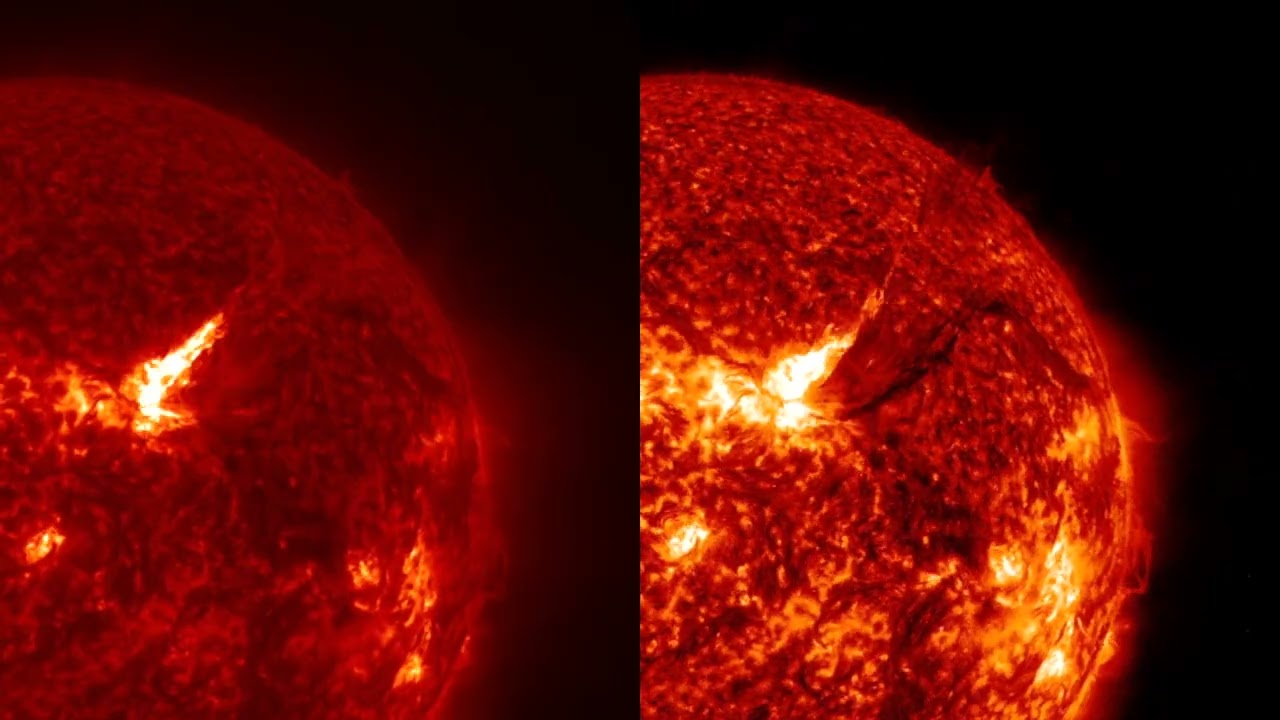
Solar Flares and CMEs at Earth - More Likely | S0 News June.3.2026
SpaceWeatherNewsS0s
2K views•2026-06-03



