The video masterfully turns a subtle orbital anomaly into a compelling challenge to our current understanding of galactic architecture. It’s a sharp reminder that even our best models are often just one unexpected observation away from being rewritten.
Install our extension to search inside any video instantly.
Something Near the Galactic Center Just Changed Direction… and Scientists Don't Know WhyAdded:
Something is moving near the heart of our galaxy and it just changed course.
Not slightly, not gradually. It turned deep inside the Milky Way, 26,000 light years away. Astronomers locked onto an object and watched it do something impossible. The laws of orbital mechanics say objects follow predictable paths. This one did not. It reversed. It shifted. The telescopes that caught it went quiet while scientists checked their instruments and checked again. We are going to travel there tonight into the fire, into the chaos, into the one place in the galaxy where something just broke the rules. Like and subscribe if the cosmos keeps you up at night. We follow the signal back to the most dangerous region in the Milky Way.
There is a place in our galaxy where stars move like bullets. At the very center of the Milky Way, packed into a region smaller than the distance between our star and its nearest neighbor, more than 10 million stars burn, collide, and tear each other apart in slow motion.
The galactic center operates by rules that make the rest of the universe look tame. To understand why something changing direction here matters so deeply, you first need to feel the scale of violence that defines this place.
Imagine taking every star visible in the night sky from Earth and compressing them all into a sphere roughly 30 light years across. That is the galactic center. Stars that would normally spend billions of years peacefully fusing hydrogen are instead flung at millions of miles hour, whipped around in visible gravitational corners and sometimes swallowed whole before they finish forming. The density here is extraordinary. Near our own region of the galaxy, stars are separated by several light years of empty space. At the galactic center, that gap shrinks to fractions of a lightyear.
Stars are so close together that collisions, near misses, and tidal disruptions happen on time scales that feel almost routine to astronomers tracking this region. And at the very heart of all this chaos sits something even more extreme. A super massive black hole with the mass of 4 million suns compressed into a point so dense that space itself curves around it like fabric around a bowling ball.
Astronomers call it Sagittarius A star, and everything in the galactic center ultimately answers to it. The gravity this object produces shapes the orbits of stars, accelerates gas clouds to near light speed, and generates bursts of energy powerful enough to be detected across the entire galaxy. Several times a year, Sagittarius AAR flares, releasing radiation that would strip the atmosphere from any planet within reach.
It is not sleeping. It is simply between meals. Around this central monster, the environment gets stranger still.
Magnetic fields twist into complex structures. Cosmic rays pour outward in jets. Gas filaments stretch for hundreds of light years like threads pulled from a wound. Astronomers have spent decades building tools precise enough to peer into this fog of radiation and gravity and actually track individual objects moving through it. And they do track them. There are stars that orbit so close to Sagittarius a star that their entire orbital period, their equivalent of 1 year, lasts only a few decades.
These stars have been watched, measured, and mapped with extraordinary precision.
Scientists know their speeds, their trajectories, and their histories down to extraordinary detail. So when something near the galactic center moves in a way that does not fit the known map, it does not get dismissed. It gets studied, cross-cheed, and debated.
Because in this region, an unexpected motion is not a glitch. It is a signal.
Whatever just changed direction near the galactic center did so inside the most closely watched, most precisely measured, most gravitationally complex address in the entire Milky Way. And that makes what happened far more difficult to explain away. Something out there moved when it should not have.
Scientists noticed and the search for an answer is pointing toward possibilities that are changing how researchers think about the very core of our galaxy. But before we can understand what changed we need to understand what changing direction even means at this scale because in space direction is not a simple thing. When something changes direction in everyday life the reason is usually obvious. A car turns because a driver steers it. A ball curves because wind pushes it. Motion follows force and force has a source you can usually point to. In space, the logic is the same, but the forces involved are invisible. The time scales are enormous, and even a tiny unexplained shift in trajectory can represent something enormous hiding just out of sight. At cosmic scales, objects do not simply decide to turn. Everything follows a path carved out by gravity.
Stars orbit black holes because the curvature of spaceime leaves them no other option. Planets circle their parent stars along paths calculated billions of years ago when the original cloud of gas and dust first began to collapse. Motion in space is not random.
It is the accumulated result of every gravitational influence ever applied to an object since the moment it formed.
This is why trajectory changes are so significant when they appear. If an object is following a predictable path and then deviates, something caused that deviation. Either there is a gravitational influence that was not accounted for, meaning there is a hidden mass somewhere nearby, or the object experienced some kind of outgassing or internal event that pushed it off course or something struck it. Every option on that list is scientifically interesting.
None of them are trivial. Near the galactic center, the problem of measuring direction is even more complex. The region is so dense with gravitational sources that calculating any single object's expected path requires accounting for the combined pull of millions of stars. The central black hole surrounding gas clouds and an unknown quantity of dark matter threading through the entire region. The math is not simple. The models are not perfect. Which means when astronomers say something changed direction and they do not know why. They are saying something very specific. They are saying the change was large enough or sudden enough that it falls outside the margin of error in their models. It is not a data artifact. It is not a calibration issue. The object went somewhere the equations did not predict. To detect this kind of deviation, astronomers track positions over time with extraordinary precision. They use radio telescopes, infrared observatories, and space-based instruments that can measure the movement of objects 26,000 lighty years away down to fractions of a millisecond of arc. That is roughly equivalent to measuring the width of a coin sitting on the surface of the moon from Earth. These measurements are then compared against orbital models built from years of prior observations.
When a new data point falls outside the predicted range, the alert goes out.
Something is wrong with the model or something is wrong with the space the object is moving through. In the case of the object near the galactic center, the deviation was not subtle. It was clean enough and consistent enough across multiple telescopes and multiple observation windows that the change was confirmed before any announcement was made. The object moved. The model said it should not have moved that way. And every tool available to modern astronomy is now trying to figure out what made it happen. To get closer to an answer, you need to understand the environment it is moving through. Because the galactic center is not empty space. It is full of gravitational traps, hidden masses, and ancient stellar debris that does not always show up in the data. And at the center of that environment, there is a gravitational engine so powerful that even light cannot fully escape it. The discovery did not come from a single dramatic moment. It came the way most genuine astronomical breakthroughs do.
slowly through the patient accumulation of data points that quietly refused to line up with expectations. Astronomers working with radio and infrared telescope networks had been monitoring a cluster of objects near the galactic center as part of long-term positional tracking programs. These programs exist precisely because the galactic center is unpredictable.
Scientists want years of baseline data so that when something unusual happens, they have enough historical context to recognize it immediately. The object in question had been on the watch list for some time. It was not the most dramatic thing near Sagittarius, a star. It was not one of the famous stars that loop around the central black hole at speeds pushing fractions of the speed of light.
It was something more modest in profile, which is exactly why its behavior became so puzzling. Early observations placed the object on what appeared to be a relatively stable trajectory. The data points mapped out a path that, while complex due to the crowded gravitational environment, was consistent and trackable. Researchers noted it, cataloged it, and moved on to more pressing targets. Then during a routine review of updated positional data, something did not add up. The most recent measurements placed the object noticeably away from where the model predicted it should be. The offset was small in absolute terms, but in the language of precision astrometry in the galactic center, small offsets are loud alarms. The first assumption was instrument error. Telescopes are calibrated constantly and even tiny drift in a sensor or a slight atmospheric distortion can introduce false positional shifts. The team went back and checked every piece of equipment involved in producing the data. Everything was functioning within normal parameters. The second assumption was a modeling error. Perhaps the gravitational inputs used to predict the object's position were incomplete.
Perhaps a nearby star had been assigned the wrong mass, or a gas cloud that exerts gravitational pull had been underweighted in the simulation. The team reran the models with updated mass estimates and more refined parameters.
The object was still in the wrong place.
At that point, the deviation stopped being a calibration question and became an observational one. Something had genuinely altered this object's trajectory. The question was when the change had occurred because telescopes do not observe continuously. There are gaps between observation windows and whatever caused the deviation may have happened during one of those gaps.
Archival data was pulled from earlier sessions and re-examined. Researchers identified a window of roughly several months during which the trajectory appeared to shift. Before that window, the object's positions matched predictions with normal precision. After it, they consistently fell outside the predicted path in the same direction and by a growing margin. That consistency was important. It ruled out a random glitch. The deviation was systematic, meaning it was accumulating over time in a single direction. Something had given the object a new component of velocity, and it had been maintaining that new trajectory ever since. What could do that in the galactic center? The possibilities were already being debated before the first formal paper was circulated and some of the options on that list were extraordinary. But to understand which possibilities were physically realistic, researchers needed to understand the full gravitational landscape the object was navigating. And that landscape is dominated by one of the strangest populations of stars in the known universe. Most of the universe operates on time scales and at distances that make it feel static. The stars visible from Earth tonight are in approximately the same positions they occupied a century ago. The constellations that ancient civilizations mapped are still recognizable. Space from our vantage point seems orderly. The galactic center operates on a different clock entirely.
At the heart of the Milky Way, gravity is so intense and stellar density so high that the rules governing motion in the rest of the galaxy break down. In practical terms, objects accelerate faster, orbits decay quicker, and interactions that would be improbably rare in the outer galaxy happen with surprising regularity near the center.
Consider stellar velocities. In our region of the galaxy, stars move at speeds of roughly 100 to 200 m/s relative to the galactic center. That is already fast by human standards. But stars in the immediate vicinity of Sagittarius a star regularly reach speeds exceeding 3,000 m/s.
Some have been clocked at speeds several times that during close approaches to the central black hole. At those velocities, even brief gravitational encounters produce orbital changes that would take billions of years to accumulate in quieter regions. The gravitational potential near the galactic center is so steep that even objects not directly interacting with one another can be perturbed simply by passing through a region of higher mass density. Gas clouds, stellar remnants, and dark matter concentrations all contribute to a gravitational field that shifts and fluctuates in ways that no model can perfectly predict in real time. There is also the matter of stellar evolution running at an accelerated pace. The galactic center is a star forming region that has produced multiple generations of massive short-lived stars. Massive stars burn fast and die explosively in supernova.
The galactic center has experienced a disproportionate number of these explosions over its history. Each one sending shock waves through the surrounding medium and imparting momentum to everything in the vicinity.
The remnants of those explosions, dense neutron stars and stellar mass black holes, are also thought to be present in large numbers near the galactic center.
These compact objects are difficult to detect individually, but collectively represent a population of gravitational perturbers concentrated precisely in the region where the direction changing object is located. A close encounter with even a stellar mass black hole could alter a trajectory measurably without leaving any obvious visible signature. Then there is the electromagnetic environment. The galactic center produces intense magnetic fields, some of the strongest measured anywhere in the galaxy. These fields interact with ionized gas and charged particles in ways that are not fully understood. For objects with any magnetic properties or surrounded by charged material, the electromagnetic environment near the galactic center could in principle contribute forces not captured by purely gravitational models.
In other words, the galactic center is a place where multiple physical processes operate simultaneously at extreme intensities. Gravity, electromagnetism, radiation pressure, and shock dynamics all overlap. Passing out which one caused a specific trajectory change is genuinely difficult, even with excellent data. This complexity is not an excuse for uncertainty. It is an explanation for why the anomalous motion of this object cannot be attributed to a single cause without rigorous elimination of alternatives.
Scientists are doing exactly that elimination right now. But first, they needed to account for the most famous inhabitants of the galactic center. The stars whose orbits have already told us more about gravity and black holes than almost any other source. 4 million times the mass of our star compressed into a region smaller than our solar system.
That is Sagittarius A star. And it is not alone. The super massive black hole at the center of the Milky Way is surrounded by a court of gravitational monsters. A dense population of stars, gas clouds, neutron stars, and stellar mass black holes that have spent millions of years falling inward, spiraling closer, and being shaped into one of the most extreme environments observable from Earth. For decades, Sagittarius A star was known to exist, but impossible to directly observe with confidence. The galactic center sits behind enormous clouds of gas and dust that block visible light entirely.
Astronomers had to build infrared and radio telescopes capable of seeing through this obscuring veil before the true nature of the central region became clear. What they found when they finally looked changed astrophysics permanently.
The innermost regions around Sagittarius A star contain a population of hot, young, massive stars that should not be there by any standard formation model.
These stars, known collectively as the star cluster, are burning bright and fast. They are the kind of stars that form in dense molecular clouds, not in the immediate vicinity of a super massive black hole where tidal forces should tear apart any gas cloud before it can collapse into a star. Their presence alone is a puzzle that has occupied theorists for years. Some researchers propose the stars formed farther out and migrated inward through a process of orbital decay driven by interactions with the surrounding stellar population. Others suggest they formed inside a massive gas cloud that spiraled in and provided temporary shielding against the tidal environment.
No consensus has been reached. But the stars are not just a formation mystery.
They are also precision tools. Because they orbit so close to Sagittarius a star at such high speeds, they allow astronomers to map the gravitational influence of the central black hole with extraordinary precision. By tracking the orbits of these stars over time, researchers can calculate the mass of the object they orbit to within a small fraction of uncertainty. One star in particular, designated stew, has been tracked through a complete orbital period. Its path confirmed the mass of Sagittarius a star to high precision and also provided the first direct evidence that the effects of general relativity, the bending of spaceime predicted by Albert Einstein over a century ago could be detected in the orbital behavior of a star around a black hole. That detection was not subtle. As Stew approached its closest point to Sagittarius a star, its light shifted in color and its orbit precessed in exactly the manner that general relativity predicts. The confirmation was a landmark result in physics achieved by simply watching a star move. Now these same techniques are being applied to understand the direction changing object. By comparing its observed trajectory against the combined gravitational influence of Sagittarius A star and the entire surrounding stellar population, researchers can identify which gravitational sources are accounted for and which are not. The initial conclusion is that the known environment does not fully explain the observed trajectory change.
Something additional is present.
Something that did not appear in previous surveys of the region. That something may have been hiding in the orbits of the stars themselves because the stars have their own secrets and those secrets are directly relevant to what just happened. The stars are a collection of massive luminous stars orbiting within a fraction of a lightyear from Sagittarius a star. They are among the most precisely tracked objects in all of astronomy. And despite decades of observation, they continue to produce results that do not fit neatly into any single theoretical framework.
Their orbits are highly elliptical.
Unlike the roughly circular orbits of planets around a typical star, the stars follow stretched paths that bring them extremely close to the central black hole at one end and carry them far outward at the other. This means their speeds vary enormously depending on where they are in their orbits. At maximum distance, they crawl. At closest approach, they streak. Several of these stars have been observed making complete orbits.
Stew, the most studied, completes a full loop in roughly 16 years. During that loop, it reaches speeds approaching 3% of the speed of light at its closest point to Sagittarius A star. That is roughly 22 million miles hour. Even at those extreme speeds, the effects of Sagittarius A stars gravity on the trajectory are precisely predictable and have been confirmed to match general relativistic calculations. But not everything about the star cluster behaves this cleanly. Certain stars in the cluster have orbital planes that are tilted at unusual angles relative to one another. In a system shaped purely by the gravity of a single central object, orbital planes would tend to align or randomize in a specific statistical pattern over time. The distribution of the star orbital planes does not match that expectation. Something appears to have scrambled their inclinations, tilting some orbits dramatically relative to others in a way that is difficult to explain purely through interactions with Sagittarius A star.
One proposed explanation is that the stars underwent a period of intense gravitational scattering shortly after their formation or migration inward. A dense cluster of stellar mass black holes thought to exist in a region just outside the star orbits could produce exactly this kind of orbital scrambling through repeated close encounters over millions of years. Another proposed explanation is the presence of an intermediate mass black hole. An object far smaller than Sagittarius a star but far larger than a stellar mass black hole orbiting in the same region. Such an object would perturb stellar orbits in a coherent way and could explain the pattern of inclination anomalies if it were located at the right distance and orbital configuration. The intermediate mass black hole hypothesis is not confirmed, but it has never been ruled out. And the reason it has never been ruled out is that the galactic center is dense enough and complex enough that an object of that mass could potentially have been present for millions of years without producing a clear unambiguous detection signal. until now. Perhaps because the trajectory change observed in the direction changing object matches in certain key properties what you would expect if an undetected massive object had passed close enough to impart a gravitational impulse and then continued on its own orbit without being directly observed. The star anomalies and the direction change may be pieces of the same puzzle. Astronomers are now looking at both sets of data together, searching for a single physical explanation that can account for all of the observations simultaneously.
What they find will depend on what else was happening in the region at the exact moment the shift occurred. The detection was not accidental.
It was the product of a systematic long-term monitoring campaign designed specifically to catch events exactly like this one. Multiple observatory networks maintain ongoing watch programs targeting the galactic center. These programs operate in infrared, radio, and X-ray wavelengths because each reveals different physical processes happening in the same region. Infrared cuts through the dust obscuring the center and shows stellar positions with high precision. Radio reveals gas dynamics, magnetic field structures, and the behavior of compact objects. X-ray captures high energy events including flares from Sagittarius A star and emissions from stellar remnants. At the time the trajectory shift was detected, at least two major monitoring programs had overlapping observation windows covering the relevant region. This overlap was fortunate because it meant the anomalous motion was captured from independent observational angles, allowing crossverification before any conclusions were drawn. The observing team using infrared data first flagged the positional offset. The object they were tracking had been cataloged in a prior survey and was being monitored as part of a broader effort to understand the three-dimensional distribution of stars and gas structures in the inner galactic region. It was not a high priority target. It was one entry among many in a database of objects being updated with fresh positional measurements as new data came in. When the software comparing new positions against predicted positions flagged the offset, the alert was filtered through a standard verification protocol.
Positions in the galactic center are notoriously difficult to measure because the region is so crowded that multiple objects can appear blended together in images of insufficient resolution. The first step was to rule out a source confusion event, meaning a scenario where the tracked object had actually remained stationary, but a different nearby object had moved into the same apparent position. Highresolution imaging using adaptive optics, a technology that corrects for atmospheric blurring in real time, resolved the target cleanly from its neighbors. The object was isolated. The offset was real. At the same time, the radio monitoring network was processing its own data set from the same region. Radio observations offer complimentary positional data at different wavelengths and with different systematic uncertainties. Comparing the two independent data sets showed the same directional shift appearing consistently across both observation modes. This cross-wavelength confirmation was decisive. Positional errors caused by instrumental effects or calibration drifts almost never produce the same false offset in both infrared and radio data simultaneously because the two systems operate through entirely different physical mechanisms.
Agreement between them meant the position change was real. Once the data was confirmed, the team began working backward through the observation archive. They wanted to identify exactly when the trajectory change had begun.
Finding the onset point would constrain which physical mechanisms could have caused it because different mechanisms produce trajectory changes over different time scales. A brief violent gravitational encounter produces an almost instantaneous deflection. A slow gravitational influence from a nearby unseen mass produces a gradual progressive deviation that builds over months or years. What the archive revealed about the timing of the shift is one of the most important clues researchers now have, and it points directly toward a class of objects that has been theorized to exist in the galactic center for years without ever being definitively confirmed through direct observation. Pinning down the exact moment a trajectory changed is not as simple as finding a single data point that looks wrong. It requires building a precise timeline from observations spread across years, identifying the window in which the deviation first appears, and then working backward to determine what was happening in the surrounding environment at that specific time. The archival analysis revealed that the trajectory change was not instantaneous.
The deviation began gradually, showing the first measurable offset approximately 14 months before it was formally flagged. In the earliest affected measurements, the positional offset was within the noise threshold of the instrument, meaning it was technically detectable in retrospect, but small enough that it would not have triggered an alert on its own. Over the following months, the offset grew consistently. Each successive observation placed the object slightly further from the predicted path, always in the same direction. The rate of deviation was not constant. It increased over time, which is a physically significant detail. An increasing rate of deviation suggests the perturbing force was not a brief impulsive event, but an ongoing or cumulative influence.
This ruled out one of the simpler explanations immediately. A single high-speed flyby of a compact object like a stellar mass black hole typically produces a sharp brief gravitational kick that deflects the target onto a new trajectory but does not continue accelerating it afterward. What the data showed instead was more consistent with a prolonged gravitational influence.
something that remained in the vicinity of the object and continued pulling it off course as both the object and the perturber moved through the region. The 14-month window also placed the onset of the deviation within a specific period in the galactic cent's recent observational history. During that same window, researchers working on separate monitoring programs had recorded several unusual events in the broader galactic center region. A faint infrared brightening event was logged roughly 6 months before the first detectable positional offset. An anomalous radio emission signature was detected in the same general zone approximately 3 months before the brightening. Whether these events are connected to the trajectory change is not confirmed.
Coincidence is common in a region as active as the galactic center. But the spatial and temporal clustering of these observations has drawn serious attention. Researchers are now analyzing whether a single physical event, perhaps the arrival of a compact object into a particular orbital zone, could have produced all three signatures in sequence. First, the radio emission, then the infrared brightening, then the trajectory pertubation as the object passed progressively closer to the source of all three signals. If that sequence holds up under analysis, the timeline would tell a coherent story.
Something entered a region of space near the galactic center approximately 2 years ago. It announced its presence first in radio, then in infrared, and then through a gravitational influence powerful enough to bend the path of a tracked object over the course of more than a year. What that something is and whether it is still in the region today is the central question driving every team currently working on this problem.
The timeline narrows the options significantly.
But it does not eliminate them. Several physical mechanisms remain consistent with the data and each one if confirmed would represent a discovery of considerable importance. When an object near the galactic center moves in a way that defies prediction, scientists do not reach for exotic explanations first.
They work methodically through a hierarchy of possibilities, beginning with the most physically straightforward and moving toward the more unusual only when the simpler options fail. The first category of explanations involves unmodled gravitational sources. The galactic center contains far more mass than is directly visible. Dense stellar clusters, embedded gas clouds, and the broad diffuse distribution of dark matter all contribute gravitational effects that no model captures with perfect completeness. A concentration of mass that was underweighted or entirely missing from the simulation could produce a trajectory deviation that looks anomalous in the data, but has a mundane physical cause.
Researchers tested this possibility by running updated gravitational simulations with adjusted mass distributions. They increased the assumed density of several known features in the region, moved stellar position estimates within their error bounds, and varied the dark matter density profile within theoretically acceptable ranges. None of these adjustments produced a simulated trajectory that matched the observed deviation. The unmodled conventional mass explanation was not sufficient. The second category involves a close gravitational encounter with a compact object. Stellar mass black holes, neutron stars, and white dwarfs are all expected to exist in large numbers in the inner galactic region. These objects are generally invisible unless they are actively accreting material. A close approach by one of these objects could produce a measurable gravitational deflection without leaving a clear optical or radio signature. This explanation is physically plausible. The problem is that the trajectory change does not quite match the signature of a single brief encounter. As discussed in the timeline analysis, the deviation built gradually over more than a year. A single compact flyby would typically produce a much sharper inflection point in the trajectory data. Something is sustaining the pertubation over time.
The third category involves an intermediate mass black hole orbiting in the region. This is where the explanation begins to get genuinely interesting. An object with a mass between 1,000 and 100,000 times the mass of our star. too large to be a stellar remnant, but too small to be a galaxy scale super massive black hole could produce exactly the kind of sustained progressively increasing gravitational influence seen in the data. The fourth category pushes further still. Some researchers have proposed that the pattern of the deviation is consistent with the object approaching a region of unusually high dark matter density, a so-called dark matter clump that has no visible stellar counterpart.
Dark matter interacts gravitationally but does not emit light. A sufficiently dense clump positioned in the right location could mimic the gravitational signature of a hidden massive object without being detectable through any direct electromagnetic observation. Each of these four categories is being actively modeled and tested. The data so far is most consistent with categories three and four, which is why those two possibilities are receiving the most attention from theorists. But before either can be confirmed, researchers need to understand the mechanics of gravitational slingshots more precisely because the galactic cent's extraordinarily complex gravitational landscape creates a specific kind of deflection event that complicates the analysis in ways that are surprisingly easy to overlook even with excellent data in turn. And gravitational slingshots are among the most elegant phenomena in orbital mechanics. They require no engines, no fuel, and no exotic physics. They operate on a principle as old as gravity itself. A moving object that passes close enough to a massive body can steal a portion of that body's orbital energy and emerge traveling faster and in a different direction than it entered. Humanity has used this effect deliberately in space flight. Several deep space probes have been accelerated by flying close to planets using Jupiter and Saturn as gravitational catapults to gain the speed needed to reach the outer solar system without carrying prohibitive amounts of fuel. The physics is well understood, repeatable and elegant. In the galactic center, gravitational slingshots happen without any human engineering. The dense population of stars, stellar remnants, and the central black hole creates an environment where close gravitational encounters occur regularly on astronomical time scales.
Stars that wander too close to a massive neighbor can be flung outward at high velocity, ejected from their previous orbit, and redirected onto an entirely new path. This process called gravitational scattering is actually one of the primary mechanisms by which the galactic center loses stars over long time scales. Some stars are scattered inward towards Sagittarius A star and eventually consumed. Others are scattered outward so violently that they achieve escape velocity from the galactic center entirely and become hypervelocity stars. Objects moving fast enough to eventually leave the Milky Way altogether. Could a gravitational slingshot explain the direction change observed in the tracked object? On the surface, the answer seems promising. The galactic center contains exactly the kind of gravitational machinery needed to produce a slingshot event. There is no shortage of massive objects to play the role of the catapult, but the details do not align cleanly with a standard slingshot scenario. In a classic slingshot, the deflection is sharp. The object approaches the gravitational perturber, swings around it, and exits in a new direction. The entire close encounter happens relatively quickly and the trajectory change is concentrated in a short time window. Before the encounter, the object travels on one path. After the encounter, it travels on a new path. The transition between the two is abrupt.
The observed trajectory change does not look like this. The deviation is gradual, building over more than a year with an increasing rate. This is not the signature of a single close encounter followed by a new stable trajectory. It is the signature of an object that is still being influenced by a gravitational source that is remaining in its vicinity. For a gravitational slingshot to produce this kind of extended, gradually accumulating deflection, the perturbing object would need to be moving at roughly the same speed as the target on a trajectory that keeps it nearby for an extended period.
This is possible in principle, but it requires a specific configuration of masses and velocities that researchers are now trying to reconstruct from the trajectory data. What the slingshot analysis does confirm is that a single brief close encounter is not the answer.
Whatever is influencing this object has been doing so consistently for over a year. That persistent influence points towards something either orbiting in the same region or moving through it at low relative velocity. And the object that best fits that description is one that has been theorized to exist near the galactic center for years without ever being directly confirmed. Dark matter is the most abundant form of matter in the universe and it is completely invisible.
It does not emit light. It does not reflect light. It does not absorb light.
The only way to detect it is through the gravitational influence it exerts on the things that can be seen. The evidence for dark matter is overwhelming.
Galaxies rotate in ways that cannot be explained by the mass of their visible stars alone. Galaxy clusters bend light from distant background objects far more strongly than their visible matter would predict. The large scale structure of the universe, the vast network of filaments and voids visible in deep sky surveys matches simulations only when dark matter is included as a fundamental component of the cosmic inventory.
Within individual galaxies, dark matter is not distributed randomly. Simulations consistently predict that dark matter forms halos around galaxies extending far beyond the visible stellar disc.
They also predict that within those halos dark matter is not perfectly smooth. It clumps. It forms dense substructures called dark matter subhalos or dark matter clumps. regions of elevated density embedded within the broader diffuse distribution. In most of the galaxy, the gravitational influence of these clumps is too small or too spread out to produce detectable effects on individual stellar trajectories. But the galactic center is different. The center of the dark matter halo coincides with the galactic center, which means dark matter density is highest precisely where stellar densities are also highest. The concentration of dark matter near the center is expected to be dramatically elevated compared to the outer regions of the galaxy. Theory predicts that near the galactic center, dark matter density may be high enough that individual clumps could in principle produce measurable gravitational perturbations on stars and other objects moving through or near them. This has been an attractive theoretical prediction for years. But observational evidence for individual dark matter clumps in the galactic center has been elusive because any gravitational signal from a dark matter clump is difficult to disentangle from the signals of the many visible massive objects in the same region. The trajectory change observed in the tracked object offers a potential window into this problem if the pertubation cannot be attributed to any known visible object. And if it cannot be adequately explained by a single compact flyby or a standard slingshot event, then a dark matter clump of sufficient density positioned in the right location becomes a candidate worth taking seriously. The mass required for such a clump to produce the observed trajectory change over the documented time scale has been estimated. Early calculations suggest the perturbing mass would need to be on the order of tens of thousands of solar masses concentrated within a region small enough to maintain the prolonged gravitational influence on the tracked object without having been previously detected in stellar kinematic surveys. This is a tight constraint. A dark matter clump of that mass and concentration would be expected to have left traces in the orbital behavior of other objects in the region. Searches are now underway to check whether any other tracked objects in the vicinity show subtle trajectory anomalies consistent with passage through a region of elevated dark matter density. If such secondary perturbations are found, the dark matter clump hypothesis gains significant support. If no other objects are affected, the explanation must lie elsewhere. And that elsewhere is one of the most debated hypothetical objects in galactic astrophysics. The question that sits at the center of every theoretical discussion about this trajectory anomaly is the same question that has shadowed galactic center research for more than two decades. Is there a massive unseen object orbiting near Sagittarius A star that has never been directly detected?
The idea is not speculative in the casual sense. It is a formally developed scientific hypothesis with specific observational predictions motivated by several independent lines of evidence that each point with varying degrees of confidence toward the same possibility.
The galactic center contains stars, gas, dust, and radiation that account for a known quantity of mass within various measurement radi. When astronomers sum up all of that known mass and compare it against the gravitational behavior of the region, there is a persistent discrepancy. The total gravitational influence observed reflected in stellar velocities, orbital shapes, and gas dynamics is slightly larger than the sum of everything visible. This excess gravitational influence could have many mundane explanations, including unresolved stellar populations too faint to count individually or systematic errors in mass estimation methods. But it is consistent with the presence of an additional massive object somewhere in the inner region. What kind of object?
The mass range suggested by the discrepancy combined with the constraint that it has not been detected as a bright point source in any wavelength points toward a compact dark object. A cluster of stellar mass black holes spread over a volume could contribute mass without a strong central emission signature. A single massive black hole that is not currently accreting material would also be dark. The most discussed candidate is an intermediate mass black hole. These objects are theorized to form through the merger of stellar mass black holes in dense stellar clusters that subsequently spiral inward toward the galactic center. They occupy a mass range between roughly 1,000 and several hundred,000 solar masses, bridging the gap between the stellar remnants that astronomy detects routinely and the super massive monsters at galactic centers. Intermediate mass black holes are notoriously difficult to confirm.
They are too small to produce the radio and X-ray signatures typical of active super massive black holes. They are too dark to appear in optical surveys unless they are disrupting a nearby star or accreting gas and in the galactic center where everything is happening simultaneously and the noise floor in every observation band is high.
Distinguishing the signal of an intermediate mass black hole from the collective background is a genuine technical challenge. But they leave gravitational fingerprints. An intermediate mass black hole orbiting within the star cluster region would perturb nearby stellar orbits in specific predictable ways. It would introduce anomalies in orbital inclinations, cause gradual drift in orbital procession rates and most relevantly for this investigation produce exactly the kind of sustained progressively increasing trajectory deviation seen in the tracked object.
The mass and orbital parameters of a hypothetical intermediate mass black hole that best fit the observed trajectory change are currently being computed by multiple teams. If a consistent solution exists, it would not constitute a confirmed detection on its own, but it would represent a significantly stronger case for follow-up observation than any previously available evidence. And if confirmed, it would change not just our understanding of the galactic center, but our understanding of how super massive black holes grow. Because there is a leading theory that every super massive black hole began as something much smaller and grew by consuming objects exactly like what might be hiding near Sagittarius A star right now. What comes next in this investigation is where the science becomes even stranger. The universe appears to have a black hole problem, not a shortage of them. The opposite.
There are two well populated categories of black holes that astronomy has confirmed with confidence. And between them sits a vast mass range where detections are rare, contested, and frustratingly difficult to nail down. At the small end, stellar mass black holes form when massive stars exhaust their fuel and collapse. These objects range from a few times the mass of our star up to perhaps 100 times that mass. They are found throughout the galaxy, detected through X-ray emissions when they accrete material from a companion star or through gravitational wave signals when two of them merge. They are well understood, regularly observed, and no longer particularly controversial. At the large end, super massive black holes anchor the centers of virtually every large galaxy in the observable universe.
Their masses range from millions to billions of times the mass of our star.
They are inferred from the orbital behavior of surrounding stars, detected through the radio emission of material spiraling into them, and in several celebrated cases imaged directly through the coordinated observations of radio telescopes spanning the entire Earth.
They too are well established. Between these two populations lies a gap. Black holes with masses between roughly 1,000 and several hundred,000 times the mass of our star. The intermediate mass category should exist in theory. The mathematics of black hole formation and growth essentially requires them as a developmental stage. But confirmed detections are sparse and every candidate announced over the past two decades has faced challenges to its interpretation.
Why is this mass range so hard to populate observationally? Several reasons compound one another.
Intermediate mass black holes are too small to produce the dramatic large-scale jets and accretion signatures of super massive black holes.
They are too large and too rare to show up in the gravitational wave surveys that have cataloged so many stellar mass mergers. And unless one is actively consuming material from a companion object, it emits nothing at all. The galactic center is one of the most promising environments to search for them. Dense stellar clusters sinking toward the galactic center through a process called dynamical friction are expected to carry intermediate mass black holes along with them. Over millions of years, these clusters spiral inward, deposit their stars into the central stellar population, and leave their central black holes orbiting within a fraction of a lightyear of Sagittarius A star. Multiple such infall events could have delivered several intermediate mass black holes to the inner galactic region over the lifetime of the galaxy. If one or more of these objects are present today, orbiting silently and invisibly within the star cluster region, they would be effectively undetectable by any current direct imaging technique. Their mass would be too small and their emission too faint. The only realistic way to find them is through their gravitational influence on the objects around them.
This is precisely why the trajectory anomaly is so significant. It offers a gravitational detection channel that does not require the intermediate mass black hole to be emitting anything at all. The tracked object does not need to know it is near a black hole. It simply responds to the gravity. And if the gravity produces a trajectory change that matches the predicted signature of an intermediate mass object at a specific orbital configuration, the detection case becomes compelling. The critical next step is constraining the mass. If the perturbing object is too light to qualify as intermediate mass, the explanation may revert to a dense stellar mass cluster. If it falls within the intermediate range, the implications are considerable. And if it is at the upper end of the intermediate range, the question of whether it will eventually merge with Sagittarius A star and what that merger would mean for the entire galaxy becomes suddenly urgent. That urgency is not abstract. It is tied directly to observations happening right now. Context matters in science. A single anomalous measurement means very little without a baseline of comparison.
But when the same measurement is placed alongside everything else ever recorded from the same region, its significance either dissolves into background noise or sharpens into something that demands explanation. In the case of the direction changing object, placing it in context has made the anomaly sharper, not softer. The galactic center has been monitored with precision instruments for roughly three decades. In that time, several dozen individual stars and other objects have been tracked with enough data points to construct meaningful orbital histories. The most famous members of this tracked population are the stars. But they are not the only inhabitants of the inner region under close watch. Infrared surveys have cataloged gas clouds, dust structures, and a handful of objects with ambiguous classifications that appear to be neither purely stellar nor purely gaseous. Among all of these tracked objects, trajectory anomalies have appeared before. The object designated G2, a compact gas cloud or disrupted star that made a close approach to Sagittarius A star roughly a decade ago, behaved unexpectedly when it survived its closest approach relatively intact rather than being fully disrupted. The object gone showed a somewhat analogous path. Several of the stars show orbital precession rates slightly different from what pure Schwarz shell geometry around a single central mass would predict.
These prior anomalies are relevant because they establish a baseline for what counts as unusual in this environment. The galactic center regularly produces deviations from simple predictions. The question is always whether a given deviation falls within the range explained by known physics applied to an imperfectly modeled environment or whether it exceeds that range. The direction changing object exceeds that range by a margin that places it in a different category from any previously documented trajectory anomaly in the inner galactic region. Its deviation has grown more rapidly than any comparable event in the observational record. Its sustained and accelerating nature distinguishes it from brief gravitational encounters that have occasionally deflected other tracked objects. And its timing and direction when plotted against the orbital geometries of the surrounding environment do not match any configuration of known objects that would explain the pertubation through conventional means. Researchers working on the comparison have also noted that the direction and magnitude of the deviation are consistent across the fulltime baseline of affected observations. There is no period within the anomalous window where the object appears to return toward its predicted path before deviating again. The pertubation is monotonic, meaning it moves consistently in one direction without reversal. This is an important discriminator between a random gravitational scatter event and a sustained influence. The cumulative deviation, the total displacement from the predicted path integrated over the entire anomalous window, now places the object at a position roughly consistent with having experienced the gravitational influence of an unseen mass of at least tens of thousands of solar masses at a distance that kept the interaction sustained over the documented period. No object in the tracked galactic center population has shown a sustained deviation of this magnitude and duration. None of the prior anomalies, including G2 and the star orbital inconsistencies, required a single unseen massive object as their primary explanation. This one may. That possibility is driving researchers toward a set of observations that have never been attempted with this specific combination of instruments and targets.
The data being collected right now could within the next several years either confirm or rule out the hidden mass explanation entirely. But the timeline is driven by something more immediate than observational patience. It is driven by the speed of the change itself.
Speed is information. In orbital mechanics, the rate at which a trajectory deviates tells you something precise about the mass and distance of whatever is causing the deviation. A slow, gentle drift over decades suggests a diffuse or distant gravitational influence. A rapid accelerating deflection over months to years suggests something massive and relatively close.
The trajectory change documented for this object falls into the second category. The rate at which the positional offset is growing has been calculated from the archival data and cross-verified across independent observation campaigns. The numbers are striking. In the first several months following the onset of the detectable deviation, the rate of positional offset growth was modest. The object was drifting from its predicted path slowly enough that the signal was near the noise floor of the instruments. This is consistent with the early stages of a gravitational interaction where the perturbing force is present, but the accumulated effect has not yet built to a clearly distinguishable level. Over the following months, the rate doubled.
Then it continued to increase. By the time the anomaly was formally flagged, the object was accumulating additional positional offset at a rate roughly five times higher than it had been at the onset. An accelerating deviation rate is physically informative. It means the perturbing gravitational influence is either getting stronger, which would happen if the object is moving closer to the perturber, or the accumulated velocity change is compounding in a way that moves the object progressively further from its original trajectory.
Both interpretations are consistent with an encounter geometry where the tracked object has been moving into a region of increasing gravitational influence rather than passing through and exiting it. This rules out a scenario where the perturber is already far away and the effect is fading. The effect is not fading, it is growing. The rate of deviation also constrains the mass of the perturber through orbital mechanics equations that relate positional change rates to gravitational force at distance. When these equations are applied to the observed data, they suggest the perturbing mass is substantial. Low mass explanations, single stellar mass black holes, ordinary stars, compact gas clouds do not produce sufficient gravitational force at plausible encounter distances to generate the observed rate of change.
The minimum mass required to explain the rate of deviation through a simple gravitational influence model exceeds 10,000 solar masses. The preferred solution, meaning the mass and distance combination that best fits the fulltime series of positional data, comes out higher than that. Some team calculations place the preferred perturb mass at closer to several tens of thousands of solar masses firmly within the intermediate mass black hole range.
These numbers are model dependent and carry significant uncertainties.
Different assumptions about the three-dimensional geometry of the encounter produce different mass estimates. The object's motion has components along the line of sight that are not directly measurable from positional data alone. And those unmeasured components introduce ambiguity into the force calculation, but even allowing for the full range of uncertainties.
The speed of the trajectory change is difficult to reconcile with anything less massive than a very dense stellar cluster or a single compact object in the intermediate mass range. The signals arriving from the same region of space are beginning to tell a story that is increasingly difficult to dismiss. And those signals are not coming from just one instrument. When multiple independent measurement systems all report anomalies from the same patch of sky within a compressed time frame, the probability that those anomalies are unrelated drops sharply. The galactic center is active enough that coincidental multi-wavelength events do occur. But the clustering of unusual signals that has been building in this specific region over the past 2 years has attracted attention precisely because the signals are not only simultaneous but spatially overlapping.
Radio observations of the galactic center have long tracked a population of compact sources, objects that emit narrow band radiation consistent with charged particles spiraling in magnetic fields. Some of these sources are associated with known pulsars, the rapidly rotating remnants of exploded stars that sweep beams of radio emission across space like lighthouse beams.
Others are associated with magnetars, a more exotic class of stellar remnant with extraordinarily powerful magnetic fields that produce sporadic intense bursts of radio energy. In the months preceding the onset of the trajectory anomaly, a compact radio source in the same general region as the tracked object briefly brightened and then faded. This event was logged in survey data, but not flagged as high priority at the time. Radio transients in the galactic center are not rare. The region produces them regularly from a variety of known and unknown sources. The event was cataloged and set aside. In retrospect, its timing relative to the trajectory onset is noteworthy. The radio brightening event occurred approximately 3 months before the earliest detectable positional offset appeared in the tracked objects data. If the two events are physically connected, the radio brightening may represent the first observational signature of whatever entered the region and began exerting gravitational influence.
Infrared monitoring of the same zone captured a separate event approximately 3 months after the radio transient. A faint diffuse infrared brightening appeared in the same general area, consistent with a modest increase in the temperature of surrounding dust or gas.
This kind of infrared signal can result from a compact object stirring up and heating nearby material as it moves through a gas-rich environment. It can also result from a tidal heating event where gravitational forces from a passing massive object raise internal temperatures in a clump of gas or a loosely bound stellar system. The infrared brightening lasted for several weeks before fading back to background levels. It did not recur. Its peak position on the sky was within the positional uncertainty range that connects it plausibly to both the radio event and the region where the tracked object subsequently began showing its trajectory deviation. X-ray monitoring of the galactic center, which is carried out routinely by space-based observatories because Earth's atmosphere blocks X-rays, showed elevated emission from the same general zone during the same period. X-ray emission near the galactic center most commonly arises from hot gas near Sagittarius a star itself from X-ray binaries where a compact object is accreting material from a companion star or from supernova remnants. The elevated emission in this case did not match the known X-ray binary population in the region and was not centered on Sagittarius A star.
Together, the radio transient, the infrared brightening, and the X-ray elevation form a multi-wavelength picture of something energetic happening in the same spatial volume over a period of several months. None of these signals individually would demand extraordinary explanation. Together, and in the context of the subsequent trajectory anomaly, they suggest a sequence of events rather than a random collection of unrelated phenomena. The one instrument that had not yet weighed in was the most powerful space telescope ever built. And when its data arrived, the picture became more complex still.
The James Web Space Telescope was not designed primarily as a galactic center observatory. Its primary scientific priorities center on the early universe, exoplanet atmospheres, and the formation of the first stars and galaxies after the Big Bang. But its extraordinary infrared sensitivity and spatial resolution make it capable of observations in the galactic center region that no previous space telescope could achieve with comparable clarity.
Observing the galactic center with James Web presents specific challenges. The region is extraordinarily bright in infrared wavelengths, which means that the most sensitive detector modes can be overwhelmed by the collective emission of millions of closely packed stars.
Observations must use carefully designed exposure strategies and filter combinations to prevent detector saturation while still capturing faint targets of interest. Despite these challenges, the Galactic Center has been targeted by James Webb as part of several approved science programs. The data relevant to the trajectory anomaly investigation comes from observations made across multiple epochs with the most recent data arriving within the past several months. What the James Web data shows in the zone of interest is not a single dramatic object. It reveals a complex substructure of sources in the region that previous instruments with lower spatial resolution had blended into apparently smooth emission. Several point-like sources that previous surveys had treated as a single unresolved object are now resolved into distinct components. The positional mapping of these components has already required updates to existing cataloges of galactic center sources. Among the newly resolved sources, at least one shows a near infrared spectral signature that does not match the expected emission from an ordinary star. The spectrum contains features consistent with hot dust heated to temperatures several hundred° above what the local radiation environment would predict. Hot dust of this kind is typically associated with a compact object embedded in surrounding gas and dust that is being heated by some internal energy source either radiation from accretion or tidal dissipation. This source is positionally consistent with, though not precisely coincident with the region where the radio and infrared transients were previously detected. The positional uncertainty is large enough that a physical connection cannot be confirmed on positional grounds alone, but the spectral anomaly is being taken seriously. James Web data has also revealed that the overall stellar density in the immediate vicinity of the trajectory anomaly zone is slightly lower than the surrounding region by a small but measurable margin. A local deficit in stellar density can arise through several mechanisms, including the gravitational influence of a massive object that has dynamically heated the local stellar population, causing stars to disperse outward from the region.
This density deficit is subtle and may be within the range of normal statistical variation, but it has been flagged as a potentially corroborating feature by two independent analysis teams. None of the James Web findings individually constitute a detection of the object responsible for the trajectory anomaly. Taken together, however, they add texture to the picture that multiple complimentary observations are building. Something in this region is behaving unusually across multiple observational channels. And the James Web data is now providing spatial resolution fine enough to begin isolating which specific sub region the anomalous signals are originating from.
That spatial isolation is critical because it determines which of the competing theoretical explanations remains consistent with all of the data simultaneously. And those competing explanations are numerous and vigorously argued. Science does not converge on a single answer the moment interesting data appears. It fragments. Multiple teams working from the same observations reach different conclusions based on different modeling assumptions, different statistical approaches, and different prior beliefs about which physical mechanisms are most plausible.
The trajectory anomaly in the galactic center is no exception. At least four distinct interpretive frameworks are currently being advanced by research groups working on this problem, and the differences between them are not minor.
They point toward physically distinct objects with very different implications for our understanding of the galactic center. The first framework advanced primarily by a team working with long baseline radio interferometry data argues that the trajectory change is best explained by a single intermediate mass black hole with a mass in the range of 40,000 to 80,000 solar masses. This team's mass estimate comes from modeling the trajectory deviation as a gravitational influence that has been operating continuously over the documented observation window. Their preferred orbital configuration places the perturbing object at a distance of roughly a few hundreds of a lightyear from the tracked object at the time of closest approach. The second framework developed by a separate team using a combination of infrared positional data and stellar kinematic surveys challenges the intermediate mass black hole interpretation on the grounds that the inferred mass would have produced detectable pertubations in the orbits of nearby stars that are not observed. This team argues instead for a dense cluster of stellar mass black holes, perhaps 50 to 100 objects contained within a very compact volume whose collective gravitational influence mimics that of a single intermediate mass object without the same orbital perturbation signature on surrounding stars. The third framework takes a different approach entirely, arguing that the trajectory change may not require any additional undetected mass at all. This team's analysis focuses on the possibility that the tracked object itself has internal structure that is more complex than assumed and that a modest outgassing event or tidal interaction with a nearby ordinary star could have imparted the observed velocity change without invoking hidden massive objects. This explanation is the least exotic but has the most difficulty accounting for the sustained and accelerating nature of the deviation. The fourth framework is the most speculative but has attracted significant attention. A small group of theorists has proposed that the trajectory change combined with the multi-wavelength transient events preceding it is consistent with the passage of a primordial black hole through the region. Primordial black holes are a hypothetical class of objects that would have formed in the very early universe from density fluctuations before any stars existed.
If they exist in significant numbers, they could be distributed throughout galaxies as a component of dark matter, detectable only through gravitational encounters of precisely the kind observed here. Each of these four frameworks makes different predictions about what additional observations should reveal. The intermediate mass black hole model predicts that prolonged monitoring should reveal a periodic signature in the trajectory deviation as the tracked object and the perturb continue orbiting. The stellar cluster model predicts a more irregular pertubation pattern over time. The internal event model predicts the deviation should gradually stabilize and cease growing. The primordial black hole model predicts a sharp eventual sessation of the pertubation as the perturb moves through and away from the region. Deciding between these frameworks requires data that does not yet exist, but the window for collecting it is open and several observatories are currently running targeted campaigns designed to produce the measurements needed. The answer when it comes will not be quiet. Among the scenarios being considered for what caused the trajectory change, one of the most physically dramatic sits near the edge of mainstream scientific discussion. It does not require invoking undetected exotic objects. It does not depend on dark matter clumps or primordial relics.
It proposes instead that what astronomers are witnessing is the aftermath of a collision that happened in the galactic center without anyone being positioned to observe it directly when it occurred. Collisions in space are rare by the standards of everyday experience, but not by the standards of the galactic center. The stellar density there is high enough that direct stellar collisions. Events that would never occur in the sparse regions of the outer galaxy happen on time scales of millions of years. Near the very center, the time scale shortens further. Stars can be stripped of their outer layers through tidal interactions.
Compact objects can merge. Gas clouds can be disrupted and reassembled. The scenario proposed by a minority of researchers working on this problem involves a collision or near collision between the tracked object and an undetected companion that was sharing its orbital vicinity. If the tracked object was originally part of a binary system, two objects gravitationally bound to each other and co-orbiting, then a close encounter with a massive third body could have disrupted the binary. One member of the pair could have been ejected at high velocity, while the other, the object currently being tracked, received a momentum kick in the opposite direction. This is a well understood process called binary disruption and it is actually thought to be one of the mechanisms responsible for producing the hypervelocity stars occasionally found racing outward from the galactic center at speeds sufficient to escape the galaxy. In the binary disruption scenario, the trajectory change would not be ongoing. It would have happened at a single moment, the moment of disruption, and the tracked object would now be on a stable but different path. The gradual nature of the observed deviation complicates this scenario. Pure binary disruption should produce an abrupt trajectory change rather than a gradually accelerating one. However, some researchers have modified the binary disruption scenario to include a secondary effect. If the disruption event also left the tracked object in a tidily disturbed state with internal oscillations or a surrounding debris cloud that is gradually asymmetrically dispersing, then a sustained reaction force could be present that mimics the signature of ongoing gravitational perturbation. This is physically speculative, but it is not physically prohibited. What makes the collision hypothesis difficult to dismiss outright is that the multi-wavelength transients preceding the trajectory change are consistent with the kind of energetic event that a close encounter or collision would present produce.
Brief X-ray and radio brightening followed by infrared emission from heated dust followed by a trajectory change is not an implausible sequence for a disruption event. The collision scenario has one significant advantage over the hidden mass hypothesis.
It requires nothing that is not already known to exist in the galactic center.
Stars, compact objects, and binary systems are all present in wellocumented abundance. No new physics and no new objects are needed. But it has one significant problem. No candidate disruption event, no specific identifiable moment of high energy emission strong enough to represent an actual collision has been found in the observational record for the galactic center in the relevant time window. The multi-wavelength transients are suggestive but subtle. A genuine stellar collision or binary disruption event should have been more energetically obvious. Unless, of course, what collided was not a star. And that possibility takes the investigation somewhere even more fundamental. Every trajectory anomaly in the galactic center is at its most fundamental level, a measurement. Not just a puzzle, a measurement. Because the magnitude, direction, rate, and duration of a trajectory change are all directly related to the gravitational forces acting on the object. And gravitational forces are directly related to the distribution of mass in the surrounding environment. This means that the trajectory change of the tracked object, whatever its ultimate cause, is providing astronomers with a detailed spatial map of the gravitational field in a small but scientifically critical region of the inner galaxy. Every data point in the trajectory is a constraint on the mass distribution at the time of observation. What those constraints are revealing about the mass distribution near the galactic center is partially confirming existing models and partially challenging them. The existing models of mass distribution in the inner galactic region predict a central mass concentration dominated by Sagittarius A star surrounded by a dense stellar population that contributes a distributed mass component which in turn sits within a broader dark matter halo that increases in density toward the center. These models have been built and refined over decades using stellar kinematics, gas dynamics, and gravitational lensing observations.
The trajectory data from the anomalous object is consistent with the broad features of these models. The overall gravitational potential the object is moving through behaves as expected for the known mass components. The anomaly is not in the background field. It is in a localized additional perturbation superimposed on that background. That localized perturbation carries information. Its direction constrains the angular position of the perturbing mass on the sky. Its rate of accumulation constrains the distance to the perturber. Its magnitude constrains the perturbers's mass. The combination of all three constraints produces a region of three-dimensional space where the perturbing object must be located. a volume that researchers are calling the uncertainty ellypoid of the hidden mass.
That uncertainty ellipsoid currently encompasses a volume of space consistent with several possible orbital configurations, but it excludes large regions of the inner galaxy where the perturbing object clearly is not. This is progress. The unknown is being systematically bounded. As the tracked object continues moving and the trajectory data accumulates additional time baseline, the uncertainty ellypoid will shrink. The angular position constraint will tighten as the direction of the deviation is resolved with greater precision over more observation epochs. The distance constraint will improve as the rate of change is tracked through more of its evolution. The mass constraint will narrow as the overall accumulated deviation better discriminates between different mass values. Researchers estimate that with 3 to five additional years of high precision positional monitoring, the uncertainty ellipsoid may shrink to a volume small enough that targeted searches for the perturbing object in that specific region become feasible with current instrumentation. The James Webb Space Telescope and future extremely large groundbased telescopes would then be able to conduct deep imaging of the constrained region, looking for any faint emission that might correspond to the perturbing object or its surroundings. This is how hidden objects are found. Not through dramatic announcements and single observations, but through the patient narrowing of uncertainty until the target volume becomes small enough to directly search. The mass distribution map being assembled from this trajectory change is already one of the most detailed pictures ever produced of the gravitational environment within a fraction of a lightyear of a super massive black hole. What it ultimately reveals about the mass hidden in that environment will reshape models that have been in use for decades. But the galactic cent's magnetic field has been largely absent from this discussion, and it should not have been. Gravity receives most of the attention when astronomers discuss forces shaping the galactic center. This is reasonable because gravity is overwhelmingly dominant on the scales relevant to stellar orbits and galactic dynamics.
But the galactic center also possesses one of the strongest and most complex magnetic field environments in the Milky Way. And dismissing its potential role in the trajectory anomaly would be a mistake. The magnetic field of the galactic center is not uniform. It is structured in ways that suggest a history of intense energy injection, rotation, and interaction with the surrounding stellar and gas populations.
Radio observations reveal a network of long thin filamentary structures stretching for tens of light years across the inner galactic region. These filaments called non-thermal radioilaments align with the local magnetic field direction and represent regions where charged particles are spiraling along field lines and emitting radio.
The magnetic field strength near the galactic center has been measured using several complimentary techniques.
Faraday rotation of radio emission from background sources provides one estimate. Polarization of thermal dust emission provides another. Zean splitting of molecular spectral lines provides a third. The combined measurements suggest magnetic field strengths in the galactic center region of the order of Miligos, roughly a thousand times stronger than the typical interstellar magnetic field in the outer parts of the galaxy. For most objects in the galactic center, a magnetic field of this strength is dynamically irrelevant.
A star orbiting at high velocity through a magnetic field of millig strength feels essentially no force that would perturb its trajectory on any observable time scale. The magnetic force on a moving charged particle is real. But ordinary stellar matter is neutral on large scales and the magnetic pressure is negligible compared to the gravitational forces governing stellar orbits. However, the tracked objects classification is not firmly established. If it is a compact object surrounded by a magnetized plasma, an accretion disc or an ionized gas envelope of any kind, then the interaction between its surrounding charged material and the galactic center magnetic field could in principle contribute a small but non-negligible force component over extended time scales. More relevantly, the magnetic field could influence the trajectory indirectly through its effect on the gas environment. If the tracked object is moving through a region where the magnetic field is confining or channeling gas flows, the ram pressure from gas moving along field lines could contribute to the net force on the object. This mechanism is speculative but not physically excluded. The reason researchers have begun taking the magnetic field seriously in the context of this trajectory change is that the direction of the observed deviation has a component that is not inconsistent with the known local magnetic field orientation in the relevant region. This is a weak and indirect observation. It could be pure coincidence. But in a scientific investigation where every constraint matters, even weak directional correlations are worth tracking as the data improves. If magnetic forces are contributing to the trajectory change, even at the 1 or 2% level, the mass estimates derived from purely gravitational models would be slightly inflated. The true perturbing mass might be somewhat lower than the gravitational only calculation suggests.
This would push the preferred perturb mass downward and potentially shift it from the intermediate mass black hole range toward the upper end of a dense stellar mass cluster. The magnetic field is not the answer to this mystery, but it may be part of the equation. And there is another possibility lurking in the same region that has never been ruled out and may never be ruled out without a detection that nobody has yet achieved. The central black hole of the Milky Way is singular in name only.
There is no physical law that prohibits a second massive black hole from sharing the inner galactic region. In fact, current models of galaxy formation and evolution strongly predict that merges between galaxies bring their respective central black holes into a shared orbit where the two objects slowly spiral together over millions of years before eventually merging in a gravitational wave event of extraordinary power. The Milky Way has experienced mergers.
Astronomical evidence for past collisions between the Milky Way and smaller galaxies is encoded in streams of stars that trace the remnant paths of disrupted satellite galaxies. The Sagittarius dwarf galaxy is one well doumented example. It has been in the process of being consumed by the Milky Way for billions of years and its stripped stars wrap around the galactic halo in extended stellar streams. If the Sagittarius dwarf galaxy or any other galaxy that merged with the Milky Way in the past possessed a central black hole of its own, that black hole would have been carried along with the merging galaxy. Over time, dynamical friction, the same process that drives stellar clusters toward the galactic center, would cause the infalling black hole to sink toward the center of the Milky Way.
If the infalling black hole had a mass in the intermediate range, the sinking time scale would be comparable to or longer than the age of the galaxy, such an object might still be on its way inward, currently orbiting somewhere in the inner galactic region, not yet merged with Sagittarius A star. A black hole of this origin, a former galactic center of a disrupted satellite galaxy, would be intermediate in mass, dark and invisible unless currently accreting material. It would orbit the galactic center on a path determined by its initial infall trajectory and subsequent gravitational interactions with the inner stellar population. It would gravitationally perturb objects it passed near without emitting any distinctive signal that would separate it from the background. This is a physically well motivated scenario. It has been modeled theoretically in many forms. The predicted orbital properties of such an infalling black hole are consistent with what the trajectory anomaly data requires of its hypothetical perturb in terms of mass range, approximate distance from Sagittarius A star and the sustained nature of its gravitational influence.
What makes this scenario particularly compelling is that a second black hole at this mass scale would also help explain some of the anomalies in the star orbital distribution discussed earlier in this investigation. An orbiting companion to Sagittarius A star at the right distance and mass could have sculpted the star orbital inclinations into the pattern that deviates from purely single center predictions. If there is a second black hole orbiting Sagittarius a star right now, it would be one of the most significant discoveries in the history of galactic astronomy. It would provide direct evidence of a past galactic merger, constrain the orbital dynamics of the impending eventual merger between the two black holes, and potentially serve as a target for future gravitational wave observatories.
designed to detect the low frequency signals produced by massive black hole binaries. The gravitational wave signal from a black hole binary of this mass range in the galactic center would be detectable by a space-based gravitational wave observatory. Several such missions are in various stages of development and approval. If confirmed, this object would become a primary science target. But there is history in this region, and that history contains unresolved mysteries that have been waiting for exactly this kind of investigation to bring them back to the surface. Science maintains archives not just as historical records, but as resources for future investigation.
Anomalous data that cannot be explained at the time of observation is cataloged, stored, and periodically revisited as new techniques become available or new context emerges to suggest a reinterpretation.
The Galactic Center archive is full of anomalies that were noted, set aside, and never definitively resolved. The current trajectory investigation has prompted researchers to revisit several of them in light of the hypothesis that an unseen massive object has been orbiting in the inner galactic region for an extended period. The first involves a population of stars in the inner galactic region that show systematically higher velocity dispersions than surrounding stars at comparable distances from Sagittarius A star. Velocity dispersion is a measure of how spread out the speeds of a group of stars are around their average. A localized excess in velocity dispersion indicates that something has been injecting energy into the stellar motions of that population, accelerating some stars more than others in a way that spreads out the speed distribution.
This velocity dispersion excess was documented in a survey conducted nearly 15 years ago. At the time, it was attributed to the general complexity of the gravitational environment near the galactic center and noted as an interesting statistical feature without a clear explanation. It was not pursued as a high priority research question in the context of an orbiting intermediate mass black hole. A localized velocity dispersion excess in the region the object has been passing through is exactly what would be expected. A massive orbiting object would scatter the stars it encounters, imparting random velocity kicks that spread the speed distribution of the local stellar population. The magnitude and spatial extent of the documented velocity excess is broadly consistent with what an object of the inferred perturber mass would produce over millions of years of orbital motion. A second historical anomaly involves an episode of enhanced accretion onto Sagittarius A star documented through X-ray observations roughly two decades ago. Sagittarius A star periodically brightens in X-ray emission when gas is driven toward it and begins falling into the black hole.
This brightening, called a flare, is a normal feature of the central black holes behavior. But the episode in question was unusually sustained, lasting for an extended period rather than the typical brief burst. The sustained nature of this historical flare has been interpreted in various ways. One interpretation that was proposed, but not followed up rigorously at the time, was that it could represent the first accretion of material tidily stripped from a compact object passing close to Sagittarius A star. If a massive companion object had passed through a closer orbital phase to Sagittarius A star at that time and had been surrounded by a gas cloud or debris structure that was partially stripped by tidal forces, the accreted material could have powered the unusually prolonged flare. A third historical anomaly is a diffuse infrared emission feature detected in the inner parseek region approximately a decade ago that was never associated with any specific known source. Its spectral characteristics were inconsistent with thermal emission from dust at normal interstellar temperatures and inconsistent with the emission expected from the known stellar population. It was listed in survey papers as an unidentified emission feature and not revisited. Three unresolved anomalies, each independently cataloged, now sitting in apparent spatial and temporal proximity to a trajectory change that requires a hidden massive perturb. The probability that these are all unrelated coincidences is being quantified by researchers working on the statistical analysis of the combined data set.
Whatever that statistical analysis reveals, it is already pointing toward a picture of the galactic center that is less well understood than the field assumed before this trajectory anomaly came to light. The galactic center is 26,000 lighty years away. By any everyday measure, that distance is inconceivably large. The light currently reaching Earth from the galactic center left its source before anatomically modern humans existed. Any event happening there right now will not affect Earth for 26,000 years. This distance is protective in ways that deserve to be clearly understood.
Nevertheless, the question of what a more active galactic center would mean for Earth and for life in the Milky Way broadly is scientifically legitimate. It is not a question about immediate danger. It is a question about the long-term habitability of the galaxy and the conditions under which life can persist in a universe that contains objects like Sagittarius A star. The primary mechanism through which an active galactic center affects distant parts of the galaxy is energetic particle radiation. When a super massive black hole enters an active accretion phase, consuming large quantities of gas, it can produce jets of particles and radiation extending for thousands of lightyear along its rotational axis.
These jets and the broader radiation field they generate would bathe the surrounding galaxy in elevated levels of cosmic rays and ionizing radiation.
Evidence that Sagittarius A star has been more active in the geological past is already present in the data. A structure called the Fermy bubbles discovered through gammaray observations consists of two enormous loes of high energy gas extending roughly 25,000 light years above and below the galactic plane. These bubbles are thought to be the remnant of a period of significantly elevated activity from Sagittarius A star somewhere between 6 million and 2 million years ago. During that period, the black hole was likely consuming material at a rate far higher than it is today. If a second black hole were to merge with Sagittarius A star at some point in the distant future, the merger would likely trigger a prolonged period of enhanced activity. The gravitational energy released during the final merger would drive enormous quantities of gas into the central region, fueling accretion and generating radiation at levels that could affect the chemical and biological environments of planetary systems throughout much of the inner galaxy. Regions of the galaxy closest to the center within a few thousand light years would be most strongly affected.
The elevated cosmic ray flux during such an active phase could erode the ozone layers of planets in those regions, increase mutation rates in surface dwelling life, and generally raise the radiation environment above levels compatible with complex biology as understood on Earth. Regions at Earth's distance from the galactic center would experience a more modest but measurable increase in cosmic ray background.
Estimates of the magnitude of this increase based on modeling of past active phases like the one that created the Fermy bubbles suggest the effect at 26,000 light years would be significant enough to be measured but probably not large enough to constitute an existential threat to life on a planet with a functional magnetic field and atmosphere.
However, this analysis applies to the kind of activity that Sagittarius A star has exhibited in the historical record.
A merger with an intermediate mass black hole would be a more energetic event.
The gravitational wave burst and the subsequent accretiondriven activity phase could be qualitatively different from anything in the galaxy's recent history. These are projections across enormous time scales. The relevant merger, if it is going to happen at all, lies millions of years in the future.
But understanding the system now while it is detectable and before the merger dynamics become irreversible is a scientific opportunity that will not repeat. Scientific discovery rarely arrives as a single moment of clarity.
It accretes, data accumulates, models are refined, and at some threshold, the evidence shifts from suggestive to compelling to definitive. The question of how long this particular investigation will take to reach that threshold depends on several variables, some of which are within the scientific community's control, and some of which are not. The most straightforward path to an answer is continued positional monitoring of the tracked object. Every additional observation epoch adds a data point to the trajectory history, tightening the constraints on the mass, distance, and orbital configuration of whatever is perturbing it. If the pertubation continues at its current rate, the uncertainty ellipsoid surrounding the hidden mass will shrink to a size suitable for targeted searches within approximately 3 to 5 years. This timeline assumes the current deviation trend continues. If the rate of deviation changes, either accelerating dramatically or suddenly stopping, the timeline would shift accordingly. A sudden sessation of the deviation would argue against the intermediate mass black hole and second black hole hypothesis and favor the internal event or brief encounter scenarios. An acceleration would strengthen the sustained gravitational influence interpretation.
Several major observatory programs have already incorporated this target into their scheduled observation campaigns.
Monitoring time has been allocated on radio interpherometry networks on groundbased adaptive optic systems capable of highresolution infrared imaging in the galactic center and at least provisionally on James Web for future observation windows. This coordinated approach means the trajectory data will be updated regularly rather than relying on ad hoc observations whenever a team manages to acquire telescope time. On a longer time scale of 5 to 10 years, the next generation of extremely large telescopes currently under construction will bring transformative new capabilities to this problem. These telescopes with mirror diameters of 30 to 40 m will achieve spatial resolution in the galactic center far exceeding anything currently possible from the ground. They will be capable of detecting individual stellar mass objects and faint emission sources at distances and brightness levels that are currently below detection thresholds.
If the perturbing object has any observable emission, even at very low levels, these instruments stand a reasonable chance of finding it.
Space-based gravitational wave observatories, if the currently proposed missions proceed on their development timelines, would reach sensitivity levels capable of detecting the gravitational wave emission from a massive black hole binary in the galactic center within the next 15 to 20 years. If there is a second black hole orbiting Sagittarius a star at the inferred mass and distance range, the gravitational wave signal from its orbital motion should be detectable by such instruments, even if no electromagnetic counterpart is ever found. The honest answer to how long the wait will be is somewhere between a few years and a generation, depending on which evidence pathway proves most fruitful. The trajectory data alone may yield a compelling result within the current decade. Definitive confirmation may require the full suite of next generation instruments. What is certain is that the investigation is not stalled. It is accelerating. And the answer when it arrives will likely not just resolve this specific mystery. It will open the next one. Every generation of astronomers inherits a model of the galaxy. A set of assumptions about what exists at the center, how mass is distributed, how black holes grow, and how the gravitational architecture of the Milky Way was assembled over billions of years. This model is not static. It is continuously revised as new observations challenge old assumptions. But revisions rarely come from a single source. They come from the accumulation of evidence that gradually makes the old model untenable and the new one inevitable. The trajectory anomaly near the galactic center, whatever its ultimate explanation, has already changed something. It has demonstrated that the inner region of the Milky Way contains at least one gravitationally significant object that was not in the catalog of known masses used to model the galactic center. This is not a small finding. The galactic center is the most intensively studied region of the Milky Way. If something of substantial mass has been orbiting there undetected, it means our inventory of the galactic center is incomplete. An incomplete inventory matters because the galactic center serves as a gravitational anchor for the entire Milky Way. The mass distribution in the inner region determines the rotation curve of the entire galaxy influences the orbital behavior of stars throughout the disc and sets the framework within which every other mass estimate in the Milky Way is ultimately calibrated. If there is more mass in the center than previously counted, every model that uses the galactic center as a reference point needs to be revisited. If the perturbing object is an intermediate mass black hole, the implications extend far beyond the Milky Way. Intermediate mass black holes have been the subject of decades of theoretical modeling that predicts them as necessary intermediaries in the formation of super massive black holes. Confirming their presence in the galactic center would validate one of the most important pathways in black hole growth theory and provide the first opportunity to study such an object in the most detail ever possible in our own galactic backyard.
If the perturbing object is a remnant central black hole from a past galactic merger, it rewrites the Milky Way's merger history in concrete terms.
Theoretical models of galaxy formation predict that large galaxies like the Milky Way have assembled through the consumption of many smaller galaxies over billions of years. But the details of that history are difficult to reconstruct from stellar streams and disrupted satellite remnants alone. A captured black hole preserves information about the galaxy that created it, including clues about its mass, its dynamics, and the geometry of the merger event that brought it here.
If the explanation proves to be a dense dark matter structure rather than a visible or compact object, the implications for dark matter physics are equally profound. Direct evidence of a dark matter clump dense enough to produce measurable gravitational effects on individual objects would represent the first spatially resolved detection of dark matter substructure in any galaxy. It would constrain the properties of dark matter particles in ways that no current direct detection experiment has been able to achieve. And if the answer turns out to be something none of the competing theories have yet predicted, something that emerges from the data in a form that surprises everyone working on the problem, then the discovery will be of a different magnitude entirely. The history of science at the galactic center is already a history of surprises. The stars should not exist where they are.
The Fermy bubbles were not predicted before their discovery. The nature of the G objects remains contested. The galactic center has consistently demonstrated that the universe has more imagination than any model built to describe it. Something near the galactic center changed direction. Scientists do not yet know why, but they are watching.
They are measuring, and the answer is coming. The Milky Way has been keeping this secret for a very long time. It will not keep it much longer.
Related Videos

Spiral Galaxy NGC 3370 from Hubble | NASA APOD 2025-11-05 #Shorts
galaxygallery
938 views•2026-05-30

SOMETHING inside the SUN is CHANGING
RaysAstrophotography
1K views•2026-06-03

There May Be A Giant Hole In The Universe... And We Might Be Inside It | The Cosmic Ledger Entry 015
TheCosmicLedger
145 views•2026-05-31

Captured the Blue Moon (with a twist) 🌙✨ #space #bluemoon #telescope
realAstroExplorer
674 views•2026-06-01

The Map We Sent to the Stars in 1977 — Why Scientists Now Regret It
TheAncientRecord7
183 views•2026-06-03

Is this a copy of our galaxy? Discover Galaxy M81!
UniverseDocumentaries-cc4mb
995 views•2026-05-31

10 Planet Where a Black Hole Replaces the Sun
cosmicexplorer-EN
147 views•2026-06-02
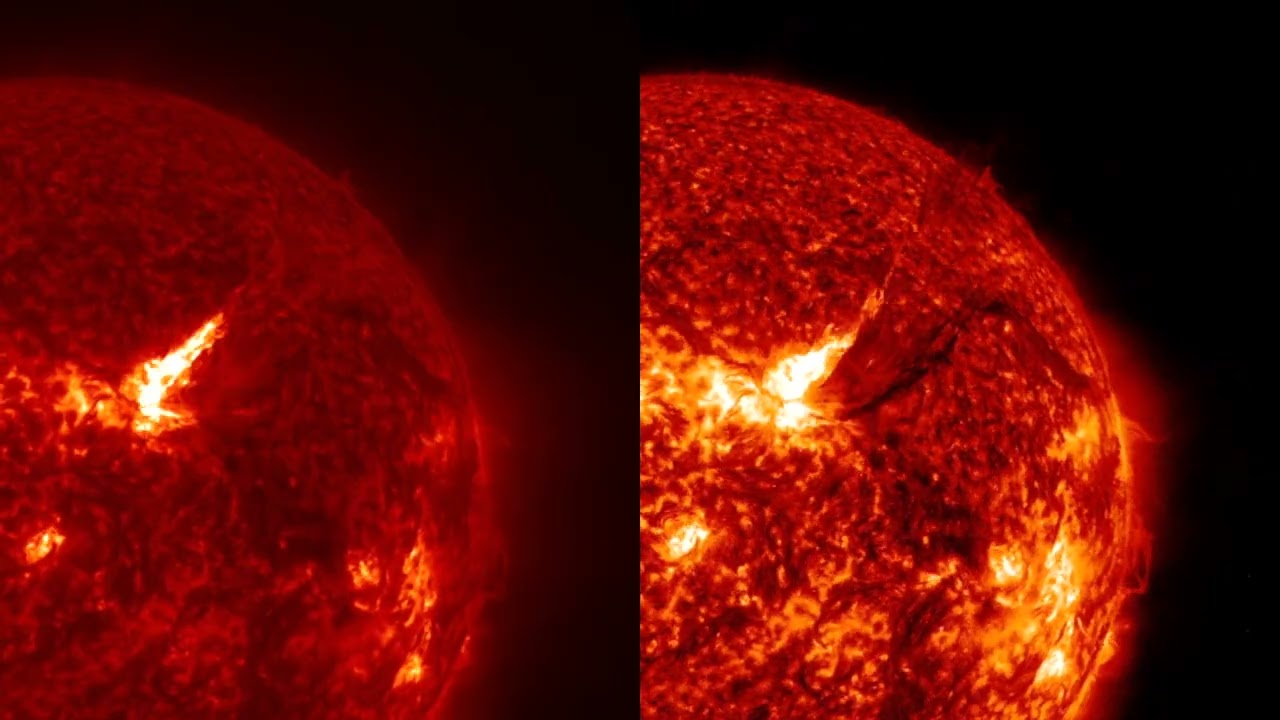
Solar Flares and CMEs at Earth - More Likely | S0 News June.3.2026
SpaceWeatherNewsS0s
2K views•2026-06-03



