The James Webb Space Telescope has revealed a 13.8 billion-year-old cosmic structure, supporting the Big Bang theory which explains that the universe began as an extremely hot, dense state containing all matter, energy, space, and time, and has been expanding and cooling ever since, forming stars, galaxies, and cosmic structures through gravitational processes.
Install our extension to search inside any video instantly.
"James Webb Telescope Uncovers a MASSIVE 13.8 Billion-Year-Old Cosmic Structure!"Added:
Yet this darkness is not empty.
It is filled with countless distant points of light, each suspended across unimaginable distances, forming delicate patterns woven into the fabric of space.
Every one of these lights is more than a star. It is a reminder that the universe is far greater, older, and more complex than our daily experience suggests.
Across civilizations and eras, humans have stood beneath this same sky in silence, reflection, fear, and awe as if answering an inspoken call across time.
This curiosity does not fade with knowledge or progress. It appears deeply rooted in human consciousness itself.
It is as though this desire to understand is not learned but inherited, carried across generations, surviving the rise and fall of empires, never extinguished, only refined.
Over time, observing the night sky evolved from simple awareness into imagination, storytelling, philosophy, and finally science.
Despite differences in culture and belief, humanity has always shared the same sky.
For ancient societies, the night sky was a tool of survival and understanding.
The stars guided navigation, marked seasons, and tracked time with precision.
To early observers, they were not random points of light, but consistent patterns that seemed to communicate through their regular motion.
In this way, the heavens became a silent language without words, yet full of meaning.
Centuries passed and human thought shifted from mythological explanations to observation, reason, and science.
In the modern era, this transformation led to one of humanity's greatest questions. How did the universe begin?
Through mathematics and physics, the big bang model emerged as the leading explanation.
It suggests the universe began about 13.8 8 billion years ago, not within space, but as a state in which space itself was extremely hot and dense, containing all matter, energy, space, and time in a single form.
Then the universe began to expand, space itself, stretching outward, carrying everything within it.
As it expanded, it cooled, allowing the first particles to form, followed by simple elements like hydrogen and helium.
Over billions of years, gravity-shaped matter into stars, galaxies, and the cosmic structures we observe today.
Yet, despite this framework, the universe still holds many mysteries.
Modern telescopes allow us to see farther into space and further back in time than ever before, revealing ancient light from galaxies that may no longer exist in their original form.
Each discovery both supports existing theories and introduces new questions.
Among the most intriguing are ancient stars like the Methuselus star whose age appears close to that of the universe itself, challenging earlier assumptions about cosmic history.
Still, such findings continue to be refined as science improves.
With every advancement, humanity reaches deeper into the unknown, but the horizon of mystery expands as well.
From ancient stargazers to modern astrophysicists, the desire to understand remains unchanged.
It is the same ancient impulse refined by time but never lost. The urge to find meaning within the vastness of existence.
In the end, the universe is not only expanding outward in space, but also inward within the human mind through curiosity and imagination.
And with every discovery, humanity once again stands at the edge of the unknown, where wonder and mystery begin a
Related Videos

Spiral Galaxy NGC 3370 from Hubble | NASA APOD 2025-11-05 #Shorts
galaxygallery
938 views•2026-05-30

SOMETHING inside the SUN is CHANGING
RaysAstrophotography
1K views•2026-06-03

There May Be A Giant Hole In The Universe... And We Might Be Inside It | The Cosmic Ledger Entry 015
TheCosmicLedger
145 views•2026-05-31

Captured the Blue Moon (with a twist) 🌙✨ #space #bluemoon #telescope
realAstroExplorer
674 views•2026-06-01

The Map We Sent to the Stars in 1977 — Why Scientists Now Regret It
TheAncientRecord7
183 views•2026-06-03

Is this a copy of our galaxy? Discover Galaxy M81!
UniverseDocumentaries-cc4mb
995 views•2026-05-31

10 Planet Where a Black Hole Replaces the Sun
cosmicexplorer-EN
147 views•2026-06-02
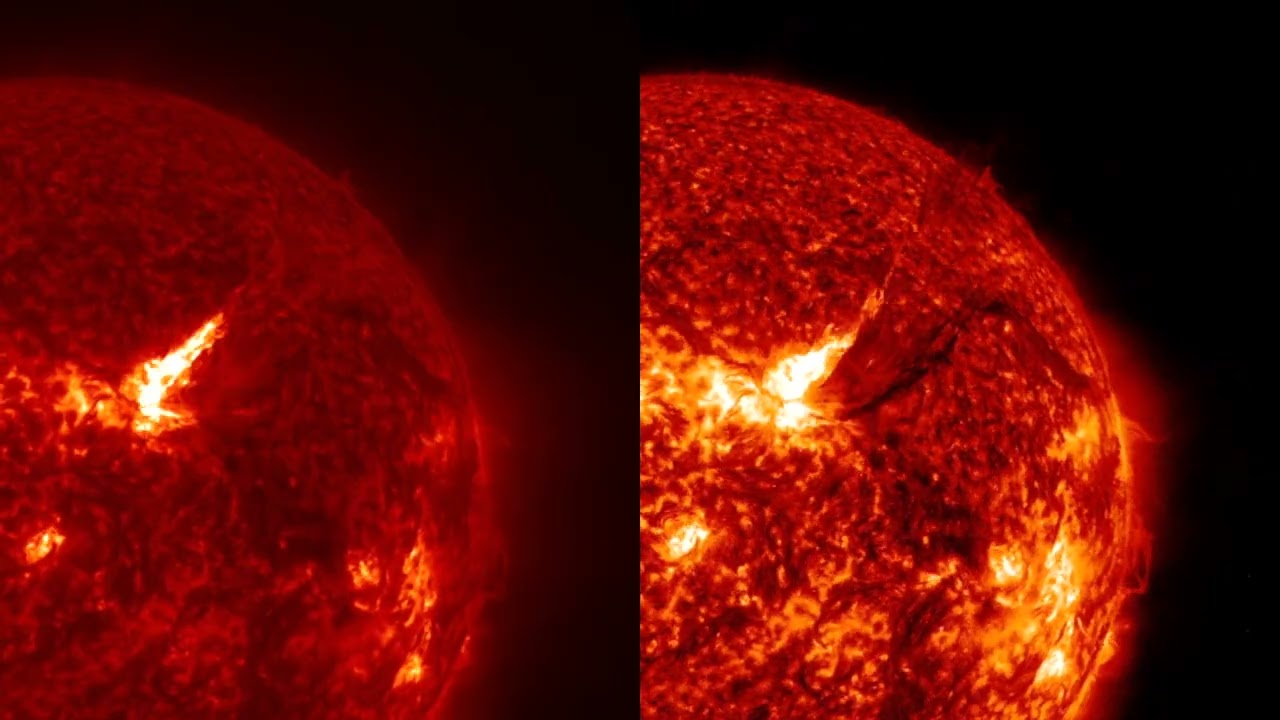
Solar Flares and CMEs at Earth - More Likely | S0 News June.3.2026
SpaceWeatherNewsS0s
2K views•2026-06-03



