This discovery elegantly replaces years of cosmic speculation with the simple reality of a binary dance, proving that even the most famous stars still hide basic secrets. It is a sharp reminder that our "established" stellar models are often just one hidden companion away from a total rewrite.
Install our extension to search inside any video instantly.
Betelgeuse Just Did Something Scientists Didn't ExpectAdded:
A star 15 times the mass of our sun is acting like nothing scientists predicted. Beetlejuice, the red shoulder of Orion, just revealed a secret hidden for thousands of years. After 8 years of silent watching, Hubble caught a ripple moving through its atmosphere. Awake like a ship cutting through fog.
Tonight, you'll see the dust cloud bigger than our solar system. The second star plowing through a giant and the countdown nobody can stop. If this fascinates you, hit subscribe. You'll want what's coming. Now, look up. We begin.
In late 2019, something began happening to one of the most famous stars in the night sky. People who had stared at Orion their whole lives, noticed something off. The hunter's right shoulder, that warm reddish point that had glowed steadily for thousands of years, was fading. At first, only careful observers caught it. By January of 2020, anyone could see it. Beetle Goose had dropped out of the top 10 brightest stars in the sky. By February 7th, it was the dimst it had been in nearly two centuries of recorded observation. Astronomers around the world stopped what they were doing.
Telescopes pivoted. Phones rang at observatories from Hawaii to Chile.
Something massive was unfolding 650 lighty years away. and no one knew what it meant. The whispers started immediately. Was Beetleju about to explode? If you don't know what that means, here's the picture. Beetleju is what astronomers call a red super giant.
A star at the very end of its life.
Stars like this die in one specific way.
They collapse inward in a fraction of a second and then blow themselves apart in a blast of light brighter than entire galaxies. The explosion is called a supernova, and humanity has not seen one this close in recorded history. The last time a supernova went off this close to Earth was in the year 1054 when Chinese astronomers wrote about a new star so bright it could be seen during the day for almost a month. If Beetlejuice exploded, every person alive would witness it. So, when the star started fading in late 2019, the question on every astronomer's mind was a simple one. Were we watching a star die in real time? News outlets ran with it. Social media exploded. Some headlines said the explosion could happen tomorrow. Others said tonight. Crowds gathered at observatories. People learned the name of a star most had never thought about before. For a few weeks in early 2020, Beetlejuice was a household word. Then something stranger happened. By April, Beetleju started getting brighter again.
Slowly. at first, then more steadily, the fading reversed itself. Within months, the star was back to its usual glow, sitting on Orion's shoulder like nothing had happened. The supernova didn't come. The headlines moved on.
Astronomers, though, did not move on because what had just happened made no sense. Stars don't dim by 60% and then bounce back over a few months. That is not how variable stars behave. That is not how dying stars behave. This was something new, something nobody had a clean explanation for. Andrea Dri, a senior astronomer at Harvard's Center for Astrophysics, summed up what her colleagues were feeling. The interior of Beetle Goose, she said, seemed to be bouncing. Something deep inside the star was misbehaving in a way the textbooks could not predict. For the next 6 years, scientists would chase this mystery.
They would rule out theory after theory.
They would aim every major telescope on Earth and in space at this single point of light in Orion. And when they finally cracked it in early 2026, the answer would be stranger than any of them had guessed. Because the dimming wasn't a warning sign, it was a clue.
And Beetlejuice had been hiding something for a very long time. To understand why Beetlejuice fascinates astronomers, you have to understand what kind of object you are actually looking at when you turn your eyes toward Orion's shoulder. Our sun is enormous.
It holds 99% of all the mass in our solar system. You could line up 109 Earths across its face. A passenger jet flying non-stop would need almost 6 months just to circle it once. By any measure that matters to a human, our sun is a giant. Beetleju makes our sun look like a marble. If you took bettle juice and dropped it into the center of our solar system, replacing the sun, the consequences would be hard to imagine.
Mercury would be inside the star. Venus would be inside the star. Earth would be inside the star. Mars would be inside the star. The asteroid belt would be inside the star. The surface of Beetlejuice would extend all the way out to the orbit of Jupiter. Everything we know as home would be vaporized inside a glowing red ocean of plasma. The numbers are almost meaningless. More than 400 million suns could fit inside Beetlejuice. It is roughly 1,400 times wider than the Sunday. Its outer atmosphere, the loose halo of gas around its actual surface, extends six times farther still, reaching out into territory that in our solar system would be roughly the orbit of Neptune. Yet, despite holding the volume of 400 million suns, Betal Juice only contains the mass of about 15 suns. This tells you something strange. The star is mostly empty. Its outer layers are so thin and puffed up that they are closer to a hard vacuum than to anything you would call a surface. If you could fly a spacecraft toward Beetlejuice, you would already be inside its atmosphere long before you saw any kind of edge. There would be no boundary. The star would simply get denser around you, hotter around you until you could no longer survive. This puffiness is the signature of a dying star. When stars like our sun age, they swell up. They lose their grip on their outer layers. Betal juice is roughly 10 million years old, which sounds long, but for a star this massive, it is ancient. Massive stars burn through their fuel fast. Our sun has been quietly fusing hydrogen for almost 5 billion years and has another 5 billion to go. Betal juice, by comparison, is nearly out of time. Here is something worth holding in your mind.
The light you see from Battlejuice tonight left the star around the year 1376.
Nights still rode through Europe. The plague had just finished sweeping the continent. That light has been crossing space for over 600 years to reach your eyes. By the time it gets here, the star itself has aged 600 years more, and we have no way of knowing what it looks like right now. For all we know, Beetlejuice already exploded centuries ago, and we are just waiting for the news to arrive. But that is not the strangest thing about this star, because Beetlejuice all this time has been keeping a passenger. Stars are not steady. Most of them, if you watch them long enough, breathe. This is not a metaphor. Many large stars actually expand and contract on regular cycles.
Their outer layers swell outward, cool slightly, and then fall back in, heating up again. As they swell, they get a little brighter. As they shrink, they get a little dimmer. From Earth, this looks like a slow, rhythmic pulsing of brightness, repeating like a heartbeat over weeks or months or years.
Astronomers have tracked Beetle Ghost's heartbeat for almost two centuries. The first records go back to the 1830s when British astronomer John Hershel noticed that the star was not glowing steadily.
Some nights it looked brighter, some nights dimmer. He kept careful notes.
Other astronomers picked up where he left off. By stitching together generations of observations, scientists slowly mapped out a clear pattern.
Bettle Goose pulses on a cycle of roughly 400 days, just over a year. Each cycle the star swells outward slightly then contracts. Its brightness rises and falls with the rhythm. This kind of behavior has a name. Astronomers call it a fundamental pulsation and it makes physical sense. Stars this large have layers of gas that resonate almost like the air inside a giant organ pipe. The frequency of the resonance depends on the stars mass and size. For Beetlejuice, that frequency works out to about 400 days. For decades, this was settled science. The 400day pulse was the explanation for why Beetlejuice changed brightness, and astronomers patted themselves on the back and moved on to other puzzles. Then, someone looked closer. When researchers stacked decades of brightness measurements on top of each other and ran them through better mathematical filters, they noticed something strange in the data.
Yes, the 400day cycle was there, clear and obvious. But underneath it, riding like a slower wave beneath a faster one, was a second pattern, a longer, deeper rhythm in the brightness of the star.
This second cycle did not fit any of the standard pulsation models. It was too slow, too clean, and too regular to be random noise. Whatever was causing it was something else entirely. The second cycle repeated roughly every 2,100 days, about 5 years and 10 months, almost 6 years, and it was significant.
Some studies showed it was responsible for as much as half of the total variation in the stars brightness. You couldn't explain bettle juice without explaining this longer cycle. And nothing in the standard playbook of stellar physics could account for it.
This is the kind of problem that gets astronomers out of bed in the morning. A regular signal, a clear period, and no idea what is producing it. It hinted at something deeper hiding in the star. For 30 years, theories piled up. Maybe it was a giant convection cell, a bubble of hot gas the size of a star slowly rising and sinking. Maybe it was a magnetic field flipping back and forth. Maybe it was a cloud of dust orbiting somewhere out in the atmosphere, periodically blocking the light. Each theory had problems. Each theory eventually broke down under closer inspection. Then a small group of researchers proposed something almost too bold to take seriously.
What if Beetlejuice was not alone? To understand why this 2,100 day cycle drove astronomers half mad, you need to know how stellar pulsations are supposed to work. When a star breathes, the period of that breathing is locked to its physical structure. A star's mass, size, internal temperature, and composition all set the pace. It is like a guitar string. A short tight string vibrates fast and gives a high note. A long loose string vibrates slowly and gives a low note. Once you know the properties of the string, you can calculate the frequency. There is no mystery. The same thing applies to stars. Once you know roughly how massive a star is and roughly how big, you can calculate what its natural pulsation frequencies should be. For Betal Goose, the math works perfectly for the 400day cycle. That number falls right where the equations say it should fall for a star of this size and mass. The 400day pulse is the stars natural breathing rate. The 2,100 day cycle, though, broke the math.
It was much too slow. Researchers tried to fit it into the standard pulsation theory and could not. They tried treating it as a higher harmonic, like the deeper notes you can coax out of a guitar string by pressing in just the right place. The numbers did not line up. They tried treating it as a beat pattern between two overlapping pulsations. Did not work either. They tried magnetic cycles, similar to the 11-year cycle our sun runs through.
Wrong physics, wrong time scale. They tried convection. Convection cells in Beetlejuice are real and they are huge, but their lifetimes do not match this rhythm. Every standard explanation failed. There was something almost mocking about the regularity of the signal. Random processes in stars produce messy drifting patterns. This pattern was clean, clock-like. Whatever was causing the long cycle in Beetlejuice was repeating with the precision of a metronome. And metronomes don't show up by accident in the chaotic interior of a dying star. In astronomy, when you see a clean, repeating signal that you cannot explain through the star itself, your mind drifts toward one specific possibility. Orbits. Planets orbit stars on regular schedules. Stars orbit other stars on regular schedules.
Gravity is the universe's most reliable timekeeper. If a small object is whipping around a larger object on a fixed path, you get a clean repeating pattern in any signal that is affected by their interaction. The cycle of 2,100 days started to look suspicious. It was the right kind of clean to be in orbit.
But this was a problem. Bettle goose had been studied for almost 200 years. Every major telescope on Earth had pointed at it. Astronomers had imaged it in infrared, ultraviolet, radio waves, and visible light. They had mapped its surface. If Beetleju had a companion star whipping around it every 6 years, surely someone would have spotted it by now. And yet, no one had. Whatever was producing the long cycle was either invisible, hidden, or so close to Beetlejuice that it was lost in the glare. The companion theory floated around in the literature for years, mentioned in research papers, debated at conferences, but never confirmed. It was the leading suspect in a case nobody could close. What astronomers needed was a way to see the unseeable. A trick. A clever observation that would force a hidden star to reveal itself. That trick would take 8 years to build. Here is the strange thing about looking for a star you cannot see. You cannot photograph it directly. The glare from Beetleju drowns out everything close to it. The same way the headlights of an oncoming car make it impossible to see anything around them. Even with the best telescopes humanity has ever built, even with the Hubble Space Telescope, even with 8 m groundbased giants in Chile and Hawaii, a small dim star sitting right next to Battle Goose would be lost in the brightness. So you cannot just take a picture. The companion, if it exists, is in the worst possible spot for direct imaging. This problem is not new in astronomy. Most of the planets we know about around other stars cannot be photographed either. Their host stars are too bright. So astronomers had to invent indirect methods. They watch how the light of the parent star wobbles when something is tugging on it. They look for tiny dips in brightness as a planet passes in front. They study the spectrum of the light, which shifts color subtly as the star is yanked back and forth by an unseen companion. These tricks work beautifully for finding planets around small, well-behaved stars. They do not work nearly as well on something like Battle Juice because Bettal Goose is anything but well- behaved. Its surface boils with convection cells the size of small stars themselves. Its outer layers wobble and pulse on multiple cycles at once. Its brightness flickers, dips, and surges in ways that have nothing to do with anything orbiting around it. The signal you would expect from a companion gets lost in a storm of stellar noise. Trying to detect a small companion this way is like trying to hear someone whisper in the front row of a rock concert. For 30 years, this is where the search ground to a halt. The signal was clearly there.
Something was making the star brighten and dim on a 6-year cycle. But pulling that signal cleanly out of the chaos was beyond what existing instruments and methods could do. Then around 2019, a younger generation of researchers took a fresh look at the problem. They had two advantages. First, they had access to longer data sets. Decades of careful observations finally building up to a length where subtle long-term patterns could be teased out. Second, they had better mathematical tools. software developed for finding exoplanets had grown more sophisticated and could now sift faint orbital signatures out of noisy data. When these new methods were turned on beetle juice, the long cycle started looking less like noise and more like a fingerprint. Different research groups working independently came to the same conclusion. The 2,100day pattern was almost certainly being produced by a small companion star orbiting deep inside Beetlejuice's outer atmosphere. The community started giving the unseen object an unofficial nickname. Some researchers called it Beetle Buddy, half jokingly. Papers were published, conference talks were given.
The companion was being mathematically modeled, simulated, and predicted in detail before anyone had ever directly seen it. Theorists worked out roughly how massive it should be, how close, how hot. They predicted that when this companion crossed in front of Beetlejuice, certain colors of light should brighten in a specific way. In 2025, those predictions started to come true. Before we get to the breakthrough, it is worth pausing on just how stubborn this mystery was. Beetle Gu is one of the most studied stars in the entire history of astronomy. Only the sun gets more attention. Every major observatory on Earth has spent time staring at it.
Every space telescope humanity has ever launched has been pointed at it. There are decades of highresolution images, spectra, radio measurements, infrared maps, and ultraviolet observations sitting in archives. If you wanted to write the biography of a star, Betal Juice is the easiest one to write. And yet, for almost 100 years, hints kept appearing in the data that something was off. strange echoes in the spectrum.
Small periodic shifts that did not match the main pulsation. Unexplained features that came and went. Each time, astronomers would notice them, scratch their heads, and chalk it up to the chaos of the super giant's atmosphere.
In the 1980s, a team studying Beetlejuice with ultraviolet instruments noticed something they could not explain. The stars spectrum showed odd shifts that suggested gas was moving in directions it shouldn't. They wrote it up cautiously and moved on. Looking back today, those observations were probably the first faint trace of the companion's influence. Nobody recognized it. Through the 1990s and into the 2000s, more clues piled up. Researchers using interferometry, a technique that combines light from multiple telescopes to create the resolution of a single huge telescope, occasionally caught hints of asymmetry in BattleJ's atmosphere. The star looked slightly lopsided. Bright spots appeared on its surface and shifted in ways that did not fit the standard convection picture. Some of these spots we now know were probably the outer atmosphere being disturbed as the companion plowed through. In 2019 and 2020, two separate teams using completely different methods independently suggested that the long cycle had to be caused by a hidden companion. They could not see it. They could only see its effects. But the data was getting hard to ignore. Then in 2024, a research group ran an enormous computer simulation that modeled Beetlejuice with and without a companion star. The version with a companion fit the observed brightness pattern beautifully. The version without it could not. This was the strongest hint yet. In July of 2025, Steve Howell and his team at NASA as Research Center announced something remarkable. Using the Hubble Space Telescope, they had picked up faint signals from a small object very close to Battle Goose. They believed they had finally caught the companion in the act. The detection was tentative. The signal was at the edge of what the instrument could measure, but they were confident enough to report it.
2 months later, in September of 2025, the international body that governs astronomical names made the discovery official. The companion was given a formal designation. It would not be called battle buddy. Charming as that nickname was, it received a name with deeper roots. Drawn from the Arabic tradition that gave Battlejs itself its name. It was named Siwara. Her bracelet.
The name Bettleju comes from Arabic.
Like most of the brightest stars in our sky, Arabic astronomers in the medieval world were the great catalogers of the heavens, mapping and naming stars with a precision that European astronomy would not match for centuries. Many of those names still survive today, slightly mangled by translation, hiding their original meanings inside familiar sound.
Bethljuice, the name we use today, is a corruption of an Arabic phrase that translates roughly as the hand of the giant. The giant in question is the constellation we now call Orion, but in Arabic tradition was a much older figure, sometimes called Elgos, a celestial figure of huge proportions striding across the sky. The bright orange star at his shoulder marked the position of his hand. When astronomers needed to give the new companion a name, they reached back into this same tradition. The companion was small, intimate, orbiting close to its giant.
So, they chose a word that fit. They named it Siwaha, which translates from Arabic as her bracelet. The name carries a specific picture. A bracelet wrapped around the wrist of the giant. a small bright thing close to a much larger one spinning around in a slow careful orbit.
The companion was officially recognized under this name in September of 2025 after the first tentative detections.
From that point on, scientific papers referred to it as Siwaha or in more technical language, alphaarionist B.
Bettlejuice itself is technically alphaarionist A. the brighter member of what astronomers now know is a binary system. What kind of object is Siwaha?
Based on the data, the picture is becoming clear. Siwaha is small.
Compared to Beetleju, it is barely there. The best estimates suggest it has somewhere between 1 and a half times the mass of our sun, which makes it a perfectly ordinary star by most standards. If it were sitting alone somewhere far from Beetlejuice, it would look unremarkable.
A small hot blue white star, the kind that fills the galaxy by the millions.
You could probably see it with a backyard telescope if it were on its own. It is not on its own. That is the entire problem. Siwaha orbits close enough to Beetle Goose that it actually swims through the giant's outer atmosphere. The two stars are companions in the deepest sense. They likely formed together around 10 million years ago out of the same collapsing cloud of gas.
They have been gravitationally bound ever since. While Beetlejuice swelled into its current bloated form, racing through its short life, Siwaha stayed small, cool, and stable. Now Siwaha is paying the price for that closeness.
Every 6 years on a clockwork schedule, it traces a path that takes it directly through the outer skin of its enormous partner. Each pass leaves a mark. Each pass plows up gas, stirs the atmosphere and sends ripples out into space. This is what astronomers had finally caught.
Not the star itself, but the marks it was leaving behind. The wake of Suaha was about to give the entire game away.
By the time researchers had a name for Siwaha, the data that would prove its existence beyond any reasonable doubt was already sitting in archives. Andrea Dri at the Center for Astrophysics in Cambridge had been quietly running a long-term project on Beetlejuice for almost a decade. Her team used the Hubble Space Telescope plus groundbased observatories at the Fred Lawrence Whipple Observatory in Arizona and the Rogue Deos Muchachos Observatory on La Palma in the Canary Islands. The plan was simple in concept and brutal in execution. They would observe Beetle Goose over and over again, year after year in ultraviolet light, mapping the changes in its outer atmosphere with as much detail as they could pull out.
Ultraviolet was the key. Groundbased telescopes mostly cannot see ultraviolet light because Earth's atmosphere absorbs it. But Hubble, sitting above the atmosphere, can. And ultraviolet is exactly the kind of light where the chemistry of a stellar atmosphere shows up most clearly. Specific elements like ionized iron glow at very specific ultraviolet wavelengths. By tracking those wavelengths over time, you can map the motion of gas in fine detail. You can see hot pockets, dense lanes, and turbulent regions. You can build a picture of what is moving and where. For nearly 8 years, Dupre's team built that picture. Snapshot after snapshot, observation after observation, they accumulated one of the most detailed long-term data sets ever assembled for a single star. For a long time, the picture looked messy. Beetlejuice's atmosphere is not orderly. Gas swirls and surges. Convection cells the size of small stars rise to the surface, dump their heat, and sink again. Trying to find a single repeating pattern in this chaos was like trying to find one specific drum beat in a thunderstorm.
Then they had the right idea. They would not look for the companion directly.
They would look for the wake. If a small star really was plowing through Betalus's outer atmosphere every 6 years, it had to leave a track. Like a boat moving through water, it would push gas aside, compress some regions, and leave a trailing line of denser material behind it. That trail of compressed gas should have a different ultraviolet signature than the surrounding atmosphere. It should be slightly hotter, slightly more ionized, slightly out of step with the rest of the star.
So they searched the data for exactly that signature. A line of unusual emission appearing at predictable times, moving in a predictable direction. When the results came back, the room went quiet. Buried in 8 years of observations was a clean repeating pattern. Just after the predicted moment when Siwaha should pass in front of Betalju, ultraviolet emission from ionized iron spiked sharply. Then, as the small star moved on, that same gas absorbed the radiation, dimming the peak. The pattern repeated every 2,19 days. Almost exactly the long mystery cycle that had baffled astronomers for 30 years. It was not a coincidence. It was not noise. It was a signature so clean it could not be anything else. The dense trail of gas left behind by a small star plowing through the atmosphere of a giant. Dupri compared what they were seeing to a boat moving through water, leaving a ripple behind it. They had found the wake. But seeing the wake meant something more disturbing was true. Something humanity had almost no experience with. A small star was not just orbiting bett. It was eating its way through it. To picture what Siwaha is doing, forget for a moment everything you think you know about how stars orbit each other. In most binary systems, the two stars are well separated. They might be thousands or millions of miles apart, swinging around each other in clean elliptical orbits like two planets dancing. The space between them is empty. Each star has its own atmosphere, its own surface, its own little world.
The fact that they are gravitationally bound is a relationship of mass, not of contact. Siwaraa and Bettle Goose do not have that kind of relationship. Siwa orbits so close to Beetlejuice that it does not have empty space around it. It moves through the giant's outer atmosphere. The boundary between where Beetlejuice ends and where space begins is fuzzy to begin with. Because Beetlejuice's atmosphere is enormous and diffuse, extending out far beyond what we would think of as the stars surface.
Siwaha's orbital path takes it through the outermost layers of that extended atmosphere. The way a small fish might swim through a bank of fog. Imagine for a moment what this looks like up close.
Siwaha is roughly the size of our sun.
Give or take. Glowing hot and white. As it moves along its orbital path, it slams into the thin hot gas that makes up Beetlejuice's outer envelope. That gas is sparse compared to anything you would experience on Earth, but it is still gas. It still has substance. As Siwaha plows forward, the gas piles up in front of it, gets compressed, heats up, and is pushed aside. This is exactly what a boat does in water. The water cannot move through the boat, so it gets pushed aside. The pressure of the boat moving forward creates a bow wave at the front and a long trailing wake behind.
The wake is denser, more turbulent, and slower to settle than the surrounding water. Siwa makes the same kind of wake, a rolling line of compressed, heated, slightly denser gas trailing behind it as it orbits. The wake is bright in ultraviolet light because the compression heats the gas, ionizing the iron and other elements, making them glow at very specific wavelengths. The size of this wake is staggering. The orbital path takes Seiwaha through regions that in our solar system would be farther out than Mars. The trail of disturbed gas it leaves behind stretches across distances comparable to the entire inner solar system. Every time Siwaha passes around the front of Beetlejuice, a fresh stretch of wake gets carved into the giant's atmosphere.
That wake then expands outward, dissipating slowly until the next orbit cuts a new one. This is why Beetle Goose looks lopsided in highresolution images.
Why bright spots appear and shift in ways that did not fit older models. Why the spectrum sometimes shows odd Doppler shifts. Hints of gas moving in directions that pure pulsation could not explain. The companion has been carving up Beetlejuice's atmosphere for as long as we have been able to observe it. We just did not know we were looking at the work of a sculptor. The wake is a fingerprint. It points directly back to the object that made it. And what made it has been there the whole time, hiding in plain sight, leaving tracks that took humanity nearly a 100red years to recognize for what they were. There is something unsettling about realizing that a star can move through another star. Stars are not solid. We tend to picture them as glowing balls with surfaces the way a lamp has a surface or a ball has a surface. In reality, the surface of a star like juice is just the place where the gas finally becomes thin enough that light can escape easily.
Below that surface there is more gas, denser and hotter. Above it, there is also gas, thinner but still substantial, extending outwards, sometimes for distances larger than the visible star itself. Bettle goose takes this to an extreme. Its outer atmosphere is so vast and so puffy that it would extend out past the orbit of Mars in our own solar system. The gas in this atmosphere is incredibly thin, much thinner than the air we breathe. But it is real and it has weight and it gets in the way of anything trying to pass through it.
Siwaha in its six-year orbit ends up flying through that atmosphere. Not over it, not next to it, through it. The forces at play here are violent in a way that does not show up in everyday experience. Siwaha is moving at orbital speeds, which for a star this massive means tens of thousands of miles hour.
The gas it plows through is hot, somewhere in the thousands of degrees, and hostile. The collision between the small star and the surrounding atmosphere creates shock waves. Those shock waves heat the gas further, ionize it, and send pressure ripples out in all directions. There is friction. Even in something as thin as a stellar atmosphere, when you are moving through it at this speed, friction is real. Each pass takes a tiny bite out of Suaha's orbital energy. Over millions of years, that friction will slow Suiwaha down.
Its orbit will tighten. It will spiral inward, getting closer and closer to Betaluse until eventually it falls all the way in. That fate is locked in. It is just a matter of when. The closeness also has another consequence. Siwa is not just brushing the outer atmosphere.
It is actually inside the region where Beetlejuice is most active, where the giant's vast convection cells churn material from deep inside up to the surface and back down. Whenever Siwaha passes through one of those upwelling regions, the interaction must be enormous. Hot plumes of gas surging outward meet a small dense star tearing through them. The result is a kind of stellar weather we have never been able to study directly anywhere else.
Astronomers think this constant battering is part of why Beetlejuice behaves so strangely. The giant's surface convection patterns, its atmospheric structure, even its mass loss rate are all being shaped by the small companion plowing through. Without Siwa, Beetlejuice would still be a dying super giant. But it would not be the unstable, restless, unpredictable star we see. The companion is not just along for the ride. It is helping write the story. There is one more thing about this dance that makes it remarkable.
Siwaha is much smaller than Betalju, but it is not weightless. Its gravity tugs on Battlejuice's outer layers as it passes. Every 6 years, when Siwaha swings around to the front of the giant, it briefly pulls a portion of Betalju's atmosphere outward. Not enough to do major damage, but enough to leave a mark. A bracelet, after all, only fits if it touches the wrist. If you tried to build a scale model of Beetlejuice and Siwaha, your hands would betray you almost immediately. Set Beetlejuice's diameter as the size of an average house, roughly 40 ft across.
A house large enough to hold a family comfortably with rooms to spare. That is your super giant. Now build siwaha. Same scale. The companion star in this model would be barely larger than a marble.
You could roll it across your kitchen floor, place that marble next to the house, and you start to grasp what astronomers are dealing with. There is no contest of size here. Beetlejuice is not slightly bigger than Siwaha. It is 1,400 times wider. The mass ratio is less extreme but still dramatic.
Beetlejuice contains about 15 times the mass of our Sunday. Siwaha contains about 1 and a half. So Siwaha is roughly a tenth as heavy as Beetlejuice. In gravitational terms, Beetlejuice is firmly in charge of the relationship. It is not a binary of equals. It is a giant carrying a small passenger. This size mismatch is exactly why finding Siwa was so hard. Imagine trying to spot a candle held next to a stadium spotlight from miles away. The light from the spotlight overwhelms everything around it. The candle is real. The candle is shining, but you cannot see it directly. You can only see what its small light does to the things around it. That is why direct imaging of Siwara has been impossible.
Even with Hubble, even with the largest groundbased telescopes, the brightness contrast between the two stars is just too brutal. Siwaha is roughly six magnitudes fainter than Beetlejuice, which in astronomy terms means about 250 times dimmer. Mix that brightness gap with the fact that Siwaha is sitting practically on top of Beetle Goose from our point of view, and you have an object that current technology cannot photograph. What can be observed is the wake, the disturbance in the atmosphere, the shifting patterns in ultraviolet light, the compression of gas in front of and behind the small star as it moves. These indirect tracks are what gave Suaha away, and they will probably be the only way we observe it for the foreseeable future. There is something poetic about all this. If you are inclined to find poetry in physics, a small ordinary star, the kind that fills the galaxy by the billions, is locked in orbit around a dying giant. The giant is so much larger that the small stars existence is almost incidental from the giant's point of view. Yet, the small star is shaping the giant's appearance, stirring its atmosphere and pulling on its gas with a persistence that has now gone on for 10 million years. There is also something darker in the geometry.
Siwaha's orbit is a slow death sentence.
The friction and tidal forces of moving through Beetleju's outer atmosphere are gradually robbing the small star of energy. With each pass, its orbit decays a little further. The two stars are slowly being dragged together. Long before they would naturally collide, Bettus is going to end its own life in an explosion that will likely vaporize Siwaha entirely. Until then, the small companion keeps doing what it has been doing, tracing its bracelet, leaving its wake, and quietly rewriting what we thought we knew about how massive stars live and die. There is something almost wrong about the orbit of Siwaha. Most binary star systems we know about have orbits that play out in clean empty space. The two stars sit a comfortable distance from each other and trace their loops through vacuum. The gravitational dance is uncomplicated. Their atmospheres do not touch. Their light barely interferes. From any distance, they look like two separate points of light. Suaha's orbit does not work like that. The orbit takes Siwaha on a six-year loop around Beetlejuice, and large portions of that loop are inside the giant's outer atmosphere, not skimming above it, not grazing the edge.
Inside it, there are stretches of orbit where Suaha is genuinely embedded in another stars outer envelope, surrounded on all sides by gas that belongs to its companion. From a certain perspective, Siwaha is not orbiting Betaluse so much as swimming inside it. This raises a question that has not really come up before in astronomy. What does an orbit even mean when one of the partners is inside the other? Mathematically, the orbit still works. Siwaha is responding to Beetlejuice's gravity, and the path it traces is governed by the same equations that govern any other orbital motion. But the path is not simple. The atmosphere it moves through creates drag, slowing it down a little with each pass. The density of that atmosphere is not uniform with denser pockets and thinner regions. So the drag changes from moment to moment. The orbit wobbles, it tilts, it distorts. It is a noisy, unstable thing compared to the clean ellipses we usually associate with orbital mechanics. The picture astronomers have built suggests Siwaha follows an orbit that takes it from the deep outer atmosphere of Battleju out to a more distant point, then loops back in. The full orbital period is 2,19 days, almost exactly 6 Earth years.
During each cycle, there is one specific moment called the conjunction when sewa passes between us and Beetlejuice. That is the moment when the wake becomes visible to us, when the ultraviolet emissions spike and when the long mystery cycle reaches its peak. After conjunction, Siwaha continues on its way, eventually swinging behind Beetlejuice, where we lose sight of it entirely. That is exactly where it is right now, hidden behind the super giant. It will not emerge again on our side until 2027 when the cycle brings it back into view. This rhythmic disappearing and reappearing is one of the strongest pieces of evidence that the discovery is real. Predictions made years ago about when Siwara should be visible match the observations almost perfectly. The orbit is real. The clock is ticking. The companion will return.
There is one strange aspect of this orbit worth dwelling on. Siwaha is a young star. It formed about 10 million years ago, the same time Beetlejuice did. For its entire existence, it has been orbiting inside another stars atmosphere. That is its normal. It has never known anything else. While our sun has spent billions of years in the cold, quiet of empty space, Siwaha has spent every moment of its life submerged in hot stellar gas. That fact alone would make Suaha unique. Add in the fact that its presence is reshaping the death of one of the most famous stars in our sky and it becomes something more. Sewa is a window into a kind of stellar relationship astronomers had only theorized about. We are seeing it in action and we are only beginning to understand what it means. The breakthrough in detecting Suaha came down to one specific element. Iron sounds like a strange thing to look for in a star. We tend to think of iron as a metal you find in railings, beams, and skillets. But iron is also a fundamental ingredient of stars. It is forged in their cores during certain phases of their lives, and it gets spread throughout their atmospheres as they age. In a star, like beetle goose, iron is everywhere, mixed into the hot gas that makes up the outer layers. When iron gets hot and dense enough, it becomes ionized. That means it loses one or more of its electrons, leaving the atoms with an electric charge. Ionized iron has a very specific signature in light. It absorbs and emits at very particular wavelengths, mostly in the ultraviolet part of the spectrum. If you point a sensitive ultraviolet telescope at a region of hot gas, the ionized iron in that gas glows like a neon sign. You can spot it from huge distances, and the strength of its glow tells you how dense and how hot the gas is. This made ionized iron the perfect tool for hunting Suaha's wake. When Siwa plows through Battle Juic's outer atmosphere, the gas it compresses gets hotter and denser. Hotter means more iron gets ionized. Denser means more iron is packed into a small volume. Both effects make the wake light up brilliantly in ultraviolet. The rest of Beetlejuice's atmosphere is also hot and full of iron, but it is not as compressed. The wake stands out from the background like a glowing thread. Andrea Dupri's team at Hubble watched this glowing thread for years. Whenever Siwaha was predicted to pass in front of Betal Goose, the ultraviolet emission from ionized iron spiked sharply. Then as Siwaha continued on its orbit and the wake stretched out behind it, that same gas started absorbing the ultraviolet light coming from Battleju dimming the peak again.
The whole pattern played out exactly as the models predicted. This is what scientists mean when they say something is a fingerprint. The shape and timing of the iron emission was so specific, so closely matched to the predicted orbital geometry that no other explanation could account for it. Random fluctuations in Beetlejuice's atmosphere do not produce regular spikes that line up with a six-year orbital period. Convection cells do not produce neat periodic ultraviolet patterns. Magnetic activity does not match this signature either.
Only an orbiting companion plowing through the atmosphere fits. There is something deeply satisfying about this method. It does not require seeing Siwaha directly. It does not require waiting for the technology to catch up.
It uses physics that we already understand to extract a hidden truth from light that has been arriving at Earth for centuries. Every photon of ultraviolet light from Battle Goose that hit Hubble's instruments was already carrying the signature of the companion star. The information was always there.
It just took the right tools and the right idea to read it. This is a recurring story in astronomy. The universe is always telling us things.
The challenge is hearing what it says.
For Beetlejuice, we have been listening for a hundred years, and only now have we learned to interpret one of the messages it has been sending the whole time. The iron fingerprint solved one mystery. But the same star had another even more famous puzzle waiting for an explanation. For almost 6 years, the great dimming of 2019 and 2020 had been the most discussed event in modern stellar astronomy. The dimming itself was real and dramatic. Starting in late 2019, Beetlejuice began losing brightness rapidly. Within a few months, it had dropped about 60% of its visible light. From any sky watchers point of view, the change was unmistakable. The star that had glowed steadily on Orion's shoulder for thousands of years suddenly looked dim, almost shy. Then, just as suddenly, it brightened back up. The first explanation was supernova panic.
Maybe Bettlejuice was finally about to explode. That theory burned out fast.
After the brightness recovered, the supernova hypothesis quietly evaporated.
The second explanation, which became the leading theory by 2022, was much stranger. Beetle goose, scientists concluded, had effectively sneezed. The technical name is a surface mass ejection. The basic idea is that a massive blob of gas was thrown off the surface of Beetlejuice, ejected violently outward into space. The blob carried a tremendous amount of material, comparable to the entire mass of gas the star normally loses in a year of slow, steady, stellar wind. It was as if the star had decided to lose a year's worth of weight in one cough. As this ejected material moved outward away from Beetlejuice, it cooled. As it cooled, the gas began to condense into something denser. It formed dust grains. By early 2020, this dust had spread out into a vast cloud more than a 100 million miles across. The cloud was sitting between us and the star, and it blocked a huge fraction of the visible light coming through. From Earth, it looked like Beetlejuice was dimming. In reality, the star was about as bright as it had ever been. We just could not see it through the dust cloud it had thrown in front of itself. By April of 2020, the dust cloud had drifted further out, dispersed, and stopped blocking our view as efficiently. Beetleju appeared to brighten again, returning to normal. The great dimming was not the star getting weaker. It was the star covering its own face. This explanation came together over several years of careful observation. Hubble caught the actual moment when ultraviolet emission from the southern hemisphere of Battlejws spiked dramatically, suggesting hot material rising from the surface. Other telescopes mapped the resulting dust cloud as it spread. Computer simulations reproduced the entire sequence from the original convective upwelling to the shock wave that pushed material out of the surface to the formation of dust grains to the dimming pattern observed from Earth. The match was precise enough that astronomers were confident. They had pinned down what happened. What they did not have was a clean explanation for why it happened. Surface mass ejections of this size had never been observed on any other star. Our sun has solar storms called coronal mass ejections. But those are tiny compared to what Beetlejuice pulled off. The amount of material was enormous. The conditions had to be just right for something this size to break loose. Was it a coincidence? Did Beetlejuice just have a really bad day?
Or was there something about the star or about its situation that made an event like this more likely? The answer to that question would come from the same investigation that found Suaha, and it would change how astronomers think about how giant stars die. The phrase, "The star sneezed," started as a joke among researchers and ended up sticking. It captures something essential about what happened to Beetle Goose in early 2019.
Whatever caused the surface mass ejection, it was sudden, violent, and oddly biological in shape. Here is the picture that emerged from the data. In early 2019, deep inside Beetleju, a vast convection cell rose toward the surface.
Convection cells in super giants are not gentle features. They are bubbles of hot gas that can be the size of small stars themselves, churning up from the deep interior, dumping heat at the surface and sinking back down to start the cycle again. In a normal pulsation cycle of beetle goose, multiple convection cells move in roughly coordinated ways, contributing to the regular 400day breathing of the star. But in early 2019, one particular convection cell rose at the wrong moment. It surged upward at the same time that Beetlejuice's outer layers happened to be expanding outward in their pulsation.
The two motions reinforced each other.
Instead of a gentle upwelling, the gas got an extra push outward. The result was a shock wave, a pressure pulse that moved through Beetlejuice's atmosphere like a hammer blow, slamming material outward at high speed. The shock wave moved through the extended atmosphere over the next 11 months. Behind it came the gas itself, ejected from the stars surface and now coasting outward into space. This was the surface mass ejection. By the standards of our sun, it was unimaginable. Solar coronal mass ejections involve a few billion tons of material at most. Bettlejuice's eruption involved a chunk of mass comparable to a year's worth of total stellar wind, which for a giant like Beetlejuice adds up to a staggering amount. The resulting cloud of gas and later of dust was wider across than the orbit of Earth around our Sunday. When the dust cooled and formed, it blocked light from reaching Earth and the great dimming of 2020 began. After the ejection, Beetlejuice was left in a strange state. Its photosphere, the visible surface, had cooled noticeably because so much hot gas had been thrown off. Its chromosphere, the layer just above the photosphere, was less dense than before.
The star had effectively lost some of its outermost shell. Then came the most surprising aftermath. For more than 2 years after the great dimming, the 400day pulsation that astronomers had been tracking for almost two centuries simply disappeared. The star stopped breathing on its old rhythm. A new shorter cycle around 200 days took over for a while. Stars are not supposed to do that. The pulsation period of a star is set by its physical structure.
Changing the period means changing the structure. Beetle goose had ejected enough material to physically alter how it vibrates. There is no comfortable framework for handling something like this. Astronomers had to invent new explanations on the fly. Some suggested that the convection patterns inside Beetlejuice had been disrupted by the ejection, breaking the resonance that drove the 400day cycle. Others speculated that the star was settling into a new mode of pulsation altogether.
Either way, what was clear was this.
Beju had not just dimmed, it had been physically transformed. And the question lurking in the background was whether Siwaha had something to do with all of it. To picture the dust cloud that produced the great dimming, you need to start with the size of our own solar system and then go bigger. When Betal Juice threw off its mass ejection in 2019 and 2020, the gas spread out as it traveled. The further from the star, the cooler the gas became. Below a certain temperature, atoms started bonding to each other, forming small grains. These grains were tiny, smaller than a grain of sand, but there were vast numbers of them, and together they made up a cloud big enough to hide the face of a giant star. By the time the cloud reached the size at which it most efficiently blocked light from Beetlejuice, it was around 100 million miles across. To put that in scale, the distance from Earth to the Sun is about 93 million miles.
The dust cloud was wider than that. If you placed it in our solar system, it would cover most of the inner planetary region. And this was just the dense part of the cloud. The actual outer reaches of the ejected material went much further. Some of it spread out over distances larger than our entire inner solar system before dispersing. Material like this normally takes thousands of years for a star to lose, slowly bleeding it off through stellar wind.
Betu threw off a comparable amount in a matter of weeks. The dust cloud was a temporary thing. It blocked light efficiently for a few months in early 2020, then drifted apart as it traveled outward, becoming thinner and less able to absorb light. By April of 2020, the visual impact was mostly gone. By mid 2020, Beetlejuice looked normal again, but the cloud itself did not disappear. The atoms in it kept moving outward into space. Some of them are still out there drifting away from Beetlejuice, slowly enriching the interstellar medium between stars. Eventually, those atoms might find their way into other clouds of gas, get pulled into the formation of new stars and planets, and participate in chemistry that has not yet happened anywhere in the universe. That is how the periodic table gets built. Stars forge elements. Stars die. Stars throw out their guts. The guts wander. New things form from the leftovers. What happened with Beetlejuice is part of the same process just compressed into a moment. A single ejection observed in real time contributing to the slow chemical evolution of the galaxy. There is an unsettling implication in all this. If Beetlejuice can throw off this much mass in one event, then what we thought we knew about how massive stars lose weight near the end of their lives is incomplete. Stellar wind models refined over decades treat mass loss as a steady drip, a constant outflow that slowly reduces the stars mass over millions of years. Surface mass ejections like the one in 2019 suggest a different picture. Massive stars may also lose weight in sudden bursts.
Episodic events that throw off years worth of material in one burst. If these episodic events are common, the math on stellar deaths changes. The amount of mass a star has when it finally explodes determines what kind of supernova it produces. It determines whether the leftover core becomes a neutron star or a black hole. It determines how the explosion shapes its surroundings. Mass loss has been called the most uncertain part of stellar evolution. After Beetlejuice's sneeze, we now know one of the reasons why. For more than 4 years after the great dimming, Beetlejuice never fully recovered. This is one of the strangest details in the whole story, and it is the one astronomers keep coming back to. The visible brightness of the star bounced back relatively quickly. Within months, Beetleju looked roughly normal to backyard observers. But underneath the surface, things had changed in ways that did not unwind. Direct measurements showed that Beetlejuice's photosphere, the visible outer layer where light escapes the star, was sitting at a slightly lower temperature than before the dimming. Not dramatically. A few hundred° cooler in some regions. But on a star, a few hundred° of cooling across the entire visible surface is a major change. It means the star had genuinely lost heat. The mass ejection had carried away energy along with material and the photosphere had not yet reheated itself.
The chromosphere, the layer just above the photosphere, was also altered. It was less dense, less active, missing some of its usual structure. Betal Juic's outer envelope had been thinned out by the eruption, and it was taking time for the deeper layers to push enough material back up to restore equilibrium. Andrea Dri, leading the long-term study, described the state of the star bluntly. Beetlejuice, she said, was bouncing. Its interior was unsettled. The normal rhythms were disrupted. The 400day pulse that had held steady for almost two centuries had vanished, replaced temporarily by a much shorter jittery oscillation around 200 days. The star was, in a real sense, recovering from a trauma. The 1970s and 80s of stellar physics had treated giant stars as relatively stable systems, slowly evolving over millions of years.
Beetlejuice's behavior since 2019 has shattered that picture. A star this large can apparently destabilize itself through a single ejection event and then take years to find its footing again. If that is true for Beetlejuice, it is probably true for other red super giants in the late stages of their lives. Many of them may be living through similar episodes that we have never noticed because the stars are too far away to study in detail. There is also the open question of why the ejection happened at all. Was it pure bad luck, a chance alignment of a convection upwelling and an outward pulsation phase? Or was Siwaha, the small companion plowing through the outer atmosphere every 6 years, somehow involved? The orbital geometry is suggestive. Siwaha was not at conjunction during the surface mass ejection in 2019. Its closest approach to Beetlejuice during that orbital cycle had happened earlier in 2017 or so. But the gravitational tides Siwaha exerts on Bettle Goose's outer layers are not zero.
Even when the small companion is on the far side of its orbit, the effects accumulate. The atmosphere of Battlejuice is constantly being stirred by Suara's presence. And that stirring may make the star more prone to triggering surface ejections at moments when it might otherwise have stayed quiet. This is still being worked out.
The simulations are running. The data is being reanalyzed. The story may yet shift. What is clear is that Beetlejuice is now considered an unstable star in a way it was not considered unstable before 2019. The textbooks have been quietly updated. The 400day cycle has become unreliable. The surface temperature is fluctuating. The atmosphere is being plowed by a companion every 6 years. And somewhere in this restless mess, the star is still building toward the event that nobody can stop. For nearly two centuries, the 400day pulsation of Beetlejuice was one of the most reliable patterns in observational astronomy. Generations of astronomers had measured it. Charts going back to the 1830s showed the brightness rising and falling on this rhythm like a metronome that never broke. You could set your calendar by it. Whatever else Beetlejuice did.
Whatever other oddities appeared in its behavior, the 400day cycle was always there underneath, steady and dependable.
After the great dimming, it stopped.
This is one of those moments in astronomy where the data is so unexpected that researchers doublech checkck everything before they publish.
They re-examine the instruments. They reconsider the calibration. They argue about whether they are reading the numbers correctly. Eventually, after enough teams confirmed the same finding independently, there was no doubt Beetle Goose's fundamental pulsation. The heartbeat that had been ticking along since before the camera was invented, had genuinely vanished. In its place, a faster, weaker oscillation appeared.
Roughly 200 days, half the normal period, the star was still pulsing, but not in its usual way. The gas was sloshing around with a different rhythm, like a broken speaker buzzing at the wrong frequency. To understand why this is so disturbing to astronomers, you have to remember what stellar pulsation actually is. The 400day cycle was not just a curiosity of brightness measurements. It was a direct read on the physical structure of Beetle Goose.
The frequency of pulsation depends on the stars mass, its size, its internal density profile, and the way energy moves through its layers. Change any of those, and the pulsation period changes, too. For the 400day cycle to disappear, something fundamental about Beetlejuice had to have shifted. The leading theory ties this directly to the surface mass ejection. When Beetlejuice threw off that enormous mass of gas in 2019, it altered its own outer structure. The photosphere cooled, the chromosphere thinned. The standing wave that produced the 400day pulsation needed those layers to be a specific way. Once they changed, the wave could not maintain its old frequency. The whole resonance broke.
What replaced it, the shorter oscillation, was almost certainly a higher harmonic, a faster mode of vibration that the disrupted star could still support. Imagine plucking a guitar string with the wrong tension. You get a different note than you expected, often a higher one. Beetlejuice, in effect, had been retuned. For more than 2 years, this strange new pulse was all the star had. The familiar 400day rhythm was simply gone. Recent observations suggest that the original pulsation has been slowly returning as the stars outer layers settle back toward their previous configuration, but the recovery is partial. Beetlejuice is still finding its way back to its old self. There is something almost personal about watching a star do this. Most things in the universe operate on time scales so long that change is invisible to us. Stars in particular are supposed to be the steadiest things in the sky.
They burn for millions or billions of years without obvious change. To watch one of the brightest stars in the sky physically reconfigure itself in real time. To see its centuries old rhythm break and reform is a privilege previous generations of astronomers never had.
And the star is not done changing. The 200-day oscillation that took over after the great dimming was not just a temporary glitch. In the years since 2020, astronomers have watched Beetlejuice settle into a more complex pattern of pulsation than it had before.
The 400day cycle is partially back, but it is weaker, less clean, less reliable than the historical record suggested it should be. The shorter mode is still present, weaving through the longer one.
Multiple pulsation modes are coexisting in the same star, each with its own period, each contributing a piece to the overall brightness pattern. This kind of multiode pulsation has been seen in other variable stars, but never quite like this. Beetlejuice used to be a clean single mode pulsator. Now it looks more like a star caught between two different ways of breathing, unable to fully commit to either. The implications are bigger than they sound. Multiode pulsation in a red super giant suggests that the stars internal structure is in a state of transition. Different modes get excited under different conditions.
When you see several active at once, it usually means the star is between configurations, a system in motion. For battle goose, this is consistent with a star in the late stages of its life, working through the final phases of nuclear burning before the fuel runs out entirely. Massive stars do not just burn one fuel and then explode. They go through a series of stages. They start by fusing hydrogen into helium. When the hydrogen runs out, they fuse helium into carbon, then carbon into neon, then neon into oxygen. Each stage is shorter than the last. By the time a star is fusing silicon in its core, the final stage before iron, it has only days left to live. Nobody knows for sure what stage Beetlejuice is in right now. It is almost certainly past the hydrogen and helium phases. Beyond that, the timeline is fuzzy. Some models suggest Beetlejuice is in a relatively early phase of late life with tens of thousands of years still on the clock.
Other models put it much closer to the end. The truth is, we do not have great tools for measuring how close a red super giant is to going supernova. The transitions happen deep inside the core, hidden from our view by hundreds of millions of miles of overlying gas. What we can see are the symptoms. Pulsation mode changes, surface mass ejections, companion influence. All of these are signs of a star moving toward the end.
They do not tell us how soon the end will come, but they tell us we are looking at a star where the end is closer than the beginning. The shifting pulsation pattern is also telling us something about how unstable Beetlejuice really is. A star in a stable configuration does not casually drop one pulsation mode and pick up another. That kind of restructuring takes energy. It requires the kind of changes that happen when the internal structure is being rearranged by forces inside the star.
Whatever is happening inside Beetlejuice, it is not quiet. Add Siwaha to the mix and the picture gets even more complicated. The companion is constantly stirring the outer atmosphere, transferring momentum and energy in subtle ways with every orbit.
Could those small but constant disturbances be helping to push Battlejuice toward the next transition?
It is plausible. The simulations are still being built. What is certain is that Battle Goose is no longer a textbook example of anything. Every assumption about what a typical red super giant looks like has had to be revised in light of what this star has been doing inside Battle Goose on a scale we can barely imagine. Something is bouncing. That word bouncing comes from Andrea Dri herself. She used it in interviews to describe what the data has been showing for years. The interior of the star is not behaving like a stable, settled system. It is slloshing around in ways that are not fully predictable, transferring energy between layers in fits and starts, generating signals that do not always match the expected pattern. Convection cells are the main suspects. In stars like Beetlejuice, convection is not the gentle rolling motion we see in a pot of boiling water on a stove. It is a violent process where bubbles of gas the size of small stars rise from deep in the interior, dump their heat at the surface, and sink back down. A typical convection cell on Beetle Goose can be larger across than the orbit of Earth around our Sunday.
There are only a few of these cells active at any given time, which makes the surface of the star look uneven and patchy. Bright spots and dark spots come and go as cells rise and fall. When you have only a few enormous convection cells, the dynamics are inherently unstable. One cell rising more vigorously than usual can disrupt the entire surface. Two cells moving out of sync can create asymmetries that ripple through the atmosphere. There is no smoothing effect from large numbers because there are not large numbers.
Every cell matters individually. The 2019 surface mass ejection is now thought to have been triggered by exactly this kind of imbalance. A particularly vigorous convection cell rose at the wrong moment, coinciding with an outward pulsation phase, and the combined push was enough to breach the surface and send material flying.
Without that specific timing, the gas might have stayed contained. The fact that it did not stay contained is what gave us the spectacle of the great dimming. The bouncing continues. New observations suggest that more convective upwelling events have happened since 2020, although none on the scale of the 2019 ejection. Some of these events have produced smaller flickers in brightness, brief asymmetries in the surface that come and go over weeks. The star is restless in a way it was not before the great dimming, or at least not in a way that we noticed. Siwaha's contribution is hard to separate from the natural turbulence.
The companion stirs the outer atmosphere continuously, but the convection cells originate much deeper, far below the layer Siwaha can reach. The link, if there is one, is indirect. By disturbing the outer layers, Siwaha may make it easier for surface mass ejections to actually break through and escape into space, even if it does not cause the underlying convective events directly.
This is one of the most active areas of current research. Computer simulations of bettle juice with and without a Siwahike companion are being compared.
Early results suggest the companion does change things. Although the magnitude is still being worked out, there is also the question of whether the gravitational tides from Siwaha can excite specific pulsation modes contributing to the multiode pattern we see now. What is clear is that we are no longer studying a quiet old star. We are studying a system. Two stars locked together with the smaller one constantly nudging and disturbing the larger one.
The behavior we see from Earth is the combined result of both and untangling which effects belong to which star will keep researchers busy for years. Despite the dimming, the dust ejections, the disappearing pulsation, and the chaotic interior, Beetlejuice is not on the verge of going supernova. This is worth saying clearly because every time the star does anything unusual, headlines appear suggesting the explosion is imminent. The reality is much less dramatic. Betil goose is dying in the sense that it is in the final stages of a massive stars life, but the final stages of a massive stars life can last anywhere from tens of thousands to hundreds of thousands of years. From a human perspective, that is not soon. The 2020 dimming did not signal an imminent supernova. It signaled a surface mass ejection which is a much smaller event in the life of a giant star. Andrea Dri said it directly when the dust cloud explanation came together. The mass loss event is not necessarily the signal of an imminent explosion. The star was being unusual but not terminal. The discovery of Siwaha actually pushes the supernova timeline further out in a sense. If the long six-year cycle is caused by an orbiting companion rather than internal stellar physics, then one of the strange behaviors that previously had no good explanation now has one that does not require the star to be on the brink. The companion model removes one of the pieces of evidence that some researchers had been pointing to as a potential warning sign. So, when will be goose actually explode? The honest answer is that nobody knows. The best estimates from stellar evolution models put the supernova somewhere within the next 100,000 years. That is a wide window. It could be tomorrow. It could be 99,999 years from tomorrow. The uncertainty is enormous because we do not have a good way to measure the precise stage of nuclear burning happening deep in the core of a star this far away. The general expectation among most experts is that the explosion is more likely to be tens of thousands of years away than imminent. The signs that would suggest an imminent supernova, things like a sudden increase in neutrino flux, a major core temperature shift, or specific late stage burning signatures, have not been observed. What has been observed is consistent with a star in the late stages, but not the final moments. There is also a strange wrinkle in this whole conversation. Because Beetleju is 650 light years away. The light we see today left the star 650 years ago. Whatever Beetleju is doing right now in real time, we will not find out about for 650 years. It is entirely possible that Betal goes already went supernova centuries ago and the light from the explosion is still on its way to Earth. It is also entirely possible that Betalju is still very much alive and will continue burning for another 50,000 years. Both possibilities are equally consistent with current data.
There is no way to distinguish between them because the relevant information is locked up in light that has not arrived yet. This means every clear night you look up at Orion and see Beetleju, you might be looking at a star that no longer exists. The shoulder of the giant might be gone. Only the messenger of its light still remains, traveling toward us across centuries of empty space, carrying news of a star that may have already finished its final act. If battle does explode, the next question is whether it could hurt us. The honest answer is no. Not at this distance.
Supernova are dangerous to nearby planetary systems. A star that explodes within a few light years of Earth could deliver enough radiation particles and shock effects to do serious damage to our atmosphere and our biosphere.
Specifically, the worry would be the destruction of the ozone layer by gamma rays, which would expose the surface to high levels of ultraviolet light from our own Sunday. Mass extinctions in the geological record have been linked speculatively to nearby supernova in the distant past. If a star went off close enough to us, the consequences would be catastrophic. But close enough is the key phrase. The radius within which a supernova poses a real threat to Earth is somewhere around 50 light years for a typical event and maybe up to about 160 lighty years for the most powerful explosions. Bettle juice is 650 light years away. That is roughly four times the threshold for any meaningful danger.
By the time the radiation and particle effects of a Beetlejuice supernova reached Earth, they would be diluted across so much space that they would barely register against the natural background. A small bump in cosmic ray flux, a slight increase in certain detector readings. Nothing that would affect daily life or biological systems.
In practical terms, a beetle go supernova would be entirely safe to watch. There would be no mass extinction, no ozone collapse, no immediate health risks. Earth would carry on as normal. The biosphere would continue. The only thing that would change would be the sky. And the sky would change in a way nobody alive has ever seen. For a few weeks after the explosion, light reaches Earth.
Beetlejuice would briefly become the brightest object in the night sky.
Brighter than the full moon, possibly bright enough to be visible during the day. It would shine as intensely as a small supernova has ever shone in human history, casting shadows on the ground at midnight, lighting up landscapes the way a quarter moon does today, except in a strange shifting orange tone that would feel wrong to anyone watching.
Over the following weeks and months, the brightness would decline. After a year or two, battlejws would still be visible to the naked eye, but no longer overwhelming. Eventually, after several years, the supernova remnant would fade from view, and the spot where Orion's shoulder used to be would be dark. The constellation would change forever.
Orion, as we know it, the figure of the hunter we have all grown up seeing, would be missing one of its most prominent stars. Future generations would learn about it as a historical figure. The Orion their ancestors knew would be a different shape with a brighter star where the shoulder used to be. For astronomers, a Beetleju supernova would be the most important scientific event in recorded history. We have never seen a supernova this close.
Every observational technique we have ever developed could be brought to bear in real time. The data would teach us things about how massive stars die that no amount of distant observation can ever match. It would be a once- in a civilization opportunity. For everyone else, it would be the strangest light show humans have ever witnessed. The brightness of a Beetlejuice supernova is hard to picture because nothing in modern human experience comes close. The brightest supernova in recorded history was the one that appeared in the year 1054 in the constellation Taurus.
Chinese astronomers wrote that it was visible during the day for 23 days and remained visible at night for nearly 2 years. The remnant of that explosion is still visible today. We call it the Crab Nebula. It sits about 6,500 lighty years away, 10 times farther than Beetlejuice.
A Beetlejuice supernova would be much closer and therefore much brighter.
Estimates vary, but most suggest the explosion would reach a peak brightness somewhere between the full moon and several times brighter than the full moon, depending on the specifics of the blast. For comparison, the full moon is roughly 400,000 times dimmer than the Sunday. So, a battleju supernova would not turn night into day, but it would turn night into something nobody alive has experienced. For weeks after peak brightness, the sky would never be truly dark. Even on a moonless night, there would be enough light from Beetlejuice to read a newspaper outside. Shadows would appear from a single bright point in the night sky, sharp and strange. The point would not move with the regularity of the moon. It would stay fixed in Orion, rising and setting on the same schedule as always, but blazing with otherworldly brightness. During the day, Battle Goose would be visible to anyone who knew where to look through clouds, through haze, through atmospheric scattering. The supernova would shine out as a small bright point in the daytime sky. People would notice it without prompting. The phrase two suns would enter the language. News coverage would be relentless. Religious responses would be intense. The cultural impact would be hard to overstate. This phase would not last forever. Supernova brightness fades over time. After a few months, Beetlejuice would no longer be a daytime object. After a year or two, it would have dimmed back down to roughly the brightness of an ordinary bright star. Eventually, it would fade further, joining the ranks of dim stars before vanishing from naked eye visibility entirely. But the years of peak brightness would leave a permanent mark on whoever was alive to see them.
Generations would grow up telling stories about the time the sky had a second sun. There would also be effects on natural systems we do not normally think about. Nocturnal animals navigate by moonlight and starlight. A second sun in the sky for months at a time would disrupt those navigation systems profoundly. Sea turtles use the brightness of the horizon to orient their hatchlings toward the ocean. With a supernova in the sky, the brightness pattern of the horizon would be wrong, and turtle navigation could fail catastrophically. Migrating birds use stars to set their headings. New stellar references would have to be learned, or migration patterns might break. For human beings, the effects would mostly be psychological and cultural, but the disruption to sleep cycles alone could be significant. A bright object in the sky at night for months on end would mess with circadian rhythms in animals and humans alike. Light pollution, already a problem in modern cities, would briefly become a global issue from a single celestial source. Astronomers would face a different problem. Their instruments would be flooded with light from Beetlejuice for the duration of the brightest phase. Sensitive observations of dim objects would be impossible in any direction near Orion. Major surveys would have to plan around the supernova for months or years, working in the parts of the sky as far from the explosion as possible. It would be inconvenient. It would also be the greatest gift astronomy has ever received if you had to predict the most likely cultural impact of a battleju supernova. The answer is not science, religion, or politics. It is calendars.
For a window of roughly 2 years after the explosion, Beetlejuice would be bright enough to throw off every assumption people have about night and day. The brightest few weeks would be the most extreme, but the months that followed would still feature a very prominent bright object in the night sky, gradually fading. During that whole window, every routine that depends on the contrast between day and night would be disturbed. Think about agriculture.
Many crops rely on photo period, the ratio of daylight to darkness to know when to flower, when to fruit, when to set seed. A persistent bright source at night, even one as dim as a half moon's worth of light, can confuse these biological clocks. Flowering schedules might shift. Yields might change.
Farmers in some regions would need to learn new tricks. Think about wildlife.
Nocturnal predators rely on the cover of darkness to hunt. Prey animals rely on darkness to hide. A sky that is never fully dark would disrupt these dynamics in ways that are hard to predict. Some species would benefit. Others would suffer. The natural balance of nighttime ecosystems would shift. Think about navigation. Modern human navigation has shifted to satellites and electronic systems. But plenty of natural navigation still happens. migrating birds, returning fish, and ocean creatures that use moonlight cues would all face disrupted reference patterns.
The full effects on global wildlife could not be predicted in advance, only observed as they happened. Then there are the cultural effects. Religious traditions would respond. New movements might form. Existing traditions would have to fold the supernova into their interpretations.
There is no major religious tradition without some narrative around unusual celestial events. And a supernova this bright would dwarf anything in recorded history. The interpretations would range from the apocalyptic to the celebratory.
And they would be loud. Governments would have to manage public response.
Historical recordkeeping would shift with timelines defined by the events of the supernova. For all the disruption, there would also be a strange beauty to the period. People who had only ever known a dark night sky would suddenly live under a sky where one specific point glowed with a steady brilliance that no human eye had ever seen at that intensity. Photographs would be taken.
Paintings would be made. Future generations would inherit a record of the time the sky had a second sun. and the cultural artifacts from that period would carry an emotional weight that we cannot fully imagine in advance. Then slowly it would fade. The 2-year window would close. Betal juice would dim back to the level of an ordinary bright star and within a decade it would be gone from naked eye visibility entirely.
Orion would have a permanent gap where its shoulder used to be. Children born after the supernova would learn about it as a historical event. Children born long after would learn about it as a story. The shoulder of the giant would simply not be there anymore. A missing piece in a familiar shape. This entire scenario depends, of course, on the explosion actually happening within human lifetimes. There is no guarantee.
The next thousand generations might never see Beetlejuice die. The next 10,000 might, or it might already be gone. The news still on its way through space toward us, set to arrive on some random night decades or centuries from now without warning. The uncertainty is part of the experience. Siwaha is going to die. Not slowly, the way most stars die, not over millions of years of cooling and fading. When Beetlejuice finally goes supernova, the small companion that has been orbiting inside its outer atmosphere for 10 million years will be caught in the blast directly and will be obliterated. This is what astronomers expect. The supernova explosion of a red super giant releases an unimaginable amount of energy in a very short time. The shock wave from the explosion races outward through the stars outer layers and into surrounding space. Anything within a few light hours of the original star, including any orbiting companions, gets caught in the worst of it. The radiation, the particles, the raw heat of a stellar explosion would tear through Siwaha in seconds. Even if the small star somehow survived the initial blast, which is unlikely, it would be left orbiting empty space where its giant partner used to be. The gravitational pull holding it in orbit would be gone. Siwaha would fly off into the galaxy as a runaway star, ejected by the loss of its dominant partner. Many runaway stars in our galaxy were once companions to super giants that exploded. Their high speeds give them away. In Siwah's case, the more likely outcome is destruction. Total destruction. The star would not survive in any recognizable form. It would be vaporized. Its material absorbed into the expanding shell of the supernova mixed in with the rest of the ejected gas. From the outside, the explosion would look like the death of one star, but it would actually be the death of two. This dynamic is part of what makes the discovery of Siwaha so significant for stellar evolution research. We have always assumed that supernovi are events involving single stars. Even when a supernova progenitor has a companion, we usually picture them as well separated with the companion surviving the blast and continuing on. The case of Beetlejuice and Siwaha breaks that assumption. Here is a system where the companion is so close to the progenitor that it cannot escape the explosion. How common is this configuration? Nobody knows yet. If it is rare, then bettle juice is a special case. If it is common, then a significant fraction of supernovi we have observed in distant galaxies might actually involve hidden close companions being destroyed simultaneously and our models of these events need to be updated. There is something almost tragic about the situation if you let yourself read it that way. Siwaha and Bettjws formed together 10 million years ago out of the same cloud of gas. They have been linked for their entire existence. Now, Beetlejuice, because of its much greater mass, is racing toward an explosive end, while Siwaha, smaller and slower, would naturally have billions of years of life ahead of it. But the bond between them is also what dooms the smaller one. By staying close to Beetleju all these years, by orbiting deep inside its outer envelope, Siwaha has put itself in a position from which there is no escape.
When Beetlejuice goes, Siwaha goes too.
Two stars vanish. One supernova is recorded. For now, both stars continue their slow gravitational dance. Siwaha keeps tracing its bracelet around Beetlejuice's wrist. Every 6 years, it loops past the front of the giant and leaves awake. The pattern repeats. The countdown ticks. There is no warning system that will tell us when the end is coming. There is just the steady rhythm of orbits and the patient watching of telescopes. Right now, as you listen to this, Siwaha is hidden behind Beetlejuice. The companion completed its most recent pass in front of the giant in early 2026.
After conjunction, it continued along its orbit, swinging around to the far side. From our point of view on Earth, Siwaha is now lost behind the bulk of Battle Goose, invisible. Its wake shielded from view by the body of the super giant itself. This is a regular feature of the orbit. Once each cycle, Siwaha disappears behind battle for an extended period. During this part of the orbit, the wake it leaves behind is on the wrong side of the giant for us to observe the ultraviolet emissions from ionized iron. The spectroscopic shifts, the pattern of light variations all quiet down. Researchers can track the orbit using indirect methods, but the direct observational signature fades.
Then on a predictable schedule, Siwaha emerges again. The next reappearance is predicted for August of 2027.
When that happens, every major observatory on Earth will be ready.
Hubble will be watching. Groundbased observatories will be positioned. New instruments that have come online since the previous conjunction will get their first chance at the system. The 2027 emergence is going to be one of the most heavily observed astronomical events of the late 2020s. What researchers hope to learn is significant. The 2026 confirmation of Siwaha's existence was a major step, but many details of the system remain uncertain. the exact mass of Siwaha, the precise tilt of its orbit, the way it is interacting with Beetlejuice's atmosphere on the side we cannot currently see. All of these can be refined with the next observation cycle. There is also the question of whether Bett will be doing anything new by 2027. The star has been restless since the great dimming. Its pulsation modes are still settling. Its surface temperature is still adjusting. New surface mass ejections are possible at any time. By 2027, the recovery from the 2019 event may be largely complete, or there may be new disturbances to track.
Either way, the data from that cycle will help refine our understanding of how the system evolves over time. For a careful observer, there is a kind of cosmic patience required to follow this system. The orbital period of Siwaha is 6 years. Each conjunction lasts only a fraction of that. To build up a clear picture of how the system behaves over its full cycle, you need to observe for multiple orbits. 8 years of Hubble data, the foundation of the 2026 confirmation only covered a little over one full orbital cycle. Three or four more cycles, decades of patient work will be needed to nail down the finer details.
Astronomy is full of this kind of long-term commitment.
Researchers start projects knowing they will not see the full payoff during their own careers. Andrea Dupri began the long Hubble study of Beetlejuice without any guarantee that the companion would be detected. The detection only became possible because she and her collaborators kept observing year after year, accumulating the data that would eventually reveal the wake. Younger astronomers are now stepping into the project. The observations will continue.
The picture will grow more detailed. In the meantime, Siwara keeps moving, hidden behind battlejws for another year and a half, slowly tracing its orbit, eventually emerging again, ready for the next cycle of observations. The bracelet keeps spinning around the giant's wrist, even when nobody is watching. If Betalju has been hiding a companion for 10 million years, what about the other super giants? This is the question that the discovery of Siwaha forces astronomers to ask.
Betaluse is the closest red super giant to Earth, which is the only reason we have been able to detect Siwaha at all.
Other super giants are much farther away, much harder to study in detail, and any close companions they might have would be even more deeply hidden than Siuaha was. There is a list of other red super giants that have shown unexplained behaviors similar to Beetlejuice.
Antares, the bright red star in the constellation Scorpius, has long been suspected of being a complex system. It has a known companion, but some researchers have wondered whether there might be additional unseen partners.
Antares shows brightness variations and atmospheric features that do not fit neatly into single star models. Could a Siwahike inner companion be at work there too? Other super giants like Vy Canis Majorus and VV Sephi show even stranger behaviors with massive surface eruptions, complex spectra and unexplained variations. Each of these stars is much farther away than Beetlejuice, often thousands of light years, which makes detailed study of their atmospheres extremely difficult.
Detecting a small companion plowing through the atmosphere of one of these stars would require either much better instruments than we currently have or a different detection method entirely. The implications for stellar evolution theory are real. If close companions are common around red super giants, then a substantial fraction of what we have been calling single star evolution may actually be the modified evolution of binary systems where one partner has been hidden in the other's atmosphere for the entire late stage. The mass loss rates would be different. The pulsation patterns would be different. The eventual supernova explosions would be modified by the presence of the inner companion. There is some evidence supporting this view. Statistical studies of massive stars have suggested for years that a high fraction of them are in binary systems, often at very close separations. Some estimates suggest that more than half of all massive stars have at least one close companion. Until now, the assumption was usually that the companion was far enough away to evolve relatively independently. The case of Suaha shows that very close atmospherically embedded companions are possible. This is not just a curiosity. It changes how astronomers interpret distant supernova observations. If a fraction of the supernova we see in other galaxies actually involve close companions being destroyed alongside the primary, then the light curves and spectra of those events would carry hidden signatures that we have been overlooking. small asymmetries in the explosion, unusual elements in the resulting nebula, specific patterns in the way the supernova brightens and fades. All of these could be partially due to inner companion effect. The theoretical work has barely started. Computer simulations of super giants with embedded close companions are now a hot research area.
The goal is to predict what observable signatures such systems should produce so that when astronomers look at distant supernovi, they can recognize which ones involved hidden companions. Within a few years, the catalog of supernova events should start to be reanalyzed with this new framework in mind. Whether other Siwahike companions exist around other super giants is currently an open question. The honest answer is probably yes. The evidence has been hiding in the data the whole time. We just had to learn how to look. The death of a massive star is one of the most powerful events in the universe. For decades, the textbook description has been straightforward. A massive star, somewhere between roughly 8 and 25 times the mass of our sun, runs through its nuclear fuel in a series of stages.
hydrogen first, then helium, then carbon, then progressively heavier elements until the core is full of iron.
Iron cannot be fused for energy. So once the core is mostly iron, the star has nothing left to support itself against gravity. The core collapses. The collapse triggers a supernova. The outer layers blow off, leaving behind a neutron star or a black hole. End of story. That description is still mostly correct, but the mostly is doing a lot of work. The Beetlejuice and Siwaha system has exposed several places where the standard picture is incomplete. The first is mass loss. Standard models treat mass loss in giant stars as a smooth continuous process driven by stellar winds. The 2019 surface mass ejection from Bettoose showed that mass loss can also happen in sudden bursts big enough to alter the stars structure and its observed behavior. If episodic mass loss is common in red super giants, then the total amount of mass a star loses before exploding may differ significantly from what smooth wind models predict. This matters because the final mass of a supernova progenitor determines what kind of remnant gets left behind. Slightly more mass loss before the explosion can be the difference between a neutron star and a black hole. Slightly less mass loss can change the explosion's brightness and the way it looks from a distance. Across populations of massive stars, getting these numbers right is essential to understanding everything from supernova rates to the formation of compact objects throughout the galaxy. The second place where the standard picture needs revision is the role of close companions. If many massive stars have companions plowing through their atmospheres, the resulting interactions can modify the entire late life of the primary. The companion can stir the outer layers, transfer angular momentum, alter the pulsation patterns, and possibly trigger or enable surface ejections that would not otherwise happen. None of this was in the textbook before Siwaha. The third place is the supernova event itself. If a close companion gets caught in the explosion, the dynamics of the blast change. The companion's mass becomes part of the supernova ejector. The explosion happens in a region that is not empty, but rather full of the gas and material left over from the companion's destruction.
This affects the brightness, the elemental composition, and the geometry of the resulting remnant. Some unusual supernovi we have seen in other galaxies, ones that do not fit cleanly into standard categories, may be examples of this kind of interaction.
These changes are not minor footnotes.
They affect predictions about how often supernova happen, what kinds of objects they leave behind, and how the chemistry of galaxies evolves over time. Over billions of years, the cumulative effect of small revisions to massive star physics adds up to substantial differences in our picture of cosmic history. For researchers, this is exciting in the best sense. New questions are being asked. New observations are being planned. New simulations are being run. The deaths of massive stars are not the closed book they sometimes seem to be. There are surprises hiding in the standard picture and Battle Goose has helped pull one of them into the open. The next decades of super giant research are going to look different from the last few decades. The framework has shifted. Hidden companions are now part of the toolkit. Episodic mass loss is now part of the conversation. The story of how massive stars die is being rewritten in real time. and Beetleju is one of the main characters. There is a quiet crisis in stellar physics and it has been around for decades. The crisis is mass loss.
Specifically, how much mass a massive star loses before it explodes and how exactly that loss happens. This single question has been called one of the largest sources of uncertainty in modern stellar evolution theory. And despite decades of work, the answer remains slippery. The standard picture is windbased. A massive star, hot and luminous, pushes off some of its outer material as a continuous stellar wind.
The radiation pressure from the stars intense brightness shoves gas outward and over millions of years, the cumulative effect is significant.
Massive stars can lose tens of% of their original mass through winds before the end of their lives. The exact amount depends on details like temperature, luminosity, rotation, and metal content.
The trouble is, when astronomers measure the final masses of supernova progenitors and compare them to the predictions of wind-based mass loss models, the numbers do not always agree.
Some supernovi appear to come from stars with less mass than they should have at the moment of explosion. Others appear to come from stars with more. The discrepancies are not subtle. across populations of massive stars. The standard models seem to be missing something. For years, the leading suspicion was that binary interactions might be filling in the gap. If a massive star has a close companion, mass can be transferred between them or stripped off through tidal interactions in ways that are not captured by simple single star wind models. This idea has gained ground steadily, but it has been hard to verify directly because we cannot observe the late stages of binary evolution in real time. Betaljuice and Siwa are now offering exactly that kind of direct observation. Here is a binary system in the late stages where the companion is plowing through the primary's atmosphere and where surface mass ejections are happening that throw off year-long quantities of material in single events. The combined effect of episodic mass loss and binary interaction is being seen for the first time. Add up the numbers. Betalus's 2019 ejection may have carried away as much mass as the star normally loses in a year of stellar wind. If similar events happen multiple times per century, the total mass loss rate of the star is significantly higher than windbased models would predict. Multiply that across the lifetime of the star and you get a substantial deviation from the standard picture. The picture extends beyond Beetlejuice. If episodic mass loss is common in red super giants and if many of them have hidden close companions stirring their atmospheres, then the entire population of super giants is losing more mass than the textbooks say. That changes everything downstream. The population of resulting neutron stars and black holes shifts.
The chemistry of supernova ejector changes. The amount of heavy elements seeded into galaxies through stellar deaths changes. This is one of those unglamorous corners of astrophysics where small revisions matter enormously.
Mass loss rates feed into models of galaxy chemical evolution which feed into models of star and planet formation which feed into questions about why certain elements exist in certain abundances throughout the universe. A correction of a few% in mass loss rates propagated through billions of years of cosmic history can produce major shifts in predicted outcomes. Researchers are now rebuilding the models from the ground up, incorporating the new findings. It will take years for the new generation of mass loss prescriptions to settle. Many uncertainties will remain, but the direction of travel is clear.
Massive star mass loss is not as smooth and predictable as the textbook suggested. It is messier, more episodic, and more shaped by hidden companions than anyone realized a decade ago.
Beetlejuice has helped open this door.
The work behind it goes much further.
Beyond the sun, no star has had more influence on human astronomy than Beetlejuice. This is partly an accident of geography. Beetlejuice sits in Orion, one of the most prominent constellations in the night sky from anywhere on Earth.
Orion is visible from both the northern and southern hemispheres. The bright stars in Orion are easy to find, easy to recognize, and have been cataloged and named in nearly every culture that ever looked up at the sky. Betel goose, glowing red orange on Orion's shoulder, is one of the most famous stars by sheer visibility. It is also one of the most useful stars scientifically because it is close only 650 lighty years away and because it is enormous hundreds of times the diameter of the sun. Betal juice is one of the very few stars whose surface can actually be imaged in detail. Most stars even with our best telescopes appear as point sources of light. They are too small or too far to show any disc or features. Bettle goose is big enough and close enough that its disc can be resolved. We can see bright spots on its surface. We can map convection cells. We can trace the structure of its extended atmosphere. This makes Beetlejuice a unique laboratory.
Almost everything we know about red super giants comes either from Beetlejuice directly or from extrapolating Beetlejuice's behavior to more distant stars of similar type. The textbooks of stellar evolution are full of pictures of beetleju, charts of its brightness, diagrams of its atmosphere.
Take beetle juice out of astronomy, and the field would have to rebuild a significant portion of its understanding of how massive stars age. The discovery of Siwaha has only made Beetlejuice more important. Now we have a binary system where we can observe a close companion in action, watch it stir an atmosphere and study the effects of that interaction on the primary star. This combination is unique. There is no other red super giant system that offers the same level of detail. Even if other super giants have similar configurations, we cannot study them at this resolution. For graduate students entering astronomy in the late 2020s, Bataluse is going to be a defining research target for the next several decades. The data accumulated over the next few orbital cycles of Suaha will yield papers, thesis, and probably entire careers. New observatories coming online, including the extremely large telescope and various space-based projects, will provide unprecedented detail on the system. The wake will be mapped in three dimensions. The pulsation modes will be characterized in ways that current data cannot achieve.
The mass loss process will be tracked over multiple events. There is a strange irony in all this. Beetlejuice is dying in the long sense of the word. It is in the late stages of a massive stars life and its days are numbered in cosmic terms. Yet during its final phase, it is offering humanity one of the richest scientific opportunities in stellar astrophysics. The death of this single star observed in real time will teach us more about how massive stars die than any other source of information. When the supernova finally happens, whether tomorrow or in 50,000 years, the loss to astronomy will be substantial. We will not have another star like Battle Goose to study at this level of detail. The next closest red super giant is much farther away. The textbook examples will all need to be updated to reflect what we learned from Beetlejuice before it went and after it. For now, the star is still here. The shoulder of the giant still glows. The bracelet still spins.
And astronomers for once get to watch a famous death unfold in slow motion, recording every detail as it goes. The hardest thing to grasp about Beetlejuice is the time scale. Stellar lifetimes are measured in millions or billions of years. The window during which a star is in its final pre- supernova phase is by stellar standards brief. For a red super giant like Beetlejuice, this final phase might last anywhere from 10,000 to a few hundred,000 years. The supernova itself, when it comes, plays out over weeks to months. The visibility of the explosion fades over a few years. Compare those numbers to a human lifetime, which is at most 100 years, even compared to the entire span of recorded human history, around 6,000 years. The relevant stellar time scales are large. The chance that Beetlejuice will explode during the lifetime of any one person or even during the lifetime of human civilization is small. Not zero, but small. This is a difficult emotional fit. We have grown up under a sky with Beetlejuice in it. The star has been there for everyone we know. to talk about it. Dying is unsettling because the way we usually talk about death implies a relatively short timeline. But for Betal Juice, the dying is already happening and may continue for a 100,000 years more before the actual explosion.
The math gets stranger when you remember the light travel time. The light reaching us from Beetle Goose tonight left the star around the year 1376.
Whatever Beetle Goose is doing right now in real time, we will not learn about for 650 years. Every observation we make of Beetle is a delayed report. The star we see is not the star that exists. It is the star as it was during the late Middle Ages. This means there is a hidden window in our knowledge. If Beetlejuice exploded today in real time, the light from that explosion would not arrive at Earth until somewhere around the year 2676.
People 6 and 12 centuries from now would suddenly see Orion's shoulder go bright.
We today would not know it had happened.
It also means that if Beetlejuice exploded 649 years ago in 1477 or so, the light is almost here. The supernova could brighten the sky any night now.
There is no warning system. The first signal we would receive of an explosion would be the explosion itself, arriving as a sudden blaze of light from Orion.
This uncertainty is part of what makes Beetlejuice compelling. We do not know whether we are looking at a star that is still very much alive or at the ghost of a star that already finished its life centuries ago. Both possibilities are present every night the constellation rises. Every glance at Orion's shoulder is a question we cannot answer. In practical terms, the most likely outcome is that Beetlejuice continues to exist in some form for many thousands of years past our own lifetimes. The pulsation will keep happening. Siwaha will keep orbiting. The slow processes of late stellar evolution will continue working through their stages. People generations from now will look up at Orion and see the same shape we see with maybe a little brighter or dimmer Beetlejuice depending on where the star is in its cycles. But there is no certainty. The countdown is real. Even if the clock is hidden, somewhere inside Beetlejuice, fuel is being consumed, layers are being depleted, and the eventual collapse is being prepared. We do not know how close that collapse is. We only know that it is closer than it was yesterday. For everyone alive right now, the most likely scenario is to live and die under a sky with battle juice still in it. For someone somewhere, on some unknown future night, that will not be true.
That night, Orion's shoulder will go bright and the world will change. Step back from the details and look at what the discovery of Siwaha really means.
For 100 years, astronomers have been studying massive stars under the assumption that most of them in their late lives can be modeled as single objects. Their pulsations, their mass loss, their mood swings, their eventual explosions, all of it was treated as the behavior of a star alone. The math was built around that picture. The textbooks were written around that picture.
Generations of researchers were trained to see massive stars as solo performers nearing the end of their acts. Siwaha breaks that picture. Not because Betalju is unique, but because Beetlejuice is close enough for us to finally see what was always there. A small companion embedded in the outer atmosphere of a giant shaping its behavior in subtle and persistent ways. The pulsation modes, the surface ejections, the long brightness cycles, the unexplained asymmetries, all of them now have a contributor we did not see before. If Beetle Goose has a hidden companion, the question is no longer whether the picture is wrong. It is how many other stars have similar passengers. The available evidence suggests that close binary configurations are common among massive stars. We just have not been able to detect them when they are buried this deep inside the primary's atmosphere. With Suaha as a known case, astronomers can now go back and look for similar signatures in data on other super giants. Many of those signatures will be much fainter. Some will never be conclusively detected. But if they exist, they have to be there in the data waiting for the right tools and the right ideas to be recognized. This is a recurring lesson in astronomy. The universe almost always contains more than we initially see. Every time we open a new window, whether through a new telescope, a new wavelength, a new analysis technique, we find that the things we thought we understood were partial. The complete picture is bigger and stranger. The next generation of observations always reveals layers that the previous generation could not access. In the case of super giants and their companions, the next generation of work is going to be substantial.
Theoretical models that include embedded close companions are being built.
Statistical surveys are being designed to look for binary signatures in distant super giants. Reanalyses of supernova data are starting, looking for traces of companion involvement in past events.
The framework for understanding the deaths of massive stars is being broadened to include binary effects in a way it has not been before. For non-cientists, the lesson might be simpler. The familiar things are not always what they seem. Betaluse has been on Orion's shoulder for as long as humans have looked up at the sky. We have given it names in dozens of languages. We have built it into our myths and our maps. Throughout all of that, it has been hiding a partner. The bracelet on the giant's wrist was always there. We just could not see it. There is something humbling in that. Even the star we know best, the most famous red super giant in the sky, had secrets we did not crack until the early 21st century. What other secrets are hiding in plain sight, in the rest of the night sky, in stars we have not yet examined as carefully? The honest answer is almost certainly many. The universe has not finished surprising us. It probably never will. For now, the count goes on.
Beetleju keeps glowing. Siwaha keeps tracing its bracelet. 8 years of patient observation cracked one mystery. The next mysteries are waiting their turn.
We started this story with a simple observation. A bright star in Orion got dim and then brightened again. And astronomers wanted to know why. We end it somewhere very different. A sky where every red super giant is suspect. A picture of stellar death that includes hidden passengers, episodic eruptions, and reshaped atmospheres. A laboratory star 650 light years away that has rewritten textbooks and is still rewriting them. A small companion named after a bracelet doomed to be destroyed in the explosion of its much larger partner. A countdown of unknown length ticking away inside a star whose actual present we cannot see. The journey from one to the other took about 6 years of intense observation and analysis. It involved Hubble groundbased observatories on multiple continents, decades of historical data, computer simulations running on supercomputers, and the patient work of hundreds of researchers across multiple institutions. The result was a single conclusion. Beetlejuice is not alone. It has never been alone. The strange behavior we have been arguing about for decades has had a hidden cause all along. The deeper truth here is about how science actually works on this kind of long-term puzzle. Nobody solved Beetlejuice in a flash of insight. The discovery came from accumulated observations, careful skepticism, repeated testing of theories, and the willingness to keep watching even when the answer remained unclear. Andrea DRI's 8-year Hubble project did not pay off until almost the very end. Steve Howell's tentative detection in 2025 set the stage for the confirmation that came months later. Generations of earlier work on Beetlejuice provided the historical baseline that made the long cycle visible in the first place. Add up all the human effort that went into understanding this one star and the total is substantial, decades of telescope time, countless graduate students, international collaborations, funding from multiple space agencies.
The fact that we now have a clear picture of why Beetlejuice behaves the way it does is the result of an enormous distributed multigenerational effort.
The payoff is not just the answer about Beetlejuice. It is the framework for asking the same question about other stars and the techniques developed along the way that will be applied to future discoveries. The wake detection method, the long-term ultraviolet monitoring approach, the way the team isolated periodic signatures from a noisy chaotic atmosphere. All of these are now part of the toolkit. They will be used again on other targets for other problems.
Beetlejuice has given us a star, but it has also given us methods. For everyone who looks up at the sky, the takeaway is even simpler. The next time you find Orion in a winter sky and you spot the warm orange light on his shoulder, remember what is actually happening up there. A star larger than the orbit of Mars, 15 times the mass of the sun in the late stages of its life, is being orbited every 6 years by a hidden companion that plows through its outer atmosphere like a small ship through fog. The companion leaves awake. The wake is slowly being mapped. The death of the giant is being tracked in real time. Even though the timeline could be tomorrow or could be centuries from now, a whole story is happening up there on the shoulder of the giant. We just had to learn how to see it. The bracelet keeps spinning. The countdown keeps ticking. And somewhere in our future, on some unknown night, the sky is going to
Related Videos

Spiral Galaxy NGC 3370 from Hubble | NASA APOD 2025-11-05 #Shorts
galaxygallery
938 views•2026-05-30

SOMETHING inside the SUN is CHANGING
RaysAstrophotography
1K views•2026-06-03

Captured the Blue Moon (with a twist) 🌙✨ #space #bluemoon #telescope
realAstroExplorer
674 views•2026-06-01

There May Be A Giant Hole In The Universe... And We Might Be Inside It | The Cosmic Ledger Entry 015
TheCosmicLedger
145 views•2026-05-31

The Map We Sent to the Stars in 1977 — Why Scientists Now Regret It
TheAncientRecord7
183 views•2026-06-03

10 Planet Where a Black Hole Replaces the Sun
cosmicexplorer-EN
147 views•2026-06-02

Is this a copy of our galaxy? Discover Galaxy M81!
UniverseDocumentaries-cc4mb
995 views•2026-05-31
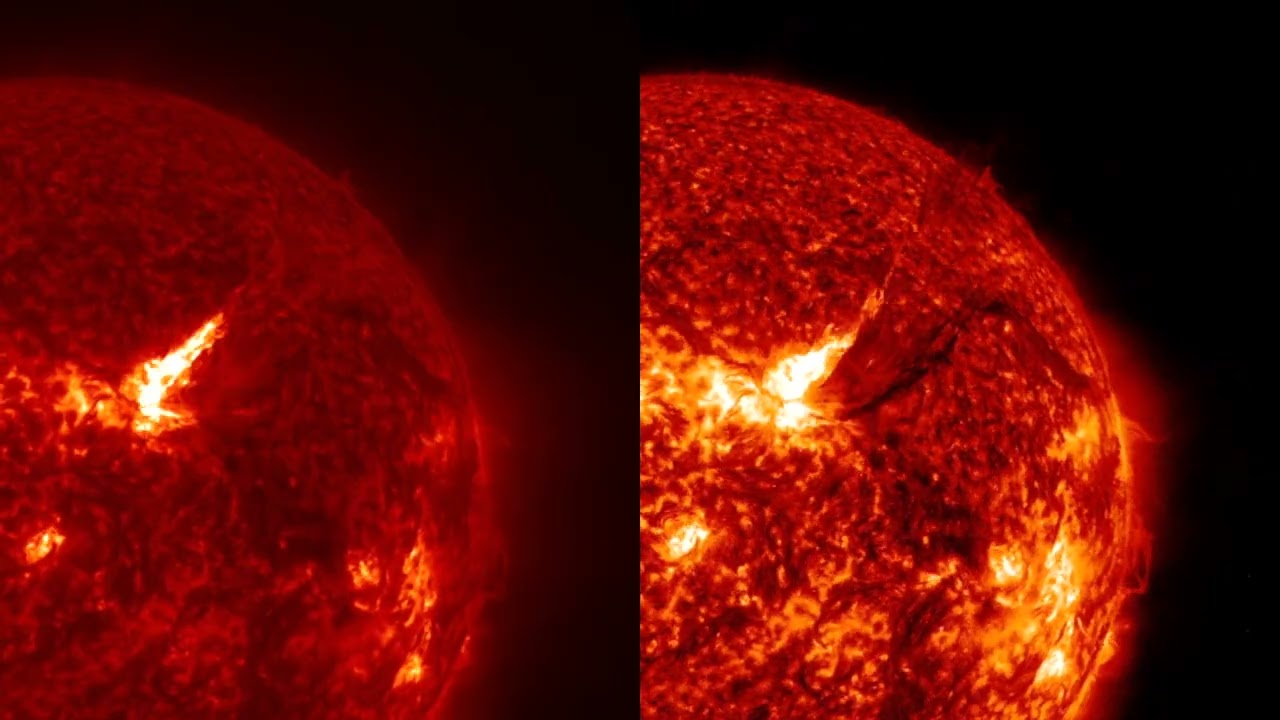
Solar Flares and CMEs at Earth - More Likely | S0 News June.3.2026
SpaceWeatherNewsS0s
2K views•2026-06-03



