The documentary effectively demonstrates how the Drake Equation transforms cosmic wonder into a structured scientific roadmap. It provides a clear, logical framework for exploring one of humanity's most profound questions.
Install our extension to search inside any video instantly.
Can The Drake Equation Prove Alien Life Really Does Exists? | FULL DOCUMENTARYAdded:
What if we're alone in the galaxy?
[music] What if no other intelligent life has [music] ever glimpsed the beauty of [singing] a star rising over a planet's horizon?
For many years, this question was asked not [music] by scientists but by philosophers and theologians.
But then 50 years ago, [crying] an astronomer came up with a mathematical equation which changed everything.
The equation estimated the number of intelligent civilizations in our galaxy and gave the possibility of their existence a scientific legitimacy.
>> [music] >> But more incredibly, this simple equation has gone on to shape the science of a generation. [music] It's led to new insights into the nature of life, the cosmos, and the enigma of intelligence.
[music] And it's allowing us to speculate on the true nature of our relationship with the universe.
>> [music] [music] >> My name's Dallas Campbell, and ever since I first read about the Drake [music] equation, I've been intrigued.
believed that a simple scientific formula could tell us so much about the existence of extraterrestrial intelligence that it could help us answer what is perhaps our most profound [music] question.
[music] When you look up at a clear desert night sky like this, you can start to physically sense just how huge the universe is. And the few thousand stars you can see are of course just a tiny fraction of the billions of stars that make up our galaxy. And I don't know about you, but when I look [music] up, I can't help but wonder what or who else might be out there.
What I want to find out is what we do know, what we can [music] know, and how close we might be to finding an answer.
And that journey starts [music] with a telescope.
50 years ago, one man tried to do something that nobody had ever really tried to do before. And that's attempt to answer this question in a more scientific, a more rational way. And that attempt happened here at the Greenbank Observatory in West Virginia.
>> [music] >> In 1960, Dr. [music] Frank Drake was a leading light in the new field of radio astronomy.
[music] With its huge radio dishes, it was revolutionizing the way we looked at the universe.
But in April that year, he decided to do something truly extraordinary.
He pointed one of the radio dishes out into space to listen for signs of extraterrestrial intelligence.
It was a decision that could have labeled him a crank. It could have ruined his career.
>> Nice place you've got here.
>> But instead, it was the beginning of a lifelong obsession.
>> All right, let's go take a look.
Oh my goodness.
Why is this important? It's probably the most important question there is. Uh what does it mean to be a human being?
What is our future? Are there other creatures like us? What have they become? What is what can evolution produce? How far can it go? All of that will come out of learning of the extraterrestrials and this will certainly enrich our lives in a way that nothing else could.
>> 1960 was the beginning of radio astronomy.
New dishes were being built which could search the heavens not for light but for faint radio signals [music] which might reveal new insights about the nature of the universe.
And Drake believed that this meant [music] he could now search for radio evidence of intelligent life.
Quite literally aliens communicating.
It was such a far-fetched idea that Frank turned to mathematics to create a theoretical framework for his obsession.
>> Can you just explain the history of the equation? Well, in 1960, the National Academy of Sciences of the US asked me to convene a meeting uh to discuss this whole subject to ground it in good sound sciences science and to develop a plan for how to proceed. So, I did that. I invited everyone in the world who I knew was interested in the subject to a meeting at Greenbank. all 12 of them, just 12 people I knew who were very interested in extraterrestrial life. And in November of 1961, we convened at the observatory in Greenbank. And so I thought through what it is you need to know about to be able to predict how many civilizations there might be to detect in our galaxy. And I realized that the number of such detectable civilization depended on seven factors.
And you could even use those factors to form an equation. So I did and that became the agenda for the meeting.
>> This is how those seven factors became [music] the Drake equation.
He estimated the number of detectable [music] intelligent communicating civilizations in the galaxy to be based on the number of stars formed every year multiplied by the fraction of those stars [music] with planets times the [music] number of those planets per solar system with environments suitable for life [music] times the fraction of those planets on which life actually appears multiplied [music] by the fraction of those lifebearing planets on which intelligence arises [music] times the fraction of those that would become technologically advanced and develop a desire to communicate [music] multiplied by the length of time that they continue to transmit detectable signals [music] into space.
So with the Drake equation in place, Frank and [music] his colleagues could start filling in the numbers and for the first [music] time make an estimate for the number of intelligent civilizations in the galaxy. [music] >> Can you put the original 1961 estimates into the equation?
>> One factor that was really wellnown was the rate of star formation. It was about 10 per year.
The fraction of stars which have planets we had indirect evidence from binary stars. It was a guess to be about 0.5.
In those days we thought the earth and if Mars had been a little more massive it would have been able to retain an atmosphere and be suitable for life. So that based on our own system was two.
The chemical experiments in the laboratory suggested that given a planet like the earth given some time by one way or another life would appear. So that fraction was one that is given enough time it appear always appears uh the fraction of these which gave rise to intelligence was a big guess and still is to this day uh.5 and then when it came to the fraction which developed with detectable technologies again was then and now based on our own history but that one seems to be one and at this point we have the rate of production of detectable civilizations. We conservatively assume that they do not remain detectable forever. But a favorite guess is 10,000 years for L.
>> Mhm.
>> And if we put that in, we get a value of N which is equal to 50,000 civilizations.
>> Now that seems like a big number when when you say 50,000.
>> It is a big number and it's very exciting. It means there's something to be found out there. We can be far wrong and there's something to be found. So that's very encouraging to people.
[music] >> But even though Frank now had a theoretical justification for his search, he and his colleagues [music] were still a lone voice.
They grabbed telescope time where and when they could, desperate to find a signal [music] to prove to the world they were right.
But the [music] deafening silence from space was a gift to their critics.
But as the years passed, the scientific [music] mood slowly shifted.
As the astronomers explored more of the universe and biologists penetrated into the workings [music] of life and as our own evolution became clearer, the scientific community began to feel that Frank wasn't quite so eccentric.
Even though ET had not been heard, the estimates in Frank's equation made real sense.
>> [music] [music] >> And now 50 years later, his initial radio telescope search of the heavens has become SETI, the [music] search for extraterrestrial intelligence and boasts its own multi-million dollar dedicated [music] radio telescope array.
And I'm off to see [music] it with the current director of the center foretti research, Dr. Jill Tarter.
>> Hi there. You guys aren't going anywhere near the ACA Allen telescope array. My name is >> D. Hi Jill. Nice to meet you.
>> I'm on my way to the Allen Telescope Array in Hack Creek in Northern California and it's the most ambitious SEI project yet.
>> [music] [music] >> Built in 2007, the array is currently made up of 42 small radio [singing] telescopes which can survey the galaxy 24 hours a day.
[music] Computers combine the signals from each dish [music] to give the equivalent sensitivity of a much larger telescope.
Well, welcome to Hat Creek.
>> Thank you for having me. So, why have we got lots of little telescopes as opposed to like a big arosibo style dish?
>> So, what we built is a fabulous survey instrument. You can survey much more of the sky to a given sensitivity than you can with a big dish.
>> If you compare what we're doing here with what Frank Derek did 50 years ago, >> there's 14 orders of magnitude improvement.
>> Yeah. 10 the 14.
>> I really get the sense that for Jill, these are more than just telescopes.
They are the link between modern science and some of the oldest questions on earth.
After millennia of asking the priests and the philosophers and whoever else we thought was wise, you know, what we should believe that suddenly we had some new technology that is radio telescopes and that those telescopes could do an experiment to find the answer and I was alive in the very first generation of humans could do this.
Most of the modern search works in much the same way as it did back in [music] Frank's day. still based on a single piece of science, radio.
>> Radio waves travel across the distances between the stars, across the whole galaxy without being absorbed by the dust that's between the stars. So radio waves are fantastic for longd distance interstellar communication.
And this unique property of radio led Drake to imagine that it would be far and away the best medium for interstellar communication.
[music] >> But the trouble is that looking for radio signals isn't quite as simple as we might imagine.
Radio signals like all electromagnetic radiation comes in waves and those waves can vary in length from trillionths of cm to kilometers and beyond. So imagine all those different wavelengths stretched out along this road here.
Let's assume that here we've got visible light and in reality the wavelength is smaller than the radius of the finest spider silk. So along this side you've got all the very small stuff. So you've got ultraviolet, you've got X-rays, you've got gamma rays, and on the other side of visible light, you've got the much bigger stuff. So you've got infrared, you've got microwave, you've got radio waves, long waves, so you can listen to the radio for cricket and very long wave. But the point is this. It's a really, really long road.
And trying to tune in to ET, excuse the cliche, really is like trying to find a tiny needle in a cosmic size hay stack.
Back then, Seti could only listen to a tiny section of the spectrum at any one time. So Drake and his colleagues had to make an educated guess where to search for [music] extraterrestrial messages.
They knew that every element in the universe has its own unique electromagnetic frequency.
So they made an assumption that if extraterrestrial life wanted to talk, then surely they'd broadcast on 1420.5 MHz, the frequency of the most common atom in the universe, hydrogen.
>> Hydrogen's the most abundant element in the universe. So when Frank Drake did his search and he had one channel, he chose the frequency of hydrogen. It's universal. When we were able to look at a little bit more of the spectrum, uh, we expanded the search to what we call the water hole. Because water is so essential to life, at least as life as we know it, we said, well, let's look between the hydrogen line that Frank started at, and we'll go up in frequency, 300 megahertz, to the line of the O radical. So H and O, that's water.
>> H2O. Yes, >> that's a special place. So, if you're trying to guess a magic frequency or a range >> where someone might decide to transmit a signal, >> that's a good guess.
>> Yeah.
>> The spectrum within the water hole has been the focus of the search for 50 years.
And recently, new advances in computing power have meant these telescopes can search billions of channels simultaneously.
But there's a problem. Since Frank Drake started looking in 1960, they've used thousands of telescope hours to search for hundreds of different star systems.
And they found nothing. Not a peep.
Silence.
This silence and the lack of any other evidence of extraterrestrial life has become known as the Fermy paradox.
It's named after the physicist Enrico Fermy who first boldly asked where is everybody?
He pointed out a clear contradiction.
If there are thousands of intelligent civilizations out there, then at least one must have left some sort of trace.
So, what's gone wrong? Have the scientists led us up the garden path? Is Frank Drake's equation just a hope driven wild overestimation? Isn't the simplest answer to the Fermy paradox and therefore the most likely that there are no aliens? We're on our own.
[music] >> [music] >> The Fermy paradox has forced scientists to look closer at the Drake equation, especially at its more speculative elements, the probability of life beginning and becoming intelligent enough to communicate across the galaxy.
Professor Paul Davies [music] for one believes the journey from life's beginnings to communicating intelligence is fraught with difficulties.
>> So I asked him to explain the most important barriers to life's development. This is something that during the 60s >> one way I think about this is that there's like a great filter that has to be passed through before you get to the point of an intelligent civilization and the first step the first hurdle if you like in that filter is the transition from non-life to life. So we can think of this as the first great hurdle that that nature has to cross. So that gives us no life this side life. So that's the beginning of biology.
>> That's the beginning of biology. Big step. I think uh it could be a very unlikely step but we don't know. Then the next might be say multisellular organisms. That's another hurdle that has to be crossed.
And then to get uh further on we need to make the transition to intelligent life.
So intelligence is something that has to evolve. And so it's yet another line in the sand. Big maybe very difficult step at the end of this long sequence of hurdles. If you pass through this filter, uh then the final goal that we're interested in is the emergence of technological communicating civilizations like that up there, our lovely telescope.
>> [music] >> So if Drake is [music] right and there are extraterrestrial intelligences elsewhere in the galaxy, they would all have to [music] overcome those three great filters.
Biogenesis, [music] the development of multisellular life, and the leap to intelligence.
And that could be almost impossible.
Okay, so this first line in the sand represents the origins of life, biogenesis. Everything on this side is physics doing its thing, chemistry doing its thing, and then suddenly, bam, it turns into biology, the first self-replicating molecules. And there's loads of good ideas, loads of good science about how this might have happened. The big question, of course, is is it common? Does it spring up as soon as the conditions are right? Or is life rare or very rare or even a unique event that could happen only once in a 13.7 billionyear blue moon?
To begin to answer this, we first need to know whether [music] the kinds of places where life can start are common, as Drake's equation would suggest, or rare. [music] In other words, is Earth a one-off?
[music] To find out, I went hunting for planets around distant stars known as exoplanets [music] at the University of London's Milhill Telescope.
[music] So, one way of detecting exoplanets is what's known as the transit method. And it's a really beautifully simple idea to understand.
So, if you imagine that this is your star, and you're wondering, well, what's going around my star? I can't see. It's all too small. Well, as your exoplanet passes in front of your star, there's going to be a dip in starlight. Now, I've got a light meter here. And so, imagine that's your telescope. And as the planet passes in between the telescope and the star, you'll actually be able to see that tiny little dip in starlight.
In practice, even using this small telescope, we can actually see that dip and infer the existence of a planet orbiting a star far out in the galaxy.
[music] >> Ingress, where it's just starting to >> to prove it, the team showed me one orbiting around a star called HAT P14, [music] 650 lighty years from Earth.
So we started observing just after sunset and we initially see the amount of light from the parent star and then we see it about half an hour later just starting to drop as the planet begins to cross the uh parent star.
[music] Using techniques like this and others, astronomers have now identified over 450 exoplanets, a handful of which look like they might be, as Drake put it, suitable for life.
[music] And they speculate that this is just a tiny fraction of the billions [music] of planets in the galaxy.
So Drake's estimate for Earthlike planets is credible.
And yet being suitable for life is only the starting point because life still has to actually begin.
And to [music] find out about that, I've come to Southern California and the Scripps Institute in San Diego.
[music] Here, Professor Jerry Joyce believes he could be on the brink of producing artificial [music] self-replicating life.
And if he's right, we may [music] understand not only how life started here on Earth, but also how life might have [music] started elsewhere in the galaxy.
In his lab, he's producing artificial RNA, which is thought to be the forerunner to DNA.
All right. So, let's uh let's replicate some RNA. Fantastic.
>> In fact, let's have you replicate some RNA.
>> So, I can do this. This is this is okay for me to do. Is it?
>> Yeah, I trust you. It's not that hard.
So, we have RNA molecules that can reproduce themselves. And all you need to do is give them the food. And then a a little test tube here that contains their their food, the building blocks that those molecules use to produce new copies of themselves. Okay.
>> All right. And I actually want you to do the replication.
>> Sure. I mean, just for the sake of argument, if I took them outside and dropped them, they're not going to suddenly devour everything around us and and start their own.
>> No, out in the wild, they wouldn't last more than a minute or two.
>> Okay. So, they're fragile. These are very, very fragile.
>> They're very fragile in in the face of biology. Yeah.
>> What [music] makes Jerry's RNA unique is that although they're completely artificial, they are capable of a key characteristic of life, replicating [music] themselves.
So what's in my test tube? I mean can we say it's life in any way?
>> They're not alive. They are a synthetic genetic system. They are undergoing Darwinian evolution in a self-sustained manner. Uh and I should say nothing in the test tube comes from biology. All right? So there's water. Uh there's some salts. Uh there's the building blocks of RNA. And then there's the the replicator molecules which contain about uh about 80 85 different pieces of RNA. [music] >> Here's a question for you. How do I know that they're actually growing? Because all I all I can see is a tiny bit of liquid in the bottom of a little test tube.
>> Right? It is just a very small volume of a clear color solution. So you don't see the molecules. However, what we've done is we put tracers on the molecules either radioactive tracers which no offense we don't trust you with that or fluorescent tracers and then we have analytical tools that lets us look at their at their growth characteristics.
>> So so there is ways of actually see seeing them doing their thing.
Now, it may not look like [music] much, but this is evidence that Jerry's RNA molecules are actually [music] replicating, turning basic sugars in the bottom two lines into new [music] RNA at the top in terms of that line, that tantalizing line where chemistry [music] turns into biology. How close are you to that line?
And can you see yourself going over it?
It it has a lot of the properties of life. And I I suppose the way I would think of things even a few years ago, uh I would have thought something like this would be over the line. But now standing right on the line or right adjacent to the line, I feel it's not over the line.
That it's not just a matter of uh having a genetic system that can replicate and evolve, but also the capacity to invent new solutions to new problems that the environment might pose. So given we've got all this understanding, can we start to to speculate in any meaningful way about how life started on Earth?
>> I think that mystery is already put to bed.
>> Yeah.
>> I think, you know, there are certainly no showstoppers in understanding how we get from inanimate chemistry to animate biology, even though the line hasn't been crossed literally in someone's hands or been witnessed other than the life form that we see on this planet. So I I don't think there's there's mystery about that, but there's still much to be learned.
Understanding the mystery of biogenesis would certainly be a key step to working out how it might happen elsewhere [music] in the galaxy.
But it doesn't necessarily make biogenesis itself any more likely.
Let's look at the only example we really know, Earth.
It's always been assumed life here on Earth started only once. [music] So everything, every living thing around us is therefore descended [music] from that single moment of biogenesis.
But that view is now being [music] challenged.
All this life around us, all what we see, we know is the same life. That is this tree behind me, you and me, these flowers here, the insects and so on. If you dig into their innards, you look at their DNA, you find they're all interrelated. So we're all cousins. All life so far studied on Earth is related to all other life. So it belongs to a single tree.
>> Yeah. And Darwin had this metaphor of the tree that it sort of started with some long ago precursor organism. uh and that over billions of years it's diversified and diversified uh into all these different branches. Each branch representing a different species. So you've got the mushrooms over there and >> you know you've got the bacteria up here and the oak trees over here and so on.
So but that's assuming that all life came from a single common origin that is it happened only once on Earth. But how do we know that? Maybe life happened many times on Earth. Maybe instead of being just one tree of life, there is actually a forest.
>> So if we if we confirm this idea of life 2.0, if you like, this separate biogenesis on Earth, can we assume with a little more certainty that life is more common in the galaxy, if not the universe?
>> Do you think it would be inconceivable that life could start twice here on Earth and not at all on all the other Earthlike planets around the universe?
So all we need is just one example of life, but not as we know it. Life 2.0.
It could be here. It could be on Mars.
Doesn't matter where it is. We just want to know that life has happened more than once. If it's happened twice, it's going to happen all around the universe.
[music] >> Yeah.
>> So, where do we start looking for life 2.0?
>> Paul suggested I [music] go looking in the murky world of microbes, most of which haven't even been classified, let alone analyzed. [music] and he suggested I visit a young biologist in San Francisco.
Dr. Felisa [music] Wolf Simon has been searching in the highly toxic depths of California's Mono Lake and believes she might have found something very unusual.
[music] A tiny microbe that can survive concentrations of arsenic that [music] would kill all normal life dead.
And this might imply that it evolved [music] from a totally separate biogenesis.
If it is, then life [music] developed on Earth not once but twice.
>> Hi Felicia. Hello. I'm Dallas.
>> Hi Dallas.
>> Nice to meet you. So >> nice to meet you.
>> Um thanks for thanks for seeing me. Um so can I just check you you've been at Mono Lake and you've been studying some interesting stuff.
>> Yes.
>> Can I have a look at it? Absolutely.
>> Well, first of actually, I should ask you why why Monolay? What's what's important about Mon?
>> First, since you're in the lab, let's get you the lab code.
>> Okay.
>> So, we can we can not just talk about it, but we can actually look at that.
>> Great.
>> So, why go to Mono Lake? So, Mono Lake for many years has been measured by many different people to be very high in arsenic, but this isn't polluted arsenic. Nothing has been dumped. This is a natural rich arsenic lake. So, this lake has been around for a long time.
probably has been enriched in arsenic for most of that time.
>> So, what do you what what have you what what have you got to show me?
>> So, um what I wanted to do is first show you um start from kind of the normal thing we might see at Mono Lake, which is still very unusual.
>> This is just some gunk from one of >> some mud from the bottom of Mono Lake and essentially you just let it sit on a window sill and over time you see these different colors evolve or develop and these are different kinds of microbes.
And this is the same source material or the same mud that we've isolated a a potentially very unusual and interesting, let's say, arsenic utilizing organism. We just want to see what's there.
>> Well, let's have a look then.
>> Absolutely. Great.
>> So, you'll see there's nothing fancy about what we're going to do.
Just take a little bit of the sample, put it on a microscope [music] slide.
>> Can I have a look, >> please?
>> Oh my god. Oh my god.
>> The toxic arsenic rich mud is actually alive with activity.
[music] >> It's almost fractal, right? The closer we go in, the busier it seems to get.
>> That's ex That is extraordinary.
>> So, [music] as we zoom in, you'll see it's just teeming, literally teeming with life.
>> That's wild, isn't it?
>> So, really amazing.
>> So, these are just organisms that were essentially laying in weight in the mud.
Most of these [music] microbes are normal life which have evolved to live in high levels of toxic arsenic.
But by [music] increasing [singing] the levels of arsenic even further, Felisa believes she may have isolated something very unusual.
>> So we have in my group in my lab I've so far looked at a bunch of different microbes and I was what the way I went about doing this. We want to give it a lot of arsenic, right? We want to really really see what can handle a lot of arsenic. So the more arsenet you give it, the more you're going to say actually, yeah, this is this is something >> it's something that >> different >> different. It's doing something unique.
>> She's convinced [music] that anything that can survive this intense arsenic bath would have to be structurally [music] different, would have unique DNA [singing] fundamentally separate from life as we know it.
If I could concretely say to you, this organism biochemically is completely different than we are [music] at a molecular level. It's either a deep root, you know, we we share a common tree, but it's a deep on on the root of the tree of life, >> which would be interesting in itself.
>> Absolutely. It suggests that well, there was really one structural way [music] to make DNA and to make genetic material or there were multiple multiple point sources of the origins of life. And have you found anything like that? Or do you think you found something that that sort of is a prime candidate if you like for [music] for that?
>> Well, it's very likely. We think we have an organism. I think that I've isolated a microbe that's doing something [music] very different. It can survive with exceedingly high levels of arsenic that would be very toxic to you and I and most other life we [music] know. It seems to be growing in a unique way. And hopefully [music] very shortly we'll be making a very interesting announcement.
And that announcement could have a huge impact on the search for extraterrestrials because if life started more than once here on Earth, then the chances that it started [music] elsewhere in the galaxy are greatly increased.
>> [music] [music] >> But for Drake's estimate [music] to be correct, it's not enough for life to just begin.
Some of that life must develop into intelligent life capable of communicating across the galaxy.
And to do that it must first become multisellular.
This is the second hurdle or great filter. So everything on this side is very simple single-sellled life bacteria and such. And this is the junction where it suddenly becomes complex ultimately blossoming into plant and animal life.
But the big question is how likely is that?
>> [music] [music] >> This is the Mojave Desert, one of the hottest, [music] most inhospitable places in the world.
And I've been brought here by [music] Dr. Chris McKay of NASA Ames, who's been studying an unexpected kind of life.
life that might [music] offer tantalizing clues to how we evolved from single-sellled organisms to something much [music] more complex.
>> Just how hot and dry is it here?
>> Well, this is the driest part of the Mojave Desert. And from a microbial point of view, it's dryness, not hotness, that that matters. And we can find a place like this where there's no trees, no plants, and it seems like it's dead. Yeah.
>> But it's not. I want to show you something. evidence that life is more clever than we think. Here on the surface of what looks like a barren desert, we can pick up clear rocks and underneath them, you can see these layers of green.
>> This is photosynthesis at its limit.
>> That's extraordinary, isn't it? Cuz that's that's thick. There's a colony here. I mean, that's a there's a lot going on. So, what is this? Is this >> These are single-sellled cyanobacteria, photosynthetic bacteria. They take sunlight. They make organic material.
They produce oxygen. Yeah, but how are they? I don't understand. How are they photosynthesizing? They're underneath a rock. So, I mean, presumably it's dark under there.
>> If you hold these quartz rocks up, you can see that light is coming through.
You can see that sunlight >> Yeah.
>> about percent or so of the sunlight gets through the rock. So, think of this as a greenhouse.
>> Yeah.
>> Light is coming through the glass. The conditions under the rock are trapping moisture. They're living in little rock green houses.
Chris McKay's green smudge is certainly tenacious, but he believes it also hints at a story much more crucial to my search for intelligent life in the galaxy. The story of how simple singleselled life became multi-selled [music] and complex. And that's because of its ability to photosynthesize [music] to use sunlight to turn carbon dioxide into food and oxygen. We think that that ability photosynthesis is going to be widespread. It's a natural result of living on a planet with sunlight, water.
Combining sunlight and water is a logical thing for an organism to do if it lives on Earth. The result of that is oxygen.
>> And that oxygen changes everything.
For most early life, oxygen is toxic.
But with the arrival of photosynthesis, oxygen is suddenly pouring into [music] the atmosphere.
Some organisms survive the new levels of oxygen and find in the process an unexpected reward.
Because using the energy that oxygen releases, single cellled organisms can supercharge their metabolism.
These organisms are responsible for polluting the earth. Billions of years ago, they produced oxygen. That oxygen changed the environment in a profound way. It changed the environment in a way that allowed for the development of huge creatures like us. So, in a sense, we owe our existence to these kind of organisms.
>> And what's more, according to Chris McKay, complexity is not only a possibility, it's an inevitability. Are you do you think once life gets going complex life will will naturally follow?
>> Yeah, I think I think given an origin of life photosynthesis will come, oxygen will come, complex life will come. I think that will be easy.
>> So if it's inevitable that simple life will become complex, what is the last great filter?
And when I look at the whole story from origin of life, development of complexity, development of intelligence, I think the hardest step [music] is going to be the final one, intelligence.
I think that's the step that's rare, that's defining [music] that separates Earth from the vast majority of other planets.
And for Frank Drake, the likelihood [music] of intelligence arising was one of the great unknowns of his equation.
He guessed intelligence was common in the galaxy, but ultimately that guess was based on a sample of [music] just one. Us.
[music] So this line is what separates us from all other life on earth. And I suppose we can call it intelligence. The big question, of course, is, is intelligence an evolutionary imperative, or are we just a once in a galaxy freak of nature?
To answer that, I'm off to Cambridge to meet paleontologist Professor Simon Conway Morris.
He believes intelligence is much more common than we might think.
In fact, to prove it, he's taken me to meet experimental psychologist, Professor Nikki Clayton, and one of the cleverest families of creatures on Earth.
>> Intelligence, >> Corvids, better known to you and me as the Crow family. [screaming] >> Hi Nikki.
>> Hello.
>> I'm Dallas. How did you do? Nice. Nice to meet you.
>> They are amazing. It's quite ominous coming here. Just the kind of noise of them. You kind of understand why they make many appearances in horror movies.
>> They're so beautiful.
>> Are they talking though? I mean, are they actually communicating?
>> Well, they're communicating, that's for sure. And they're doing lots of body language. If you meant language in a psychological sense, no. But language in a communicative biological sense, yes.
>> Nikki and her team have been giving puzzles to her crows and jays and been finding some impressive results.
So if you give them a tube of water and there's a worm, the Belgian truffles of the croworld floating on the top, but the worm is out of beat reach because the water level is too low, what they will do is pick up stones and use the stones as tools to raise the water level and thereby get the juicy worm at the end of it.
Another experiment reveals a very unexpected human characteristic.
>> So one of the things that's thought to sort of make humans special of a suite of things that have been claimed. One is theory of mind and that's the ability to be able to think about what other people are thinking and the jays are very very good at that. So in one of perhaps the most striking case of that is the case where they hide food and if another bird is watching them they later come back when the other birds have left and move the food to a new place.
But the really cool thing is that not all birds do this moving of food to a new place. It's only those birds who themselves have been thieves in the past that do it. So it's not a hardwired reaction. It takes the thief to no one if you like. And the the idea is that that is a special form of this experience projection. It's reasoning by analogy based on your own experience.
>> Wow.
>> If I were the seat, I would do X and therefore I'll move it.
>> Your Corvette is your sort of ZX81 and we're a kind of iPad.
>> Well, not me personally.
>> My my view is I mean these these and maybe a few other groups, maybe the elephants also. I think the dolphins are just on a threshold of what we were only 100,000 years ago.
>> This is what I want to know.
>> Very exciting, isn't it?
>> It's super exciting.
>> What makes this especially exciting is that crows are so far from us on the evolutionary tree.
And this suggests that intelligence is evolutionarily convergent. See, >> that intelligence is such a good solution to living in our complex world that evolution will fall upon it time and time again in many different organisms.
Just like that other great evolutionary success story, the eye.
What could be more different than an octopus to ourselves?
>> Yeah.
>> But now what I'm going to show you is in fact just in this area here is not for the squeamish. This is the eye of the octopus.
>> Yeah.
>> If I was to dissect out that eye, it would be in certain respects almost indistinguishable from our eye. It's built on a so-called camera principle.
And there are many ways of building eyes. But this camera eye, remember, is in an animal which is a close relative of the garden snail.
>> So, we can say that eyes are convergence.
>> Eyes are converg >> because they again they've happened lots of different times throughout the >> Yeah. And we shouldn't be surprised because eyes are a good trick.
>> [screaming] >> Now, if the crow's behavior really implies that intelligence is convergent, then it has serious implications for our search.
Because not only would it lend support to the idea that aliens would involve intelligence, it might allow us to imagine how they think, too.
At least if I'm right about the convergence, one could say, you know, they after all they come from the same universe with the same periodic table governed by the same evolution. Even if there wasn't a hand to shake of the alien, >> yeah, >> we would still know each other.
>> Simon's research really lends intriguing [music] support to the more speculative parts of the Drake equation, but there's one final element that's lesser.
L the length of time a civilization [music] might last.
Maybe galactic civilizations last just a [music] short blink of the eye.
[music] Which means that perhaps there's yet another great filter ahead in our future. [music] The question is, is the eerie silence uh because we're alone in the universe or is it because there are many civilizations that emerge but they don't last long that they get wiped out fairly soon after they arise.
>> What sort of when you say wiped out, what kind of thing are we talking about?
Well, I suppose we can think of man-made disasters like the release of some genetically engineered organism that uh that just uh infects us all or nuclear war or there could be natural disasters like the impact of an asteroid or comet or the explosion of a nearby star as a supernova. There are many ways that we could meet our demise.
Does this explain the conundrum of why we haven't heard from any extraterrestrial life, the so-called Fermy paradox?
If civilizations disappear quickly, then we're unlikely to hear their short bursts of radio.
But there may be another reason. If the value of L was large, we might not hear ET because our radio technology might be much too primitive.
After all, radio's only been around about 100 years, and already it's changed many times.
Now, this little diddy radio here is tuned to AM, which is where mediumwave and longwave radio stations broadcast.
>> And you can hear it. It's low quality and consequently rarely used now by any broadcaster.
But >> nowadays, of course, we don't use AM as much because we've got FM, frequency modulation, which of course gives us a much better signal.
[screaming] >> FM is a newer technology. It's clear as a bell, and as you can hear, it's very, very busy.
like a blizzard.
>> And this is the thing, our technology is constantly changing. So, it's very likely that an extraterrestrial technology is going to be hugely different from ours. So, in the same way that an AM receiver can't pick up FM, maybe SETI are listening in the wrong way.
>> Don't be a I always kind of assume that well we're just expecting everyone else out there to have our technology where we are. Are we being quite anthropocentric about the way we we look for?
>> How would you look in a way that you don't know anything about?
>> I know exactly.
>> We have to use the tools that we have.
We have to base it on what we know. And in fact, it might well be that in some other planet, it's the um it's the Institute of Ancient Instruments that is broadcasting SETI signals.
>> But back at Greenbank, Frank Drake believes the real reason we haven't heard anything [music] is much much more simple.
But even if we haven't obviously you know despite [music] what people may think they see or believe happens we you know other civilizations haven't [music] come here why haven't we been able to detect them I mean forget about space travel [music] but detect that that's easy we just haven't tried enough >> uh we I think have again been misled by unfortunate >> uh exuberant claims by my myself and other colleagues that we've done a lot of searching and we haven't we've looked carefully at only a few thousand stars on a very small number of the channels that are possible in the electromagnetic spectrum. And that's just hardly even a start. Uh if you take perhaps uh reasonable or even optimistic values for the factors that go into the equation, it it suggests that right now there are maybe only 10,000 civilizations we can detect in the galaxy. That's one in 10 million stars. We have to look at 10 million stars and before we have a good chance of succeeding, we have a long way to go.
Hearing Frank say this [music] made me realize that the one thing I hadn't done was actually look myself.
And almost exactly 50 years after [music] Frank's first search, he and I have been given an exceptional opportunity.
This is the Robert Bird telescope, the largest steerable radio telescope in the world, [music] and we're going to use its incredible radio sensitivity to perform a landmark experiment.
So, here we are actually in the mission control of the Greenbank Telescope.
We're going to be redoing the original project with Frank. Frank's over here.
Come with me. We're going to look at the stars from his original search that Frank still believes are good candidates for intelligent life.
>> Here we are 50 years later looking at the same two stars apart from obviously the sort of anniversary.
>> Does it make sense to look at those two stars?
>> Yes. But there is a catalog called the Habcat catalog which is the habitable stars catalog and there are five stars in that catalog that are considered the prime candidates and two of them are these two.
>> [music] >> As the telescope locked onto the star, I had to admit to feeling a surge of adrenaline.
Just [music] a single beep beep beep will change everything.
>> Okay, here we go. We started, folks.
[music] >> Are we on?
>> We're on.
>> Okay, >> good luck, everyone.
>> All right, so here is hydrogen coming from the Milky Way. [music] >> And so we know now that everything is okay.
>> Okay, >> now we're looking at the star.
>> Yeah.
Well, you get you get the excitement that goes [music] with doing SETI the first time.
>> Maybe the whole world is going to change.
>> I remember Carl Sean doing this with me once and he he was sure we were going to find something [music] within the first hour. After the first hour, he sort of started nodding off and he got the newspaper and started reading it.
>> Yeah.
[music] >> He's starting to get the first data from Terasics.
to die.
>> You so want there to be something. Every time you see one of those >> blips on the line, you you you just want it to be uh to be real.
>> Just a few minutes into the search [music] and an unexpected peak crops up amongst the normal background signal.
>> So a true extraterrestrial signal will be broadened. extra structural signal will be >> but disappointingly it turns out to be merely interference. [music] >> So we're going we're saying no no extraterrestrials.
>> Yeah.
[music] >> How do you feel about are you sort of disappointed?
>> No. That's like buying a ticket in the lottery. If [music] you if you're going to be disappointed that every ticket loses uh you shouldn't be in the business. See, that's the difference between me and you because you can be you can you can be very sort of pragmatic about it and say, "Well, it's okay. It's like it's like a lottery ticket. Two chances a million."
I'm, >> you know, that's my first search.
>> Yeah.
>> And I'm disappointed because I secretly deep down wanted to hear a sign.
>> Don't be depressed. Your reaction is very standard. Everybody thinks that there's going to be success on the first search.
I told you about Carl Sean.
He's took him one hour to go from wild excitement to >> let's go home.
>> I guess that's the ultimate question is it is it worth it?
>> Yeah. Is it is it worth that that much effort?
>> And is it worth that much effort?
>> Yeah. People in STI think the ultimate impact on society is great enough to justify 50 years of failures. You can call them failures.
Lack of success.
>> Yeah. observations.
[music] [music] 50 years on and that lack of success might to some suggest a lost cause, a lottery in which any jackpot [music] might not even exist. But these SETI types are made of sterner stuff. And what's more, where some see failure, [music] they see hope.
I think everything we've learned about Earth builds in us an intuition that [music] life is common. Uh but it's important to emphasize that at this point it is just [music] an intuition.
We don't have any hard facts. And that's what this horse race is all about is to get some hard facts, some scientific facts to try to understand is life on Earth a rare, unusual, unique story, or is the events that unfolded on this planet a common story that occurred many times in many different places.
[music] To me the thing that STEI brings out is the intrinsic connection that we have with the cosmos.
I mean we are star [music] stuff studying the stars. If you see yourself in that kind of a larger perspective, it really [music] does change what you think about other humans on this planet.
I think Frank [music] Drake summed it up very well when he said that SETI is really a search for ourselves, who we are and where we fit into the universe.
And that's why it's great to do even if it's a needle in a haststack search without any guarantee there's a needle out there. It's good that we should ask questions like what is life? What is intelligence? [music] What is the destiny of mankind? These are all very healthy things particularly for young people to deliberate on.
>> [music] >> So, is it worth it? Is the optimism of Frank's estimate [music] and the search for extraterrestrial intelligence naive?
Or is it enough that through the process of looking, we [music] learn more about ourselves and what it means to be human?
To be honest, I still don't know.
[music] What I do know is that after some 50 years of searching, we're just beginning to find some real tangible evidence that [music] life could exist beyond the Earth. And if you want to know what I believe, I agree with Arthur C. Clark when he said, "Sometimes I think we're alone. Sometimes I think we're not. But either way, the implications are staggering. [music] >> [music] [music]
Related Videos

Spiral Galaxy NGC 3370 from Hubble | NASA APOD 2025-11-05 #Shorts
galaxygallery
938 views•2026-05-30

SOMETHING inside the SUN is CHANGING
RaysAstrophotography
1K views•2026-06-03

Captured the Blue Moon (with a twist) 🌙✨ #space #bluemoon #telescope
realAstroExplorer
674 views•2026-06-01

There May Be A Giant Hole In The Universe... And We Might Be Inside It | The Cosmic Ledger Entry 015
TheCosmicLedger
145 views•2026-05-31

The Map We Sent to the Stars in 1977 — Why Scientists Now Regret It
TheAncientRecord7
183 views•2026-06-03

10 Planet Where a Black Hole Replaces the Sun
cosmicexplorer-EN
147 views•2026-06-02

Is this a copy of our galaxy? Discover Galaxy M81!
UniverseDocumentaries-cc4mb
995 views•2026-05-31
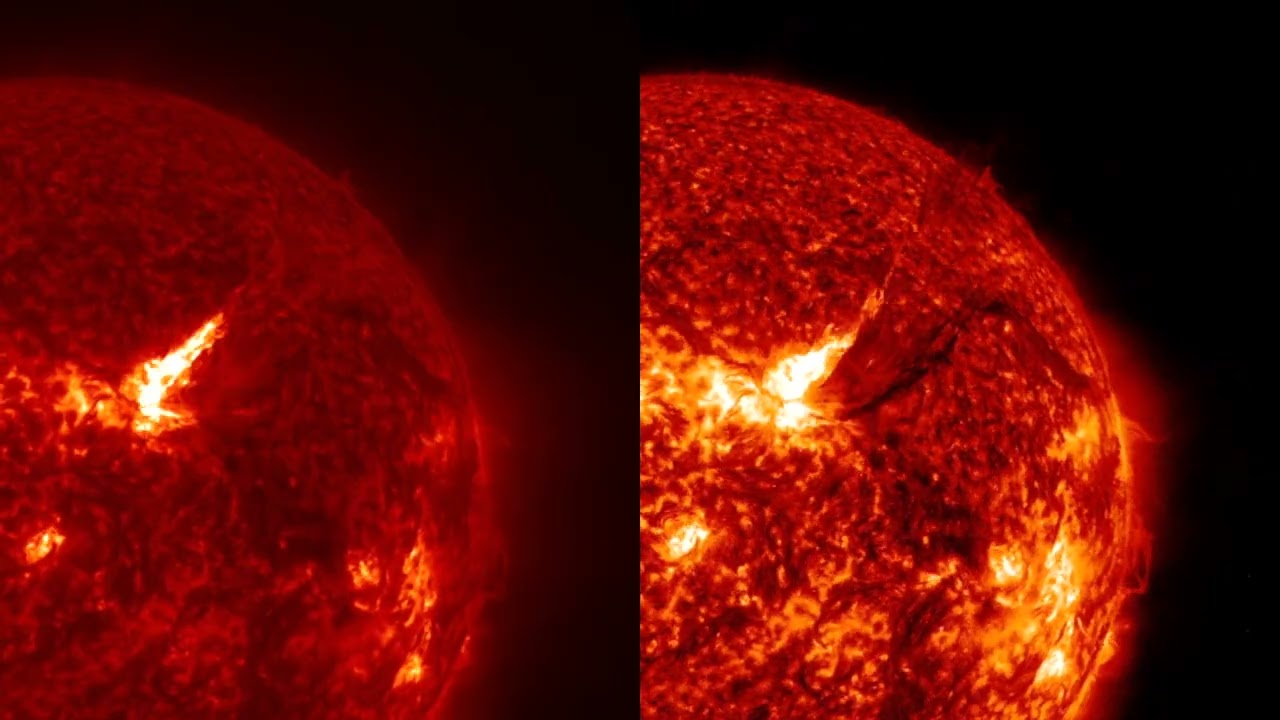
Solar Flares and CMEs at Earth - More Likely | S0 News June.3.2026
SpaceWeatherNewsS0s
2K views•2026-06-03



