Messier 81 (Bode's Galaxy) and Messier 82 (Cigar Galaxy) are two nearby spiral galaxies located approximately 11.6-12 million light-years away in the constellation Ursa Major. M82 exhibits extreme starburst activity, with young stars forming 10 times faster than in our Milky Way, creating a galactic wind that compresses gas to form millions of additional stars. Hubble images reveal M81's spiral arms containing young bluish stars formed in the past few million years, while M82's red and infrared emissions indicate intense star formation activity.
Install our extension to search inside any video instantly.
Bodes Galaxy and Cigar GalaxyAdded:
Bod's galaxy upper left is located approximately 11.6 to 12 million lightyears away from Earth. It is a grand design spiral galaxy situated in the constellation Ursa Major making it one of the nearest large galaxies to our Milky Way. The cigar galaxy M82 lower right around the galaxy center. Young stars are being born 10 times faster than they are inside of our entire Milky Way galaxy. Radiation and energetic particles from these newborn stars carve into the surrounding gas and the resulting galactic wind compresses enough gas to make millions of more stars. The Cigar Galaxy is about 12 million lightyear away. Both of these galaxies are able to be photographed at the same time because they are so close to each other located here within Ursa Major, also known as the Great Bear.
This stunning Hubble image was assembled using observations in visible and infrared light. The galaxy's spiral arms, which wind all the way down into its nucleus, are made up of young bluish hot stars formed in the past few million years. They also host a population of stars formed in an episode of star formation that started about 600 million years ago. Ultraviolet light from hot young stars is fluoresing in the surrounding clouds of hydrogen gas. A number of sineuous dust lanes also wind all the way into the nucleus of M81.
This beautiful Hubble image of M82 was assembled using observations at different wavelengths. The red in the image represents hydrogen and infrared light indicating starburst activity. The blue and greenish yellow color represents visible wavelengths of light.
This is Dobs reminding you to keep looking up and asking questions.
Related Videos

Spiral Galaxy NGC 3370 from Hubble | NASA APOD 2025-11-05 #Shorts
galaxygallery
938 views•2026-05-30

SOMETHING inside the SUN is CHANGING
RaysAstrophotography
1K views•2026-06-03

There May Be A Giant Hole In The Universe... And We Might Be Inside It | The Cosmic Ledger Entry 015
TheCosmicLedger
145 views•2026-05-31

Captured the Blue Moon (with a twist) 🌙✨ #space #bluemoon #telescope
realAstroExplorer
674 views•2026-06-01

The Map We Sent to the Stars in 1977 — Why Scientists Now Regret It
TheAncientRecord7
183 views•2026-06-03

Is this a copy of our galaxy? Discover Galaxy M81!
UniverseDocumentaries-cc4mb
995 views•2026-05-31

10 Planet Where a Black Hole Replaces the Sun
cosmicexplorer-EN
147 views•2026-06-02
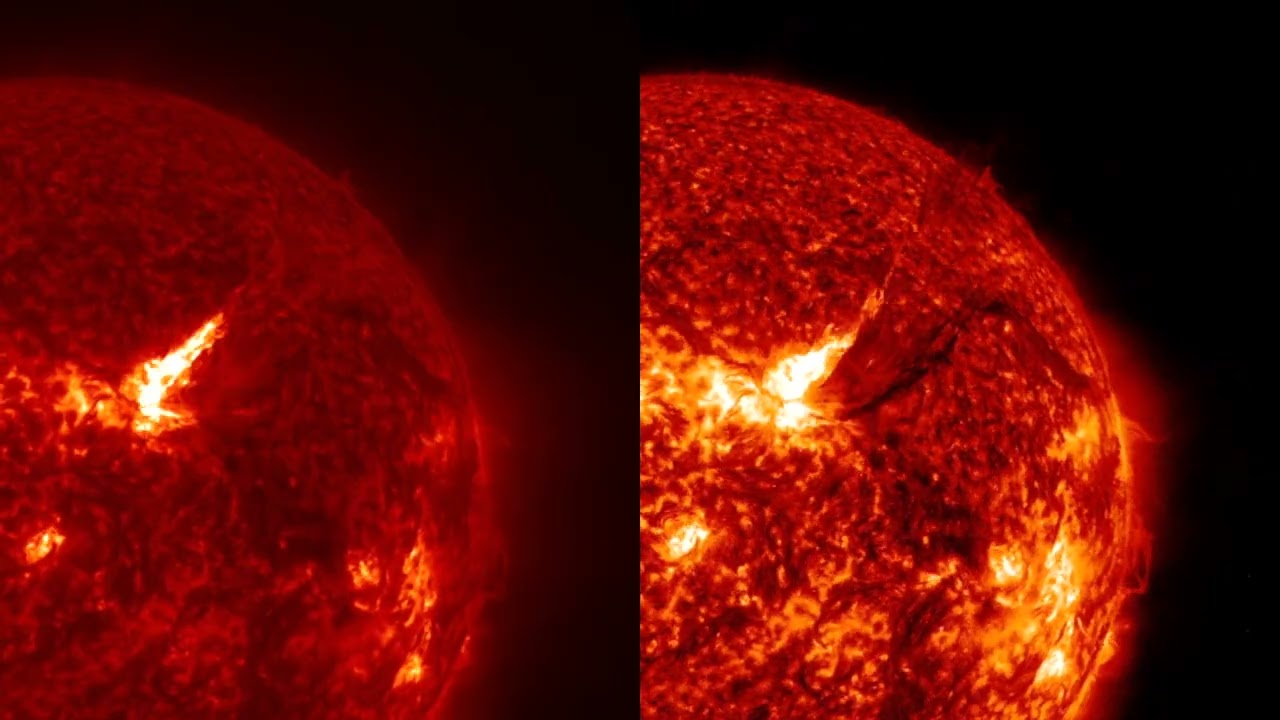
Solar Flares and CMEs at Earth - More Likely | S0 News June.3.2026
SpaceWeatherNewsS0s
2K views•2026-06-03



