This video serves as a humbling reminder that our current laws of physics are merely provisional models waiting to be refined by the universe's persistent anomalies. It effectively captures the intellectual thrill of standing at the edge of the known, where observation outpaces theory.
Install our extension to search inside any video instantly.
10 Mysterious Cosmic Events That Should Not Be PossibleAdded:
There's a place in the universe where the laws of physics don't just bend, they shatter. And we found it not because we were looking for it, but because something out there forced us to notice. 7 billion lighty years away in a seemingly empty patch of sky, a single point of light appeared on telescope feeds. It looked like a supernova. It acted like a supernova until astronomers realized it was five times brighter than any supernova had any right to be.
And then it did something that erased nearly a century of cosmic understanding. It exploded. And then it exploded again. Same location, same intensity, 50 years apart. That's not how stars die. That's not how anything in physics works. And yet, the data didn't care about our theories. What you're about to see isn't science fiction. These are real events captured by satellites, observatories, and space telescopes that have forced astrophysicists to rewrite what they thought was possible. events that shouldn't exist but do. Phenomena that break every rule we've written about the cosmos. And the most disturbing part, we're only now beginning to understand what they might mean. Let's start with the thing that exploded twice. In 2014, the Pan Stars telescope in Hawaii detected a flash of light in a galaxy far beyond our own. Cataloged as PS1 10 AFX. It looked like a type 1 supernova, the kind used as cosmic mile markers because they always burn with the same predictable brightness. But this one wasn't predictable. It was 50 times too bright. Astronomers initially dismissed it as an anomaly, a lensing effect where gravity bends light and magnifies an otherwise normal event. Except follow-up observations showed no gravitational lensing, no galaxy cluster in the foreground, no natural magnifying glass, just an explosion that broke the brightness limit of known physics.
The team shelved the data, too weird to publish, too unexplainable to trust.
Then in 2019, the same telescope found something eerily similar. Another supernova, another impossible brightness. But this time, they had the tools to analyze it properly. And what they found made the first event look almost normal. This second event designated SN 2016 apps didn't just emit too much light. It emitted 5 times the energy of a standard supernova while releasing nearly 60 solar masses of material. To put that number in perspective, most supernova eject between 1 and 10 times the mass of our sun. 60 is not an outlier. 60 is a challenge to everything we thought about how stars die. The only model that could explain it required two massive stars merging before the explosion, creating a star so unstable that its core collapsed into a magnetar, an ultra dense neutron star spinning hundreds of times per second whose magnetic field alone could theoretically supercharge the explosion.
But even that model fails to account for the repetition problem. Because in 2021, telescopes picked up another flash from the exact same coordinates as PS1 10FX.
same galaxy, same location. 50 years after the first explosion, stars don't survive supernova. They don't explode, reform, and explode again. That's not how fusion works. That's not how gravity works. And yet, the light curve matched perfectly. Either something exploded twice in the exact same place or something far stranger is happening in those distant galaxies, something we haven't named yet. And that's just the first mystery. A thousand lighty years closer to home in the constellation of Orria, a star named HD 37397 has been behaving like nothing else in the galaxy. It's a hot, massive star, the kind that typically burns bright and dies young. But this one isn't dying.
It's screaming. Radio telescopes detected bursts of coherent radio emission coming from the stars magnetic field. Pulses so organized and structured that they look artificial. In fact, the signal was so strange that the first scientist to analyze it, Dr. Ivet Sendez of the Harvard Smithsonian Center for Astrophysics, publicly called it the weirdest radio signal we've ever seen.
Coherent radio emission usually requires highly ordered systems like pulsars or magnetars. But HD 37397 isn't a neutron star. It's an ordinary massive star, which shouldn't be capable of producing this kind of organized electromagnetic scream. The signal pulses every week, then stops, then restarts. There's no known physical mechanism that can explain a massive star emitting coherent radio bursts on periodic cycles. The leading hypothesis is that HD 37397 has a companion, an invisible neutron star or black hole, whose interaction with the stars magnetic field creates the pulses. But follow-up observations show no companion. No wobble in the stars motion. No X-ray emissions from accretion. Nothing. Just a star that's figured out how to shout into the radio spectrum and refuses to tell us why. But at least HD 37397 is a star. What we found in 2018 wasn't even supposed to exist as a category.
They're called OC's, odd radio circles.
And when they first appeared in data from the Australian Square Kilometra Array Pathfinder, the astronomers who discovered them thought their equipment was broken. An orc looks like a ghostly ring of radio emission, perfectly circular, sometimes with a galaxy at its center, sometimes not. They're huge, some spanning a million lightyear across. They emit no visible light, no infrared, no x-rays, just radio waves arranged in a perfect geometric ring that physics cannot explain. Here's why they shouldn't exist. Supernova remnants are rings, but they fade after tens of thousands of years. Oarks are billions of light years away and still glowing.
Planetary nebula are rings, but they're tiny and come from dying stars like our sun, which can't produce that much energy. Galactic winds can create bubbles, but they're irregular, chaotic, not perfect circles.
Gravitational lensing can create rings, but that requires a perfectly aligned galaxy cluster, and OC's appear in empty fields with no foreground mass. The only theory that survives scrutiny is also the most uncomfortable. Some astronomers believe OC's are the shells of shock waves from massive galactic mergers where two super massive black holes collided and sent ripples through intergalactic gas. But that would require the black holes to be hundreds of millions of solar masses and the merger would have happened recently enough that the shock wave hasn't dissipated. That's statistically unlikely. Extremely unlikely. Another theory suggests they're the afterglow of ancient starbursts where a galaxy rapidly created and destroyed stars blasting its own gas into a spherical shell that's only visible in radio. But no known starburst galaxy creates rings this perfect. The truth is no one knows.
Six OC's have been found so far. Each one identical in structure, each one a perfect circle, each one from a different cosmic era. They're not rare.
We just weren't looking for them. And that's the pattern you'll notice across all these mysteries. We didn't find them because we knew what to look for. We found them because we finally built instruments sensitive enough to see what was always there. Quietly breaking our rules, like the thing that shouldn't be glowing at all. In 2019, astronomers using the Hubble Space Telescope pointed it at a patch of sky near the large melanic cloud, searching for something entirely different. What they found instead was a cluster of white dwarfs, the dead cores of stars like our sun, cooling down after billions of years.
White dwarfs glow faintly from residual heat. They don't change brightness. They don't pulse. They just slowly fade to black. Except these weren't fading. They were pulsing. Every few minutes, their light would increase by a measurable fraction, then dim back down. That's not possible. White dwarfs have no internal fusion, no nuclear burning, no mechanism for periodic brightening. The only way a white dwarf can change brightness is if something is orbiting it, passing in front and blocking its light. But these pulses were too fast for planets and too irregular for anything else. The team published their findings anyway, fully expecting the astrophysics community to tear the paper apart. Instead, the response was silence. Not because the finding was wrong, but because no one could offer an alternative explanation.
Then, in 2023, the James Web Space Telescope looked at the same white dwarfs with its infrared instruments and found something even stranger. The pulsing was accompanied by a dust signature. Fine particles of carbon and silicate orbiting the dead stars in a disc. A disc around a white dwarf means one thing, planets. But planets don't exist around white dwarfs. The stars death throws, its red giant phase, would have vaporized any orbiting worlds and scattered their remains unless something put that dust there recently. Something that shouldn't exist in dead star systems. The current theory is the most speculative in modern astronomy. Some researchers believe these white dwarfs are consuming the remains of planets that survive the stars death, dragging their debris inward and creating periodic flashes as material hits the stellar surface. But that would require planets to somehow reform after being vaporized, or for the white dwarf to capture rogue planets billions of years after its birth. Neither option fits the timeline. Neither option fits the physics. But the pulses are real. The dust is real. And the dead stars are glowing when they shouldn't be. We could stop here and still have enough mystery for a dozen documentaries. But the next one is where things move from puzzling to genuinely disturbing. In 2007, a graduate student named David Narovik was digging through archive data from the Parkus Observatory in Australia, looking for something completely unrelated. He found a burst of radio energy so intense that it saturated the telescope's receiver. The burst lasted 5 milliseconds. In that 5 milliseconds, it released as much energy as our sun emits in 10,000 years. He almost deleted the file. Radio interference from Earth from cell towers, lightning strikes, even microwave ovens can produce signals like that. But something about the frequency sweep looked wrong for Earthbased interference. Atmospheric signals scattered differently. This one didn't scatter at all. It arrived clean, which meant it had traveled through the vacuum of space untouched by the interstellar medium. He brought the data to his adviser, who told him it was probably nothing. But Narovich couldn't let it go. He spent months analyzing the dispersion measure, the way radio waves spread out as they traveled through space, and calculated that this burst had come from at least 3 billion light years away. 3 billion light years in 5 milliseconds. He published the finding in 2010 and the astrophysics community did what it always does with impossible data. It ignored him until 2012 when Parkers found another one, then another.
Then the Arosibo telescope in Puerto Rico found four more. Suddenly, these fast radio bursts orrbs were everywhere.
Hundreds of them. Thousands. Each one releasing the energy of a star in a fraction of a second. Each one from a different distant galaxy. Each one impossible to explain. The first major breakthrough came in 2016 when astronomers traced infer to a dwarf galaxy 3 billion lighty years away. The galaxy was old, dead, barely forming new stars. That was wrong. Whatever produces should require young energetic environments like supernova remnants or magnetars, not dead galaxies. Then in 2020, the Chime telescope in Canada detected an FURB that repeated not once, not twice, 185 times from the exact same location.
A repeating FURB breaks every model.
Most cataclysmic events, supernova, gamma ray bursts, neutron star mergers happen once and never again. A repeating burst means the source survived.
Something up there is screaming into the radio spectrum on a regular schedule, and it's still intact. The leading theory is magnetars, neutron stars with magnetic fields a thousand trillion times stronger than Earth's. In 2020, a magnetar in our own galaxy, SG1 1935 + 2154 produced in Furblike burst that was detected by multiple telescopes. For the first time, we had a local candidate.
The problem was solved. Except it wasn't because the Milky Way magnetar's burst was a million times weaker than the distant FRBs.
And it only happened once. The repeating FRBs from distant galaxies are thousands of times more energetic and stubbornly periodic. Magnetars can't explain that level of repetition. Nothing can. Some researchers have proposed more exotic explanations. Neutron stars collapsing into black holes, producing a final burst of energy before disappearing forever. That would be a one-time event, not repeating. Superconducting cosmic strings from the early universe vibrating and releasing energy. That would be periodic but has no observational support elsewhere. Or the option no one wants to say out loud, artificial origin, structured, repeating, energetic, and coming from deep space. No serious scientist has claimed FRRBs are aliens. But no serious scientist has ruled it out either because the data doesn't rule anything out. And that brings us to the final mystery.
The one that's so impossible, so deeply unsettling that the astronomer who discovered it spent 2 years trying to disprove her own work before she would publish. In 2021, Dr. Natasha Hurley Walker of Curtain University in Australia was analyzing data from the Merchesen Widefield Array, a radio telescope in the remote outback. She was looking for pulsars, rapidly spinning neutron stars that emit beams of radiation like cosmic lighouses.
Instead, she found something that pulsed once every 18 minutes. 18 minutes is impossibly slow for a pulsar. The slowest known pulsar spins once every 23 seconds. 18 minutes would require a neutron star to be spinning so slowly that its radio emission mechanism, which depends on rapid rotation, would have shut off completely. Below a certain rotation speed, pulsars just stop emitting. Every model says so. But this object wasn't just emitting. It was alternating between three distinct states. Sometimes it was bright in radio. Sometimes it was bright in X-rays.
Sometimes it was completely invisible.
And it switched between these states unpredictably with no pattern anyone could detect. Hurley Walker named it GPM J1839 10 and spent the next two years trying to prove it was something mundane. A flare star, a white dwarf binary, a rotating radior transient. Every possibility she tested failed. No known class of celestial object could produce a periodic signal this slow while switching between emission states. She finally published in 2023, and the paper's conclusion was three words that almost never appear in serious astrophysics. We are puzzled. Since then, four more objects like GPMJ1839, 10 have been found. Every one of them pulsing too slowly to be a pulsar. Every one of them too energetic to be a white dwarf. every one of them positioned away from the galactic plane where most neutron stars live. They're not rare, they're everywhere. We just weren't looking at the right time scales. The most unsettling theory comes from Dr. Koshi Masui of MIT, who suggested that these slow pulsars might be something entirely new. Not neutron stars, but quark stars. Hypothetical objects where the pressure is so intense that neutrons themselves break down into their constituent quarks, creating a state of matter that's never been observed and might have completely different magnetic and rotational properties. A quark star could theoretically pulse at any speed because its emission mechanism doesn't depend on rotation in the same way. But quark stars are purely theoretical. No evidence for them exists anywhere else in physics. And even if they exist, they wouldn't explain the state switching.
Something that powerful shouldn't turn off and on randomly unless it's not random, unless it's responding to something we can't see. That's the thread that runs through every event you've heard tonight. The supernova that exploded twice. The star that screams in radio. The perfect circles in empty space. The dead stars that won't stop glowing. The millisecond bursts from billions of light years away. The 18-minute heartbeat of something that shouldn't exist. None of these should be possible. Our best theories tested for decades, refined by thousands of scientists cannot account for them. And yet the data is unforgiving. The telescopes don't lie. The anomalies are real. Which means one of two things is true. Either we have fundamentally misunderstood how stars live and die, how magnetic fields work, how matter behaves under extreme conditions, and our entire cosmic physics framework is due for a rewrite on par with the shift from Newton to Einstein or something else is out there. Something we haven't named, something that doesn't follow our rules because it plays by a completely different set. The universe has been running for 13.8 billion years. In all that time, we've had sensitive telescopes for barely a hundred. That's like watching the ocean for 1 second and declaring there are no whales. Every impossible event on this list was discovered in the last 20 years. New telescopes are coming online now that are 10 times more sensitive than anything we've built before. If history is any guide, the next decade will reveal not dozens of these anomalies, but thousands. The question isn't whether the universe is stranger than we imagine. We already know that answer. The question is whether we're ready to accept what it's trying to tell us.
Related Videos

Spiral Galaxy NGC 3370 from Hubble | NASA APOD 2025-11-05 #Shorts
galaxygallery
938 views•2026-05-30

SOMETHING inside the SUN is CHANGING
RaysAstrophotography
1K views•2026-06-03

There May Be A Giant Hole In The Universe... And We Might Be Inside It | The Cosmic Ledger Entry 015
TheCosmicLedger
145 views•2026-05-31

Captured the Blue Moon (with a twist) 🌙✨ #space #bluemoon #telescope
realAstroExplorer
674 views•2026-06-01

The Map We Sent to the Stars in 1977 — Why Scientists Now Regret It
TheAncientRecord7
183 views•2026-06-03

Is this a copy of our galaxy? Discover Galaxy M81!
UniverseDocumentaries-cc4mb
995 views•2026-05-31

10 Planet Where a Black Hole Replaces the Sun
cosmicexplorer-EN
147 views•2026-06-02
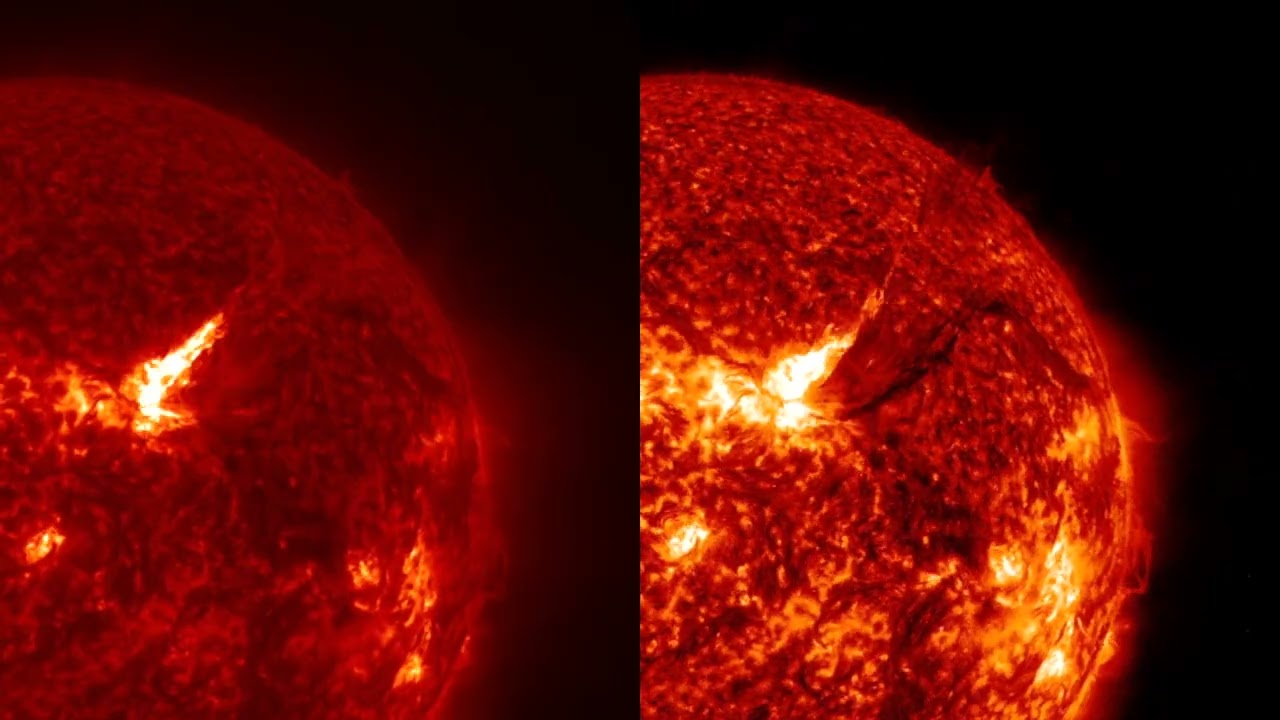
Solar Flares and CMEs at Earth - More Likely | S0 News June.3.2026
SpaceWeatherNewsS0s
2K views•2026-06-03



