A black hole is a region of space where space-time is so severely curved by concentrated mass that it flows inward faster than the speed of light, creating an event horizon—the point of no return where even light cannot escape. From Einstein's perspective, gravity is not a force but the curvature of space-time itself, meaning objects are not pulled by a force but are carried along with the inward flow of space-time. The event horizon is defined by the Schwarzschild radius, the critical size where escape velocity equals the speed of light. At the center lies a singularity where space-time curvature becomes infinite, representing a breakdown of current physics where general relativity and quantum mechanics produce conflicting predictions.
Install our extension to search inside any video instantly.
Modern Physics - Part 12
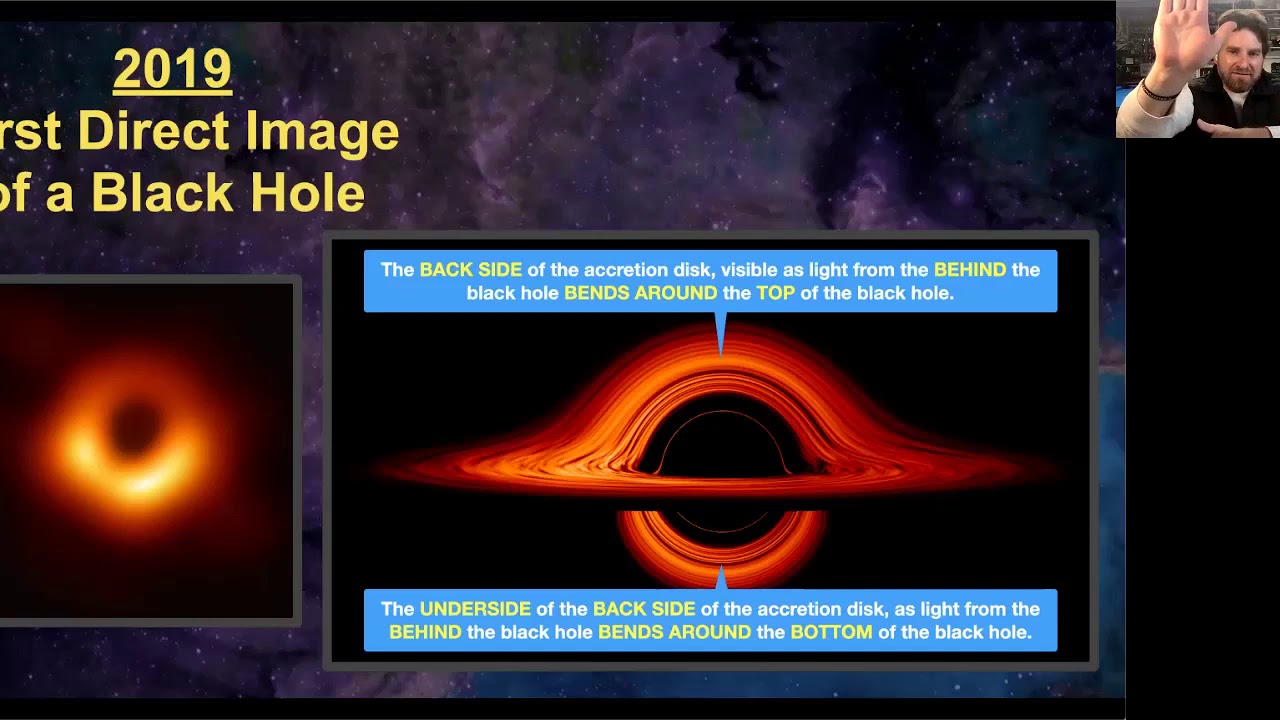
Added:ladies and gentlemen welcome back to part 12 of our look at modern physics today we are going to take our understanding of general relativity the flow of space-time the curvature of space-time and apply it to a new more modern understanding of black holes so without further ado let's dive into it so we actually proposed an idea of what a black hole is just based on newtonian physics you recall that we talked about the concept of surface gravity and escape velocity and we noted that an object whose mass is condensed into a small enough radius can have a surface gravity that is so great that the escape velocity from the surface of that object would exceed the speed of light and therefore any object that fell onto that object would not be able to escape because nothing can go faster than the speed of light this would be true of light as well if light is indeed affected by gravity like everything else but even before einstein's work newton had argued that light is a particle and like any particle light should be affected by gravity and so even from a newtonian's perspective one could argue that if light moved at a finite speed which had already been speculated and somewhat determined by the time of newton's work then light could be trapped by such an object the newtonian perspective of a black hole implies that gravity is a force that reaches out from this super dense object and grabs onto and holds onto other things including light in the einsteinian perspective of gravity in general relativity gravity is not a force at all but gravity instead is the result of the flow or the curvature of space-time itself around a massive object which means that to define a black hole from the perspective of general relativity means talking about the nature of space and time around this super dense object so what is a black hole from the einsteinian perspective well according to general relativity a black hole could be thought of as a region of space so severely distorted by a high concentration of matter that space time flows inward faster than the speed of light okay so let's slow down and talk about what that means remember earlier we had talked about that from einstein's perspective the acceleration of space-time inward and the feeling of gravity pulling down are equivalent and so if the newtonian perspective says gravity is a force that is pulling down towards this object then from an einsteinian perspective one could argue that in fact it's space time flowing inward towards this object and the idea is is this object is so condensed so compact just like we argued from the newtonian perspective that space-time can flow faster and faster and faster before you reach the surface of the super dense object and at some point space time can flow inward at or even faster than the speed of light now before you say wait a minute i thought nothing could go faster than the speed of light remember that relativity says that no object with any mass can go faster than the speed of light and because light has no mass it actually has to go at the speed of light but there's nothing in general relativity that limits the rate at which space-time itself can flow it's only objects that move within space-time but space-time itself has no limit to how fast it can flow so let's talk about exactly what that would mean with respect to creating a black hole so one really useful way of modeling what a black hole is is to imagine that you have a huge body of water and that water is flowing towards some big sinkhole in the middle of that body of water now the image you see here is a real image this is a reservoir and that round drain you see is a drain that sucks water from the reservoir and diverts it outside the dam so basically you have water flowing down into this big drain now it turns out the physics of water flowing into this drain actually match quite well the physics of the flow of space-time into a black hole now of course in this case the hole itself is two-dimensional and water is flowing along a surface into this two-dimensional hole that then drops down into a third dimension in reality a black hole is not a two-dimensional circle but a three-dimensional sphere with space-time flowing inward in all directions three-dimensionally so here's the idea imagine that you are sitting in a boat somewhere on this reservoir far from this sinkhole and you can imagine that if you're far from the sinkhole the rate at which water is flowing towards the sinkhole is extremely low in fact it might be so low that you wouldn't even notice it even if you sat in that boat for hours so if you're far from this object you won't notice it you won't even feel as though you're being pulled in by the flow of the water but if you were to venture too close you might notice that you are flowing towards it now you could argue you're being pulled by some force or you could argue that you are just moving with the flow of the water now let's imagine that you're not happy about this and so you jump out of the boat and try to swim away now let's say the fastest that you can swim is 10 miles an hour well if the water's flowing towards the hole at one mile an hour but you're swimming through the water in the opposite direction at 10 miles an hour then you can escape the pole of that hole at a net speed of 10 minus 1 or 9 miles an hour but let's say that you notice this later in the process and you only notice it when you're at a point where the water is flowing inwards at eight miles an hour so you jump out of the boat and you start swimming away from the hole now can you still escape and of course the answer is yeah you can still get away from that sinkhole at a net rate of about two miles an hour so it's still escapable but what if you got to a point where the water was flowing in towards the hole at 10 miles an hour now if you jumped out of the boat at that point is there some sort of signage some sort of magical barrier at that point where the water is flowing just as fast as you can swim no and you would find that when you jump into the water no matter how fast you try to swim upstream you will inexorably be pulled towards that hole and in fact as the rate of the water flowing towards that hole goes faster and faster no matter how fast you swim you are going to be pulled into that hole in other words past that point where the water is flowing at 10 miles an hour in towards the hole the hole is now essentially inescapable you have entered a region of water surrounding the hole where you can no longer escape so here is a way of visualizing that as the water flows faster and faster towards the hole as you get closer and closer to this the faster you have to swim to stay out of it and if at some point the water is flowing faster than you are capable of swimming then you are doomed you are stuck and you will go down that hole this is essentially what a black hole is from einstein's perspective it is an object where space-time is flowing so fast that at some point it flows at and then within that faster than the speed of light and this of course would apply to light as well no matter how fast light tries to swim through space which has to be at the speed of light if space is flowing inward faster than that then even at the speed of light moving through space it cannot escape the pull of that hole and so it becomes a black hole in space literally a region of space that once you go in you can't get out a hole so let's watch a brief video that helps understand the physics of a black hole from the perspective of flowing water let's take a look near a black hole space and time do some very strange things because black holes are probably the most violent places we know of in the universe this river provides a beautiful analogy for what happens to space and time as you get closer and closer to the black hole now upstream the water is flowing pretty slowly let's imagine that it's flowing at three kilometers per hour and i can swim at four so i can swim faster than the flow and can easily escape but as you go further and further downstream towards the waterfall in the distance the river flows faster and faster [Music] imagine i was to decide to jump into the river just there on the edge of the falls the water is flowing far faster than i could swim so no matter what i did no matter how hard i tried i would not be able to swim back upstream i would be carried inexorably towards the edge and i would vanish over the falls well it's the same close to a black hole because space flows faster and faster and faster towards the black hole literally this stuff my space that i'm in flowing over the edge into the black hole and at the very special points called the event horizon space is flowing at the speed of light into the black hole light itself traveling at 300 000 kilometers per second is not going fast enough to escape the flow and light itself will plunge into the black hole now as you get right to the center then our understanding of the laws of physics breaks down our best theory of space and time einstein's theory of general relativity says that space and time become infinitely curved that the center of the hole becomes infinitely dense that place is called a singularity and it is the place where our understanding of the universe stops okay welcome back so in this video you heard the term event horizon defined and the term event horizon is one of the most important things to understand about a black hole from a relativistic perspective essentially the event horizon is the point of no return it's that place in the water where the water is flowing faster than you can swim there's no signage there's no boundary there's nothing physical there that tells you that this is where the event horizon is it's just a place in this case in the water where the water happens to be flowing faster than you can swim so obviously for different swimmers this point is going to be at a different distance from the center of that hole if you can swim at 20 miles an hour then of course your event horizon is going to be much further in because you are more capable of swimming upstream in fast moving water but if you can only swim at two miles an hour then your event horizon is going to be further out but in the case of black holes the speed limit is the same for everybody it's the speed of light and so the event horizon for any black hole is going to be that region of space that distance from the center of the black hole where space is flowing inward at the speed of light that is your point of no return if anything including light crosses that boundary it is never ever getting out back to the rest of the universe well remember horizon means the point past which you can no longer see if you think of the horizon that you look out upon where the sky meets the land that horizon is defined as the point past which you can no longer see any more land so that's literally what we mean by horizon the farthest that you can see something what's an event it's anything at all that happens in space time and so past the event horizon since information about that event can only travel through space at the speed of light and nothing not even light can get out of the black hole past the event horizon then you can't know about you can't get any information about any events occurring within that boundary therefore as viewed from the outside that boundary literally is a horizon for seeing events occur in the universe it is an event horizon what would that actually look like to your eyes well essentially what it would look like is a region of space that would be not circular like you see on your screen but spherical and it would be basically a big dark sphere because anything past that point you can't see any information about it now the interesting thing is that dark sphere isn't itself a solid object and in fact as we'll see the black hole itself has no solidity whatsoever within the event horizon there's still space so black holes are kind of like las vegas whatever happens within the event horizon stays within the event horizon any information about it will never escape and will ultimately be sucked in towards the center of the black hole now what defines where the event horizon is you'll recall earlier in a in an earlier lesson when we talked about gravity we talked about something called the short shield radius what was the short shoulder radius it was the smallest radius any amount of mass would have to be compacted into to become an object whose escape velocity was equal to or greater than the speed of light you might recall that for the sun you have to squeeze it down to something about the size of a mountain for earth you'd have to squeeze it down to something the size of a marble and for a human being you'd have to collapse yourself down to billionths the size of a proton the short shield radius is basically defined as where the event horizon would be for any massive uh black hole so whatever the mass of the black hole is the short shield radius is where the event horizon would be or put another way any amount of mass that collapses in beyond the short shield radius collapses in and within its own event horizon and so as it collapses beyond the event horizon you can't see it collapse any further past that you'll just see it suddenly goes dark so basically black holes are objects that collapse within their own event horizon and that is another way of thinking of a black hole so what about the center of a black hole well from the perspective of general relativity it is a place where all the matter of the black hole all the mass of the black hole is collapsed infinitely down so you could think of a singularity as singular because it's literally a single point a place where space and time narrow infinitely down into just this ever falling thread of space and time now the event horizon is obviously somewhere outside of that singularity so you can see a diagram here that if this is the singularity the center of the black hole then somewhere further out from the singularity is the event horizon anything that occurs in space-time above this red line theoretically is observable and could ultimately escape the pull of the black hole if it could reach incredible speeds but anything that happens in the region of space-time below this red circle is inside of the black hole and can never escape and will ultimately and inexorably fall towards the singularity okay now here's the interesting thing the truth about singularities is this and that is we don't know what they are because it turns out general relativity which is an extremely successful theory defining how space and time and gravity behave on large scales predicts that inside of a black hole space time must narrow to zero but quantum physics another extremely successful field of physics that describes the behavior of the subatomic world with a very high degree of accuracy something we'll be talking about in a few days makes an entirely different prediction it says that it's impossible to collapse matter and energy down to zero and so general relativity says a singularity should collapse to zero quantum physics says it cannot collapse to zero and they do not produce the same outcome they don't speak the same language they don't predict the same outcome and so a singularity is essentially undefinable in a way that agrees both with general relativity and quantum physics and so what a singularity really represents is the place where our current understanding of physics completely breaks down and that means that singularities are the current frontier of astrophysics they are the holy grail of theoretical astrophysics right now in the 21st century solving the problem of singularities not only would ultimately help us understand what happens inside of a black hole and what is the ultimate fate of matter and energy and information in a black hole but it turns out it will also help us understand the origins of the universe itself when you think of the big bang you probably know that the big bang theory says that the whole universe began from an infinitely small point that for some reason rapidly expanded and gave birth to space time matter and energy as we know it well that little point from which the universe expanded is itself also a singularity the same kind of singularity you find at the center of a black hole so it's interesting that the center of a black hole which is a finite object within the universe and the origins of the entire universe itself are directly connected to each other through the exact same physics so to sum things up general relativity and quantum physics are arguably the two most successful physics theories to come out of the 20th century both do an incredibly fantastic job of explaining the way the universe behaves on each of their respective scales general relativity does a fantastic job explaining how the very massive influences space and time around it on a very large scale quantum physics does a spectacular job explaining as strange as it is the weird behavior of the subatomic world so the holy grail of theoretical astrophysics right now is a theory that combines both general relativity and quantum physics into a single theory that equally if not better predicts all of the behavior on the large scale and all of the behavior on the small scale and also provides sensical predictions and explanations for things that are both massive and tiny like singularities that theory has come to be known as quantum gravity thus far there is no successful proposal of quantum gravity that has been tested and verified this is the holy grail of 21st century physics a theory of quantum gravity there are lots of candidates out there and people have been working for decades trying to develop a self-consistent theory that successfully explains everything on all scales all the way down to singularities and when that happens and i'm certain it will it will unlock mysteries that will open up a whole new paradigm shift in our view of the nature of space time matter and energy and you can be part of those discoveries so we're going to end today by watching a video to extend our understanding of what a black hole is and then next time we'll explore a little bit more about what would happen as you approach a black hole what would happen as you fall into a black hole see you next time [Music] in a previous episode we discussed the true nature of black holes we talked about them as general relativistic entities as space-time regions whose boundary curvature effectively removes the interior from our observable universe now it'd be a great idea to watch this video first if you haven't already now these are some abstract ideas and really black holes were at first just a strange construction of general relativity and just because something exists in the mathematics does not mean it has to exist in reality so are black holes real the answer is yes black holes are astrophysical realities that we have ample evidence for yet to actually form a black hole einstein's descriptions of mass energy and space time are not enough we need quantum mechanics if you're up for it let's build a black hole first step find a very massive star and wait let it cook not for long because these guys have very short lives just wait a few million years for the supernova the details of the deaths of massive stars are pretty awesome but they can be found in lots of places so we'll just gloss over them here in the last throws of a very massive star's life increasingly frantic fusion in the interior produces one periodic table element after another in russian doll shells of increasingly heavy nuclei that finally surround an iron core the formation of that core represents the end of exothermic fusion fusing two iron nuclei absorbs energy it doesn't release it so starved of an energy source the stellar core collapses on itself electrons are slammed into protons in the iron nuclei forging a neutron star the collapsing outer shells ricochet off this impossibly dense nugget in a supernova explosion enriching the galaxy with juicy new elements the leftover core the neutron star is a very weird beast a ball of neutrons the size of a city with the mass of at least 1.4 suns and the density of an atomic nucleus until now the neutron star has hovered above a critical size the space-time curvature at the neutron star's surface is pretty extreme clocks run noticeably slower and the densities inside the star produce some very strange states of matter however despite this the star is still very much a thing in this universe and yet below the star's surface there lurks the potential event horizon the surface of infinite time dilation now the event horizon doesn't actually exist as long as the neutron star stays larger than the would be horizon however if we can increase the mass of the neutron star the actual star shrinks and the event horizon expands you can see where i'm going with this there's a mass where the radius of the neutron star and the event horizon overlap it's three times the mass of the sun at this point the event horizon actually comes into being and the neutron star submerges beneath it we finally created our black hole but what happens to the star when it slips below its event horizon everything inside is lost from this universe space-time is radically altered inside the star with all geodesics space-time paths turning inward towards the center when the black hole first forms the material inside must resemble the stuff of the original neutron star but there's no stopping ultimate collapse all paths lead to the central point of infinite curvature the singularity from the point of view of the star itself the inward cascade happens all position space collapses towards the singularity neutrons are certainly shredded into component quarks and gluons but what happens to these as the star approaches an infinitesimal point the planck scale physics cannot yet tell us from the point of view of an outside observer so us this never happens the black hole forms the stellar core goes dark but on our timeline nothing ever happens beyond the event horizon again we can't meaningfully think about what's happening now beneath the event horizon there is no corresponding now the material of the star and all events that happen to it are no longer a part of the timeline of the external universe on our clock the singularity forms infinitely far in the future to us there is only the event horizon so this is how a real astrophysical black hole is
Related Videos
Modern Physics - Part 13
joshbbloom
225 views•2026-06-08

Lateral shift and apparent depth
surendrapasumarthi
121 views•2026-06-10

25 Facts About Shadows That Will Blow Your Mind
list25
409 views•2026-06-07

Moments 1
MathsA-LevelCarolyn
195 views•2026-06-08

Racing Random Cars on the Moon
HudsonsPlaygroundGaming
5K views•2026-06-11

Nature can create light shows that look like pure magic ✨🌍 #ScienceEELab #shorts #AuroraBorealis
Science_EE_Lab
266 views•2026-06-06

The Major Earthquake That Just Hit The Philippines Made A Wave Too Small To Be Possible
AshfallDebrief
122 views•2026-06-10

Where does mass actually come from? #Physics #Science
Space-Facts_96
2K views•2026-06-09