A 4,500-year-old Sumerian clay tablet (YBC 11304) held in Yale's Babylonian Collection describes six categories of beings believed to inhabit the moon's interior—breathers, listeners, keepers, sleepers, bound, and an unnamed sixth category—each with specific activation conditions. Modern scientific evidence, including Apollo mission moonquake data showing deep seismic events tied to the lunar orbital cycle and increasing frequency, and radio astronomers detecting irregular pulse patterns during eclipses, suggests these ancient observations may have documented real phenomena rather than mythology. The tablet's activation conditions (increased cold light during eclipses, anthropogenic radio emissions, and surface penetration) have all changed measurably since the 20th century, raising questions about whether these ancient descriptions were literal observations of lunar phenomena.
The Sumerian Tablet Listing 6 Things That Live Inside the Moon — And Why They're StirringAdded:
A 4,500 year-old clay tablet, smaller than most and shaped [music] almost perfectly square, sits in the Yale Babylonian Collection in New Haven, Connecticut, catalog number YBC 11304.
Most visitors to the [music] collection never see it. The tablet is not on display in the public gallery. It is held in the research storage of the Sterling Memorial Library, accessible to scholars by appointment. The reason for its restricted access is not officially explained. The tablet's content, when read in full, is unusual enough that the curatorial decision is not difficult to understand. YBC 11304 is a list. The list [music] has six entries. Each entry describes a category of thing. The cuneiform heading above the list, translated literally, reads, "That which is contained within the great vessel of the night." The great vessel of the night, in Sumerian astronomical vocabulary, is the moon.
The list is what lives inside it, not on its surface.
>> [music] >> Inside, the Sumerians, in the third millennium before the common era, recorded six categories of things they believed to inhabit the interior of the moon. They described what each category did. They described where in the lunar interior each category resided. They described what would cause each category to become active. The tablet records the activation conditions in detail. The conditions, when measured against the present day, are not encouraging. The tablet was acquired by Yale University in 1924 from a private collector who had purchased it on the antiquities market in Baghdad. Its provenance before that purchase is not documented. The tablet was cataloged upon acquisition as a religious text dealing with lunar mythology, miscellaneous category, and placed in the research storage where it has remained. The 1924 catalog card noted that the tablet was unusual but not exceptional and recommended no further study. No further study was conducted for 98 years. The text was assumed to be a poetic enumeration of mythological figures associated with the lunar deity Nana, comparable to dozens of other minor religious tablets in the collection. The assumption rested on the heading, which was read as a metaphorical reference to the moon as a divine vessel. The contents of the list were assumed to be allegorical beings rather than literal occupants. Dr. Theodora Krouse at the Oriental Institute of the University of Chicago accessed digital images of YBC 11304 in 2022 during a project on Sumerian descriptive vocabulary for non-terrestrial bodies. She was searching for examples of a specific class of verb used in Mesopotamian astronomical observation. The verbs appeared throughout YBC 11304.
Krouse noted that the verbs were not the verbs Sumerian scribes typically used for mythological description. The verbs were the verbs used for empirical observation. The tablet was not describing what the Sumerians believed about the moon as a religious symbol. It was describing what the Sumerians believed they had observed inside it.
The grammatical mood is declarative, the same mood used for inventory and census records. The list is not a hymn, it is an account. Krouse published her grammatical reanalysis in the Journal of Near Eastern Studies in 2023. The academic response was silence. No rebuttal, no follow-up survey, no engagement with the verb analysis. The paper exists, the reanalysis exists, the list with its declarative grammar and observational vocabulary is now in the published record. Yale has not authorized public display of the tablet.
The reason given is preservation. The tablet is in excellent condition. To understand what Krouse found, it helps to read the six entries as the Sumerians wrote them. The first entry is described as the breathers. The cuneiform specifies that the breathers occupy the outer shell of the lunar interior, immediately beneath the surface. They are described as drawing in what the tablet calls the cold light, the diffuse illumination that reaches the moon from sources other than the sun.
>> [music] >> The breathers do not move. They remain in fixed positions across the inner surface of the lunar shell. The tablet describes them as numerous, possibly continuous, [music] lining the interior of the outer crust like cells in a honeycomb. Their activation condition is the increase of cold light. When the cold light intensifies, the breathers draw more deeply. The drawing produces a low vibration that can be detected from the surface as a tremor. The second entry is described as the listeners.
They occupy what the tablet calls the middle hollow, the chamber between the outer shell and the deeper core. The listeners are described as conscious, mobile, and few in number. The tablet specifies that there are not many of them. The listeners do exactly what their name indicates. They listen. The cuneiform is clear that the listening is directed outward, away from the lunar interior, toward the surface of the moon and beyond it. They listen for specific sounds. The sounds they listen for are not named in the list itself, but are referenced in a parallel text. The activation condition for the listeners is the increase of a specific frequency originating from the surface of Earth.
The tablet does not describe the frequency in modern terms. It describes it as the hum of the many. The third entry is described as the keepers. The keepers occupy the lower chambers of the middle hollow, closer to the lunar core.
They are described as guardians of something the tablet refers to only as the seal. The seal is not described in the entry itself. The keepers maintain it. The cuneiform indicates that the seal separates the upper portion of the lunar interior from the deeper portion below. The keepers do not allow movement across the seal. Their activation condition is any attempt at penetration.
[music] The tablet specifies that the penetration could come from above, from the lunar surface inward, or from below, from beneath the seal moving upward. The fourth entry is described as the sleepers. The sleepers occupy the chamber directly beneath the seal. They are described in the cuneiform as numerous, formless when at rest, and capable of taking form when active. The tablet states that the sleepers have been asleep since before the time the Sumerians could remember. Their activation condition is the failure of the seal. If the seal breaks, the sleepers wake. The tablet does not describe what the sleepers do when they wake. The entry ends with the phrase "The records do not extend that far."
The fifth entry is described as the bound. They occupy a smaller chamber adjacent to the sleepers. The bound are described as conscious, aware, and held in place by mechanisms the cuneiform does not specify. [music] They are described as the ones who would not serve. The tablet states that the bound are kept separate from the sleepers [music] because the bound, if released, would attempt to wake the sleepers regardless of the surface conditions.
Their activation condition is sustained contact with anything that reaches the chamber from above or below. The tablet uses an unusual phrase to describe what the bound want. The phrase translates roughly as "The bound desire to be heard." The sixth entry is described differently from the first five. The cuneiform does not give the sixth category a name. It is described only as that which is below the bound, that which the bound were created to keep contained. The sixth entry is not described in terms of what it is. It is described only in terms of where it sits and what it is not allowed to do. The activation condition for the sixth entry is the activation of the previous five.
The tablet specifies the sequence. If the breathers are stirred, the listeners begin to focus. If the listeners focus on a specific source, the keepers prepare. If the keepers are challenged, the sleepers near waking. If the sleepers stir, the bound begin to press against their restraints. If the bound succeed in being heard, the sixth category begins its own activation. The tablet does not describe what the sixth category is. It does not describe what its activation means. It records only that activation, once begun, cannot be reversed. The Enuma Anu Enlil, the Babylonian astronomical compendium held in the British Museum and dated to approximately 1700 BCE, contains a passage that has been read for a century as a poetic description of lunar eclipses. The passage describes the moon as containing within it inhabitants who become disturbed when the moon enters Earth's shadow. The standard interpretation reads the disturbance as a religious metaphor for the diminishment of lunar light. Kraus re-examined the passage. The new detail here is mechanism. The Babylonian text specifies that the disturbance is caused not by the loss of sunlight, but by the increase of a different kind of light that reaches the moon only during eclipse when the sun's light is blocked.
The increase of cold light is the first activation condition on YBC 11304.
The eclipses in this reading are not symbolic. They are triggering events.
The Egyptian Book of the Dead, the collection of funerary texts copied across many papyri and dated variously across the second and first millennia BCE, contains a section in which the deceased soul travels past the moon on its journey through the night sky. The section describes guardians at the lunar surface and at progressively deeper levels of the lunar interior. The new detail here is correspondence. The Egyptian guardians match the Sumerian categories in number, position, and function. The Egyptian text uses different names, but describes the same six categories in the same vertical order. The fifth Egyptian guardian, corresponding to the bound on YBC 11304, is described in the Book of the Dead as the ones who speak against the silence.
The phrasing is different. The role is identical. The Mayan tradition preserved in the Popol Vuh and supplemented by oral accounts recorded by ethnographers in the 20th century includes a teaching about the moon as a sealed container.
The Mayan tradition does not enumerate six categories. It describes the moon as containing two layers, an upper layer of those who watch and a lower layer of those who wait. The new detail here is timing. The Mayan tradition includes a calendar that tracks when the layers of the moon are expected to stir. The cycle the Mayan elders described corresponds to a specific lunar [music] configuration that occurs approximately every 3,000 years. The configuration involves the moon's distance from Earth, the alignment of Earth's axis, and the position of the sun relative to the galactic center. According to the tradition, the next stirring is imminent within the current astronomical window.
Seismographic instruments left on the lunar surface by the Apollo missions between 1969 and 1972 detected thousands of moonquakes during their operational years. Four categories of moonquakes were identified by NASA. Deep moonquakes, originating [music] between 700 and 1200 km below the surface.
Shallow moonquakes, originating within the upper crust. Thermal moonquakes, caused by temperature variation. Impact events, caused by external objects striking the surface. The deep moonquakes are the category that has resisted explanation. They occur on a regular schedule tied to the lunar orbital cycle. They occur at specific depths. They occur at specific locations. NASA models attribute them to tidal stress from Earth's gravity, but the modeled stress is approximately an order of magnitude lower than the energy released by the largest observed deep events. The discrepancy has been noted in the technical literature and has not been resolved. A 1972 internal NASA report, declassified in part in 2011, described a particular moonquake recorded on March 13th, 1971, that produced acoustic ringing across the lunar surface for more than 3 hours. The report's authors compared the signature to that of a hollow object struck from inside. The technical conclusion of the report was inconclusive. The phrase from inside was retained in the document. The report has not been the subject of follow-up publication. The original recording tapes from the Apollo lunar seismic network were transferred to a NASA archive facility [music] in 1977 and were subsequently cataloged as misplaced during a 1981 inventory. A partial duplicate set held by the Lunar and Planetary Institute remains accessible. The duplicate set is incomplete. The portion of the record containing the March 13th, 1971 event is among the missing sections. Independent radio astronomers monitoring lunar emissions have logged irregular pulse patterns in the kilohertz range at intervals across the decades [music] since the Apollo missions, most consistently during periods of unusual solar activity and during lunar eclipses. The patterns are not random.
They are not yet explained. Here is what keeps researchers up at night. The activation sequence on YBC 11304 describes a chain that begins with the breathers and ends with the sixth unnamed category. The first activation condition is the increase of cold light, which the parallel Babylonian text identifies with eclipses. [music] The second activation condition is a specific frequency from Earth's surface, described as the hum of the many. The third activation condition is attempted penetration of the lunar surface or interior. The fourth is the failure of the seal. The fifth is sustained contact with the bound. The sixth is the activation of the previous five. Each of the first three conditions is measurable in modern terms. And each of the first three conditions has [music] changed measurably since the middle of the 20th century. Lunar eclipses occur on a fixed schedule, but the resonance produced by Earth during eclipses has changed.
Anthropogenic radio emissions from Earth's surface have increased by a factor of millions since 1900. The hum of the many in any reasonable reading is now louder than it has been in human history. The third condition, attempted penetration, has occurred. The Apollo missions placed instruments below the lunar surface. Soviet missions extracted samples. Subsequent missions have included orbital impactors deliberately crashed into the surface to study the resulting plumes. The third condition is no longer hypothetical. It has been done. The fourth condition is the failure of the seal. There is no measurement available from outside the moon for the integrity of an internal seal. The Sumerian tablet does not describe what the seal looks like or how its failure would appear from the surface. The tablet only describes what follows. The deep moonquakes recorded by Apollo instruments have, according to a 2019 reanalysis published in a planetary science journal, been increasing in frequency and average magnitude over the period of available measurement. The increase is small but consistent. The 2019 paper proposed several possible explanations, including ongoing internal cooling and tidal effects. The paper did not propose any explanation involving internal occupants. The category of explanation was not considered. YBC 11304 sits in the research storage of the Sterling Memorial Library at Yale today.
It is not on public display. Dr. Kraus offers a translation of the final line of the tablet that differs from the standard reading. The final line beneath the six entries has been translated for a century as may the moon remain whole, a benediction. Kraus reads the verb form as a continuous present rather than an optative. The line is not a wish. It is a statement of ongoing condition. The line reads, the moon is being kept whole. By what? By whom? The tablet does not say. By something. By something. The breathers draw the cold light. Cold [music] light. The listeners attend the hum of the many. The hum. The keepers maintain the seal. Maintain. The sleepers near waking. Waking. The bound press to be heard. Heard. And below them. Below.
Related Videos

Spiral Galaxy NGC 3370 from Hubble | NASA APOD 2025-11-05 #Shorts
galaxygallery
938 views•2026-05-30

SOMETHING inside the SUN is CHANGING
RaysAstrophotography
1K views•2026-06-03

Captured the Blue Moon (with a twist) 🌙✨ #space #bluemoon #telescope
realAstroExplorer
674 views•2026-06-01

There May Be A Giant Hole In The Universe... And We Might Be Inside It | The Cosmic Ledger Entry 015
TheCosmicLedger
145 views•2026-05-31

The Map We Sent to the Stars in 1977 — Why Scientists Now Regret It
TheAncientRecord7
183 views•2026-06-03

10 Planet Where a Black Hole Replaces the Sun
cosmicexplorer-EN
147 views•2026-06-02

Is this a copy of our galaxy? Discover Galaxy M81!
UniverseDocumentaries-cc4mb
995 views•2026-05-31
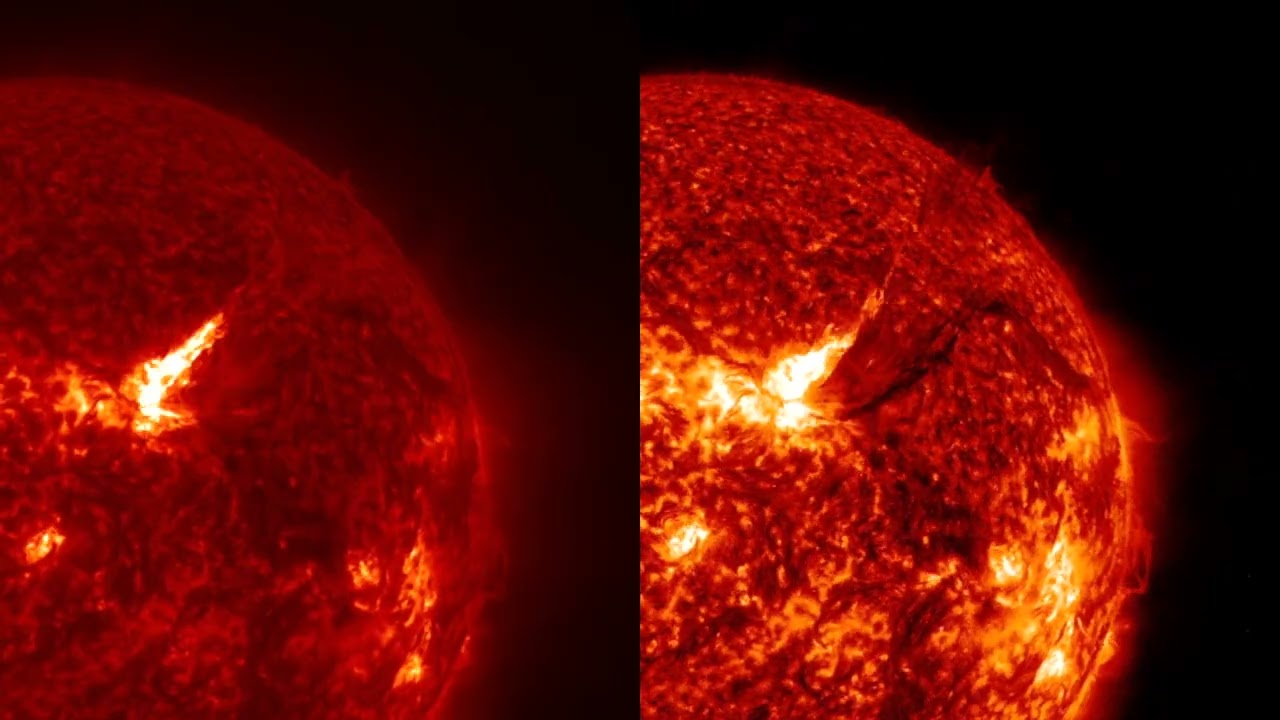
Solar Flares and CMEs at Earth - More Likely | S0 News June.3.2026
SpaceWeatherNewsS0s
2K views•2026-06-03



