Photothermal conversion uses light-absorbing materials (like carbon black or cobalt catalysts) to generate localized heat that drives chemical reactions, enabling spatial and temporal control over organic synthesis, polymerization, and depolymerization processes. This approach can achieve high yields in plastic recycling by converting waste polymers back to monomers using sunlight, and can facilitate challenging reactions like SNAr and C-N bond formation without traditional heating methods.
Install our extension to search inside any video instantly.
ACS DOC Webinar
Added:to answer.
Um, but anyways, we have a really exciting lineup of speakers for you today. However, before we get to the speakers, as always, we have a few announcements from the division for you.
So, as some of you may be aware, the ACS fall is coming up quickly. It's taking place in Chicago. Um, so that's August 24th to August 27th. Uh, and the division, as well as our glorious program chairs, have been really working hard to prepare some really great symposia and award talks for you. So, if you are able to attend, I highly recommend you check out at least some of these incredible lectures.
In addition, the graduate research symposium is quickly upcoming. So, that's taking place in about a week at Emory University from July 23rd to 26th.
Uh, and if you're fortunate to attend, there's a really great lineup of speakers there as well, as depicted on the slide.
Um, lastly, the Amos Smith Award, which is a new award from the division, uh, is calling for nominations.
So, the deadline for nominations is September 15th. Uh, the awardee will be presenting at the NOS, uh, taking place at the University of Minnesota in July of 2027.
Um, so if you know of anyone who meets the criteria, uh, please submit a nomination. Uh, the link is provided at the bottom of the page, as well as through a convenient QR code. So, we're looking forward to the nominations.
And on that note, I am very excited to introduce our first speaker, Aaron Walsh, who's an associate professor at Princeton, um, who will, as you will come to find out, has had a very interesting journey, uh, getting to where she is now. So, as I find found out reading her website, which is very informative by the way Erin, prior to coming to Princeton, Erin conducted graduate work at Colorado State University, but being unsure of whether she wanted to pursue academia or industry, Erin left and worked for a year at a local pharma company.
Following this, she moved to California and worked in a laboratory focused on materials engineering for aerospace and automotive applications. So, you know, pretty diverse scope of work there.
This experience ultimately convinced her to return to academia and finish her PhD.
After her PhD, Erin conducted her post postdoctoral work with Professor Brett Fors as one of the inaugural presidential post postdoctoral fellows at Cornell.
Today, Erin's research group is focused on advancements in efficient synthesis and polymer utilization.
Thank you for dedicating your time today, Erin, and presenting at this forum. We're really looking forward to your presentation.
>> Thank you so much for that kind introduction.
Surprising, I didn't even know I had all that on my website.
No.
>> That was very helpful, so.
>> All right.
Share screen. Here we go. Can you see my slides?
>> Looks perfect.
>> All right, great. Well, thank you so much um to the organizing committee for inviting me to give this uh seminar. I haven't given a talk in a really long time, so I'm a little bit nervous.
Um but I'm really excited to tell you about what we've been working on um throughout my independent career for about the last 6 years. I changed my title, so I'm going to talk about photothermal conversion uh and how it's applied to organic synthesis.
And so, photothermal conversion is sort of exactly what it sounds like. Um it's converting those photons of visible light into energy, thermal energy that you can and use to drive chemical reactions. And so very simply, you imagine radiating particles or dyes that can undergo photothermal conversion.
They'll take that light energy, convert it into heat, and then near the surface of that particle or dye, it's going to be very hot, and that heat will diffuse away into lower temperatures as it moves away from the surface. So there's been a number of research works done in this area. Ben Lear, Thor Clark, and many others who have sort of pioneered some of the early work specifically identifying photothermal conversion particles.
And we can think about photothermal as compared to conventional organic heating. You know, when you run a thermal reaction, right, you program in a temperature, and that'll go at a certain rate constant based on the temperature and the thermodynamics of the reaction. A photothermal conversion is somewhat unique in that only near the surface of the particle where you have sufficient energy to drive a chemical reaction. And so you'll have a very large rate constant near the surface, and this will diffuse away as you move away from the particle.
This should allow you to achieve spatial and temporal control over the reaction and achieve much cleaner product distributions as opposed to just bulk heating.
This, if you think about how this is working, you can increase the population of your reactive species such you can now overcome the barriers for uncatalyzed reactions. Typically, we use catalysis, we're trying to actually overcome some of these barriers not using catalysis, just using this introduction of photothermal heating.
But there is some reactivity considerations that we have to take into account. Specifically, when you have this local phenomenon, you need to have your reactive species near the surface of the particle in order to take advantage of that thermal energy. And so if you're thinking about intramolecular versus intermolecular reactions, you have very different reactivity principles you need to consider, and I'm going to talk about these through each of my different stories today and how we think about using photothermal conversion from anywhere from polymer synthesis, depolymerization to small molecule organic reactions.
So first I'm going to talk about polymer chemistry, then eventually I'll I'll end on some synthetic chemistry, synthetic organic chemistry.
So polymer architectures, advanced polymer architectures are all achieved through controlled radical polymerizations. And these are really important for a number of applications, um, anywhere from viscosity modifiers to a lot of biomedical applications. We like to have good control over, um, the polymer so it can take on these different properties and make these different materials.
And so, one way to achieve controlled radical polymerization is through atom transfer. Right, so you're just transferring, um, a a deactivating group off of your polymer chain so you can control the radical concentration and avoid side reactions like radical radical coupling.
And so, you can do this with a number of different metals. Um, we are specifically interested in cobalt. So, you take a cobalt two metal with an alkyl halide. This will reduce the alkyl halide to generate a propagating radical which can then make polymer. And then a cobalt three dormant species. And then you control this equilibrium, um, by the cobalt catalyst and the alkyl halide that you're using so that you have more of these dormant species rather than, uh, having a high radical concentration.
So, you control this, um, dissociative exchange of the halide.
And so, this can look like a catalytic cycle. Cobalt two activates a polymer chain. You generate your propagating radical. And then cobalt three can, uh, regenerate the dormant state. Now, there are some other considerations. Like I mentioned termination. So, if you have too high of a radical concentration, you get to these dead polymer chains and you'll build up cobalt three concentration. So, you need to find a way to convert cobalt three back into cobalt two.
Uh, and so, when we started in this area, we were looking at vitamin B12 derivatives uh, as a potential way to use biocatalysts to control radical polymerizations. And so, we came up with this, uh, HMB cobalt catalyst.
And when we reduce this from cobalt three to cobalt two, this can reduce the polymer chain to generate our propagating radical. And as I showed before, this propagates with vinyl monomers and generate your polymer chains and, um, close the catalytic cycle by uh, oxidizing the chain and reinstalling that bromide. And so, there's a a small thermal barrier for this activation event. We run this reaction about 60° C.
Um, we found that we could use a variety of different alkyl halides as the initiator and we could use very low cobalt catalyst loadings, which is good cuz vitamin B12 is not uh the cheapest catalyst.
But in thinking about making advanced polymer architectures, one um area of research to consider is photo-controlled polymerizations. So you can get spatial and temporal control over your um three-dimensional architecture. And photoredox catalysis has been used before to activate these polymer chains, use a highly reducing photocatalyst in its excited state, and you can generate your propagating radical and then recap the polymer chain just like I showed you before.
And so we thought that with this cobalt catalyst um having this corrin uh core having been used in other types of photoredox processes before, we thought that maybe this would engage in a photo-controlled radical polymerization.
And so when we turned on the light, use white light LEDs, we found a very well-controlled polymerization, converting about 50% of the monomer, low dispersities, and good initiation good initiation efficiency suggesting that um our initiator is starting one polymer chain.
And notably in the dark we don't see any polymerization, uh very low conversion of the monomer.
But when we turned to our colleagues to understand the photophysics of this process, uh Daniel Blinsky ran some transient absorption for us, and what he found is a metal-to-ligand charge transfer event, uh not unexpected, [clears throat] but was what was un- which was surprising is that there was a very rapid back electron transfer. So 4.6 picoseconds, which is not long enough to um engage in bimolecular chemistry.
And when we add in alkyl halide and run the same experiment, we see the same excitation. We also see a very rapid back electron transfer, slightly longer, but still not sufficient for um uh doing that excited state uh reduction. And we observe no excited state quenching of the alkyl halide with the cobalt complex.
So we propose that this is actually undergoing photothermal conversion. So rather than excited state chemistry, um in the dark or at room temperature, we have a cold catalyst, it's very slow activation, we don't see polymerization, but when we turn on the light, now we're generating these thermal gradients as the heat is released from the catalyst, and this will result in fast activation, so that we can promote our polymerization with good control.
And rapid polymerization. So, this is a photo-controlled activation, but it's through a thermal process. So, we can still get that spatial-temporal control that you love from photo-controlled polymerizations, but it is still a ground-state thermal reaction.
More evidence that this is a photothermal process. We doped in larger concentrations of the cobalt catalyst in the absence of monomer, and we do see a temperature increase when the light is on. So, there's a background increase of about 2° but as we add in more and more cobalt catalyst, you generate more heat, and the reaction mixture warms up.
So, you see some IR camera here.
>> [clears throat] >> At the beginning of the reaction, it's a little bit cold here in Frick, about 20° C, and then after some period of radiation, you can see that the vial has warmed up when it has a cobalt catalyst.
And we compare this to a standard iridium catalyst like iridium PP2, which we would typically use for a photo ATRP process, and you don't see any bulk temperature increase here.
And that's because it's undergoing photoluminescence, it's giving off light, it's not giving off heat like our cobalt complexes.
And when we really blast it with photons, you can see we can actually boil the solution. The cobalt catalyst has generated enough heat that it's boiling the monomer. This is not active polymerization, this is just showing that the catalyst is getting hot.
Uh we showed that this will work with a number of different wavelengths, so anywhere from broad-spectrum white LEDs, UV to red. Um you see pretty similar end polymerization results, although the kinetics are a little bit different, so if anybody's curious, we can talk about that a little bit more.
We can use very low catalyst loading, so down to 0.2 mol % and pretty good um still control over the polymerization.
And most excitingly, we show that we have temporal control. So, only polymerization only occurs when the light is on, we turn it off, polymerization stops, so on and so forth.
And where this is really important and how to contrast this is through the thermal polymerization. So, when we first developed this chemistry, we used AIBN um to introduce a few radicals into the system. And so, you have to run that reaction at elevated temperatures.
And so, you can turn off the heat, but that doesn't stop the polymerization because the bulk temperature is high.
And so, the polymerization continues to proceed slowly until the bulk temperature gets low enough that it will shut down. This is in contrast to our photothermal process where you see the polymerization stops immediately when the light is turned off. And that's because the bulk temperature is very low. It's only warm near the catalyst surface.
And regardless, in both systems we achieve very good control over the polymerization.
So, thinking about this from photothermal conversion perspective, how do we interpret um these results? We're running this reaction in solution, so you might think that the catalyst will generate this heat, but that most of that heat would be lost to the solvent, and you wouldn't actually see productive chemistry.
And so, what we think, especially when you're running these reactions in solution, you need to have a very good association between your substrate and your photothermal catalyst, in this case the cobalt. And so, what we think, with the transient absorption spectroscopy data, when you see that longer excited state lifetime in the presence of the alkyl halide, we believe that's because it's associating to the cobalt catalyst such that when it's hot and it's able to activate the alkyl halide, it is in proximity, and you get very efficient thermal transport and electron transfer.
And in a different system where you use a thiolate ligand, you can actually see a shift in the UV-Vis absorption spectrum when you add in the alkyl bromide, suggesting that there is this pre-association pre-association of the initiator to the cobalt complex.
Okay, so that's the polymerization that I was going to talk about. I'm going to move on to a lot of the work that we do in depolymerization. So, I'm sure you all are well aware of the plastics crisis that we're facing.
And so, many of us have put a lot of effort into um converting the carbon content that's lost in plastic waste back into useful products, uh sometimes other commercial products, but um very commonly trying to convert chemically recycle it back into the monomers so you can continue to make virgin polymers.
And so, the reason this is so challenging for most of our commercial polymers is that polymerization is very enthalpically driven. You're going typically from a vinyl polymer into a long-chain alkyl backbone, and so all those polymerizations run downhill. And so, in order to reverse that process, you need to put in a lot of energy. So, for polystyrene, for example, when we think about polymerization at room temperature, um we we start up here and we end up uh way down here when we make the polymer.
But, of course, there is an entropic penalty for stringing all of these monomers together. And at a certain temperature, called the ceiling temperature, the rate of polymerization and depolymerization becomes equal. And so, you have equal populations of these species.
So, if you want to drive depolymerization, you want to make the monomers more stable, you need to get well above the ceiling temperature so that Keq is much less than one. You can drive depolymerization, recover those monomers, and then make more polymer.
You can imagine for vinyl polymers, this number is very large. So, there's a huge energy input. For polystyrene, the degradation temperatures, that's to break the carbon-carbon bonds of the backbone, is about 350°C.
And then, the ceiling temperature for polystyrene is about 400°C. So, that's the temperature you need to achieve to induce depolymerization back into the monomer. So, for context, polystyrene pyrolysis, when it's done commercially, is typically done about 500°C to get efficient depolymerization. You still get um a mixture of coke products as well from uh degradation.
So, we need to break the carbon-carbon bonds in a very efficient manner, and we need to maintain these high temperatures for depopagation and try to avoid all of the side reactions. And so, we thought photothermal conversion would be an ideal um strategy for inducing depolymerization.
And so, carbon black is a very common photothermal agent. Um it's been used in a number of different applications, and it's incredibly cheap. And notably, it's used a lot in the plastics industry. So, if you think about all the black plastics that are out there, most of these are going to be formulated with some type of carbon black. It's a very efficient photothermal converter. It's essentially a black body. All of that light gets turned into heat.
And so we thought this might be an interesting strategy for trying to depolymerize these commercial plastics.
Interestingly, black plastic recycling is nearly zero because it can't be sorted very efficiently until recently.
And so all of this material ends up in the landfill.
And so this work was all carried out um by Seywan Henning and started by Leah.
And when we started, we wanted to have a very controlled system. And so what we started doing is synthesizing polystyrene with carbon black incorporated. So we actually used carbon black in the synthesis. So we made these polymer composites and then we exposed them to white light radiation under vacuum distillation so that we could recover the styrene monomer and quantify these other byproducts.
And so what we found is that without any carbon black, you don't see anything.
The light is not enough to activate the polymer backbone.
And as you start to increase the carbon black loading, you see pretty efficient depolymerization, almost 60% yield of the styrene monomer. Dimer and trimer are very common byproducts from depolymerization. So you can see a fair amount of those and then a small amount of leftover polystyrene. And here's just a video to show you um how this depolymerization works. We just have the vial of black powder sitting above the light and then you will see very quickly as the light is turned on, we generate those thermal gradients, it breaks those carbon-carbon bonds, generates monomer, and all of that moisture coming up is the monomer being pulled off.
So it's very fast and very efficient.
And as I mentioned before, carbon black is used extensively in the plastics industry, up to 40% sometimes in composites, even higher. And so we found these eight different polystyrene containing products. They're not all pure polystyrene, they have other materials, um fillers, and other polymers in them, but all of them contain what is likely carbon black. All of them contain some polystyrene. And we did not add anything to these samples. All we did is cut them up in a smaller pieces, put them in the vial, and shine the light. And we're able to recover the monomer using the um formulation that uh already in these products. And very um comparable yields to to somewhat more modest yields. So, we're very excited that we could just directly depolymerize plastic waste and recover the monomers.
Now, of course, we're still plugging into the grid, right? Using electricity to power our LEDs. And so, we questioned whether or not we can use sunlight, which is obviously our most renewable resource. And so, if we focus the sunlight using a Fresnel lens, uh with pure polystyrene, we don't see any depolymerization. But when we do this with the black polystyrene foam, in just 5 minutes, we see 80% yield. You can see this is much higher than even the yield we can get with the LEDs. I think this is because of the higher solar intensity, we're getting much um hotter and therefore depolymerizing at a much higher efficiency.
Now, the nice thing about this approach is that you don't need to have the carbon black directly incorporated into your plastic. You can take a mixture of black plastic and non-black plastic and still get depolymerization of the entire species. And that's because the carbon black isn't being consumed, right? It's just getting hot. It depolymerizes everything around it, and then as it comes into contact with um this clear plastic, it's able to depolymerize that.
So, even at 25 weight percent of black plastic and 75 weight percent of clear plastic, we still get over 40% yield with our LEDs, and with sunlight, we're well over 60%. And we can take a whole mixture of different um polystyrene products that we can get off the street or um after we use the the materials, and we can get up to 70% yield using sunlight.
So, this is a different situation in how we're thinking about photothermal conversion. Instead of running a reaction in solution, now we have a solid-state reaction. So, we have our polymer mixed in with carbon black.
Because it's a low-mobility polymer, it's high molecular weight, it can't diffuse away from the carbon black even when it gets hot, and so that heat is efficiently transferred to the polymer, breaks those carbon-carbon bonds, and then it generates monomers, which are high vapor pressure, which are moved away from the surface of the carbon black, so we don't see depolymerization.
And so, photothermal conversion is ideally suited for depolymerization of commercial plastics.
But, of course, there's still some issues here. Um how do we incorporate the carbon black into the polymer? Sure, some uh polymers have black plastic, um but others you have to incorporate carbon black in some other way.
The surface area of irradiation, I often get questions about scale-up. Pretty challenging in this system to get an efficient scale-up. And of course, if you're using carbon black, you're going to have this build-up over time, even if it comes in the um black plastics.
And so, we teamed up um with a colleague here at Princeton, Professor Craig Arnold in mechanical and aerospace engineering, and they were looking at porous carbon materials derived from egg white um to for a number of different applications, but one of them was for filtering polystyrene microplastics, which was pretty successful. And so, we hypothesized that this carbon is likely photothermally active, and we could depolymerize microplastics or potentially even more commercial plastics.
And the idea now is that you would have this highly porous carbon material, the polymer would sit on the surface, and as the carbon is irradiated, the polymer will melt and infuse into the pores, and then induce depolymerization. And the monomer could either come out the side the polymer's going in, or if you could uh develop a flow setup, it could come out the other side.
And so, now you have a very high surface area of photothermal material, you have a reusable scaffold, and you can imagine scaling this in some type of flow setup.
All this work was carried out um by Dr. Jang.
So, this is uh some photographs of the carbon material. You can see after 1 minute of irradiation, the polystyrene that was sitting on top is now sort of melted and infusing into the pores after 3 minutes, and then after 10 minutes and 20 minutes, most of the polymer is gone.
Some SEM image SEM images also show this. The polymer's sitting on the surface, and then after longer reaction times, the polymer is depolymerized, and we can recover all the monomer. We can also reuse this scaffold up to five times without any loss of uh efficiency.
Nice thing about this system in photothermal conversion in general is that it's very polymer um promiscuous.
It can work with a number of different materials. So, polystyrene, 64% yield, MMA, and then we can also um perform ring-closing depolymerizations.
So, polycarbonates or polylactic polylactide in high yields. PET, we can add an ethylene glycol and now we can depolymerize this and recover 96% yield of this potential monomer.
Again, this works on commercial samples.
It's very important for us to try our chemistry on commercial materials. And so, with Styrofoam or other different polystyrene-containing products, we get very high yields. And in this case, all we have to do is put the plastic on top of the carbon, we radiate, and it all depolymerizes.
Works with Plexiglas, a number of different PLA samples. Uh this one is kind of interesting, this plastic bag.
So, it says PLA on it, um but if you actually take an NMR and analyze it, it's like less than 20% PLA. It's other uh probably polyesters.
Um so, when the plastic says it's a certain polymer, all it means is it contains a little bit of that polymer.
It does not mean that it is actually um primarily composed of that. So, good to know.
Uh and then PET, a number of different plastics. So, water bottles, we can even take some of our lab trash. Uh so, some of our solvent containers and and depolymerize that. And then polycarbonates um also work really well.
And here's the another video to show how simple and easy this process is. You can see down here, this is the porous carbon, and this is just a little chunk of Styrofoam in the bottom. We turn on the light, and the Styrofoam just sort of melts into the carbon, and then you can see the vapor rising as the monomer is generated.
Um Oh, let me go back to that. And so, in this I'm not going to show you the the scale-up, but we were able to scale this process up to 10 g, uh much more efficiently than we could with pure carbon black. And we use, I think about a tenth the amount of egg white uh by mass as we do in carbon blacks. This process is very um exciting for potential scale-up applications.
Okay. So, moving on to some small molecule chemistry, um carbon black or photothermal conversion is not unique to polymer applications, polymerization or depolymerization. You can also imagine using this for high activation barrier uh reactions.
And so, we applied this to the Newman-Kwart transformation, a classic reaction converting >> [clears throat] >> phenols into thiophenols um through a unimolecular rearrangement.
And so, we take our starting material, we mix it with carbon black, so you get this little powder.
We radiate it for up to 40 minutes, just set it on top of the light, and you get your product in nearly quantitative yields, and all you have to do is filter off the carbon black at the end. And so, this is a very simple, efficient way to run a reaction at about 300° C instead of using oil bath or sand bath, you just have this powder and you radiate with light for a few minutes. Um very rapid conversions across the whole gamut of substitutions here. We can do very electron-rich and very sterically hindered um Newman-Kwart substrates, and we can choose the product distribution depending on the wavelength of light or the intensity of light that we use. And I'll talk a little bit about that in the in the future reaction here in a second.
And this work was all carried out by I got to update this slide. So, now Dr. Megan Mather, uh one of my former PhD students.
Of course, the Newman-Kwart was a great demonstration, but we wanted to move on to more challenging like bimolecular reactions. And so, of course, C-N bond formation is very important for pharmaceutical applications and agrochemicals, um found in all these top 200 selling drugs, of course. Typically, this is done through transition metal catalysis, Buchwald-Hartwig coupling, uh longer reaction times, expensive ligands, higher temperatures, etc. And so, we wanted if we could use photothermal conversion to forge these carbon-nitrogen bonds in the absence of transition metals and using photothermal conversion, so we can uh achieve this under ambient atmosphere and in very rapid time frames. This work was carried out by Megan, uh Rory, and Kristina.
And so, we thought we could achieve this through a an SNAR reaction. Classic reaction, typically a two-step uh process. Nucleophile adds in, forms a Meisenheimer intermediate, and then elimination of the fluoride will give you the coupled product.
Of course, this is usually restricted to aryl fluorides and very electron-withdrawing substitutions. So, typically nitro or multiple nitro groups.
Now, more recently, a concerted SNAR has been probed um computationally and experimentally, where instead of going through the Meisenheimer intermediate, you go through this very high uh transition state energy species, and we are making and breaking the bonds in one step, and you get to your um desired product. So, it's a concerted pathway, and it expands the scope of electrophiles to chlorides and bromides, and you can use more electron-donating substitution, which of course would expand our um plethora of CN bond-forming reactions.
And so, we started out with this uh bromotrifluoromethylbenzene.
Typically not used in SNAR reactions.
CF3 is not uh activating enough, and it's thought to go through a concerted pathway. Using piperidine as a nucleophile, DBU as a base. Use red light, um mild intensity, and some carbon blacks. This is a heterogeneous, solventless reaction.
And we can achieve the coupled product um in 20% yield in just 2 hours of irradiation.
Now, for context, if you want to run this reaction thermally to achieve a comparable yield, takes about 180°C in an oil bath.
And if we want to get to uh near 100% conversion or yields, we can run this reaction for extended time periods.
Now, we often get questions on how do you think about light intensity and um temperature? We're still working on this. We don't have a full answer yet.
But, here's just a plot of light intensity versus reaction yield for this particular reaction. You can see with lower intensities, this is a shorter time frame, um you don't see any yield, but as you increase the light intensity, you're increasing the temperature at the surface of the carbon black, and so you get a higher yield to get more productive reactivity.
Now, if we try a more challenging intermolecular reaction, so if we go with this three-bromopyridine, now we basically don't see any reaction.
We get very low yields even with extended reaction times.
We can increase the intensity, so if we double the nearly double the intensity, we do start to get some yield in just 30 minutes, but we see a lot of dehalogenation of the pyridine, and so we don't get productive chemistry.
And so this was interesting to us since we wanted to look at this computationally, and you can just look at the activation barriers, and they're very different, right? This is a more activated substrate versus a three-bromopyridine, and so maybe if this can be explained um just by the difference in activation barrier.
But if you um do the computations, that doesn't actually pan out.
And so we wanted to find a comparable activation barrier, but with an intramolecular substrate. So we tethered this amine to this uh bromobenzene using similar reaction conditions. Now we can get productive chemistry in just 5 minutes. We get 33% yield of the intramolecular reaction, even though um we have a similar activation barrier.
And so this gets to the point of intermolecular chemistry and using photothermal conversion.
So as you get closer to the photothermal agent, the probability of colocalization is going to be very very low.
And so for an intramolecular reaction, this doesn't really matter. You'll get enough stochastic interactions with a photothermal agent. As you get close enough, you can promote the reaction, and there's no problem. But the intermolecular chemistry, as you get very close to the photothermal agent, you're going to have zero probability of uh seeing a productive reaction because the entropic penalty for bringing those two things together at such a hot temperature is near zero. Um so you have this sort of sweet spot in the distance of the photothermal agent where you can actually do productive intermolecular chemistry with these high activation barriers.
And so this is one of the challenges we're facing um in in promoting this chemistry.
So one way to overcome this challenge is to do a sequential SNAR process where we first do an easier SNAR that can occur further away from the photothermal agent.
And then, um, a second SNAR into the less activated position.
And so, if we have, uh, this diamine with this, uh, halogenated pyridine, we first activate, we first couple at the less activated, at the more activated position, the two, uh, position. And then, a second SNAR into the less activated less activated position now from an intramolecular substrate gives us a desired product in high yield. We had excellent chemoselectivity, of course, for the more activated substrate, and we only see reactivity at the three chloro, uh, position because of this, um, intramolecular nature of the reaction.
These types of, uh, sort of interesting heterocycles they map on well to different pharmaceutical agents, and we can do this with a number of different nucleophiles. Um, we can do pyrazines, which are much more activated.
Um, we can use other types of, uh, diamines.
You can also use, um, sulfur nucleophiles or a mixed nitrogen-sulfur nucleophile to make larger rings, and we can even do this quadruple SNAR reaction, um, in modest yield. We sort of get to these all these interesting heterocycles, um, using this method.
But, of course, this doesn't really overcome the problem. How do we access these high barrier bimolecular reactions when we have this challenge, um, of trying to colocalize our reagents near the photothermal agent when it's hot enough?
And so, the way we overcame this in in the stories that I've shown you so far, um, one, we basically had an inner-sphere electron transfer from our cobalt catalyst to our alkyl halide such that we could promote polymerization.
And so, when the catalyst gets hot, when it's irradiated, the halide is in proximity to receive that electron, and then, um, that can go on and and react to make the polymer, uh, away from the photothermal agent.
Um, the polymerization, we have the solid-state polymer, and that's near the surface, and so, that can, um, easily depolymerize. What we really need to have is substrate proximity to our photothermal agent through some sort of non-covalent interaction or a transient covalent interaction. So, how can we have our two biomolecular substrates come into um contact with the photothermal agent when it's a radius so we can have productive chemistry.
And so, one way we're demonstrating this is through a decarboxylative uh ketonization reaction.
And so, we take two carboxylic acids with our catalyst that's unpublished so I don't have to have this down here. Um red light and we generate this intermediate and through decarboxylation we get to the desired ketone.
This is all work that's been done um by a rising third-year graduate student Amory. This is actually a pretty old reaction. So, ketonization has been around for a long time. It's how we used to make acetic acid or acetone from acetic acid. Uh typically, industrial processes this will occur well over 400° C but at least over 300. A lot of gas phase chemistry, um very poor cross-selectivity. You imagine there's an opportunity here to make non-symmetric ketones and use a lot of designer catalysts.
And so, in this case what Amory's been able to show is that we can take a number of aryl carboxylic acids with this alkyl carboxylic acid in just 1.3 equivalents. So, I'm not in a major excess. We use our charred catalyst and we get to our cross-coupled product in very high cross-selectivity. You see here, yields are often um you know, very high with different substitution. Um can tolerate heterocycles.
Um both uh furan and thiophene.
Um and what's sort of interesting here is is one of the byproducts we'll see in these lower-yielding reactions is decarboxylation. So, the carboxylic acid the aryl carboxylic acid is decarboxylated near the surface of the catalyst.
And we're able to overcome that by going in with the ester instead. And so, we have very slow hydrolysis over time to generate the carboxylic acid. And so, we use a more bulky ester, we can actually improve that yield from nothing um up to almost 50%. This works for other types of heterocycles where decarboxylation is more prominent um in very electron-rich substrates as well. And so, we're continuing to work on this if we can make a um, in situ ester formation followed by uh, coupling. So, we're pretty excited to show that in this case, what we think is happening in the carboxylic acids are coordinating to the main to the catalyst surface such that you can induce um, the desired reactions. That's how you're bringing your two substrates into the photothermal agent and engaged in in productive chemistry.
And so, with that, uh, hopefully I've shown you that we can use photothermal conversion for all sorts of manner of organic reactions, polymerization, depolymerization, and now even some intermolecular uh, coupling reactions.
So, I just need to thank the group. It's a very new picture. Um, I didn't highlight everybody's names, but hopefully I highlighted them throughout the talk. Uh, great group of people to work with. They do everything. I'm very secondary to the process. Uh, thank all of our funding sources, and thank you so much for the invitation and for all of your attention. I'd be happy to take any questions.
Oh, hi, Alex.
>> Hi, everybody.
>> Made it.
>> Yeah, thanks so much for a great talk, Aaron. Um, for everyone who's in attendance, if you have a question, there's a Q&A box at the bottom of the screen. If you could please input your questions there, uh, and we will read them out.
I guess in the meantime, Aaron, I have a question, and I apologize if you addressed this, but with the um, depolymerization of the plastics, mhm, um, the products that you're getting out, like if you were to use this like a as an industrial approach to, you know, decompose plastics, um, would you isolate all of those different components and then reuse them? What's like the idea there with that?
Yeah, that's a great question. Um, so, one of the things you want to achieve in any sort of recycling process is to get a very clean product stream. Um because isolations and separations, right?
That's a whole 'nother ballgame in in energy costs.
Um and so what we've shown with polystyrene is based on boiling points.
And this is how they do this in industry. They kind of separate things based on boiling point. And so you can get clean polystyrene to come off, collect it. Sometimes there's special um purification things that it go goes through. You can get pure styrene monomer and then you can repolymerize it. Um what we've shown we've shown that we can collect the monomer and repolymerize it and get similar products.
You know, in the case of sunlight when we really only get styrene a little bit of dimer and trimer, I think you could just repolymerize that and and make more polystyrene. But my guess is industry would not like um that, you know, question of of purity in that case cuz you might get a few, you know, side chains or something like that, which could change the properties a little bit. But Yeah, but that that's definitely one of the things we're trying to accomplish is get very good very high yields of of a single product so you don't have to worry about separations.
>> Yeah, very nice. That uh the video you shared was really cool. Um how fast is that? Is that like a uh a sped up video or >> Yeah, it is a sped up video. Um but it is still very fast. Um the the sunlight experiment, I mean it really only takes 3 minutes and the the polymer's gone.
It's all monomer. Um with the LEDs it's a lower intensity and so it takes a little bit more. They're they're unfocused, you know, broad spectrum LEDs. You can get them off of Amazon. Um and so there's definitely efficiencies we need to make up, but they're they're still pretty fast compared to, you know, getting out your sand bath and waiting for it to heat up and and all that, right?
>> Yeah, very cool. Uh Alex, you got a question?
>> [snorts] >> I sure do. Aaron, a really lovely talk.
I I very much enjoyed all of it. I missed I think only the first slide or two. Uh so it seems really simple and and practical.
So question one, is there anything special we need to know about the charred catalyst or the carbon black if this were to be attempted to be used by somebody outside of your laboratory?
>> [sighs and gasps] >> Not really. We've looked at different carbon containing materials and so far we don't really see much of a difference. That's definitely something we want to look into, right? Especially when you're you know this last part that I talked about getting association between your catalyst and substrate. The surface chemistry is going to be really important. But if you're just trying to do you know bulk heat transfer, especially intramolecular reactions, you just toss in any carbon black and it'll work.
>> Okay, so the the bottle from Aldrich in the laboratory already >> We use it from Alpha, but yeah. Yeah.
>> Okay. I'm sorry, what? Where are you?
>> Oh, ours is from Alpha, but >> Alpha, okay, great. So regarding that last project that the the dimerization of the two different carboxylic acids is there any involvement of like a pre a pre-organization of the two carboxylic acids that brings them together like a temporary temporary intramolecularity that's being taken advantage of?
>> Yeah, so the the reaction is thought so it's with all these different metal oxide catalysts reaction is thought to proceed through first absorption of the carboxylic acid to the surface.
And then you know you you get the coupling reaction. Now it's not it's still unclear why we're getting such good cross selectivity. But it makes sense that the aryl carboxylic acid can't couple with itself because you need to do that enolization.
But it's not clear why the aliphatic acid is not coupling with itself and you're getting sort of a statistical mixture. And so that we're still trying to investigate if there's just a stronger association of the aryl carboxylic acid to the manganese catalyst surface.
>> [laughter] >> And and what's sort of driving that that product selectivity. So that's still under investigation, but it is thought that we have the two partners come together at the catalyst surface.
>> Okay.
Great, really interesting. Thank you so much.
>> There is one question from the chat.
>> Sure.
>> Rebecca asked "Any ideas on how to apply this to destroying microplastics?"
>> Mhm. Yeah, that was one of our ideas with the porous carbon material. Um, yeah, if you essentially filter the microplastics into the carbon and then you could just irradiate it and then depolymerize the microplastics. And so I think that is a potential um, strategy. We pursued, you know, more broad applications to commercial plastics, but I think if you just collect the microplastics in the forest structure, irradiate it and then you could just get the monomers back.
Uh, we haven't seen, I mean, we haven't looked at microplastics in particular, but we haven't really seen much of a size effect, particle size of the polymer in depolymerization, so I um, would imagine that microplastics would depolymerize just as well.
>> Thank you. Mhm.
Um, all right. If you could all join me in thanking Aaron one more time for a really great presentation. Uh, in keeping with time, um, Alex, I'll turn it over to you to introduce our next speaker.
>> Great. Fantastic. Thank you, Alex.
>> [clears throat] >> Okay, our next speaker for today's virtual symposium is Professor Mark Taylor from University of Toronto.
Um, Mark, it's a pleasure to meet you. I I've I've never met you in person, so I'm looking forward to hearing about your science and having a small chat with you after this.
Um, ma uh, Professor Taylor's background includes uh, training uh, at University of Toronto as an undergraduate, um, PhD work at Harvard, postdoctoral uh, a postdoctoral fellowship at MIT, and uh, and 2007 he began his independent career back at University of Toronto, so a bit of a homecoming for Mark.
Um, and he's been uh, at Toronto since moving through the ranks assistant associate and now a full professor.
Um, a few awards that Mark has received that I noted here uh include uh international awards as well as some local to his university uh Sloan fellowship in uh 2012, uh a Kitanio award in 2017, and has recently been recognized by University of Toronto uh as a Dean's Research Excellence awardee.
Uh so congratulations on all those very nice awards, Mark. Um, I think the overlying theme of Mark's research will be uh methods development and catalysis, and that work spans a lot of different types of chemistry um including carbohydrate chemistry and many other unique uh uh applications of his group's studies.
And with that, I think I'll turn the floor over.
Mark, it's all it's all yours.
>> Okay, thank you very much for the introduction, Alex. Great to meet you, and thanks for including me in this.
Let's see. Hopefully, that is sharing.
Hopefully, that uh looks okay to everyone.
Uh so yeah, it's really a pleasure to uh to be here today and to be able to share with you some of the work that that my group has been uh doing. I'm going to focus uh on a project involving uh thinking about how to reduce selectively functionalize uh amidine nitrogen nucleophiles. So, azole-type uh heterocycles.
Uh before I do that, I would like to start by acknowledging the students who uh who did the work. This is actually an older group photo, but I'm showing it because it includes the the really the two students who did all of the the work that I'm going to be sharing with you today. So here we have Shrey Desai. He graduated with a PhD from my group a couple of years ago and is now a postdoc at NYU in the Prez room group. So look out for Shrey. He's um he's really very talented young chemist. And the other key player in this work is Matthew Zambri who just recently finished drafting his thesis and will defend later in the in the summer.
This is really a project that went in a direction that I couldn't have anticipated and so it's really to the credit of the students for for for taking in in that in that direction. So I'll actually try to illustrate sort of how we ended up stumbling upon really this this question of how to regioselectively functionalize nitrogen heterocycles. I'd also like to thank the students who conduct sorry, the funding agencies and in particular NSERC for really sustained funding of our research program over the years.
All right. So as Alex mentioned in the introduction, we're involved in catalytic methodology development in a number of different areas and for many years have been focused on the question of how to control site selectivity in reactions of organic molecules. And this started out as very much a hypothesis driven project. We were hoping to take advantage of the molecular recognition chemistry of organo functionalizations OH functionalizations of carbohydrates. And indeed what we found is boron bonds and one BOH group will interact with cis groups in sugars to generate tetracoordinate adducts, which are then activated nucleophiles. So, they'll react selectively with an electrophile at a rate higher than that of a free hydroxyl group, allowing us for a selectively allowing for us to selectively monofunctionalize the carbohydrate and then turn over the organoboron catalyst.
Uh over the years since making this discovery, we've been thinking about other ways to take advantage of these kinds of complexations to do selective chemistry on carbohydrates. Uh so, I highlight here an example of selective Chan-Lam type uh couplings where we use the boronic acid as both the the aryl transfer reagent, but also as a transient protective group for the the uh diol group in the sugar. So, this allows us access to some interesting sugar-derived aryl ethers that would be difficult to to synthesize by other other means.
More recently, we've been thinking about how to use these kinds of coordinations to activate C-H bonds in sugars. And so, this takes advantage of hydrogen atom transfer uh chemistry. Uh so, the diol adducts generated from the boronic acids uh have activated C-H bonds. Those C-H bonds are more hydritic than prior to the the boronic uh condensation. And so, we can use this phenomenon to selectively generate radicals from sugars and then trap those to do homologations of the sugar backbone or uh redox uh adjustments.
So, while thinking about this chemistry of diols and organoboron compounds, we also got to thinking about what we might be able to do with epoxy alcohols as substrates. You can imagine that ring opening of a 2,3-epoxy alcohol in the presence of an organoboron compound would generate a species similar to what we get from direct binding of a diol group to, for instance, a boronic acid.
Uh and so, my student Kashif Tangri showed that this was indeed uh the case.
He was develop He was able to develop a number of interesting uh regioselective functionalizations of of 2,3-epoxy alcohols taking advantage of this kind of a opening uh and then subsequent functionalization mode. So, using for instance, benzoyl chloride, he could accomplish a chloro isolation of the epoxy alcohol. We conduct a similar reaction in the presence of iodide, we get iodide-induced ring opening, followed then by a semi-pinacol type rearrangement to expel the iodide.
So, iodide is is co-catalytic in these reactions.
Finally, if we move that hydroxyl group one carbon further away from the epoxide, we get a a different type of mechanism here. We get sort of a temporary intramolecularity type mechanism, where the boronic acid binds to the hydroxyl group and to the nucleophile, and then it delivers that bound nucleophile to the proximal position. So, we get C3 selective ring opening of these 3,4-epoxy alcohols, which is often a challenging outcome to to achieve. So, it's here that the that the azoles come in. In thinking about alternative nucleophile classes that we might be able to explore for this chemistry, we became interested in 1,2,3-triazoles and and other acidic NH azoles. They had similar pKa's to other nucleophiles that had been used successfully in this chemistry. And so, Shrey was able to to find that indeed this this worked in practice. So, you can see selective C3 selective ring opening of this 3,4-epoxy alcohol with with 1,2,3- triazole. So, so this was was sort of as we expected, but what surprised us here was the relatively high level of regioselectivity that we saw for functionalization of one of those two nitrogens. Of course, in 1,2,3-triazole, there are two possible regioisomers, N1 and N2 functionalization, and we saw very high levels of N1 selectivity. And this proved to be the case over a number of different ambident azole type nucleophiles, so including indazole, this triazolopyridine, purine, benzotriazole, substituted tetrazoles, etc. And so, this was unexpected. We had uh anticipated that we would get regi- uh mixtures of of regioisomers in these kinds of of reactions.
Uh and so Shrey turned to computational modeling to understand the basis for the selectivity. Uh and what he found is that uh one's able to rationalize these selectivities by invoking a coordination between the organoboron catalyst and the pronucleophile. So again, similar to what I showed you for some of the preceding work. And if this coordination is selective, then the adjacent nitrogen's the one that's activated, these seven-membered ring type cyclic transition states. Uh and through this selective coordination and then activation of an adjacent nitrogen, we can account for the regioselectivity that we see uh in these types of uh of processes. And so then again, the the utility of these compounds is they're somewhat reminiscent to acyclic uh nucleoside analogs that are quite an important class of uh of drugs.
But more broadly, we realized this is quite an important general challenge in organic chemistry, this issue of how does one regioselectively functionalize uh ambident uh azoles. Uh some of the interest in this problem stems from the fact that of course azoles are very prominent scaffolds in medicinal chemistry. So I'm just showing you three of really hundreds of of examples of such molecules that I could use to uh to illustrate this. Uh if we look at sort of wish lists from the pharmaceutical chemist uh chemistry uh colleagues on reactions that they that they would hope would be developed, you'll often see this question of site-selective or regioselective functionalization of azoles uh uh being highlighted as as a problem that's that's of sustained interest uh there.
Uh and so indeed, this is a problem that's really captured the interest of the synthetic community for some time, but in particular in recent years. So there are a number of really elegant strategies that have been advanced by the groups that I've listed uh below here. And again, And is this is not an exhaustive uh list. So, the question uh to us became, is this sort of a one-off observation, this special case of 3,4-epoxy alcohols, or is there something more general that we can take advantage of here in using coordination of an organoboron catalyst to an azole as a way to achieve site-selective NH functionalization?
Uh and so, of course, to do this, we started to explore other classes of uh electrophiles. Uh enones were one of the first classes that we that we looked at.
So, trying to achieve aza-Michael-type reactions. And I'm showing you here a catalyst optimization for uh N-alkylation of, again, this triazolopyridine uh pronucleophile.
So, what you can see is that using this ethanolamine ester of diphenylborinic acid, this is a very common precatalyst that we use. Diarylborinic acids are somewhat sensitive towards oxidation upon storage. One can uh protect them from [snorts] that oxidation by generating tetracoordinate complexes.
So, this ethanolamine uh ester is a conveniently handled white solid that one can store in the in the fridge without issues. So, when we use that precatalyst, we get relatively good yield and uh appreciable regioselectivity for the formation of the isomer that I'm showing you here.
What surprised us is that if we then generated the free diarylborinic acid and subjected it to the same set of reaction conditions as this catalyst, we now see very low yield. So, this this really did surprise us because, again, normally this ethanolamine is present just as sort of a a spectator uh to stabilize that precatalyst. Uh what we found is that by introducing another amine, so, for instance, benzylamine, we could restore the reactivity of that diphenylborinic acid.
So, you can see now we're getting, again, uh appreciable yields of that N-alkylation uh product. So, we think about this in terms of a mechanism involving activation of the enone as an iminium ion.
Uh and I'd say more broadly, what we found with this chemistry is that it tends to work best when the electrophile is a cation so that we can benefit from an ion pairing interaction with this anionic tetra coordinate organoboron adduct.
Um We carried out a number of mechanistic studies. I'm showing you here just some variable time normalization kinetic analysis that we did to show that it's displays first order kinetics in the concentration of both of the co-catalyst here. So first order in diphenylborinic acid and first order in in the benzoyl amine.
So just a couple of examples of the types of substrates that we can use in these selective azo Michael type reactions. You can again see 1 2 3 triazoles, purines, 1 2 4 triazole, benzotriazole.
In all cases we're seeing relatively high levels of selectivity for one of the two or more nitrogens that that that could react in the in these kinds of of systems.
One feature of this that I'll point out here and it's it's that's a general one in the context of this chemistry is we often see these sort of countersteric outcomes where the electrophile is introduced at what appears to be the more sterically hindered position of the heterocycle. So you can see here we're functioning as a functionalizing adjacent to this hexyl or aryl substituent in these substituted 1 2 3 triazoles. So I'll get back to to how we think about that in a moment.
This mode of activation of the nucleophile is compatible with transition metal catalysis for activation of the electrophilic component. And so I'm showing you here palladium boron co-catalyzed N-allylation reaction where the palladium catalyst is serving to activate an allylic alcohol towards pi-allyl formation and it's that pi-allyl of palladium electrophile that's capturing the boron complexed nucleophile to generate the the carbon nitrogen bond. So again, this is this is where Matthew came into the project.
And so I'll show you a number of other contributions that that that he made over the course of the rest of the talk.
So you can see here that this is a method that again applies to quite a broad collection of heterocyclic partners. Once again, you see these examples of contra steric outcomes where we're functionalizing what appears to be the more hindered position. The method is tolerant of highly functionalized partners, so we can use some of these free NH tetrazoles that are used as drugs. We can we can carry out selective functionalizations of the NH groups in those kinds of compounds.
This is also a useful method for activation of aminate NO nucleophiles.
So pyridones and related compounds present a regio selectivity challenge.
It's quite an important one I would say, and you can see that here we get selective N-allylation of a range of these types of of partners. So that chemistry is is outlined in this Synlett paper that I'm citing at the bottom of the slide here.
We're still I would say working to develop a full picture of what controls regio selectivity in these types of systems, but we have a basic computational model that often provides a useful starting point for how to think about this. And so what we're really considering in these calculations is the thermodynamic selectivity for binding of the boron to to two or more of the possible nitrogens along with the charge distribution in the resulting species. And so the charge distribution where we're determining based on the Mulliken charges at at each of those those nitrogens. So you can see for a simple case like this pyrazole, there's two possible sites of coordination. Of course, the nitrogen that's not bound is the one that's going to react. And so if we look at this at this uh this phenyl pyrazole, uh the calculations predict that this should be the more stable essentially boron tautomer of of this azole. And indeed, we see selective reactivity at the position that's that's indicated here.
Uh similarly similarly for this tetrazole, again two possible sites of of binding.
Uh it's this adduct that's the more stable one and and we would predict this nitrogen to be the the more reactive uh one. So again, this is an approximation that ignores steric effects in the transition state as we functionalize that that complex with an electrophile.
So for instance, in the second example here, the steric effects are likely to further favor the the the complex that I'm showing you here because we're going to activate the the less hindered nitrogen. We find though that this model does correctly predict the outcomes or at least correspond to the outcomes that we see in some of these counter steric cases. So here you can see this phenyl triazole case where we predict that the major adduct should be this one. It should selectively functionalize at the position adjacent to the the aryl group.
And similarly, these calculations give us the the correct outcome in terms of this triazole a pyridine uh adduct.
Right, diving a little bit deeper into the mechanism of this cooperative organoboron palladium catalyzed N-allylation reaction, we thought this was an interesting reaction to study mechanistically because we have these two catalysts that are working synergistically.
Uh so if you really simplify the mechanism, you can think about it as involving two steps. There is the ionization part of the mechanism, more than more than two elementary steps, but we can think about it as being sort of one one element of this this mechanism.
So the ionization step where we generate the pi allyl palladium from the palladium coordinated allylic alcohol, and then the CN bond formation step where the organoboron complex nucleophile reacts with the pi allyl palladium species.
A word about this ionization step, this we think is assisted by the acidification of the azole that accompanies binding to the organoboron catalyst. So, we calculate that the pKa drops by about six units upon coordination. So, then this acidic NH group can help us to to dehydrate this this complex to to result in the pi allyl palladium species.
So, if we think about substituent effects on the organoboron catalyst in this first step, the ionization step, the organoboron catalyst is acting either as a Lewis acid or perhaps you can think about it as adding acting as a Bronsted acid. So, in either of those cases we would expect electron-withdrawing groups to to speed up the ionization process. On the other hand, in the second step we're destroying negative charge as this nucleophile undergoes enalation, so we should expect the opposite in terms of substituent effects on aryl groups here. So, if we look at a Hammett plot for substituted arylboronic acids as our co-catalyst, we see indeed that has a positive slope. So, that really points towards the ionization step as being turnover limiting in in this process.
We did a number of other mechanistic experiments and computational experiments that I won't get into, but I did want to briefly show you the kinetics of this reaction, which are somewhat unusual. So, again we use variable time normalization analysis to to infer the rate law for this process.
So, I'm showing you here a plot that allows us to determine the kinetic order in the concentration of the palladium catalyst. So, we run the reaction at three different palladium concentrations, normalize the time axis for the palladium concentration raised to the power of one. Overlay of these plots shows us that that we have first-order kinetics in in the palladium catalyst.
That's useful information. You can get one other kind of information from this plot. So, if you look at the concentrations of product versus time or or normalized time axis, they're they're linear to relatively high levels of conversion. So, linear product versus time plots are telling us that we have an overall zero-order apparent zero-order uh rate law. So, that's uh not impossible. I'd say somewhat unusually in in in catalysis, uh but uh this was obviously something that we that we took from this experiment as well.
Nonetheless, we went on to determine the kinetic orders in the other species. So, if you look at the the order in the uh arylboronic acid co-catalyst, we actually see apparent zero-order kinetics in this species from concentrations ranging from 10 mol % to to 40 mol %. So, we're essentially saturating that that organoboron uh catalyst through through these concentrations.
Zero-order kinetics in the allylic alcohol component, again consistent with overall zero-order kinetics, but quite a surprising result when we look at the kinetic order in the in the triazole, in the nucleophile. Now, we see first-order kinetics in the triazole. So, this this is not what we expected. If the reaction shows apparent overall zero-order kinetics, we can't have a kinetic order in in one of the the reagents. So, we were quite taken aback by this and uh spent quite a bit of time thinking about what could cause such an observation and realized that what we were seeing here could result from an autocatalytic reaction. So, if the reaction is accelerated by the product, then the effects of first-order dependence on the starting material concentration could be compensated for by an accelerating effect by other product, giving what appears to be an overall zero-order uh rate law.
And so, this is indeed what we see. If we add increasing amounts of this N-allyl triazole product to the reaction, we actually see an increase in the rate of the reaction.
And if we analyze the kinetic order in the product, we see that that that we have first-order kinetic dependence in that N-allyl triazole product. So, again, the apparent zero-order kinetics that we're seeing are arising because of the compensating effects of first-order dependence on substrate concentration and product acceleration in the reactions.
Uh So, as I showed you before, ionization is the turnover-limiting step of this reaction. And so, I'm showing you here a calculated transition state for that ionization, right? We're cleaving the carbon-oxygen bond to generate the pi-allyl palladium.
And what we've been able to find is that this N-allyl triazole can act as a weak sigma-donor ligand for this developing electron-deficient palladium in that oxidative addition step. Uh and so, thereby stabilize that that transition state in a way that gives rise to acceleration.
So, one question that we asked ourselves is could we mimic this effect by additives that might be present from the outset of the the reaction and that might be able to do this more effectively than N-allyl triazole. And so, after quite extensive uh additive screening, uh Matthew was able to find this compound, trifluoroacetophenone, that actually serves to uh accelerate these reactions, presumably in a similar way to how our N-allyl triazole is acting, by uh by working as a as a as a sigma-donor ligand. What's also important here is that it not be too Brønsted basic. If it's too Brønsted basic, it it causes deprotonation of that acidic NH group uh that I showed you is important for the ionization. So, uh there's sort of a sweet spot here where the additive has to act as a sigma-donor but can't act as a as a strong Brønsted Uh so in any case, you can see that by using this trifluoroacetophenone, we're able to reduce the catalyst loadings, the palladium loadings in a number of these reactions. And you can So you can see there's an appreciable effect on the yield of these reactions uh by by the uh incorporation of this uh of this additive. So this is a pretty unusual additive in transition metal catalysis, and we're interested to see whether there are other situations where it might be uh might be helpful.
Okay, switching uh to another class of uh electrophiles, if you think about modifications of of NH uh azoles that are that are important in biology and medicinal chemistry, glycosylation is i- i- is is uh really a crucial one. Uh this is because uh these these sorts of N-glycosides are uh nucleoside analogs, which are a tremendously important class of uh drugs, and primarily antivirals and anticancer uh compounds, but also of course important building blocks for therapeutic uh nucleic acids, which are really a a huge growing area of interest for um uh for therapeutics.
It turns out that the N-glycosylation reactions that are needed to construct these compounds are actually quite challenging. So, azoles are relatively poor nucleophiles, and on top of that are often quite poorly soluble in the nonpolar organic solvents that are typically used for glycosylation reactions, and so that means that the these are not straightforward glycosylations to to conduct. So, I'm showing you here some examples of sort of state-of-the-art N-glycosylations. Uh uh uh for Bruggink type glycosylations are a very important way to sort of presilylate the the nucleobase in order to increase its solubility and activate it towards N-glycosylations. Uh more recent developments along this line often take it uh advantage of designer leaving groups. So, you can see here the incorporation of this alkyne, which is activated by uh in this case a gold catalyst. So, really uh gold catalysis under rigorously anhydrous conditions is I'd say the state of the art for accomplishing these kinds of of transformations.
So, the hypothesis that we had was that again, binding of the organoboron catalyst to the azole would acidify the NH so that it could be suitable for activation of a leaving group that's activated by Bronsted acid uh catalysis.
And so, these types of trichloroacetimidates and related imidate type leaving groups, which are very commonly used in carbohydrate chemistry, seem to us to be well suited for this purpose. So, you can then imagine proton transfer followed by loss in this case of trichloro uh acetamide generating uh either the N-glycos the N-glycoside directly through SN2 type processes or an ion pair and then uh and then C-N bond formation through an SN1 uh type mechanism. And again, there are a number of examples of uh organocatalysis using Bronsted acids to achieve uh these types of N-glycosylation reactions. So, good precedence for this idea.
As you can see, this ribosyl trichloroacetimidate being coupled um uh here with a purine type uh glycosyl acceptor to to generate the N-glycoside uh in in quite good yield and and reasonable uh in this case N9 to N7 uh regioselectivity. Uh what I think is important to point out about these reactions is that they're quite simple operationally. So, we're heating in toluene. We don't need any special uh drying agent. Um uh and these are these are reactions that are relatively insensitive to to air and moisture, which is a contrast from several of the other N-glycosylation methods that that have been reported previously.
So, I won't belabor the the scope of this reaction overly. Uh it's quite a useful way of generating 1,2-trans glycosides from these ester-protected uh ribos- ribofuranosyl uh type donors. So, we can use this to install canonical nucleobases, but also to install unnatural nucleobases like triazoles, indazoles, etc. If we work with two deoxy systems, now we have a problem with stereoselectivity. So, you can see that we get essentially equimolar amounts of the alpha and beta anomers here. And likewise, if our protected hydroxyl group isn't an ester type group, again we see we tend to see alpha beta mixtures. So, there's areas here where we can where we still need to improve in terms of stereoselectivity.
Regioselectivity is usually quite high for these systems. Again, as we generally see for for these organoboron catalysts. Finally, this is actually a useful way to conduct N-glycosylations of these these bioactive NH tetrazoles.
So, I'm showing you here one of these antihypertensive type drugs. So, of course, the active form is the NH tetrazole, but we can glycosylate uh quite selectively using this method.
Imagine that hydrolysis of this N-glycoside would would release the active active agent.
One feature of this chemistry that we find quite interesting and I'd say are still really struggling to understand is that we can switch the regiochemical outcome of these reactions by our choice of organoboron catalyst. So, typically the catalyst that we use for these reactions is this 3,5-bistrifluoromethylphenylboronic acid. That, for instance, will deliver N1 functionalization of triazoles, benzotriazoles, etc. If you use the this 3-pyridylboronic acid, we actually get N2 selective functionalization. So, you can see that's the case for for for benzotriazole and also for the 1,2,3 triazole shown here. You can also see changes in the regioselectivity for this indazole reaction partner. So, while we don't have a full picture mechanistically of what's responsible for this switch, again, I showed you that that acidic proton is likely quite important for glycosyl donor activation in these reactions. We suspect that the position of that acidic proton changes when we have this three-pyridyl boronic acid and that may cause a a shift in the in the mechanism of these reactions. So, in any case, this really highlights that there are opportunities to modify the structure of the boron catalyst in a way that influences the regioselectivity of these kinds of of N-glycosylations.
All right, just in the in the very last little bit of the the talk, I'd like to show you some some very recent work where we've tried to take a different approach towards this question of selective N-functionalization of azoles, taking advantage of some relatively established concepts involving formation of hemiaminals from azoles. So, I actually this question of prodrugs for NH azoles.
One very well-precedented way to do this is to make these O-acylated hemiaminals.
So, this is an idea that was initially advanced by a group at BMS in the mid-1990s. You can see that this this hemiaminal ester, when subjected to an esterase in vivo, is going to undergo ester hydrolysis, then the hemiaminal breaks down to release the the free NH tetrazole. The advantage, of course, of the hemiaminal ester is that it's more bioavailable than the than the free NH tetrazole.
These kinds of hemiaminal esters can be synthesized by a three-component coupling of azole, aldehyde, and an acylating agent. Again, that's chemistry that goes back to the early 1990s.
We were really sort of drawn to observations made by a group at Pfizer in 2016 where they showed that a hemiaminal sulfonate, so the species generated by trapping of of this type of azole hemiaminal with with tosyl chloride was able to undergo CC bond formation with organoaluminum reagents.
So, trimethyl and triphenyl aluminum allowed for the formation of the the corresponding um uh sort of benzylic uh tetrazole derivatives. And we thought it'd be interesting to try to explore revisit essentially this bottom result in light of more modern discoveries involving deoxy native type couplings. So, the idea became basically can we incorporate a redox active leaving group at this oxygen that would allow for radical formation to generate this azole methyl type radical and then trap that for instance in nickel catalyzed reaction to accomplish carbon-carbon bond formation. So, the appeal in this method is that we would then be able to start with a combination of azole, aldehyde, and for instance a halo arene and construct the two bonds shown here through this this sequence of hemiaminal formation and then and then and then reductive coupling. And so, indeed what we find is that using this mixed oxalate as our redox active ester, subjecting that to again nickel catalysis along with zinc as our reducing agent and a halo arene partner, we can give an electron to the oxalate.
This fragments to generate the azole methyl radical and again that's trapped in the nickel catalyzed cycle, uh eventually enabling the the the arylation of this of this compound being accomplished quite effective generation of the sorts of N-functionalized azoles that I'm showing you on this slide here. Also, really the the nickel catalyzed reactions of these um of these oxalate esters goes back to work that was was conducted by Hegedus' group in 2019. So, we're really taking advantage of that discovery uh and using it on these these hemiaminal derived uh reaction partners.
But, you can see here that this is quite a general way to be able to construct the sorts of derivatives that I'm showing you here, particularly I'd say from from NH tetrazoles and triazoles as a reaction partners. Uh and so, these are often substrates that that um are less well represented in other types of methodology that that that allow for construction of similar bonds. So, we're quite excited uh both by the sort of modular nature of this reaction and more broadly about how we can use related hemiaminals as precursors uh for uh for cross-coupling type uh type reactions.
So, again, this is Matthew's work that was published just uh earlier this year.
Okay, so that takes me to the end of the the chemistry that I wanted to show you.
So, it just remains for me to again thank the students who conducted uh this work. Thank the organizers of the symposium for including me. It's really been a pleasure to to be able to show you some of our chemistry today. Uh and of course, I'd be very happy to answer uh any questions.
>> Thank you, Mark.
Okay, the floor is open for questions.
And uh let's see. Okay, we do have a question from John, which I will read to you.
Uh let's see. It reads in this eight, what other amine additives were screened? Any chance of an enantioselective variant with an aza-Michael addition?
>> Yes, it's a good question. Um let's see here. So, uh Sorry, I don't normally screw uh scroll through every slide, but don't know how to do it while sharing.
Um yeah, so the question is here, given that we're invoking generating an iminium ion from the the benzoyl amine, you might imagine that a chiral amine might allow us to do an enantioselective catalytic version.
That's something we tried. We looked at it pretty extensively. Most recently I had a fourth-year undergrad thesis student who that was that was the goal of her work. We weren't able to to find chiral amines that gave appreciable amounts of induction here. It seems that as you start to increase the steric bulk on the amine, the the rates of the reaction tend to really fall off and so that's that's a problem. But yeah, we did pretty extensive screening of primary amines to look for optimal reactivity.
As well as chiral amines to look for enantioselectivity and in the end that wasn't a very fruitful endeavor, I would say.
Although it does feel like it looks good on paper.
>> Okay, thank you, Mark.
Um any other questions? I certainly have two, but I don't want to steal the the floor if anyone else has one.
Okay, Mark. I You've touched on two things that I that I love very much. Allylation chemistry and I'm learning a bit more about um glycosidic chemistry.
Uh so for the for the allylation chemistry, um I saw that you were proposing that the alcohol is activated by a Bronsted acid, but did you consider a mechanism where it's like a condensation at the boron metal center?
So you have both the the heterocycle, the aryl and alcohol, and the allyl alcohol attached, and somehow that is driving the um oxidative addition process.
>> No, you're you're absolutely right, and in fact that's that's correct. In the end, the lowest energy calculated pathway that we can find has the boron coordinated to the oxygen of the allylic alcohol. And And in fact, to rationalize our overall kinetics, we need for that to be the resting state of the catalyst.
So, so yeah, overall our catalyst resting state is palladium bound to allylic alcohol that's coordinated to to boronic acid. That That's what's consistent with the kinetic orders and also what calculation finds. Then there's a proton transfer that has to happen. The proton has to get from the nitrogen to the OH to allow for that to leave as BOH. Um I think I might actually have a slide on it if we have time. Let's see.
>> Yeah, we have a few minutes.
>> Yeah, [clears throat] okay. Um so I go like Yeah, so your instinct is is a good one, Alex.
So, that's This is sort of exactly what we see. So, right, the the what we're proposing as the resting state is is this species here, palladium bound to allylic alcohol bound to boron. Then azole has to bind and then essentially um we get eventually to this this transition state where again, we've had to still protonate that that oxygen to allow it to leave as as BOH. So, ultimately that proton comes from the from the azole essentially. But But yes, this is the This is the pathway that we're proposing for the the ionization step.
>> Okay, cool. Thank you.
All right. So, one other question for you, the uh your on your glycoside chemistry, have is there a possibility of working this general synthetic strategy into C-glycoside formation?
Like moving away from nitrogen nucleophiles.
>> Yeah, that's an interesting idea.
Um I feel like yes. So, our very first project, this entire boron catalysis area that we've worked in, it started out as a really simple project idea. It was trying to direct aldol reactions of pyruvic acids boron catalyst. So, boron catalyst because we had read a paper showing that that boronic acids will stabilize the enol tautomer of pyruvic acids, basically.
So, that's how this all started. We realized that we were making tetracoordinate adducts and and that those were the nucleophiles and we sort of then took that into into diols. But, so there are a number of C pro nucleophiles that are activated by making uh an organoboron compound uh or organoboron complex. So, you can use things like hydroxy ketones, but pyruvic acids are another example. So, I think that's what you need. You need a pronucleophile that uh that is activated by for instance two-point binding to to boron, right? For instance, through through two oxygens. Um I guess we've been kind of maybe intimidated a little bit by how good the the methods using glycosyl radicals are, right? There's been just an explosion of of research. Dowden, Yu group, Minjoo Ko, all those all those folks are just doing amazing stuff in that area. So, it's been kind of hard for us to think about what we could do there that would that would really compete, but uh maybe phenolics C-glycosylations could also be a good a good fit. I I probably haven't thought about that as as as closely as I or as carefully as I ought to have. Again, in part just cuz of the intimidation factor from from all the awesome radical stuff that's uh that's out there.
>> Thank you.
Okay, I am not seeing any other questions. So, let's um please join me in thanking both of our speakers, Aaron and Mark. Uh we really appreciate your time. Thank you for being with us and all of our guests um attending. Thank you for joining us this summer for a DOC virtual symposium.
Thank you Thank you, everybody.
And take care.
>> Thank you.
>> Um Aaron, good to see you. Mark, nice to meet you. Really enjoyed both of your talks.
>> Yeah, great to meet you, Alex.
>> Yeah, that was awesome.
>> Yeah.
>> Yeah, good seeing you, Alex. It's been been too long.
>> Yeah, indeed.
>> [laughter] >> Aaron, I'm particularly interested in your your discovery of carbon black catalyzed SNAR reactions.
We just discovered a a type a new type of SNAR reaction and we've hit a wall where it stopped working and so now I'm curious if um we just need to add some carbon black in there and it'll speed it up.
I can't hear you. I'm not sure what if your speaker's on or not, but I can lip read you. Let me try again.
No, don't worry about it. Um Okay, uh do we need to debrief on anything else, Alex?
>> I don't think so. I think we're good to go.
>> Oh, no, we're Oh, wow. I I was logged into my other Televis, so that's why.
>> I see. Okay.
>> Yeah, yeah. I mean, maybe just adding a little bit of carbon black and giving it some some light.
>> Yeah. I I In particular, I was asking about the uh the dimerization of the two species if that's important because we know that our molecules come together and they're near each other >> Yeah.
>> but they don't do chemistry. So, now I'm wondering if if we can just locally heat them up next to some carbon black and >> Yeah, if you know they're coming together, that's a great that's a great start.
Cuz they don't necessarily have to come into they don't necessarily need to localize at the catalyst. Like we have another Snail that we're working on as well um where it seems like they're coming together and then yeah.
>> Well, hopefully we're not working on the same Snail.
>> [laughter] >> Oh, it's funny.
Oh, unrelated but Mark, your student uh Matt Zambry, is he doing a post doc or is he considering industry?
>> I think he'd think about it. I think he'd think about it, yeah.
>> Okay, but no plans as of yet?
>> No, um I actually need to check back in with him.
Related Videos
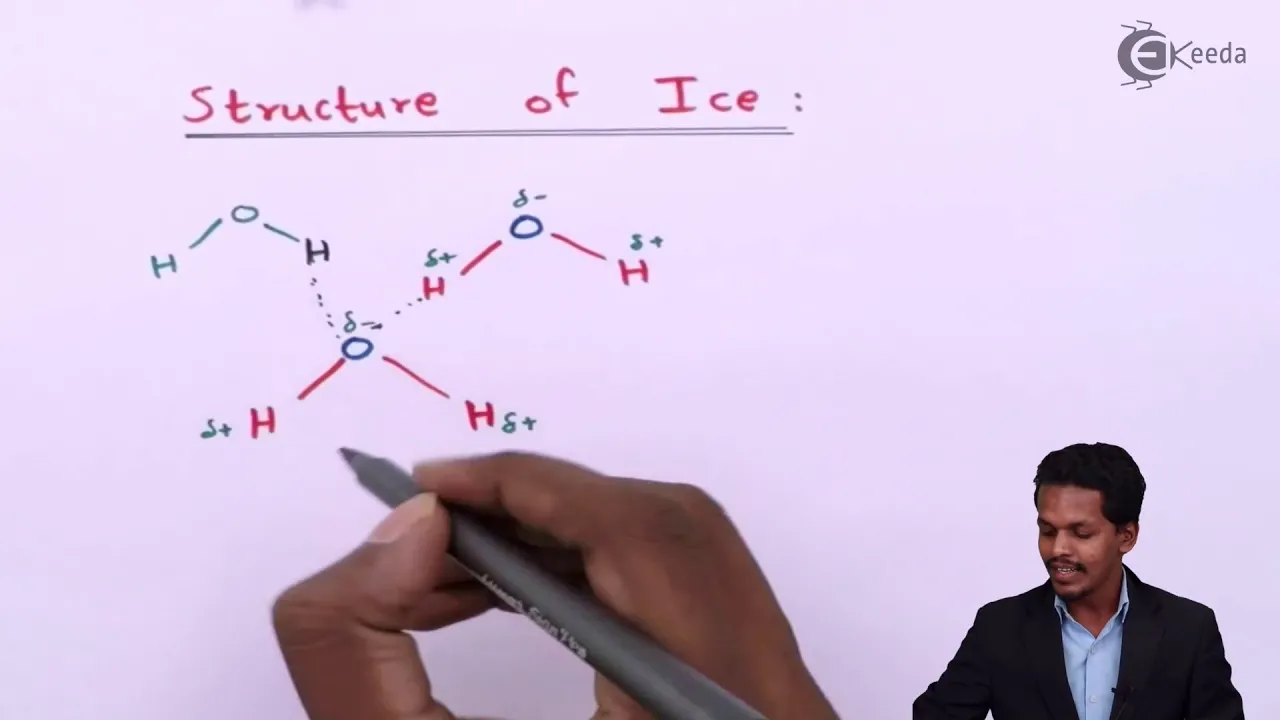
5:56
Chemistry
Structure of Ice - Hydrogen - Chemistry Class 11
Ekeeda
50K views•2019-05-06
45:56
Chemistry
2019 O Levels revision - O Levels Combined Chemistry 2018 revision
acescorers3110
646 views•2019-10-29
6:56
Chemistry
Study Organic Chemistry with Lluís: Total Synthesis of Vilmoraconitine
NROChemistry
2K views•2025-01-09
1:08
Chemistry
How to Write the Formula for Tin (II) sulfate
wbreslyn
11K views•2019-02-26
18:46
Chemistry
Why “Chemical-Free” is a Lie | Exposing Chemophobia
PaleBlueThoughts
978 views•2023-10-13

1:55
Chemistry
OCl2 Lewis Structure (Dichloride monoxide)
geometryofmolecules6271
5K views•2022-03-28

3:31
Chemistry
Lets Talk About Peacock Ore! Are Those Colors Natural?!
YeOldeRockShop-com
14K views•2021-03-09

2:42
Chemistry
Use of strontium in daily life
Viveksirmotivation
599 views•2022-01-18
Trending

13:25
Business
Playstation NO DISC/NO BUY Fight Is Over...
DavidJaffeGames
4K views•2026-07-23

16:52
Anthropology
Americans Confused in Australia for 17 Minutes Straight
IWrocker
17K views•2026-07-23

7:38
Blockchain & Crypto
Bitcoin Social Interest: Dozens of us Left
benjaminjcowen
12K views•2026-07-23

11:32
Business
Tesla Profits Plunge & SpaceX Stock Continues Fall
TheJohnJohnstonLounge
6K views•2026-07-23