In 1979, NASA's Voyager 1 spacecraft discovered that Jupiter's moon Io is geologically active, featuring eight simultaneous volcanic eruptions with plumes reaching 500 km in height—more than 40 times taller than Mount Everest—ejecting sulfur dioxide gas that freezes in space and creates Io's distinctive yellow-orange coloration from different sulfur compounds at various temperatures.
Install our extension to search inside any video instantly.
What NASA Found on Io | Jupiter's Most Violent MoonAdded:
March 5th, 1979.
The Voyager 1 spacecraft flies past Jupiter [music] at 60,000 km/h.
Scientists are thrilled.
>> [music] >> They expect to see a dead, cratered moon similar to our own.
What they got instead was something that made jaws drop across NASA.
Navigation engineer Linda Morabito was the first to see it.
While analyzing an image of Io to check the spacecraft's position, she noticed something strange rising above the moon's limb.
A giant, umbrella-shaped [music] plume.
At first, she thought it was another moon behind Io.
It was not.
It was a volcanic eruption.
The first active volcano ever discovered on another world. And it was not alone.
By the time the Voyager team finished reviewing the images, they had found eight active volcanoes erupting [music] simultaneously.
Eight. On a single moon.
The plumes reached heights of up to 500 km.
More than 40 times taller than Mount Everest.
And the material being ejected was not just rock.
It was sulfur dioxide, a gas that freezes immediately in space [music] and falls back to the surface as a fine, yellow-orange frost.
This is why Io looks the way it does.
That distinctive yellow color? That is sulfur. The red and brown patches?
>> [music] >> Different forms of sulfur at different temperatures.
Related Videos

Spiral Galaxy NGC 3370 from Hubble | NASA APOD 2025-11-05 #Shorts
galaxygallery
938 views•2026-05-30

SOMETHING inside the SUN is CHANGING
RaysAstrophotography
1K views•2026-06-03

There May Be A Giant Hole In The Universe... And We Might Be Inside It | The Cosmic Ledger Entry 015
TheCosmicLedger
145 views•2026-05-31

Captured the Blue Moon (with a twist) 🌙✨ #space #bluemoon #telescope
realAstroExplorer
674 views•2026-06-01

The Map We Sent to the Stars in 1977 — Why Scientists Now Regret It
TheAncientRecord7
183 views•2026-06-03

Is this a copy of our galaxy? Discover Galaxy M81!
UniverseDocumentaries-cc4mb
995 views•2026-05-31

10 Planet Where a Black Hole Replaces the Sun
cosmicexplorer-EN
147 views•2026-06-02
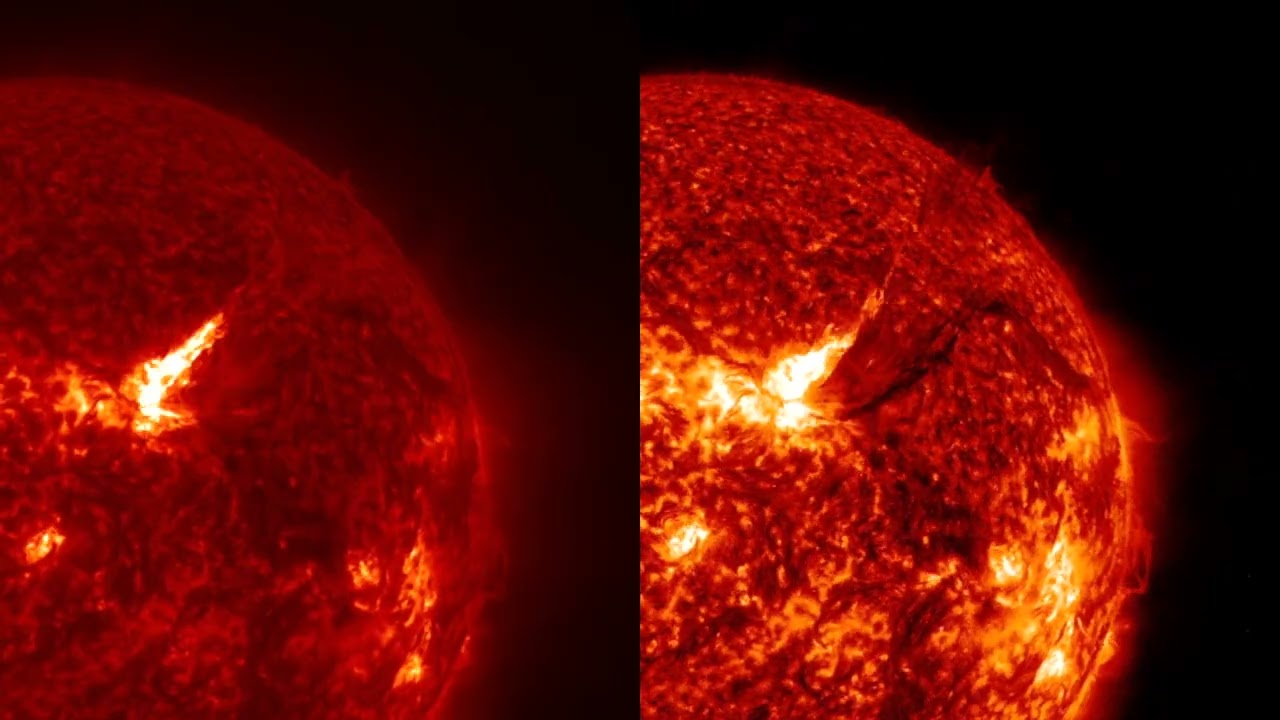
Solar Flares and CMEs at Earth - More Likely | S0 News June.3.2026
SpaceWeatherNewsS0s
2K views•2026-06-03



