This discovery effectively shatters the simplistic assumption that size dictates geological activity, revealing a surprisingly dynamic outer solar system. It serves as a poignant reminder that our current models are often just placeholders for a much more complex reality.
Install our extension to search inside any video instantly.
Tiny Rock In the Solar System Contains Atmosphere and Nobody Knows WhyAdded:
Hello person. This is Anton and today we're going to be discussing a really exciting discovery from right here in the solar system. And once again, a discovery astronomers did not expect and didn't just expect. It should not even be possible according to our current understanding of how planets work. And that's because deep in the frozen reaches of the solar system beyond the orbit of Neptune, there is a small icy world referred to as 2002 XV93.
Yep, it's one of those objects that doesn't even have a proper name. An object that, as the name implies, was discovered in 2002. And though it was always believed to be relatively minor, extremely recently, astronomers have now confirmed that it actually seems to contain a global atmosphere, something that we always thought only actually belongs on planets and much larger objects with a lot more mass. And so, let's talk about this bizarre discovery in a little bit more detail. Starting with exactly what this actually is. What exactly is this object? Well, it's technically classified as a plutino, a specific group of transnunian objects whose properties are extremely similar to Pluto. And the thing is, the solar system in general contains a lot of these trans neptunian objects, many of which you might already know and many of which still contain no names and are just as mysterious as Pluto was a couple of decades ago. But a very specific group of TNOs or transnian objects seem to orbit in a very specific way and basically share the orbital rhythm with Pluto. For every two times they orbit the sun, Neptune orbits three times. And it's really because of Neptune that they seem to have these orbits. It kind of forced them to acquire this planetary resonance. And so as a result, many of them seem to orbit in a very similar way despite being in a very different part of the night skies at all times. And well mathematically this is how their orbits compare. This is in terms of distances and inclination. And though quite a few of these plutinas have been discovered since early 2000s, some of them obviously stood out quite a lot.
Apart from Pluto, we also have an object known as Orcus and another one known as Ixion. As a matter of fact, Orcus is sometimes referred to as the antipluto because it's practically on the opposite side in terms of the orbit. But right there, there's this other tiny object referred to as 2002 XV93 that seems to just blend in and did not appear to be special at all at first, mostly because it's not too big, not too small. Recent measurements suggest that it's about 470 to maybe 500 km across. So, this is about 1/5 of Pluto and obviously much much much smaller than the moon. As a matter of fact, at these sizes, it technically does not even qualify to be a dwarf planet. It's essentially a minor planet or an extremely large asteroid.
But unlike Pluto and some other TNOs, the surface of this object seems to be incredibly dark. It actually seems to reflect only about 4% of the light even though it's covered with water ice and frozen carbon dioxide. And we know this based on the observations from the GN space telescope that discovered a somewhat dark gray surface enriched in water ice but lacking so-called hypervolatiles compounds like methane and nitrogen which we know are present in very large amounts on Pluto. But in every other sense this is just as typical as all other TNOs. It's extremely cold with the temperatures of about -233 C. It takes about 246 years to complete a single orbit at the average distance of about 39.3 astronomical units and based on preliminary observations it does not seem to be spherical which is not unusual for an object of its size and its mass but this recent discovery essentially challenges everything and so here the Japanese scientist whose paper you can find any description relied on a technique referred to as stellar occultation. This was actually done on January 10, 2024 and is essentially kind of a natural experiment where the object passes directly in front of a distant star and we can then see its shadow and thus calculate certain things in regards to its size and possibly even see what's happening on the surface. And well, normally if an object has no atmosphere, which is the case for pretty much most of these rocks, the stars of light will wink out instantly when a solid edge of the world covers it. But that's not what happened in this case. By using three separate locations in Japan, the locations you see in this image, including one operated by a citizen astronomer here, scientists realized that the light did not disappear instantly and instead surprisingly it faded gradually over approximately 1.5 seconds. And in astronomy, this gradual dimming compared to instant dimming is a direct detection of irrefractive signature. Meaning that the starlight was being bent and filtered through a somewhat thin layer of gas before the solid body blocked it out. In other words, if you were to, for example, look at planet Earth from a distant object, you would sort of see very similar effects because of the refraction, which essentially suggested atmosphere. But as I mentioned before, this is a really small object. It's five times smaller than Pluto. And so this is super unusual. And that's because in planetary science there is a concept referred to as volatile retention. If the world is too small, its gravity is going to be too weak to hold on to any gas on the surface. And so all gas should have escaped long time ago. And so for a world that's only about 500 km across, all of these gases should have leaked out into space almost immediately. And here scientists even have a very specific calculation to determine how fast all of this should happen. It's actually referred to as the genes parameter named after James genans and is a kind of an astrophysical ratio that measures the tendency for gas to escape from a body into outer space. And for this object, the value is so low that any atmosphere should escape at a time scale that's much much shorter than the entire solar system with the specific calculations showing that the atmosphere might only last for approximately 1,000 years maximum with everything disappearing from the surface after that. And yet here it is. Although I guess just to clarify, we're not talking about very thick atmosphere, something where you can basically breathe or even survive on. And actually a more accurate term would be an exosphere. The pressure in this case is only about 200 nanobars.
It's about 50 to maybe 100 times thinner than Pluto and approximately million times thinner than right here on Earth.
But still for a 500 km rock or basically for an asteroid this is massive and completely unexplainable or I guess almost unexplainable because we'll discuss a few explanations in a few seconds. And by the way, just to clarify, even the discovery of atmosphere on Pluto was actually super surprising when it was officially uncovered by the New Horizons probe. And here we have an actual image with the atmosphere visible as the halo around Pluto. But for Pluto, there are quite a lot of explanations, mostly involving cryovcanism and a relatively active surface that's technically geologically active, but just different from Earth.
It involves a lot of Isis and a lot of recycling on the surface. So what exactly is happening here then? How can such a tiny object contain anything at all? Well, the only explanation that kind of makes sense is if all of this was replenished relatively recently. In other words, within the last thousand years, something must have happened here in order to create this temporary atmosphere. And the most likely conclusion is some kind of a recent impact, possibly a comet or a small icy object might have crashed into this object not so long ago. And so the heat from this impact would probably vaporize all of the ices on the surface and basically create a kind of a temporary cloud of atmosphere that just did not have enough time to drift away yet. And if this hypothesis is correct, it means that by observing this object again sometimes in the next decade or so, we actually should be seeing a slight reduction or basically the light should be fading slightly quicker. But then there is also the second explanation that's possibly more exciting. There could be a lot of cryovalkcanism or basically this object could be covered in a lot of volcanoes but instead of lava there remaining huge amounts of volatile compounds and so here because of the internal heat or a lot of antifreeze chemicals like ammonia lots of different liquids and gases seep out from the interior constantly refilling the atmosphere as it leaks into the outer space. And technically something very similar is known to exist around at least a few more objects with one of them that we've discussed not so long ago literally being the largest cry volcano in the solar system. You can learn about this in one of the videos in the description. But the problem with this explanation is that a few years back Jean Webb actually looked at this world and discovered no signs of methane or nitrogen or basically no signs of crybanic compounds that we normally find on objects like Pluto. And because these are the most likely gases to form in the atmosphere right now, this explanation is not favored. And though it's quite possible that maybe these cry volcanoes are producing something slightly different, something that was just not observed yet. Currently, the impact hypothesis makes just a little bit more sense. And so there are definitely quite a lot of unanswered questions.
Nevertheless, this is a really important discovery for astronomy because it essentially changes the traditional idea in regards to these global atmospheres around small objects. Here, this observation confirms that a lot of these cold, very distant, and somewhat empty objects, objects that we sometimes imagine as frozen in time, seem to be very dynamic and a lot more active, and seem to contain signs of events that we normally expect from planetary objects and not asteroids. In other words, this is a really exciting discovery and suggests that something very similar potentially exists around a lot of other TNOs and even asteroids much closer to us while at the same time highlighting the power of so-called citizen science essentially using amateur astronomers or non-professional astronomers in order to conduct observations and in order to collect results. And specifically in this case, it was actually the amateur astronomer with a 25 cm telescope in their backyard that confirmed this impossible atmosphere 6 billion km away from planet Earth. Here's roughly where this object is located compared to everything else in the solar system. And so future observations will probably tell us a little bit more about what's happening here and whether this is a result of an impact or this is another crycanic object producing a lot of emissions of something that was just not considered before. For now though, as of 2026, this is just going to remain another beautiful mystery. A tiny new world that just refuses to follow the rules we kind of wrote for them. On that note, once we learn something else, we'll discuss this in some of the future videos. Subscribe. Come back tomorrow to learn something else. Support this channel on Patreon where you can find additional videos, videos without any and can DM me directly or by joining a channel membership that grants you early access and a few additional videos. You can also support this channel by buying a wonderful person t-shirt in the description below. Stay wonderful. I'll see you tomorrow and as always, bye-bye.
Related Videos

Spiral Galaxy NGC 3370 from Hubble | NASA APOD 2025-11-05 #Shorts
galaxygallery
938 views•2026-05-30

SOMETHING inside the SUN is CHANGING
RaysAstrophotography
1K views•2026-06-03

Captured the Blue Moon (with a twist) 🌙✨ #space #bluemoon #telescope
realAstroExplorer
674 views•2026-06-01

There May Be A Giant Hole In The Universe... And We Might Be Inside It | The Cosmic Ledger Entry 015
TheCosmicLedger
145 views•2026-05-31

The Map We Sent to the Stars in 1977 — Why Scientists Now Regret It
TheAncientRecord7
183 views•2026-06-03

10 Planet Where a Black Hole Replaces the Sun
cosmicexplorer-EN
147 views•2026-06-02

Is this a copy of our galaxy? Discover Galaxy M81!
UniverseDocumentaries-cc4mb
995 views•2026-05-31
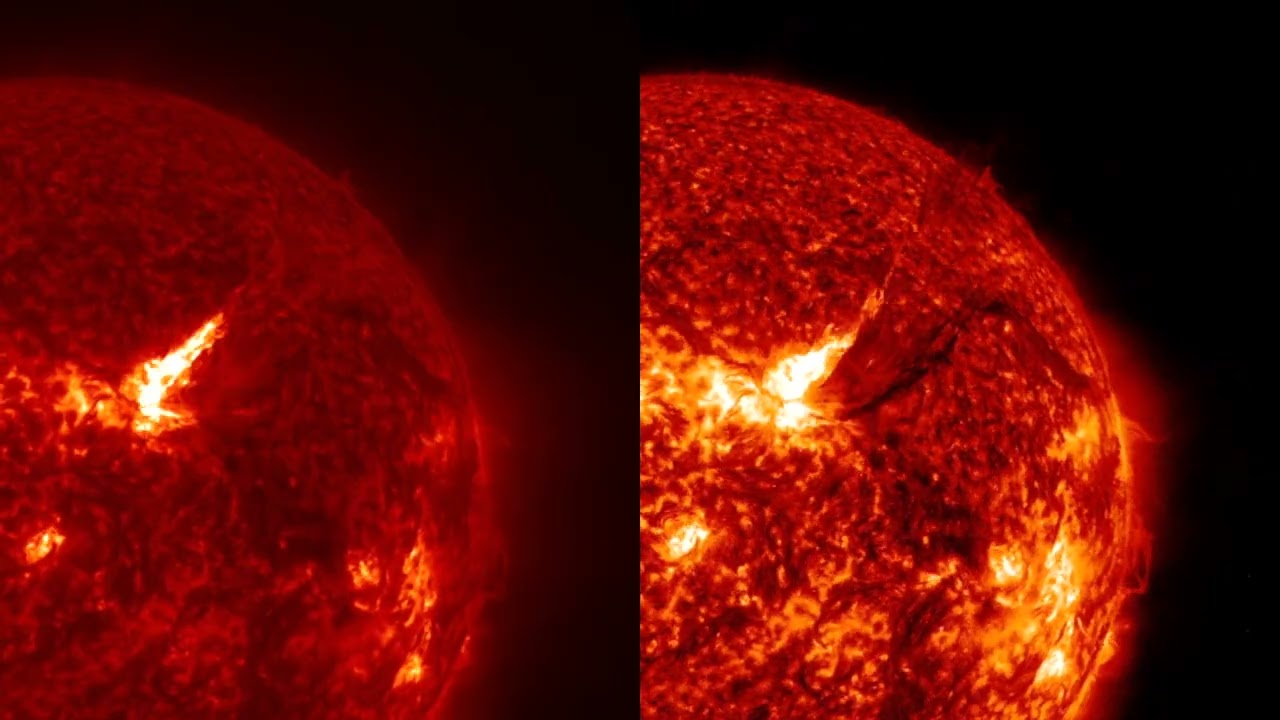
Solar Flares and CMEs at Earth - More Likely | S0 News June.3.2026
SpaceWeatherNewsS0s
2K views•2026-06-03



