The Andromeda Galaxy, located approximately 2.5 million light-years away and spanning over 220,000 light-years in diameter, contains nearly 1 trillion stars; even at the speed of light, crossing it would take longer than all of recorded human civilization multiplied thousands of times, making intergalactic travel effectively impossible for human beings due to the immense distances, radiation hazards, energy requirements, and time dilation effects that would cause civilizations to become isolated and disconnected from their origins.
Install our extension to search inside any video instantly.
How Long Would It REALLY Take to Reach the Andromeda Galaxy (It's Terrifying)Added:
For most of human history, Andromeda was just a ghost in the sky, a faint blur above the darkness, barely visible to the naked eye. Ancient civilizations saw it long before telescopes existed, but they had no idea what they were looking at. To them, it was simply another mysterious light hanging over Earth.
Today we know better or at least we think we do because Andromeda is not a cloud. It is not a nebula. It is not a star. It is an entire galaxy. A colossal rotating city of nearly 1 trillion suns stretching across more than 200,000 light years of space. And somehow, despite the unimaginable scale of that sentence, the human mind still fails to understand what it truly means. We look at images of Andromeda and it feels peaceful, beautiful, even spiral arms glowing softly in the dark. A neighboring galaxy drifting quietly beside our own. Something distant but reachable. the next destination after humanity conquers the solar system.
Science fiction has trained us to think this way. In movies, galaxies feel small enough to cross in a single jump.
Civilizations spread between stars as if the universe were merely a larger version of Earth. Spacecraft dart effortlessly through the cosmos.
Distances shrink. Time becomes irrelevant. But reality is much colder.
Andromeda is approximately 2 12 million light years away from Earth. That number is so enormous that it stops feeling meaningful almost immediately. So consider this instead. The light entering your eyes tonight left Andromeda 2 1/2 million years ago.
When that journey began, humanity did not exist in its modern form. There were no cities, no languages, no pyramids, no history. Our ancestors were primitive creatures struggling to survive on a very different Earth. Everything humanity has ever accomplished happened while that light was still traveling toward us. And that is only the distance to Andromeda, not across it. Because Andromeda itself is vastly larger than the Milky Way. Its diameter stretches over 220,000 light years from one side to the other.
Even traveling at the speed of light, the absolute fastest speed physically possible in the universe, crossing it would take longer than all of recorded human civilization, multiplied thousands of times over. This is the moment the illusion begins to collapse. Because the universe is carefully designed to deceive us, the night sky looks small.
Stars appear close together. Galaxies resemble glowing islands floating gently in darkness. But the human brain evolved to understand forests, rivers, mountains, storms, distances we could walk across before dying. Not this.
Nothing in human experience prepared us for cosmic scale. And once you truly understand the scale of a galaxy, something disturbing happens.
Space stops feeling adventurous. It starts feeling hostile.
Imagine boarding a spacecraft and attempting to cross Andromeda itself.
Not visit a nearby star, not explore a planet, but cross the galaxy from one side to the other. How long would it really take? At first, the answer sounds merely difficult. Then the calculations begin. A commercial airplane would need hundreds of billions of years. Modern spacecraft would require millions upon millions of human lifetimes. Even Voyager 1, the fastest object humanity has ever sent into deep space, would barely make progress against distances this large. Suddenly, Andromeda no longer feels like a destination. It feels like a wall. An endless ocean of darkness so vast that human civilization begins to look microscopic against it.
And the terrifying part is this. We have not even reached the worst of it yet.
Voyager 1 is the fastest spacecraft humanity has ever truly lost to the darkness. Launched in 1977, it has traveled farther from Earth than any human-made object in history. It crossed the planets, escaped the solar system, entered interstellar space. Even now, nearly 50 years later, it continues drifting outward into the black at roughly 38,000 mph. That sounds impossibly fast. On Earth, it would circle the planet in less than an hour.
But against the scale of a galaxy, Voyager 1 is almost motionless. If Voyager somehow aimed directly toward Andromeda, it would need more than 40 billion years to arrive, nearly three times the current age of the universe.
And even that journey only gets us to the galaxy itself. Crossing Andromeda would take far longer. This is where space becomes psychologically disturbing because human beings instinctively imagine travel as movement between places. You leave one city, cross a landscape, and arrive somewhere new.
Even oceans have changing skies, weather, coastlines, signs of progress.
But interstellar space offers none of that. For thousands of years, nothing would appear to change. The stars ahead would barely move. The stars behind would barely fade. There would be no sensation of speed because speed itself becomes meaningless in emptiness this large. Imagine staring out of a spacecraft window for an entire lifetime and watching the universe remain almost completely frozen. No sound, no nearby planets, no passing objects, no rescue.
just darkness and distant stars that never grow closer quickly enough to matter. Science fiction rarely shows this truth because it is too terrifyingly slow. Galaxies in movies look crowded. Ships weave between stars like aircraft through clouds. But reality is almost entirely empty space.
If our solar system were shrunk to the size of a coin, the nearest star would still be thousands of miles away. The galaxy is not a city. It is a graveyard of distance. And even if humanity somehow solved propulsion, the horror does not disappear. Because eventually physics itself becomes the enemy.
Suppose an advanced civilization built a ship capable of traveling at 99% the speed of light. At that speed, strange things begin happening to time itself.
According to relativity, time slows down for the travelers on board. To the crew, the journey might feel dramatically shorter. Years could pass for them while thousands pass outside the ship. At first, this sounds like salvation until you realize the cost. Everyone back home would die. Not metaphorically, literally. Every person you have ever known, every city, every nation, every language gone long before you reached your destination. Messages sent back to Earth would take thousands or millions of years to arrive. Entire civilizations could rise, collapse, evolve, and vanish before a single reply returned.
Eventually, the travelers would no longer belong to humanity at all. They would become detached from history itself. Imagine leaving Earth knowing you are witnessing your species for the final time. Knowing every memory, every culture, every human connection will disappear into the past while you drift deeper into the galaxy. This is the true horror of galactic travel. Not the engines, not the distance, the isolation. Because the moment you attempt to cross a galaxy, you effectively abandon your world forever.
And suddenly a disturbing possibility emerges. Maybe advanced civilizations are not exploring the universe. Maybe they are trapped inside their own tiny islands of stars.
Just like us. By the time a spacecraft enters the deep interior of a galaxy, survival itself becomes unnatural. Human beings evolved beneath the protection of a planet.
Earth shields us with an atmosphere, a magnetic field, gravity, liquid water, ecosystems carefully balanced over billions of years. Every second you remain alive is supported by invisible systems. The universe almost never provides naturally deep space strips all of that away. And the longer the journey becomes, the more the galaxy starts trying to kill you. Radiation is the first threat. Beyond Earth's magnetic field, space is flooded with high energy particles moving near the speed of light. Cosmic rays from exploding stars, radiation from black holes, ancient particles accelerated across the galaxy for millions of years before striking your ship. Over short missions, exposure is dangerous. Over interstellar time scales, it becomes catastrophic. Cells mutate. Electronics fail. DNA slowly breaks apart under constant bombardment.
Even thick shielding cannot stop everything forever. A spacecraft drifting across Andromeda for thousands or millions of years would gradually decay from the inside out. Then there is the dust. Not asteroids, not giant rocks, dust, tiny microscopic grains floating invisibly through interstellar space at ordinary speeds. They are harmless. But near the speed of light, even a speck of dust carries the energy of an explosive weapon. A collision could tear through metal like a bullet through tissue. At relativistic velocity, the galaxy itself becomes a minefield.
And the terrifying part is that you would never see the impact coming. There are darker things hiding out there, too.
Rogue planets wandering without stars.
Frozen worlds drifting invisibly through the void. Dead suns collapsed into neutron stars dense enough to crush atoms. Black holes moving silently through the galaxy with gravity powerful enough to rip apart entire systems. Most of them emit almost no light. You would only notice them once it was already too late. But perhaps the greatest obstacle is energy. To move even a relatively small spacecraft close to the speed of light requires unimaginable power.
Entire civilizations might consume the resources of planets simply to launch a single intergalactic mission. The energy demands become so absurd that galactic travel starts looking less like exploration and more like controlled extinction. And then another problem emerges. Human beings do not live long enough. Even optimistic journeys could require centuries. More realistically, thousands of years. No crew could survive that naturally. So civilizations imagine generationships, massive artificial worlds drifting through darkness while countless generations live and die on board before arrival.
Children born inside metal corridors.
Entire societies evolving in isolation.
Humans who never see Earth, never experience a real sky, never touch an ocean. Over enough time, the mission itself could collapse. Cultures change.
Knowledge degrades. Civil wars emerge.
The descendants of the original crew may forget where they were even going. A ship traveling long enough through interstellar darkness might stop being a mission and become a prison civilization trapped between stars forever.
Which leads to an even more disturbing possibility. Maybe biological intelligence is not meant for galactic exploration at all. Machines may inherit the cosmos. Instead, artificial intelligence does not age like humans.
It does not fear isolation. It can sleep for millennia, repair itself, wait patiently through endless darkness without psychological collapse.
If any civilization truly spreads across galaxies, it may not be flesh and blood that survives the journey. It may be something else, something posthuman. And suddenly the Fermy paradox begins to feel different. People ask why we have never encountered alien civilizations.
But maybe the answer is simple. Galaxies are too large. Distance itself may be the great filter. Civilizations rise around their local stars, dream of conquering the cosmos, and then discover the horrifying truth too late. The universe is not built on scales living creatures can meaningfully cross. Not because aliens do not exist, but because the void between everything is practically unbeatable. The universe may not need monsters to keep civilizations isolated. Distance alone is enough.
Humanity has always imagined the future as expansion. First across rivers, then oceans, then continents, then planets.
Every generation assumes the next boundary will eventually fall. It is one of the oldest instincts in our species.
The belief that no frontier is permanent, that somewhere ahead beyond the horizon, another world is waiting.
Andromeda destroys that illusion.
Because once you truly understand the scale of a galaxy, you begin to realize something deeply unsettling.
The universe may already be divided into isolated islands that can never meaningfully touch. Even if civilizations survive for millions of years, even if technology becomes unimaginably advanced, even if faster spacecraft are eventually built, the distances remain monstrous.
Every step into the cosmos costs time, energy, memory, identity. Eventually, the journey itself becomes larger than the civilization attempting it. And perhaps that changes everything. Right now, the Milky Way and Andromeda are moving toward each other at more than 200,000 mph.
In roughly 4 and a half billion years, the two galaxies will collide and merge into a single enormous structure stretching across the darkness. That sounds catastrophic, but the terrifying truth is stranger. Almost no stars will actually hit each other. Because galaxies are mostly empty space, entire galaxies can pass through one another like ghosts. That is how enormous the void truly is. Even during a galactic collision, most stars remain hopelessly isolated from their neighbors.
The night sky deceives us into believing the universe is crowded, connected, alive with movement and proximity. But reality is silence, separated by impossible distance. Earth itself is microscopic against this scale. Our entire civilization exists on a tiny rock orbiting one ordinary star near the edge of one galaxy among trillions.
Every war in human history, every religion, every empire, every person who has ever fallen in love, suffered, dreamed or died. All of it happened inside a fraction of a fraction of a cosmic structure we cannot even cross.
And there may never come a day when we truly can. This is the existential horror hidden inside Andromeda. Not aliens, not black holes, not cosmic disasters. Scale, pure, overwhelming scale. Because the observable universe may be fundamentally too large for intelligence to experience in any complete way. There may be civilizations scattered everywhere across the cosmos, each staring into their own night skies, believing they are explorers.
While remaining permanently trapped inside tiny neighborhoods of stars, they can never escape. Even communication becomes meaningless over enough distance. A conversation between galaxies could require millions of years between messages.
By the time one civilization says hello, the other may already be extinct. The cosmos does not merely separate worlds physically. It separates them through time itself. And perhaps that is why the universe feels so quiet. Not because life is rare, but because distance has already buried everyone in silence. One day, humanity may leave the solar system. We may build colonies around distant stars. We may even survive long enough to witness the Milky Way and Andromeda slowly merging in the far future sky. But crossing a galaxy truly crossing it that may remain forever beyond creatures like us. Because the final truth Andromeda reveals is not that the universe is dangerous. It is that the universe is indifferent. The stars above us look close enough to touch. Yet in reality, every light in the sky exists inside an abyss so enormous that human history disappears into insignificance against it.
Andromeda is terrifying not because of what is inside it, but because it reveals the true scale of the prison we already live in.
Related Videos

Spiral Galaxy NGC 3370 from Hubble | NASA APOD 2025-11-05 #Shorts
galaxygallery
938 views•2026-05-30

SOMETHING inside the SUN is CHANGING
RaysAstrophotography
1K views•2026-06-03

Captured the Blue Moon (with a twist) 🌙✨ #space #bluemoon #telescope
realAstroExplorer
674 views•2026-06-01

There May Be A Giant Hole In The Universe... And We Might Be Inside It | The Cosmic Ledger Entry 015
TheCosmicLedger
145 views•2026-05-31

The Map We Sent to the Stars in 1977 — Why Scientists Now Regret It
TheAncientRecord7
183 views•2026-06-03

10 Planet Where a Black Hole Replaces the Sun
cosmicexplorer-EN
147 views•2026-06-02

Is this a copy of our galaxy? Discover Galaxy M81!
UniverseDocumentaries-cc4mb
995 views•2026-05-31
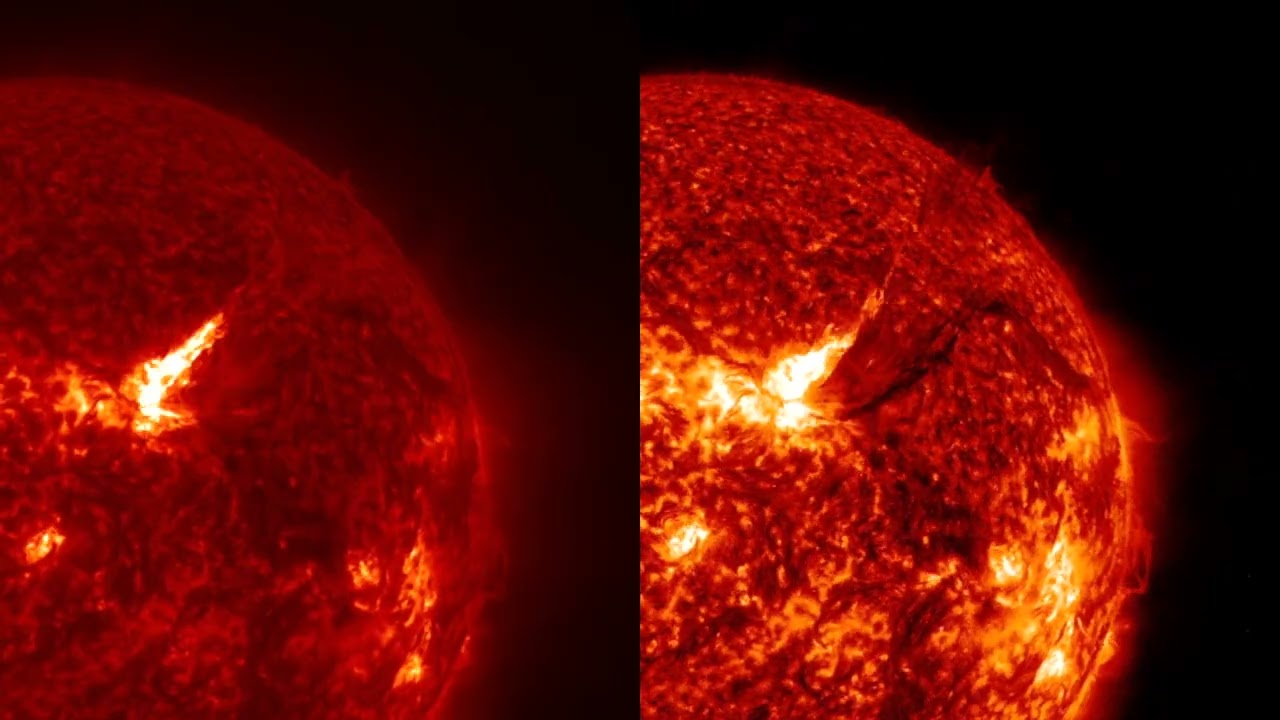
Solar Flares and CMEs at Earth - More Likely | S0 News June.3.2026
SpaceWeatherNewsS0s
2K views•2026-06-03



