The video masterfully transforms a slow-moving piece of space junk into a haunting monument to human vanity and existential loneliness. It is a poetic reminder that our greatest reach into the cosmos only serves to measure the terrifying scale of our own insignificance.
Install our extension to search inside any video instantly.
The Terrifying Truth About the Voyager Journey | Neil DegrasseAdded:
Right now, something is happening that I want you to think about before you do anything else today.
Right now, at this exact moment, as you sit, wherever you are sitting, two machines built by human hands are moving through interstellar space.
Not space near Earth. Not space near the Sunday interstellar space. The space between the stars.
The space that no humanmade object had ever entered before they crossed into it. moving at roughly 35,000 mph, faster than any bullet ever fired, faster than any aircraft ever built, faster than anything our civilization has ever accelerated to through its own power.
And at that extraordinary speed, they're so far away that the radio signals they send back to us traveling at the speed of light. take more than 22 hours to arrive.
22 hours at the speed of light and they are still in the cosmic neighborhood.
These are the Voyager spacecraft, Voyager 1 and Voyager 2. Launched in 1977, nearly five decades ago.
Built with computers less powerful than the device you are using right now, by factors of millions, weighing roughly a,000 pounds each, running on nuclear power sources that are slowly dying, sending back data on a transmission power of roughly 22 watts.
the same power as a refrigerator light bulb from the edge of the solar system and beyond. And we can still hear them.
I want to tell you everything about what the Voyager journey has revealed. Not the sanitized version, not the triumphant narrative of human achievement that glosses over what the data actually says about where we are and what surrounds us. the real version version that contains both the most profound pride I feel as a member of this species and the most vertigenous terror that cosmology is capable of producing because the Voyager journey has revealed something terrifying. Something that I think most people have heard about but have not actually let land.
have not actually felt in the way it deserves to be felt and I am going to make you feel it today. Not just understand it, feel it.
Let us start with where they are.
Voyager 1 is currently approximately 23 billion miles from the Sunday. 23 billion miles. Let me give you a way to feel that number.
The distance from Earth to the Sunday, the distance we call one astronomical unit, is approximately 93 million miles.
Voyager 1 is currently about 250 astronomical units from the Sunday. 250 times the distance from Earth to the Sunday.
Still not feeling it? Let me try another way. If you shrunk the solar system so that the distance from Earth to the sun was 1 in 1 in then Voyager 1 would be about 21 ft away. 21 ft.
In that same scale model, the nearest star Alpha Centauri would be about 4 and a/4 miles away. four and a quarter miles from where you are standing. Voyager 1 after nearly five decades of travel at 35,000 miles hour is 21 ft from the sun in a scale model where the nearest stars foreign able/4 miles away 21 ft out of 4 and a/4 miles.
That is where we are after nearly 50 years of our fastest travel. That is the scale of the problem. That is the terrifying truth that the Voyager journey has made visceral in a way that no textbook ever could.
We launched something nearly 50 years ago and it has traveled continuously at a speed that would take you around the Earth in less than a minute. And it is covered less than onetenth of 1% of the distance to the nearest star. Less than onetenth of 1%.
This now let me tell you what that means for the future of these spacecraft because this is where the vertigo really sets in. Voyager 1 crossed what we call the helopause in 2012. The helopause is the boundary where the solar wind, the continuous stream of charged particles flowing outward from the Sunday, finally loses the battle against the interstellar medium, the interstellar wind coming from outside the solar system. The helopause is where our sun's bubble of influence ends and interstellar space truly begins. It is the edge of the heliosphere, the protective cocoon that the sun has been inflating around the solar system for 4 and a half billion years. When Voyager 1 crossed that boundary, it became the first human-made object to enter interstellar space.
genuinely interstellar space.
The space between the stars, the space that was there before the sun was born and will be there after the sun dies.
The ancient medium that threads through our entire galaxy. Um, Voyager 1 became an interstellar object carrying the mark of humanity into the void between the stars.
That is genuinely one of the most remarkable things our species has ever done. Um, I want to be clear about that.
The intellectual and engineering achievement represented by the Voyager program is staggering.
The fact that we can build something that small and launch it and navigate it past four giant planets using their gravity as a slingshot and then track it for nearly 50 years as it crosses into interstellar space while still receiving coherent scientific data from it. That is extraordinary.
That is what I mean when I say human beings are capable of extraordinary things.
pine. And now I need to tell you what Voyager 1 will do next.
In approximately 40,000 years, Voyager 1 will pass within roughly 1.6 light years of a star called Gleas 974, not arrive at not orbit, pass within um 1.6 6 light years is still an enormous distance roughly 10 trillion miles. It will not enter that star system.
It will not slow down. It will not be captured gravitationally.
It will simply pass through the general neighborhood of another stellar system for the first and only time after 40,000 years of travel.
40,000 years, modern human civilization, everything from the first cities to the internet to the phone in your pocket to fits into roughly 10,000 years. 40,000 years ago, our ancestors were painting cave walls in Europe, making handprints in red ochre in fire lit caverns, wearing animal skins, hunting with stone tipped spears. 40,000 years from now, Voyager 1 will have its closest approach to another star. And it will not stop.
It will not slow down. It will keep going into the dark forever unless something intercepts it, which in the emptiness of interstellar space is extraordinarily unlikely.
The the Voyager spacecraft are not going anywhere specific. They are going everywhere in general, proddding.
They're falling through the galaxy on trajectories that will carry them past stars, on time scales measured in tens of thousands of years, getting farther and farther from the Sunday, getting fainter and fainter in our instruments until they pass beyond our ability to detect them entirely.
We will lose contact with Voyager one in approximately 2025.
That is not a dramatic projection into the distant future. That is next year or the year after the nuclear power sources aboard both Voyager spacecraft are running out.
The plutonium dioxide pellets that have been generating electricity through radioactive decay for nearly 50 years are producing less and less power as the plutonium decays.
The engineers at JPL have been heroically managing the power budget, shutting down instruments one by one to keep the most critical systems running.
But the physics is inexurable. The power will eventually drop below the threshold required to keep the transmitters and receivers operating and the signal will go silent permanently.
When that happens, we will lose contact with the most distant human-made objects in existence.
Two small machines carrying golden records encoded with the sounds and images of Earth. Carrying greetings in 55 languages, carrying music from Bach to Chuck Berry to Azerbaijani folk songs carrying diagrams of our location in the galaxy and the structure of our DNA. Um, two messages in bottles thrown into an ocean so vast that the probability of them ever being found is essentially indistinguishable from zero. Blaze and they will keep going anyway in silence without us into the dark. I want to stop here and let you feel that because I think it is one of the most emotionally complex facts in all of space exploration.
The Voyager spacecraft are going to keep traveling after we lose contact with them. They're going to keep moving through interstellar space for millions of years, billions of years longer than the current age of the Earth, longer than the remaining lifetime of the Sunday.
They will outlast our civilization.
They will outlast our species. They will outlast the solar system itself if it is not captured or destroyed by some stellar encounter in the distant future.
They're the most permanent things we have ever made. More permanent than the pyramids.
more permanent than any city or any monument or any artifact of human civilization because there's nothing in interstellar space to erode them. No weather, no geological processes, no biological decay.
The primary threats are micromedorite impacts and cosmic ray bombardment which will very slowly degrade their surfaces over millions of years. But the golden records protected by their aluminum cases may remain essentially intact for hundreds of millions of years, perhaps more than a billion years.
We have made something that will outlast everything else we have ever made.
something that carries a message about who we were at this moment uh in our history into a darkness where it may never be found into a silence that may never be broken that is simultaneously the most beautiful and the most haunting thing about the Voyager program.
Now let me tell you about what the Voyager spacecraft found when they crossed into interstellar space.
Because the scientific revelations of the Voyager journey are extraordinary and some of them are genuinely surprising in ways that the popular narrative does not fully convey.
When Voyager 1 crossed the helopause in 2012, the instruments aboard measured something unexpected. The density of the plasma, the ionized gas in interstellar space was about 40 times higher than predicted.
The magnetic field direction changed abruptly at the helopause, but not in the way the models expected. The intensity of galactic cosmic rays, the high energy particles from outside the solar system increased sharply as Voyager crossed the boundary, going from the relatively sheltered interior of the heliosphere to the full cosmic ray flux of interstellar space is beater. And the measurements revealed something about the structure of the heliosphere itself that was not anticipated.
The transition from the interior of the heliosphere to interstellar space was not gradual. It was sharp, dramatic, a relatively thin boundary region rather than the broad gradual transition many models predicted. The sun's bubble has a more defined edge than we thought.
Voyager 2 crossed the helopause in 2018 about 11 astronomical units from where Voyager 1 crossed crossing. And the measurements at that crossing point were different from the Voyager one. Measurements in ways that revealed something profound.
The the heliosphere is not a perfect sphere. It is asymmetric shaped by the relative motion of the sun through the galaxy and by the structure of the interstellar magnetic field in our neighborhood. The bubble the sun blows is not round. It is distorted, stretched, and compressed by the environment it is moving through.
I these are not minor technical details.
They are revelations about the nature of the environment our solar system is embedded in about the interface between our sun's influence and the broader galaxy about the structure of the medium we are moving through as the sun orbits the galactic center at a speed of roughly half a million miles per hour completing one orbit of the galaxy every 225 million years and the interstellar medium that Voyager is now moving through. The actual space between the stars is genuinely strange.
Far from being the simple void it was once imagined to be, it is a complex dynamic medium threaded with magnetic fields filled with a diffuse plasma of ions and electrons pervaded by cosmic rays of extraordinary energies carrying the chemical signatures of stellar explosions from millions of years ago.
The the interstellar medium is the connective tissue of the galaxy. The medium through which elements forged in stellar cores are distributed through which the shock waves of supernova explosions propagate through which the galaxy breathe. hostile and it is extraordinarily hostile to biological life.
The cosmic ray flux in interstellar space outside the heliosphere is roughly 400 to 600 millisevers per year.
As I described in our conversation about galactic travel, that is 100 to 200 times the background radiation on Earth's surface. The heliosphere, the bubble of solar wind that the sun inflates around the solar system, provides significant shielding against the lower energy galactic cosmic rays.
When you leave the heliosphere, the full interstellar radiation environment arrives unmediated. Voyager has given us the first direct measurements of what that environment is actually like. Not models, not theoretical predictions, direct measurements from instruments inside the actual interstellar medium.
And those measurements confirm that interstellar space is as hostile as theory predicted and in some ways more complex than the models anticipated. But here is the thing about those measurements that I want you to appreciate. Voyager is giving us data from less than 150 astronomical units away in a galaxy that is 100,000 light years across. One lightyear is about 63,000 astronomical units.
100,000 lighty years is about 6 billion 300 million astronomical units.
Voyager has given us direct measurements of the interstellar medium at distances of less than 150 out of 6 billion 300 million astronomical units of galactic diameter. We have sampled the interstellar medium in our immediate cosmic neighborhood, our immediate neighborhood. And what we found was already surprising.
What waits at greater distances in the different environments of different regions of the galaxy in the vicinity of young hot stars or old red giants or stellar nurseries or supernova remnants. Uh we do not know.
We have sampled one point in a space so vast that our sample represents essentially nothing statistically and that is the terrifying truth hiding inside the triumph of the Voyager program. We launched two spacecraft uh nearly 50 years ago, the most distant human-made objects ever built, moving at speeds that would span continents in minutes. Uh and they have given us measurements from a region so close to the sun that on a galactic scale it is indistinguishable from the sun itself.
They have told us about the interstellar medium within our immediate stellar neighborhood.
The cosmic equivalent of sampling the air in your living room and claiming to understand Earth's atmosphere.
The galaxy is humbling beyond any comfortable description. And Voyager has made that humbling concrete in a way that no telescope image ever could.
Because Voyager is actually there in that void, moving through it, measuring it, sending back 22 watts of signal that we can barely detect with our largest antennas.
A whisper from the dark that carries scientific data about the most hostile and most ancient environment our instruments have ever directly sampled.
It's less. And in part two, I want to take you somewhere deeper into what this all means. I want to talk about the golden records, about what it means to throw a message into a void where the probability of it being found is essentially zero and do it anyway.
I want to talk about what the scale revealed by the Voyager journey implies for our understanding of our place in the cosmos.
And I I want to address the question that I think sits beneath all of this.
The question that the Voyager journey forces upon anyone who thinks about it seriously enough.
Are we alone out here in this dark moving through this ancient hostile void?
Um, is the silence that surrounds the Voyager spacecraft, the silence of a universe that has never produced another mind capable of receiving the message on those golden records?
Or is it the silence of distances so vast that even the fastest signals we know of would take years and decades and centuries to cross them? The Voyager journey has not answered that question.
But it has made the question feel different, more physical, more immediate, more real.
Because somewhere out there right now, two small machines are moving through the actual interstellar void in actual silence and carrying actual messages from actual human beings who lived and worked and dreamed and then died.
who built something that will outlast everything else they ever made and sent it into the dark hoping, not knowing, hoping. And the dark has not answered yet. I want to talk about the golden records. Not as a piece of nostalgia, not as a charming historical footnote to the Voyager program, as a philosophical act, as one of the most deliberate and considered statements our species has ever made about who we are and what we value and what we hope.
In 1977, Carl Sean chaired the committee that designed the contents of the Voyager golden records. Two 12in goldplated copper discs, one attached to each spacecraft encoded with sounds and images intended to communicate the nature of Earth and its inhabitants to any extraterrestrial intelligence that might someday find them.
The records contain 115 images, greetings in 55 human languages and one citation language, humpback whale song, 90 minutes of music from cultures across the world and a variety of natural sounds, um, wind and rain and surf and the vocalizations of animals.
The records come with a cover, a aluminum jacket engraved with instructions for how to play the record and diagrams showing the record's rotation speed in terms of the hyperfine transition of hydrogen. the most universal clock available. Diagrams showing the position of our solar system relative to 14 pulsars. Natural cosmic lighouses whose pulse frequencies can serve as a coordinate system. Diagrams showing the structure of DNA and a diagram of a man and a woman standing in front of the spacecraft for scale.
Everything on the cover is encoded in the most universal language available, mathematics and physics. Because if there is a universal language in this cosmos, if there is anything that an intelligence anywhere in the galaxy would recognize, regardless of its biology or its evolutionary history or its sensory apparatus, it is mathematics and it is physics. The laws that govern the universe are the same everywhere. The hyperfine transition of hydrogen has the same frequency in every corner of the galaxy.
Pulsars have measurable and identifiable pulse frequencies regardless of who is measuring them. Mathematics is the one thing we can be confident any sufficiently advanced intelligence would understand.
Sean and his colleagues were trying to do something genuinely unprecedented.
They were trying to communicate across a gulf so vast that no communication had ever crossed it across species lines across evolutionary histories so different they might have nothing in common. across physical distances measured in light years in a message that had to be self-interpreting that could not rely on any shared context, any shared language, any shared assumption about what minds are like or how they perceive or what they value. They were trying to say we exist. We are here. This is who we are.
And they encoded into the records a selection of music that I find genuinely moving when I think about it in this context. Box Brendenburg concerto number two in F major. Mozart's the magic flute. Beethoven's fifth symphony. Chuck Barry's Johnny be good. Blind Willie Johnson's dark was the night cold was the ground. Georgian coral music. A Navajo night chant, Peruvian wedding song, Chinese classical music, Indian ragas, Japanese shakuahachi, Azerbaijani folk songs, Australian Aboriginal songs, the the full breadth of human musical expression, the full range of what human beings have discovered about how to organize sound into meaning. sent into the dark as a kind of sonic portrait of our species emotional and aesthetic life.
As evidence that whatever we are, we are the kind of beings who make music, who organize vibrations in air into patterns that carry meaning beyond the information content of the sounds themselves.
who have been doing this on every continent for as long as we have been human. If that record is ever found and ever played by a mind that can perceive its contents, the first thing that mind will know about us is not that we are technological, not that we understand mathematics and physics, not that we have mastered spaceflight. The first thing it will know is that we make music.
That we are the kind of beings for whom sound carries beauty and meaning and emotional weight beyond its informationational content. I find that choice extraordinarily revealing about who we are and about what Sean and his colleagues thought was most important to communicate about us. How now let me tell you about the probability that those records will ever be found. It it is essentially zero. I do not mean that as hyperbole. I mean it as a careful physical statement.
Interstellar space is so vast and so empty that the probability of any object the size of the Voyager spacecraft being intercepted by another object in the foreseeable future is extraordinarily small. The density of matter in interstellar space is roughly one hydrogen atom per cubic cm.
The density of objects large enough to intercept the Voyager spacecraft is incomparably lower. Stars are separated by an average of several light years.
The Voyager spacecraft will pass within a few light years of another star system roughly once every 40,000 years or so.
crates and passing within a few light years is nothing like being intercepted. A few light years is a gulf of trillions of miles.
For the golden records to be found, they would need to be encountered by an intelligent civilization capable of recognizing them as artificial, capable of retrieving them, capable of playing them and motivated to do so. The probability of all those things occurring in any given period is vanishingly small. Not impossible, but vanishingly small. Sean knew this. The committee knew this. Everyone involved in designing the golden records knew this. They were not making a practical communication effort.
They were making a statement. A statement about who we are as a species, about what kind of beings we are, about whether we are the kind of beings who bother to introduce themselves to a universe that may never hear the introduction. And they decided we are they decided that the act of making the statement has value independent of whether the statement is ever received.
that throwing a message in a bottle into an ocean, you know, is essentially infinite is still worth doing because the act of throwing it says something about you, about your values, about your hope, about your recognition that you exist in a universe larger than you and that existence in such a universe carries certain obligations.
One of those obligations is to try. I am. And here is what I find most remarkable about the golden records in the context of everything else we have established about the Voyager journey.
The records were made at a moment when humanity was just beginning to understand the scale of what surrounds us. Just beginning to measure the distances to nearby stars with enough precision to appreciate their implications.
Just beginning to develop the theoretical frameworks for thinking about interstellar travel and its challenges.
Just beginning to grapple seriously with the question of whether other civilizations exist in the galaxy. And in that moment of growing understanding of the scale, of the void, of the silence, of the distances, and um the humans at JPL and at the universities and laboratories who designed and built and launched the Voyager spacecraft chose to put a message on board anyway, a message they knew would almost certainly never be received. on spacecraft they knew would be lost to contact within a human lifetime.
Moving at speeds they knew would take 40,000 years to bring them to the neighborhood of another star.
They did it anyway because that is what we do because we are the kind of species that makes music and puts it on a spacecraft heading into the void.
Because we are the kind of species that carves greetings in 55 languages onto a golden disc and attaches it to a machine that will outlast our civilization by billions of years because we are the kind of species that tries its core. Now I want to bring you to the scale question one more time because I think the Voyager journey has given us the most physically grounded appreciation of cosmic scale that any human achievement has ever provided.
Close and I want to make sure you have felt it fully before we conclude.
We we launched the Voyager spacecraft in 1977 47 years ago.
They have been traveling continuously at 35,000 mph.
Every hour of every day for 47 years, they have covered a distance that is genuinely extraordinary by any human standard.
23 billion miles for Voyager 1, 19 billion miles for Voyager 2. distances that dwarf anything in human experience or human history.
And they have covered less than onetenth of 1% of the distance to the nearest star.
The nearest star, not a distant star, not a star in another part of the galaxy. The nearest one, the closest neighbor to our sun in the entire galaxy, is so far away that the fastest thing we have ever launched, moving continuously for 47 years, has barely begun to close the distance. At Voyager's current speed, reaching Alpha Centauri would take roughly 73,000 years. 73,000 years. As I noted in our conversation about leaving the solar system, that is more than 10 times the entire span of recorded human civilization.
That is the time since Neanderthalss and modern humans were both walking the earth simultaneously.
And Alpha Centauri is the nearest star.
The galaxy contains roughly 200 to 400 billion stars spread across a disc 100,000 lightyears in diameter. The distances between stars are not the anomaly. They are the rule.
The galaxy is mostly void. vast ancient freezing void threaded with magnetic fields and cosmic rays and the diffuse plasma of the interstellar medium punctuated here and there by the extraordinary anomalies we call stars.
Warm oases in an otherwise cold and dark and hostile expanse. And the Voyager spacecraft are in that void right now, moving through it, experiencing it, measuring it.
Their instruments sampling the actual environment of actual interstellar space and sending that data back to us as a whisper of 22 watts across 23 billion miles.
When the deep space network antennas, the largest radio antennas on earth, receive the signal from Voyager 1, they are detecting a power level of roughly 2 * 10 to the - 26 watts. That is 0.02 yakawatts.
A number so small it has no intuitive analog in human experience.
It is a signal that would be lost in the thermal noise of the electronics if it were not for the extraordinary engineering of the receivers and the careful choice of transmission frequencies that avoid interference.
We are hearing a whisper from interstellar space.
A 22 watt whisper that has traveled 23 billion miles and arrived at Earth as a signal so faint that it makes the most sensitive measurement you have ever heard of seem crude by comparison. And from that whisper we are extracting scientific data about the actual interstellar medium about the actual magnetic field structure about the actual cosmic ray flux about the actual plasma density.
That is engineering. That is science.
That is what we are capable of at our best. And it is going to go silent within the next few years.
The power output of the radioisotope thermmoelectric generators aboard Voyager 1 has dropped from roughly 470 watts at launch to somewhere around 50 watts. Today it continues to drop at roughly four watts per year as the plutonium decays.
When the power drops below the level required to maintain the transmitter and the receiver somewhere in the next few years, the signal will stop and Voyager 1 will continue its journey through interstellar space in silence alone without us carrying its golden record and its instruments and the microscopic traces of human hands that assembled it into the dark. I want to sit with that for a moment because I think it is one of the most emotionally significant events in the history of space exploration and it is going to happen soon, possibly within the next year or two. The most distant human-made object in existence. The first thing ever built by human hands to enter interstellar space is going to go silent and we are going to lose contact with it. And it is going to keep going for the rest of your life, for the rest of your children's lives, for the rest of your grandchildren's lives and their children's lives, and on through generations stretching into the future that we cannot imagine.
Voyager 1 will be moving through interstellar space in silence, getting farther and farther from the Sunday. The golden record intact.
The spacecraft structure slowly degrading under cosmic ray bombardment and micromedorite impacts, but moving always moving. At 35,000 miles per hour through the dark in 40,000 years, it will pass through the neighborhood of another star. Not stop, not be captured, pass through.
In a 100,000 years, it will be in a completely different region of the galaxy's disc.
In a million years, it will have moved far enough that the sky as seen from Voyager 1 will look nothing like the sky as seen from Earth.
The familiar constellations will have dissolved. The stars will have moved.
The sun will be an anonymous point of light indistinguishable to the naked eye from thousands of other stars.
In 5 billion years, when the sun expands into a red giant and swallows the inner planets, Voyager 1 will be somewhere in the galaxy, moving in silence.
The golden record still attached, the message still encoded on its surface, a fossil of the civilization that made it preserved in the cold of interstellar space long after the civilization itself has ceased to exist in any form we would recognize. That is either the most haunting thing I can tell you or the most inspiring. And I genuinely think it is both simultaneously raised. Now I want to address the question that I believe is the deepest one raised by the Voyager journey. The one that the golden records make unavoidable.
The one that the scale of the void makes urgent in a way that comfortable suburban existence tends to obscure.
Are we alone?
The Voyager journey has not answered this question. It has made it feel different, more real, more physical, more urgent.
Here is why. Before the Voyager journey, the question of whether other civilizations exist in the galaxy was primarily a theoretical question and a question addressed by radio astronomers listening for signals and by astrobiologists calculating the probabilities of life arising under various conditions.
It was an important question, but it was somewhat abstract, somewhat distant from immediate experience.
The Voyager journey has made it concrete because Voyager has shown us what the void between the stars actually looks like.
what it is actually like to be a small object moving through interstellar space.
What the distances actually mean in physical terms rather than uh in the abstract language of light years. And what it has shown us is sobering.
Interstellar space is extraordinarily hostile. The radiation environment alone would be lethal to any unprotected biological organism.
The distances are so vast that even signals moving at the speed of light take years to cross them.
The void is so empty that encountering any object of any size is an extraordinarily rare event. The galaxy is not a neighborhood.
It is an archipelago of isolated islands separated by uncrossable seas.
If other civilizations exist in our galaxy, they are as isolated as we are.
separated from us by the same distances that separate a Voyager from its destination.
Surrounded by the same hostile void, sending signals that take years and decades and centuries to cross the distances between stellar systems.
unable to travel between stars on any time scale relevant to biological life, confined to their home systems the way we are confined to ours.
And the silence, the silence that surrounds the Voyager spacecraft as they move through interstellar space.
is the silence of distances too vast for any signal we know of to bridge in a meaningful time. But when we listen for signals from other civilizations, we are listening across gulfs so enormous that even a civilization broadcasting continuously for millions of years might produce a signal too diffuse for us to detect at our current sensitivity.
The silence does not prove we are alone.
It proves the galaxy is vast. It proves that connection across interstellar distances is extraordinarily difficult.
I it proves that the isolation we feel when we contemplate the Voyager spacecraft moving through the void is not just uh human emotional response is a physical reality a consequence of the actual structure of the actual universe we inhabit. But here is what I find genuinely moving about the golden records in the context of that silence.
We made them anyway.
We encoded our music and our greetings and our images and our mathematical self-portrait onto goldplated copper discs and attach them to machines heading into the void. Knowing the void is vast. Knowing the silence is deep, knowing the probability of the records ever being found is essentially zero. We did it anyway because that is what conscious beings do in a vast and silent universe. They reach, they try, they throw messages into the dark and hope.
Not because the hope is wellounded statistically, but because the alternative, assuming the silence means no one is listening and therefore not bothering to speak, um is a kind of defeat that goes against something deep in what we are.
We are the part of the universe that became conscious enough to ask whether the universe contains other conscious parts.
We are the part of the universe that looked out at the void and decided to introduce itself.
We are the part of the universe that made music and carved it onto gold and launched it into the dark. Knowing it would probably travel forever in silence.
Doing it anyway that is either beautiful or tragic depending on how you receive it. I think it is both. I think the beauty and the tragedy are inseparable. I think that inseparability is one of the most honest things about what it means to be us. The Voyager spacecraft are out there right now moving through the dark, carrying their golden records, getting farther from the sun with every passing second, sending their fading whisper back to us across the void. And in a year or two, that whisper will go silent.
And they will keep going in silence into the dark alone.
47 years of travel, 35,000 mph, 23 billion miles, less than one tenth of 1% of the distance to the nearest star.
The universe is not built to human scale. It is not built for us. It does not care about us. It does not notice us.
It has been here for 13.8 billion years.
And it will be here long after every trace of our civilization has dissolved back into the atoms from which it was briefly assembled. And we are here right now in this moment on this planet around this star in this galaxy and capable of of understanding that capable of measuring it, capable of building machines that cross into interstellar space and send back data about what they find there. It's capable of making music and putting it on a golden disc and attaching it to those machines and sending them into a void we know they will traverse forever in silence.
capable of sitting here and feeling the weight of it, the scale of it, the beauty and the terror and the loneliness and the extraordinary improbability of our existence in the middle of all that darkness.
The Voyager spacecraft are the most honest thing we have ever made. They tell the truth about where we are in this universe, about how small we are, about how far the dark extends, about how little of it we have crossed and how little of it we will ever cross, about the silence that surrounds us on all sides.
About the vast and ancient void that was here before we arrived and will be here long after we are gone. And on the side of each one, a golden record carrying the sounds of Earth, carrying the music we made, carrying the hope that somewhere in the dark someone might find it and know that once there was a world and on that world were beings who looked up at the night sky and reached.
Who reached into the silence? Meditate on
Related Videos

Spiral Galaxy NGC 3370 from Hubble | NASA APOD 2025-11-05 #Shorts
galaxygallery
938 views•2026-05-30

SOMETHING inside the SUN is CHANGING
RaysAstrophotography
1K views•2026-06-03

There May Be A Giant Hole In The Universe... And We Might Be Inside It | The Cosmic Ledger Entry 015
TheCosmicLedger
145 views•2026-05-31

Captured the Blue Moon (with a twist) 🌙✨ #space #bluemoon #telescope
realAstroExplorer
674 views•2026-06-01

The Map We Sent to the Stars in 1977 — Why Scientists Now Regret It
TheAncientRecord7
183 views•2026-06-03

Is this a copy of our galaxy? Discover Galaxy M81!
UniverseDocumentaries-cc4mb
995 views•2026-05-31

10 Planet Where a Black Hole Replaces the Sun
cosmicexplorer-EN
147 views•2026-06-02
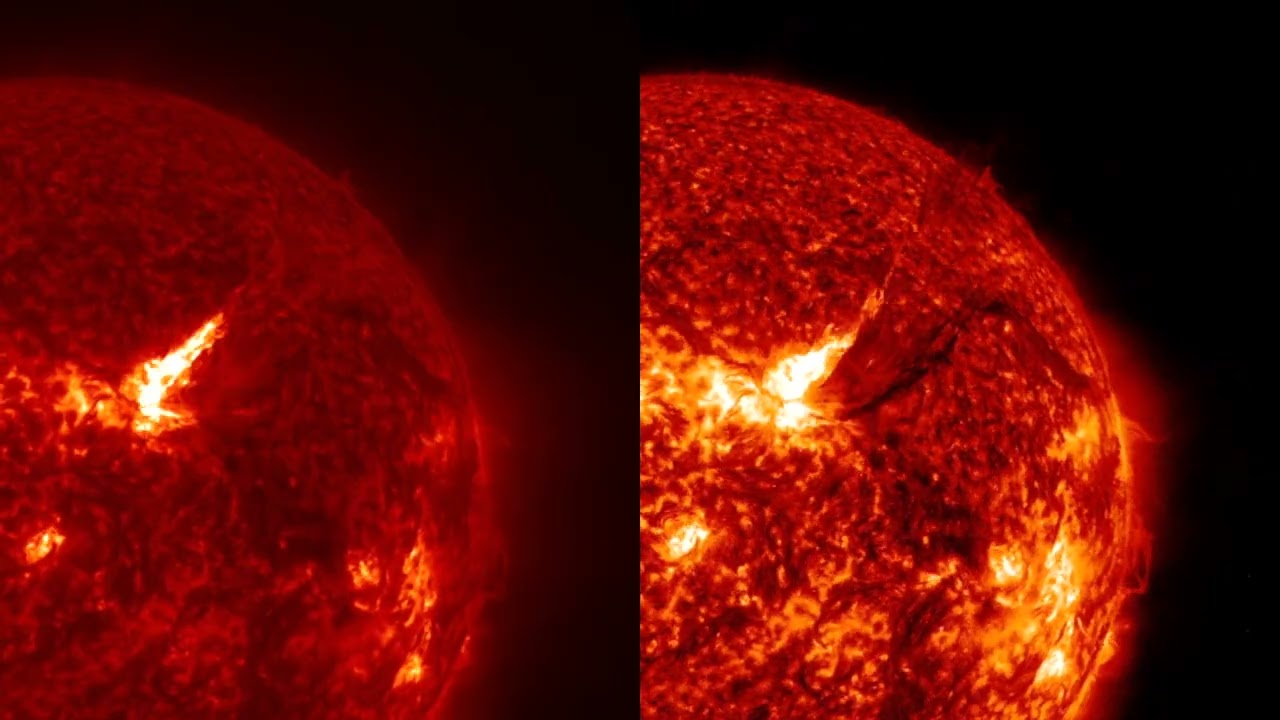
Solar Flares and CMEs at Earth - More Likely | S0 News June.3.2026
SpaceWeatherNewsS0s
2K views•2026-06-03



