The video expertly distills complex astrophysical data into a coherent narrative that demystifies Betelgeuse’s behavior without losing scientific depth. It is a rare example of science communication that balances popular intrigue with genuine academic rigor.
Install our extension to search inside any video instantly.
Shocking: Something Strange Is Happening to Betelgeuse — And Scientists Finally Know Why. makeAdded:
In 2019, a star 700 times the size of our sun ripped off a chunk of its own surface and launched it into space. 400 billion times more mass than anything our sun has ever thrown off.
The star's heartbeat flatlined for 2 years. Its surface was left wobbling like a plate of gelatin. And when astronomers finally figured out what triggered it, they found something hiding in the data that had been there for over a century. Something nobody had ever seen. A second star buried inside the giant's atmosphere, dragging trails of gas behind it like a boat cutting through an ocean of plasma. The star is Betelgeuse. That reddish-orange dot on the shoulder of Orion that you have looked at your entire life without knowing what it actually is. It sits roughly 650 light-years from Earth. If you dropped it into our solar system, it would swallow Mercury, Venus, Earth, Mars, the asteroid belt, and stretch nearly to the orbit of Jupiter. It is between 16 and 19 times the mass of the sun. It is only 10 million years old, which sounds ancient until you realize our sun is pushing 5 billion and still has another 5 billion years of fuel left. Betelgeuse burned through its supply at a rate that would be reckless if stars had a choice. It didn't. And when a star this massive runs out of fuel, it does not dim gracefully. It collapses. The core implodes at a quarter the speed of light, and then it detonates. A supernova bright enough to read a book by at night, visible in broad daylight for months. So, when Betelgeuse suddenly lost 60% of its brightness in late 2019, dropping to the faintest it had been in over 50 years of continuous monitoring, the question that ripped through the astronomical community was obvious. Is this it? Is this the beginning of the end?
The answer was no. But what actually caused it was, in many ways, stranger than an impending supernova. And the full explanation took 6 years of detective work across multiple space telescopes, ground observatories on three continents, and a prediction so precise that scientists knew exactly which week to point a telescope at the sky and what they would find there. Here is what the Hubble Space Telescope caught. Because Hubble did not just observe the dimming, Hubble caught the crime while it was still in progress.
Andrea Dupree, an astrophysicist at the Center for Astrophysics at Harvard and the Smithsonian, had been studying Betelgeuse for years.
She was actually one of the first scientists to directly image the surface of a star other than the sun back in 1996 using Hubble. So, when Betelgeuse started dimming, she had the data. She had the baseline. And she had the tools to figure out what went wrong. What her team found, published in the Astrophysical Journal in 2022, was staggering. Betelgeuse had not simply dimmed. Betelgeuse had blown off a piece of its own face. In early 2019, months before the visible dimming began, a massive shockwave originated deep inside the star. That shockwave pushed an enormous plume of superhot plasma upward through the star's convective layers and out through its surface. The material was blasted millions of miles into space.
As it traveled outward through the cooler outer atmosphere, the plasma cooled and condensed into a cloud of solid dust grains.
That dust cloud then drifted in front of the star from our perspective here on Earth, blocking roughly a quarter of Betelgeuse's visible surface. That was the great dimming, not a supernova warning, a stellar sneeze. Except this was no ordinary sneeze. Our sun does something vaguely similar.
It regularly throws off portions of its outer atmosphere in events called coronal mass ejections. But the Betelgeuse event, which Dupreez's team classified as a surface mass ejection, was 400 billion times more massive than a typical solar coronal mass ejection.
400 billion. That number is so large, it essentially stops being a number and becomes a concept. Betelgeuse ejected a substantial fraction of its total annual mass loss in a single explosive event.
Nothing like this had ever been directly observed on any star. And the aftermath was equally bizarre. After blowing its top, Betelgeuse was left with a cooler average surface temperature, an unusual short-period brightness oscillation that had never been seen before, and the complete disappearance of its familiar 400-day pulsation cycle. For more than 2 years after the great dimming, that fundamental heartbeat of the star simply vanished. Dupreez described the star's interior as bouncing, like a plate of gelatin dessert that had been struck.
Think about that for a second. A star 700 times the diameter of the sun, a ball of plasma so enormous it would engulf Jupiter, was wobbling, shaking, recovering from a self-inflicted wound so massive that it altered the star's fundamental behavior for years. By April 2020, Betelgeuse had returned to its normal brightness. The dust cloud had dispersed or moved out of our line of sight. The immediate crisis was over, but the questions were just beginning.
What caused the shockwave in the first place? Was this a one-time event or part of a pattern? And what did it mean for the star's long-term future? The answers came from a direction nobody anticipated, and they started with a question that had been nagging astronomers for decades. For decades, astronomers had noticed something odd about Betelgeuse beyond its roughly 400-day pulsation cycle.
The star also exhibited a longer, slower variation in its brightness, a secondary period of approximately 2,100 days, or about 5.9 years. The short cycle made sense.
It was driven by the star physically pulsating, expanding and contracting as pressure waves moved through its interior. The long cycle was a mystery.
Various theories were proposed.
Some suggested it was a different mode of pulsation. Others pointed to large convective cells on the star's surface rising and falling over multi-year time scales, but none of the explanations quite fit the data.
Then, in 2023, two independent research teams proposed a radical explanation.
The long secondary period was not caused by anything inside Betelgeuse at all. It was caused by something orbiting Betelgeuse, a companion star.
The idea was not entirely new. Binary star systems are extraordinarily common in the galaxy. Roughly half of all sun-like stars have at least one companion. For massive stars like Betelgeuse, the fraction is even higher, but detecting a companion around Betelgeuse would be absurdly difficult.
The star is so bright, so enormous, and so surrounded by ejected material that spotting a faint companion nearby would be like trying to photograph a firefly hovering next to the headlight of a semi-truck at night, from a mile away.
The two 2023 studies approached the problem differently.
One team, led by Jared Goldberg at the Flatiron Institute, analyzed observational data and proposed that a companion star of roughly one solar mass orbiting at about 8.6 astronomical units could explain the 2,100 day cycle.
The companion would periodically clear away dust in its orbital path, allowing more of Betelgeuse's light to reach Earth and creating the observed brightening and dimming pattern.
A second team independently examined over a century of archival data and reached a similar conclusion, suggesting a companion with an orbital period of about 5.8 years. Both teams made predictions about where the companion should be and when it would be best positioned for detection. The optimal window was calculated to be around the 6th of December 2024, when the companion would be at its greatest angular separation from Betelgeuse.
Multiple observatories prepared: Chandra X-ray Observatory, Hubble Space Telescope, and critically, the Gemini North Telescope in Hawaii, equipped with an instrument called 'Alopeke, a speckle imager capable of capturing extremely high-resolution images by taking thousands of short exposures and computationally combining them to cut through atmospheric distortion.
On the 9th of December 2024, 3 days after the predicted optimal window, the Gemini North Telescope captured something.
A faint point of light, roughly six magnitudes dimmer than Betelgeuse, sitting at an angular separation of 52 milliarcseconds at a position angle of 115° east of north, exactly where the dynamical models predicted the companion should be.
Not approximately, not in the neighborhood, exactly where the math said it would be, on exactly the week the math said to look.
The companion star had been found, and it was not remotely what anyone expected.
For years, the most popular hypothesis had been that the companion was a compact object, a white dwarf, perhaps, or a neutron star, the remnant core of a star that had already lived and died.
This would make sense dynamically and would explain certain X-ray emissions detected near Betelgeuse, but the data told a different story.
In May 2025, studies using ultraviolet and x-ray observations ruled out the possibility that the companion was a compact star.
Instead, the evidence pointed to something much stranger.
A young stellar object, a star roughly 1.4 to 1.6 times the mass of the Sun, likely an F-type pre-main sequence star.
Not a dead stellar corpse, but a relatively young active star that appeared to have formed alongside Betelgeuse roughly 10 million years ago.
Jared Goldberg had given the hypothetical companion a nickname during his research, Betel Buddy.
The name stuck in the scientific community and the press.
But by September 2025, the companion received a formal proposed name that reflected the cultural heritage of Betelgeuse itself, Siwarha, which means her bracelet in Arabic, echoing Betelgeuse's traditional Arabic name meaning the hand of Orion.
The discovery was published in the Astrophysical Journal in October 2025 by a team led by Anna O'Grady, a postdoctoral fellow at Carnegie Mellon University.
O'Grady described the brightness difference between Betelgeuse and its companion as absolutely insane and noted that the fact they could confirm something was there at all demonstrated how far observational science had come.
The mass ratio of the system is extreme.
Betelgeuse at 16 to 17 solar masses, Siwarha at roughly 1.6.
This kind of extreme mass ratio binary is unusual and challenges current models of binary star formation. How did these two very different stars form together?
How has the smaller star survived this long in such close proximity to a bloated supergiant? These questions are still open.
But what happened next made the discovery even more significant. Because Siwah was not just orbiting Betelgeuse at a safe distance, it was plowing directly through the star's extended outer atmosphere. In January 2026, at the 247th meeting of the American Astronomical Society in Phoenix, Andrea Dupree presented findings that took the Betelgeuse story to an entirely new level.
Using nearly 8 years of continuous observations from Hubble, the Fred Lawrence Whipple Observatory, and the Roque de los Muchachos Observatory, her team had detected something remarkable.
A dense wake of gas trailing behind Siwah as it moved through Betelgeuse's vast outer atmosphere.
Dupree described it plainly. It is like a boat moving through water. The companion star creates a ripple effect in Betelgeuse's atmosphere that we can actually see in the data.
For the first time, astronomers were seeing direct signs of this wake, a trail of disturbed gas confirming that Betelgeuse really does have a hidden companion shaping its appearance and behavior.
The wake appears shortly after Siwah passes in front of Betelgeuse, roughly every 2,100 days, consistent with the long secondary period that had puzzled astronomers for decades. The companion does not just orbit, it sculpts, it churns, it drags material with it, clears dust its path, and leaves behind a swirling trail of dense gas that expands outward into the surrounding space.
And just like that, mysteries that had frustrated astronomers for decades clicked into place. The long secondary period, the irregular spectral variations, the weird gas velocity shifts in the outer atmosphere.
The unusual brightening in 2023, when Betelgeuse peaked at magnitude 0.1, brighter than it had been in years. All of it, not something wrong with Betelgeuse, something orbiting Betelgeuse.
And it raises a question that astronomers are still debating.
Did Siwah play a role in the great dimming [clears throat] of 2019?
The timing is suggestive. The surface mass ejection that triggered the great dimming occurred when Siwah was positioned relatively close to Betelgeuse in its orbit.
Could the gravitational influence of the companion have helped trigger the massive convective outburst that launched all that plasma into space?
Could the companion's passage through the extended atmosphere have destabilized the outer layers enough to contribute to the eruption?
Nobody can say for certain. The surface mass ejection may have been a purely internal event driven by the star's own violent convection.
Betelgeuse is chaotic enough on its own to produce something like this without any outside help.
Or the companion may have been the nudge that pushed an already unstable system over the edge.
A gravitational tap on the shoulder of a star that was already barely holding itself together.
The data cannot yet distinguish between these possibilities, but the coincidence is hard to ignore.
Now, the question everyone really wants answered. When is Betelgeuse going to explode?
This is where the science gets messy because different research teams have reached wildly different conclusions.
And the answer depends entirely on what is happening in a place no telescope can see, the core.
Stars like Betelgeuse die by running through a sequence of nuclear fusion stages, and the progression is one of the most dramatic countdowns in all of physics.
First, they burn hydrogen into helium in their cores.
That is the longest phase, lasting millions of years. The star is stable, balanced, content. Then the hydrogen runs out and gravity squeezes the core until helium ignites, fusing into carbon and oxygen.
This phase lasts hundreds of thousands of years, still a long time by any human measure, still enough time for entire civilizations to rise and fall on any planet orbiting nearby. But from here, the timeline accelerates terrifyingly.
Carbon burning lasts roughly a thousand years. Neon burning lasts about a year.
Oxygen burning lasts a few months.
And silicon burning, the final stage before collapse, lasts approximately one single day, 24 hours.
After millions of years of steady burning, the star reaches its last day and burns through its remaining silicon fuel in a desperate, frantic, final act.
And then, the core fills with iron. Iron is the dead end of nuclear fusion. Every element lighter than iron releases energy when fused. Every element heavier than iron absorbs energy. The star has been held up its entire life by the outward pressure of fusion energy pushing against the inward pull of gravity. When the core becomes iron, that energy source vanishes instantly.
There is no next fuel.
No next stage. No escape. The outward pressure that has supported the star for 10 million years simply disappears. And the core collapses at roughly a quarter the speed of light.
The implosion rebounds off the incompressible core material, sending a shock wave outward that tears the star apart in a fraction of a second.
Supernova. In June 2023, a team of researchers from Tohoku University in Japan published a paper in Monthly Notices of the Royal Astronomical Society that analyzed Betelgeuse's multiple pulsation periods. They found that all four detected pulsation modes from the 2,200 day cycle down to the 185 day cycle could be explained by a star in the late stages of core carbon burning. Their conclusion was stated directly. Betelgeuse is in the late stage of core carbon burning and a good candidate for the next galactic supernova. After carbon is exhausted in the core, a core collapse leading to a supernova explosion is expected in a few tens of years.
Tens of years, not thousands, not hundreds of thousands, tens. The paper generated enormous attention and enormous pushback.
Morgan MacLeod, a postdoctoral fellow in theoretical astrophysics at Harvard, led a team that reached a very different conclusion. Their best models indicated that Betelgeuse is still in the helium burning phase, converting helium to carbon and oxygen in its core. This stage lasts tens to hundreds of thousands of years and is much further from the terminal collapse than carbon burning. MacLeod's analysis, published in the context of studying the great dimming event, placed the supernova much further in the future.
The disagreement comes down to a fundamental problem. You cannot directly observe what is happening in the core of a star. The core of Betelgeuse is buried beneath layers of plasma so thick and opaque that no electromagnetic radiation from the core reaches the surface.
Everything astronomers know about the core must be inferred from surface observations, pulsation patterns, and computational models. And different models with different assumptions about mass, opacity, convection, and rotation produce different answers.
Nobody disputes that Betelgeuse will eventually explode. That part is settled. The only question is when.
The consensus range spans from tens of years if the Tohoku team is correct about late carbon burning to roughly 100,000 years if the star is still in earlier evolutionary stages. That is a wild spread. But even the upper end is absurdly soon by astronomical standards.
The universe is 13.8 billion years old.
100,000 years is nothing. And what will happen when Betelgeuse finally goes? It would be the most spectacular astronomical event any living human has ever witnessed. Betelgeuse sits roughly 650 light-years from Earth, close enough to produce an absurd visual display, far enough to pose no danger whatsoever to life on our planet. When the core collapses and the supernova detonates, Betelgeuse will briefly reach a luminosity roughly 10 billion times that of the sun. From Earth, it will appear as bright as the full moon, except concentrated in a single point of light.
Miguel Montargès, an astronomer who studied the great dimming, described what it would look like. When it happens, the star will become as bright as the full moon, except that it will be concentrated in a single point. For maybe 2 months, it will be so bright that if you shut down all the lights in a city and have no clouds, you would be able to read a book in the light of the supernova. It will be visible in the daytime sky for roughly a year, according to simulations. At night, it would remain visible to the naked eye for several years as the supernova remnant slowly fades. Orion would lose its shoulder. The familiar pattern that has guided navigators, inspired poets, and anchored winter skies for all of human civilization would be permanently altered. Where Betelgeuse once burned red, there would eventually be nothing visible to the naked eye, just the expanding shell of debris detectable only through telescopes, slowly dispersing into interstellar space over thousands of years.
Could it hurt us? No. The scientific consensus is firm on this point. A supernova would need to occur within roughly 160 light-years of Earth to pose a direct radiation threat to life.
Betelgeuse is about four times that distance. The neutrino burst from the collapse would wash through our planet, billions of them passing through every square centimeter of your body, but neutrinos interact so weakly with matter that you would not feel a thing. Not a tingle, not a warmth, nothing.
The gamma rays, the x-rays, the charged particles, all of it would be diluted by 650 light-years of empty space to levels far below any danger threshold. You could stand outside and watch the entire event without a single cell in your body being harmed.
But the effects would not be zero, either. Astronomers have noted that many animals use the moon for navigation and could be seriously disoriented by a persistent, unexplained light source in the night sky that was not there yesterday.
Astronomical observations would become significantly harder during the months of peak brightness, with ground-based telescopes struggling against the glare.
And the psychological impact of watching a familiar star die in real time, visible to every human on Earth without any equipment at all, would be unlike anything our species has experienced.
The last supernova visible to the naked eye in our galaxy was Kepler's supernova in 1604, observed by Johannes Kepler himself.
That star was roughly 30 times farther from Earth than Betelgeuse.
It remained visible during the day for over 3 weeks.
A Betelgeuse supernova would dwarf it completely. And then there is the fate of Siwah.
The little companion star that astronomers spent years hunting that was finally confirmed in 2025 after decades of speculation that rewrote our understanding of why Betelgeuse behaves the way it does.
When Betelgeuse explodes, the supernova blast wave will almost certainly consume and destroy Siwah.
The companion that spent millions of years quietly orbiting its enormous partner, plowing through its atmosphere, leaving wakes of gas in its trail, will be vaporized in seconds. Gone. 10 million years of orbiting erased in less time than it takes you to blink.
But we are getting ahead of ourselves because right now, in this moment, Betelgeuse is still burning, still pulsating, still throwing off material, still being sculpted by its tiny companion. Astronomers are already planning the next round of observations.
Siwah is expected to emerge from behind Betelgeuse again in 2027 offering another opportunity to study the companion directly and refine measurements of its orbit, mass, and influence on the supergiant's atmosphere. Each orbital pass provides new data. Each observation narrows the uncertainties.
And every measurement brings us incrementally closer to understanding the life cycle of massive stars, the mechanisms of mass loss in red supergiants, and the conditions that precede one of the most powerful events in the universe.
We keep watching Betelgeuse because it is not just a star. It is a clock, a countdown running in real time above our heads every winter.
The constellations that feel permanent, that feel like they have always been there and always will be, are temporary arrangements.
Patterns made by stars at different distances, moving in different directions, living and dying on wildly different time scales. Orion will not always look like Orion. The shoulder will go dark.
The pattern will break.
And some generation of humans, whether in 50 years or 50,000, will look up at the winter sky and see something different from what we see tonight. The great dimming of 2019 was not a supernova warning. It was a stellar explosion of a different kind, a surface mass ejection so massive it had never been observed before on any star.
The discovery of Siwah was not a footnote. It was the key to understanding decades of puzzling behavior, and the scientific debate over when Betelgeuse will finally die is not academic.
It is the most direct confrontation our species has ever had with the impermanence of the night sky.
Betelgeuse is roughly 650 light years away.
The light you see when you look at it tonight left the star around the year 1376.
The Hundred Years War was raging across Europe. The Ming Dynasty was rising in China. The light that is leaving Betelgeuse right now, at this moment, will not arrive at Earth until approximately the year 2676.
Whatever Betelgeuse is doing today, whatever is happening in its core right now, we will not know for centuries. It is entirely possible that Betelgeuse has already exploded, that the core has already collapsed, that the supernova shockwave has already torn through Siwah and begun expanding outward at tens of thousands of kilometers per second, and the light from that explosion is currently somewhere in interstellar space, racing toward us at 300,000 kilometers per second, carrying the news. We just have not received it yet.
The next time you step outside on a clear winter night and look up at Orion, find the red dot on the shoulder. It is not a distant, abstract point of physics.
It is a real star with real companions, real eruptions, real convective storms raging across a surface larger than the orbit of Mars. It has been watched by every civilization that ever existed on this planet.
And one day, without warning, it will become the brightest object in the night sky besides the moon. A light so intense, it will cast shadows on the ground visible in broad daylight.
A beacon that every human alive will be able to see regardless of where they live, what language they speak, or what they believe. And then it will fade, and Orion will have a hole where a shoulder used to be.
Scientists have finally figured out what has been happening to Betelgeuse, a hidden companion star plowing through the giant's atmosphere, a surface mass ejection unlike anything ever recorded.
A star in the late stages of its evolution burning through fuel at a rate that makes its death a certainty, with only the timeline left to determine.
The mystery is far from closed, but for the first time, the pieces actually fit together, and the picture they form is one of the wildest detective stories in the history of astronomy.
If this video changed how you think about the stars above your head, subscribe. We cover the universe from the edge of the observable cosmos to the surface of dying stars every single week.
The next video on screen right now dives into something even stranger that is happening to our own planet's magnetic field. You do not want to miss it.
Related Videos

Spiral Galaxy NGC 3370 from Hubble | NASA APOD 2025-11-05 #Shorts
galaxygallery
938 views•2026-05-30

SOMETHING inside the SUN is CHANGING
RaysAstrophotography
1K views•2026-06-03

There May Be A Giant Hole In The Universe... And We Might Be Inside It | The Cosmic Ledger Entry 015
TheCosmicLedger
145 views•2026-05-31

Captured the Blue Moon (with a twist) 🌙✨ #space #bluemoon #telescope
realAstroExplorer
674 views•2026-06-01

The Map We Sent to the Stars in 1977 — Why Scientists Now Regret It
TheAncientRecord7
183 views•2026-06-03

Is this a copy of our galaxy? Discover Galaxy M81!
UniverseDocumentaries-cc4mb
995 views•2026-05-31

10 Planet Where a Black Hole Replaces the Sun
cosmicexplorer-EN
147 views•2026-06-02
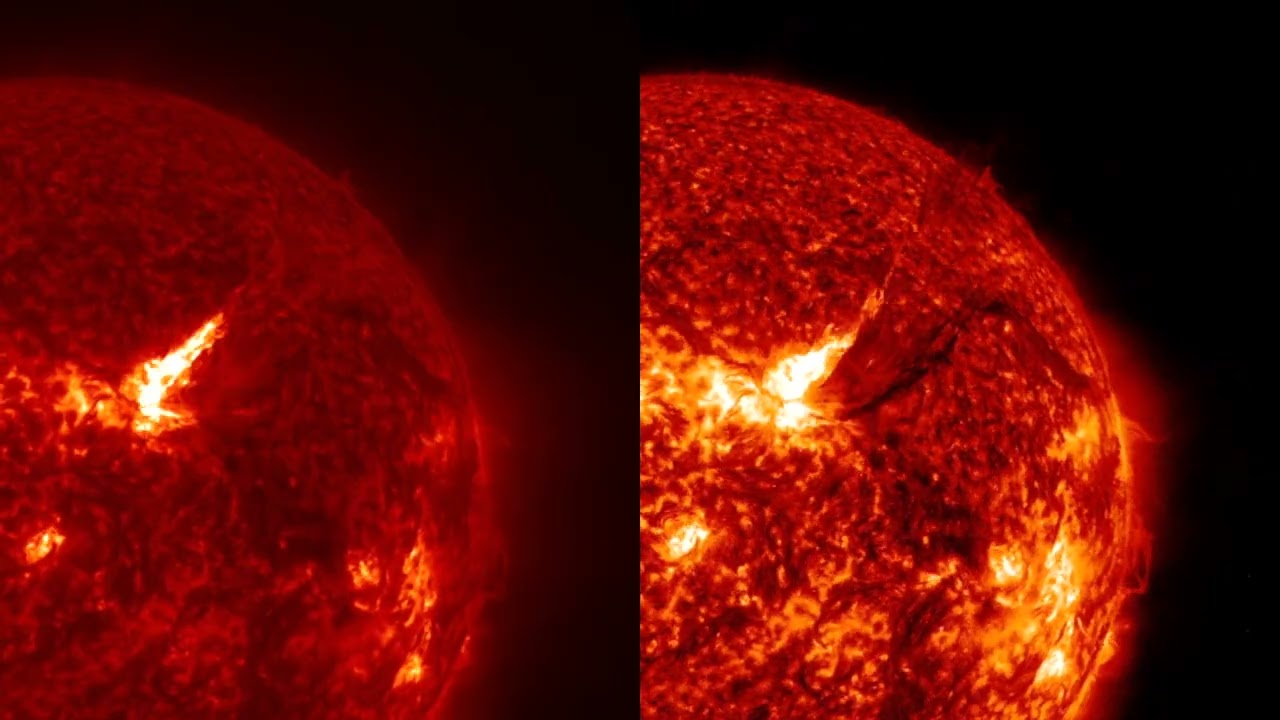
Solar Flares and CMEs at Earth - More Likely | S0 News June.3.2026
SpaceWeatherNewsS0s
2K views•2026-06-03



