While the "universe breaker" framing is a bit sensationalist, the video correctly identifies a genuine crisis in modern cosmology. It serves as a sharp reminder that our most established theories are only as good as our latest observations.
Install our extension to search inside any video instantly.
JWST Just Found “Universe Breakers” That Shouldn’t ExistAdded:
6,328 views506likes2:51TheUnknown-102Original Release: 2026-05-12
When the James Webb Space Telescope opened its golden eye, astronomers expected to see the slow, messy dawn of the universe. Instead, they found something impossible. Galaxies existing just 300 million years after the Big Bang that appear far too massive and far too mature to actually exist. Some astronomers are calling them [music] universe breaker.
And they might just force us to rewrite the standard model of cosmology. To understand why this is a crisis, we have to look at the Lambda-CDM model. This is our current framework for the universe.
It tells us that after the Big Bang, dark matter acted like an invisible scaffolding. Over billions of years, gravity [music] slowly pulled gas into this scaffolding forming small clumps that eventually merged into massive [music] galaxies like our Milky Way.
It's a bottom-up process. It takes time.
A lot of time. But JWST's infrared data is showing us fully formed massive galaxies at a time when the universe was less than 5% of its current age. Imagine walking into a kindergarten classroom and finding a fully grown adult sitting at one of the tiny desks.
That's what Webb is seeing.
According to our models, there simply hasn't been enough time for that much normal matter to assemble into stars.
This leaves us with two uncomfortable possibilities.
Either our measurements are completely wrong or our understanding of the universe is fundamentally broken.
Let's look at the first option.
Are these galaxies actually as massive as they seem? Recent follow-up studies suggest a twist. Some of these early giants might be hiding a secret.
Hyperactive supermassive black holes. As these black holes gorge on [music] surrounding gas, they glow incredibly bright masking the true size of the galaxy. It makes a smaller, younger galaxy look like an ancient heavyweight.
But even if some are illusions, others are holding up under scrutiny.
And if even a handful of these universe [music] breakers gave our galaxy the breakers are real, we have a major problem. It means we have to rethink dark matter's role in early cosmic assembly. Maybe dark matter clumped together much faster than we thought. Or perhaps early stars formed with a completely different hyper-efficient process that we've [music] never seen before.
The Lambda-CDM model has survived every test we've thrown at it for decades.
But, as JWST pierce deeper into the [music] cosmic dawn, the cracks are starting to show. We aren't just taking pictures of the early universe anymore.
We are stress testing the laws of physics. [music] Are we about to witness a cosmological revolution? Let me know what you think in the comments. And make sure to subscribe to keep exploring the mysteries of the universe [music] with us.
Related Videos

Spiral Galaxy NGC 3370 from Hubble | NASA APOD 2025-11-05 #Shorts
galaxygallery
938 views•2026-05-30

SOMETHING inside the SUN is CHANGING
RaysAstrophotography
1K views•2026-06-03

Captured the Blue Moon (with a twist) 🌙✨ #space #bluemoon #telescope
realAstroExplorer
674 views•2026-06-01

There May Be A Giant Hole In The Universe... And We Might Be Inside It | The Cosmic Ledger Entry 015
TheCosmicLedger
145 views•2026-05-31

The Map We Sent to the Stars in 1977 — Why Scientists Now Regret It
TheAncientRecord7
183 views•2026-06-03

10 Planet Where a Black Hole Replaces the Sun
cosmicexplorer-EN
147 views•2026-06-02

Is this a copy of our galaxy? Discover Galaxy M81!
UniverseDocumentaries-cc4mb
995 views•2026-05-31
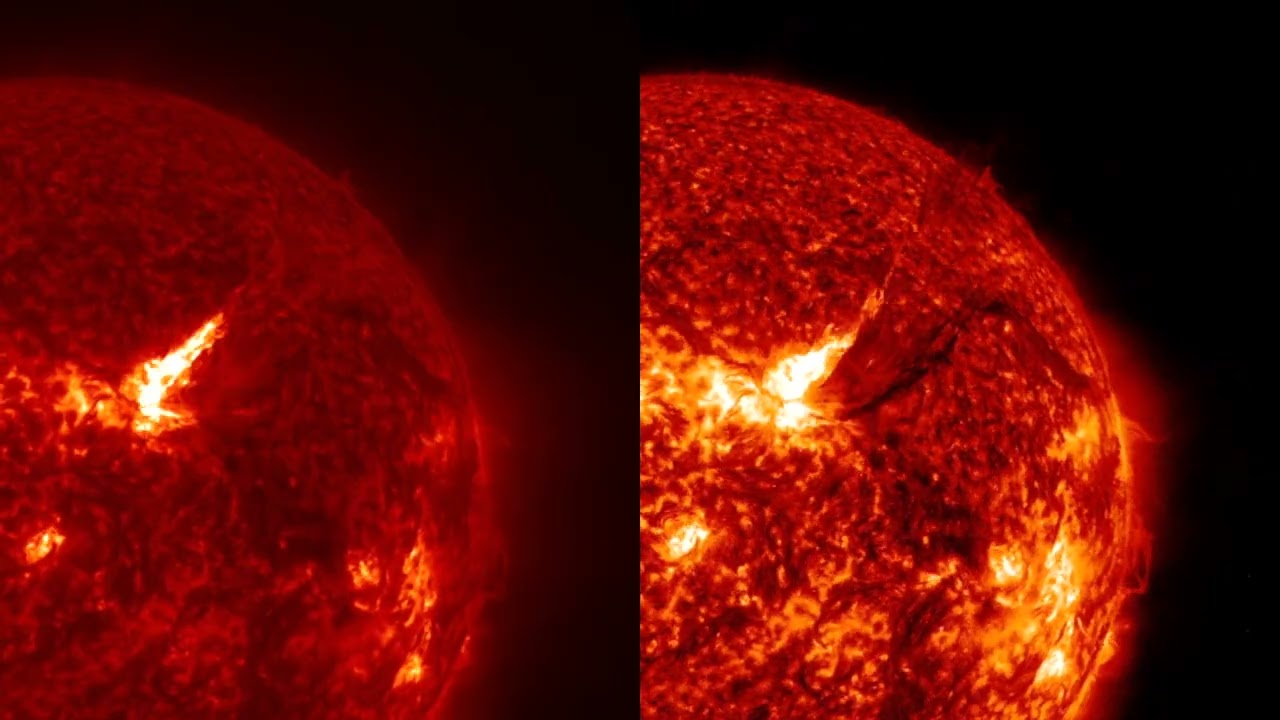
Solar Flares and CMEs at Earth - More Likely | S0 News June.3.2026
SpaceWeatherNewsS0s
2K views•2026-06-03



