The discovery that Earth-like planets are statistically common fundamentally shifts our perspective from cosmic isolation to a universe of possibilities. It is a concise reminder that our world is likely one of many, rather than a lonely anomaly.
拡張機能をインストールして、あらゆる動画内を即座に検索しましょう
NASA’s Discovery of Earth-Like Planets Revealed!追加:
For most of human history, the night sky looked silent in the most brutal way possible. Beautiful, yes. Mysterious, yes, but silent. We could stare at the stars and imagine other worlds. [music] Yet, imagination was all we had. Then NASA launched a telescope that did something [music] extraordinary. It stopped asking whether planets existed around other stars and started [music] counting them. And once it began counting, the silence changed. Because hidden inside the darkness were not just [music] a few exotic worlds, but thousands of planets. Some scorching, some bizarre, [music] some enormous, and some so eerily Earthlike that they forced humanity to confront a possibility it had dreamed about for centuries. Maybe our planet was never meant to be unique.
When NASA launched Kepler in 2009, the mission sounded [music] almost impossible in its precision. The telescope would stare at a fixed patch of the Milky Way [music] and look for the faintest dips in starlight caused by planets passing in front of their stars.
That method, known as the transit method, demanded absurd sensitivity. A truly Earthlike planet crossing a sun-like star would dim the light by a tiny fraction, so small that missing it would be easy, and detecting it reliably would be extraordinary. And yet, Kepler did it. Over 9 years, it monitored more than 530,000 stars and confirmed 2,662 exoplanets. [music] That alone would have changed astronomy forever. But the deeper impact [music] was not just the number of discoveries.
It was the realization that planetary systems are [music] not rare accidents.
They are part of the normal architecture of the galaxy. Once Kepler started [music] reporting back, the universe stopped looking like a place where planets might exist. It became a place where planets [music] are everywhere.
That changed the emotional tone of astronomy immediately. Because once you know that planets are common, the next question [music] becomes unavoidable.
How many of them could actually be places? Not gas giants with crushing atmospheres. Not lava worlds glowing under impossible heat. Real worlds, [music] temperate ones, rocky ones, worlds where water might pool, climates might stabilize, and life [music] might get a chance to begin. Kepler was not merely finding planets. It was narrowing the loneliness [music] of Earth.
Before Kepler, many people imagined other planetary systems [music] would probably look somewhat like ours. A few rocky planets near the star, gas giants farther out, [music] everything reasonably orderly. Kepler destroyed that comfort. It found hot Jupiters hugging their stars so tightly that their atmospheres were being roasted. It found super Earths larger than our planet but smaller than Neptune, worlds that have no [music] exact equivalent in our own solar system. It found planets orbiting two stars, worlds where the sky itself would look like science fiction every day. And it found lava planets so hot that rock and metal could melt across their surfaces. That flood of strange worlds mattered because it forced humanity to stop assuming [music] that the solar system was the cosmic template. It isn't. The galaxy is much weirder [music] than that. Planetary systems can be violent, compact, asymmetrical, and utterly alien in structure. Kepler's discoveries opened the [music] door to a universe of planetary diversity so extreme that even astronomers had to adjust their instincts about what a normal world might be. But buried inside all that chaos was something even more important.
Once you search long enough, you don't only find the bizarre [music] cases, you begin finding the promising ones, too.
Worlds in calmer zones. Worlds at the right distance from their stars. Worlds whose sizes, orbits, and [music] light exposure begin to echo something emotionally dangerous for us. Home.
This is the point where Kepler's mission [music] crossed from fascinating into profound. Among the thousands of worlds it helped reveal were planets in the habitable zone. That narrow range around a star where temperatures could allow liquid water to remain on the surface.
Not a guarantee of life, of course, but the condition that makes life, at least [music] as we know it, scientifically plausible. Once Kepler started finding Earth-sized or [music] near Earth-sized worlds in those zones, the dream stopped being poetic and became empirical.
Kepler 186F became one of the first major [music] examples to capture the public imagination. roughly Earth-sized, sitting in the habitable zone, and possibly enjoying enough long-term orbital and axial [music] stability to maintain a relatively steady climate.
Then came Kepler 1649C, which looked astonishingly close to Earth in some of the ways people care about most, only slightly larger, receiving roughly 3/4 [music] of the starlight Earth gets, and positioned in a way that makes scientists seriously consider the possibility of [music] Earthlike surface temperatures under the right atmospheric conditions. And of course, there was K218b, a world much larger than Earth, but still placed in the habitable zone with water signatures detected in its atmosphere. It did not look like [music] a comfortable blue twin of our planet.
It looked stranger, heavier, more like a sub Neptune or mini Neptune. But that is what made it so important. It suggested that habitability might [music] not belong only to neat Earth copies. The universe may support life- friendly chemistry in worlds far stranger than our old imagination allowed. [music] That is a huge expansion of what possible means.
Individual planets are thrilling, but Kepler's most important discovery may not have had a single name. It may have been statistical. By measuring so many stars and so many planetary transits, astronomers began [music] extracting something much deeper than a list. They began estimating how common Earth-sized worlds [music] inhabitable conditions might actually be. And the answer was staggering. Roughly one in five sunlike stars may host a planet of that kind.
Think about that for a moment. The Milky Way contains hundreds of billions of stars. A significant fraction of them are sunlike. If even a fifth of those have Earth-sized planets receiving roughly Earthlike levels of energy, then we are no longer talking about one or two rare examples scattered across impossible distance. We are talking about billions of candidates in our galaxy alone. billions of worlds where the chemistry of habitability may have had [music] a chance to begin doing something interesting. That is why Kepler changed the emotional scale of the universe forever. Earthlike planets stopped being [music] mythological. They became probable. The silence of space did not disappear, but it became harder to interpret as emptiness. It started to feel more like ignorance, more like distance, more like the simple fact that the galaxy is so large and we are still so young as a species that we have only just begun to learn how to notice what has been out there the whole time.
Kepler retired in 2018, but by then it had already done the thing that mattered most. It made a second Earth scientifically plausible on a galactic scale.
One of the most fascinating shifts in exoplanet science is that researchers are no longer only asking where is another Earth. They are also asking a much stranger question. What if some worlds are actually better for life than Earth is? Bigger rocky planets with stronger gravity could hold thicker atmospheres for longer. Slightly warmer climates might support broader habitable [music] regions. And stars smaller and longer lived than the sun, especially orange dwarfs could give life tens of billions of years to evolve instead of only a few. That is why candidates like KO15715.01 feel so powerful. A rocky world in the habitable zone of an orange dwarf is not just another Earth clone. It may represent a kind of superhabitable environment where the conditions for biology are stable for [music] absurd stretches of time. Earth needed around 4 billion years to produce everything from [music] microbes to modern civilizations. Imagine a world where evolution had 40, 50, or even 70 billion [music] years to work. The result would be impossible to picture with any confidence. But that is exactly [music] what makes it so thrilling. And once you allow that possibility into the conversation, the search changes. We stop looking only [music] for mirrors of ourselves and start looking for environments where life may have had even more favorable odds than it had here. That is a humbling thought because it means Earth may not be the peak example of a [music] living world. It may simply be one decent case in a galaxy containing planets with more time, more stability, and perhaps better biological opportunities than our own.
And maybe that is the most emotionally difficult part of all this. Kepler did not bring us nearby worlds [music] we can visit tomorrow. It brought us a revolution of possibilities spread across impossible distance. Kepler 22b may be an ocean world. Trappist 1E [music] may be one of the best nearby habitable zone candidates. Kepler 452b may be an older, heavier cousin of Earth. But even the nearby [music] ones are still separated from us by distances so vast they are almost mocking. That creates a strange tension in modern [music] astronomy. We now have strong reasons to believe the Milky Way may be crowded with potentially habitable worlds. [music] worlds with water, with stable temperatures, with long lived stars, with atmospheres [music] worth studying. And yet, for now, all we can do is detect their shadows, measure their starlight, infer their chemistry, and imagine their skies. The universe has [music] become less lonely, but not less unreachable. In some ways, that makes the [music] discoveries even more haunting. These are not destinations yet. They are silent [music] invitations. And that is the legacy Kepler left behind. It transformed [music] the question from do earthlike planets exist into how many are there and what are they like? It turned the galaxy from a backdrop into a catalog of possible homes. And in doing so, it made one thing almost impossible to ignore.
If life- friendly worlds are this common, then the real mystery [music] may no longer be whether there are other Earths. The real mystery may be how long it will take before humanity is finally capable [music] of truly meeting one.
So, in the end, NASA's discovery of Earthlike planets revealed [music] something far bigger than a list of distant worlds. It revealed that Earth may not be a lonely exception. [music] After all, Kepler showed us that planets are everywhere, that habitable zone worlds are real, [music] and that some of them may not just resemble Earth.
They may offer even better conditions for [music] life than our own planet ever did. That is why this changes everything. Because once Earthlike planets stop being fantasy and start becoming statistics, the universe feels different. The silence of the stars no longer sounds like emptiness. It sounds like distance. It sounds like limitation. It sounds like a [music] galaxy full of worlds we now have every reason to believe may exist in staggering numbers, waiting beyond our current reach. Worlds with oceans, climates, atmospheres, and histories that may have unfolded for billions of years without us ever knowing. And maybe that is the most haunting and beautiful part of all. Kepler is gone now, silent after changing astronomy forever. But the door [music] it opened is still there. James Webb and the next generation of observatories are already stepping through it, moving from planet counts to atmospheres, from shadows to chemistry, from maybe to something closer and closer to proof. One day, perhaps sooner than we dare expect, humanity may finally [music] look at one of these distant worlds and know for sure that Earth was never alone. If this changed the way you see the cosmos, subscribe, turn on notifications, and stay with us because the [music] next Earthlike world we uncover may not just resemble our own. It may finally answer the biggest question we've ever asked.
関連おすすめ

Spiral Galaxy NGC 3370 from Hubble | NASA APOD 2025-11-05 #Shorts
galaxygallery
938 views•2026-05-30

SOMETHING inside the SUN is CHANGING
RaysAstrophotography
1K views•2026-06-03

Captured the Blue Moon (with a twist) 🌙✨ #space #bluemoon #telescope
realAstroExplorer
674 views•2026-06-01

There May Be A Giant Hole In The Universe... And We Might Be Inside It | The Cosmic Ledger Entry 015
TheCosmicLedger
145 views•2026-05-31

The Map We Sent to the Stars in 1977 — Why Scientists Now Regret It
TheAncientRecord7
183 views•2026-06-03

10 Planet Where a Black Hole Replaces the Sun
cosmicexplorer-EN
147 views•2026-06-02

Is this a copy of our galaxy? Discover Galaxy M81!
UniverseDocumentaries-cc4mb
995 views•2026-05-31
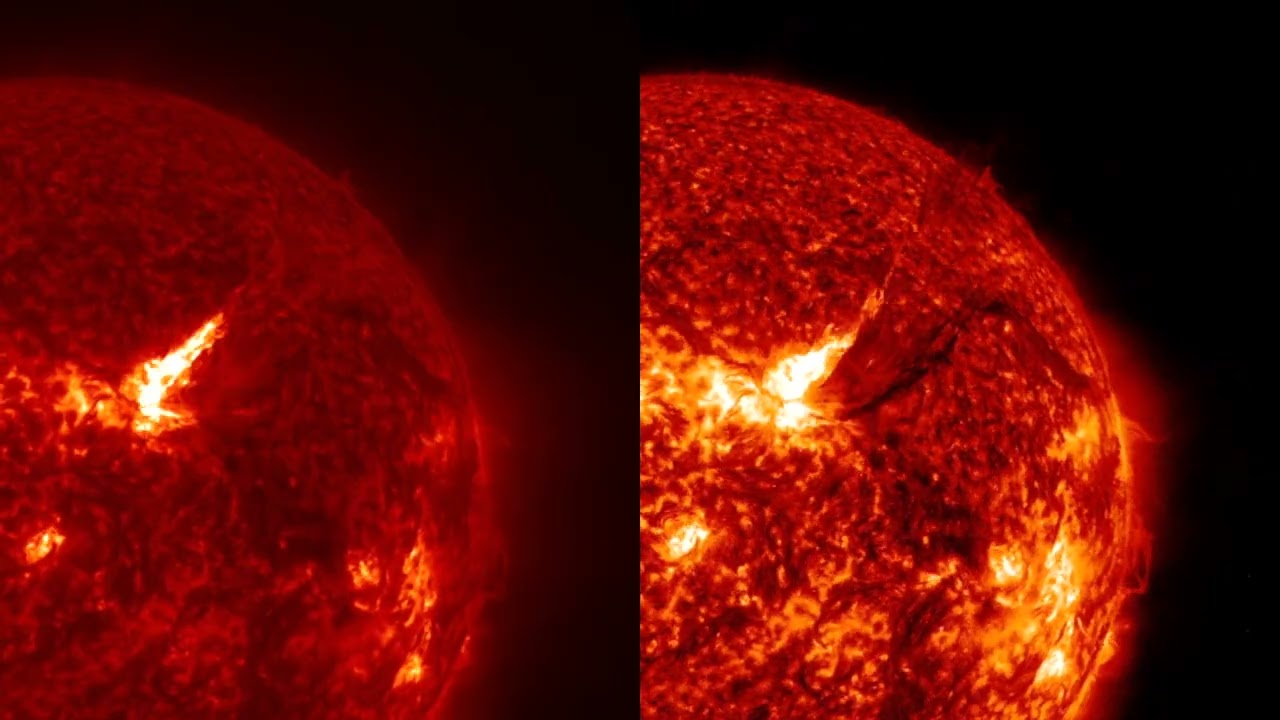
Solar Flares and CMEs at Earth - More Likely | S0 News June.3.2026
SpaceWeatherNewsS0s
2K views•2026-06-03



