Stars are born from collapsing gas clouds called nebulae, where gravity pulls matter together until nuclear fusion ignites in the core, releasing energy that powers the star for billions of years; stars like our Sun eventually expand into red giants and shed their outer layers to become white dwarfs, while massive stars end their lives in violent supernova explosions, leaving behind neutron stars or black holes.
Install our extension to search inside any video instantly.
DIES IN SECONDSAdded:
Every star in the night sky has a story.
Some are just being born. Some are living peaceful lives. And somewhere in the universe right now, a giant star is exploding in one of the most violent events ever seen. But have you ever wondered how does a star actually begin?
And how does something so powerful finally die?
Tonight, we're traveling billions of years through the life of a star. From birth to destruction to what remains after death, a star begins inside a gigantic cloud of gas and dust called a nebula. These clouds can be larger than entire solar systems. At first, everything is cold, dark, and silent. But gravity never sleeps. Slowly, gravity pulls the gas together. The cloud becomes tighter, denser, and hotter. Over thousands, sometimes millions of years, a glowing object forms at the center. This is called a protoar. And then something incredible happens. The core becomes so hot that hydrogen atoms begin crashing into each other. This process is called nuclear fusion. Fusion releases unimaginable energy. And at that exact moment, a star is born. Most stars spend billions of years in balance. Gravity tries to crush the star inward while fusion pushes outward. That perfect balance keeps the star alive. Our own sun is currently in this stage. And every second, the sun converts around 600 million tons of hydrogen into energy. That energy travels across space, warming earth, powering weather, and making life possible. But stars cannot live forever. Eventually, they begin to run out of fuel. For stars like our sun, death comes slowly. As hydrogen disappears, the star becomes unstable.
It expands into a massive red giant. So large it could swallow nearby planets.
The outer layers begin drifting away into space, creating glowing clouds called planetary nebuli. And at the center, only the dead core remains. A tiny object called a white dwarf. No explosions, no violence, just a slowly cooling ember in the darkness of space.
But massive stars die very differently.
The biggest stars burn hotter, live faster, and die violently. When massive stars run out of fuel, gravity suddenly wins. The core collapses in seconds.
Then boom, a supernova explodes across space for a short moment after the explosion. Something terrifying may remain. Either a neutron star or a black hole. Objects so powerful not even light can escape. Every star you see in the night sky is part of a cosmic cycle.
Birth, life, death, and rebirth. The universe destroys stars only to create new ones again. What other mysteries of the universe should we explore next?
Please leave your comment and don't forget to like, subscribe, and hit the notification bell for more videos
Related Videos

Spiral Galaxy NGC 3370 from Hubble | NASA APOD 2025-11-05 #Shorts
galaxygallery
938 views•2026-05-30

SOMETHING inside the SUN is CHANGING
RaysAstrophotography
1K views•2026-06-03

There May Be A Giant Hole In The Universe... And We Might Be Inside It | The Cosmic Ledger Entry 015
TheCosmicLedger
145 views•2026-05-31

Captured the Blue Moon (with a twist) 🌙✨ #space #bluemoon #telescope
realAstroExplorer
674 views•2026-06-01

The Map We Sent to the Stars in 1977 — Why Scientists Now Regret It
TheAncientRecord7
183 views•2026-06-03

Is this a copy of our galaxy? Discover Galaxy M81!
UniverseDocumentaries-cc4mb
995 views•2026-05-31

10 Planet Where a Black Hole Replaces the Sun
cosmicexplorer-EN
147 views•2026-06-02
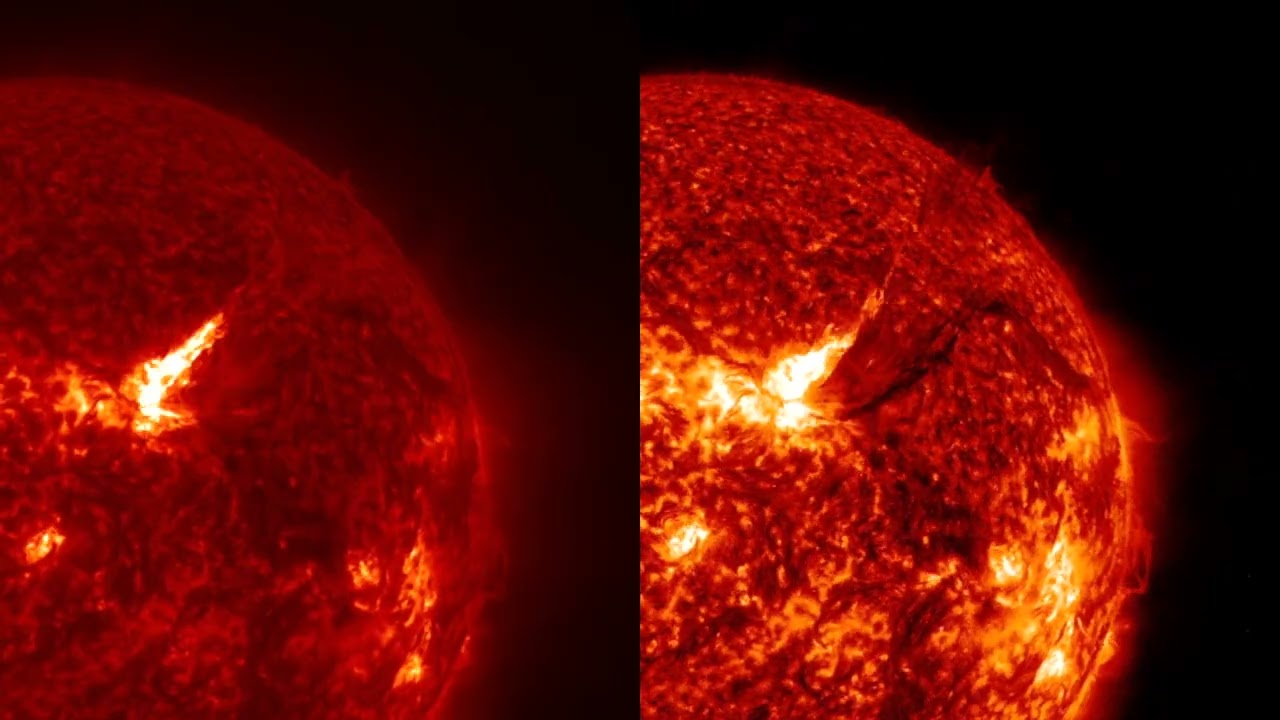
Solar Flares and CMEs at Earth - More Likely | S0 News June.3.2026
SpaceWeatherNewsS0s
2K views•2026-06-03



