The video masterfully deconstructs Saturn’s serene aesthetic to reveal the chaotic physical reality hidden beneath its iconic rings. It serves as a sharp reminder that cosmic beauty is often just a byproduct of immense, destructive forces.
Install our extension to search inside any video instantly.
Why Saturn Is The Scariest Planet (It's not peaceful)Added:
[music] Listen carefully. That isn't background music. That's Saturn itself. Radio waves translated into sound. A planet broadcasting its fury [music] into empty space. For centuries, we treated it like jewelry. The crown of the solar system.
a golden giant wrapped in glowing rings [music] drifting peacefully through the dark. We called it beautiful, but beauty is the most dangerous illusion. Saturn is not gentle. It's a violent colossus, a massive sphere of hydrogen and helium spinning so fast it bulges at the equator, warped by [music] its own speed. A world of endless storms, geometric nightmares, and [music] gravity so merciless it tears moons apart just to adorn [music] itself.
Welcome to Chaos with a halo. Start with the rings. From Earth, they look smooth, solid, eternal. Fly inside them, and you'd enter a meat grinder. They aren't bands. [music] They're a blizzard.
Trillions of shards of ice and rock from dust-sized grains [music] to mountainscaled blocks racing around the planet at thousands of kilome hour.
Constantly colliding, fracturing, and reforming. A storm of frozen shrapnel [music] nearly 300,000 km wide, yet in places only about 10 m thick, a cosmic razor slicing through darkness. So, where did this spectacle come from?
Almost certainly from destruction. Long ago, a [music] moon, possibly comparable in size to Titan, drifted too close. It crossed the Ro [music] limit, the point of no return. Saturn's gravity seized it, ripped crust from core, and shredded an entire [music] world into countless icy fragments. The rings aren't decoration. They're remains. a planetary graveyard frozen in orbit. But Saturn's strangeness doesn't stop there. Look at [music] its north pole. Nature favors curves, swirls, spirals. Yet Saturn hosts something impossible. A perfect hexagon carved into its atmosphere. Not a symbol, a storm. A six-sided hurricane [music] large enough to swallow four Earths. Its walls plunge hundreds of kilometers deep. And at its center [music] spins a vast vortex, a red rotating m like a rose made of hurricanes. It's been raging for decades, maybe centuries, a geometric scar that never heals. And when Saturn truly stirs, [music] the entire planet transforms. Roughly once every 30 Earth years, a colossal storm system awakens.
[music] the great white spot. It wraps around the entire world. Imagine a thunderstorm that circles a planet, firing lightning thousands of times more powerful than anything on Earth. It dredges ammonia ice clouds from deep within Saturn's interior, bleaching the golden globe ghost [music] white, a reminder that beneath those calm looking bands [music] lies a furnace of pressure and heat, always waiting. Saturn rules over a vast court, more than 140 moons, but one stands apart, Titan. It's the only moon in the solar system with a thick atmosphere, denser at the surface than Earth's. From the ground, you'd see rivers, lakes, clouds. It almost feels familiar. Almost. Because Titan is Earth's toxic mirror. [music] Its rain isn't water. It's liquid methane. and ethane, natural gas falling from the sky in slow motion. Surface temperatures plunge near minus 179° C. Jump into one of its lakes, and you wouldn't just [music] freeze, you'd shatter. Its dunes aren't sand, but dark hydrocarbon grains, electrically charged plastic-like particles piled into alien deserts hundreds of meters tall. A world that mimics life using [music] chemistry built for death. Farther out drifts a tiny white moon. Enceladus once dismissed as frozen rubble. Then we saw the tiger [music] stripes glowing fractures near its south pole. And from those wounds it erupts. Geysers of water vapor blast [music] hundreds of kilome into space at supersonic speed. Saturn's gravity needs this small moon like dough, keeping [music] its core warm. Beneath the ice lies a global ocean, [music] liquid water, salt, heat, organic molecules. In the [music] dark pressure below, shielded from space. Something might be moving. We went to Saturn expecting [music] gas and rock. We may have found the conditions for life. But learning these secrets came at a cost. In 2017, [music] the Cassini spacecraft, humanity's lone envoy to Saturn, began running out of fuel. To protect pristine moons like Enceladus from accidental contamination, NASA made a hard decision. They ordered Cassini to die. On its final orbit, the [music] probe plunged directly into Saturn's atmosphere, fighting to keep its antenna aimed at Earth, transmitting data [music] until the last possible moment. Saturn offered no mercy. Heat and pressure [music] tore the spacecraft apart. It melted, vaporized, and became part of the planet it had studied for 13 years. Saturn feels eternal. It [music] isn't. Even the rings are fading.
Gravity is slowly driving them downward in a phenomenon called ring rain. In about 100 million years, a blink in cosmic time, they'll be gone. Saturn will [music] stand bare. Just another gas giant in the dark. So look while you can. What you're [music] seeing is temporary. A masterpiece sculpted by gravity and violence. A beautiful trap that drew [music] us across the solar system only to remind us how small we are. Saturn may be the most stunning object in our sky. Just remember, beauty can be lethal.
Related Videos

Spiral Galaxy NGC 3370 from Hubble | NASA APOD 2025-11-05 #Shorts
galaxygallery
938 views•2026-05-30

SOMETHING inside the SUN is CHANGING
RaysAstrophotography
1K views•2026-06-03

There May Be A Giant Hole In The Universe... And We Might Be Inside It | The Cosmic Ledger Entry 015
TheCosmicLedger
145 views•2026-05-31

Captured the Blue Moon (with a twist) 🌙✨ #space #bluemoon #telescope
realAstroExplorer
674 views•2026-06-01

The Map We Sent to the Stars in 1977 — Why Scientists Now Regret It
TheAncientRecord7
183 views•2026-06-03

Is this a copy of our galaxy? Discover Galaxy M81!
UniverseDocumentaries-cc4mb
995 views•2026-05-31

10 Planet Where a Black Hole Replaces the Sun
cosmicexplorer-EN
147 views•2026-06-02
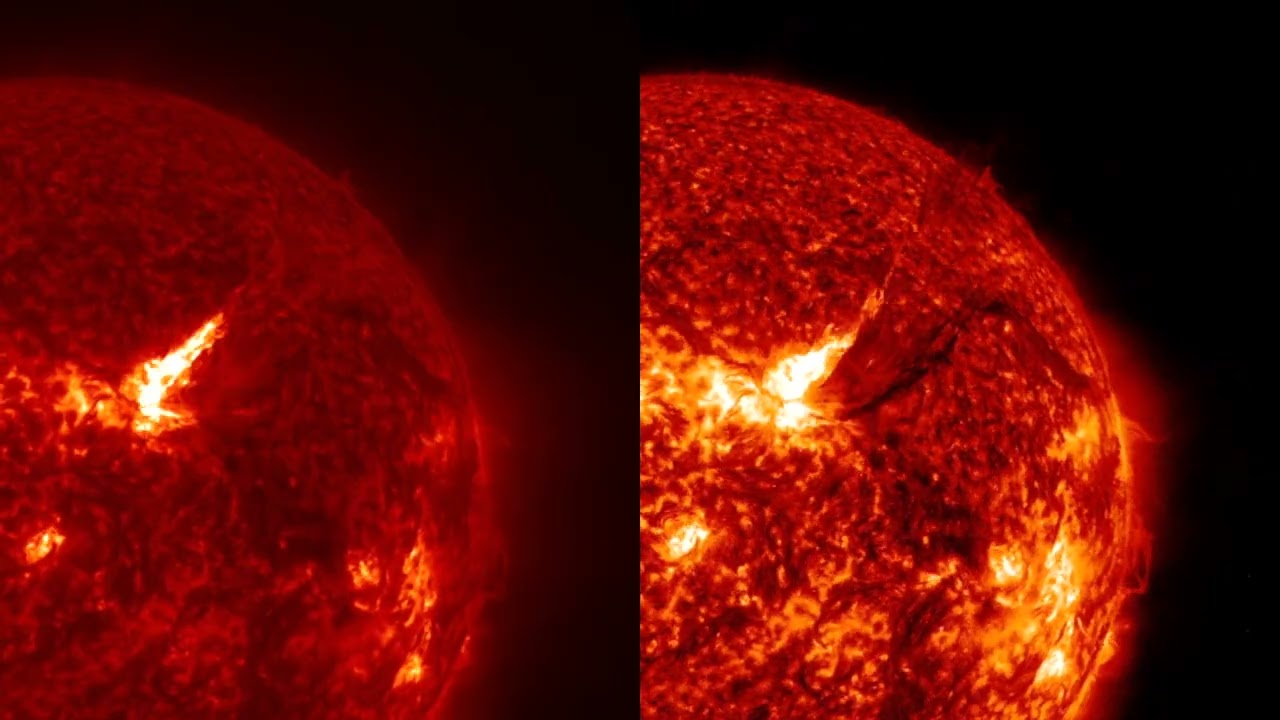
Solar Flares and CMEs at Earth - More Likely | S0 News June.3.2026
SpaceWeatherNewsS0s
2K views•2026-06-03



