This video elegantly illustrates how cosmic shadows are not voids, but rather the fertile nurseries where the chemical precursors of life are shielded and forged. It serves as a poignant reminder that in the universe, the most profound beginnings often occur in total darkness.
Install our extension to search inside any video instantly.
2026 May 20 - The Dark Wolf NebulaAdded:
Greetings and welcome to the Astronomy Picture of the Day podcast.
Today's picture is titled the Dark Wolf Nebula.
So, what do we see here?
Well, here we see the nebula known as the Dark Wolf Nebula, actually a dust cloud located within another nebula known as Gum 55.
And this is located in the direction of the towards the center of our galaxy in the constellation of Scorpius. Now, the center of our galaxy is actually located in Sagittarius, but these are very close constellations. So, we're looking in the general direction of the center of our galaxy where there's a lot more dust clouds and gas, and there's a lot of going on there because we're looking in the very highest concentration of material in our galaxy.
Now, the galaxy center itself could not be visible because it is blocked out by all the light and dust within the plane of our galaxy. And that's a similar thing here when we look at the Dark Wolf Nebula. The dark nebula is dark dusty regions that actually block out the light from behind. So, what does the wolf do? It actually absorbs all of the ultraviolet and visible light that are emitted by the stars. So, stars forming within it, we cannot see them yet, and that's because all of their light is being absorbed by the dust in the nebula.
Now, the energy has to go somewhere. You can't just lose energy. So, the energy that was ultraviolet and visible light is now going to be infrared. And nebulae like this tend to look very prominent in the infrared portion of the spectrum.
So, often we study these with things like the James Webb Space Telescope, which allows us to image directly in the infrared and to see within some of these star-forming regions. Now, within that dusty area, we also start to form molecules. So, molecules will start to form. We get what we call molecular clouds. Now, some of these, depending on their density, can form even more complex molecules and very interestingly, organic molecules. Now, organic molecules are carbon compounds and anything based on the chemistry of carbon. Though it's not necessarily living, but some of the basic materials and very complex carbon compounds can form within dark dusty nebulae like this. Now, they can often be detected with radio waves.
Molecules will emit a lot of radio waves because they have various different types of transitions that we see as compared to ordinary atoms. Why don't we normally see molecules around? Well, primarily because the molecules are broken apart by ultraviolet light from stars. So, out in space, we don't see molecules, but within dense molecular clouds such as this, where they are shielded and there are then regions that can then begin to form molecules even some similar to what we see here on Earth.
So, that was our picture of the day titled the Dark Wolf Nebula.
We'll be back again tomorrow for the next picture. So, until then, have a great day, everyone, and I will see you in class.
Related Videos

Spiral Galaxy NGC 3370 from Hubble | NASA APOD 2025-11-05 #Shorts
galaxygallery
938 views•2026-05-30

SOMETHING inside the SUN is CHANGING
RaysAstrophotography
1K views•2026-06-03

There May Be A Giant Hole In The Universe... And We Might Be Inside It | The Cosmic Ledger Entry 015
TheCosmicLedger
145 views•2026-05-31

Captured the Blue Moon (with a twist) 🌙✨ #space #bluemoon #telescope
realAstroExplorer
674 views•2026-06-01

The Map We Sent to the Stars in 1977 — Why Scientists Now Regret It
TheAncientRecord7
183 views•2026-06-03

Is this a copy of our galaxy? Discover Galaxy M81!
UniverseDocumentaries-cc4mb
995 views•2026-05-31

10 Planet Where a Black Hole Replaces the Sun
cosmicexplorer-EN
147 views•2026-06-02
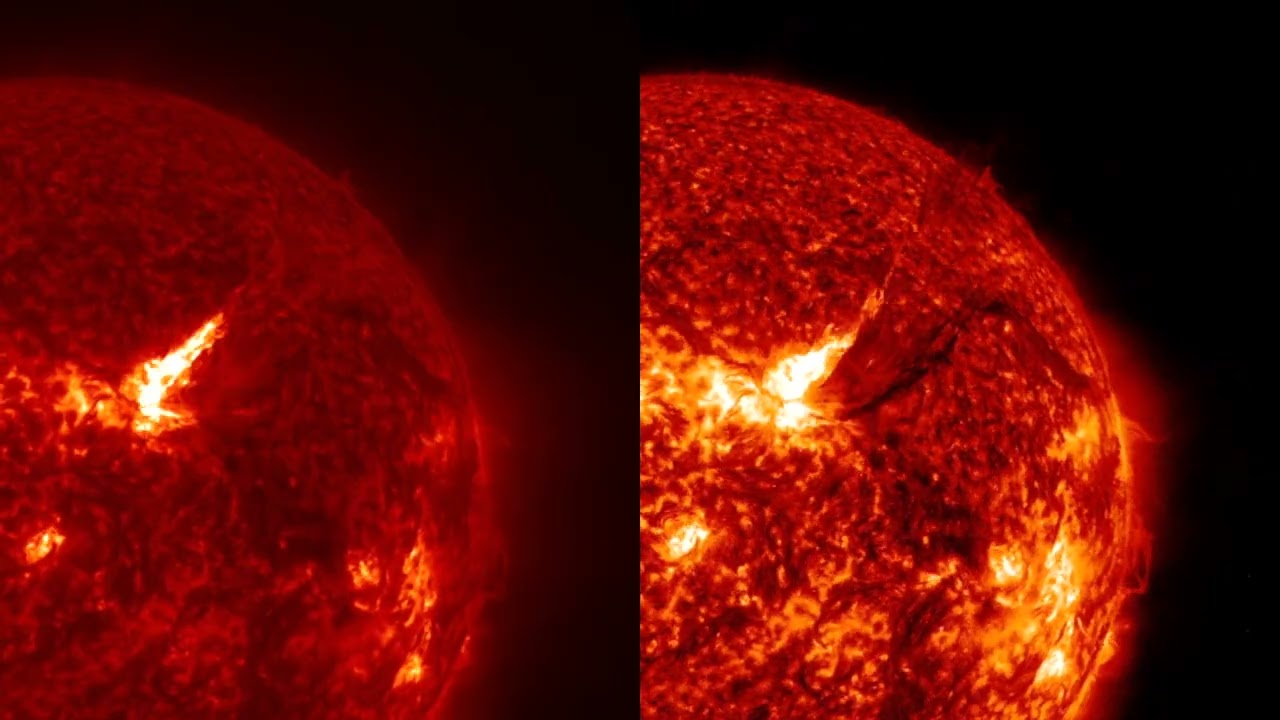
Solar Flares and CMEs at Earth - More Likely | S0 News June.3.2026
SpaceWeatherNewsS0s
2K views•2026-06-03



