Loeb rightly dismisses the Pentagon’s messy paperwork as scientifically useless, choosing instead to rely on independent, high-resolution data. He is successfully moving the UAP conversation away from government secrets and toward measurable physics.
Install our extension to search inside any video instantly.
Avi Loeb on the Pentagon’s UFO file release: What the data really shows | ChicagoLIVEAdded:
Pentagon has started releasing never before seen files relating to unidentified anomalous phenomena. Uh thank you so much for joining us again.
What are your thoughts on this big development today?
Thanks for having me. Yeah, it's a special day and that President [clears throat] Trump referred to the UFO file release uh with the words "Have fun and enjoy." And indeed that this is exactly what the Galileo Project research team under my leadership did today. Uh we looked through the files and uh you know, there is new information, new data there.
Uh it's probably not the most intriguing data that the US government has because uh that will take more time to be declassified. Um but um at any event, you know, science is the privilege of staying curious uh and asking important questions. And you know, Enrico Fermi asked in 1950, "Where is everybody?" And this is not a philosophical question. It's a scientific question that can be addressed based on data. And the answer might be right here.
And so the US government released the first batch of public UFO and UAP files.
And it includes 162 records altogether, 82 of them from the Department of War, 56 from the FBI, 12 from NASA, and eight from the State Department. So, we're dealing with information related to very serious people that are mostly focused on national security. And they see or notice objects that they cannot figure out. And I hope that this will bring the subject to the mainstream. It will not be ridiculed or sidelined because it's a serious matter. We if we are being visited by objects from adversarial nations, we need to know about it. We need to figure them out.
And if it's not human-made, then that will be the biggest discovery ever made by science. So, altogether, it's exciting.
It's like a detective story where we're trying to figure out what the data means. And you know, among the the different files, there are images from the Apollo 12 and 17 missions to the moon. And they show lights above the horizon. Uh the question is whether these lights might be related to flares from impact of asteroids. It could also be potentially related to reflections within the optics of the camera.
So, it's not clear that we're dealing with something really extraordinary. Uh and there are also some videos and images in various places around the earth uh showing objects behaving in ways that are quite unusual. But unfortunately, some of the information is redacted, so we can't really tell. I would say based everything that was released today, you know, is intriguing, but it's not conclusive. It doesn't show with beyond any reasonable doubt that we're looking at something out out of this world. Uh nevertheless, you know, there are also documents going all the way back to 1947 uh regarding flying discs.
There is a a letter that was sent to the chief of staff of the Air Force back in 1947. You know, that was shortly after the Roswell incident and discussing flying discs and uh this means that you know, military personnel for decades were reporting about this. It was never taken seriously enough for this to become a mainstream subject.
And now perhaps is the time, thanks to the initiative by President Trump.
The true age of disclosure.
Right. And you know, like in any detective story, the question is I mean the the the most important aspect of the of the story is what does the data show? What does the evidence show? Uh we shouldn't have a prejudice. We should just look at it with a sense of curiosity. And that's what makes it fun.
It's work in progress and as we go into the weeks ahead, there will be more and more files released and my hope is that at some point the there will be very intriguing objects that we can't really explain as human-made. Okay, so thus far you said that you know, your your the Galileo project that your researchers, you all have already started looking over, you know, certain things. Anything that caught your eye as odd or more so just okay, well, you know, I'm going to set this to the side, revisit that or like, yeah, I kind of knew about that.
Yeah, so indeed the Galileo project is monitoring millions of objects right now. We have three observatories and we are looking at the an object from different directions so we can figure out its distance, velocity, acceleration. And that allows us to ask whether it the motion of the object can be reproduced by human-made technologies.
That kind of sophistication, this this kind of data is not available from the release today.
in the future, if we do see objects that are outside the performance envelope of human-made technologies, obviously we let the public know and that would of course trigger more more data uh because a lot of people would be curious about it.
So far we haven't seen an object that we can definitely say we without any doubt that behaves outside what we can imagine based on human made technologies. But you know, the government was collecting data for decades and they have much a much larger budget.
You know, the defense budget for 2026 was a trillion dollars. So there is presumably much more interesting stuff with it that is hidden from you view right now and hopefully in the coming weeks it will be declassified. But irrespective what the government did and you know, they did it as part of their effort to the to to secure national safety of the nation.
Irrespective of that, you know, there there needs to be a scientific research program trying to figure out what such incidents are. What these unusual objects that the government cannot figure out. And at the end of the day, you know, it might well be that we can explain all of them scientifically as human made things or or natural phenomena, but it may also be the case that one out of a million would be intriguing and that you know, that would be the next revolution in science. You used the term adversarial. How do you know we don't have like friendly aliens that are watching us?
Oh, I was referring to humans as potentially adversarial. You know, that's what the intelligence agencies and the Pentagon are always worried about adversarial nations. With respect to our dating partner, you know, in this blind date of interstellar proportions, we have no idea. I mean, it's most likely that that that they are not out to kill us because they could have done it long ago and they haven't done so but we should always you know open our eyes and and check what their intentions might be if we find any evidence for a probe nearby.
My hope is that it will bring us to a better place because we would recognize new technologies new signs that we are not aware of because presumably they are more advanced than we are if they arrived at our backyard before we arrived at their backyard. It will also inspire us to explore space and it will change the way we view ourselves. You know if we are not at the top of the food chain we should be more humble.
Also it will change our perspective instead of engaging in conflicts here on earth. You know this sounds childish when you think about the big picture of the universe because there is much more real estate out there and we keep being obsessed with the resources here on this planet and so it will be a wake-up call for us to realize that there is much more out there and perhaps it will inspire us to work together because we are all in the same boat you know on this planet and rather than waste energy resources time and lives on conflicts we should do better by regarding ourselves as all members of the same family the human family the human civilization here. So if we do recognize a neighbor that would define us better and will give us aspirations beyond our geopolitics of the day and so my hope is it will bring us to a better place and that's why I'm pursuing this. I mean there aren't many questions in science that can do the same.
I did ask you about you know what you all have seen so far. I didn't really hear you mention like what was the most important or most significant thing that you've seen so far?
Well, we looked at the videos and the images. Oh, you're talking about the Galileo Project. Uh for for the files today.
For the files today, yes.
Um my research team we you know went through all of the data that was released and unfortunately in many cases there were reductions. So, we couldn't really infer what the actual velocity or what is the time that elapsed when we're looking at the video, what is the distance of the objects we're looking at from the camera, what was the camera doing, was it attached to an airplane or something else? And all these uncertainties did not allow us to come to a conclusion that we're looking at something unusual. I mean, in many cases we might have been looking at a balloon or you know in one case even a bug or in another case perhaps a laser beam moving so it wasn't clear what we're looking at.
So, I I would say that the current release is full of uncertainties and ambiguities. We can't really say whether there is anything out of this world, but but it's it's the opening shot in a long journey. You know, it's the first step and in the coming weeks we'll get much more intriguing data that's that will inspire us to to do more research into it. For example, there are 46 videos that were requested from the Pentagon by Congresswoman Anna Paulina Luna and presumably they will be released in the next batch the next next release that hopefully will be within a week or so. Okay, and that's uh that was going to be my final question. So, you think we'll get the next release in about a week?
Well, that's what we were told on the internet, but you know, time will tell because in the past we waited for much longer than expected. I mean, President Trump said very, very soon and it took a few weeks for it.
So, but now that the first release took place, then I think we might have a steady stream in the coming weeks of of new information. And that makes it exciting and you know, obviously there will be the film of Steven Spielberg, Disclosure Day, coming out in June.
And my hope is that Disclosure Day will come in reality because nature is much more imaginative than even Steven Spielberg.
Well, my, my, my, maybe we'll be talking to you again in a week or maybe a little bit longer, but it sounds like we'll we'll be speaking with you very, very soon.
>> [laughter] >> Thank you so much for having me. Thank you as always. We appreciate you, Professor Loeb.
Related Videos

Spiral Galaxy NGC 3370 from Hubble | NASA APOD 2025-11-05 #Shorts
galaxygallery
938 views•2026-05-30

SOMETHING inside the SUN is CHANGING
RaysAstrophotography
1K views•2026-06-03

There May Be A Giant Hole In The Universe... And We Might Be Inside It | The Cosmic Ledger Entry 015
TheCosmicLedger
145 views•2026-05-31

Captured the Blue Moon (with a twist) 🌙✨ #space #bluemoon #telescope
realAstroExplorer
674 views•2026-06-01

The Map We Sent to the Stars in 1977 — Why Scientists Now Regret It
TheAncientRecord7
183 views•2026-06-03

Is this a copy of our galaxy? Discover Galaxy M81!
UniverseDocumentaries-cc4mb
995 views•2026-05-31

10 Planet Where a Black Hole Replaces the Sun
cosmicexplorer-EN
147 views•2026-06-02
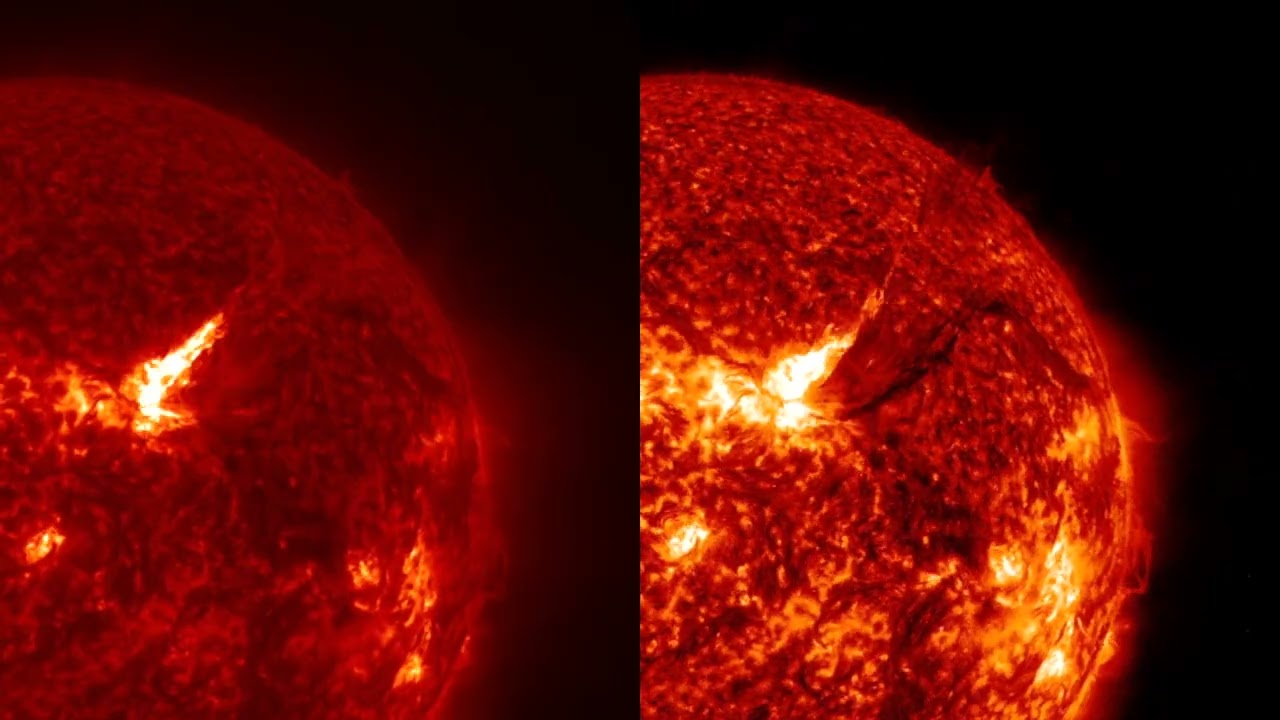
Solar Flares and CMEs at Earth - More Likely | S0 News June.3.2026
SpaceWeatherNewsS0s
2K views•2026-06-03



