This video offers a sobering, scientifically grounded look at the thermodynamic inevitability of our planet's demise. It effectively contextualizes human existence as a brief, fragile miracle within the vast and indifferent timeline of stellar evolution.
Install our extension to search inside any video instantly.
The Last Billion Years: How Earth Loses Its Oceans and All Life EndsAdded:
There is a question that most people never ask themselves. Not because it is frightening, though it is frightening, but because it is too large. How much longer will Earth survive?
Not Earth [music] as a planet of rock and iron. It will endure for several billion years more, but Earth as a living planet. Earth with oceans. Earth with an atmosphere.
Earth where something can [music] exist.
The answer exists and it is unambiguous.
Earth will be destroyed by its own star slowly, [music] inevitably, according to laws of physics that admit no exceptions.
Within 1 billion years, give or take, there will not be a single living organism on this planet. We know this not because we are guessing. We know it [music] because we understand stars.
The question is not whether this will happen. The question is what will occur between now and then. Before we get down to business, please subscribe to this channel. Your support makes it possible for us to continue this work and we are genuinely grateful for it. Thank you.
Now let us walk to the end of the world.
There is a particular kind of vertigo that comes from thinking about the future in geological time.
We are comfortable enough with the past.
We have learned over the last two centuries to absorb deep time in the backward direction.
We understand that the dinosaurs lived 66 million years ago. We understand [music] that the first complex animals appeared 600 million years ago. We have built a fairly detailed picture of the history of this planet stretching back 4 billion years. And while that picture has required significant effort to construct, the basic cognitive operation it demands is one we find manageable.
The past is fixed. It already happened.
We are simply reading it. The future is different. The future has not happened yet. And this makes [music] it feel uncertain, speculative.
the province of science fiction rather than science. But here is what most people do not realize.
For time scales long enough, the future is not particularly uncertain at all.
In fact, [music] for time scales of millions and billions of years, the future of this planet is in some ways more predictable than the weather next Tuesday.
This seems paradoxical. So, let me explain it. The uncertainty in forecasting [music] is driven primarily by complexity, by the enormous number of interacting variables that make any given system hard to predict in the short term.
The climate [music] next week depends on the exact state of every air mass on the planet, every ocean current, every surface temperature gradient. A chaotic system in the mathematical sense where tiny differences in initial conditions produce wildly different outcomes.
We cannot predict it accurately beyond about 10 days. But stellar physics is not chaotic. The behavior of a star, including our sun, is governed by the simple, relentless logic of nuclear fusion and [music] gravitational pressure. And that logic plays out on time scales of billions of years in ways that are calculable to a surprisingly high degree of [music] precision.
We know with considerable confidence how bright the sun was 4 and a half billion years ago when the Earth formed. We know how bright it is today. And we know how bright it will be in 1 billion years and in [music] 5 billion years because the physics that governs stellar evolution does not depend on anything [music] as unpredictable as weather or politics or the decisions of individual organisms.
This is the foundation of everything we are going to discuss today. The story of Earth's future is at its deepest level the story of a planet in an increasingly uncomfortable relationship with its star.
And the star, unlike everything [music] else in this picture, follows a script written in the laws of nuclear physics.
A script that is already known, already calculated, and already being executed.
Let us start with what is coming soon.
In geological terms, soon means the next million years. And the next million years, it turns out, will be eventful.
Right now, at this moment in the geological present, we are living in an interglacial period.
a warm interval between ice [music] ages. The last glacial maximum when ice sheets extended across much of North America and Northern Europe to depths of more than a mile ended approximately [music] 11,000 years ago. In geological terms, that was yesterday.
The warmth we currently enjoy. The climate that [music] has allowed human civilization to flourish that has allowed agriculture that has allowed the development of everything from the wheel to the smartphone is a temporary condition. A mild [music] hospitable window between episodes of ice. The natural orbital cycles that drive ice ages. Cycles in the shape of Earth's orbit [music] around the sun.
Cycles in the tilt of Earth's axis, cycles in the wobble of that axis, continue operating regardless of anything we do. Under natural conditions, without any human modification of the atmosphere, Earth would be expected to [music] enter the next glacial phase somewhere between 50,000 and 100,000 years from now. The ice would return slowly. Over thousands of years, the sheets would build. Sea levels would drop by hundreds of feet. The landscapes of northern North America and Europe would be buried under ice a mile thick.
I want to be precise here because this is a point that is frequently misunderstood in discussions of climate change.
The current warming driven by greenhouse gas emissions does not eliminate the ice age cycle.
What it does is delay it and possibly delay it for an extraordinarily long time.
Calculations published in recent decades suggest that the current pulse of carbon dioxide in the atmosphere may be sufficient to postpone the next glacial maximum by somewhere between 50,000 and 500,000 years. Which means that in an ironic twist of planetary history, the same species that is currently [music] destabilizing the holosene climate may also be the species that inadvertently prevented the return of the ice ages for half a million years.
This is not an argument for inaction on climate change.
The short-term consequences of rapid warming are serious and deserve serious attention.
But it illustrates something important [music] about how planetary systems operate at the scale we are discussing today. The rules are different at different time scales and what looks like catastrophe at one scale can look like a minor perturbation at another.
At the scale of a million years, here is what matters. Earth will experience at least several more glacial cycles separated by warm interglacials.
The specific timing depends on many factors, including the chemistry of the atmosphere.
The ice will advance and retreat, carve landscapes, deposit glacial sediments, and reshape coastlines.
This has happened many times before, and the biosphere has adapted each time.
Life does not care about ice ages in the way we might fear it would. It bends [music] around them, shifts polewood and equatorwood as conditions change, and reassembles itself in new configurations when the ice retreats.
But something else is coming within the next million years that is far less predictable and far more sudden.
The Yellowstone super volcano.
I want to be careful here because Yellowstone has become something of a media fixture, a source of dramatic [music] headlines that frequently overstates the imminence of the threat.
The Yellowstone caldera has erupted three times in the last 2.1 million years. Roughly 2.1 million years ago, 1.3 million years ago, [music] and 640,000 years ago. The intervals between those eruptions are approximately [music] 600 to 800,000 years.
We are currently about 640,000 years past the last major eruption, which means that by a strictly periodic model, we are statistically within the window of the next one.
In reality, super volcanic eruptions are not strictly periodic, and Yellowstone may not erupt again for millions of years, or it may never produce another caldera forming eruption at all.
The magma chamber is large, but the conditions required for a super eruption. Sufficient magma, sufficient volatiles, sufficient pressure are not continuously met. Current monitoring shows no evidence of an imminent eruption. But here is the reason it belongs in this story. When Yellowstone does erupt again, not if, but when. On the time scale of a million years, the consequences will be unlike anything in recorded human history. A super volcanic eruption of Yellowstone's caliber [music] would release somewhere between 1,00 and 2,500 miles of volcanic material.
For comparison, the Mount St. Helen's eruption of 1980 released approximately 0.3 cub miles.
We are talking about an event between 3,000 and [music] 8,000 times larger than one of the most dramatic volcanic eruptions in the modern era. The immediate effects would be catastrophic at a regional scale. The long-term effects, the injection of sulfur dioxide into the stratosphere, the global cooling from volcanic aerosols, the disruption of agriculture across the northern hemisphere for years would affect the entire planet.
Civilizations have been disrupted by smaller eruptions.
The eruption of Tambora in 1815 triggered what historians call the year without a summer. Crop failures across the northern hemisphere, famines, social disruption, disease.
Tambbora released approximately 12 miles of material.
Yellowstone at its worst would release 200 times that. And Yellowstone [music] is not the only super volcano on this planet. There are others. The Long Valley Calera in California, the Camp Flegre system in Italy, the Toba Caldera in Indonesia, which produced an eruption approximately 74,000 years ago that may have reduced the global human population to as few as 10,000 individuals. All of these systems are on the time scale of a million years capable of erupting again.
The point is not to frighten you. The point is to establish what the baseline level of geological violence on this planet actually looks like when [music] you extend the time frame beyond human experience.
We live in a geologically quiet moment.
The next million years will be significantly louder.
There is one more visitor in the next million years that deserves attention before we move forward. The asteroid.
Not Apous.
Not any specific named object that currently has a measurable probability of impact.
I mean the statistical certainty that over any sufficiently long period of time, this planet will be struck by objects large enough to matter globally.
The impact that ended the Cretaceous 66 million years ago involved an asteroid approximately 6 mi in diameter. Objects of that size hit Earth roughly once every 100 million years. less frequently than some people imagine, but with a frequency that is far from negligible over the time scale of a million years.
An object large enough to trigger global climate disruption comparable to the Cretaceous event has perhaps a 1 inund chance of striking Earth in [clears throat] any given million-year period.
What this means practically speaking is that over the next million years there is a real probability, not a certainty but a real probability of an impact event that would dramatically reset the trajectory of whatever civilization or biosphere exists at that time. The dinosaurs did not see it coming. We have the advantage of being able to track near-earth objects with telescopes and increasingly with space-based sensors. We have developed, [music] at least in theory, the ability to deflect smaller objects.
The Dart mission in 2022 demonstrated that a kinetic impactor can meaningfully alter the orbit of an asteroid.
But deflection technology scales poorly with object [music] size. A 100 meter object capable of devastating a city or triggering a regional tsunami is theoretically manageable with current technology given sufficient warning time. A kilometer scale object capable of triggering global climate disruption is at the edge of what could be addressed with near future technology.
A six-mile object like the Chickixul impactor is [music] with any technology we can currently envision essentially undelectable.
The statistical reality of impact risk is one of the reasons that in the very long view the continued existence of complex life on any single planet is inherently precarious.
Not because impacts are frequent, but because over time scales of hundreds of millions of years, the probability of a civilization ending event approaches certainty. This is one [music] of the arguments made by scientists and philosophers who study long-term existential risk that the long-term survival of any intelligent species requires expansion beyond its home [music] planet. Not because the home planet is unimportant, but because the home planet is statistically mortal.
But that is a conversation for another time. For now, let us take the longer view. But now, let us skip ahead because the [music] next major chapter in this story does not take place in a million years. It takes place in something closer to 50 million. In 50 million years, this planet will be geographically unrecognizable.
The continents are not fixed. They never have been. The theory of plate tectonics, the understanding [music] that Earth's surface is composed of a dozen or so large plates of rock floating on the semi molten mantle below. Moving at roughly the speed at which fingernails grow, driven by convection currents in the mantle, is one of the great achievements [music] of 20th century science and one of its most powerful predictive tools.
We can measure the current velocity and direction of continental motion with GPS satellites and we can extrapolate those motions forward in time with considerable confidence.
The Atlantic Ocean is currently widening at approximately 1 in per year.
The African plate is moving northward slowly closing [music] the Mediterranean Sea.
Australia is moving northward toward Asia. The Indian subcontinent, which collided with Asia roughly 50 million years ago and produced the Himalayan mountain range, is still moving north and still pushing those mountains upward.
and the Pacific Ocean. The largest geographic feature on this planet's surface is being consumed at its margins. The Pacific plate sliding under the surrounding plates [music] at subduction zones that ring it in the zone of seismic and volcanic activity we call the ring of fire.
In 50 million years, the Mediterranean will be largely closed, replaced by a new mountain range. As the African and Eurasian plates complete [music] their collision, East Africa will have rifted away from the rest of the continent along the East African rift system, creating a new island landmass [music] in what is currently the Indian Ocean. Australia will have collided [music] with Southeast Asia, creating a new mountainous zone in the equatorial Pacific region.
And California, or at least the part of California west of the San Andreas fault, will have moved northward far enough to become an island archipelago somewhere off the coast of what is now Alaska. [music] In 250 million years, the current trends in continental motion will have produced something that geologists are already beginning to model, a new superc continent.
The leading model is called Pangia Ultima and it describes a configuration in which the Atlantic Ocean closes as North [music] America and Europe converge. The Pacific shrinks further and the major land masses reassemble into a single continent centered roughly on the equatorial region. This would be the third or fourth time in Earth's history that the continents have assembled into a superc continent. The previous one was the original pangia which broke [music] apart approximately 200 million years ago and whose breakup set in motion all the continental arrangements we see today.
The assembly of Pangaya Ultima would have profound biological consequences.
A single superc continent [music] centered near the equator would be an extraordinarily harsh environment for most complex life.
The interior of such a landmass thousands of miles from any ocean would be a vast arid desert.
extreme temperature swings between [music] summer and winter. Almost no moisture penetrating from the coasts.
The habitable zone for complex multisellular life would be a relatively narrow band [music] around the continental margins exposed to the modulating influence of the ocean.
Now, pause here for a moment because I want you to consider what life on that future continent would look like. We tend to think of evolution as producing creatures that [music] are variations on themes we already know. Bigger mammals, faster predators, more colorful birds.
But 250 million years of evolution from today's starting point would produce a biosphere as different from ours as ours is from the perian world that preceded the age of dinosaurs.
The mammals that survived the Cretaceous extinction 66 million years ago gave rise in 66 million years to everything from blue whales to bats to elephants to us. In 250 million years from now, the descendants of today's mammals, if mammals still exist, would have had nearly four times that long to diversify. We have absolutely no way to predict what they would [music] look like. The body plans, the ecological strategies, the sensory systems, all of it would be alien to our eyes. And yet it would all be built from the same basic materials, the same genetic toolkit, operating under the same evolutionary pressures that [music] have always governed life on this planet.
Whatever those creatures are, they will face a world defined by the superc continent's geography.
They will evolve in the context [music] of vast interior deserts, narrow coastal habitable zones, mountain [music] ranges as large as the current Himalayas produced by the continental collisions, and a [music] climate dominated by monsunal circulation patterns driven by the enormous land area. It will be a hard world, but life has always managed hard worlds. The dinosaurs lived through the assembly of pangia. Complex life survived the end perian extinction when the superc continent of the time contributed to conditions that killed 96% of marine species.
Life is [music] as we have established many times on this channel extraordinarily persistent.
But the superc continent cycle is not the most important geological process shaping the distant future of this planet.
What matters most, what will increasingly dominate the trajectory of Earth is the sun.
The sun is getting brighter.
This is not a hypothesis [music] or a projection. It is a wellestablished consequence of how stars work.
In the core of the sun, hydrogen atoms are being fused into helium at a rate of approximately 600 million tons per second.
As this process continues over billions of years, the proportion of helium in the core increases. The core gradually contracts and heats [music] up under the weight of the layers above it and the rate of fusion increases slightly. The result is [music] a star that grows gradually but relentlessly more luminous over time. When the sun formed roughly 4 12 billion years ago, it was approximately 70% as luminous as it is today. At the current moment, it is 100% as luminous as it is today. By definition, in 1 billion years, it will be approximately 10% more luminous than it is today.
In 2 billion years, roughly 20% more luminous.
In 5 billion years, as it begins its transition to a red giant, it will be dramatically more luminous, eventually expanding to engulf the inner planets entirely.
10% more luminous might not sound dramatic, but the Earth's climate system is extraordinarily sensitive to small changes in solar input.
A 10% increase in the energy arriving from the sun is from the perspective of climate science an enormous pertubation.
For comparison, the difference between a typical interglacial period and a full glacial maximum between the relatively warm climate we have now and a world with ice sheets extending to the latitude of New York City corresponds to a change in effective solar input of roughly 1 to 2%.
A 10% increase in solar luminosity arriving over the course of approximately 1 billion years will overwhelm every climate feedback mechanism on this planet.
The question is not whether it will fundamentally transform the earth. The question is precisely how and in what sequence the transformation will occur.
The first system to come under pressure is one you might not [music] expect.
Not the oceans, not the ice caps, not the rainforests, the carbon dioxide cycle.
Here [music] is something that most people do not know about the long-term carbon cycle. Over geological time, carbon dioxide is continuously added to the atmosphere by volcanic activity [music] and continuously removed from the atmosphere by a process called silicut weathering.
When rain falls on exposed silicut [music] rock, the most abundant type of rock on Earth's surface, it reacts with carbon dioxide dissolved in the water to form carbonic acid, which then reacts with the rock minerals to produce carbonate compounds that are eventually carried by rivers to the ocean and deposited as seafloor sediment.
This process draws carbon dioxide out of the atmosphere and locks it [music] in the rock cycle. It is one of Earth's primary long-term climate regulators and it is temperature sensitive in a crucial way.
Warmer temperatures accelerate the rate of chemical weathering which removes more carbon dioxide from the atmosphere which cools the planet.
This feedback system has kept Earth's climate within habitable bounds [music] across hundreds of millions of years of changing solar luminosity.
As the young sun slowly brightened, the silicut weathering feedback compensated by drawing down atmospheric carbon dioxide, [music] keeping temperatures from running away.
It is a remarkably elegant [music] regulatory mechanism and it has worked well for most of Earth's history, but it cannot work forever because there is a lower limit to how much carbon dioxide the atmosphere can sustain.
And that lower limit is not zero. It is the concentration required to support photosynthesis. [music] Most plants cannot photosynthesize below a carbon dioxide concentration of approximately 150 parts per million. Today, [music] the atmosphere contains roughly 420 parts per million, elevated from the pre-industrial level of 280 by human activity. In the natural carbon cycle, without human interference, that level would decline as the sun continues to brighten and silicate.
Weathering continues to draw carbon dioxide down somewhere between 500 million and 800 million years from now. The models vary in their precise estimates, but they converge on this general time frame.
Atmospheric carbon dioxide will fall below the threshold required for most plant life to photosynthesize.
This will not happen overnight.
It will happen gradually over millions of years as carbon dioxide levels inch downward.
But the consequences when they arrive will cascade through the entire biosphere in a way that makes the current climate disruption look mild.
When plants can no longer photosynthesize effectively, the base of the food web collapses.
Everything that eats plants and everything that eats things that eat plants faces starvation.
The oxygen that plants produce will no longer be [music] replenished at the same rate and the atmospheric oxygen concentration will begin to decline.
Soils which are maintained in large part by the biological activity of plant roots and the organisms associated with them will begin to degrade the microisal networks we discussed in our previous video. The underground [music] biological internet that has been running for 450 million years will lose their plant partners and collapse.
The entire terrestrial biological system built over hundreds of millions of years on the foundation of photosynthesis will begin to unwind.
This is the first apocalypse in our story. Not a sudden catastrophe, not an asteroid or a super volcano, but a slow, inexurable, chemically driven collapse of the foundation of complex life on land. And it will play out not over decades or centuries, but over millions of years, giving whatever life exists at that time ample opportunity to adapt.
But nowhere to go because the same process is occurring everywhere simultaneously.
What survives some life as we have established in earlier videos is extraordinarily difficult to eliminate completely. The organisms most [music] likely to persist as carbon dioxide falls are those that already operate at the margins of the photosynthetic economy.
organisms with more efficient carbonfixing pathways and >> [music] >> ultimately the nonphotosynthetic organisms, the bacteria, the archa, the chemosynthetic microbes that derive their energy not from sunlight but from chemical reactions in rock and water.
But I want to spend a moment on something that is easy to skip past.
Because the transition from the complex biosphere of today to the microbial world of 500 million years from now is not a single event. It is a process. And that process will produce its own extraordinary chapter in the history of life. As carbon dioxide falls and photosynthesis becomes less efficient, the organisms most affected first will be those that depend most on high carbon dioxide levels. Many terrestrial plants, particularly those using what biologists call the C3 photosynthetic pathway, which includes most trees and many crop plants, are already operating close to their lower tolerance limits for carbon dioxide. As levels drop, these plants will retreat from the interior of continents first, concentrating in coastal areas and high humidity environments where conditions remain marginally favorable.
The C4 plants, grasses, corn, sugar cane, which evolved a more efficient carbon dioxide concentrating mechanism, will fare somewhat better and will dominate the shrinking habitable zones for longer. The animals that depend on these plants will follow.
What we would see over millions of years is a slow biogeographic contraction.
The great diversity of terrestrial life compressing toward the oceans, toward the poles, toward whatever refugeia remain where photosynthesis is still [music] possible.
Ecosystems that currently span continents shrinking to fragments.
Species ranges narrowing. extinction rates rising not in a sudden spike but [music] in a sustained multi-millionyear wave.
The oceans during this period will still be alive and the evolution occurring in the oceans during this slow terrestrial collapse may be among the most remarkable in the entire history of life.
With the land surface becoming increasingly inhospitable, marine environments will [music] be the last refuge for complex multisellular life. Organisms that can exploit the remaining photosynthesis in the upper ocean. Organisms that can shift to chemosynthetic energy sources in the deep ocean. Organisms that can tolerate increasingly warm and acidic conditions.
These will be the evolutionary winners of the long twilight of Earth's biosphere. We have no way to predict what these creatures will be, but we can be reasonably confident that they will be there.
That the final epoch of complex life on this planet will not be a whimper, but a sustained [music] chapter perhaps hundreds of millions of years long. of adaptation and diversification in a world that is slowly, inexorably becoming more challenging.
The world 500 million years from now, if current models are correct, will be a world dominated by microbes. complex multisellular life, plants, animals, [music] fungi will be in severe decline or absent entirely from most of the planet's surface. The land will be largely bare. The oceans, still present but warmer and more acidic than today, will still harbor marine microbial communities.
But the world that produced the dinosaurs, that produced the [music] amber forests, that produced the tailed spiders and the anantorn birds, that world will be gone.
And we have not yet reached the truly terminal phase.
600 million years from now, the sun is approximately 6% brighter than today.
The silicut weathering feedback having done its work has reduced atmospheric carbon dioxide to trace levels.
The land surface is largely barren.
Microbial mats in favorable locations, but no forests, no grasslands, no coral reefs, no complex ecosystems of any kind.
The planet's surface temperature is rising, not rapidly by human standards, but relentlessly and without the cooling feedback provided by abundant plant life to reflect sunlight and transpire water vapor.
The ocean is still there, warmer than today, significantly warmer, but still [music] present. The marine environment is still biologically active, still hosting microbial communities [music] and possibly some of the hardier marine invertebrates. Though the complexity of marine ecosystems will have declined dramatically as the planetary systems that support them have degraded. But the ocean's days are numbered and the mechanism of its ending is one of the most dramatic physical [music] processes in planetary science.
As global temperatures rise, the rate of water evaporation from the ocean surface increases.
This puts more water vapor into the atmosphere. Water vapor is itself a greenhouse gas. a very effective one.
And more water vapor in the atmosphere drives further warming which drives further evaporation which drives further warming.
This is a positive feedback loop and at some threshold temperature it becomes self- sustaining and unstoppable.
Planetary scientists [music] call this the runaway greenhouse effect. And it is the process that transformed Venus from a potentially habitable world with liquid water into the hellish environment it is today.
A planet with surface temperatures of approximately 870° [music] F.
an atmosphere of dense carbon dioxide and clouds of sulfuric acid.
Earth will undergo the same transformation.
The timing is uncertain.
Different models give different estimates for when the runaway greenhouse threshold will be crossed, ranging from approximately 1 billion years from [music] now at the conservative end to closer to 1.5 billion years [music] at the optimistic end.
The uncertainty arises primarily from questions about cloud behavior in a warmer [music] atmosphere, which remains one of the most difficult problems in climate science.
But the eventual outcome is not uncertain.
At some point within the next 1 to 1.5 billion years, the feedback will tip.
When it does, the oceans will begin to evaporate in earnest.
Not suddenly, this will unfold over millions of years, perhaps tens of millions of years. The shallow seas will dry first, exposing vast evaporite deposits, salts and minerals left behind as the water vanishes.
The deeper ocean basins will hold water longer, but one by one, the world's ocean basins will empty and the water will [music] be in the atmosphere, creating a thick, hot, wet blanket of greenhouse gases that will drive temperatures higher and higher.
The last puddle of liquid water on Earth will evaporate. The last ocean will be gone.
The planet's surface will become a barren, scorched rock under a sky so dense with water vapor and carbon dioxide that it traps almost all of the sun's energy, driving surface temperatures far above the boiling point of water. And at this point, [music] we are looking at a planet that from the outside resembles nothing so much as Venus. Here is the profound irony in this story. Venus and Earth formed at roughly the same time from the same material in the same solar system. They are nearly identical in size and mass.
They are separated by a distance that on the scale of the solar system is modest.
And yet today they are almost as different as two planets could be. Earth is blue and living and temperate. Venus is orange and dead and hot enough to melt lead. The prevailing scientific view [music] is that Venus was not always the way it is now.
Early in the solar systems history, Venus may have had liquid water, possibly even a shallow ocean.
The runaway greenhouse may have occurred on Venus within the first billion years of the solar system's existence when the young sun's output was lower, but Venus's proximity to it was already pushing it past the threshold.
What we are describing for Earth's future may be in a very real sense a replay of what happened to Venus billions of years ago. The same physics, the same inexurable process just offset in time because Earth is slightly farther from the sun. We are in this ming watching a slow motion preview of Earth's fate by looking at Venus.
Every measurement we take of Venus's atmosphere, every model we build of its climate history is simultaneously a model of Earth's future. The two planets are not different kinds of worlds. They are the same kind of world at different stages of a process driven by the same star. We are in this reading watching a slow motion preview of Earth's fate by looking at Venus.
Every measurement we take of Venus's atmosphere.
Every model we build of its climate history is simultaneously a model of Earth's future.
The two planets are not different kinds of worlds. They are the same kind of world at different stages of a process driven by the same star.
This is one of the most important and [music] least discussed insights in planetary science. When the Mellan spacecraft mapped the surface of Venus in the early 1990s, it found a world of enormous volcanic [music] plains, highland continents, and extraordinarily little evidence [music] of water.
No ancient ocean basins, no river channels, no sedimentary sequences of the kind that water leaves behind over billions of years.
Whatever water Venus had, and models suggest it may have had a substantial amount early in its history, is gone.
The surface temperature of Venus is approximately 870° F everywhere, day and night, poles and equator.
The atmospheric pressure at the surface is 90 times Earth's, the equivalent of being nearly a mile beneath the ocean. The clouds are made of sulfuric acid. And yet Venus is almost exactly the same size as Earth.
Its gravity is almost the same. Its composition is almost the same. It formed from the same solar nebula at almost the same time.
The differences between Venus and Earth are not differences of fundamental planetary character. They are differences of orbital distance [music] from the sun and the cascade of consequences that flows from that difference. Earth is currently [music] outside the inner edge of what planetary scientists call the habitable zone, the range of orbital distances from a given star at which liquid water can exist on a planet's surface over long time scales.
The inner edge of the habitable zone is defined roughly by the distance [music] at which the runaway greenhouse becomes inevitable.
Venus is inside that inner [music] edge.
Earth is currently outside it comfortably enough that we have had liquid water for 4 billion years.
But the habitable zone is not fixed. As the sun brightens, the inner edge of the habitable zone moves outward.
And at some point, 1 billion years from now, or perhaps 1 and a half billion years from now, Earth will cross the inner edge of the habitable zone. When that happens, we become Venus.
This is not a metaphor. It is a calculation.
And it is [music] to my mind one of the most important calculations in all of science. Not because it tells us something we need to act on immediately, but because it places our current moment in its proper context. We live on a planet that is in the cosmic time scale, running out of time as a habitable world.
The clock has been running since the sun ignited. We are somewhere past the halfway mark.
But let us be precise about the timeline.
Because between [music] the current moment and the complete loss of Earth's oceans, there is a very long time. And within that time, remarkable things may still occur.
800 million years from now, carbon dioxide is very low, the land surface is largely barren. Ocean temperatures have risen significantly from today's levels.
Whatever complex life still exists is concentrated in the oceans, in the deepest and coldest regions, and possibly in high alitude environments where temperatures remain somewhat more moderate. the surface of the continents, whatever configuration they happen to be in at that point. Some version of the post pangia ultima reassembly is hot, dry, and largely lifeless.
But there is still water.
And where there is water, there is the possibility of life.
Not complex multisellular life as we [music] know it. The era of animals and plants is almost certainly over. But the domain of life that has been with us since the very beginning, the domain that predates every multisellular organism that has ever lived, the bacteria and the archa. [music] These will still be present in the deep ocean in hydrothermal vent systems on the seafloor in the rock pores deep beneath the surface where chemolithotrophic bacteria extract energy from the chemical reactions between water and rock.
There is a concept in astrobiology called the deep hot biosphere.
The idea that microbial life exists within the rock of Earth's crust to depths of several miles, surviving on the heat and chemistry of the interior of the planet. This is not speculation.
We have found microbes at depths of more than 2 m beneath the surface in conditions of extreme temperature and pressure subsisting [music] on chemical energy rather than sunlight.
These organisms are largely isolated from the surface biosphere. They do not depend on photosynthesis.
They do not depend on the oxygen in the atmosphere. They are in a very real sense the most self-sufficient life forms on this planet and they will be the last to go. As the surface of the Earth becomes increasingly hostile over the next billion years, the deep hot biosphere will remain a refuge. The surface is irrelevant to organisms that live 2 m underground in the rock. The ocean is irrelevant to organisms that live on chemical energy from hydrothermal systems. The sun's increasing luminosity will gradually heat the planet's interior slightly, but the interior was always hot to begin with, and the change will be slow enough that the deep biosphere can adapt.
The last living things on Earth will not be the animals we recognize or even the plants.
They will be microbes, invisible, nameless, living in conditions that would destroy any [music] organism we would recognize as complex.
Living in the dark, in the rock, on chemistry, exactly as life began 4 billion years ago, before oxygen existed in the atmosphere, before sunlight had been recruited as an energy source, before any multisellular organism had ever existed. The first living things on Earth were microbes in the rock. The last living things on Earth will be microbes in the rock. The entire story of complex life, the 500 million years of animals and plants and fungi, the dinosaurs and the amber forests and the tailed spiders and the feathered dinosaurs and the anant ornithine birds and the woodwide web and every organism we have discussed in every video on this channel.
All of it is a brief brilliant episode between two immensities of microbial existence.
This is not a depressing thought.
It is, I think, one of the most clarifying thoughts in all of science.
Let us go to the very end, 1 billion years from now.
The sun is 10% brighter than today.
The oceans are in the final stages of their evaporation.
The surface temperature of the Earth has risen to levels that no multisellular organism and possibly no organism of any kind except the deepest subsurface microbes can tolerate.
The atmosphere is thick with water vapor. The oceans are literally in the sky. The greenhouse effect is operating at full intensity. The sky is no longer blue. From space, the Earth looks different, brighter with a thick, reflective atmosphere.
But beneath that brightness, the surface is a furnace.
Clouds of steam bare rock surfaces at temperatures that would incinerate wood.
The characteristic blue color of Earth, the thing that makes our planet visible from space as a living world is gone.
The hydrogen in the [music] water vapor in the upper atmosphere is being split by ultraviolet radiation from the sun.
The lightweight hydrogen atoms escape to space. They are too light to be retained by [music] Earth's gravity against the solar wind. The oxygen left behind bonds to rock minerals.
Slowly over millions of years, the water that was once the ocean is being lost to space.
Not as water, as its constituent atoms, split apart by radiation and then individually lost.
This is the final chapter of the hydraological cycle.
Water arrived on this planet in part from comets and asteroids in the early solar system. It stayed for 4 billion years, cycling between ocean and atmosphere, between rain and river and sea, supporting every living thing that ever existed on this planet.
And now it leaves not in a dramatic flood or a sudden evaporation, but atom by [music] atom, hydrogen by hydrogen, disappearing into the vacuum of space over millions of years.
When the last hydrogen has escaped, when the last water molecule has been split and its components have drifted away, the surface of Earth will be dry. Truly, permanently, irrevocably dry.
No ocean, no rain, no water vapor in the atmosphere, just rock, bare and hot [music] and exposed to the full intensity of a sun that is now significantly more luminous than the one we live under today. The Earth at this point is not dead in the geological sense. The tectonic plates are still moving. more slowly than before. As the planet has lost some of its internal heat over 4 billion years of geology, but still moving.
Volcanoes are still erupting. The interior is still molten, but there is nothing on the surface that we would recognize as life. and there is nothing in the atmosphere that would support it even if it existed.
We have reached the last day of Earth as a living planet.
We have spent considerable time today looking outward and forward at the physics of stars, the chemistry of atmospheres, the mechanics of continental drift.
But I want to spend the final portion of this journey looking inward at the question that all of this raises and that science by itself cannot answer.
What do we do with this knowledge?
The conventional response to the kind of long-term thinking we have done today is to shrug.
A billion years is so far beyond any human planning horizon that it seems almost frivolous to discuss it.
We cannot predict next year's elections with confidence.
We cannot agree on climate policy for the next 50 years.
What is the point of discussing what happens to the oceans in 1 billion years?
I think the shrug is wrong. [music] Not because we need to formulate policy for events 1 billion years away. We obviously do not. But because the perspective that comes from looking at the full arc of Earth's future changes how we see the present. It does what all genuine perspective changes do.
It reveals which things matter and which things only seem to matter. Here is what looking 1 billion years forward reveals about today. The biosphere we currently inhabit, the extraordinary, [music] complex, diverse, interconnected web of life that covers this planet is not the natural default state of Earth. It is a temporary condition, a window. It required 4 billion years to produce. It will last perhaps another 500 million years in its current complexity and it will never exist again. When it is gone, it is gone. There is no second chance, no reset, no recovery.
The sun is going to brighten. The carbon dioxide is going to fall. The oceans are going to evaporate. And this particular experiment will end. This means that every species currently alive on this planet is from the perspective of deep time extraordinarily rare and [music] extraordinarily precious.
Not because individual species are important in some sentimental way, but because each one represents as millions of years of evolutionary investment, a unique solution [music] to the problem of surviving in a specific environment, a node in a network of ecological relationships that has no equivalent anywhere [music] else in the known universe. When we drive a species to extinction, and we are currently doing so at rates estimated to be somewhere between 100 and 1,000 times the natural [music] background rate. We are not making a minor adjustment to a resilient system.
We are making a permanent subtraction from a finite [music] and irreplaceable account.
The biosphere does not have unlimited time to recover from the losses we are inflicting on it. In the geological past after mass extinction events, the biosphere recovered. New species evolved. New ecosystems assembled. The lost complexity was largely rebuilt over millions of years. But those recoveries occurred within a window of geological time when recovery was possible.
The window is not always open. And as the sun continues to brighten, as carbon dioxide continues to be drawn down by silicut weathering, the conditions for the reassembly of complex life become progressively less favorable.
A mass extinction that occurs in 10 million years may not be recoverable in the same way that the end cretaceous extinction was recoverable because the conditions for the diversification of complex life will be deteriorating from that point forward.
We are in other words not in the middle of an unlimited story. We are in the final act of a very long story. And the choices we make about how to treat the biosphere in this act have consequences that extend beyond any human planning [music] horizon. Consequences that affect what the final chapters of Earth's biological story will contain.
There is another dimension to this that I find genuinely important and that I want to raise carefully because it sits at the boundary between science and speculation.
Among the things we know about the future of Earth is that the sun will eventually expand into a red giant roughly 5 billion years from now and will almost certainly engulf the inner planets including Earth.
Before that happens, well before the oceans evaporate and the last microbes die, there is a question that science can pose but cannot answer. What will become of the intelligent life that currently exists on this planet? 1 billion years is an almost [music] incomprehensible span of time. For comparison, 1 billion years ago, the most complex life on Earth was single cellled. The entire history of complex multisellular [music] life. Everything with a body plan, everything with organs, everything with a nervous system fits within the last 500 to 600 million years, roughly half of 1 billion years.
The entire history of terrestrial vertebrates fits within the last 370 million years.
The entire history of mammals fits within the last 220 million years.
The entire history of primates fits within the last 65 million years.
All of human evolutionary history fits within the last 6 to 7 million years.
All of recorded human civilization fits within the last 12,000 years.
1 billion [music] years is longer than all of that. By a factor of more than 160.
Within 1 billion years, if our species or its descendants survive, [music] we will have had more time to develop than the time between the first multisellular organism and us. Whatever intelligence exists on this planet 1 billion years from now will be to us [music] as we are to a bacterium.
Not in a biological sense but in the sense of accumulated knowledge, capability [music] and perhaps wisdom.
The constraints that shape our thinking today, our lifespans, our cognitive limitations, our dependence on this particular planet may be as relevant to that future intelligence as the constraints of a single bacterial cell are to us.
This is speculation.
I acknowledge it as speculation, but it is grounded speculation.
the kind that follows from taking seriously both the scientific facts about Earth's future and the scientific facts about the pace of change in intelligent systems.
And it raises a question that I think deserves to be part of this conversation.
Is the story of life on Earth limited to [music] this planet and this star?
The sun's brightening is not negotiable.
The eventual loss of Earth's habitability is [music] not negotiable.
But the survival of life, including intelligent life, [music] is not necessarily tied to the survival of this particular planet.
The same technology that allows us to track near-earth asteroids and potentially deflect them is [clears throat] in principle a step on a very long path toward the capacity to operate [music] beyond this planet.
The same understanding of physics that tells us [music] Earth's habitability window is closing is also the understanding [music] that in principle points toward alternatives.
I am not suggesting that moving humanity to another planet is easy or imminent or certain. It is none of those things.
What I am suggesting is that the full context of Earth's future, the one that includes the brightening sun and the falling carbon dioxide and the eventual loss of the oceans, is also the context in [music] which the question of what to do about all of that becomes over sufficiently long time scales not rhetorical but practical. Life has always found a way to persist through changing conditions.
The microisal networks [music] survived five mass extinctions.
The microbes in the deep rock will survive the runaway greenhouse.
Life is stubborn in ways that [music] constantly surprise us. The question of whether the stubborn, adaptable, occasionally brilliant [music] species currently running this planet will find a way to persist beyond the window of this planet's habitability is one that I genuinely do not know the answer to.
But I do not think it is a foolish question.
There is a question underneath all of this that the science alone cannot answer.
Not what will happen that is settled, but what it means and how it should change the way we think about the planet [music] we are currently living on.
We have spent the last hour and a half traveling 1 billion years into the future.
We have watched [music] the carbon dioxide drop below the threshold for photosynthesis.
Watched the complex biosphere unwind.
Watch the oceans evaporate. Watch the last microbes survive in the deep rock.
Watch the hydrogen escape to space.
We have seen the end point. And here is what strikes me [music] about that end point and about the journey to reach it.
Every step in this story is the consequence of natural processes.
The brightening of the sun is not a catastrophe imposed from outside.
It is the ordinary expected behavior of an ordinary star. The silicut weathering feedback that will eventually strip carbon dioxide below the level that plants need is not a malfunction. It is the same process that kept Earth habitable for 4 billion years, doing exactly what it has always done, pushed past its operating limits by the relentless increase in solar energy.
The runaway greenhouse that will eventually evaporate the oceans is not unprecedented. It happened on Venus probably billions of years ago and it is simply the next stage in the same story.
This planet [music] is not going to end. It is going to transform.
It has transformed many times before.
From a molten ball of rock to a world with oceans. From a world of anorobic microbes to a world with oxygen. From a world of bare rock to a world of forests. From a world of forests to a world of grasslands. From a world of dinosaurs to a world of mammals. Each transformation was from the perspective of the organisms living through it an ending. Each ending was from the perspective of geological time a transition.
Here is what gives this entire story its meaning. We are here now. We exist [music] in the middle of the story. Not at the beginning and not at the end, but in what turns out to be a remarkably privileged moment. The moment when the planet is warm enough for liquid water, but not too warm. When carbon dioxide is low enough for breathable air, but high enough for photosynthesis.
When the oceans are full and the atmosphere is oxygenated and the biosphere is complex and diverse and on geological time scales still [music] close to its peak, we have perhaps somewhere between 500 million and 1 billion years of complex life remaining on this planet.
That sounds like a long time. In one sense it is. But consider complex life has already existed for approximately 500 to 600 million [music] years.
We are at roughly the midpoint of the window for complex life on Earth or possibly past it. This is not [music] a reason for despair. It is a reason for a specific kind of attention.
The question of how we treat the biosphere, how we treat the soils and the forests and the oceans and the atmosphere matters not only in the human context of the next [music] century or the next millennium. It matters in the much larger context of what this planet still has to offer. Every species [music] we drive to extinction is a loss from the total account of what Earth's biosphere will produce.
Every ecosystem we degrade is a subtraction from the remaining richness of the 4 billionyear experiment.
The sun will eventually take this planet from us. That is [music] not negotiable.
The physics is not negotiable.
But the question of how much of the remaining window we use, well, how much of the remaining biodiversity we protect, how much of the remaining ecological complexity we maintain, that question is ours to answer. 1 billion years, an almost incomprehensible span of time.
And yet from the perspective of a planet that has already run the experiment for 4 billion years, it is the last quarter, the final chapter, the diminuendo at the end of a very long symphony. The question of how we spend it seems worth taking seriously.
Related Videos

Spiral Galaxy NGC 3370 from Hubble | NASA APOD 2025-11-05 #Shorts
galaxygallery
938 views•2026-05-30

SOMETHING inside the SUN is CHANGING
RaysAstrophotography
1K views•2026-06-03

There May Be A Giant Hole In The Universe... And We Might Be Inside It | The Cosmic Ledger Entry 015
TheCosmicLedger
145 views•2026-05-31

Captured the Blue Moon (with a twist) 🌙✨ #space #bluemoon #telescope
realAstroExplorer
674 views•2026-06-01

The Map We Sent to the Stars in 1977 — Why Scientists Now Regret It
TheAncientRecord7
183 views•2026-06-03

Is this a copy of our galaxy? Discover Galaxy M81!
UniverseDocumentaries-cc4mb
995 views•2026-05-31

10 Planet Where a Black Hole Replaces the Sun
cosmicexplorer-EN
147 views•2026-06-02
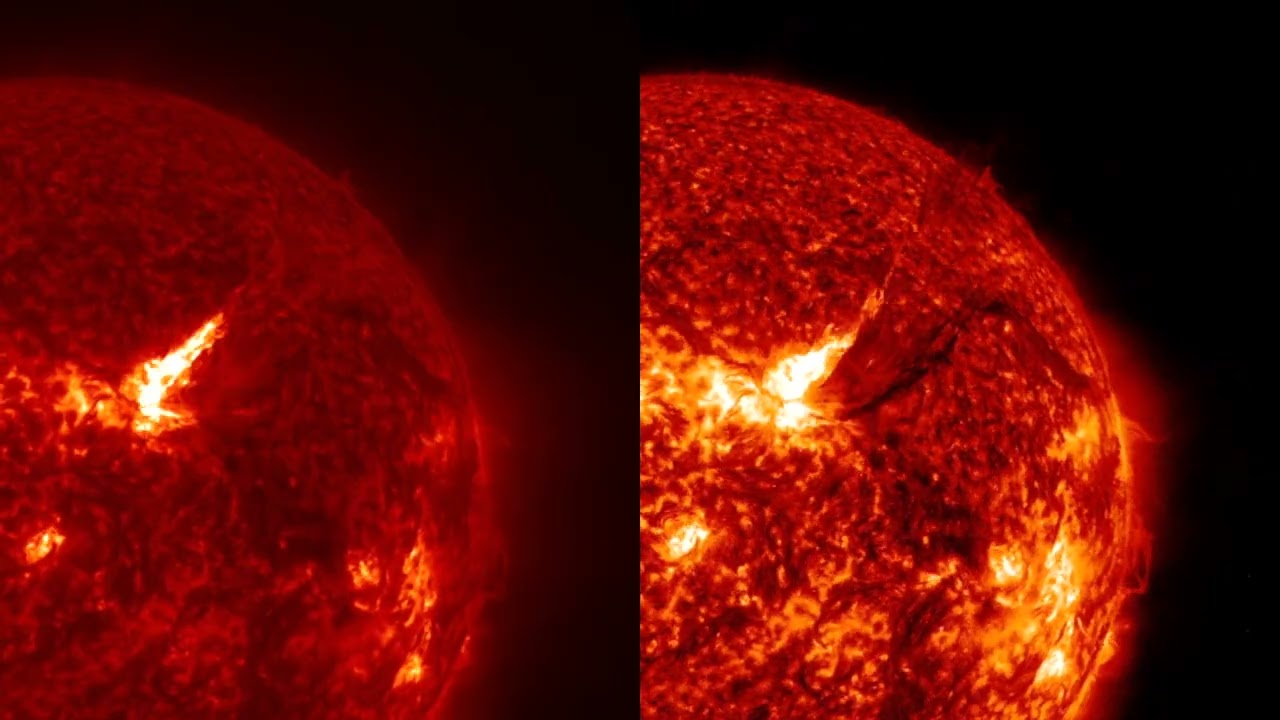
Solar Flares and CMEs at Earth - More Likely | S0 News June.3.2026
SpaceWeatherNewsS0s
2K views•2026-06-03



