Voyager 2, launched by NASA in 1977 during a rare planetary alignment, has traveled through deep space for over 40 years, using gravity assists from Jupiter, Saturn, Uranus, and Neptune to explore our solar system's outer planets while continuing to send valuable scientific data back to Earth despite its extreme age and limited power.
Install our extension to search inside any video instantly.
Voyager 2 CONFIRMS what WE ALL FEARED in Deep SpaceAdded:
Voyager 2 is one of the most incredible spacecraft ever created by humans.
It has been traveling through space for more than four decades.
The spacecraft continues moving farther away from the Sun every day.
It now travels through a dark and distant region of deep space.
In this faraway area, sunlight becomes very weak.
The light is no longer strong enough to provide normal energy or warmth.
Space around Voyager 2 feels cold, silent, and almost completely empty.
There are no nearby planets or stars surrounding it.
Temperatures in deep space are extremely low.
Almost no heat exists there, creating a frozen environment filled with darkness.
Voyager 2 moves through this endless cosmic ocean alone.
Even after such a long journey, it continues sending information back to Earth.
The mission began when NASA launched Voyager 2 in 1977.
Scientists designed it as a robotic explorer for studying the outer planets.
At the time, nobody knew how long the spacecraft would survive.
Researchers only hoped it would complete its planned mission.
The launch happened during a rare alignment of the outer planets.
This special event created a perfect path for exploration.
Because of this alignment, Voyager 2 could use gravity assists from giant planets.
This helped the spacecraft travel faster without much fuel.
Each time Voyager 2 passed near a large planet, gravity pulled and pushed it forward like a slingshot.
This clever method allowed the spacecraft to visit several planets during one mission.
It became one of the greatest achievements in space exploration.
The spacecraft first traveled toward Jupiter, the largest planet in our solar system.
Scientists eagerly waited for the images it would send back.
When Voyager 2 arrived near Jupiter, it captured breathtaking photographs.
The planet's colorful clouds and giant storms amazed researchers.
One of the most famous features it observed was the Great Red Spot.
This enormous storm is larger than Earth itself.
Voyager 2 also discovered that Jupiter has very strong radiation belts.
These findings prove the planet has a powerful magnetic field.
The spacecraft studied Jupiter's moons as well.
One of the biggest surprises came from a moon called Io.
Voyager 2 detected active volcanoes erupting on Io's surface.
This was the first time scientists saw volcanic activity beyond Earth.
The discovery changed how researchers viewed moons and planetary systems.
It proved distant worlds could still be active and dynamic.
After leaving Jupiter, Voyager 2 continued toward Saturn.
This beautiful planet is famous for its bright rings made of ice and rock.
The spacecraft captured detailed images of Saturn's rings.
Scientists learned the rings are made of countless frozen particles.
Voyager 2 also discovered new moons around Saturn.
Each discovery provided more knowledge about the formation of planets and moons.
Saturn's atmosphere also revealed powerful winds and giant storms.
The planet became even more fascinating after Voyager's visit.
Next, Voyager 2 traveled to Uranus.
Before this mission, scientists knew very little about this icy blue world.
Uranus appeared strange because it rotates on its side.
This unusual position creates seasons that last for many years.
Voyager 2 measured powerful winds moving through Uranus's cold atmosphere.
It also studied the planet's unusual magnetic field.
Neptune surprised scientists with its violent weather.
Voyager 2 captured images of huge dark storms moving across the planet.
The spacecraft also recorded the fastest winds ever discovered in the solar system.
Some reached incredible speeds greater than 1,200 miles per hour.
Neptune proved that even distant frozen planets can remain active and powerful.
This discovery shocked many scientists.
After exploring Neptune, Voyager 2 entered a distant region beyond the known planets.
This area contains ancient frozen objects from the early solar system.
To keep Voyager 2 alive, engineers carefully turn off systems that are no longer needed.
This saves energy for the most important instruments.
Every decision is made very carefully because power is extremely limited.
Scientists want the spacecraft to survive as long as possible.
Even today, Voyager 2 still sends faint radio signals back to Earth.
These signals travel billions of kilometers through empty space.
By the time the signals arrive, they are incredibly weak.
Giant antennas on Earth are needed to detect them.
Communication with Voyager 2 takes many hours because of the enormous distance.
Messages travel slowly deep space.
Despite these delays, the information remains valuable for scientists.
Every signal helps researchers learn more about the universe.
Voyager 2 also helps scientists study the heliosphere.
This giant bubble surrounds our solar system and is created by the sun.
At one point, Voyager 2 suddenly stopped sending signals.
Scientists worried the mission had finally ended after so many years.
The silence created concern because the spacecraft is extremely old.
Many believed its systems had finally failed.
Each message carries important information about places humans may never reach themselves.
Voyager 2 has become a symbol of discovery and exploration.
Even when its mission finally ends, its legacy will continue inspiring future generations to study the universe and search for answers.
Subscribe to our channel and thanks for watching.
>> Mhm.
Related Videos

Spiral Galaxy NGC 3370 from Hubble | NASA APOD 2025-11-05 #Shorts
galaxygallery
938 views•2026-05-30

SOMETHING inside the SUN is CHANGING
RaysAstrophotography
1K views•2026-06-03

There May Be A Giant Hole In The Universe... And We Might Be Inside It | The Cosmic Ledger Entry 015
TheCosmicLedger
145 views•2026-05-31

Captured the Blue Moon (with a twist) 🌙✨ #space #bluemoon #telescope
realAstroExplorer
674 views•2026-06-01

The Map We Sent to the Stars in 1977 — Why Scientists Now Regret It
TheAncientRecord7
183 views•2026-06-03

Is this a copy of our galaxy? Discover Galaxy M81!
UniverseDocumentaries-cc4mb
995 views•2026-05-31

10 Planet Where a Black Hole Replaces the Sun
cosmicexplorer-EN
147 views•2026-06-02
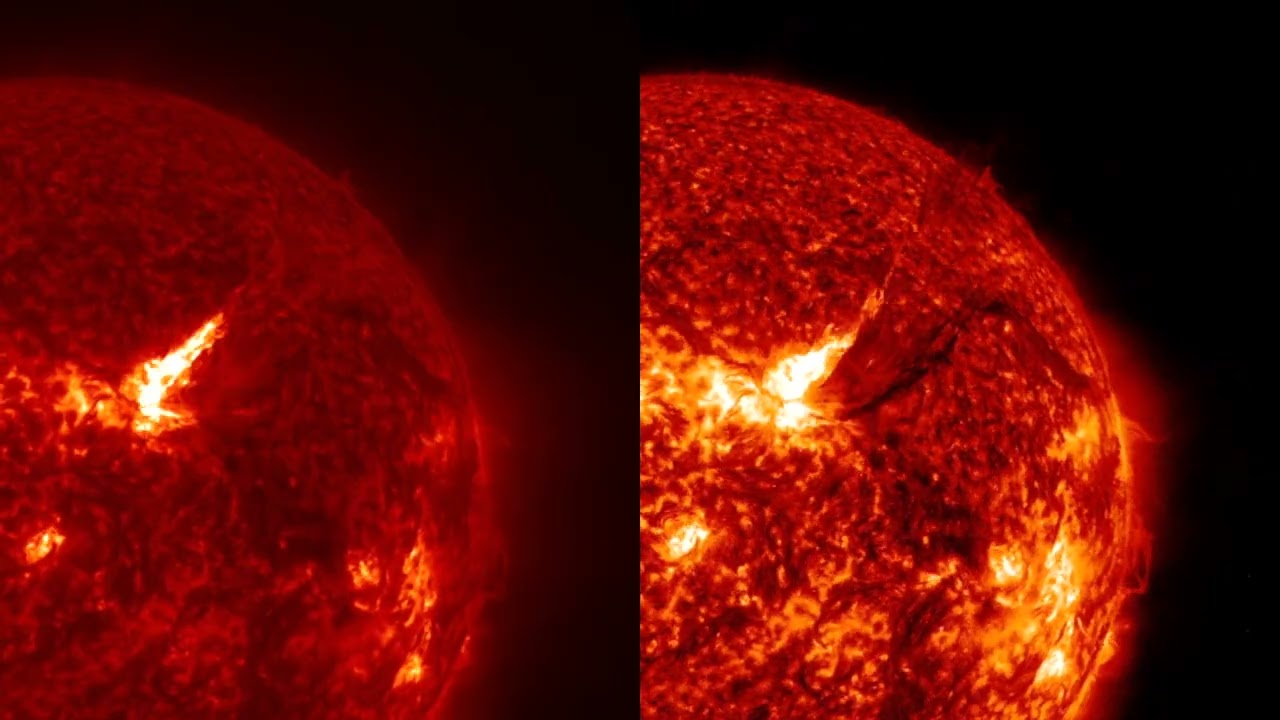
Solar Flares and CMEs at Earth - More Likely | S0 News June.3.2026
SpaceWeatherNewsS0s
2K views•2026-06-03



