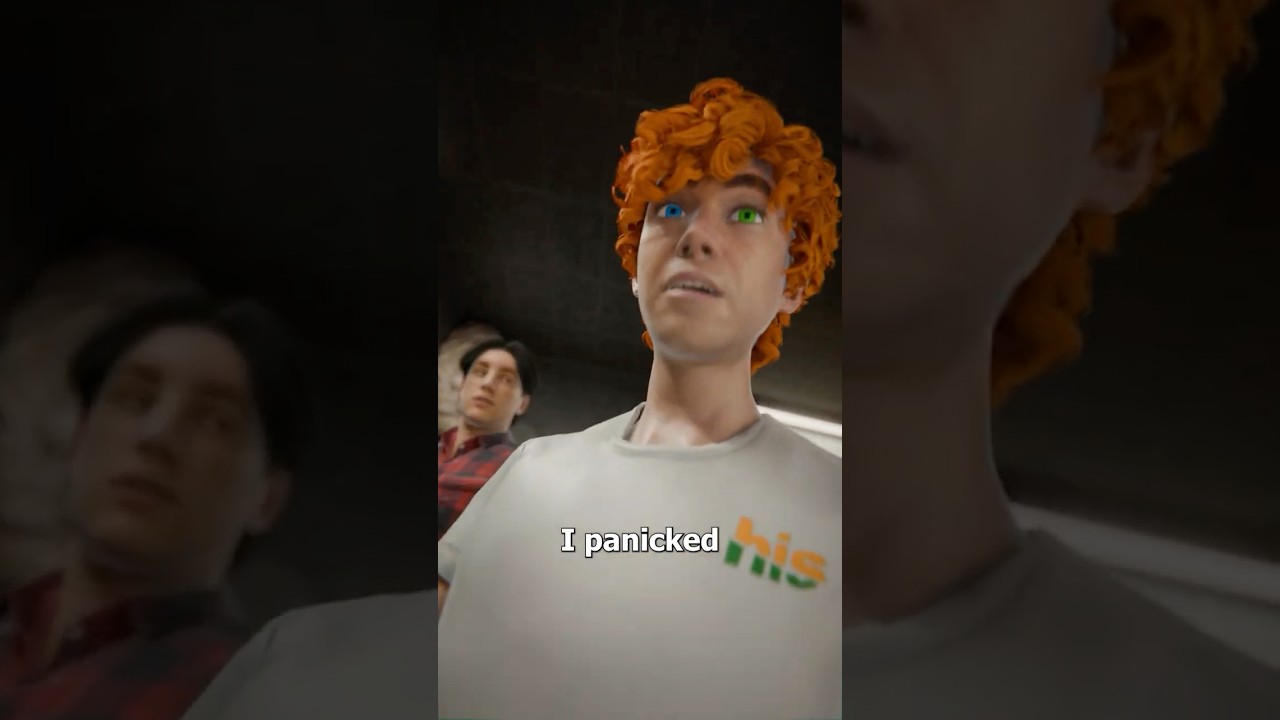
Humans are the only species that fears things that don't exist, a unique capability that evolved approximately 1.9 million years ago when Homo erectus developed a prefrontal cortex large enough to run mental simulations of future threats. This fear system, centered in the amygdala, triggers the same biological stress response (cortisol release, increased heart rate) for imagined threats as for real ones, because it evolved as a survival mechanism that allowed our ancestors to prepare for dangers before they occurred. While this causes modern humans to experience anxiety over non-existent threats like future meetings, this 'error' is actually a load-bearing evolutionary feature that enabled our ancestors to survive by anticipating and preparing for potential dangers, ultimately leading to the development of civilization.
Why Humans Are the Only Animal That Fear Things That Don't Exist
Added:A gazelle is eating grass on the Serengeti.
Then a lion shows up.
47 seconds of pure terror. Full sprint.
Lungs on fire. Hooves hammering into dry cracked earth.
The lion gives up. The gazelle slows down, stops, takes two breaths, and goes right back to eating grass. Not in an hour. Not after some long recovery period where it processes what just happened.
Seconds.
The threat is gone. So the fear is gone.
That's it. The gazelle's nervous system did exactly what it was built to do.
Switched on. Saved a life. Switched off.
Clean.
Efficient.
Done. Now cut to a man on a couch in Brooklyn. Monday night, 900 p.m. No lion within a thousand miles. No predator.
Nothing physically threatening him in any way. His heart rate is sitting at 110 beats per minute. His palms are damp. His jaw won't unclench.
He is being hunted by a meeting on Thursday morning. The gazelle has already forgotten the lion existed.
The man cannot stop thinking about a lion that doesn't exist yet. That gap, that strange, weirdly expensive, uniquely human gap is exactly what this video is about. Here's the strange part.
Every animal on this planet has a fear system.
The amygdala, small almond-shaped cluster sitting deep in the brain, fires the moment danger shows up. Adrenaline floods in. Cortisol spikes. Heart rate climbs. The body becomes a weapon pointed at one thing staying alive. That system is old. Ancient actually. A rat has it. A crow has it. A chimpanzeee has it. And it runs the same way across 300 million years of vertebrate evolution.
Something dangerous appears. The system kicks on. The animal reacts.
But only one species on this planet activates that same system with nothing.
No predator.
No real threat.
No stimulus at all. Just a thought.
just a Tuesday that hasn't arrived yet.
And here's the question that should genuinely bother you if this is a malfunction.
Why didn't evolution just remove it?
Natural selection is ruthless.
Merciless actually. It throws out what doesn't work. But 300,000 years of homo sapiens and this so-called error is still running in every single one of us, every culture, every continent, every generation.
That's not a glitch that slipped through. That's a signal.
Every animal fears what is. Only one fears what isn't. To understand why, you have to go back. And I don't mean centuries, not even thousands of years.
Fossil records suggest we need to travel roughly 1.9 million years to East Africa to a hominin called Homo erectus.
Erectus wasn't the first creature to feel fear. But researchers estimate it was the first with a preffrontal cortex large enough relative to its body size to do something completely new with that fear. something no nervous system on Earth had ever done before. It could run a simulation.
Picture this. A dry riverbed in what is now Kenya. Late afternoon, a single Homo erectus standing at the water's edge, looking down at the sand. In the sand leopard tracks, not fresh, yesterday's, the leopard is long gone. Every animal before this moment would have read those tracks the same way. No threat here. No threat now. Move on. Respond to what is real. But this creature did something different. Something that had genuinely never happened in the history of life on this planet. It looked at yesterday's tracks and thought, "What if it comes back tonight?"
Not in language. Not out loud. in something older than language, a simulation running in the preffrontal cortex, a mental film of a future that hadn't happened yet, a leopard that didn't exist yet, arriving at a campfire that hadn't gone dark yet.
So, it moved the fire back from the riverbank, shifted the group, chose a sleeping spot with a clearer line of sight. It survived. Its children survived.
And that gene, the one for imagining threats that don't exist yet, propagated, multiplied, spread across an entire species. The first imagined danger saved the first imaginative mind.
And that mind is sitting inside your skull right now.
Still running the same simulation.
still watching for leopards at the riverbank. Except now the leopard is a performance review and the fire going dark is your inbox.
So what's actually happening inside you when Thursday starts to feel like a threat? Here's the mechanism. And once you see it, you genuinely can't unsee it. When you're lying awake at night rehearsing a difficult conversation, your amygdala cannot distinguish that conversation from a predator at the door.
Same neural circuit, same cortisol, same heart rate climbing. Your body is running a full biological stress response to a scenario that exists only in your prefrontal cortex. Not a small alert, not a low-level ping, a full response, the kind your ancestors used for things with teeth.
Wait, it gets stranger. Researchers at Harvard, Killingsworth, and Gilbert 2010 tracked thousands of people in real time using a phone-based study.
Their findings, the average adult spends roughly 47% of waking hours thinking about something other than what they're actually doing.
Nearly half of conscious life spent somewhere that isn't here, isn't real. And most of that mental time travel goes in one direction, forward into futures that may never arrive. This is your default mode network, a web of brain regions that lights up precisely when you're not focused on a task, when your mind is idle. When you're technically at rest, your brain doesn't go quiet when you rest. It goes elsewhere. It runs scenarios. It assembles threats. It rehearses failures that haven't happened and may never happen. The biological term for this is prospection. The common name for it is dread. Your body can't tell the difference between a lion and a Thursday. It treats both with the same seriousness, the same chemistry, the same cost. And that cost isn't nothing.
Chronic cortisol exposure disrupts sleep, suppresses the immune system, and current evidence suggests it accelerates cellular aging at the level of telmir length. You're not just anxious, you are in a real and measurable biological sense, wearing down at the hands of events that haven't occurred, events that may never occur. That is the architecture of a phantom threat built from nothing, costing everything.
Now think about the North American red squirrel, Tamiascurus Hudsonicus.
Every autumn, it buries thousands of seeds and pine cones across a wide stretch of territory. Methodical, tireless. From the outside, it honestly looks like planning. It looks like foresight.
It almost looks like worry.
But neuroscientists who study this behavior keep pointing to one important thing. The squirrel isn't imagining winter. It's responding to a stimulus.
Specifically, the shortening of daylight hours triggers a hormonal cascade that drives the caching behavior.
The squirrel doesn't picture an empty food store in January. It doesn't lie in its nest running through scenarios about whether it buried enough. It responds to the light. The light shifts. The behavior fires. The preparation happens.
Then the squirrel buries its last seed of the day, climbs back into the nest, and falls asleep.
Researchers estimate the settling to sleep time is about 4 seconds.
4 seconds. Now, picture a 32year-old investment banker in London. Does well, healthy. By every measurable standard, he is safe. And tonight at 11 p.m. he is running spreadsheet projections for his retirement fund, calculating compound interest for the year 2061.
A year 35 years from now, a year he may not live to see. A year that doesn't yet exist in any form that means anything to his nervous system. The squirrel prepares.
The man predicts.
Only one of them suffers for it. Not because the man is weak, not because he's being irrational, but because his brain is doing exactly what 1.9 million years of evolution shaped it to do. Project forward, simulate outcomes, and prepare for the worst.
The squirrel has no worst. It has only now. And a hormonal nudge in the right direction. The man has a mind that can reach 35 years into the future and feel the texture of a fear that doesn't even have a shape yet.
If you've ever lain awake rehearsing a conversation that never happened, you already know what that feels like. Stick around. The next part explains why the tribe that worried the most is the exact reason you exist at all. And if this is already shifting how you think about your own mind, hit subscribe.
What's coming next changes how you'll hear your own thoughts at 3:00 a.m. Go back 70,000 years. Southern coast of Africa, the cognitive revolution, the period when fossil records suggest modern human behavior essentially exploded. art, complex tools, long-distance trade, coordinated large-scale planning.
Two groups of Homo sapiens are living near each other on this coastline. Same geography, same food sources, roughly the same physical capabilities.
The first group lives in the present.
They respond to threats when threats actually arrive. When food gets scarce, they forage. When weather turns, they find shelter. Between dangers, they are calm, efficient, unbburdened, present.
The second group can't stop imagining.
They look at a clear sky and picture drought. They count their food stores when the stores are full. They build barriers before any enemy has shown up.
They argue at night about what might go wrong next season. They lose sleep over winters that haven't turned yet.
Which group do you think made it through the next 500 years?
The warriors built the graneries. The warriors mapped the territory beyond the next hill. They formed alliances before they needed them. Stockpiled resources before they ran out. caught early warning signs that the calm group, the present focus group, noticed too late and too slowly and not at all.
Anxiety, preemptive preparation, the biological drive to simulate catastrophe before it arrives.
Not a weakness, a strategy, a winning strategy. And here's the part that should stop you cold. Every single person watching this video is descended from the warriors. You are not a random cross-section of ancient humanity. You are the biological legacy of the ones who could not stop imagining the worst and survived because of it. Your anxiety is not a modern disease. It is an ancient inheritance.
It is the evolutionary receipt for belonging to the lineage that actually made it. You are the descendant of the ones who couldn't stop imagining the worst.
And that is precisely specifically why you are here. But wait, someone watching this is already raising a hand. What about chimpanzees?
Anyone who spent real time studying primates knows they don't exactly look carefree.
Jane Goodall's decades at Gome Stream starting in the 1960s continuing for years after documented chimpanzees showing what looks honestly unmistakably like anxiety pacing tense posturing constant agitated glancing over the shoulder individuals who seemed by every behavioral measure worried. So, are humans actually unique here? Or are we just chimps with better vocabulary and worse sleep?
Here's the distinction that actually matters. Every anxious behavior ever recorded in chimpanzees traces back to something present, something recent. A dominant male who displayed aggression an hour ago. A rival group heard moving through the treeine. A wound that's still raw. Chimps respond to what happened and what is happening.
Their fear has an anchor in the real world, something you can point to, something that exists.
Not one study, not from GMI, not from any primate research center anywhere has produced evidence that a chimpanzee lies awake processing a social interaction scheduled 3 days from now.
Not one.
The future as a source of dread appears to be ours alone. Other animals fear shadows. Only we fear shadows that haven't been cast yet. That gap between fearing what exists and fearing what might exist is not a small step. It is the entire distance between a nervous system and a mind. So, here's the easy answer, the one you've probably already heard in some form or another. Anxiety is a disorder, a malfunction, a byproduct of modern life, of screens and deadlines, and a world that never fully switches off. Something to be corrected, medicated, optimized away until it's quiet. The story goes, we were fine once, and now we are broken.
That answer is wrong. Not partially wrong. Not missing a few nuances.
Fundamentally wrong. If anxiety were a malfunction, natural selection would have removed it. That's how evolution works with grinding, ruthless efficiency across geological time. Traits that cost survival disappear. Traits that cost reproduction disappear. A feature that burned energy wrecked sleep and flooded the body with cortisol for no survival benefit would have been gone within a few thousand generations.
It has been 300,000 generations of homo sapiens. The anxiety is still here in every culture on every continent in every era of recorded human history going as far back as the records go.
That is not a bug that slipped through quality control.
That is a loadbearing wall. Here's the real answer.
The one that costs more to hear but holds more weight when you actually sit with it. Anxiety and foresight are not two separate systems that happen to coexist. They are the same system. The same prefrontal circuitry that lets you save money for your kid's future. That lets you plan a trip 6 months out.
Recognize a pattern before it becomes a crisis. Build something that outlasts you. That exact circuitry is what runs the Thursday meeting through your nervous system like a live threat. You can't have one without the other. You can't keep the planning and quietly discard the dread. They run on the same engine, same direction, same fuel.
Your ancestors didn't survive in spite of their anxiety. They survived because of it. Every generation that made it through drought, through winter, through predators and plague and famine, they were the ones who imagined the worst early enough to do something about it.
And you are sitting here watching this because thousands of generations before you could not stop imagining lions that hadn't arrived yet.
Anxiety is not the disease.
It is the receipt for being human. So, let's make this personal because this is where it actually lands. The next time you're lying in bed at 3:00 a.m., heart moving faster than the room is quiet, mind locked onto a scene that hasn't happened, rehearsing words for a conversation that may never take place, stop for just one second before you decide something is wrong with you.
That is not a broken mind. That is not weakness.
That is not some modern malfunction unique to your generation or your circumstances.
That is a homo erectus standing at a dry riverbed in Kenya 1.9 million years ago staring at yesterday's leopard tracks and asking, "What if it comes back?"
That is a woman on the southern coast of Africa 70,000 years before you were born. counting food stores in a season that is still warm because she can already picture the one that comes after. That is every single ancestor in the line between them and you who survived not because the world was safe, but because their minds refused to assume it was. Your 3:00 a.m. mind is running the same program, same architecture, same impulse. It is scanning the horizon for threats because that is the one behavior more than any other most responsible for your existence.
The problem, the only problem is that the horizon has changed. The threats look different now. Your brain was calibrated for leopards and drought and rival tribes moving through the treeine at dusk. It was not calibrated for performance reviews and group chats and the low constant hum of a news cycle that never actually ends.
But your brain doesn't know that. It can't tell the difference between a famine and an unanswered email. It only knows how to do one thing with uncertainty. Take it seriously.
So it does. It takes everything seriously. It builds lions out of Thursdays.
It manufactures predators out of ambiguity. It runs the simulation whether you asked it to or not. Not because it's broken, because it's doing exactly exactly what two million years of survival shaped it to do.
Your 3 a.m. mind is not your enemy. It is your oldest survivor. Go back to the gazelle. It's on the Serengeti right now, or something exactly like it is.
eating grass, moving through the late afternoon light, carrying no memory of the lion from this morning, carrying no image of a lion that might come tonight.
The threat passed. The chemistry cleared. The moment closed. Done.
It will likely die within 8 to 12 years.
It will not see its grandchildren.
It will not build anything that outlasts a single season.
It will not carve a name anywhere or store food for a winter it imagined 3 months early or lie awake constructing a future that terrifies and motivates it in equal measure.
It will simply be here fully without cost. That is a kind of freedom, a real one, not a lesser thing. a genuinely different relationship with time, with threat, with the present moment. The gazelle owns something we gave up so slowly, so gradually, we never noticed it was gone. And yet, of the estimated 8.7 million species currently living on this planet, only one keeps itself awake at night over things that haven't happened yet. Only one runs simulations of futures that may never arrive.
Only one pays the full biological cost of imagining.
That same species built the pyramids, mapped the human genome, set foot on the moon.
Not despite the sleepless nights.
Not despite the phantom threats and the cortisol and the 3:00 a.m. mind running its ancient relentless program.
Because of it, the restlessness and the reach are the same thing, just pointed in different directions on different days. The gazelle forgets.
The man lies awake building a future that may never come.
One of them is free. The other built the world.
Freedom from fear is the gift the gazelle gets to keep.
Civilization is the price we paid to lose it. If this changed how you'll hear your own thoughts tonight, subscribe.
There are more things only humans do, and we're going to find every single one of them.
Related Videos

The Brain Science of a Perfect Soccer Play
columbiauniversityszuckerm8456
759 views•2026-06-11

Your Brain Rewires When You Learn NEW Skills! #brainscience #neuroscience #shorts #brain
NeurobiologyForEveryone
248 views•2026-06-09
WHAT IF THE MIND IS NOT BROKEN, BUT OVERRIDDEN? - Hijacked Minds
alyrifai
115 views•2026-06-08

Frontal Polar Cortex: Your Brain's Most Evolved Area
AskTechFitness
149 views•2026-06-10
Why Your Brain Invents Memories That Never Happened
flic999
282 views•2026-06-11
What Keeps a Neuroscientist Up at Night | Good Night with Ben Gleib (Ep 2)
goodnight
115K views•2026-06-09
Synaptic density & autism
AdultAutismAssessmentCenter
880 views•2026-06-10

Anxiety Isn't Your Fault — It's a Wiring Problem
MindSpectrumbyTheCognitiveLab
154 views•2026-06-10