The James Webb Space Telescope has discovered galaxies that formed 280 million years after the Big Bang—when the universe was only 2% of its current age—galaxies that should not exist according to the Lambda CDM standard model, which predicts early galaxies should be small, dim, and rare. These 'impossibly early' galaxies, including JADES-GS-z14 at redshift 14.44, are 100 times more common than theoretical models predicted. Additionally, Webb has detected polycyclic aromatic hydrocarbons (complex organic molecules) in galaxies less than 500 million years old, and confirmed the Hubble Tension—a 9% discrepancy between measurements of the universe's expansion rate from the early universe (67 km/s/Mpc) versus the local universe (73 km/s/Mpc). These discoveries suggest the standard model of cosmology is incomplete and may require new physics to explain how galaxies formed faster, how complex chemistry appeared earlier, and why the expansion rate differs from predictions.
13.5 Billion Years Old Galaxies That Existed BEFORE The Universe | JWST's Impossible DiscoveryAdded:
The universe is 13.8 billion years old.
The James Webb Space Telescope just found a galaxy that was already ancient when the cosmos was 280 million years old. That galaxy should not exist.
According to everything we thought we knew about time, matter, and the cold mathematics of cosmic assembly, there was not enough time in the entire history of reality for that object to form. And it is not alone. 1 million miles from Earth, floating at a gravitational balance point between our planet and the sun, the most powerful telescope humanity has ever built, is sending back images that do not fit.
Galaxies too bright, too massive, too structured for the infant universe they were born into. Stars that might not be stars at all, but something else entirely. Something powered by the annihilation of dark matter in their cause. complex organic molecules drifting through radiation fields so intense they should incinerate anything more fragile than bare protons. And woven through all of it, a deepening tension between two measurements of how fast the universe is expanding. Numbers that refuse to agree no matter how precisely we calculate them. Web was not supposed to break cosmology. It was supposed to confirm it, to fill in the blanks, sharpen the details, give us cleaner pictures of a story we already understood. Instead, it has spent the last 2 years systematically dismantling the standard model, one impossible observation at a time. And the deeper it looks, the stranger things become.
Galaxies that existed before galaxies should exist. light from objects that formed when the universe had barely learned how to make atoms. Evidence piling up in every wavelength that something in our elegant equations is deeply fundamentally wrong. This is the story of what Web found at the edge of time and what it means when the rules stop working.
Welcome to Magnetic Space. If you're new here, please subscribe. We make these documentaries every day and honestly we'd love to have you along for the ride. Before we begin, tell us in the comments where you're watching from and what time it is there. Now settle in.
This is going to be a good one.
The universe has a birth certificate.
It's not stamped on parchment or carved into stone. It's written in light, in the spectrum of radiation that fills every cubic cm of space, in the motion of galaxies fleeing from one another at speeds that would make a photon jealous.
And according to that certificate, verified by decades of observation and calculation, the universe is roughly 13.8 billion years old. That number is not a guess. It's the product of some of the most careful measurements human beings have ever made. Measurements of the cosmic microwave background, the faint afterglow of creation itself, measurements of the distances to the oldest stars we can find, measurements of how fast space is expanding and how that rate has changed over time. Put all of that together, run the equations backward, and you arrive at a single point, a moment when everything that is, everything that was, and everything that will ever be occupied, a space smaller than an atom. Then it exploded. That's the big bang. Not an explosion in space, but an explosion of space. The universe did not expand into anything. There was no room waiting to be filled. Space itself came into existence in that moment and it has been stretching ever since, carrying matter and energy along with it like ink dots on an inflating balloon. In the beginning, there were no galaxies. There were no stars. There was not even light in any form you would recognize. For the first 380,000 years, the universe was a fog of superheated plasma. A soup of electrons and protons so dense and so hot that photons could not travel more than a tiny fraction of a distance before slamming into another particle. Light was trapped, scattered endlessly going nowhere. Then the universe cooled.
Electrons and protons combined to form hydrogen atoms. And suddenly the fog cleared. Light was free to travel and it has been traveling ever since. That ancient light stretched and cooled by 13 billion years of cosmic expansion is what we call the cosmic microwave background. It is the oldest thing we can see. A snapshot of the universe as it looked when it was still an infant, barely old enough to have a structure.
After that came the dark ages. Hundreds of millions of years when the universe was filled with nothing but neutral hydrogen gas drifting in the void. No stars, no heat, no light, just cold gas slowly clumping together under the pull of gravity, drawn into invisible halos of dark matter that had begun to take shape in the chaos of the early universe. Eventually, those clumps grew dense enough to ignite. The first stars flickered to life, massive and blue and short-lived. They burned through their fuel in a few million years and exploded, seeding the surrounding space with the first heavy elements. From those ashes, the next generation of stars formed. And from those stars, the first galaxies began to assemble. This is the story we have been telling for decades. It is elegant. It is well supported. It explains nearly everything we see when we look out into the cosmos.
And according to the rules embedded in that story, galaxies do not appear overnight. They grow slowly, peacemeal, over hundreds of millions of years.
Small clumps of stars merge into larger ones. Gas clouds collapse and ignite.
Dark matter halos pull in more material.
The process is gradual, messy, inefficient. Early galaxies, the ones that formed closest to the Big Bang, should be small. They should be dim.
They should look like cosmic infants because that is what they are. Fragile structures still assembling themselves from the raw materials of creation.
That was the expectation. That was what the textbooks said. That was what every simulation and every theoretical model predicted when astronomers began planning the next generation of space telescopes. Before we get to what changed, we need to talk about what it means to look at the sky. When you point a telescope at a distant galaxy, you are not seeing that galaxy as it is today.
You are seeing it as it was when the light you are detecting left its surface and began the long journey to your lens.
Light moves fast, but space is vast. The Andromeda galaxy, our nearest large neighbor, is about 2 1/2 million light years away. That means the light hitting your retina tonight, left Andromeda 2 1/2 million years ago, back when early humans were just beginning to chip stones into tools. You are not looking at Andromeda. You are looking at Andromeda's past. Now scale that up. The most distant galaxies we have ever observed are more than 13 billion light years away. When we point a telescope at those galaxies, we are seeing them as they existed 13 billion years ago when the universe itself was less than a billion years old. We are quite literally looking backward in time. The further out you look, the further back you go. This is not a metaphor. This is the actual structure of observation in cosmology. Distance equals time. And the edge of the observable universe is not a wall in space. It is a wall in time. The horizon beyond which light has not yet had enough time to reach us. The universe may be infinite. It may go on forever in every direction. But we can only see the part of it whose light has had time to arrive. That boundary, that sphere of visibility surrounding us is the observable universe. And for most of the history of modern astronomy, the edge of that sphere has been frustratingly far from the moment we most wanted to see. The moment when the first galaxies ignited. For decades, the workhorse of deep space observation was the Hubble Space Telescope. Launched in 1990, Hubble revolutionized our understanding of the cosmos. It peered deeper into space than any telescope before it, capturing images of galaxies billions of light years away. It gave us the Hubble Deep Field, a photograph of a patch of sky no larger than a grain of sand held at arms length, containing thousands of galaxies stretching back to when the universe was less than a billion years old.
Hubble was extraordinary, but it had limits. Hubble observes primarily invisible and ultraviolet light that works beautifully for nearby objects, but it runs into a problem when you look at the most distant galaxies in the universe. As light travels through expanding space, the wavelengths get stretched, the effect is called red shift, and it is a direct consequence of cosmic expansion. Light that left a distant galaxy as ultraviolet radiation arrives at Earth stretched into visible light. Light that left as visible arrives as infrared. The further away the galaxy, the more its light has been stretched and the redder it appears. By the time you are looking at galaxies from the first few hundred million years after the Big Bang, their light has been stretched so far into the infrared that Hubble can barely see them. They are there faint smudges at the edge of detection. But Hubble's instruments were not designed to work in that part of the spectrum. It was built for a different era of the universe. To see the cosmic dawn, to push past Hubble's reach and observe the very first galaxies forming in the aftermath of the Big Bang, astronomers needed a telescope built for infrared light. They needed something larger, more sensitive, and capable of staring at the faintest, most distant objects in the universe for days at a time without blinking. They needed the James Webb Space Telescope. Web is not Hubble's replacement. It is Hubble's successor. And the distinction matters.
Hubble still works. It is still taking data. Web is not filling a gap left by a broken instrument. It is opening a window into a part of the universe Hubble was never designed to see. The telescope launched in December 2021 after decades of planning, delays, cost overruns, and a development process so long that some of the scientists who proposed it retired before it ever left the ground. It traveled to a gravitationally stable point in space about 1 and a half million km from Earth, a location called Lrangee. two, where it unfurled a mirror 6.5 m across, coated in gold to maximize its reflection of infrared light. That mirror is not a single piece of glass.
It is 18 hexagonal segments, each one polished to a precision measured in nanometers and aligned so perfectly that they function as a single reflective surface. The engineering required to make that work is borderline absurd. Web also carries a sunshield the size of a tennis court, a five layer barrier that keeps the telescope cold enough to detect the faint infrared glow of objects billions of light years away without being blinded by heat from the sun, the earth, or its own electronics.
Operating temperature -223° C. cold enough that most materials would shatter if you touched them. Web's mission, as described by NASA, is to study the solar system, the atmospheres of exoplanets, and the origins of the universe. But the part that has captured the public imagination and the part that has rattled the foundations of cosmology is that last goal, the origins of the universe, the first stars, the first galaxies, the moment the lights came on.
NASA put it plainly, "We is pushing the boundaries of the observable universe closer to cosmic dawn." and it has succeeded. Almost immediately after the telescope began its science operations, the data started pouring in. Deep field images, spectroscopic observations, galaxies at red shifts higher than Hubble had ever reliably detected. And not just faint smudges. bright, structured, surprisingly massive galaxies sitting at distances that correspond to times less than 500 million years after the Big Bang.
Galaxies that according to the standard model should not look like that yet.
Some of them should not exist at all.
The theoretical framework for early galaxy formation is built on a foundation of dark matter, gravity, and time. Dark matter, whatever it is, makes up about 85% of the matter in the universe. It does not emit light. It does not interact with electromagnetic radiation in any way we can detect. But it has mass and mass means gravity. In the first moments after the Big Bang, tiny fluctuations in the density of the universe, quantum ripples blown up to cosmic scales by a brief period of exponential expansion called inflation, created regions where dark matter was slightly more concentrated than elsewhere. Those concentrations pulled in more dark matter. Over time, they grew into vast halos, invisible scaffolding that attracted normal matter, hydrogen and helium gas into their gravitational wells. Inside those halos, the gas cooled and collapsed.
When it got dense enough and hot enough, nuclear fusion ignited. Stars were born.
Stars clustered together into proto galaxies. Proto galaxies merged into larger galaxies. The process was hierarchical, bottom up, slow. That is the model. Small things first, then bigger things, then bigger things still.
And crucially, the model includes a speed limit. Stars take time to form.
Galaxies take time to assemble. You cannot skip steps. You cannot fast forward. A galaxy that we observe at a time when the universe was only 300 million years old should be small and young because there simply has not been enough time for it to grow into anything more. That is what the equations say.
That is what the simulations predict.
That is what every astronomer expected Web to confirm. Then web looked and it found galaxies that were not small, galaxies that were not dim. Galaxies that looked mature, structured, bright, massive, sitting there in the early universe as if someone had skipped the first few chapters of the instruction manual. The discoveries came fast. Teams around the world analyzing web's first deep field observations began reporting objects at red shifts previously thought to be near the edge of detectability.
Redshift 13, redshift 14. One object, a galaxy given the designation mz14 clocked in at a red shift of 14.44.
That corresponds to light that has been traveling for over 13 billion years.
Light that left its source just 280 million years after the Big Bang when the universe was barely 2% of its current age. The discovery was described by the research team and by multiple media outlets as a cosmic miracle.
Another object J A D S--D3-1 was confirmed at a red shift of 13 corresponding to 330 million years after the Big Bang. A third gl 13, widely reported as roughly 13 1/2 billion years old, sits at a similar distance 300 million years after the universe began. These are not anomalies.
They are part of a pattern. Web is detecting galaxies in an era of cosmic history that was supposed to be dark, quiet, empty of anything large or bright. And yet there they are. The European Space Agency, one of the partners in the web mission, put it simply. Web's goal is to see further than ever before into the distant past of our universe. It is doing exactly that. and what it is seeing does not match the script. The headlines of course went wild. Galaxies older than the universe, impossible objects, cosmology in crisis. Most of those headlines are exaggerations. None of these galaxies are literally older than the Big Bang. That would require a level of rulebreaking that even the most radical physicist is not prepared to endorse. But the exaggeration contains a kernel of truth. These galaxies appear earlier than they should. They are brighter than they should be. They look more mature than the available time allows. Something about the early universe, something about the process of galaxy formation in those first few hundred million years is not behaving the way our models predicted. Either the models are incomplete or the observations are being misinterpreted or there is new physics hiding in the gap between theory and data and the telescope that was supposed to confirm our understanding of cosmic dawn has instead turned it into a question mark.
This is where the story begins not with answers but with objects that refuse to fit. galaxies that should not exist sitting at the edge of the observable universe like facts that simply will not behave.
The first cracks appeared in photographs, not physical cracks, not artifacts in the data, but objects that simply refused to fit. galaxies sitting in the deep field images captured by the James Webb Space Telescope glowing brightly in eras of cosmic history where the standard model said they had no business existing. And the more astronomers looked, the more of them they found. Bright structured massive galaxies appearing in the universe's infancy like skyscrapers built on a construction site that was supposed to still be pouring the foundation. The problem has a name. Astronomers call it the impossibly early galaxy problem, though some prefer the time problem because that is what it comes down to, time, or rather the lack of it.
According to every simulation, every theoretical model built on decades of physics, galaxies in the early universe should be small, dim, and rare. They should look like proto structures, collections of the first stars clumped loosely together, still in the process of assembling themselves from the primordial gas left over from the big bang. What Web found instead were galaxies that looked ready for their closeup. Mature, organized, shining.
Take Jay's GSZ140.
The name is a mouthful. a designation that tells you more about the survey program that found it than anything about the object itself. Jay's stands for JWST Advanced Deep Extragalactic Survey, a coordinated international effort involving hundreds of hours of telescope time and dozens of researchers all focused on one goal. Push web to its absolute limits and see what is sitting at the edge of the observable universe.
Jade's GSZ140 is what they found. A galaxy confirmed at red shift 14.44.
That number translates to light that has been traveling toward Earth for over 13 billion years. Light that left its source just 280 million years after the Big Bang. 280 million years sounds like a long time. In human terms, it is an eternity. In cosmic terms, it is a blink. The universe at that point was barely 2% of its current age. Imagine a human toddler, not even old enough for preschool, already building particle accelerators in the backyard. That is the scale of the mismatch. NASA described the galaxy as part of a growing group of unexpectedly bright early galaxies. The research team that confirmed the discovery ran the numbers and found that galaxies like this one are about 100 times more common than theory predicted before web launched.
100 times. That is not a minor adjustment to the model. That is the model being wrong by two orders of magnitude. If your weather forecast was off by a factor of 100, you would not call it partly cloudy. You would call it a hurricane.
The galaxy itself is not particularly large. It is about 50 times smaller than the Milky Way, a modest structure by modern standards. But size is not the issue. The issue is that it exists at all and that it is bright. Brightness in astronomy is a proxy for activity. A bright galaxy is a galaxy full of young, hot, massive stars burning through their fuel at a ferocious rate.
Stars like that do not appear overnight.
They form from clouds of gas that have to cool, collapse, and reach the temperatures and densities required for nuclear fusion to ignite. Then they have to live long enough to light up the surrounding space. The whole process from gas cloud to shining star cluster takes tens of millions of years at the absolute minimum. And that is just for the stars themselves. Building a galaxy requires multiple generations of stars forming, living, dying, and seeding the surrounding gas with heavier elements so that the next generation can form faster and more efficiently. J's GSZ140 contains carbon and nitrogen. Those elements do not exist in the primordial universe. Hydrogen and helium came out of the big bang. Everything heavier had to be forged inside stars and scattered into space when those stars exploded.
The presence of carbon and nitrogen in this galaxy means that earlier generations of stars had already lived and died before this galaxy even assembled itself. The clock does not start at 280 million years. It starts earlier. Somewhere in the darkness before this galaxy became visible, other stars had to ignite, burn, explode, and enrich the gas that eventually formed Jay's GSZ140.
The timeline keeps shrinking, and the models keep struggling to keep up. Then there is Jay's GSZ131, sitting just slightly closer in time, but still firmly in the cosmic dark ages. This one was observed at red shift 13 corresponding to about 330 million years after the big bang. The European Space Agency, one of the partners in the web mission, noted that the galaxy is clearing the fog of the early universe in a way that is, and this is their word, mysterious. The light from this galaxy shows strong hydrogen emission.
The kind of signature you get from very hot, very massive stars flooding their surroundings with ultraviolet radiation.
Stars like that are expected to be part of the first generation, the so-called population 3 stars that have never been directly observed. Theoretical monsters, hundreds of times more massive than the sun, burning so hot they would appear blue white even from millions of light years away. Population 3 stars are supposed to be rare, short-lived, and scattered. The first flickers of starlight in an otherwise dark universe.
Jade's GSZ131 appears to contain an entire population of them, clustered together and bright enough to carve a bubble of ionized gas around the galaxy, large enough to be detected across more than 13 billion light years of space. That bubble is important because ionized gas is transparent. Neutral hydrogen, the kind that filled the universe during the dark ages, absorbs ultraviolet light. To clear a bubble that large, you need an enormous amount of energy pouring out of the galaxy over a sustained period of time, either from an unusually dense population of massive stars or from something even more energetic. The European Space Agency floated a second possibility. The brightness might not be coming from stars at all. It might be coming from a super massive black hole, an active galactic nucleus powered by gas spiraling inward at relativistic speeds, heating to millions of degrees, and outshining the entire galaxy around it. If that is the case, the galaxy is not just early. It is hosting one of the first super massive black holes in the universe. An object that itself poses a separate timeline problem because black holes that massive take time to grow.
You do not start with a collapsing star and end up with a million solar mass black hole in a few hundred million years. The math does not work unless the black hole did not start from a star.
Unless it formed through a process called direct collapse, where a giant cloud of primordial gas skipped the stellar phase entirely and became a black hole all at once. Direct collapse black holes are theoretical. No one has ever confirmed one, but they solve a lot of problems if they exist. and Jade's GSZ131 might be the first real evidence that they are not just convenient math tricks. The galaxy is either full of impossible stars or it is powered by an impossible black hole. Either way, the standard model is being stretched to its limits. And then there is the broader population. Jade's GSZ140 and Jade's GSZ131 are not outliers. They are examples. Web has been finding galaxies like this at a rate that was not supposed to happen.
Every deep field observation turns up more bright early galaxies sitting in time periods where the universe was supposed to be quiet. Some of them are even brighter. Some of them show signs of dust, which is another chemical signature that requires previous generations of stars to produce. Dust is made of heavy elements. Carbon, silicon, oxygen forged in stellar cores and blown out into space by supernova explosions.
Finding dust in a galaxy 300 million years after the Big Bang is like finding rust on a brand new car. It means something happened before the car left the factory. Something that was not part of the original manufacturing process.
The lambda CDM model, the standard cosmological framework that has guided the field for decades, is built on a specific set of assumptions about how structure forms in the universe. Lambda stands for dark energy, the mysterious force that is accelerating the expansion of the universe. CDM stands for cold dark matter, the invisible scaffolding that pulls normal matter together into galaxies and clusters. According to lambda CDM, structure formation is hierarchical. Small things form first, then merge into larger things. Dark matter halos collapse. Gas falls into them. Stars ignite. Galaxies assemble piece by piece over hundreds of millions of years. The model predicts how many galaxies should exist at any given time, how massive they should be, and how bright they should appear. Web's observations are pushing against those predictions. The number of bright galaxies at high red shift, the ones sitting in the first few hundred million years after the Big Bang, is higher than lambda CDM predicts. Not by a small margin, by a factor of 10, sometimes a factor of 100. If you run a standard lambda CDM simulation and ask it how many galaxies like Jade's GSZ140 should exist at Redshift 14, the answer you get back is essentially none. Maybe one or two in the entire observable universe if you are lucky. Web has found dozens. That does not mean Lambda CDM is wrong. It means Lambda CDM as currently configured is incomplete. Something about the way galaxies form in the early universe is not being captured by the simulations. Either the efficiency of star formation was higher than the models assume or the initial conditions were different or there is a physical process happening in the first few hundred million years that does not happen later and that we have not accounted for. One hypothesis is that the early universe was simply denser. In the immediate aftermath of the Big Bang, matter was packed more tightly together than it is now. Galaxies forming in that environment would have access to more gas in a smaller volume, which could accelerate star formation dramatically.
If the gas was denser, it would cool faster. If it cooled faster, it would collapse faster. If it collapsed faster, stars would ignite sooner. Speed up every step in the process by even a small factor, and you can shave hundreds of millions of years off the timeline.
That might be enough to explain galaxies like Jade's GSGSC140 without breaking the underlying physics.
Another hypothesis points to the stars themselves.
population three stars, the first generation born from pure hydrogen and helium with no heavier elements to slow them down, might have been far more massive and far more efficient than modern stars. A star with no metals in its composition can grow to hundreds of solar masses without blowing itself apart. Stars that massive burn through their fuel in just a few million years.
But while they are alive, they are extraordinarily luminous. A single population three star could outshine an entire modern galaxy. If the early universe was full of them, even a relatively small galaxy could appear much brighter than a lambda CDM simulation would predict. The trade-off is that population 3 stars die fast.
They explode as supernova or in some cases collapse directly into black holes without exploding at all. That means the brightness would be short-lived, a brief flare in cosmic time. But if galaxies in the early universe were constantly forming new generations of massive stars, the flare would keep going. Each generation would light up, explode, enrich the gas, and the next generation would ignite even faster because the gas now contained the heavy elements needed to cool more efficiently. It is a feedback loop and if the loop was faster in the early universe than it is today, the models need to be updated. A third hypothesis is more radical. Some researchers have suggested that the standard cosmological parameters themselves might need adjustment. The Hubble constant, the rate at which the universe is expanding, is already under dispute. If the true value is higher than the standard model, assumes the universe would be younger than 13.8 billion years, which would make these early galaxies even earlier in relative terms. That makes the problem worse. not better. But it also opens the door to the possibility that other parameters, things like the density of dark matter or the timing of realization might also be off by small amounts. Small adjustments in the initial conditions can propagate forward through 13 billion years of cosmic history and produce very different outcomes at the end. None of these hypotheses are comfortable. Each one requires either accepting that our models are missing something important or that the observations are being misinterpreted in some systematic way.
The observations so far have held up.
Every high redshift galaxy candidate that looked too bright or too massive in the initial imaging has been followed up with spectroscopy and almost everyone has been confirmed. The red shifts are real. The distances are real. The brightness is real. These galaxies are exactly where they appear to be, and they are exactly as luminous as they look. Spectroscopy is the key. A photograph can tell you that an object is red, but it cannot tell you why.
Spectroscopy splits the light into its component wavelengths, revealing the chemical fingerprints of whatever is producing the glow. By looking at where the dark absorption lines and bright emission lines fall in the spectrum, astronomers can measure the red shift directly, identify the elements present in the galaxy and determine whether the light is coming from stars, hot gas or something else entirely. Web carries two spectrographs and both of them have been working overtime. Almost every major early galaxy discovery announced in the last 2 years has been confirmed by follow-up spectroscopy.
The candidates that turned out to be false alarms, closer galaxies misidentified as distant ones were caught by the same process. Spectroscopy does not lie. Jade's GSZ140 was confirmed spectroscopically.
So was Jade's GSZ131.
The red shift measurements are solid and the chemical signatures are clear. These galaxies contain elements that require stellar nucleiosynthesis.
They are not primordial gas clouds. They are real galaxies full of stars sitting at the edge of the observable universe.
And they are not alone. Web's first few years of operation have produced a steady stream of similar discoveries.
Glass Z13, another confirmed early galaxy sitting at roughly the same distance as Jesus ZSZ131.
Mom Z14, a name that sounds less like astronomy and more like a serial number, sitting at the same red shift as JSZSZ140.
Each one adds weight to the growing pile of evidence that the early universe was busier, brighter, and more complex than the models predicted.
The lambda CDM model is not collapsing.
It is too successful in too many other areas to be fundamentally wrong. It explains the cosmic microwave background. It explains the large scale structure of the universe, the way galaxies cluster together into filaments and voids. It explains the observed abundances of light elements like helium and dutyium. It works, but it works best in the middle of cosmic history, the era from a few billion years after the Big Bang to today. The edges, the very early universe, and the accelerating expansion driven by dark energy are where the cracks are showing. The galaxy's web is finding are stress- testing the model at the edge of its applicability. They are not violating the laws of physics. They are not older than the universe, but they are brighter, more massive, and more abundant than the simulations said they would be. And every time a new one is confirmed, the gap between theory and observation gets a little wider.
Astronomers are not panicking. This is not a crisis in the sense of a total collapse. It is a crisis in the sense that the field now has to do what it always does when observations and theory diverge. Figure out what is missing.
Adjust the models, propose new hypotheses, test them, refine them, repeat. The process is messy, but it is also how progress happens. The standard model did not spring fully formed from someone's forehead. It was built piece by piece over decades, adjusted every time new data came in, refined until it matched what we could see. Web is delivering new data faster than the field can absorb it. And the models will catch up eventually. But for now, the galaxies sit there glowing in the deep field images, defying expectations, refusing to behave. And somewhere in the gap between what they are and what they should be, there is new physics waiting to be found. Physics that will explain how galaxies can form this fast, this early, this bright. Physics that might involve exotic populations of massive stars, or direct collapse black holes, or adjustments to the cosmological parameters we have been using for years.
physics that will eventually close the gap. Until then, the question remains, how does a universe barely old enough to have cleared the fog, managed to build galaxies that look like they have been around for billions of years? The answer is out there, written in the light, still traveling toward us from the edge of time. And the light, as it turns out, carries more than just an image. It carries a chemical signature, a temperature, a story, and in some cases, it carries evidence of objects even stranger than the galaxies themselves.
Objects that glow in the darkness, powered by something that is not quite a star.
And somewhere in the gap between what they are and what they should be, there is a possibility even stranger than galaxies forming too fast. A possibility that the first light in the universe might not have come from stars at all.
Not in the way we understand stars. Not powered by fusion, not burning hydrogen into helium in their cores, but glowing from something else entirely, something darker. Before we get there, we need to talk about what most of the universe is made of. And the answer is going to sound like a joke, but it is not. We do not know. Roughly 85% of all the matter in the cosmos is invisible. It does not emit light. It does not absorb light. It does not reflect light. It does not interact with electromagnetic radiation in any way we can directly detect. We know it exists only because of what it does to the things we can see. Galaxies rotate too fast for the visible matter inside them to hold together. Galaxy clusters are too heavy for the stars and gas we observe to account for their gravitational pull. The universe's large scale structure, the way galaxies cluster into filaments and voids, only makes sense if there is far more mass out there than we can see. That invisible mass is called dark matter, and it is the scaffolding holding the cosmos together. The name is misleading.
Dark matter is not dark in the sense of being black or shadowy. It is transparent, perfectly transparent. A chunk of dark matter the size of a planet could pass through your body right now and you would feel nothing. No collision, no friction, no interaction at all. It does not couple to the electromagnetic force which means photons ignore it completely. Light passes through dark matter as if it is not there. But gravity does not care whether something emits light. Gravity responds to mass and dark matter has plenty of that. Enough to outweigh all the stars, planets, and gas in the universe by a factor of more than 5 to one. Every galaxy sits inside a halo of dark matter far larger and more massive than the galaxy itself. The visible part, the stars and gas we see in photographs, is just the tip of the iceberg. The bulk of the mass is invisible, surrounding the galaxy like a fog that cannot be photographed. We have never directly detected a particle of dark matter. Not in a laboratory, not in a particle accelator, not anywhere. The leading hypothesis is that dark matter is made of something called WIMPs.
Weakly interacting massive particles.
The name is not a joke, though it sounds like one. WIMPs are hypothetical particles that interact only through gravity and possibly the weak nuclear force. The same force responsible for certain types of radioactive decay. If they exist, they would be drifting through the universe in enormous numbers, passing through ordinary matter almost without noticing it. Detectors buried deep underground have been searching for WIMPs for decades, waiting for one to collide with an atomic nucleus in a tank of liquid xenon or a crystal of geranium. So far, nothing.
Either wimps are rarer or more elusive than the models predict, or dark matter is made of something else entirely. But the lack of a direct detection does not mean dark matter is a myth. Its gravitational fingerprints are everywhere. The rotation curves of galaxies, the motion of galaxy clusters, the bending of light around massive objects, the pattern of fluctuations in the cosmic microwave background. All of it points to the same conclusion. There is more matter out there than we can see. And it is not made of atoms. It is something else. Something that was there from the beginning mixed into the fabric of the universe when it was still a hot dense soup of particles in the moments after the big bang. In the early universe, dark matter played a crucial role in structure formation. After the big bang, the universe expanded and cooled. For the first few hundred,000 years, it was too hot for atoms to hold together. Electrons and protons were ripped apart by the intense heat, creating a fog of charged particles that trapped light and made the universe opaque. When the universe finally cooled enough for hydrogen atoms to form, the fog cleared. Light was free to travel.
But the matter, both normal and dark, was still spread out almost uniformally across space. Almost, but not quite.
tiny fluctuations in density. Quantum ripples blown up to cosmic scales during a brief period of exponential expansion in the first fraction of a second created regions where matter was slightly more concentrated. Those fluctuations were small, less than one part in 100,000.
But gravity amplifies tiny differences over time. Regions with slightly more dark matter pulled in more dark matter.
Regions with slightly more hydrogen pulled in more hydrogen. Over millions of years, the clumps grew. Dark matter because it does not interact with light or pressure could collapse more efficiently than normal matter. It formed halos first. Invisible wells of gravitational potential scattered across the universe. Normal matter, hydrogen and helium gas fell into those wells.
And inside the deepest, densest halos, where the gas was compressed enough by gravity to reach the temperatures and pressures required for nuclear fusion, the first stars ignited. Those first stars are called population 3. The name comes from an older classification system where astronomers divided stars into populations based on their chemical composition. Population one stars are young metalrich stars like the sun born from gas clouds enriched by previous generations of supernova. Population 2 stars are older metal pore stars found in the halos of galaxies and in globular clusters. Population 3 stars are the first generation born from pure primordial gas with no heavy elements at all. Just hydrogen, helium, and traces of lithium left over from the big bang.
No carbon, no oxygen, no iron, nothing heavier than helium. A star forming from gas with no metals behaves very differently from a star forming in the modern universe. Metals in astronomy mean any element heavier than helium.
They absorb energy and remit it as infrared radiation, allowing the cloud to shed heat and keep collapsing.
Without metals, the only coolant available is molecular hydrogen, and molecular hydrogen is far less efficient. That means primordial gas clouds had to be much hotter to collapse into stars. Hotter gas means larger stars. Population 3 stars are predicted to have been enormous, tens or even hundreds of times more massive than the sun. A star that massive burns incredibly bright and dies incredibly fast. The most massive population three stars might have lived only a few million years before exhausting their fuel and exploding a supernova. In that explosion, the star would have forged and scattered the first heavy elements into the surrounding gas, seeding the universe with the building blocks of planets, dust, and eventually life.
Population three stars are the reason the universe contains anything other than hydrogen and helium. They are the alchemists of the cosmos, turning light elements into heavy ones in the nuclear furnaces of their cause. The problem is that no one has ever seen one.
Population 3 stars are so short-lived that none of them should still exist today. They all exploded billions of years ago. The only way to find one is to look far enough back in time to the first few hundred million years after the Big Bang when they were still forming. The James Webb Space Telescope was built in part to do exactly that and it is looking. But the search is harder than it sounds because a single population three star, even a massive one, is too faint to be detected across 13 billion light years of space. What Web can detect are galaxies, collections of millions or billions of stars. If some of those stars are population three, their signature might be buried in the combined light of the galaxy.
Except there is another possibility. A possibility that was first proposed in 2007 by a team of physicists who asked a simple question. What if dark matter does not just provide the gravitational scaffolding for the first stars? What if it provides the fuel? The idea is called a dark star and it sounds like science fiction but it is grounded in real physics, speculative physics but real.
The hypothesis goes like this. In the earliest stages of star formation, a cloud of primordial gas collapses inside a dark matter halo. As the gas falls inward, so does the dark matter. Dark matter particles are everywhere in the universe and they do not interact with each other or with normal matter very often, but they do interact gravitationally.
As the gas cloud collapses, dark matter particles get dragged along with it, accumulating in the densest part of the collapsing core. If dark matter is made of wimps, and if wimps are their own antiparticles, then when two of them collide, they annihilate. Matter and antimatter annihilate when they meet, converting their mass directly into energy. According to Einstein's equation, if wimps are their own antiparticles, the same thing happens when two wimps collide, they destroy each other and release energy in the core of a collapsing gas cloud, that energy has nowhere to go. It heats the surrounding gas. And if enough dark matter has accumulated in the core, and if the annihilation rate is high enough, the energy released could be enough to halt the collapse. The gas cloud would stop shrinking, held up not by the pressure of nuclear fusion like a normal star, but by the heat generated from dark matter annihilation. You would have a star, a glowing ball of gas in hydrostatic equilibrium, powered by something that is not fusion. A dark star. Dark stars are predicted to be very different from normal stars. For one thing, they would be much larger. A typical dark star might be several times the diameter of the sun, possibly larger. They would also be much cooler.
Fusionpowered stars, especially massive population 3 stars, are hot. Their surfaces reach tens of thousands of degrees and they emit most of their light in the ultraviolet. Dark stars powered by the gentler heat of wimp annihilation would have surface temperatures closer to 10,000° or less.
That means they would glow in the visible and near infrared, not the ultraviolet. They would be red or orange instead of blue. They would also be surprisingly bright, not because they are hot, but because they are enormous.
Luminosity depends on both temperature and surface area. A star that is cooler but much larger than a normal star can still be very luminous. The models suggest that a dark star could shine with the brightness of a million suns or more, not from fusion, but from dark matter particles tearing each other apart in its core. The lifespan of a dark star depends on how much dark matter is available. As long as the core keeps capturing dark matter particles from the surrounding halo, the annihilation continues and the star keeps glowing. Eventually, the supply runs out. Either the halo is depleted or the gas cloud collapses further and fusion ignites, turning the dark star into a normal star or the object collapses entirely and becomes a black hole. The dark star phase is temporary, a transitional stage in the birth of the first stars, but it could last for millions of years, long enough to be detected if we know where to look. The hypothesis is elegant, but it is also speculative. There is no confirmed observation of a dark star. No one has pointed a telescope at an object and said definitively that is powered by dark matter annihilation. The idea exists in the space between theory and observation, a prediction waiting to be tested. And the James Webb Space Telescope is the instrument that can test it. Here is why. If dark stars existed in the early universe, they would show up in Web's deep field observations as bright infrared sources at very high red shifts. The light from a dark star originally emitted in the visible or near infrared would be stretched by cosmic expansion into the wavelengths web is designed to detect. A dark star at red shift 10 or 15 would look like a compact luminous object with a spectrum that does not quite match a normal star or a normal galaxy. Too bright for a single star, too compact for a galaxy with colors that suggest a cooler surface temperature than a typical population three star. The key is in the spectroscopy. Web spectrographs can measure the detailed chemical fingerprints of distant objects, revealing what elements are present and what kind of radiation is being emitted. A normal population three star would show strong hydrogen emission and very little else. No heavy elements, no dust, just the clean signature of a star burning primordial gas. A dark star would look similar but with subtle differences. The energy distribution would be skewed toward longer wavelengths because the surface is cooler. The hydrogen lines might be broader or shifted in ways that suggest unusual physical conditions in the stars atmosphere. And if the dark star is still accumulating gas from its surroundings, there might be signs of infall gas moving toward the object at high speeds, a signature that is harder to explain with a conventional star.
Astronomers have started looking. In 2023, a team led by researchers at the University of Texas at Austin analyzed three bright objects in Web's early deep field data and suggested they might be dark star candidates. The objects observed at red shifts between 10 and 11 were unusually luminous for their size and had spectral features that were difficult to explain with standard stellar models. The researchers were careful. They did not claim a discovery.
They said these objects are consistent with the properties predicted for dark stars and they warrant further investigation.
That is the language scientists use when they have something interesting but not yet conclusive. Other teams pushed back.
Alternative explanations were proposed.
Maybe the objects are not single stars at all, but dense clusters of normal population three stars packed so tightly together that they look like a single bright source. Maybe they are active galactic nuclei, super massive black holes in the centers of very young galaxies powered by infalling gas rather than dark matter annihilation. Maybe they are just normal high red shift galaxies whose light has been gravitationally lensed magnified by a foreground galaxy cluster making them appear brighter than they really are.
All of these explanations are plausible and all of them fit the data as well as the dark star hypothesis. That is the problem with searching for something new. The universe has a lot of ways to make bright objects and most of them do not require exotic physics. The debate is ongoing. More observations are needed. Deeper spectra, higher resolution imaging, follow-up studies with web's full suite of instruments. If dark stars are real, they should have distinctive signatures that will eventually separate them from the alternatives. One prediction is that dark stars should be variable. As the annihilation rate fluctuates, the energy output would change, causing the star to brighten and dim over time scales of months or years in the stars rest frame.
Observed from Earth, that variability would be stretched by red shift into time scales of decades or centuries, too slow to detect in a single observation.
But if webb keeps watching the same patches of sky over the years, variability could emerge. Another prediction is that dark stars should be rare. They only form in the densest dark matter halos in the earliest universe and they only last for a limited time before transitioning into something else. If Web finds too many of them, that would actually be a problem for the hypothesis because the models do not predict a large population.
But if web finds a few scattered across the deep fields with properties that cannot be explained by conventional stars or galaxies, that would be compelling. The implications of discovering a dark star would be enormous. It would be the first direct evidence that dark matter can interact with itself in a way that produces observable consequences beyond gravity.
It would confirm that wimps or something like wimps exist and that they annihilate when they collide. It would open a new window into the nature of dark matter, a substance that makes up most of the universe but has so far resisted every attempt at direct detection. And it would mean that the first light in the universe came not just from fusion but from the destruction of particles that do not emit light under normal circumstances.
Dark matter is the ghost in the machine.
It is everywhere holding galaxies together shaping the large scale structure of the cosmos. But it is invisible and silent. A dark star would be the moment the ghost speaks. a visible, measurable consequence of dark matter's presence, glowing in the sky like a beacon from the earliest moments of cosmic history. If they exist, they are fossils of a time when dark matter was not just the invisible scaffolding of the universe, but an active participant in the process of star formation. And they would tell us something profound about the relationship between the matter we can see and the matter we cannot. For now, the evidence is tantalizing but inconclusive. The bright objects Web has found at high red shifts could be dark stars or they could be something else.
The only way to know for sure is to keep looking, keep measuring, keep testing the hypothesis against the alternatives until one explanation fits the data better than all the others. That is how science works. You propose an idea, you make predictions, you gather evidence, and you let the universe tell you whether you are right or wrong. The search is not happening in isolation.
Web is also finding other strange things in the early universe. Molecules that should not exist yet. Complex carbon compounds floating in space less than a billion years after the Big Bang.
chemistry that requires multiple generations of stars to produce, appearing in galaxies that look too young to have gone through multiple generations. Every discovery adds another piece to the puzzle, another clue about what the early universe was really like. And each piece makes it harder to ignore the possibility that the standard story, the one we have been telling for decades, is missing something important. Dark stars are one piece of that puzzle. If they are real, they are a bridge between the invisible universe of dark matter and the visible universe of stars and galaxies. They are the moment when dark matter stops being a theoretical abstraction and becomes something tangible, something that glows, something that can be photographed and studied and understood.
And if they are not real, if the bright objects Web is finding turn out to be something more conventional, that is also useful information. It narrows the possibilities. It tells us that whatever dark matter is, it does not behave the way the dark star hypothesis predicts.
Either way, we learn something, but the possibility lingers. Somewhere out there in the deep field images Web is capturing, there might be a star that is not powered by fusion. A star glowing with the energy of dark matter tearing itself apart. A star that should not exist according to everything we thought we knew about how stars are born. And if we find it, if we confirm it, if we can point to a single object in the sky and say with confidence that is a dark star, it will be one of the most profound discoveries in the history of astronomy.
A glimpse of the invisible universe made visible, glowing softly in the infrared, waiting for us to notice. And beyond the stars themselves, whether dark or conventional, the space around them holds another kind of surprise.
molecules, complex chemistry, the building blocks of something that should not yet exist. Chemistry floating in the void, defying the timeline, whispering secrets about what happens in the spaces between the first lights. And beyond the stars themselves, whether dark or conventional, the space around them holds another kind of surprise. Not light, not gravity, not even matter in the way we usually think about it.
chemistry, molecules, complex carbon-based structures floating in the void between the first galaxies, defying every expectation about when and where such things should exist.
The universe, it turns out, did not wait politely for conditions to improve before getting started on the building blocks of life. To understand why this matters, you need to understand what space is actually made of. Most people picture the universe as empty, a vacuum punctuated by occasional stars and galaxies with nothing in between. That picture is wrong. Space is full. Not full in the way a room is full of air, but full in the sense that between the stars, scattered across trillions upon trillions of kilometers, there is dust.
Tiny grains of solid material, each one smaller than a particle of smoke, drifting through the darkness in numbers so vast that they add up to a significant fraction of all the solid matter in the universe. This is not dirt. It is not debris in the sense of trash or leftover junk. It is a fundamental component of how the universe builds things. Without dust, there would be no planets. Without dust, star formation would be far less efficient. Without dust, you would not exist because the atoms in your body were once part of a dust grain floating in a cloud of gas that eventually collapsed to form the sun and the earth.
Dust forms in the atmospheres of dying stars. When a star runs out of fuel and its core collapses, the outer layers are blown off into space. In those expanding shells of gas, carbon, silicon, oxygen, and other heavy elements cool and condense into tiny solid particles.
Those particles are the seeds of dust grains. Over time, they drift through space, accumulating coatings of ice and organic molecules, growing larger and more complex. When a new star begins to form, the dust grains in the surrounding gas cloud play a critical role. They absorb starlight and remit it as infrared radiation, cooling the cloud and allowing it to collapse faster. They also provide surfaces where atoms can meet and bond, forming molecules that would never form efficiently in open space. Dust is a catalyst, a coolant, and a construction material all at once.
In the modern universe, dust is everywhere. The Milky Way is full of it.
Look at a photograph of the galaxy edge on and you will see dark lanes cutting across the bright disc. Those lanes are not empty. They are dust clouds so thick that they block the light of the stars behind them. Point an infrared telescope at those clouds and they light up glowing with the heat of embedded protostars and the chemical signatures of thousands of different molecules.
Dust is what allows molecular clouds to exist. Without it, the gas would be too hot to collapse and stars would form far more slowly. But dust takes time to build. The raw materials carbon, silicon, oxygen have to be forged inside stars and then scattered into space when those stars die. In the very early universe, in the first few hundred million years after the Big Bang, there were not supposed to be enough dead stars yet to produce significant amounts of dust. The first generation of stars, the population three giants were only just beginning to explode as supernovi.
The gas in the early universe was still mostly pristine hydrogen and helium with only traces of heavier elements. Dust clouds, if they existed at all, were expected to be rare, small, and chemically simple grains of pure carbon or silicon oxide. Maybe nothing fancy, nothing complex. Then the James Webb Space Telescope started looking and the early universe turned out to be dustier than anyone predicted. Not just a little dust, significant amounts. Enough to be detected in galaxies less than a billion years after the Big Bang. In some cases, less than 500 million years. That was the first surprise. The second surprise was what the dust was made of. Not simple carbon or silicates, complex organic molecules, polycyclic aromatic hydrocarbons.
If you have never heard that term before, you are not alone. Polyyclic aromatic hydrocarbons, mercifully shortened to P A's, are not the kind of thing that comes up in casual conversation, but they are everywhere on Earth. P Ahsm whenever organic material burns incompletely. They are in smoke, in soot, in charred meat, in the exhaust from car engines. They are also in space and they are one of the most common types of complex molecules in the universe. A pay molecule is built from rings of carbon atoms linked together in flat hexagonal structures like molecular honeycombs.
The simplest PAHs have two or three rings. Larger ones can have dozens. They are stable, resilient, and remarkably good at absorbing ultraviolet light and remitting it in the infrared. That makes them easy to detect with an infrared telescope. And it also makes them important for the energy balance of interstellar clouds. In the modern universe, Pahes account for a significant fraction of the carbon in space. They form in the atmospheres of carbonrich stars, in the outflows from supernova, and possibly in the photochemical reactions that occur in dense molecular clouds. Once they form, they are hard to destroy. Pass can survive in environments that would tear apart most other molecules. They are cosmic survivors, drifting through space for millions of years, getting incorporated into dust grains, coating the surfaces of comets and asteroids, and eventually finding their way into planets. Some of the pahes detected in meteorites that have fallen to Earth are older than the solar system. They are literally pieces of interstellar chemistry preserved in rock waiting to be studied. On Earth, Pahes are considered pollutants. Many of them are carcinogenic, but in space, they are building blocks. They are part of the chemical pathway that leads from simple carbon molecules to the more complex organic compounds that life requires.
Amino acids, sugars, nucleotides, all of the molecules that biology depends on start with simpler precursors. And PH's are part of that chain. They are not alive. They are not even close to being alive. But they are a step in the right direction. And finding them in space tells you that the chemistry necessary for life is happening out there far from any planet in the cold and the dark. The expectation was that phes like dust in general would be rare in the early universe. The first stars were hot and bright, flooding space with ultraviolet radiation that should have broken apart any complex molecules that tried to form. The gas was thin, the heavy elements were scarce, and the environment was about as hostile to organic chemistry as you can imagine without actually lighting everything on fire. Pars were expected to show up later once the universe had calmed down and the first few generations of stars had seeded space with enough carbon to make their formation efficient. Not in the first billion years, not in galaxies that were still assembling themselves from primordial gas. Web found them anyway. In multiple early galaxies at red shifts high enough that the light has been traveling for more than 13 billion years. Web's spectrographs detected the characteristic infrared signatures of polyyclic aromatic hydrocarbons. Not faint traces, strong signals. Pahas were present in quantities comparable to what we see in some modern galaxies sitting in environments that according to every model should have destroyed them the moment they formed. The discovery was not entirely shocking. Web was designed to find dust and molecules in the early universe and the instrument suite includes spectrographs specifically tuned to detect pah emission. What was shocking was how early they showed up and how abundant they were. One of the record setting galaxies observed by web a system at red shift 12.33 was seen as it existed just 400 million years after the big bang. At that point the universe was only 3% of its current age. The galaxy itself was undergoing extreme star formation, churning out new stars at a rate far higher than anything we see in the local universe today. The radiation field inside that galaxy would have been intense. Hot, massive stars pumping out ultraviolet photons at a ferocious rate, ionizing the surrounding gas, blasting apart any molecules that got too close. And yet the spectroscopic data showed clear evidence of PAHs glowing in the infrared surviving in conditions that should have been lethal.
Another galaxy, the one designated Mum Z14, sits even further back in time, 280 million years after the Big Bang, Redshift 14.44.
This galaxy is about 50 times smaller than the Milky Way. A compact, intensely bright structure that should still be in the earliest stages of assembly. The spectral analysis revealed not only hydrogen and oxygen which were expected but also carbon and nitrogen. Those elements do not exist in the primordial universe. They have to be forged inside stars. And their presence in Mumzi 14 means that earlier generations of stars had already lived, died and enriched the gas before this galaxy even formed. That chemical enrichment is what makes PH possible. Carbon is the essential ingredient. And if carbon is present in significant amounts, phes will form eventually. The question is whether they can survive long enough to be detected.
The answer apparently is yes. Even in the harsh radiation soaked environment of a galaxy forming just a few hundred million years after the big bang. Paas are resilient enough to persist. That resilience is part of what makes them interesting. Paas are not delicate. They do not fall apart the first time a high energy photon hits them. They absorb the energy, get excited, and then remit it as heat. The molecular structure is stable enough to withstand repeated bombardment by ultraviolet light, as long as the flux is not so intense that it literally rips the molecule apart atom by atom. In the dense cores of star forming regions where dust provides some shielding from the surrounding radiation, phes can accumulate and even grow larger by adding more carbon rings.
The presence of phes in the early universe has implications that go beyond dust and chemistry. It tells us that the building blocks of organic chemistry were available much earlier than we thought. Astrobiologists have long speculated about when and where the precursors to life could have formed.
The traditional answer was that you need several billion years for the universe to produce enough heavy elements for planets to form, for stable environments to exist, where chemistry can happen slowly and carefully. The discovery of ps in galaxies less than half a billion years old suggests that the timeline can be compressed. The chemistry does not wait for calm conditions. It happens in the chaos, in the radiation fields, in the star forming regions where everything is hot and violent and moving fast. Life, or at least the chemistry that precedes life, is more opportunistic than we gave it credit for. There is also a practical implication for how we interpret early galaxies. Dust and P ahs affect the light we see from distant objects. They absorb ultraviolet and visible light and remit it in the infrared. That means a galaxy that looks faint in one wavelength might be much brighter when you account for the dust. Early galaxies that appear dim in Hubble images because their light is being absorbed by dust can light up in web's infrared view, revealing star formation that was hidden. The presence of PAH's and dust also tells you something about the chemical state of the galaxy. A galaxy with strong PH emission is a galaxy that has already gone through at least one generation of stars, possibly more. It is not a pristine metalf-free system. It is chemically evolved, enriched by supernova and actively processing carbon into complex molecules. The detection of phahs in the early universe is also a technical achievement. These molecules emit light in very specific wavelengths, narrow features in the infrared spectrum that correspond to the vibrational modes of the carbon rings. Detecting those features requires high spectral resolution and a lot of sensitivity. Web has both. The near infrared spectrograph, one of the key instruments aboard the telescope, can resolve spectral lines with a precision that allows astronomers to identify individual molecular species in the light from galaxies billions of light years away. The spectrograph works by splitting the incoming light into its component wavelengths, spreading it out like a rainbow, and then measuring the intensity at each wavelength. where there are dips or peaks in the spectrum, there are molecules absorbing or emitting light. By comparing the observed spectrum to laboratory measurements of known molecules, astronomers can figure out what is present in the distant galaxy. The technique is called spectroscopy and it is one of the most powerful tools in astronomy. A photograph can tell you what an object looks like. A spectrum can tell you what it is made of, how fast it is moving, how hot it is, and what kind of physical processes are happening inside it. In the case of PAS, the spectrum shows a series of bright emission features at wavelengths around 3.3 microme, 6.2 microme, 7.7 microme, and 11.3 microme. Those features are like fingerprints. No other molecule produces that exact pattern. When you see those peaks in a spectrum, you know you are looking at P ahs. Web's detection of PAHs in early galaxies was not a fluke. Multiple independent observations have confirmed the presence of these molecules in different systems at high red shifts. In one case, a team using both web and the Atakama Large Millimeter Array, a groundbased radio telescope in Chile, detected PH's in a galaxy at red shift 12.33.
That system observed as it existed just 400 million years after the Big Bang showed strong emission from excited hydrogen and oxygen, signs of intense star formation. The same system also showed PHA features in the infrared, indicating that carbon-based chemistry was already well underway. The team described the galaxy as the first astronomical object detected by ALMA at a red shift greater than 10, a milestone that highlights just how far back in time astronomers are now able to see.
The harsh environment of the early universe makes the survival of phahes all the more remarkable. In a young galaxy undergoing extreme star formation, the radiation field is dominated by massive hot stars. These stars emit enormous amounts of ultraviolet light, enough to ionize the surrounding gas and create what astronomers call an HIi region, a bubble of ionized hydrogen surrounding the star. Inside that bubble, molecules are constantly being broken apart by the high energy photons. P AS because of their structure are more resistant than most molecules but they are not invincible. If the radiation is intense enough even phes will be destroyed. The fact that web is detecting them in these environments suggests that there are regions within the galaxy probably the denser parts of molecular clouds where the dust is thick enough to provide shielding. The phes survive in the shadows, protected by layers of gas and dust, while the outer regions of the cloud are scoured clean by radiation.
The chemical evolution of these early galaxies is happening fast, faster than the models predicted. In a typical galaxy formation scenario, the first generation of stars, population 3, ignites and lives for a few million years before exploding as supernova.
Those explosions scatter the first heavy elements into the surrounding gas. The second generation of stars, population 2, forms from gas that is slightly enriched with metals. Those stars live longer, but they also eventually die and add more metals to the mix. By the time you get to the third or fourth generation, the gas is enriched enough that dust can form efficiently and molecules like PAHs start showing up in significant quantities. That process was thought to take hundreds of millions of years, maybe longer. The fact that pahees are showing up in galaxies like MOMZ14 just 280 million years after the big bang means that the cycle of star formation, death, and chemical enrichment is happening on a much shorter time scale than expected. One possible explanation is that the first stars were so massive and so short-lived that they went through their entire life cycle in just a few million years.
If the early universe was filled with stars that lived fast and died young, the chemical enrichment would happen quickly. Another possibility is that the efficiency of star formation was higher in the early universe. Modern galaxies convert only about 10% of their gas into stars. The rest is blown out by radiation pressure or heated by supernova explosions or simply never gets dense enough to collapse. If early galaxies were more efficient, converting a larger fraction of their gas into stars, they would produce more heavy elements in a shorter amount of time.
That would accelerate the chemical evolution and explain why we are seeing complex molecules like PAHs so early.
There is also the question of where the PAHs are forming on Earth. PHs form in combustion processes incomplete burning of organic material. In space there is no combustion in the usual sense but there are similar processes in the atmospheres of carbonri stars called carbon stars. Carbon atoms can link together into chains and rings as the gas cools and flows away from the star.
In the shock waves from supernovi, carbon grains can form directly from the vapor phase as the explosion cools. In dense molecular clouds, carbon atoms on the surfaces of dust grains can bond together through surface chemistry, building up larger and larger molecules over time. All of these processes can produce phahs and all of them were likely happening in the early universe.
The question is which process was dominant and whether the same mechanisms that produce phs today were operating in the same way 13 billion years ago. The discovery of phes in the early universe also has implications for the search for life. Astrobiology is the study of the origin, evolution and distribution of life in the universe. And one of the central questions in the field is how the building blocks of life are assembled. Life as we know it is based on carbon chemistry. Proteins, nucleic acids, lipids, carbohydrates, all of the molecules that make up living cells are built from carbon backbones with other elements like nitrogen, oxygen, and phosphorus attached. The first step in building that chemistry is getting carbon into complex structures. P Ahs are not alive and they are not even particularly close to the molecules that life uses, but they are part of the chemical pathway. They are proof that carbon-based chemistry can happen in space in harsh environments without the help of a planet or a protective atmosphere. If PHAS can form and survive in a galaxy 280 million years after the Big Bang, then the chemical ingredients for life were available much earlier than we thought. That does not mean life itself existed that early. There is a long way to go from PA to amino acids and an even longer way from amino acids to a living cell. But it does mean that the timeline for the emergence of life in the universe is not as tightly constrained by chemistry as we once believed. If complex organic molecules can form in the chaos of the early universe, then the potential for life is not limited to old, quiet, stable systems, it could emerge anywhere there is carbon, energy, and time. And the universe, it turns out, is very good at providing all three. The resilience of phahes is also a reminder that the universe does not care about our expectations. We build models based on the conditions we observe today and we assume that the past was similar just scaled down or slowed down. But the early universe was not just a younger version of the modern universe. It was a different place with different physics, different densities, different energy distributions. Star formation in the early universe was not a calm, orderly process. It was violent, chaotic, and fast. Galaxies were colliding and merging constantly. Gas was being heated and ionized and blown around by the radiation from young stars. And in the middle of all that chaos, chemistry was happening. Molecules were forming, surviving, drifting through space, getting incorporated into new stars and planets. The fact that we are finding phes in the early universe is proof that chemistry is more robust than we gave it credit for. It does not need a safe, quiet environment. It just needs carbon and time and a little bit of luck. The discoveries are still coming in. Web has only been operating for a few years and the full data set from its deep field observations is still being analyzed.
Every new galaxy that gets observed, every new spectrum that gets measured adds another piece to the puzzle. Some of those pieces fit the models. Some of them do not. The ones that do not are the interesting ones because they are the ones that tell us we are missing something. And right now, the early universe is full of things we are missing. Galaxies that are too bright, too massive, too chemically evolved.
stars that might not be powered by fusion, molecules that should not have survived the radiation. Every observation raises new questions, and every answer seems to come with a footnote that says, "But we are not sure why." The presence of phes in the early universe is one of those footnotes. It is a fact confirmed by multiple observations, but it is also a mystery.
How did these molecules form so quickly?
How did they survive in such harsh environments? What does their presence tell us about the chemical pathways that lead from hydrogen and helium to the complex organic molecules that life requires? And if complex chemistry was already happening in the first few hundred million years after the big bang, what does that mean for the possibility of life elsewhere in the universe? The answers to those questions are still being worked out, but the data is clear. The early universe was not the sterile simple place we thought it was.
It was messy, complex, and full of surprises. And somewhere in that mess, in the radiation soaked cores of the first galaxies, in the dust clouds surrounding the first dying stars, chemistry was getting started. The building blocks of life were being assembled, not carefully, not slowly, but in the chaos of creation itself.
Pars floating in the void, glowing in the infrared, whispering across 13 billion years of cosmic expansion, that the universe was ready to build something long before anyone thought it could. And while the chemistry was happening, while the molecules were forming and surviving in conditions that should have destroyed them, the universe itself was expanding. Space was stretching, carrying galaxies apart. And the rate of that expansion was becoming a problem. A problem that has nothing to do with early galaxies or dark stars or complex molecules, but everything to do with whether we understand the rules governing the cosmos at all. Because two different methods of measuring how fast the universe is expanding are giving two different answers and the gap between them is wide enough that something fundamental might be wrong. And while the chemistry was happening, while the molecules were forming and surviving in conditions that should have destroyed them, the universe itself was expanding.
Space was stretching, carrying galaxies apart. And the rate of that expansion was becoming a problem.
A problem that has nothing to do with early galaxies or dark stars or complex molecules, but everything to do with whether we understand the rules governing the cosmos at all. Because two different methods of measuring how fast the universe is expanding are giving two different answers and the gap between them is wide enough that something fundamental might be wrong. This is not a small disagreement. This is not a rounding error or a minor calibration issue that can be fixed by tweaking a few numbers. This is a core feature of modern cosmology refusing to behave and it has a name, the Hubble tension. The phrase sounds polite like the kind of thing you might discuss over tea. It is not polite. It is a crisis dressed in euphemism and it is getting worse with every new observation. To understand what is happening, you need to understand what the Hubble constant actually measures. The Hubble constant, usually written as H0, is the number that tells you how fast the universe is expanding right now, not yesterday, not a billion years ago, not in some theoretical future, right now. At this exact moment in cosmic history, it links two things together. a galaxy's distance from us and the speed at which that galaxy is moving away from us. The further away a galaxy is, the faster it is receding. That relationship, distance equals speed divided by the Hubble constant is called Hubble's law. And it is one of the foundational observations of modern cosmology. Edwin Hubble figured this out in the late 1920s by measuring the distances to nearby galaxies and comparing them to how fast those galaxies were moving. He found a pattern. Galaxies twice as far away were moving away twice as fast. Galaxies 10 times as far away were moving 10 times as fast. The relationship was linear, clean, and impossible to explain unless the universe itself was expanding. Not the galaxies moving through space, but space itself stretching, carrying the galaxies along with it like dots on the surface of an inflating balloon. The discovery fundamentally changed how we think about the cosmos. Before Hubble, the universe was assumed to be static, eternal, unchanging. After Hubble, it became dynamic, evolving, and most importantly, it had a beginning. If the universe is expanding and you run the clock backward, everything gets closer together, rewind far enough, and you reach a point where all the matter and energy in the universe was compressed into an infinite decimally small, infinitely dense state. That moment is the big bang. The Hubble constant is not just a number describing how fast galaxies are moving. It is the number that tells you the age of the universe, the size of the observable universe, and the fate of everything that exists. It is one of the most important measurements in all of science. And we do not know what it is. Well, that is not quite right. We know what it is. We just get two different answers depending on how we measure it. And the difference between those answers is large enough that it cannot be explained by measurement error. The first method looks backward in time all the way to the cosmic microwave background. The cosmic microwave background is the oldest light in the universe. Radiation that has been traveling through space for more than 13 billion years. It was emitted about 380,000 years after the Big Bang. At the moment when the universe cooled enough for atoms to form and light to travel freely, that light has been stretched by the expansion of the universe, shifted from visible wavelengths into the microwave part of the spectrum. But it is still there, filling every cubic cm of space with a faint glow. The European Space Ay's Plank satellite spent years mapping that glow in exquisite detail, measuring tiny fluctuations in temperature from one part of the sky to another. Those fluctuations are not random. They are the imprints of sound waves that rippled through the hot plasma of the early universe, frozen in place when the plasma cooled and the light was released. By analyzing the pattern of those fluctuations, physicists can extract the initial conditions of the universe. How much normal matter there was, how much dark matter, how much dark energy, how fast the universe was expanding at that moment. Plug those numbers into the standard cosmological model, a framework called lambda CDM, and you can run the equations forward 13.8 8 billion years to predict what the universe should look like today. One of those predictions is the Hubble constant. According to plank and the lambda CDM model, the value should be about 67 kilm/s per mega parcap for reference is about 3.26 million lightyear. So for every 3.26 26 million lighty years. You look outward into space. Galaxies are receding 67 km/s faster. That number comes with a very small margin of error, less than 1%. The measurement is solid. The model is well tested and the physics underlying it has been confirmed by decades of independent observations. The early universe method is trusted. It works. It explains the cosmic microwave background, the abundances of light elements, the large scale structure of the universe. It is the foundation of modern cosmology. The second method does not look backward. It looks at what is happening right now in the local universe using objects we can measure directly. This is called the distance ladder and it works by stacking different types of distance measurements on top of each other. Each one calibrated by the one below it. The process starts with nearby stars called sephiid variables. Sephiids are pulsating stars and their brightness varies in a very predictable way. The rate at which a sephid pulses is directly related to how luminous it actually is. Measure the pulse rate and you know the stars true brightness.
Compare that to how bright it looks from Earth and you can calculate its distance. It is the same principle you use when you see a distant street light and estimate how far away it is based on how dim it appears. Once you have distances to nearby seafs, you can use them to calibrate the next rung of the ladder. Type 1A supernova. These are exploding white dwarf stars and they are incredibly useful because they all explode with roughly the same peak brightness. That makes them standard candles, cosmic lighouses that can be seen across vast distances. By observing cphids and type 1A supernovi in the same galaxies, you can figure out how bright a type 1A supernova really is. Once you know that, you can spot them in galaxies hundreds of millions of light years away and calculate those distances. Combine the distances with the red shifts, the Doppler shift of the light caused by the galaxies moving away from us, and you get the Hubble constant directly. This method is led by a team called SH0ES, which stands for supernova H0 for the equation of state. The lead scientist is Adam Ree, a Nobel Prize-winning physicist at John's Hopkins University.
Ree and his team have spent years refining the distance ladder, improving the calibration, reducing the uncertainties. They have measured hundreds of sepas dozens of supernova pushed the technique to its limits. And the number they get for the Hubble constant is 73, not 67. 73 km/s per mega parc 6 units higher than the early universe prediction. That might not sound like much, but in a field where measurements are routinely precise to within 1%, a discrepancy of 9% is enormous. At first, most astronomers assumed the problem was with the distance ladder. Measuring distances in astronomy is hard. Seafeds are often found in crowded starfields and it is easy for their light to get blended with light from nearby stars making them appear brighter than they really are. If you think a seaf feed is brighter than it actually is, you will calculate a shorter distance. Shorter distances mean a higher Hubble constant. Fix the blending problem and the tension should go away. That was the hope. The Hubble Space Telescope was used to observe the sephieds in as much detail as possible.
But even Hubble has limits. Its resolution is good, but not perfect.
Blending was still a concern. So when the James Web Space Telescope came online, one of the first things Adam Ree did was point it at the same seed variables Hubble had been observing.
Web's infrared cameras can cut through dust and resolve crowded starfields with a precision Hubble cannot match. If blending was causing the problem, Web would reveal it. The seafoods would look dimmer through Web's eyes. The distances would stretch. The Hubble constant would drop back towards 67.
Crisis averted. That is not what happened. Web confirmed Hubble's measurements almost exactly. The seeds looked the same. The distances held. The Hubble constant stayed at 73. In early 2024, Ree and his team published a paper announcing that they had now observed sephids in multiple galaxies with web spanning distances out to more than 100 million light years, a thousand cifheds, five host galaxies, eight supernovi. The conclusion was clear. Mezment error could be ruled out with very high confidence. The discrepancy is real. Ree put it plainly with the errors eliminated what is left is the possibility that we have misunderstood the universe. That is not hyperbole.
That is a Nobel laurate reading his own data and telling the rest of the field that something in the standard model of cosmology is wrong. The tension is not going away. It is getting stronger. The more precise the measurements become, the wider the gap looks. Both methods, the early universe cosmic microwave background approach and the late universe distance ladder approach have been refined, tested, cross-cheed and verified by independent teams. Both are giving answers that are internally consistent. Both have uncertainties smaller than the size of the discrepancy and they do not agree. The universe according to one method is expanding at a certain rate. According to the other method, it is expanding faster. Both cannot be right. Either one of the methods has a systematic error no one has found yet or the standard model of cosmology is incomplete. The phrase Hubble tension understates the problem.
Tension suggests a minor disagreement, something that can be resolved with a little more data or a small adjustment to the models. But after years of additional observations, the tension has not relaxed. It has tightened. The statistical significance of the discrepancy is now above 5 sigma, which in physics is the threshold for claiming a discovery. If this were a particle physics experiment and two detectors were giving results this far apart, physicists would say one of the detectors is broken or there is new physics happening that the theory does not account for. In cosmology, the situation is the same except the two detectors are not broken. They are working perfectly. Which means the problem is with the theory. The implications are unsettling. The Hubble constant is not just a number. It is woven into every calculation in cosmology. If the true value is closer to 73 instead of 67, the universe is younger than we thought. The distances to far away galaxies change. The timeline for when the first stars formed, when galaxies assembled, when planets became possible. All of it shifts. A universe expanding faster than the models predict is also a universe with a different energy budget. Dark energy, the mysterious force driving the accelerated expansion, would need to be stronger or behave differently than the lambda CDM model assumes. And if dark energy is different, then every prediction based on lambda CDM becomes suspect. There is also the question of what is causing the discrepancy. If the early universe method is correct and the Hubble constant really is 67, then something about the distance ladder is wrong in a way that has not been detected despite decades of scrutiny. If the late universe method is correct and the Hubble constant really is 73, then something about the early universe is wrong. Either the cosmic microwave background is not telling us what we think it is telling us or the lambda CDM model is missing a piece of physics that was important in the early universe but not today. Several hypotheses have been proposed to explain the tension and none of them are comfortable. One idea is called early dark energy. This is a hypothetical form of energy that existed in the first few hundred,000 years after the Big Bang and then disappeared.
If early dark energy was real, it would have caused the universe to expand slightly faster during that period than the standard model predicts. That extra expansion would change the conditions in the early universe just enough to shift the predicted Hubble constant upward closer to the value measured by the distance ladder. The hypothesis is elegant and it solves the tension without breaking anything else. The problem is that there is no direct evidence for early dark energy. It is an adjustment to the model designed to make the numbers fit and physicists are always wary of adjustments that feel too convenient. Another hypothesis involves sterile neutrinos. Neutrinos are ghostly particles that barely interact with anything. They are produced in vast numbers by nuclear reactions in stars and trillions of them pass through your body every second without you noticing.
The standard model of particle physics includes three types of neutrinos. But some theories predict the existence of a fourth type, a sterile neutrino that does not interact through any of the known forces except gravity. If sterile neutrinos exist and were present in the early universe, they would have contributed to the overall energy density and affected the expansion rate.
that in turn would change the predicted Hubble constant. Like early dark energy, this hypothesis solves the tension but requires adding something new to the model that has not been directly observed. A third possibility is that gravity itself behaves differently on cosmological scales. General relativity.
Einstein's theory of gravity has been tested extensively in the solar system, in binary star systems, and in the strong gravitational fields near black holes. It works. But it has never been tested on the scale of the entire observable universe. If gravity is slightly different at the largest scales, the expansion history of the universe could be different from what the lambda CDM model predicts. Modified gravity theories have been proposed and some of them can ease the Hubble tension by changing how structure grows over time. The challenge is that most modified gravity theories also change other predictions and many of those predictions do not match observations.
Finding a version of modified gravity that fixes the Hubble constant without breaking everything else is difficult.
The fourth possibility, the one no one wants to admit but everyone is quietly considering is that the standard model is more than incomplete. It might be wrong in a fundamental way. Not wrong in the sense that it does not work at all.
Lambda CDM explains an enormous amount of data but wrong in the sense that it is an approximation, a model that works well in certain regimes but fails when pushed to the extremes. The Hubble tension might be the first crack, the first clear sign that the framework needs to be rebuilt from the ground up.
If that is the case, then every cosmological measurement, every timeline, every prediction about the future of the universe will need to be reconsidered. The James Web Space Telescope is playing a critical role in this debate. Web was not built to measure the Hubble constant directly, but its observations are sharpening the constraints on both sides of the tension. On the distance ladder side, Web is confirming the sephiid measurements with unprecedented precision. On the early universe side, Web is observing galaxies at extreme red shifts, providing new data about the conditions in the first billion years after the big bang. Those observations are being used to refine the cosmological models, tightening the predictions for what the Hubble constant should be. So far, Web's data has not resolved the tension. If anything, it has made the problem harder to ignore.
One of the surprising results from Web's early observations is that galaxies in the early universe are brighter and more massive than the standard model predicts. That finding, which we have already discussed, is related to the Hubble tension in a subtle way. If galaxies are forming faster and more efficiently than the models assume, it suggests that the conditions in the early universe were different from what lambda CDM predicts. Different initial conditions could lead to a different expansion history which could affect the predicted Hubble constant. The connection is not straightforward and astronomers are still working out the details. But the fact that web is finding multiple discrepancies with the standard model, not just one, suggests that the problem is systemic. The tension is also showing up in other measurements. Independent estimates of the Hubble constant using gravitational lensing, a technique that uses the bending of light around massive galaxy clusters to measure distances, have produced values somewhere in between the early universe and late universe numbers. Some lensing measurements lean towards 67, others towards 73 and a few fall right in the middle. That scatter is frustrating because it does not clearly favor one side or the other, but it does confirm that the tension is not an artifact of a single measurement technique. Multiple independent methods are giving inconsistent results and that is a sign that something deeper is going on. Wendy Freriedman, an astronomer at the University of Chicago, has been working on an independent version of the distance ladder that relies less heavily on sephides. Her team uses other types of stars, red giants, and carbon stars that are found in less crowded regions of galaxies and are less likely to be affected by blending or dust. When she published her results in 2024, her combined measurement came out to about 70, sitting in the middle of the tension. Not high enough to agree with Ree, not low enough to agree with Plank.
Some researchers saw that as evidence that the truth might lie somewhere between the two extremes. Others pointed out that Freriedman's uncertainties were larger than Ree's, and that the difference could still be explained by the methods used.
The debate continues. What is clear is that the Hubble tension is not going away. It has been confirmed by multiple independent teams using different techniques. It has survived the scrutiny of the James Web Space Telescope. It is statistically significant, persistent, and deeply puzzling. And it is forcing cosmologists to ask uncomfortable questions about whether the framework they have been using for decades is as solid as they thought. The standard model lambda CDM is built on a specific set of assumptions. The universe is homogeneous and isotropic on large scales meaning it looks roughly the same in every direction. Dark matter is cold, meaning it moves slowly compared to the speed of light. Dark energy is a cosmological constant, a fixed energy density that does not change over time.
General relativity is correct. The laws of physics are the same everywhere.
These assumptions are not arbitrary.
They are based on observations and they work extraordinarily well in most contexts. But if any of them are even slightly wrong, the predictions of the model will be off. And the Hubble tension might be the first clear sign that one or more of these assumptions needs to be revisited. The debate has become one of the most closely watched controversies in modern physics.
Conferences are held, papers are published, teams argue over methodology, systematics, and interpretation. Some researchers believe the tension will eventually be resolved by finding a subtle error in one of the measurement techniques. Others think it is pointing toward new physics, something exotic and unexpected that will require a major revision of cosmological theory. A few quietly are starting to wonder if the problem is even deeper. If the entire framework of cosmology is built on a foundation that is less secure than anyone wanted to admit, Adam Ree has been vocal about the implications. At a 2019 conference, he asked David Gross, a Nobel Prize-winning particle physicist, whether the field should start calling the discrepancy a problem instead of a tension. Gross corrected him. He said they should call it a crisis. That word crisis is not used lightly in science.
It suggests that the normal process of adjusting models and refining measurements is not going to be enough.
It suggests that something fundamental is broken and that the fix will require rethinking the rules. The Hubble tension is a reminder that cosmology, for all its successes, is still a young science.
We have only been able to observe the universe in detail for about a century.
The cosmic microwave background was discovered in the 1960s.
Dark energy was discovered in the 1990s.
The first exoplanets were confirmed in the early 2000s. The James Webb Space Telescope launched in 2021.
We are barely past the beginning of serious observational cosmology and already we are finding cracks in the models. That should not be surprising.
Every time astronomers build a more powerful telescope, they find things that do not fit. The question is whether the cracks can be patched or whether they are signs that the whole structure needs to be rebuilt. For now, the tension sits there unresolved, growing more statistically significant with every new measurement. Two methods, both careful, both precise, giving two different answers to one of the most important questions in science, how fast is the universe expanding? And if we cannot answer that question, if we cannot even agree on the value of the Hubble constant, then what else are we wrong about? What other numbers? What other assumptions? What other pieces of the standard model are quietly failing when we push them too far? The Hubble tension is not just a problem with one measurement. It is a symptom of something larger. A sign that the universe is more complicated than the models allow. And the James Web Space Telescope, for all its power, is not making the problem go away. It is making it sharper, clearer, harder to ignore.
The tension is tightening. And somewhere in the gap between 67 and 73, there is new physics waiting to be found. Physics that will explain why the universe refuses to expand at the rate we think it should. physics that might require rewriting the textbooks, adjusting the timelines and admitting that the foundation we have been building on for decades is not as solid as we believed.
And if that foundation is cracked, if the standard model is incomplete in ways we are only beginning to understand, then the question is not just how fast the universe is expanding. The question is what else is wrong? And if that foundation is cracked, if the standard model is incomplete in ways we are only beginning to understand, then the question is not just how fast the universe is expanding. The question is what else is wrong? Because the Hubble tension is not the only crack. It is one piece of a larger pattern, a series of observations that refuse to fit the story we have been telling about the universe.
And when you step back and look at all of them together, the bright early galaxies, the possible dark stars, the complex molecules appearing billions of years too soon, the expansion rate that will not cooperate. What you see is not a few isolated anomalies that can be explained away with minor adjustments.
What you see is a model under stress.
The lambda CDM framework, the standard model of cosmology that has guided the field for decades, is being pushed to its limits by a telescope that was supposed to confirm it. Let's be clear about what lambda CDM is and why it matters. The name itself is a description of the universe's contents.
Lambda is the cosmological constant, Einstein's term for the energy density of empty space. In modern terms, that is dark energy. The mysterious force that is causing the expansion of the universe to accelerate. CDM stands for cold dark matter. The invisible scaffolding that holds galaxies together and provides the gravitational wells where normal matter can collapse to form stars and planets.
Put them together and you have a universe that is roughly 70% dark energy, 25% dark matter, and 5% normal matter. Everything you can see, every star, every planet, every atom in your body is a rounding error in the cosmic inventory. Lambda CDM is not just a description of what the universe is made of. It is a framework for understanding how the universe has evolved from the big bang to the present day. It explains the cosmic microwave background, the pattern of fluctuations in the ancient light from when the universe was 380,000 years old. It explains the large scale structure of the universe, the way galaxies cluster into filaments and voids like a cosmic web. It explains the abundances of light elements like hydrogen, helium and lithium forged in the first few minutes after the big bang. It has been tested against observation after observation and it works not perfectly but well enough that for years it was considered the best explanation we had for the cosmos, the standard model. But the James Webb Space Telescope is finding things that do not fit. Not one thing, multiple things. And they are not minor discrepancies that can be smoothed over with a tweak to the parameters. They are observations that push the model into corners where it starts to creek, where the predictions it makes and the reality it is supposed to describe start pulling apart. Start with the galaxies. The bright, massive, chemically evolved galaxies sitting in the first few hundred million years after the Big Bang. Galaxies like Jade's GSZ140, confirmed at Redshift 14.44, glowing in an era when the universe was only 280 million years old. Galaxies like Jade's GSZ131 seen at 330 million years already carving bubbles of ionized gas around themselves with the energy output of massive stars. Galaxies like glass Z13 sitting at roughly the same distance packed with stars that should not have had time to form yet. These are not outliers. They are part of a population.
Web has found dozens of them, maybe hundreds depending on how you count.
Bright early galaxies that according to pre-web models should have been rare, dim, and small. NASA's own assessment is that these objects are about 100 times more common than theoretical studies predicted before the telescope launched.
100 times. That is not a minor adjustment. That is the model being wrong by two orders of magnitude. Lambda CDM has a specific story to tell about how galaxies form. Dark matter clumps together under gravity forming halos.
Normal matter falls into those halos.
The gas cools, collapses, and ignites stars. Stars cluster together into proto galaxies. Proto galaxies merge and grow over time. The process is hierarchical, bottom up, slow, small structures first, then bigger structures, then bigger structures still. And crucially, it has a speed limit. There is only so much gas available. There is only so much time for stars to form, live, and die. A galaxy observed at red shift 14 should be a baby, a loose collection of the first stars, not a fully assembled structure shining brightly enough to be detected across 13 billion light years.
You can make the models work if you adjust the parameters. If you assume star formation was more efficient in the early universe, if you assume the gas cooled faster, if you assume the first stars were more massive and more luminous, you can get galaxies to form earlier and brighter than the standard assumptions allow. But every adjustment you make has consequences.
crank up the star formation efficiency and you also change the chemical enrichment timelines, the amount of metals produced, the rate at which supernova explode and blow gas out of galaxies. The models are interconnected, pull one thread and the whole fabric shifts. The fact that web is finding so many bright early galaxies suggests that something about the assumptions underlying lambda CDM's galaxy formation models is off. Either the initial conditions were different or the physics of star formation in the early universe was different or both. Then there are the dark star candidates. The possibility, still unconfirmed but tantalizing, that some of the bright objects Web is detecting are not galaxies at all, but individual stars powered by dark matter annihilation.
If dark stars are real, they represent a completely new chapter in the story of the early universe. A phase of stellar evolution that has never been observed, driven by particles we have never directly detected, producing light in ways that bypass the normal fusion processes. The hypothesis fits some of the observations. Bright, compact, unusually cool objects sitting at very high red shifts hard to explain with conventional stellar models. But it also requires accepting that dark matter is not just gravitational scaffolding. It requires accepting that dark matter interacts with itself in a way that produces observable consequences beyond gravity. That wimps or something like wimps exist and that they annihilate when they collide, releasing energy that can heat a collapsing gas cloud enough to make it shine. Lambda CDM does not predict dark stars. The standard model treats dark matter as effectively invisible, interacting only through gravity. Dark stars would be evidence of new physics, a hint that dark matter has properties we have not accounted for. If even one of the candidate objects turns out to be a real dark star, confirmed by follow-up spectroscopy and variability studies, it will force a revision of how we think about the role dark matter played in the earliest moments of structure formation. And if dark stars were common in the early universe, if they were a routine part of the first generation of luminous objects, then Lambda CDM's story about how the first light appeared is incomplete. The model would still work. It would just need a new chapter added at the beginning, one that nobody wrote because nobody knew it needed to be there. Then there are the molecules, the polycyclic aromatic hydrocarbons floating in space just a few hundred million years after the big bang, glowing in the infrared in galaxies that should be too young and too hostile for complex carbon chemistry to survive. Pahs are not exotic. They are common in the modern universe. But finding them in a galaxy at red shift 14.44 44 in an environment flooded with ultraviolet radiation from massive stars is surprising. It means that the chemical enrichment cycle, the process of stars forming, fusing light elements into heavy ones, exploding and scattering those heavy elements into space was already well underway. It means that carbon had already been produced in significant amounts by earlier generations of stars. It means that the timeline for chemical evolution like the timeline for galaxy formation was faster than the models predicted.
Lambda CDM can accommodate this. The model does not say that chemical enrichment is impossible in the early universe. It just says it should take time, hundreds of millions of years for the first stars to form, live and die.
more time for the next generation to ignite. More time still for the chemistry to get complicated enough to produce molecules like PH's. Finding those molecules at red shift 14 means either the process was faster or the first stars were more efficient at producing heavy elements or both. Either way, it is another adjustment. Another parameter that needs to be tweaked, another assumption that turns out to have been slightly wrong. And then there is the Hubble constant. The expansion rate of the universe measured two different ways giving two different answers. 67 km/s per mega parseek from the cosmic microwave background and the early universe models. 73 from the distance ladder and observations of the local universe. a gap of 9% that has been confirmed by multiple independent teams and has not gone away despite years of additional observations. The Hubble tension is not about galaxies or stars or molecules. It is about the fundamental rate at which space itself is expanding. And if that rate is different from what lambda CDM predicts, then everything downstream of that prediction shifts. The age of the universe, the distances to faraway objects, the timeline for structure formation, the nature of dark energy, all of it is tied to the Hubble constant, and the Hubble constant refuses to settle down. Lambda CDM predicts 67. Observations of the present-day universe say 73. Both measurements are precise. Both are trusted. Both cannot be right. Something is wrong. Either there is a systematic error in one of the measurement techniques that no one has found yet or the model is incomplete. Maybe dark energy is not a constant. Maybe it changes over time. Stronger in the early universe, weaker now or vice versa.
Maybe there is a new form of energy or matter that was important in the early universe but not today. Maybe gravity behaves differently on the largest scales than general relativity predicts.
All of these are possible explanations and all of them require adding something to the model that is not there now. Look at all of these observations together and a pattern emerges. The early universe, the first few hundred million years after the big bang is not behaving the way lambda CDM says it should.
Galaxies are forming faster. Stars might be powered by exotic processes.
Chemistry is happening earlier. The expansion rate might be different. Every single one of these observations can be explained individually by adjusting the model. But when you try to adjust the model in multiple directions at once, it starts to feel less like refinement and more like patching holes. You can fix one problem by tweaking star formation efficiency. You can fix another by adding early dark energy. You can fix a third by assuming the first stars were unusually massive. But each fix is independent. And the more fixes you stack on top of each other, the less elegant the model becomes. Lambda CDM is starting to look less like a clean unified framework and more like a structure held together with duct tape.
That does not mean the model is wrong.
It means the model is incomplete.
There is a difference. Lambda CDM explains an enormous amount of data. The cosmic microwave background, the large scale structure, the light element abundances, the accelerated expansion, all of it fits. The model works in the middle of cosmic history, the era from a few billion years after the Big Bang to today. The problems are at the edges.
The very early universe where web is now looking and the accelerated expansion driven by dark energy which we still do not understand. The edges are where models break and lambda CDM is breaking at both ends. The scientific process is designed for this. You build a model based on the best available data. You make predictions. You gather new data.
If the new data fits, the model is strengthened. If the new data does not fit, you adjust the model. You refine the parameters, add new components, test the revised version against more observations. The process is iterative and it never ends. No model in science is ever final. Every model is provisional, a tool for making sense of the universe as we understand it right now. Subject to revision whenever better information comes along. Lambda CDM is no different. It has been revised before and it will be revised again. The question is whether the revisions required by web's observations are minor tweaks or major overhauls. Right now the field is split. Some researchers believe the anomalies can be explained within the existing framework by adjusting assumptions about star formation, feedback processes, the efficiency of gas cooling, the mass distribution of the first stars. These are astrophysical solutions, not cosmological ones. They do not require changing the fundamental parameters of lambda CDM. They just require accepting that the early universe was a more chaotic, more efficient, more extreme place than the simulations predicted. If that is the case, the standard model survives. It just needs better input data about what actually happens inside the first galaxies. Other researchers are less optimistic. They look at the Hubble tension, the bright early galaxies, the possible dark stars, the early chemistry, and they see a pattern that cannot be fixed by adjusting astrophysics alone. They see a model that is missing something fundamental.
Maybe the nature of dark matter is more complex than lambda CDM assumes. Maybe dark energy is not a constant, but a field that evolves over time. Maybe there is new physics in the early universe. Some process or particle or force that was important then but not now. These are cosmological solutions and they require adding new components to the model, new parameters, new fields, new particles. The model gets more complicated, but it also gets more flexible. Flexible enough maybe to explain the observations. The tension between these two camps is healthy.
Science does not progress by consensus.
It progresses by argument, by testing hypotheses against data, by refining theories until they match reality as closely as possible. The fact that Lambda CDM is being questioned is not a failure. It is the system working the way it is supposed to. A model that cannot be questioned is not science. It is dogma. and lambda CDM is being questioned hard right now by the best data humanity has ever gathered about the early universe. The James Web Space Telescope is functioning as a disruptor.
That word gets thrown around a lot in technology and business. But in this context, it is accurate. Web is disrupting the comfortable consensus that had formed around Lambda CDM.
Before web launched, the model was in good shape. There were a few loose ends, the Hubble tension being the most prominent, but nothing that looked like a crisis. The general expectation was that web would fill in the gaps, observe the first galaxies forming in real time, confirm the predictions, and move on.
That is not what happened. Web found galaxies that were brighter and more massive than predicted. It found chemistry that was more advanced than expected. It confirmed the Hubble tension rather than resolving it and it raised the possibility that some of the objects it is seeing might not fit into any existing category of astronomical object. NASA has been careful with its language. The agency does not say that lambda CDM is broken. It says that web is pushing the boundaries of the observable universe closer to cosmic dawn. It says that the telescope is challenging researchers to explain what they are seeing. It says that the discoveries are forcing astronomers to rethink assumptions about the early universe. That is diplomatic phrasing.
But the message is clear. The data is not matching the models and something has to give. One of the lead researchers on the Jade survey, Peter Van Duckham, put it plainly. He said that Webb was not expected to find any galaxies this early in the history of the universe. He also said he would not be surprised if the telescope eventually finds galaxies at redshift 15 or 16, even earlier than the current record holders. That is not a scientist expressing confidence in the standard model. That is a scientist watching the frontier move faster than theory can keep up and admitting that the rules might need to be rewritten.
The broader scientific community is watching closely. Conferences are being held. Papers are being published at a rate that makes it hard to keep up.
Teams are proposing new models, new hypotheses, new explanations for why the early universe looks the way it does.
Some of those explanations will turn out to be correct. Most of them will not.
That is how the process works. You throw ideas at the wall and see what sticks.
The ideas that survive are the ones that match the data, explain the observations, and make testable predictions about what future observations will find. Lambda CDM has survived for decades because it did all of those things. The question now is whether it can continue to do so or whether the weight of web's discoveries will force the field to move on to something new. The critical point is that Lambda CDM is not being dismissed lightly. The model has earned its status. It works. It explains the universe as we understood it before web launched. The fact that it is now struggling with web's data does not erase everything it got right. What it means is that the model, like all models, has limits. It works in certain regimes and breaks down in others. The early universe, it turns out, is one of the regimes where it breaks down. The expansion rate measured directly versus inferred from the past is another. Those are the places where new physics might be hiding. Those are the places where the next breakthrough will come from.
The process of revising a scientific model is slow and messy. It does not happen overnight. It happens through years of observation, debate, refinement, and testing. Lambda CDM will not be replaced tomorrow. It might not be replaced at all. It might just be expanded, modified, adjusted until it fits the new data. Or it might turn out that the new data is pointing towards something genuinely new, a framework that includes lambda CDM as a special case but extends beyond it. Either way, the field is entering a period of uncertainty and uncertainty is uncomfortable but also exciting. It is where the breakthroughs happen. It is where the new discoveries are made. The role of web in all of this cannot be overstated. The telescope was built to answer specific questions about the early universe. But it is doing more than that. It is asking new questions.
It is finding things no one predicted.
It is forcing astronomers to confront the possibility that their models are incomplete. And it is doing all of this with a precision and a reach that no previous instrument could match. Web is not just confirming what we thought we knew. It is showing us what we do not know. And the list of things we do not know is getting longer. The bright early galaxies are a problem. The dark star candidates are a problem. The early chemistry is a problem. The Hubble tension is a problem. Individually, each of these could be explained away with adjustments. Collectively they suggest that lambda CDM is missing something important about the first few hundred million years after the big bang.
Whether that something is astrophysics or cosmology, whether it is an adjustment to star formation models or a new component in the universe's energy budget is still being debated. But the fact that the debate is happening, that the model is being questioned and tested and pushed to its limits is a sign that the field is healthy.
Science does not advance by protecting its theories from scrutiny. It advances by subjecting them to the harshest possible tests and seeing what survives.
Lambda CDM is being tested right now by web, by the data pouring in from the telescope's observations, by the astronomers analyzing that data and comparing it to the predictions. The model is not collapsing. It is being refined, adjusted, expanded, but the process is not smooth. The cracks are showing and they are getting harder to ignore. The early universe was not the simple, orderly place the models assumed. It was chaotic, efficient, and full of surprises.
Galaxies formed faster than they should have. Stars might have been powered by mechanisms we have never observed.
Chemistry happened earlier than it had any right to, and the expansion rate, the single most important number in cosmology, refuses to settle on a single value. The cracks in lambda CDM are not fatal. Not yet. But they are real and they are widening. The model that has guided cosmology for decades is under stress and the stress is coming from the best data humanity has ever gathered about the origins of the universe. The James Web Space Telescope is showing us what the early cosmos actually looked like and it is not quite what we expected. The question now is whether Lambda CDM can adapt to the new reality or whether the field will need to move beyond it. Whether the cracks can be patched or whether they are signs that the foundation needs to be rebuilt. And as the cracks widen, as the observations pile up, as the debates intensify, the field is being forced to ask a question it has not had to ask in a long time.
What comes next? If lambda CDM is incomplete, what replaces it? If the standard model is not enough, what is?
The answers are not clear yet. But the process of finding them is already underway, driven by a telescope that has barely begun its mission and has already changed the conversation. The early universe, it turns out, has more to teach us than we thought. And the lessons are just beginning. And as the cracks widen, as the observations pile up, as the debates intensify, the field is being forced to ask a question it has not had to set in a long time. What comes next? If lambda CDM is incomplete, what replaces it? If the standard model is not enough, what is? The answers are not clear yet.
But the process of finding them is already underway, driven by a telescope that has barely begun its mission and has already changed the conversation.
The early universe, it turns out, has more to teach us than we thought. And the lessons are just beginning. This is not the end of cosmology. This is the beginning of something new. A new era driven by observations that refuse to fit the old frameworks. Powered by an instrument that is showing us corners of the universe we have never been able to see before. The James Webb Space Telescope has been operational for less than 3 years. And in that time it has delivered more surprises than most telescopes manage in a decade. It has found galaxies at the edge of time, chemistry that should not exist yet, possible stars powered by dark matter, and confirmed a tension in the expansion rate of the universe that will not go away no matter how many times we measure it. And it is not done, not even close.
Web was designed to operate for at least 5 years, possibly 10 or more if the hardware holds up. Every additional year of observations is another year of data, another set of deep field images, another collection of spectra from the most distant objects in the cosmos. The discoveries are accelerating and the field is racing to keep up. The urgency in cosmology right now is palpable.
Researchers who spent decades refining Lambda CDM are watching their models bend under the weight of new data. Young scientists entering the field are inheriting a version of the universe that is more uncertain, more open-ended, and frankly more exciting than the one their advisers were taught. Conferences that used to focus on incremental refinements to well understood processes are now dominated by questions about fundamental assumptions. How do galaxies form? What is dark matter? Is the Hubble constant really constant? Are we measuring it wrong? Or is the model predicting it wrong? The tone of the discussion has shifted from confidence to curiosity. And that shift is healthy.
Science does not thrive on certainty. It thrives on questions that do not have easy answers. The observations coming from web are forcing theorists to get creative. When a model does not fit the data, you have three options. You can assume the data is wrong and wait for better observations. You can assume the model is wrong and build a new one. Or you can assume the model is incomplete and try to patch it. Right now, cosmologists are pursuing all three simultaneously, which is messy but productive. Some teams are going back through Web's early observations, looking for systematic errors, reanalyzing the photometry, checking the red shift measurements, making sure that the galaxies really are as distant and as bright as they appear. So far, the data is holding up. The red shifts are confirmed by spectroscopy. The distances are real. The brightness is real. If there is a systematic error hiding in the observations, no one has found it yet. Other teams are working on modifications to the standard model, adjustments that would allow Lambda CDM to accommodate the bright early galaxies without breaking everything else the model gets right. One of the most promising ideas is called early dark energy. The hypothesis is simple. What if there was a brief period in the very early universe somewhere between the end of inflation and the formation of the first stars when an additional form of energy dominated the cosmos. This energy would have caused the universe to expand faster during that specific window changing the initial conditions for structure formation. then it would have decayed or diluted away leaving the universe to evolve according to the standard rules. The effect would be like giving the universe a head start.
Galaxies would begin forming earlier because the conditions that trigger star formation, the collapse of dark matter halos and the cooling of gas would have occurred sooner than lambda CDM predicts. Early dark energy is not a new idea. Physicists have been talking about it for years as a possible solution to the Hubble tension. If the early universe expanded faster than the standard model assumes, the predicted Hubble constant shifts upward closer to the 73 kilometers/s per mega parc that Adam Ree and his team keep measuring.
The same mechanism could also explain why web is finding so many bright early galaxies. Faster initial expansion means earlier structure formation means earlier galaxies. One hypothesis, two problems solved that is elegant and elegance counts for something in physics. The catch is that there is no direct evidence for early dark energy.
It is a theoretical patch designed to make the numbers fit and scientists are rightly cautious about adding new components to the model unless the data demands it. The question is whether Web's discoveries combined with the Hubble tension are enough to justify the addition. That debate is happening now in journals and at conferences and it will take years to resolve. Another idea gaining traction is modified gravity.
General relativity. Einstein's theory of how gravity works has been tested extensively on small scales. It explains the motion of planets. the bending of light around stars, the behavior of black holes, but it has never been tested on the scale of the entire observable universe. What if gravity behaves slightly differently on cosmological scales than general relativity predicts? If the gravitational attraction between dark matter halos was stronger in the early universe or if the rate at which structure grows over time is different from what Einstein's equations say galaxies could have assembled faster that would explain the bright early objects without requiring adjustments to the energy content of the universe. The challenge is that most modified gravity theories also change other predictions and many of those predictions do not match observations. Finding a version of modified gravity that fixes the early galaxy problem without breaking the cosmic microwave background, the large scale structure and the light element abundances is difficult but not impossible. teams are working on it, running simulations, testing different formulations, looking for a version that fits. There are also more radical ideas circulating. Primordial black holes, massive compact objects that formed directly from density fluctuations in the first fraction of a second after the Big Bang, could have seeded the first galaxies far earlier than stars ever could. If those black holes existed and grew by accreting gas from their surroundings, they could have powered the bright sources Web is detecting without requiring a full generation of stars to form first. Dark stars, if they turn out to be real, would be evidence that dark matter played a more active role in the early universe than Lambda CDM assumes. Some researchers are even revisiting the idea that the universe might be older than 13.8 billion years.
Though that hypothesis runs into problems almost immediately because the cosmic microwave background data constrains the age very tightly. You cannot just add a billion years without changing everything else the model predicts.
The point is that the field is wide open. Ideas are being proposed, tested, refined, and discarded at a rate that has not been seen since the early days of modern cosmology. And driving all of it is the data from web. The telescope is not just observing the early universe. It is forcing the field to reconsider what the early universe was, how it evolved, and what rules governed it. Every new galaxy web finds, every new spectrum it measures, every new red shift it confirms adds another constraint to the models. Theories that looked plausible a year ago are being ruled out by new observations. Theories that seemed unlikely are being reconsidered because nothing else fits.
The process is chaotic, but it is also exhilarating. This is what science looks like when it is working at full speed.
Not calm, not orderly, but fast, messy, and driven by the urgent need to make sense of observations that refuse to behave. The James Web Space Telescope is also shaping the future of observational astronomy. Before Web launched, the next generation of groundbased telescopes was already being planned. The extremely large telescope in Chile, the 30 m telescope in Hawaii, the giant Mellan telescope. All of them designed to push optical and near infrared astronomy to new limits. Those projects are still moving forward. And Web's discoveries are informing their science goals. If web is finding galaxies at redshift 14, the next generation of groundbased telescopes will target redshift 1516, pushing even closer to the moment of cosmic dawn. If web is detecting phahes in the early universe, future instruments will search for other complex molecules, amino acids maybe, or even signatures of organic chemistry that could hint at the building blocks of life forming in the first billion years. There are also proposals for new space telescopes designed to follow up on Web's discoveries. The Habitable Worlds Observatory, a concept still in the early planning stages, is intended to search for signs of life on exoplanets, but its design will also allow it to study the early universe in wavelengths that web cannot reach. The Louvoir telescope, another proposed mission, would be even larger than Web, with a mirror big enough to resolve individual star clusters in the most distant galaxies. These missions are decades away from launch, but they are being designed now and the science cases being written for them are based on what web has already found. The telescope is not just answering questions. It is identifying the next set of questions that need to be asked and it is showing the astronomical community where to point their instruments next. The philosophical implications of Web's discoveries are harder to quantify, but no less important. For most of human history, our understanding of the universe was limited to what we could see with our eyes. The invention of the telescope in the 17th century expanded that view, revealing moons around Jupiter, rings around Saturn, countless stars too faint to see without optical aid. The 20th century brought radio telescopes, infrared detectors, X-ray observatories. Each one opening a new window into the cosmos and revealing phenomena that no one had predicted. The Hubble Space Telescope, launched in 1990, was a milestone. It showed us the universe in unprecedented detail.
galaxies billions of light years away.
Nebula glowing with the light of newborn stars, the deep fields that revealed thousands of galaxies in a patch of sky no larger than a grain of sand held at arms length. The James Web Space Telescope is the next step in that progression. And it is showing us that even after a century of modern astronomy, after decades of observations from space, we still do not understand the universe as well as we thought we did. Every time we build a more powerful telescope, we find things that do not fit. The early universe was not the simple, orderly place we assumed. The expansion rate is not the number we calculated. The galaxies are brighter, the chemistry is more complex, the timeline is shorter, the universe, it turns out, is full of surprises. And we have only scratched the surface. That realization is humbling. It is also exciting because it means there is still so much to discover, so much we do not know, so many questions we have not even thought to ask yet. The standard model of cosmology lambda CDM has been enormously successful. It has explained the large scale structure of the universe, the cosmic microwave background, the accelerated expansion.
But it is not the final answer. No scientific model ever is. Every model is provisional, a tool for understanding the universe as we observe it right now, subject to revision whenever better data comes along. And better data is coming faster than the field can process it.
The discoveries web is making are also forcing us to reconsider our place in the cosmos. For a long time, humanity has operated under the assumption that we understand the rules. We know how stars form, how galaxies evolve, how the universe expands. Those assumptions gave us a sense of control, a feeling that even though we are tiny, even though we occupy a single planet orbiting an average star in an unremarkable galaxy, we at least understand the big picture.
Web is challenging that sense of control. The universe is not behaving the way the models say it should. The rules we thought we understood are being tested and in some cases they are failing. That is unsettling. It is also a reminder that the universe does not owe us answers. It does not care whether its behavior matches our equations. It is what it is and our job as scientists is to observe it as carefully as we can and adjust our understanding to fit the reality we see. The process of adjusting that understanding is slow. It is frustrating. It involves years of debate, mountains of data, countless simulations, and arguments at conferences that sometimes get heated because people care deeply about getting the answer right. But it is also the most important thing humanity does.
Because understanding the universe, understanding where we came from, how the cosmos evolved, what the rules are that govern everything from the smallest particle to the largest galaxy cluster.
That is the ultimate scientific quest.
It is the question that has driven astronomers for centuries. And it is the question that web is helping us answer.
Not by confirming what we already thought we knew, but by showing us what we got wrong. and pointing us toward the next piece of the puzzle. One of the most striking aspects of Web's discoveries is how quickly they have forced the field to adapt. The telescope launched in December 2021. The first images were released in July 2022.
By the end of that year, astronomers were already reporting galaxies at red shifts higher than Hubble had ever reliably detected. By early 2023, the first spectroscopic confirmations were coming in. Jade's GSZ140 Redshift 14.32.
Jade's GSZ131 Redshift 13 glass Z13 roughly the same distance by mid 2024. Another record mom's 14 red shift 14.44 44 280 million years after the Big Bang, the most distant object humanity has ever confirmed, and the search is still ongoing. Peter Van Duckham, one of the lead researchers on the discovery team, said plainly that he would not be surprised if web eventually finds galaxies at redshift 15 or 16. The frontier is moving faster than anyone expected, and the models are struggling to keep up.
The philosophical question underlying all of this is whether there is a limit to how much we can know. Will there always be new surprises waiting at the edge of observation? Or will we eventually reach a point where the models work? Where the observations match the predictions? Where the universe stops surprising us? The history of science suggests the former.
Every time we thought we had the universe figured out, a new discovery upended the consensus. Newton's laws worked beautifully until they did not.
And Einstein had to invent general relativity. Quantum mechanics was supposed to be the final theory of the small, but it turned out to be incomplete, and physicists are still searching for a way to unify it with gravity. The standard model of particle physics explains almost everything we can measure in a laboratory. But it does not explain dark matter and it does not explain why the universe has more matter than antimatter. Every answer leads to more questions and there is no reason to think cosmology will be any different.
The discoveries web is making are part of that pattern. Lambda CDM worked for decades. It explained the observations we had. But now we have new observations and the model is struggling. That does not mean cosmology is broken. It means cosmology is alive, evolving, responding to new information the way it is supposed to. The cracks in lambda CDM are not a failure. They are an opportunity. An opportunity to build a better model. One that fits the universe as it actually is. not as we assumed it would be. And the process of building that better model is already underway.
The urgency driving this work is not just intellectual. It is deeply human.
We want to know where we came from. We want to know how the universe began, how it evolved, how it will end. We want to understand the rules not because understanding them gives us power though sometimes it does but because understanding them gives us meaning.
Cosmology is not just physics. It is philosophy. It is history. It is the story of everything that exists and we are part of that story. The fact that we are here, conscious, capable of building telescopes and pointing them at the sky and asking questions about what we see is itself one of the most profound mysteries in the universe. The atoms in our bodies were forged inside stars that exploded billions of years ago. The carbon in our DNA, the oxygen in our lungs, the calcium in our bones, all of it was created by nuclear fusion in stellar cores and scattered into space by supernova explosions. We are quite literally made of stardust. And now we are using instruments built from that stardust to look back in time and see the stars that made us. There is a poetry to that, a circularity that is almost too perfect. The James Web Space Telescope is our latest tool in that quest. And it is revealing a universe far stranger than we imagined. A universe where galaxies form faster than the models predict. Where stars might be powered by the annihilation of invisible particles. Where complex molecules drift through space just a few hundred million years after the Big Bang, defying every expectation about when chemistry should begin. Where the expansion rate refuses to settle on a single value, no matter how many times we measure it. A universe that is full of surprises, full of mysteries, full of questions we have not even thought to ask yet. And that is the point. The goal of science is not to arrive at a final answer and stop. The goal is to keep asking questions, to keep refining the models, to keep pushing the boundaries of what we can observe and what we can understand. The James Webb Space Telescope is pushing those boundaries faster than any instrument in history. It is showing us galaxies at the edge of time. It is revealing chemistry in the cosmic dawn.
It is confirming tensions in the expansion rate that might require rewriting the textbooks. And it is doing all of this with a precision and a reach that no previous telescope could match.
The future of cosmology in the JWST era is not settled. It is wide open. The models are being tested. The theories are being revised. The field is in a state of productive chaos driven by observations that refuse to fit the old frameworks. And somewhere in that chaos, in the gap between what we see and what we expected to see, there is new physics waiting to be found. Physics that will explain how galaxies form so quickly.
Physics that will tell us whether dark stars are real. Physics that will resolve the Hubble tension and explain why the universe is expanding faster than our best models predict. Physics that might require adding new components to lambda CDM or modifying gravity or accepting that dark matter is more complex than we thought. physics that will eventually close the gap between theory and observation and give us a clearer picture of how the universe actually works. But that picture will not be the final one. It never is.
Because every time we answer a question, we find 10 more waiting behind it. Every time we build a more powerful telescope, we see things we did not expect. Every time we think we have the universe figured out, it surprises us. And that is not a bug. That is a feature. That is what makes science worth doing. Not the arrival at a final answer, but the journey toward understanding. The process of observing, questioning, testing, refining, and discovering that has driven human curiosity for thousands of years and shows no sign of stopping.
The James Webb Space Telescope is the latest chapter in that journey and it is already one of the most important chapters we have written. It has shown us the early universe in a way no previous instrument could. It has challenged our assumptions, disrupted our models and forced us to reconsider what we thought we knew. And it has done all of this in less than 3 years. The telescope is still working. The data is still coming in. The discoveries are still being made and the questions are multiplying faster than the answers.
That is the state of cosmology in the JWST era. Uncertain, exciting, wide open. A field in flux, driven by observations that are rewriting the story of the early universe and forcing theorists to get creative. A field where the old models are cracking under the weight of new data and the new models are still being built. A field where every observation raises more questions than it answers and where the questions themselves are becoming more profound.
The universe has a secret. It has always had a secret. The secret is that it is far more complex, far more strange, far more interesting than we give it credit for. Every time we peel back a layer, we find another one underneath. Every time we think we understand the rules, the universe shows us we were only seeing part of the picture. And every time we build a telescope powerful enough to see further, we find something that does not fit. That is the secret. The universe is not finished surprising us. It never will be. And our job as scientists, as explorers, as curious beings trying to make sense of the cosmos is to keep looking, keep questioning, keep refining the models, keep pushing the boundaries of what we can observe and what we can understand. The James Web Space Telescope is showing us that the early universe was not the place we thought it was. It was brighter, faster, more chemically evolved, more full of surprises. And if the early universe was that different from our expectations, what else are we wrong about? What other corners of the cosmos are hiding things we have not accounted for? What other observations are waiting to overturn the consensus and force us to rebuild the models from the ground up? Those questions do not have answers yet, but they will because the data is coming.
The telescopes are observing. The simulations are running. The theories are being tested. And somewhere in the messy, chaotic, exhilarating process of modern cosmology, the next breakthrough is waiting. The next discovery that will change everything. The next piece of the puzzle that will make the picture a little clearer. And when that discovery comes, when the next record-breaking galaxy is found, when the next tension in the models becomes impossible to ignore, when the next piece of new physics reveals itself in the data, we will be ready because that is what we do. We observe, we question, we refine, we discover, and we never stop looking up at the sky and asking, "What else is out there? What else have we missed?
What else can we learn? The universe is 13.8 billion years old, give or take a few hundred million. It contains more galaxies than there are grains of sand on all the beaches on Earth. It is governed by laws we are still trying to understand, filled with matter we cannot see, and expanding at a rate we cannot agree on. And somewhere out there at the edge of the observable universe, in the first few hundred million years after the Big Bang, galaxies are glowing.
Bright, massive, chemically rich galaxies that should not exist yet, but do. Galaxies that are forcing us to rethink everything we thought we knew about how the cosmos came to be. The James Web Space Telescope is showing us those galaxies. And in doing so, it is showing us that the universe still has secrets. That the story of creation is not finished being written. That the models we built are good but not good enough. That there is more to discover, more to learn, more to understand. And that the journey, the long difficult exhilarating journey of trying to make sense of it all is far from over. It is just beginning. And the early universe with all its impossibilities, with all its bright galaxies and early chemistry and stubborn refusal to follow the rules, is waiting, waiting to be understood, waiting to reveal the next piece of the puzzle, waiting to show us once again that the cosmos is stranger and more wonderful than we ever imagined. So here we are standing at the edge of the observable universe with a telescope that was supposed to confirm what we knew. And instead it handed us a list of things we got wrong.
Galaxies that formed too fast. Stars that might glow without fusion.
Molecules drifting through space billions of years before they had any right to exist. an expansion rate that refuses to pick a number and stick with it.
Every observation we expected to fit has come back slightly bent, slightly off, slightly wrong in ways that add up to something bigger than measurement error.
Lambda CDM is not collapsing. It is creaking. The standard model that has guided cosmology for decades is being pushed into corners where it does not quite work anymore. And the telescope doing the pushing is not even halfway through its mission. There are years of data still to come. More galaxies waiting to be found. More spectra waiting to be measured. More surprises waiting at red shifts we have not reached yet. And every new discovery will tighten the vice a little more, forcing the field to choose between patching the cracks or rebuilding the foundation. The question is not whether the models will change. They will. The question is how much. Whether this is a refinement or a revolution, whether Lambda CDM survives with a few new parameters added or whether something deeper is broken. And the answer to that question is being written right now in
Related Videos

Spiral Galaxy NGC 3370 from Hubble | NASA APOD 2025-11-05 #Shorts
galaxygallery
938 views•2026-05-30

SOMETHING inside the SUN is CHANGING
RaysAstrophotography
1K views•2026-06-03

There May Be A Giant Hole In The Universe... And We Might Be Inside It | The Cosmic Ledger Entry 015
TheCosmicLedger
145 views•2026-05-31

Captured the Blue Moon (with a twist) 🌙✨ #space #bluemoon #telescope
realAstroExplorer
674 views•2026-06-01

The Map We Sent to the Stars in 1977 — Why Scientists Now Regret It
TheAncientRecord7
183 views•2026-06-03

Is this a copy of our galaxy? Discover Galaxy M81!
UniverseDocumentaries-cc4mb
995 views•2026-05-31

10 Planet Where a Black Hole Replaces the Sun
cosmicexplorer-EN
147 views•2026-06-02
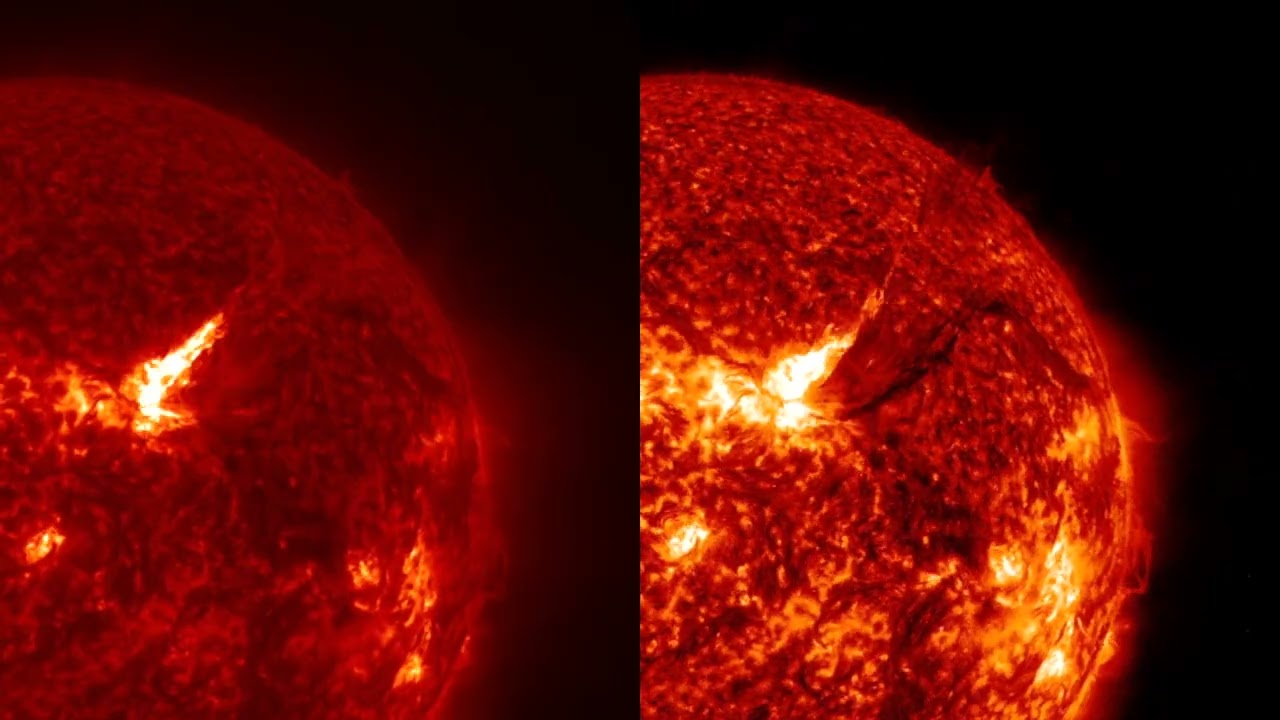
Solar Flares and CMEs at Earth - More Likely | S0 News June.3.2026
SpaceWeatherNewsS0s
2K views•2026-06-03



