This video masterfully strips away the romanticism of space to reveal a cosmic graveyard defined by extreme hostility and indifference. It serves as a sobering visual testament to the fragile miracle of Earth’s survival within a chaotic planetary neighborhood.
Install our extension to search inside any video instantly.
The Entire Solar System Explained in 13 MinutesAdded:
We tell ourselves a comforting lie that the night sky is peaceful, that the universe is silent, beautiful, distant, harmless.
But beyond the thin layer of air wrapped around Earth, space is not a sanctuary.
It is a graveyard of worlds.
A realm where planets are stripped by radiation, crushed by gravity, drowned beneath toxic atmospheres, and frozen in darkness so deep that sunlight itself begins to die.
And the deeper we travel into the solar system, the more terrifying it becomes.
Our journey begins at the edge of the sun.
Mercury, the closest world to our star, a scorched planet trapped in a brutal gravitational embrace.
From its surface, the sun appears enormous, more than three times larger than it does from Earth. a giant sphere of nuclear fire hanging in a pitch black sky.
During the day, temperatures climb above 400° C, hot enough to melt lead.
But Mercury's cruelty has two faces.
Because it has almost no atmosphere to hold warmth, the heat vanishes the moment darkness arrives.
Nightfall plunges the planet to nearly - 180° C.
On Mercury, existence swings endlessly between incineration and deep freeze. A silent world condemned to suffer beneath the star that created it.
If Mercury is suffering, Venus is hell.
From orbit, it almost resembles Earth.
Similar size, similar gravity, similar structure.
But this planet is a warning from the universe itself.
Beneath its clouds lies an atmosphere so dense that the pressure would crush the human body in moments.
The sky rains sulfuric acid and surface temperatures approach 500° C, hotter than mercury.
Not because Venus is closer to the sun, but because its atmosphere trapped the heat until the entire world became a furnace.
Nothing survives here. No oceans, no rain, no wind carrying life. Only rock, pressure, and endless heat beneath the sky no human would ever see clearly.
Venus is what happens when a planet loses control of its own climate.
And then there is Earth, a fragile anomaly suspended in the dark.
From space, the atmosphere protecting every forest, every ocean, every city, and every human life appears almost invisible. A paper thin membrane wrapped around stone.
Everything we have ever known exists beneath that delicate layer of air. One small failure and the void takes everything.
Beside Earth drifts the moon. Silent, scarred, ancient.
Its surface bears the wounds of billions of years of impacts, remnants of an era when the inner solar system was flooded with violence.
The moon is not a dead companion. It is evidence of what Earth survived.
Humanity dreams of reaching Mars, of building cities beneath its skies.
But Mars is not waiting to welcome us.
It is the corpse of a world that once may have been alive.
Billions of years ago, rivers likely carved through its surface. Oceans may have covered entire regions of the planet.
Then Mars lost something essential. Its core cooled. Its magnetic field collapsed.
Without protection, solar radiation slowly stripped the atmosphere away into space. What remains today is a frozen desert drenched in radiation.
Olympus Mons rises nearly three times higher than Mount Everest. Dust storms consume continents, and the thin atmosphere can barely hold warmth.
Mars is more than a dead planet. It is a vision of planetary extinction.
Beyond Mars lies a vast field of debris orbiting the sun. Fragments left behind from the birth of the solar system itself.
worlds that never finished forming.
Some are small enough to fit inside cities. Others stretch hundreds of kilome across.
They drift in silence through the cold dark between planets. Ancient ruins from a violent beginning.
And beyond them, something enormous waits.
Jupiter, the largest planet in the solar system.
More than a thousand Earths could fit inside it, and the giant would barely notice.
There is no solid ground here, no surface to stand on, only layers of clouds descending endlessly into darkness.
As gravity drags matter deeper toward the core, pressure rises to unimaginable extremes.
Hydrogen itself begins to transform into liquid metal.
And above this abyss, storms larger than entire planets rage without rest. The Great Red Spot.
A cyclone wider than Earth has been churning for centuries.
Jupiter doesn't feel like a planet. It feels ancient, like a colossal force of nature that existed long before humanity and will continue long after we are gone.
From afar, Saturn appears almost peaceful, a pale golden world wrapped in brilliant rings.
But beauty in the cosmos is often deceptive.
Those rings are not solid structures.
They are trillions of fragments of ice and rock orbiting at enormous speeds. A vast storm of debris circling the planet like blades.
Deep beneath the clouds, lightning storms erupt with energies thousands of times more powerful than those on Earth.
And at Saturn's north pole, a giant hexagonal storm spins endlessly through the atmosphere.
No one truly knows why it exists. The deeper we look into the solar system, the stranger it becomes.
Far beyond Saturn, sunlight begins to fade. Out here, the sun no longer feels powerful. It is only a distant star.
And in this cold darkness drifts Uranus, a planet unlike any other.
Long ago, something catastrophic likely struck this world with such violence that the entire planet tilted onto its side.
Now, Uranus rolls through space almost horizontally.
For decades at a time, entire regions of the planet remain trapped in darkness.
Its atmosphere is a frigid ocean of hydrogen, helium, and methane.
Temperatures plunge toward absolute zero.
Uranus feels less like a world and more like an abandoned relic drifting at the edge of light.
And finally, Neptune, the last giant planet before interstellar space.
At this distance, sunlight is weak. The world should be silent, frozen, still.
It is not.
The atmosphere of Neptune erupts with supersonic winds exceeding 2,000 km hour, the fastest planetary winds ever discovered.
Storms swirl through the darkness, carrying frozen methane ice across a world illuminated by barely any sunlight at all.
Neptune exists in a realm where day resembles permanent twilight. A planet of endless storms wandering through the cold frontier of the solar system.
Beyond Neptune, the solar system dissolves into darkness. Here drift the dwarf planets Pluto, Aerys, Hela, Mak M.
Small, frozen, nearly forgotten.
On Pluto, daylight is dimmer than a moonlit night on Earth.
These worlds receive so little warmth that entire landscapes remain locked beneath ancient ice for billions of years.
No cities will rise here. No oceans will return. Only silence remains.
And beyond this frozen frontier, there is nothing but interstellar night. An ocean of darkness stretching farther than the human mind can truly comprehend.
We are tiny creatures living on a thin layer of air wrapped around a fragile world. And yet somehow in all this violence, Earth still breathes.
for now.
Related Videos

Spiral Galaxy NGC 3370 from Hubble | NASA APOD 2025-11-05 #Shorts
galaxygallery
938 views•2026-05-30

SOMETHING inside the SUN is CHANGING
RaysAstrophotography
1K views•2026-06-03

There May Be A Giant Hole In The Universe... And We Might Be Inside It | The Cosmic Ledger Entry 015
TheCosmicLedger
145 views•2026-05-31

Captured the Blue Moon (with a twist) 🌙✨ #space #bluemoon #telescope
realAstroExplorer
674 views•2026-06-01

The Map We Sent to the Stars in 1977 — Why Scientists Now Regret It
TheAncientRecord7
183 views•2026-06-03

Is this a copy of our galaxy? Discover Galaxy M81!
UniverseDocumentaries-cc4mb
995 views•2026-05-31

10 Planet Where a Black Hole Replaces the Sun
cosmicexplorer-EN
147 views•2026-06-02
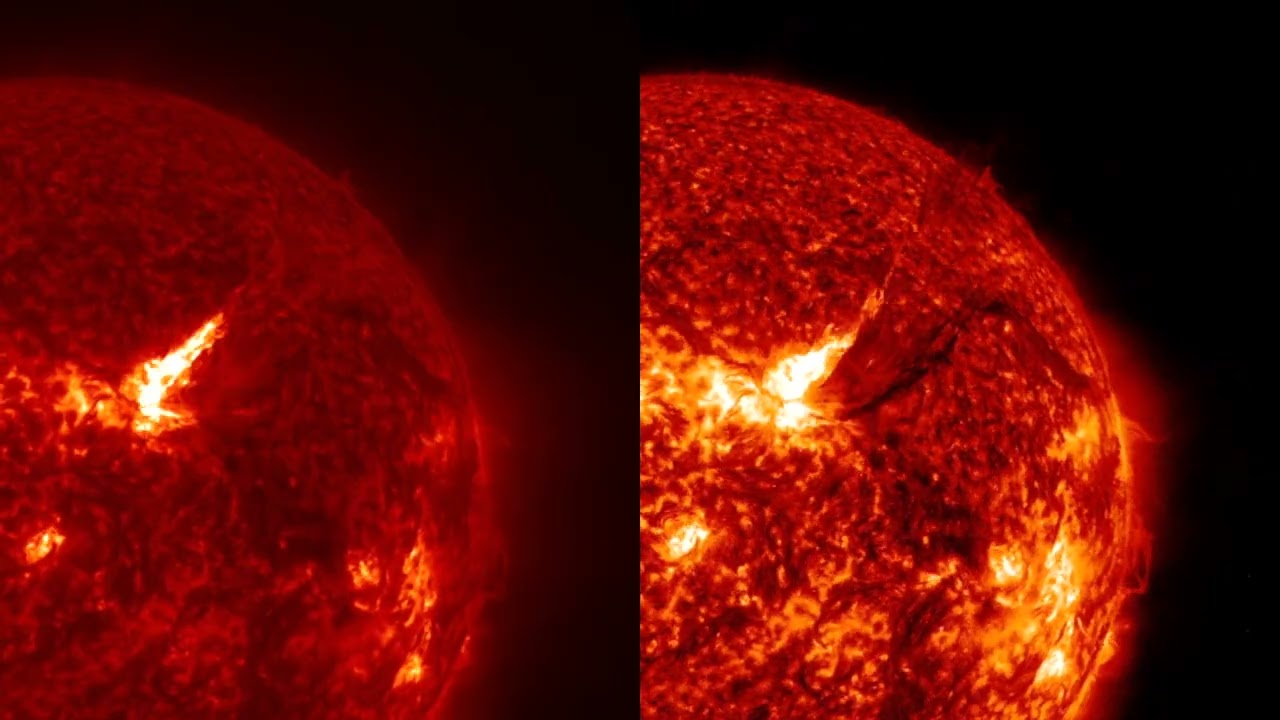
Solar Flares and CMEs at Earth - More Likely | S0 News June.3.2026
SpaceWeatherNewsS0s
2K views•2026-06-03



