Profe Luis Conchas masterfully deconstructs the "sign error" trap, offering a foolproof procedural discipline that turns basic algebra into a precise science. It is an essential, high-utility guide for any student aiming to eliminate careless mistakes in high-stakes exams.
Install our extension to search inside any video instantly.
Exani II - Examen FINAL - Matemáticas Parte 1 // UV - UANL - UAEMex - UAEH - UAA - BUAPAdded:
Hello, hello, hello. What's up, guys?
How are you? Good evening, welcome to this live broadcast. Professor Luis Concha greets you with great pleasure, live and in full color from the beautiful city of Guadalajara, Jalisco, Mexico. This is for you, who are about to take the Exani 2 exam.
That exam is practically around the corner for many universities in Mexico. As I've been mentioning throughout these past weeks while we've been broadcasting and sharing this content, the Exani 2 exam is one of the most frequently administered exams nationwide, and time waits for no one.
The moment has practically arrived for many universities in Mexico to administer this exam. That is to say, this coming week, on May 30, the exam will be administered, for example, at the Veracruzana University. It will be implemented in Veracruz, and it will also be implemented in Nuevo León. If my memory serves me right, it also applies to the UAN, the University of Nayarit, and some other universities that I may be forgetting, that are off the radar, but they are going to apply their entrance exam.
So guys, welcome to this live stream. I am Professor Luis Conchas. We have a new schedule for Exani 2. I know you were very used to connecting with me for Exani 2 at 9 pm, but this week I will be broadcasting from 7:30 to 8:30 or we will extend it a little longer until we answer the 10 exercises that I have designed for you in each of the next three classes. We'll be broadcasting live on Monday the 25th, Tuesday the 26th, and Thursday the 28th, covering these 30 exercises to help you prepare for your Exani 2 exam. It's the final exam, so welcome! I hope you do your best. I'm going to say hello to some of you who are connected here on YouTube. I'll just say hi to the guys who are online on TikTok and we'll start in a moment. But before I go, I want to remind you that if you're on TikTok, for example, and haven't downloaded the practice exam, you can find it in this QR code or on my profile; you can find it in the link in my profile. Guys who are on YouTube, you already know that in the video description where I've always put the same links, you'll be able to find the exercises. So welcome. Let me quickly say hi to the guys who are around here on YouTube. Sebas, what's up? How are you?
Welcome, he says, "Professor, greetings," says Tod. He says, "I thought it was the math exam." Yes, it's a math exam. What's up? Jos says, "Professor, I'm from the PA. Thank you so much for everything you taught us these past few months. Yes, there were some sections very similar to what we've already seen. I hope I get accepted to study physical therapy in the future.
Let's go, eh, congratulations. I hope you did very well on your academic aptitude test."
Popet says, "I'm afraid." Mario, "What's up?
How are you?" Carmen Carmín says, "Teacher, I already took my entrance exam, mission accomplished. Thank you so much for everything, teacher. Carmen Carmín, I'm sending you a big hug." He says, "Professor, I got into WAP through direct admission. What's up, Sebas?
Congratulations after three attempts, thanks for your classes, but I still need to prepare more for IPN. That's my first attempt there, and I'm using your videos and I've learned a lot. Sebas, Sebastián, give it your all. Congratulations," he says.
We had already read here that Jos says, "Professor, my exam was on Saturday, it was very easy for me." Thank you. It's not me, F6G, I wish you much success in the outcome. She says, "Hi, teacher, it's been a month until the WAP exam, I'm a little nervous about the limited spots and not getting a place." This, multifandom, oh well, we have to go all in, but come on, of course it can be done. Professor, I'm taking my UAN exam this Saturday. I knew that UAN was one of the universities applying this weekend. Let me point it out here. The one in Nayarit will be implemented this weekend. Okay, guys, it's going to apply just like this, look, this weekend it applies to Nayarit, it applies to Veracruz, it applies to Nuevo León, maybe some other places I'm forgetting.
He says, "In Pre-Medicine he recommends that I memorize or practice clinical cases." For Premedicine, I recommend the UNX Premedicine page or the classes we upload to my channel or to Professor Cristian's channel or to the UNX page called Premedicine so that you can study the content. Exit. He says, "Good luck to those from PA." Of course, Saul. It says here, "I read the people on TikTok." I say, "Professor, UACAM is also going to apply." What is the Waam?
Remember me. Zacatecas too. Alright, my guys from Zacatecas. So, they also apply this weekend. So let's go all out, shall we? He says, "Teacher, I switched from YouTube to TikTok, Mau. Um, I'm really glad to see you here too."
He says, "Thank you so much, Unx. The best, the very best. I felt great during the exam. Thanks, Changuito. It has a monkey symbol.
Santi Méndez says, "Hey, teacher, I have my UDG prep exam, I have 4 days to study." What do you recommend?
Santi Méndez, I recommend you check out the Think 2 guide on my YouTube channel. It explains the entire Think 2 guide. Okay, guys. This guy says, "Teacher, I found the entrance exam really easy." Thank you so much, Brip Ponce. I wish you all the best. Good luck with this result on your way to the UDG exam.
Okay, guys, I think it's time we started. Here's the QR code to download the exercises. It's on my TikTok profile, YouTube guys. You know it's at the usual link. Okay. He says, "Pure damn NX."
[laughs] "What's up, Soul?" Oh, no, what are you all like? He says, "Teacher, what about Sonora?" I don't know when the Sonora exam is, triple heart, but you have to know it well. He says, "Exam 2 is over, no, we're just about to start with the exercises." Guys, remember that my accounts are Professor Luis Conchas on Facebook, YouTube, TikTok, and Instagram. Where are the classes saved? They're always saved on YouTube, okay? So welcome, welcome, let's get started. He says, "Teacher, I saw you on Saturday at Cooks. I'm sending you a big hug." Santiago.
He says, "Professor, it's going to be recorded like they always are on YouTube." He says, "UNACAR." I don't know what UNACAR is, but if they're going to administer the Exani 2 exam, we're going to give it our all. Okay. Very good, guys. Also, a reminder that we'll be at a mock exam on Sunday, June 7th, in the city of Morelia for those who are going to the Michoacan University. You know? I had to put a little circle here because it turns out that the Michoacan University posted that this event was fake. We never said we were the Michoacan University. We never said it was the Michoacan University. In fact, it clearly says Exani 2 mock exam with modules in health sciences areas. So, we're not pretending to be the Michoacan University, please. Then, [laughs] really, the Michoacan University made a post, the Michoacan University made a post on their page, how do you... I called? From Facebook. I said, "What's up with the Michoacan University?"
We never said we were the Michoacan University. We're going to do a Michoacán-style mock exam. Okay.
So, uh, Milly, what do I recommend you watch? Think Two.
The content is called Think Two on the website.
Okay, please, no spamming. So, guys, we're going to be in Morelia, Michoacán, next Sunday the 7th.
Professor Lora, Professor Cristian, and myself, Professor Luis, giving a mock exam. If you want more information, it's in my profile link.
So, let's get started, guys.
Let's begin. Give it your all because it's the final exam. Hey, Professor, what does "final exam" mean?
It means that after this week there wo n't be any more content. This is my last week of class with you. This is my last week of class with you here leading up to the entrance exam. It's the last week of live classes. All the others will be saved on my channel, as always, on my YouTube channel. It's the last week of classes, guys, and the final exam because the exams are here, so Okay, let's give it our all. Professor, can this also be done for the University of Veracruz? Of course, this is Exani 2, it works perfectly. It works really well. So, all set, guys. It says, "Professor, what classes do you recommend I take if I'm going to take the exam for V?" Everything that Exani 2 says, okay? Everything that Exani 2 says. In fact, we're going to be in Veracruz, the UNX team, Professor Cristian, myself, and Professor Lora.
We're going to be in Veracruz. On Saturday we'll be in the city of Jalapa and on Sunday we'll be in Veracruz Port heading towards your entrance exam, okay? It says, "When will classes start again?" Not until August.
Classes start again in August because there won't be any more entrance exams. So, guys, welcome to these exercises. We're going to answer exercises 1 through 10 to prepare for your Exani 2 exam. So, let's get started. Let's get started and get right to it.
It says, "Given the following polynomials, find the value of a - b - c." Look closely, I'm going to zoom in a little so we can see it clearly. It's asking us to identify the value of a - b - c. Okay? That's what the exercise is asking us to do. It's important that you verify that we have a minus sign here. There's a minus sign here and a minus sign here. That minus sign tells me that after the minus sign, I'm going to open parentheses and insert polynomial B and polynomial C. So, first I'll insert my polynomial A. Since there's no sign before the letter A, I'm going to insert polynomial A exactly as it appears. Polynomial A will be inserted as -3x + 4y + 2. However, after that, I'm going to put my minus sign and then I'm going to insert polynomial B with the parentheses.
But I have to put the I need parentheses because otherwise I'll make a mistake. I have to put the parentheses, and I'm going to put -2x + y - 1. Then I'm going to zoom out a bit. I'm going to put my minus sign back in, and I'm going to open another set of parentheses and put the polynomial C, which would be 7x. Hey, teacher, why are you putting the minus sign? Because that minus sign—look closely, sorry— why am I putting the parentheses here? Why am I putting these parentheses here?
Because this minus sign will multiply everything inside the other set of parentheses by a minus sign. It's very important that if you have this minus sign outside, you open parentheses so that this minus sign multiplies everything inside the other set of parentheses. Otherwise, you're going to make a mistake. Let's do the operations. The first one is brought down exactly the same way: -3x + 4y + 4y + 2. However, I want you to pay close attention. Attention. Here we're going to multiply the signs. Minus * + 2x - and minus times plus, sorry, minus times minus would give me +1. I want you to notice that this minus sign was distributed as minus times minus. That's why I got plus here. Minus times plus, that's why I got minus here. And minus times minus, here I got plus. And finally, in the last one, this minus sign also distributed as minus times plus here -7x. And once we have that distribution of signs, now we're going to group like terms. Teacher, what does " like terms" mean? It means x terms with x terms, y terms with y terms, and terms without x terms with terms without x terms.
So, let's group like terms.
-3 - 3x + 2x - 7x. Let's see. -3 - 7 would give us -10x + 2x + 2x. Look closely, I put it in laser mode. -3 - 7 would give us -10. + 2. This would give us minus, I'm going to put the result here, -8x.
I repeat, -3 - 7 would give us -10x + 12x + 12x would give us -8x, okay?
That's where that -8 came from. Now, the y terms, 4y - y, would be if I take one away from 4y, I would get 4 - 1, I would be left with 3y, so it would be + 3y. And finally, the ones without letters, which would be 2 + 1, would give me +3.
The correct answer would be located under letter A for Antonio in this exercise number one. The important thing in this exercise, pay close attention, the important thing in this exercise is to be very careful.
Pay close attention, I'm just going to emphasize that you have to be very careful. If you have this -b sign here, then it means that when you substitute -b -c, it is necessary to open parentheses here. It is necessary to open parentheses here so that you can insert the value of polynomial B and the value of the polynomial. C. so that this minus sign multiplies the values inside the parentheses, like we did here. Look, that's why we opened those parentheses here so that this minus sign multiplies each of the elements inside the other parentheses. Okay? What's this topic called? Operations with polynomials. That's what this topic is called. I'm going to repeat it completely, okay? I'm going to go over it again, repeat it. The exercise is asking us to do a - b - c. It's necessary that after the minus sign you put a parenthesis so that when you substitute polynomial B, which I'm marking in blue, and polynomial C, which I'm marking in green, that minus sign outside multiplies each of the ones inside. So it will look like this, look. Polynomial A doesn't need parentheses, we simply bring down -3x + 4y + 2. I want you to see it by Colors.
Polynomial A is the one I'm marking in yellow, and it's this one right here.
Next, I'm going to bring down this minus sign, which I'll put in red. I bring down this minus sign, but then I'm going to open parentheses and insert polynomial B. Polynomial B is -1x + y - 1. And finally, I put my minus sign and again insert polynomial C, which would be 7x. Okay? Look, polynomial B is this here, it's polynomial B, and polynomial C is this one here. You do your multiplication of signs and say minus times minus, minus times plus, minus times minus, and the parentheses disappear. I'm going to bring down the ones that were the same at the beginning: -3x + 4y + 2. And pay attention, now for the multiplication. Minus times minus, plus, minus times plus, minus. And minus times minus, plus. Be very careful; I would end up with +2x - y + 1. And finally, minus times minus x.
Now, now we group the x with the x terms.
-3x + 2x - 7x leaves me with -8x - 8x.
The y terms, 4y - 1y, would leave me with +3y. And now those without y terms, 2 + 1, would leave me with +3. And the answer is letter A for Antonio. Exercise number one. Let's move on to the next one, okay? Let's move on to the next one. It's called operations with polynomials and it's a basic topic, of course it's on your entrance exam. V says, if it turns out to be more than one term, you don't need parentheses, right? Because the plus sign would n't change the sign inside.
Okay? Very good. He says, "Teacher, by any chance is there any kind of tip to do these exercises faster?" Of course, practice makes perfect. That is, you can solve any exercise very quickly by practicing. For example, this exercise at first glance I say 8 * 2 = 16. This is 4 * 4 - x + 7y. I multiply it and the answer is letter C for house because this is squared because it's repeated Twice. But to do it quickly, remember that easy and difficult don't exist. There's only what you practice and what you don't practice.
Every exercise can be solved quickly as long as you practice more and more. The important thing is to understand the procedure, practice more, and then you'll get faster, because remember, easy and difficult don't exist. There's only what you practice and what you don't practice.
So, if we want to do it quickly, we have to practice a lot.
Okay? So, that's the key. Very good. Here we go. Pay close attention, everyone.
Exercise number two says, which option is equivalent to the following expression?
This type of exercise is about grouping elements. Listen carefully. It's about grouping. In order to group the elements, you have to have equal groups. Teacher, what do you mean by equal groups? This is for Exani 2, everyone. It's for Exani 2. Okay?
Very good. What do you mean by equal groups?
Look closely, I want you to notice that what 's here inside the yellow parentheses is Exactly the same as this other one here in yellow. They're the same, that's very good. But the ones that are n't the same are this two and this oo.
But what do you think if we multiply that two and that one, teacher? Why?
To combine them. Why? Because they're elements that don't have x, they're independent elements.
2 * 8, what would that give us? 2 * 8 gives us 16. I repeat, that 2 times that 8 would give us 16. I'm going to keep pointing it out in blue.
I repeat, this 2 times this 8 would give us 16.
I need you to separate that 16 into two exactly equal elements. It would be 4 * 4. Listen carefully. You can separate that 16 into two exactly equal elements. You separate it into 4 * 4. Hey, teacher, why do I have to separate it into two exactly equal elements?
Listen and observe. Because now you would have a four, which would be the equivalent of that blue one, you would have the -x.
+ 7 and, which It would be one of the yellow ones. Look closely at how I'm making little groups. I'm making groups that have to be exactly the same. You would have the other one, the other four. You would have the other four together with the other yellow one. You would have together with the other yellow one, which would become -x + 7y, which is the other yellow one. Teacher, why is that? Because I need you to make groups that are exactly the same among them.
Why? So that you can group them, because it's the only way you can group them like that. I need you to make groups that are exactly the same among them. Why? So that if you multiply this one by this one and this one by this one, you would get -4x + 28y, which multiplies the same as 4 * -x and 4 * 7 - 4x + 28y. And now, since these two elements combined are exactly the same, now the answer to this would be -4x + 28y. But all of this squared. What is the correct answer to the exercise then? The letter C.
So, so that they can Grouping, listen carefully, so that they can be grouped, you need to make groups that are exactly the same. Right now the groups aren't the same. Look, notice how this yellow is the same as this yellow. Let's see, compare them. The yellows are the same. Yes, they are the same. Look, this yellow with this yellow are exactly the same, but this blue with this blue are not exactly the same. Teacher, and why do we need them to be exactly the same? So that they can be grouped.
Because the only way you can group these polynomial multiplications in powers is if they are the same. Because if I had, for example, 3x + 2y multiplied by 3x + 2y, this is the same as 3x + 2y squared. Why? Because it's the same thing that appears once twice, that's why it 's squared. If it were three times, if it were three times and I had 3x + 2y * 3x + 2y * 3x + 2y, this would be 3x + 2y, but all cubed because it appears three times. But you need to make groups that are exactly the same.
You need to make groups that are exactly the same so you can group them like this, squared or cubed. I'm going back to the original exercise.
I need to make groups that are exactly the same. Look closely. I'm going to erase everything. I'm going to erase everything. I need to make groups that are exactly the same. Notice how these ones in yellow are already exactly the same. Do you agree? The two in yellow are already exactly the same. However, these ones I 'm pointing out in blue are not the same. So, if I multiply this one and this one, they wo n't be the same so I can group them later. So, what are these kinds of exercises about? These ones without a letter, 2 * 8, what would that give you? 16. Now, this 2 * 8 that gives you 16, separate it so there are two equal elements. 4 * 4, right?
So, as if you had 4 multiplying -x + 7y on this side times -x + 7y, which multiplies by 4. That is, this 2 * 8, which is 16, I separate into 4 * 4. And if you look, now this blue and this blue are the same. This yellow with this yellow are the same. And what do I have left? 4 multiplying -x + 7y, which multiplies -x + 7y. But each of these multiplied by four is this yellow and this blue. So, now I can do those multiplications and group them. I do the multiplication, this times this, this times this: -4x + 7 * 4 = 28y. I distribute the multiplication, this times this, this times this: -4x + 28y. And now there are two equal groups. I'm going to put what's left here in another color. I'm going to put it in purple. Now there are two equal groups. Group them. -4x + 28y. All of this squared, and the answer would be the letter C. In this exercise, This is a classic EXANID 2-type entrance exam exercise.
Okay? Very good.
So, the elements have to be exactly the same. Teacher, my exam is on the 30th, that's why we're reviewing our final exam. Sara, okay? Very good. She says, "Teacher, yes, they're good for the high school exam for Pensamiento Dos." No, this is from EXANID 2, which is at the undergraduate level. Exercise number three.
Ready? Rot says, "Thank you, you passed the exam." Very good, very good. Let's go all out. She says, "Teacher, it's just started."
Well, let's go to number three. Exercise number three. It says, "The graph shows the representation of the parabola y = x²."
It says, "The representation of the graph y = -x + 2 squared is obtained by shifting the original graph two units to such a side and making the parabola open to such a side." Okay, let's remember how our parabolas behave.
Pay close attention, let's try to remember how they Parabolas behave like this. Pay attention to this.
The first thing I want you to remember is this: if I have y = x², if it 's positive—that is, if it doesn't have a sign here—by default, I know it's positive. Remember that it's a parabola that opens upwards, okay? It's a parabola that opens upwards. And if I had y = a minus sign and then x², it means it's a parabola that opens downwards. That's the first thing I want you to remember: if it has a minus sign here, it's a parabola that opens downwards; if it doesn't have a sign here because it's a plus sign, it's a parabola that opens upwards.
So, to begin with, if we have this minus sign and here's the square, then that means this is a parabola that opens downwards. This minus sign that appears here means it's a parabola that opens downwards.
Okay? So, with this, we can rule out option A because it says it opens upwards. This sign The minus sign indicates that it opens downwards.
This topic is called the behavior of quadratic equations.
Graphical behavior of quadratic equations. And we had a very comprehensive class on this. Graphical behavior of quadratic equations. And what else do you have to remember? That when we have y = x and they put x squared here, remember that if there's a minus sign inside, it means that this is moving to the right.
And if you had y = x, I'm going to erase this one below, if you had y = x and a plus sign and this squared, I'm going to put this sign in red, this plus sign, means that the parabola is moving to the left. So you have to remember these kinds of elements, that when we have y and parentheses squared, but inside there's x, if you're subtracting something, it's because that graph moves to the right. If you have y = x, the x is being added to it, it's moving to the left. If there's a plus sign here, it's to the Left.
If it has a minus sign here, it's to the right. That's how it works. So, if they 're telling me what it is, wait, let's see, let's reconstruct it. If they're telling me it's y = a - x + 2 squared, this minus sign tells me it's a parabola that opens downwards.
And this plus sign tells me it shifts to the left.
So I'm looking for an option that tells me it shifts to the left and opens downwards. What's the correct answer to this exercise?
The letter B. Teacher, what's the name of this topic? Graphical behavior of quadratic equations. I'll repeat it. What's the name of the topic?
Graphical behavior of quadratic equations. I have a complete lesson on the YouTube channel so you can remember what this type of movement is like on your Exani 2 exam. Remember that it's not just about studying the topics in general, you also have to review how these topics are asked on your entrance exam.
A topic appears on the Exani 2 exam. called the graphical behavior of quadratic equations. I have a fully explained lesson. I have a fully explained lesson. So, look closely, in summary, just so you can put it in your study notes. Look closely, if they give you y = ( x + something squared) in parentheses, this sign here that doesn't appear, this sign that doesn't appear indicates that it's a parabola that opens upwards. It indicates that it opens upwards. Professor, what do you mean it opens upwards? Yes, it would be drawn like this. It opens upwards. And if here I have a plus sign inside the parentheses that is squared, it indicates that it shifts.
It shifts to the left.
To the left. If I had y = ( x + something squared) in parentheses, the moment I see that there is no plus sign, it means that it opens upwards, and this plus sign indicates that it is, sorry, here a minus sign. Here a minus sign, sorry, and there we put a minus sign. It shifts, it shifts to the Right. Okay?
So, it opens up and moves to the right. It opens up and is moving to the right.
Here it opens up and moves to the left. Okay? Now, what would happen if we had a minus sign here?
If there were a minus sign here, I'll draw it up here for you. If there were a minus sign there, it means it opens down.
Hey, teacher, but I don't understand that, that it moves to the right, it moves to the left. Look, I'm going to back up a bit.
An equation Quadratic, if you only have the pure x squared, it's like this, but if you want it to shift to the right, if you want it to shift, to shift 1, two, three to the right and it's measured like this, it's measured like this one I'm drawing here, but I'm going to lower it a little more, it means that you would have to put y and the same. I'm going to put it a little lower and zoom out a little. Y = a parentheses x - 3 squared. If you want it to move to the right, do you notice? He moved to the right. Three spaces. 1 2 3. That's what it means. OK? So you're a complete class, it's recorded on the channel. OK? So there it is, Mario, for you to see. There it is. If it is inside the parentheses, it means that it is shifted to the left. This plus sign means it moves to the left and this minus sign means it moves to the right.
OK? That's what that symbol inside the parentheses means. Okay? Very good. So, it's all about practice, Carlitos. So, Carlos Ríos, it's all about practice. He says, "Teacher, I was watching the live streams that came out in January that I wanted from PA. They're useful for WAP."
No, switch to everything that says Exani 2.
Okay? And whether it goes up or down, López, that's the element at the end, but if you want to know when it goes up or down, check it directly in the class I gave, it's saved on the channel, in the QR code, which is here, here's the QR code that takes you to the classes I always teach and they're all saved. This QR code takes you to all the live streams I've given, and you'll find one that says "behavior of quadratic equations." There you'll find out where I explained what happens when you move to the right, what happens when you move to the left, what happens when you move up, what happens when you move down. OK?
Very good. He says, "Teacher, what about the ones that have no solution?" I don't understand the question, toast. The truth is that I do n't understand the question because it's not asking us to solve it, it's asking us to analyze its graphical behavior. OK?
Good. Exercise number four.
Exercise number four belongs to the topic of asking, "Will it be the same as -x² + 4?" No, because that -x² + 4 is a quadratic function that opens upwards with a vertical upward shift. Let's learn together. Be very careful. You need to watch that class so you can clearly understand what a horizontal displacement means and what a vertical displacement means.
OK? Very good.
Exercise number four. Calculate the value of x that makes the proportion y I'm going to write down the proportion tells me that AB/BC is equal to 5. Good. The only thing I wrote down was this here. Look. It's telling me that segment AB divided by segment BC should equal 5. That's why I noted here ABC has to equal 5. What is the value of segment AB? Segment AB is worth X + 9. So, here I'm going to put it, pay close attention to how I'm going to substitute it. I'm going to put x + 9 x + 9 between the segment BC, which is this distance here, which is 2x, this has to give me 5. The easiest way to solve this exercise is by substitution. Teacher, what does " with substitution" mean? Grab the options, teacher. And what would it be like to pick up the options? Look, the options would be, what if I think the answer is 5co? It would be 5 + 9 / 2 * 5 will give me 5. Let's see, let's see. 5 + 9 = 14.
14 / 10 = 5. The answer is no. The answer is not A.
Now, what if I think the answer is B? 2 + 9 / 2 * 2 2 + 9 11 / 4 te 5 The answer is no. The correct answer is the letter C for house. Why? Because if I substitute, look closely, 1 + 9, what did you get above? 10.
2 * 1 2. If you divide 10 / 2 you get 5.
I repeat, what we are doing is simply substituting.
We want something that tells us that the division AB, which is X + 9, divided by BC, which is 2x / 2X, has to give me 5.
If C is 1, look closely at what will happen.
1. Sorry, if x equals 1, then 1 + 9 / 2 * 1 will give me these 5. Yes, look, 1 + 9 10 2 * 1 2. What is 10? Look above at how we got 10/25. That's correct. And the answer is the letter C for house. It's done with a replacement, okay? It is done with substitution. Goes.
He says, "Hi, teacher. I took my entrance exam yesterday. Thank you so much for all the teaching. Carlos, I'm sending you a big hug and mission accomplished." He says, "Hi, teacher, good evening." I am here to thank you because on Saturday I took my mission exam and I felt so confident, since everything I studied with you was covered in the exam. Thank you, Miguel Basilio, I'm sending you a big hug, mission accomplished, and best of luck with your exam results." He says, "Can you always use substitution?" Yes, you can always get it with substitution. You'll always get it with substitution.
The only thing you have to do is check what it's asking you to do. Here it's telling us to find AB and BC. It's asking us to find AB.
What is AB? AB is X + 9.
So, X + 9 / BC. BC is 2X. And it tells me that this has to be 5.
You substitute.
If you substitute x with 1, 1 + 9 = 10. 2 * 1 = 2. What is 10 / 2? Five.
So, it does fulfill the correct answer. It does, it's the letter C. It works with substitution. Very good.
Exercise number five.
Exercise number five says, "Teacher, what do you recommend if I haven't studied anything for my exam except for my subject?" Well, study, Val. [laughs] Imagine if I told you, Imagine. No, Val, you know what? I recommend you light a Paschal candle. Yes, light the candle, but we need to get down to studying. It comes out, it says, "What happens when there is AB between BC and D between FG?" "You do the divisions and you do the substitution." Cristian, if you look for my algebraic division class, you'll find it. Professor, where is your class? I'll put the QR code again. If you're on TikTok, go to my profile, there's a link, and that link takes you to a series of buttons. The first button takes you to all the Exani 2 classes, okay? But if not, here's the QR code, because this topic is classic. You have to do substitutions; it's just setting up the division and doing the substitution. It's always substitution. It's always substitution, it always works. There's the QR code: 5 4 3 2 1. If you're on TikTok, you can also find it on my TikTok profile, okay? Okay, let's move on to the next one. Exercise number five.
Exercise number five says, "The table shows the data on the socioeconomic characteristics of a population." It says, "What is the percentage of brick-roofed homes that have access to potable water? They're asking me for the percentage, the percentage of homes with brick roofs that have potable water.
So I want brick roofs.
Brick roofs with potable water.
So they're practically telling me that there are 422,000 brick-roofed homes.
How many of those 422,000 have potable water? 85,000.
So, look closely, it's a rule of three. Look at how many homes there are with brick roofs. With brick roofs. There are 422,000.
Out there. How many of those have potable water? 85,000 have potable water.
So, the question is, how many out of every 100? If I want to know how many out of every 100, teacher, why out of every 100?
Because it says so here, out of every 100, out of every 100, out of every 100. If there are 85,000 out of every 422,000, how many will there be? It's a rule of three.
How many out of every 100 will there be? That's practically the rule of three we have to solve. Teacher, why out of every 100? Because here in the exercise it says out of every 100, out of every 100, out of every 100. Out of 422,000, there are 85,000.
How many out of every 100? Remember that the rule of three is solved like a worm. The direct rule of three is solved like a snail. You cross-multiply and divide by the value you get. Fortunately, in Exani 2 they allow us to use calculators, so I'm going to get mine out. Remember that in Exani 2 they allow you to use a calculator. I'm going to multiply 85,000 * 100 and divide by 422,000 and the answer is 20.14.
The answer is then equal to 20.14.
So there's my answer.
Approximately it would be 20 out of 100.
Okay? The answer would be 20.14.
Look closely. It says, "Yes, they allow it." Yes, Arabela, I hope you read the rules for your exam. All of Exani 2, all of Exani 2. All of Exani 2, all of Exani 2, all of them allow you to use a basic calculator. A basic calculator is one that has addition, subtraction, multiplication, and division.
Okay? So, a basic calculator, teacher, the one on your cell phone. No, you have to bring a basic one like this.
A basic one like this, but not the one on your cell phone. Okay. So, if your exam is Exani 2, yes, it allows you to use a calculator, okay? All of Exani 2 allows you to use a calculator. Teacher, I don't know what Exani 2 is. So, first, research, first, research what the exam at your university is called. For example, these universities, all of these universities use Exani 2, all of them. In fact, the University of Veracruz, the University of Nuevo León, the University of Nayarit, and The University of Zacatecas is administering the exam next weekend, May 30th. There are 7 days left until that entrance exam. Well, 5 days. Everyone uses the Exani exam; they allow you to use a basic calculator—a scientific calculator, not a basic one.
Puebla also uses Exani 2, but Puebla doesn't administer it until June 20th. But all these universities, all of them among others, administer Exani 2. Look, 27 in Colima. Perfect. So we're getting to the entrance exams. Okay, let's continue. So, I'll repeat, since they allow you to use a calculator, you simply have to set up your rule of three. It says, "What is the percentage of brick-roofed homes that have access to potable water?" How many houses have brick roofs? Of the 422,000 houses with brick roofs, 85,000 have drinking water. So, out of all the homes, of the 422,000 homes, 85,000 have drinking water. Potable. Very good. So, if I want to know about every 100, because of the wording, you see?
It says out of every 100, out of every 100, out of every 100. The question is, how many have drinking water? out of every 100 is a direct rule of three. You cross-multiply and divide by the value you have left, right? So, that's why we do the multiplication and divide by the other value. It's in the shape of a snail, it comes out to 20.14. Therefore, the answer is the letter C for house. Okay, very good.
He says, "Teacher, someone told me that if I cancel the zeros in that exercise, it would give me the answer." Okay, you want to cancel the zeros, fine, but do you have a calculator? Why cancel zeros if you have a calculator? I mean, if you didn't have a calculator yet, you'd have to put in 422 85 because I cancelled three zeros. I cancelled three zeros. And here I'm going to put out of every 100, how many? So that? Anyway, you have a calculator. So if you have a calculator, I'm not worried about you having 7 zeros, I just need to press the right button on my calculator and that's it. So anyway, whether you have one or not, if you're going to do it, if you have a calculator, why waste time with that "oh, I'll calculate zeros" stuff? So, to each their own, right? But it's okay, that's correct. Uh, exercise number six says, "Select the value of x so that the following equality holds true." I'm going to write it a little bigger. Says n as a child taking its root and here I have root degree x. But all this, all this raised to the power of 18 has to give me n to the power of 6. Let me tell you what's happening.
This is a law of exponents. This law of exponents tells you that it is a fraction. It's called n. It's called n.
raised to the power of a over b. I call him master on a donkey. I call him master on a donkey. Teacher, what does that mean?
This law tells you that exponents are multiplied together. Teacher, what are exponents? Yes, look, here's an exponent one. The exponents are multiplied together, and here you would get n to the power of 1 * 18.
And if there were several roots, the roots are multiplied together, okay?
They multiply among themselves, but there's nothing here. There is nothing. So, there's the letter x, it would be n to the 6th power. And this becomes a division. This becomes x to the 18th power, sorry, n to the 18th power / x. Why, professor?
Because there's a law of exponents that says, look closely, there's a law of exponents that says something like this: x to the power of a over a donkey is equal to x raised to the power of a, the a is inside the little house between the root degree B. So, this is the a This is the master and this is the donkey.
The master stays inside the house and the donkey stays outside the house. What does that mean? If you have a letter n raised to the power of 18 and you are taking a certain degree of root and you get n to the power of 6, it means that this n will be raised to the power of 18, which is the master. That 18 is the boss. It is the one inside the little house divided by x. And this has to give me n to the 6th power. The question is, what do you divide 18 by to get six?
How many times do you divide 18 to get six? And the answer is that you have to divide by 3, because if you divide 18 / 3, you would get 6. I'll go back to the exercise. Look closely, in this exercise, then you have to divide this 18 by this value to get six. So that value has to be 3 so that you get 18 / 3 and 18 / 3 gives you this 6. What does this letter X have to be worth? It has to be worth three.
Look carefully, I'll tell you something again.
This exercise only shows one root, but I want you to listen very carefully.
I want you to listen very carefully. There are times, listen very carefully, listen very carefully, there have been times when exercises have appeared in the Exani 2 exam that come something like n to the 8th power and I take the root, I'm going to take the cube root and again I take the root, I'm going to invent a square root. Listen carefully, I want to tell you something so you know what you have to do.
Pay close attention and I'm going to give another example which is n to the 8th cube root cube root and all this squared. Look closely, eh, pay close attention. When you have several nested roots, listen carefully, when you have several roots that are grouped together, you have to multiply the root by the root.
The roots are multiplied together and this would leave you with n raised to the 8th power taking the sixth root. Teacher, why the sixth root?
Look closely, because you multiply 2 * 3.
However, powers are multiplied together. If for example I have this n to the 8 which is squared, this would be like n to the 2 * 8 16 16 and I take the cube root. Okay? So, be very careful. Pay close attention, the degrees of the root are multiplied together and the powers are multiplied together. Just so you know which one to multiply with when you have several roots or several powers.
Powers are multiplied together and degrees of roots are multiplied together. That's why in this exercise I'm going to erase everything. In this exercise I want you to visualize that here I had n root of degree x. This is equal to all of this raised to the 18th power. It tells us that this is equal to n to the 6th power. It is assumed that here we have an exponent of 1, that's why we multiply 1 * 18, we would get n to the 18th power and I am taking the xth root and this has to give me n to the 6th power.
So this is a division. N to the 18th power divided by x must equal n to the 6th power.
What must it be divided by? 18 by what number do you divide to get 6?
And the answer is that x equals 3. The answer is the letter C from casita. Laws of exponents, okay? And dividing 18 by 6 is wrong, isn't it, Johan? It's the same thing. Just be careful. It's not worth it, it's not worth 6, it's worth three. OK? Okay. He says, "If I divide 18 / 6 it gives 3. Very good, Arturo. Excellent. That's correct. 6 * 3 = 18. 18 / 3 gives you 6 and 18 / 3 gives you 6. That's correct. That's correct. He leaves. He says, "Hello, teacher." On Saturday I took my exam at WAS there in Sinaloa. Your videos are extremely helpful to me. Thank you, Arturo, I send you a big hug and much success in your result already in Sinaloa. Exit. Very good. So, there's exercise number six. Ah, very good. Excellent.
Exercise number seven. It says, "In a circle of radius 6 cm, the central angle determined by arc AB measures 150º." Okay, first I'm going to draw a circle. I'm being told that this circle has a radius of 6 cm. The radius is the line that goes from the center of the figure to any point on the circumference. Is it going out? So, the radius is equal to 6. Very good. That's what he's telling me. In a circle of radius 6, the central angle that determines arc AB is 150º.
So, if they're telling me there's a 150º arc, which is arc AB, they're telling me that this central angle is 150º.
In short, they're telling me that this arc, this arc is represented by these 150º, okay? It is represented by these 150º.
The exercise asks, what is the length of arc AB? Remember that the word " arch," this word "arch" refers to this part of the outline, okay?
So, the word arch always refers to a part of the perimeter, right? So, that's what the word arch means.
The arc is always a part of the perimeter, it doesn't refer to the area, eh, it refers to a part of the perimeter. That's what the word arch means. It is part of the perimeter. It says again, in a circle of radius 6, because here I put radius 6, radius 6, the central angle that determines the arc AB is 150º. So, it's telling me that this central angle is worth 150 gr, which is this arc AB. What is the length of arc AB? The exercise, what we have to figure out is what 150º would be of the whole circle. These are called circular segments. In the classes I was teaching you during the semester, which you can find on the profile, in the video description, on my TikTok profile, in the classes I was teaching you, we covered this topic in depth. It's called, uh, it's called circular segments, okay?
Circular segments. We gave a complete lesson on this topic. If they ask us for an arch, then it's part of the perimeter.
So, let's find out that perimeter equals pi times diameter. Pi times diameter.
If the radius is 6, the diameter would be another six. Because?
Because the radius is from the center to any point on the circumference. The diameter is completing the circle from side to side.
If the radius is six, then the diameter would be another six. The diameter would be equal to 12. So the answer will come from pi * 12. But apart from that, multiplied by 150 gives 360. What? That's the answer.
Uh, that's the answer. Look carefully, I'm going to write it on a separate sheet.
The answer to the exercise will be the following. If we have a radius equal to 6, and we have an angle of 150º, because they are telling me that the central angle is 150º and I want to know how much this arc that I am marking in green is worth, then the answer will be perimeter will be equal to pi times diameter. The diameter is 12. So it would be 12 pi multiplied by the arc we want to know, which is 150º, but of what, 360. Teacher, why 360? Because the entire circle is 360.
This 150 over 360 represents 150º out of 360. And that's the multiplication. Let's multiply.
So, remember that you're allowed to use a calculator: 12 * 150. 12 * 150 and you divide by 360. I'm going to get my super calculator out. 12 * 150 would give me 1800.
1800 divided by 360 / 360 divided by 360. This would give me 5 pi. What is the answer? The answer is 5 pi.
Letter A for Antonio. Teacher, it's always 360. Yes, because all circles have 360, okay? So, the answer would be 5 pi. We multiply 12 * 150 because that's the angle we need and we divide by 360. Teacher, but why do we divide by 360? It's like calculating a proportion. It's like calculating a proportion. Where did the 150 come from? of the exercise. of the exercise. In fact, I repeat, the exercise. Here we go again. Here we go again. It says, "In a circumference of radius 6, then I'm going to put a circle of radius 6."
The problem states it exactly as it is. Look, I'm building it with what he says. In a circle with radius 6, the central angle that determines arc AB measures 150.
The arc, the central angle measures 150.
Teacher, what is a central angle? A central angle is one that is formed from the center of the circle. He's telling me it's 150º. He's asking me how much the arc encompassed by that 150º angle is worth.
So, he's asking me how much this bow costs from here to here. 150 gr. The one I'm marking in blue.
So, remember that arches are always perimeters. Perimeter. And what is the formula for the perimeter of a circle?
Perimeter equals pi times diameter, but you'll have to multiply that by 150 divided by 360.
Teacher, why 150 instead of 360? Because you only want 150 out of 360.
You want 150 out of 360, so you multiply by 150 and divide by 360. What is our diameter? If the radius is 6, the diameter is equal to 12, it's the same thing. So the radius, the radius is 6, the diameter would be another six, the diameter is 12.
Therefore, the perimeter will be equal to pi * 12 * 150 di 360. And we do the multiplication. 12 * 150 / 360. And the answer is that the perimeter is equal to 5 pi. We did the calculations and the answer we got was the letter A. It says, "Why should I multiply and not do another operation?"
Paulina, look closely. Look closely, Paul.
Observe the following. Imagine I tell you, "Paulina, I ate 180 grams of a cake." Imagine, I ate 180 grams of a cake. Look closely. I ate 180 grams of a cake. You're going to say, "Teacher, he ate half a cake." Sure, because 180/360, that's half a cake. It's 180 out of 360. Imagine I tell you, "Paulina, I ate, I ate 90 grams of a cake."
90 grams of a cake. Teacher, if you ate 90 grams of a cake, 90 grams means that you ate 90 out of 360, which is a quarter. It's a quarter of the size, but sometimes the proportions aren't so visual, you know? They 're not that visually appealing. So what happens when I eat 150 grams of a 360-piece cake? That's why if I ate 150º of a cake, well, it would be like when it 's 90º it's 90 360, which is 1/4. So if it's 150º you say, well, it's 150 out of 360. You can simplify, eh, it gives you 15 out of 36, you can simplify, it gives you 5/1 twelve. I'm eating 5/1 twelfths. But why simplify if you can simply find out what 150 is out of 360? Do you see that's why you multiply by 150 and divide by 360 because you're calculating a proportion? We're calculating a ratio. Exercise number seven.
OK?
He says, "Teacher, is there a video that explains how the Exani questions are structured and what to do or what you recommend?" I'm trying to understand the question, Kayumi. Yes, I have Exani 2 classes.
I think this is week 17 and each week I taught between three and four classes a day, four classes a week. So, in the playlist that's in the link here in the video, I should have about 60 classes, no less. I think he got about 58 classes of Exani. So, if you're asking me if there's a video where I explain how the Exani questions come about, the answer is yes. I have taught nearly 60 Exani classes, including this one. These are all Exani-type exercises, okay? So, uh, just trying to answer the question.
Very good. So, there's exercise number seven. Let's move on to exercise number eight.
Based on the equation 3x + 7y = 17, which statement is true? Okay, first of all, the first thing I want you to visualize is that if they're telling you that a solution is 1,2 or they're saying the solution is 1,2, the first thing I want you to remember is that if they're giving you coordinates, if they're saying 1,2 or they're saying 2,1, remember that the first letter is always X and the second letter is always Y. The first letter is always X and the second letter is always Y. Why? Because they are coordinates. The coordinates are always X Y. Okay? So, the coordinates are always X Y, right? That's the first thing.
Now, there's something you need to analyze in this exercise.
If I have the expression 3x + 7y = 17, I want you to visualize that this is an equation. We only have one equation. We have an equation.
An equation. And we have two unknowns.
Unknowns.
Look closely. I want you to visualize that we have a single equation and two unknowns. Teacher, what do you mean by two unknowns? We have both the letter X and the letter Y. We have an equation and we have two unknowns. Did you know that when there are more unknowns than equations, the answers are infinite? I'll say it again. When we have more unknowns than equations, the answers are infinite.
They are infinite. What does that mean? There are many answers, many, many values that will fulfill that.
There are infinitely many values that will satisfy the relation 3x + 7y = 17. So, be very careful. The correct answer to this exercise is 1,2.
One of many solutions. One of many.
Teacher, but why do you say the answer is A and not B? What's the difference? Look, to begin with, if I substitute x with 1 and y with 2, I will get 17 because it would be 3 * 1 3 + 7 * 2 14. Look, 3 * 1 3 + 14 does give me 17.
That is, with x = 1, y = 2, I do get 17, because it would be 3 * 1, 3, 7 * 2, 14, 3 + 14 does give me 17, which is what it's indicating here. But that doesn't mean it's the only one that meets the requirements. She's not the only one who complies. Because?
Because if I have two unknowns and one solution, two unknowns and one solution, it means that the solutions are infinite. Professor, but I don't understand what the difference is between a solution and the solution. If you've ever seen Kung Fu Panda, I hope this is very clear to you. When Po becomes the Dragon Warrior, he's not just a panda, he's THE panda. When it's the panda, it means he is the only dragon warrior. When it says the solution, it means it's the only solution. It's like the panda, the dragon warrior.
When they say "one panda," it means there are many pandas. So when they say, "No, I'm the panda, I'm the dragon warrior." So, saying "a solution" is not the same as saying " the solution." When they say the solution is the only solution, it is the solution. So when it says one solution, it means there are many.
So when you read this about a solution, it means it's one of many, as we're identifying here. Why?
Because there are infinite solutions. I'm going to give you an example, pay close attention. I'll give you an example. Look closely.
Imagine I told you, "Hey, x + y = 10. Tell me what values you can use so that x + y equals 10."
Imagine I tell you, "Teacher, 5 + 5 equals 10." That's one solution. Tell me another. Tell me what other solution would give you 10. Teacher, I can use 1 + 9. So, that's another solution. Teacher, I can use 2 + 8. That's another solution. Teacher, I can use 3 + 7. That's another solution.
Teacher, I can use 4 + 6. That's another solution. There are many. When you have—listen carefully—when you have only one equation, one equation and two unknowns, when you have more variables than equations—listen carefully— when you have more variables than equations—the solutions are infinite.
So, this is one, this is another, this is another, this is another, this is another. Let's go back to the exercise. Let's go back to the exercise. Look closely, when you have a single equation, just one equation, but you have more variables, that is, two or three variables, it has many solutions. Many. There are many solutions, many. If you have an equation and that equation has two unknowns, then it will have many solutions.
So, that's why when they tell me " a solution" or "the solution," the answer has to be one solution.
One. Why? Because when they say "the solution," it's like the dragon warrior is the panda. It's the panda. It's the only one.
When they say "a panda," it means there are many pandas. So, I hope this makes a little sense to you. So, one solution out of many is this one here. Why? Because if I write 3x + 7y = 17, they're telling me that one solution is 1, 2. It means it 's 3 * 1, because remember, this is x and this is y. 3 * 1 + 7 * 2 will give me 17, right? 3 * 1 3 + 14 does give me 17.
But that's one solution. One solution, teacher. What if I have two equations and two unknowns? That's called a 2x2 system, and it has only one solution if the equations aren't parallel or if they're not overlapping. But normally, when I have two equations and two unknowns, there's one solution. If I have three equations and three unknowns, there's one solution. If I have four equations and four unknowns, there's one solution. Normally, unless one of them is parallel. So, there's the answer to exercise number eight. There you go. I'm the one who got in.
[laughs] Hey, what a great example you gave here. It's just that on YouTube it says, "Teacher, it says here, Sidmi Torres, I'm not an admitted student, I'm the admitted student."
[laughs] Great, great. Uh, that's a very good example. So, you're not an admitted student, I'm the admitted student. I'm not an applicant, I'm the Applicant. [laughs] He says, "Teacher, how do I know when there are more equations?" Well, because you can literally count more. Imagine the following exercise. Let me give you an example where there are more equations, because you literally see more equations. Okay? So, teacher, how do I know there are several equations? Because you literally see more equations. Here I go, here I go, here I go.
Let me give you one. For example, in the topic of systems of linear equations. Look. Okay, here, guys.
Okay, this example. I'm not going to solve it. I'm not going to solve it, but count the equations. Count them.
How many equations do you see? One, two equations. Very good. How many equations are there? Two equations. How many unknowns are there? One, two unknowns. How many answers will there be? Only one. That's the answer. The answer.
Okay. That's the answer. Why? Because there are two equations, two unknowns. That's the answer. It's the only one. Does it work? That's the answer. So, I'm going back here.
How many equations do you see here? How many equations do you see here? Let's see, based on the equation, how many is it? Well, one. It's one equation. How many unknowns do you see?
Two. If you have more equations than unknowns, there are infinite solutions.
Teacher, what do you think of someone? He says, "No, I do n't know that teacher, no, I don't know him." " So, I can't give an opinion about someone I do n't know." He says, "Professor, the physics module will explain it." No, no, I'm not going to explain it. He says, "I thought it was something different, wasn't it?" "Well, if there are two equations and two unknowns, then there's only one solution." Okay. Very good. He says, "Professor, what do you recommend I do to prepare for the Piens 2 exam?"
Here on YouTube, I recommend you check out my Piens 2 playlist. It's an explanation of at least the study guide. Okay. Okay. So it's a study guide. It says something like B. It says, "Professor, if I can cover the material in 4 days." Well, yes, if you can cover it in 4 days. I mean, it's better to study as much as you can, right?
Yes. It's better to study as much as we can, right? Not studying at all, okay? So it's always better to study as much as we can. Okay. Very good.
Then he says, "Professor, do you think I can study for the exam on the 30th?"
Well, study as much as you can. Remember, that's the goal. He leaves. He says, "Professor, when there are more equations than unknowns, there is one solution, Monce, one solution." When you have more equations than unknowns, it's still a solution. Okay? Very good, ready. Here we go. Ready. Exercise number nine. It says, "Diego is going to buy sporting goods."
Diego says, "It's the same as Professor Cris." This, look, it's that someone, look, I don't know why you're asking about different teachers. Of course I know everyone in the industry, but you can never ask someone what they think of another person, because what I'll always tell you is that they're good people, they're always good people, and I think if someone is trying to help you, I think they're a good person.
However, you also have to be very careful about who you lend your ears and your mind to, because everything that reaches your ears passes through your mind, and after it passes through your mind, it reaches your heart. Is it going out? And when I'm asked about some teachers, I'll only be able to give my opinion to those I know firsthand. For example, who do I recommend? Who would I recommend watch their content? Of course I'm going to recommend Professor Cristian to you. Professor Cris. Professor Cris. He is a great friend of mine. I've known my friend, Professor Cristian, for almost 14 years now, and he also has his own YouTube channel. In fact, if you look at his set, if you look at his set, it looks a lot like mine, doesn't it? In fact, I helped him with how to implement the camera and everything. So, this, Professor Cris is also part of the UNX team. I also recommend Professor Lora.
Professor Lora specializes in Spanish, he is also part of the ONX team and his voice, if you see his set it is also very similar to ours because he is part of the same team of teachers, he is part of the same work team. I also recommend Professor Caleb. In fact, Professor Caleb, the Spanish teacher, was doing a live stream on YouTube a while ago for those who want to study the Spanish part. Professor Cris teaches math, Professor Lora teaches Spanish, and Professor Caleb teaches Spanish. There are also more teachers, for example, I highly recommend Professor Dani, his name is Dani Aguirre. Dani Aguirre, this one, he is also a mathematics teacher. Also the teacher, Professor Armando Méndez. Armando is also a math teacher for the UNX team. So, there are many of us teachers who share content. Therefore, I cannot speak about any other professor that I do not know firsthand. For example, I know Professor Tokski, I know him.
Once we met here in Guadalajara, I talked to him, I have his number, I know the professor, Professor Daniel Carreón, I have also had the opportunity to talk with him at YouTube meetings.
I know the doctor, Dr. Carla and Dr. Dani from UNX Premed.
So, of course I know them because they are people I've had the opportunity to live with. So, uh, but it's also very important that you trust your content creator.
Pay close attention, it is very important that you trust your creator. Why?
Because it's not just about studying for your emotional exam, it's about having someone who inspires confidence, someone who inspires you to be your best self, someone who helps you maintain your balance between the technical aspects and what you're learning in the process. Because you know, passing your entrance exam isn't just about knowledge.
Passing your entrance exam is also about keeping what you have here in your heart. I have my Pretel here, because I was given a Pretel PIN. So, it's also about taking care of what you have in your heart, because that's what will give you the strength to keep going, okay? So, uh, [clears throat] I'm sending you a big hug.
If you are here and you think, I like how Professor Luis Conchas teaches, I am here to serve you and I give thanks to God, to life, to the universe, whatever you want to call it, whatever you want to call it. I thank God for allowing us to meet, and I wish you much success in what you are going to experience in your next mission exam, okay? I wish you much success.
Okay. Okay, guys. So, let's follow him. He says, "Teacher, what would be another solution besides 1,2?" There are so many. Look, I can make one up for you. Look, if I put 3x + 7y = 17, what if x equals 0? And y equals 17.
So it would be 3 * 0 + 7 which multiplies 177.
This equals 17. This 7 cancels out. 3 * 0 0 + 17 gives you 17. So that's another solution, okay? It's another solution. So another solution could be that x equals 17/3 and y equals 0. And that would be 3 multiplying 17/3 + 7 * 0 = 17. I'm just making up the ones that seem most logical to me. Exit. 7 * 0 0. This 3 with this 3 simplifies. 17 + 0 = 17. And these are different values, do you notice? X = 17/3, Y = 0. Eh, X = 0, Y = 17/3 or also 1.2. There are infinite values. Yeah? Therefore, there are infinitely many values that can give you the answer. Okay, let's move on to the next one, guys. Ready?
He says, "Teacher, when is it that there is no solution?" Look, there's a class I taught in Exani 2. There's a class I taught called graphical behavior of systems of equations.
Graphical behavior of systems of equations, because there are many elements that you have to analyze. If one equation is parallel to another, it means that the two lines go that way and never intersect; there is no solution. So, there's a class I taught called, Graphical Behavior of Systems of Equations. Is it going out? So, check it out, it's on my YouTube channel or it's in the video description, okay? It's very important that you cover several topics, that's why it's not just like this exercise; this is an exam, but each exercise has a topic, okay? Okay, exercise nine. Let's get to exercise nine, guys. It says, "Diego is going to buy sporting goods. A sweatshirt costs 248.75, but he'll get a 20% discount. A pair of sneakers costs 689 and he'll get a 35% discount. When he arrives, he's told that all the sweatshirts have an additional 15% discount on top of the already reduced price. What is the approximate amount Diego will pay if he buys both items? Pay close attention, I'm going to give you a tip so you can answer this quickly.
Look closely, this is the fastest way to answer this exercise. Observe.
I'm going to make a table about the sweatshirt, and I'm going to make another table about the sneakers. Look closely, the sweatshirt costs 248.75.
What is the first discount they're going to apply? If they're going to apply a 20% discount, I want you to listen very carefully, if they're going to apply a 20% discount, it means you pay the 80.
Listen carefully. If they're going to give you a 20% discount, that means you're going to pay 80%. That's very important. If they give you 20%, you pay 80%. And when you get to the register, they tell you they're going to give you an additional 15%. If they're going to give you an additional 15%, that means you're going to pay 85%.
Teacher, but where do the 80% and the 85% come from? Whenever they give you a discount, you have to see what percentage is needed to reach 100%. Listen carefully. If they give you 20%, how much more do you need to reach 100%? You need 80%. If they then give you 15%, how much more do you need to reach 100%? You need 85%. That missing percentage is very important because the way you can quickly get the answer, in the case of the sweatshirt, is... Now we'll analyze the sneakers. You're going to multiply 248.75 by 0.8 and then multiply it again by 0.85. Why? Because if they apply a 20% discount first, it means you pay 80%, which is 0.8%. And if they then apply a 15% discount, it means you pay 85%. That's why you're going to multiply it by 0.85, and you're going to do it with your calculator, and it'll be very quick.
How much are you going to pay for the sweatshirt? 248 times 8 times 85.
The answer is that you're going to pay 168.64 for the sweatshirt.
That's what you're going to pay for the sweatshirt. Now, how much are you going to pay for the sneakers? The sneakers cost 689.40.
What discount are they going to apply? 35%.
If they're going to apply a 35% discount, how much do you pay? You pay the 65. So, watch out for that. You're going to multiply 689 by 65 to find out how much you'd pay for the sneakers.
689 x 4.
4 times 6, and you get that you'll pay 448.11 for the sneakers.
How much will you pay in total? You'll pay 168 for the sweatshirt, 448.11, and the answer would be, let's see, 168.
I think I put a decimal point wrong, wait.
I think I put a decimal point wrong. 168 + 448 equals 600. Okay, I got a decimal point wrong, but the letter A is there. Look closely. There it is. Look closely. It says, "What is being explained should be saved in YouTube videos." Yes, it's always saved.
Look closely. Pay attention to this. I think I need more space for this exercise. Let's see, let's see, I'm going to repeat the slide. I'm going to try to write smaller to see if we can figure it out. Information. Look, the sweatshirt.
The sweatshirt costs 248.75.
Okay, they're going to apply your first 20% discount. So, with your first discount, if they apply a 20% discount, it means you'll pay what's left to reach 100%. You'll pay 80%.
So, the first step is to multiply that 248.75 by 0.8, teacher, why? Because 80% is the same as multiplying by 0.8. If they then apply an additional 15% discount on the sweatshirt, it means you'll pay 85%, teacher. Why? Because that's what's needed to reach 100. So you multiply by 85, teacher. And what are those multiplications for? So you know exactly how much you would pay for the sweatshirt, because they're going to apply the 20% and then tell you they have an additional 15% discount on the sweatshirts.
So, it would be 248.75. I 'm writing it down here on my calculator, okay? Multiplied by 0.8 * 85.
I'm doing the multiplications on my calculator. You can bring your calculator, okay? So, there it is. So, how much would you pay for the sweatshirt? The sweatshirt, the final price would be 169.15.
Very good. Now I'm going to make a separate calculation for the sneakers. For the sneakers. The sneakers. The sneakers cost 689.40.
What do you mean? They're going to give you a 35% discount on the sneakers. If they're going to give you a 35% discount, how much are you going to pay? How much is needed to get from 35 to 100? It's needed to get 65%.
That's what you're going to pay. So, you're going to multiply 689.40 * 65.
Teacher, but I don't understand where the 0.85 comes from, guys. It comes from moving the decimal point two places. It's like dividing by 100. It comes from moving the decimal point two places. So, if you move the decimal point two places in 0.65, it becomes 0.65. It becomes 0.65. Now then. So, the sweatshirt 689.4 * 65 tells me that I'm going to pay for the sweatshirt, sorry, for the sneakers, the sneakers, not the sweatshirt, the sneakers. 448.11.
Now I do my addition. I do my addition.
Sweatshirt this price, sneakers at this price. How much did I pay? Plus 169.15.
The answer is 617.26.
That's the quickest way to solve this exercise.
Okay? In Exani 2, calculators are allowed. That's why the numbers are so ugly. Teacher, why such ugly numbers?
I don't like having to multiply 248.75 by 0.8 by hand. They're not easy to multiply by hand. Teacher, what would it be like on an exam where calculators aren't allowed? The numbers would be more... Round numbers. They would be numbers without so many decimals. What's this called?
Percentages. It says, "Professor, you can also do it with the rule of three." Yes, but this is the fastest method. If you want a fast, efficient method that will always work, there it is. If it's an online exam, you can use a calculator. Yes, a button will appear to open a calculator like the one on your computer.
Yes, like the one in your internet browser.
Last exercise of the night, everyone.
Last exercise of the night. Ready?
Here it goes.
It says, "Professor, thanks to your courses I managed to get a 70% scholarship at Tech de Monterrey." Okay. This, this Chinese guy, like this. Well, this is your username, Chinese guy. Um, congratulations, uh, congratulations.
It's a very good scholarship. Take advantage of it, make the most of it, uh, thank your parents for their great support and congratulations. Well done, my dear Chino says, "Teacher, why aren't the discounts added together after being applied separately?" Well, Hidaweight, because additional discounts— let me explain something— additional discounts are never added together; they're always applied separately. Once you apply one, the other one is applied, okay? Additional discounts—once you apply one, the other one is applied.
Whenever I tell you it's an additional discount, you first apply one and then the other one. That's why there are two multiplications. Let me explain.
Pay close attention before we finish the class; we're going to the last exercise, everyone. Imagine I find a super deal.
Listen carefully. Imagine I find a super deal during the Hot Sale and I see a jacket that costs 2000. Imagine why the discounts aren't added together. Listen carefully.
Imagine I find a super deal now during the Hot Sale on a jacket and I say, "This jacket would look good on Professor Luis Conchas."
And I hear them say, "50% off.
50% off and an additional 50% off.
" And you say, "Oh, 50% off and an additional 50% off." And it turns out Professor Luis Conchas doesn't know, Professor Luis Conchas doesn't know percentages. Imagine I go to the store, to Coppel, to Fábricas de Francia, to Liverpool, to Palacio de Hierro, Palacio de Fierro, Palacio de Hierro. And I tell them, "Hey, I heard that a jacket that costs 2000 pesos has a 50% discount and an additional 50% off." 50 + 50, 100%. I'm here for my free jacket. Question: Is the jacket free? So, 50% off plus an additional 50% would mean a free jacket, right? TRUE? Then you say, "No, teacher, don't make things up, don't make things up, he's going to make a fool of himself, teacher." No, because the additional discounts are not added together. If the additional discounts were added, well, I'd still get my jacket for free. That's not the case. What would it be like? Well, first they apply the 50%. What is 50% of 2000? 1000. And then they apply the other 50%. What is 50% of 1000? 500. So, how much would you pay?
You would pay 500. You would pay 500. That makes sense, doesn't it? That's why we don't add up the additional discounts, because it's absurd to add up additional discounts. That's why if they tell you they're applying 20% and then 15%, that's why you have to do both percentages. First we apply a 20% discount, which is paying 80%. Then we apply the 15% discount, which would be paying 85%, and that's why we do both. That's why they do n't add up. Yes.
Very good, exercise number 10. Very good.
It says, "One clock has a radius of 10 cm and another has 25 cm. So, I'm going to draw a smaller clock and a larger clock, because one has 10 and the other has 25." Okay? So, I'm going to put here that I have my little watch. So, one has a radius of 10 and the other has a radius of 25. We have two little clocks, okay? The first one says, "The hand turns from 2 to 5." Oh boy, let's see, I'm going to make my hands. Here would be 12, here are three, here are six, here are nine and here would be 1, two, then here is 4 5 Oh, wow.
Seven. Just a second, guys, just a second.
Okay, give me a second. Okay, give me a second because I'm getting a call and I imagine it's an " Oh my God." Give me a second, guys. I'm going to mute the call, the class, a little. Give me a second, I'll be right back. I'm going to mute myself on both. Give me a second. Yes, one second, guys. Leave. I just wanted to check that everything was in order and that there was no sound. No, I wasn't talking. I told them I was going to mute the live stream for a second because I needed to make a call to verify that it wasn't an emergency. Okay, now he says, "Teacher, I can't hear anymore." No, I muted myself, I muted myself. Exit. Okay, so be careful with this. The first step is to build your clock. I hope you know how to build a clock, okay? I hope you know how to build a clock. How are the hours going? Okay, first when you're going to build a clock, you first put 12, three, six and nine. Then you put the others: one, two, three, then four, five, six, seven, eight, ten, and eleven.
Okay. What is the exercise telling me?
It says that on the first clock, the hand moves from 2 to 5. So, I'm going to make that hand big.
Two o'clock tour. Turn from 2 to 5. That means it turned. Let's see how many slices of pizza. From 2 to 5 he turned three slices of pizza. One, two, three slices of pizza. From 2 to 5 he turned one, two, three slices of pizza. Exit. They are three slices of pizza. From 2 to 5 it turned one, two, three slices of pizza and the other clock turned from 8 to 11. The other clock then tells us that it turned from 8 to 11. I'm going to mark it a little thicker. It rotated from 8 to 11. How many slices of pizza did it rotate? He also turned three slices of pizza. One, two, three slices of pizza. Then, look closely, the little clock turned three slices of pizza. One, two, three slices. And the big clock turned one, two, three slices of pizza. One turned from 2 to 5 and the other from 8 to 11. Which statement is correct? The correct statement would be letter C. Both rotate the same angle.
Why, professor? Because the pizza slice is the same size. Three slices of pizza each, because it has to be the same angle. It doesn't matter if the watch is small, it doesn't matter if the watch is big. A tiny clock and a giant clock, their pizza slices are the same size. Each one is worth 30º.
Each of these slices that forms a clock face, for example, if you have this here that goes from 6 to 9, each slice is worth 30 grams. Teacher, why? Because if, for example, I had this to be 90º, then it would be 30 30.
On a 12-hour clock, each slice is 30º. Because? Because it would be 360 hours, each one worth 30º. OK?
So if they both turn three slices, it doesn't matter if the clock is small or the clock is large. In terms of angles, they are worth exactly the same. A small watch and a large watch are worth the same in terms of degrees. So it's the same 90 grams whether it's three slices of pizza. Is it going out? So, here, guys, if it says that one turned from 2 to 5 and another from 8 to 11, then they each turned 90º. 90º.
Both turned 90º. The answer is C. Let's look at the others. Let's look at the others. The others say, "The second clock travels a greater angle."
No, no, no, no. The second clock does not travel a greater angle. The second clock would travel a greater distance.
a greater distance the hand. If you were to ask me what it says about covering a greater distance, of course, being larger, this distance, this arc would be greater. But they're not telling me it's an arc, they're not telling me it's a bigger arc, they're telling me it's a bigger angle and that's a lie. Option A is not. Option B says, "Both travel the same distance." No, that's not true, it's not the same distance because this little clock's distance is small and this big clock's distance is large. If the clock is small, this distance is small. If the clock is large, this distance is large. Distance. Distance. Angle is the same. If I say to you, "Hey guys, this distance, which one is greater?"
Well, clearly if we were talking about distance, this distance would be greater. If I see which distance is greater, in distance this, this is greater than this.
This distance is greater than this distance. But if you ask me, angles are equal. Because? Because angles, for example, 90º, 90º would be the same 90º for both.
So, be careful. It's not the same as being told a wider angle, that's not true. It isn't true. A wider angle, that's not true. This is a lie. No wider angle. Lie. Now, they both travel the same distance, right? The same distance, right? Therefore, both travel the same angle. Yes, they both travel the same angle. Okay? So, there's the answer to exercise number 10.
As you can see, does it make sense? Does it make sense to you that when it's an angle we count how many slices there are? If there are three slices on one and three slices on the other, the angle is the same. But when we talk about distance, when we talk about distance, well, it clearly refers to this part here.
When we talk about distance, yes, it refers to this, but when we talk about angle, the angles are equal.
OK? So, guys, that concludes today's class. Tomorrow we're going to look at exercises 11 through 20.
Those are the exercises we'll be looking at tomorrow. Try to answer them because on Thursday we're going to look at exercises 21 through 30. Try to answer them. Here is the QR code so you can download the exercises we will see tomorrow and also the ones we will answer on Thursday. What time will I be able to connect with you this week? I'll be online from 7:30 until we finish. Normally when there are 10 exercises we go into a little more detail.
We started today at 7:30.
Tomorrow, Tuesday, we will connect again at 7:30 until we explain the 10 exercises. For example, today we connected from 7:30 to 9:12 at night. It took almost 2 hours, 1 hour and 45 minutes to explain the 10 exercises we had planned for today. How do we download that? Look, you have two options to download it. If you're on TikTok, you can scan this QR code and it will take you up to week 17 and the PDF is there. If you don't want to scan the QR code and you're on TikTok, go to my profile.
In my profile there is a link called Link Tree, like a tree. There's a link called Link Tree and you click on the first button, it says final exam.
Final exam, you go there and you'll be able to download it at the end. Guys who are on YouTube, guys who are on YouTube, it's in the video description in the first link, okay? YouTube guys already know. So, the 83 people who are here on YouTube already know where it is. The 100 people who are on TikTok already know where it is. TikTok, my profile, Link Tree and download it. Exit.
Remember that all classes are saved on YouTube, all of them. And remember that this content is useful for Exani 2. For Exani 2, teacher. And what is the Exani 2? The Exani 2 is one of the most widely used exams. If you are going to do paperwork in Veracruz, Nuevo León, Nayarit or Zacatecas, you have your exam this weekend. So there you have it. Start studying, start studying.
She says, "Teacher, my entrance exam is this Saturday, and I just discovered your channel. I'm terrified of math. Rebeca, do your best this week.
Focus on studying and reviewing; the list of all the classes is in the description." Exit. It also says Campeche. Ah, Campeche also applies this this weekend. Melisa, I wish you much success and give it your all.
"My exam is on Friday," Magaña says. Much success, Magaña. And for Sonora it's also an exam. Yes, the one from Sonora. Look, Sonora appears here.
Sonora. There it is. OK. It's also Exani 2. He says, "Teacher, is Exani 2 EPIU the same thing?" Yes, the Exani 2 Epio is the one from Puebla. Same thing, look. But here's Puebla, it comes out. Yes, it's good, guys. So, Colima this Wednesday.
Much success to the boys from Colima.
Go all out. And for PA, well, I'm done with PA because the exam was last weekend, but the classes are saved on YouTube. Exit. Very good, guys.
Let's go. Tony, this is the last week.
Tony, this is the last week. He says, "Teacher, I arrived very late, I was doing the drill." The teacher is fine, Tony, the important thing is that you 're practicing, okay? That's what's important. He says, "Teacher, how come the students answer in one minute?"
With rich practice. With rich practice.
Aguilar says, "Professor, my exam is online on the 2nd, but I want to go see what time you'll be there on the weekend." In fact, on Friday we will be there, we will post it on social media, but on Saturday we will be in Jalapa and on Sunday we will be in Veracruz Port, but we will be at a specific venue. I'll share it on social media tomorrow. It turns out very well.
He says, "Teacher, I was very stressed in the PA, but you already gave it your best." Exit. You already gave it your best and I wish you much success in your result. I'm sending you a big hug. Teacher, I got 91 out of 131. I'm doing well. You're moving forward, Mit. You're doing well. Don't give up. Exit. Since when will he be dictating combinations?
A recorded combinatorics class is already available. It's already recorded. It goes well. And for Chihuahua, well, Chihuahua is Exani 2 too. Look, I actually don't know. Oh, it's not listed here, but Chihuahua is also an exani 2. Guys, I'm leaving now. Take good care of yourselves. He says, "Teacher, I'm taking the Exani 2 exam and I don't know which calculator to bring." You need to bring a calculator like this one, look. Not this brand or anything, I'm not talking about a brand, but rather that it has this shape. Basic calculators, that's it, the most basic ones.
This one says, "Teacher, what exercises are we going to do tomorrow?
Tomorrow we're going to do from 11 to 20, okay? Durango also uses Exani 2. Wap too, look, it says Puebla here. Look, here's the website logo, okay? This website logo.
It says, "Teacher, do you know of any physics teacher for Exani 2?" Look, I know Professor Armando, but he hardly ever uploads free content.
Okay, guys, I'm leaving now.
It says, "When do the PA results come out?" Until August 10th at UDG."
He says, "Same for the WAP calculator." Yes, for the bot too.
He says, "Professor, what exam does it administer?"
Look, here's the EXANI 2. All of these, all of these administer the EXANI 2, all of them.
Uh, what's the blue thing? Universities that are administering it this weekend. I was also told that Colima is administering it next Wednesday, I think. So, all of these are the ones that are administering it on the 30th. On May 30th, next Saturday, all of these, the ones in blue, are administering it. Pam, pam, pam, pam. Okay, I'm leaving now, guys, I'm leaving now. Take good care of yourselves.
Um, I'll see you tomorrow. I'm sending you a big hug, and Colima is still on Wednesday, guys. The exam is coming up.
Very good. He says, "Professor, when do they publish the UNL results?" I'm not sure. I 'm not sure. We have to check the announcement. Okay. Good. He says, "Professor, no I found your PN 2 playlist." It's not a Hidaway playlist, it's just the study guide. It's called, uh, the PIENS 2 study guide. Look it up, search for it as PIENS 2 study guide or practice test.
It's a video, a video where I explain all the PIENS 2 exercises. It has like three or four short videos.
It says, "Teacher, I passed." Let's see. Sorry, Mat Block says, "Hi, teacher, today I took my entrance exam." Thanks to your videos, I did well. I reckon he's at 14."
Thank you so much. Um, Matlock, let's hope he gets that 100 or more. So, I'm sending you all a big hug. Mission accomplished.
Okay. Sorry for ignoring this one. It says statistical probability, do you have any videos? Yes, there are several videos.
Keep it up, Tony. Keep it up. He says, "Professor, a question, with 6 months, can I prepare well for the PEA?" Yes, Rica Aguilar, it really is a good amount of time. What time is the class? At 7:30. It's going to be at 7:30. Okay. Very good. All right, guys. I'm leaving now. I'm leaving now. Have a great night. I'll see you tomorrow at 7:30. 7:30, Central Mexico time. Professor, do you know any other professors for Exani? Uh, what other professors do I know for Exani that I can recommend? Uh, I know some, I have a list here, professors.
There it is Professor Cristian, Professor Cris Guillel, who is also part of the Buenx team, Professor Lora, who is also part of the Buenx team, Caleb, who is also part of the Buenx team, Professor Dan Aguirre, Professor Armando, who is also part of the Buenos Al team.
Very good. UDG already applied. Yes, Lovita. Yes, she already applied. She says, "Professor, which practice exam do you recommend?" Well, there are several free ones. There are several free ones on my profile. Okay. Very good. Let's go then, guys. Okay, that's it, we're done for today's session. I'm sending you all a big hug, take good care of yourselves, and I'll see you tomorrow, okay? See you tomorrow, guys, and have a great night.
Let's go then. Let's go. Okay, guys. See you later.
Related Videos

Olympiad Mathematics | Indian | Can You Solve This One?
PhilCoolMath
650 views•2026-06-03

Escaping the Fog
LogicLemurGaming
760 views•2026-06-03

A Brutal Radical Expression Made Easy! The Shortcut Changes Everything.
tamoshop
112 views•2026-06-02

V : jee main /advance class 11 mathematics : Binomial Theorem class-1 ( 29 may 2026 )
dcamclassesiitjeemainsadva9953
125 views•2026-05-29

Is This Pentomino Tileable?
3cycle
241 views•2026-05-30

This Sudoku Has Many Lines!!
CrackingTheCryptic
2K views•2026-05-29

Olympiad Mathematics | Indian Can You Solve This One?
PhilCoolMath
268 views•2026-06-02
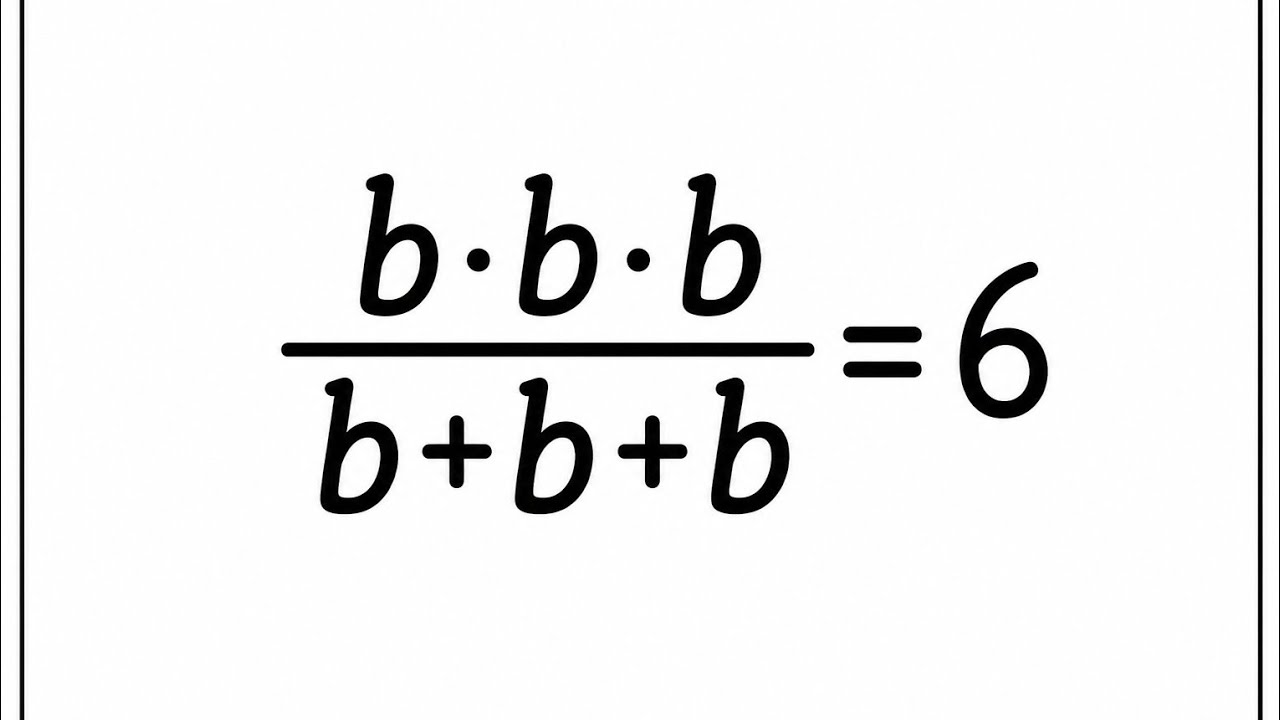
Olympiad Mathematics | Indian | Can You Solve This?
PhilCoolMath
669 views•2026-06-02



