This content masterfully contrasts the violent expansion of the cosmos with the quiet, stubborn resilience of 1970s human engineering. It serves as a poignant reminder that our scientific curiosity often outlives the very hardware we send into the void.
Install our extension to search inside any video instantly.
NASA’s Hubble & Voyager 1 Mind-Blowing Space Discoveries You Won't Believe Are Real!Added:
What's up, space enthusiasts? Welcome back to the channel where the universe is our playground, and today we're diving into some seriously mind-blowing cosmic juicy-ness. [music] First up, let's talk about everyone's favorite comeback kid, Voyager 1. This legendary spacecraft, which has been cruising through space for nearly 47 years, just [music] pulled off the ultimate comeback story. After 5 months of radio silence [music] that had NASA scientists probably biting their nails like nervous theater kids, Voyager 1 is back. That's right. [music] This 15 billion-mile-away just resumed all four science instruments and is once again sending us juicy [music] data from interstellar space. And get this, the engineers literally had to resync its time software because apparently [music] even spacecraft from the 1970s can't escape daylight savings time issues.
[music] Now, let's zoom over the Hubble Space Telescope, which just dropped some epic new footage of the Crab Nebula.
>> [music] >> Hubble revisited this cosmic explosion aftermath after 25 years, and the difference absolutely nuts. The nebula is expanding [music] at 3.4 million miles per hour. That's faster than my Wi-Fi on a bad day. The filaments are literally tearing through space like [music] cosmic fireworks on permanent display. Astronomers spotted filaments moving by comparing current images with ones [music] from 1999. Talk about your ultimate glow-up transformation. Here's the mind-bender, this supernova explosion was actually witnessed by Chinese [music] astronomers in 1054 AD.
That's right, people nearly a thousand years ago looked up and said, "Hey, what's that bright new star?"
>> [music] >> And now we're watching its after-party in glorious 4K resolution. The pulsar at the center is spinning [music] so fast and creating such intense magnetic fields that is literally driving this entire nebula outward. It's like the ultimate cosmic DJ spinning tracks [music] that make gas and dust dance across light-years of space. The coolest part, Hubble is the only telescope with both the longevity and resolution to capture [music] these changes over 25 years. While other telescopes are great for snapshots, Hubble is our cosmic time-lapse [music] camera, showing us that space isn't static, it's alive and constantly evolving. So, the next time someone [music] tells space is boring and unchanging, tell them about Voyager 1's epic comeback [music] and the Crab Nebula's explosive expansion. The universe isn't just out there, it's moving, and we've got front-row seats.
Thanks for watching, [music] space nerds. Smash that like button if you love cosmic comebacks. Subscribe for more space content, and I'll catch you in the next video. Peace.
Related Videos

Spiral Galaxy NGC 3370 from Hubble | NASA APOD 2025-11-05 #Shorts
galaxygallery
938 views•2026-05-30

SOMETHING inside the SUN is CHANGING
RaysAstrophotography
1K views•2026-06-03

There May Be A Giant Hole In The Universe... And We Might Be Inside It | The Cosmic Ledger Entry 015
TheCosmicLedger
145 views•2026-05-31

Captured the Blue Moon (with a twist) 🌙✨ #space #bluemoon #telescope
realAstroExplorer
674 views•2026-06-01

The Map We Sent to the Stars in 1977 — Why Scientists Now Regret It
TheAncientRecord7
183 views•2026-06-03

Is this a copy of our galaxy? Discover Galaxy M81!
UniverseDocumentaries-cc4mb
995 views•2026-05-31

10 Planet Where a Black Hole Replaces the Sun
cosmicexplorer-EN
147 views•2026-06-02
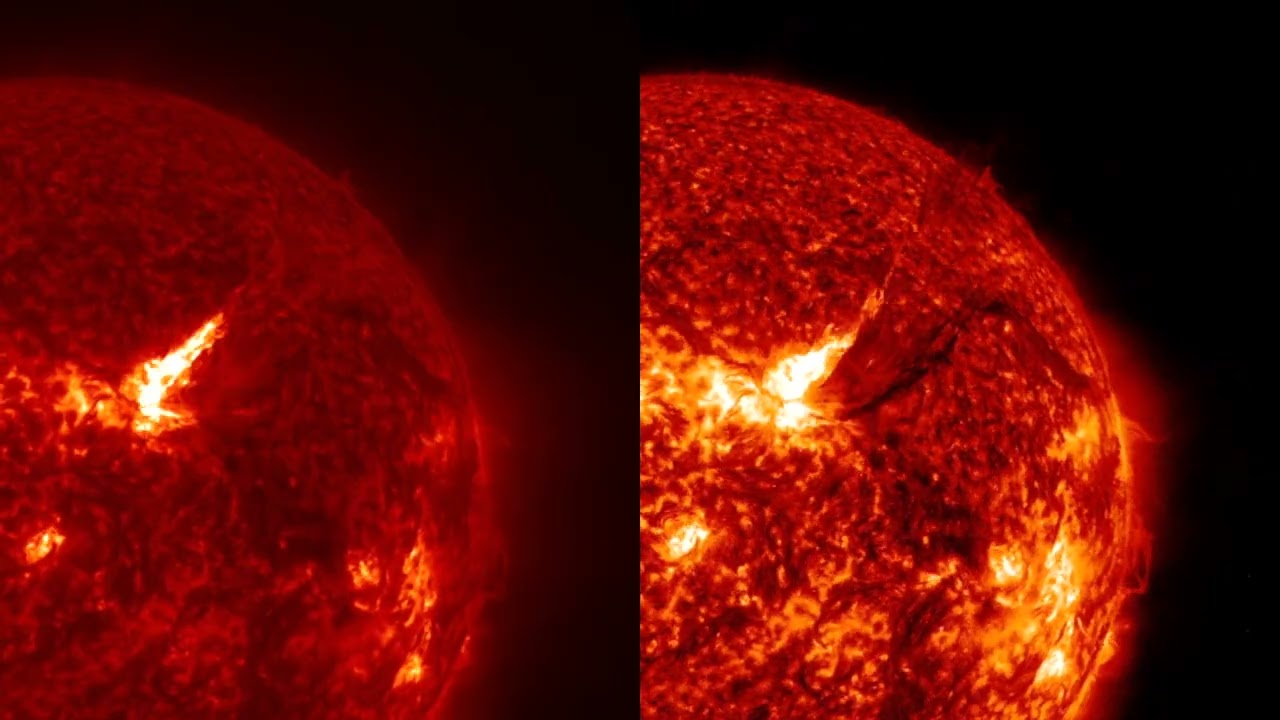
Solar Flares and CMEs at Earth - More Likely | S0 News June.3.2026
SpaceWeatherNewsS0s
2K views•2026-06-03



