A compelling look at how Caravaggio weaponized his own guilt into a masterpiece to bargain for his life. It brilliantly exposes the transactional nature of high art where genius serves as the ultimate bribe for survival.
Install our extension to search inside any video instantly.
This Painting Helped Him Get Away With Murder
Added:This piece is called David with the Head of Goliath by Caravagio. Wait, is that Elijah Wood holding the head of Wolverine? Oh, no, no. This painting was made in the 1600s, so that's impossible.
This is actually a self-portrait of the artist as a decapitated head that he sent as a bribe, hoping to secure a pardon after committing a murder.
A lot of people have existed on planet Earth throughout the existence of humans on planet Earth. And among those humans, a small fraction of them fall into the category of genuinely terrible people.
And an even smaller fraction could be considered artistic geniuses. And when those two circles overlap, you get the tiniest sliver of the population that's artistically brilliant and also extremely morally questionable human beings. And that's where you'll find an artist named Caravagio. You could call him a sociopath. You could call him an [ __ ] You could call him whatever you want, just not to his face because you might get a plate of artichokes chucked at your head or your balls chopped off.
But I'm getting ahead of myself. This painting is based on the famous biblical story of David and Goliath, where the Israelites are at war with the Philistines, but the Philistines have a giant warrior named Goliath, who challenges the Israelites to a single combat, but no one wants to fight him because he's like 9 ft tall and he's never lost. Then a young shepherd named David arrives and volunteers to fight him with only a sling and a few stones.
First Samuel 17 describes exactly what happens next. Reaching into his bag and taking out a stone, he slung it and struck the Philistine on the forehead.
The stone sank into his forehead and he fell face down on the ground. David ran and stood over him. He took hold of the Philistines's sword and cut his head off. The passage goes on to say that David was brought before King Saul, still holding the head of the giant in his hand. And that is the exact moment Carvajio captures here. David stands at the entrance of Saul's tent and shows off his trophy. Ish David is carved out of the darkness by a harsh light. He grips Goliath's sword with his right hand and in his outstretched left hand, he dangles Goliath's severed head by a fistful of his dark matted hair. By this point, artists have been depicting this story for centuries, almost always as a triumphant victory where the young hero stands bathed in glory over the monster he's just destroyed. But in Caravagio's version, there's no celebration, no sky.
The background is a suffocating, impenetrable wall of black. David just became a national hero by defeating the unbeatable Goliath. But he doesn't look like that. He looks like he actually feels sorry for him. Blood flows from Goliath's severed neck. His jaw is slack. His eyelids hang heavy over his eyes that kind of drift in different directions. His furrowed brow directs us to the spot in the middle of his forehead where David struck him with a stone and killed him. But Caravagio didn't just paint a random guy as Goliath. He painted himself. This is a self-portrait of the artist. But why?
Why would Carvajio paint himself as a decapitated head? It's because when Caravagio painted this, he wasn't just your ordinary Johnny slinging a paintbrush. He was a wanted murderer, a fugitive with a literal bounty on his head, hoping this painting would be his get out of jail free card. Caravagio's life was a total mess. He had a lot of issues, and we're going to talk about almost all of them. But if he was sick, he just scooted down to the local barber surgeon, the guy who cut his hair and balanced his humors and stitched up his wounds. And from what I understand, leeches were sometimes involved as well.
I'm glad that time is behind us. But nowadays, we face a different type of horror, and that is finding the right doctor. And that's where the sponsor of today's video, Zach, comes in. Zockd is a free app and website that helps you find and book highquality in-et network doctors so you can find someone you love. Finding a doctor you actually like feels like finding a diamond in the rough. You want someone who makes you feel at ease, listens, and explains things clearly. That's why Zachdoc is so useful. You can compare highquality in-et network doctors by insurance, location, specialty availability, and verified patient reviews. You can see real appointment openings and instantly book online with appointments often available within 24 to 72 hours and sometimes even same day. They also have more than 100,000 providers across 200 plus specialties from mental health to dental care to dermatology and more. So stop putting off those doctor's appointments and go to zdock.com/artdeco to find and instantly book a toprated doctor today. That's zoodoc.com/artdeco.
This message is sponsored by Zdoc. Now back to late 16th century Rome.
Caravagio came along after the high renaissance. You can think of the high renaissance as the peak of the era when Leonardo, Michelangelo, and Raphael lived and worked at the same time. And I wonder if that was just such an insane time in the art world that afterwards everyone had a bit of a hangover because that's when an art movement called mannerism pops up and it was strange.
Everyone was just trying to figure out the next big thing in art and clearly they hadn't figured it out yet. But the people in Caravagio's paintings look like someone you might pass on the street. He used a technique called tennibism that created dramatic contrasts of light and shadow that made his paintings look almost cinematic. He took these sacred biblical scenes commissioned by the church and made them look like they were unfolding right in front of you. Nobody painted like Caravagio. He painted his very good friend Mario in Boy with the Basket of Fruit looking like fruit might be the last thing on his mind. He painted himself as Bacus, the god of wine, but he looks absolutely terrible because he painted it while recovering from being kicked by a horse, but also like he might be looking at Mario. He also painted boy bitten by a lizard, which is much more provocative than you might expect. And I'm working on a video deep dive on that painting that will be up toward the end of the month on my website behindthepainting.com. If you're interested in that, I'll leave the link in the description box below. Caravagio was really good at pushing the limits of what was acceptable when it came to his art and his personal life for that matter. Before Caravagio even arrived in Rome, he had already gotten in trouble with the law. Nobody knows exactly what went down, but one of Caravagio's biographers and someone who knew him years down the road wrote of the incident. They committed a murder.
Prostitute. Tough guy. Gentlemen, tough guy hurts gentlemen. Prostitute slashes insult into the skin with knife.
Policeman killed. They wanted to know what the accomplice is. He was in prison for a year and then wanted to see his property sold. In prison, he didn't confess. Yeah. So, that was both the most straightforward but confusing thing I think I've ever read. Brothel were the center of social life for a lot of artists living in Rome at this time. And a whole underground economic system developed between painters and sex workers. Artists needed models to s for their paintings, but often couldn't afford to pay them. So the sex workers would sit for them and in return the sex workers were paid in art. If the artist eventually became famous, the sex worker could sell the art and have a way out of their profession. Because of this dynamic, the most successful high-profile sex workers usually ended up modeling for the greatest painters, which seems like it would have caused problems with the church who commissioned many of these paintings, but it wasn't because nothing really makes sense in this entire story.
Caravagio painted the biblical passage of Judith beheading Holofernes where a widow named Judith seduces and beheads the Assyrian general Holofernes to save her people from his invading army. Cara Vagio paints it in a tight intimate setting complete with hard nip ple. Can I say that word on YouTube? Anyways, that was apparently a very big deal. The woman who modeled for this painting was a sex worker named Fed Melendroni. a woman Caravagio was clearly taken with.
She was beautiful and sassy apparently, and she appears in several of his works.
Fit's pimp, a guy named Renuio Thomason, had to have felt uneasy about this arrangement. After all, every hour Fel spent posing was an hour she wasn't earning him money, and he also risked losing a very valuable employee.
Caravagio liked to prowl the streets of Rome at night, dressed in black and armed. Carrying a sword was technically illegal, but his position under a cardinal's patronage afforded him protections most men didn't have. If anything, that immunity seemed to only embolden him. He understood that Rome's most powerful men needed art, and that the artist who supplied it occupied a uniquely untouchable position. It seemed like he could get away with murder, and he would test that theory. To really understand who Caravagio was, I think we should flip through some of his rap sheet. It was something of an open secret in Rome's artistic circles that Caravagio was involved with his studio assistant Czecho. And Czecho modeled for a lot of Caravagio's paintings, often in very compromising positions. Gosh, Carvajio really was the worst. A rival painter named Giovani Baglioni hated Caravagio so much that he created an entire painting just to insult him. In the painting, Caravagio appears as the devil caught in the act with a young Cupid who is supposed to be his assistant Czecho and he's being driven away by an avenging angel. And back then sodomy of any kind was illegal. So, Bagleion was basically accusing Carvajio of a crime. Caravagio's response was to do what any mature adult would do. Write a bunch of filthy poems about Bagleion and pass them around Rome. He called him names like Johnny Testicle. Here's a couple of the translated poems that you may want to read at your own risk.
Bagleion sued him for liel, won the case, and Caravagio was thrown in jail.
In6004, Caravagio ordered a plate of artichokes while eating at a tavern with half of them cooked in butter and half in olive oil. When he asked the waiter which artichokes were cooked in butter and which were cooked in oil, the waiter told him to smell them to find out. This really rubbed Carvajio the wrong way and he hopped up and said to the waiter, "It seems to me you [ __ ] over that you think you're speaking to some kind of damn provincial." Then he grabbed the plate of artichokes and smashed it in the server's face, cutting open his left eye. In6005, Caravagio got into an argument with a notary named Mariano Pascualone over a woman named Lena, who was a cortisan who modeled for Caravagio. A few days later, Caravagio snuck up behind the notary in the street and hit him in the back of the head with a hatchet. When Mariano was questioned about the incident, he said he had upset Caravajio's woman, which at the time usually meant a prostitute that worked for him. This is by no means an extensive list of all of his crimes, but I think you get the gist. Caravagio had disregarded the law and other people for that matter for so long. But it all came to a head on May 28th,6006 when Feliped's pimpio demanded they meet at a tennis court to settle their differences once and for all. The tennis court setting might sound strange, but apparently that was the place to have a sword fight back in the day. During the fight, Caravagio sliced Renuio's femoral artery, causing him to bleed out and die. But in his defense, Carvajio wasn't trying to murder him. He was trying to cut off his balls, but he missed. You can't even make this stuff up. But something about this story doesn't quite add up. What beef did Carvajio and Renuio have in the first place? Well, looking back at Carvajio's criminal record, a lot of historians now believe he was actually a part-time pimp. A P I M P. Okay, I'm going to stop spelling now. And honestly, this makes his criminal record make a lot of sense.
Remember Pasqualone calling Lena Caravagio's woman? Caravagio may have been trying to entice Fed away from Reuccio to work for him. Being a pimp would have also given Carvajio a steady rotation of potential models for his paintings. The news of Reuio's death spread throughout Rome, and it didn't take long for authorities to figure out what went down. Caravagio was given a capital sentence which means that anyone could kill him with no strings attached.
And they also put a bounty on his head so that anyone who brought back Caravagio's literal head received a reward. Caravagio grabbed Czecho and they fled the city. It was during this time that he created David with the head of Goliath. He created it as a gift for Cardinal Shipion Borgaz. Shibion was the Pope's nephew, an obsessive art collector, and the minister of papal justice. This might be why Caravagio painted David's face as disgusted with having killed Goliath. It was an emotional appeal to Shipion that if he didn't remove the bounty over Caravajio's head, he may end up regretting it. Some believe the model for this painting was Czecho. Others have proposed something far more meta that David is actually meant to be a self-portrait of Caravagio as a younger man. If that's true, it completely transforms the painting. This theory is somewhat supported when we notice the inscription on David's sword. H A S O S often understood as an abbreviation of the Latin phrase that translates to humility kills pride. We look at a young Caravagio confronting the mess he's made of his life. And it's also kind of like he's saying, "Here's my severed head.
Please have mercy on me and accept this painting instead of my actual head." So why is everyone in this story so insane?
There's a theory that a lot of artists during this period were violent because of the lead in their white paint.
Basically, they all had lead poisoning, which can cause severe paranoia and violent outbursts. They would often drink alcohol to help curb the symptoms.
And that only made things worse. David with the head of Goliath was delivered to Rome and did exactly what it was supposed to do. Shipion Borgaz was successful in securing Caravagio a papal pardon. But the artist wouldn't be around to receive it. Caravagio died on July 18th, 1610 at the age of 38, possibly of sepsis or lead poisoning.
But honestly, with the way he lived his life, it's kind of a wonder he made it as long as he did, Caravagio is one of the greatest artists of all time. And because of that, he was basically able to do any horrible thing he wanted. And maybe that's why this painting feels a little bit different than his other works, because it freezes him forever in a moment of desperation, begging for his eenth pardon, the only one he wouldn't live to see.
Related Videos

'Wings of the Rainbow' Pulse Memorial takes shape in Osceola County
News6WKMG
775 views•2026-06-17

POV: Golden hour at Qutub Minar, Delhi
devbarsaiya2621
814 views•2026-06-19

Vajrapani Bhutadamara (HAR 64)
himalayanartresourcesinc.7267
218 views•2026-06-16

Who Actually Finished the Dome of St. Peter's (It Wasn't Michelangelo)
ThroughEternity
1K views•2026-06-15

The Nefertiti Bust Concealed a Secret for 3,300 Years — Until Now
OpticExpedition
309 views•2026-06-19
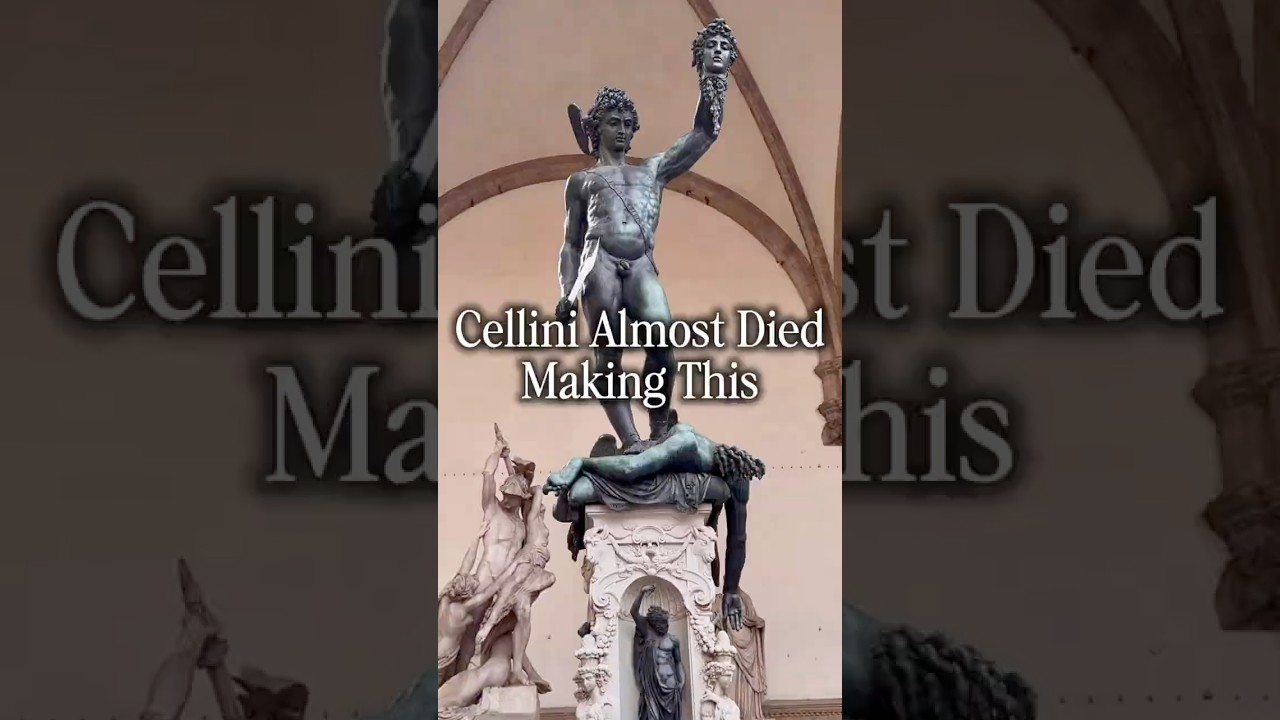
How Cellini Cast Perseus in One Night and Nearly Died Doing It
ThroughEternity
3K views•2026-06-14
Interview | Tony Albert 'Not a Souvenir' | ArtsHub
artsHubAustralia
177 views•2026-06-15

What makes Grand Central Terminal so much more than a train station?
News12Originals
290 views•2026-06-15



