If the red supergiant star Beetlejuice (14-20 times more massive than our sun, 1,000 times larger in diameter) replaced our sun, Earth would be engulfed in a stellar inferno since Beetlejuice's diameter would stretch 3.6-4.6 astronomical units, swallowing Mercury, Venus, Earth, and Mars; however, at its actual distance of 600 light years, a supernova would be visible as bright as a full moon but would not damage Earth's ozone layer or cause mass extinction, though it would create a new habitable zone 10 times further out than Neptune.
Instala nuestra extensión para buscar dentro de cualquier video al instante
假如參宿四取代了太陽,世界會怎樣?【中文字幕】|大膽科學Añadido:
You could fit over 1 million Earths inside our sun, but you could squeeze over 1 billion suns into the absolutely gigantic star named Beetlejuice.
No, not that Beetlejuice. This Beetlejuice is an unstable red super giant that's rapidly pushing into its final fusion cycles before it detonates into an extremely violent supernova.
You really wouldn't want to see this in our neighborhood. If Beetlejuice replaced our sun, it would swallow half of the solar system. And that's before it explodes.
Would you survive?
Well, it ain't looking so good for you, but let's find out.
Scientists aren't really sure exactly how far Beetlejuice is from Earth. We know it's in our Milky Way galaxy, and we estimate it's between 550 to 700 light years away.
We also don't know how big and how massive this star really is. That's because this giant is a pulsating mess that's too bright for our telescopes to see more precisely.
We know it's between 14 and 20 times more massive than the sun and up to 1,000 times larger in diameter. That's over 1 billion km across.
What we do know is that it's bright, hot, young, and explosive.
As in, it's about to explode soon, sometime in the next 100,000 years. It could happen in 10 years or 10,000 or tomorrow. It could happen any day. So, what would happen if it explodes?
Well, that's one of the most anticipated astronomical events in history. And scientists have been watching closely because lately, Beetlejuice has been acting weird. I mean, Beetlejuice has always been kind of weird because it's so close and so huge. It's one of the most studied stars in the sky. And we know it's a highly volatile star. We're talking shock waves and hot spots driven by these massive internal bubbles.
Convection cells so big they'd swallow Earth's entire orbit.
These convection cells disturb the surface and trigger violent shock waves.
All that disturbance creates massive hot spots that make Beetlejuice go darker and brighter, pulsating in cycles that can last years. In 2019, it went through what many astronomers thought was a pre supernova phase.
It was the opening act before the star exploded, an event known as the great dimming.
Yeah, this massive, super prominent star in our sky just went dark down to a third of its usual brightness.
Scientists eventually figured out that it was because it blew a great chunk of seething plasma into space.
That chunk was 400 billion times the mass of the chunks our sun emits.
When the dust cooled off, Beetlejuice blocked so much of its own light, we could hardly see the star anymore.
That dimming was extraordinarily and highly violent.
Kind of like blowing both your pecs off.
So yeah, Beetlejuice is ready to go boom.
What will happen when it does? Well, if a star like that exploded in place tomorrow, it would light up our night sky. Even that far away, it would be as bright as a full moon and it would be visible in full daylight. Beetlejuice is so big and red because it's burned through all of its hydrogen, which means it's burning helium now and maybe even carbon. And once stars start doing that, well, they also start fusing heavier elements like neon and iron. When Beetlejuice's core is full of iron, nuclear fusion will stop. The core will cool and gravity will overwhelm the star. The core will collapse and the rest of the star will fall inwards towards the imploding core. In a split second, all that star matter will hit the superheated core and bounce off of it as a super violent shock wave and boom, supernova.
Yeah. When Beetlejuice does go supernova, well, the scale will be so massive that it's almost impossible to imagine. It makes everything on our tiny blue marble feel insignificant.
But if there's one thing I've learned from hosting this show, it's that even in a universe of exploding stars, what happens here on Earth matters. And that brings me to a what if that I've been thinking about a lot lately. I'm going to ask you to do something I wouldn't normally do, and that's sit through this ad. Because even if you don't click on the link, just hearing this message helps. Imagine a world where for every single human being there are 13 farmed animals. Now imagine the vast majority of them living in a state of constant systemic suffering on factory farms. To me that kind of feels like a glitch in our own humanity because this is not a hypothetical. This is the real world you live in today. I often feel helpless about it. It's like watching a disaster in slow motion. And while we have the power to save lives here on Earth, there isn't much you can do when massive stars go supernova.
For Beetlejuice, well, that would be the end of its days. But it's a good thing because when massive stars like Beetlejuice end their life cycles in a violent cosmic explosion, they scatter elements like carbon and iron in the nearby space. All those elements that are crucial to life. Without the death of stars like this, well, life wouldn't exist. You and I and our ironbased blood wouldn't be around. Okay. If Beetlejuice went supernova exactly where it is now, it would release so much energy that you'd see it with the naked eye. But what would that kind of energy do to Earth? Well, the good news is 600 light years, give or take, is still way too far to deal with any kind of damage to our planet. But by the time the gamma rays and x-rays from the explosion reached Earth, they'd spread out way too much. Yeah, they wouldn't be powerful enough to breach our magnetic field or damage the ozone layer. Plus, it would take a long time for any gas and matter from the dying beetleju to reach our solar system. I mean, it could take millions of years.
I don't know. To see some real supernova danger, we'd need to move this enormous dying star a little closer to home, like 160 light years from us.
Yeah, this is exactly how close a star needs to go supernova to shake things up down here on Earth. If Beetlejuice was sitting 160 light years away from us, it would be far bigger and brighter in the sky. And it's already famously bright.
One of the 10 brightest stars in the sky.
You've already seen it, even if you didn't realize it. It's this bright star anchoring Orion's shoulder. What's so cool about Beetlejuice? Astronomers have been watching it for so long that we have firsthand observations from ancient Greek astronomers. And surprise, Beetlejuice used to be a different color. Which means that even in our brief civilized time on this planet, humans have watched it go from a pale yellow to the reddish color we see today. Now, what would happen if that star went full thermonuclear blast at 160 light years away? Well, it would be bright, like brilliant, lighting up the night bright. The explosion would shower Earth in X-rays and poke holes in the ozone layer. And yeah, you really need Earth to have its ozone layer because it's like a premium planetary sunblock, except instead of a greasy lotion, it's a thin layer of gas high in the sky keeping you from being literally cooked.
This gassy layer acts as a giant shield that absorbs the sun's harshest UV radiation before it can hit the ground.
Without it, you'd get brutal sunburns in minutes of being out in the open. And with enough of this radiation, your DNA would get all wrecked. Now, Beetlejuice going supernova 160 light years away from Earth wouldn't shred the ozone layer to pieces, but it would cause extra mutations to plants and animals, extra skin cancer, extra northern lights and southern lights.
Well, auroras everywhere.
But it wouldn't wipe humanity out.
Actually, this kind of explosion likely did happen in the last 10 million years and Earth is still here today. Now, if we move Beetlejuice even closer, well, that's a different story.
If we moved Beetlejuice 50 light years from Earth and it went supernova, well, its explosion would be deadly. Like mass extinction event deadly. And to give you a sense of how dangerous this supernova is, this explosion would take place nearly 500 trillion km away and still it would destroy our entire ozone layer.
Suddenly, you'd have zero protection against the sun's UV rays.
And maybe you're thinking, "Ah, no big deal. Just put on some more sunblock."
The problem is you can't put sunscreen on phytolanton and reefs. The sun's radiation would decimate them and that's dangerous because the reefs and plankton are the foundation of Earth's food chains. Those food chains would collapse and die would ripple upwards from single-sellled organisms to apex predators. That's mass extinction. Earth would be showered with gamma rays and radiation and our atmosphere would be swamped with smog like nitrous oxide.
It would be bad news for our climate and you wouldn't last very long in these harsh conditions. Hopefully though, you'd get a glance of the supernova exploding so close to Earth just before our planet burns up. Because if we moved Beetlejuice to the center of our solar system, you wouldn't have time to witness a supernova. You'd die long before Beetlejuice explodes.
All right. If we replaced our sun with Beetlejuice, well, that would be a dramatic killer event. Beetlejuice is not just a star. It's a monster.
Remember, you can fit 1.2 billion suns inside of it. So, if you were standing there on Earth looking up at the sky when this happened, what would you see?
Well, not much. There wouldn't be a sky.
Earth wouldn't orbit Beetlejuice. It would be inside it. Yeah. Our entire planet would be engulfed in a stellar inferno.
Because that's how enormous Beetlejuice is. For a fraction of a fraction of a second, you'd see the brightest reddish orange flash you've ever seen, and then you'd be incinerated.
Yeah. You and the rest of the creatures on planet Earth would be reduced to ashes, airfried, barbecued.
You know, actually, despite its size, Beetlejuice is actually pretty cool for a star, its surface is only about 3,200° C. That's 5,800° F. The sun's surface is a lot hotter at 5,500° C.
But still, that's more than enough to cremate every living thing on Earth in real short order. In other words, you'd be dead.
So, you wouldn't have to wait around for Beetlejuice to go supernova.
Like I said, Beetlejuice is gigantic.
It's so big. It's got a diameter between 640 to 1,000 times our sun. Now, scientists measure the distance between the sun and Earth in astronomical units.
Specifically, that distance is exactly one astronomical unit. Beetlejuice would stretch 3.6 to 4.6 astronomical units in all directions.
Yeah, it wouldn't just swallow Earth.
Mercury and Venus would be gone, too, as they're even closer to the sun than Earth is. Even Mars would be inside this violent super giant. If Beetlejuice replaced the sun, there wouldn't be eight planets in our solar system.
There would be only four, maybe even three, because Jupiter would now be dangerously close to this super giant.
If you really wanted to avoid being toasted, you'd have to be out by Saturn.
At this point, you might as well just move to Pluto. Now, Jupiter would be in a pickle. Being the closest planet orbiting Beetlejuice, it would turn into a hot Jupiter, which is actually a thing. Hot Jupiters are a class of some of the first exoplanets we ever found.
They are superheated gas giants in tight, low orbits around their star with temperatures ranging in the thousands of degrees.
Most hot Jupiters orbit much smaller stars with orbital periods of 12 days.
But Jupiter would go around Beetlejuice in 12 years.
It's likely that Beetlejuice would cook Jupiter along with the inner solar systems planets. All that hydrogen and helium that Jupiter's made of is perfect fuel for Beetlejuice. And Jupiter's icy moons, it would just melt. If there was any life hiding in the oceans of Jupiter's moons, well, those Jovians wouldn't be so jovial.
Yeah. Okay, that is a nasty space dad joke. In any case, though, Jupiter would get hot if it survived at all. But here's the thing. You somehow predicted this violent solar system change and moved out to one of Saturn's moons like Titan. Well, from here the sky would be a deep blood red orange color. Much of the ice in Saturn's rings would melt and vaporize, blasted into space by Beetlejuice's stellar wind. Titan's atmosphere would puff up from the heat.
it would stop raining methane and it would just start raining. Scientists have actually studied this idea to explore what would happen in 5 billion years when the sun expands into a red giant. Though they didn't factor in a super giant, so they'd have to adjust their math.
They also didn't factor in this. Yeah, Beetlejuice comes with a little surprise.
a second star in orbit around Beetlejuice.
Scientists just discovered that the red super giant is actually in a relationship. That is, it has a companion star. It's a unique binary star system. And scientists didn't notice this companion until recently because Beetlejuice is so big and bright.
This young new blue white star is similar in size to our sun and about 1 and a half times the mass of our sun.
Compared to Beetlejuice though, it's a tiny dot. It's also orbiting Beetlejuice at a distance of about four astronomical units. That means if we teleported Beetlejuice and its companion to our solar system, we'd have this new smaller star in the range of Saturn's orbit.
Yeah, Saturn could be on a collision path to real trouble from Beetlejuice's companion star, the ominously named star, Beetle Buddy. Beetle Buddy.
Beetle Buddy. Yeah. Well, that's the bodiest mcboat facest name for a star I've ever heard. And nicely done, Jared.
Okay, it sounds like Jared Goldberg and his colleagues who discovered this companion star formally named it Alpha Ori.
I still prefer Beetle Buddy. In any case, it's Goodbye Saturn and probably Goodbye Beetle Buddy. Well, we hardly knew you. Yeah, scientists figure that Beetle Buddy's going to be pulled into Beetlejuice within 10,000 years anyway.
So, if we replace the sun with Beetlejuice, well, either Beetle Buddy would get consumed by the red super giant, gutshot by Saturn, or blown to pieces in a supernova.
Okay. After Beetlejuice and Beetle Buddy swallow the inner planets and blast Saturn and Jupiter to cosmic dust, what would be left of the solar system?
Well, you've still got Neptune and Uranus. And Beetlejuice, like any star, would create a new habitable zone around itself.
Because Beetlejuice is about 100,000 times more luminous than the sun and up to 1,000 times its diameter, the new habitable zone would be pushed way out to about 316 astronomical units. That's 10 times further out than Neptune, way out past the Kyper belt.
All those icy objects floating in the dark corners of the solar system like Triton and Pluto would suddenly get a lot of heat from the new sun. Even further out, trans neptunian objects like the potential dwarf planet Sedna or even the mysterious planet X would be the best places for life to survive.
Well, small chance of that, but still, even with this new habitable zone, there wouldn't be enough time for life to emerge on any of the planets beyond the Kyper belt because Beetlejuice is about to blow. Yeah, remember the supernova?
Yeah, it's happening. If Beetlejuice went supernova from the center of our solar system, well, it would release a blast of energy bigger than our sun will ever produce over its entire 10 billionyear lifetime.
Imagine every ray of sunshine that will ever hit Earth compressed into a burst lasting just a few seconds. Well, that's Beetlejuice going supernova.
By then though, Earth would be long gone and the remaining planets would be obliterated. You could kiss Uran anus goodbye. Hey, I mean, we haven't had a good Uranus joke in 2026 yet. And that's the only one we're doing. I swear. I mean, probably not, but whatever. It's right there. Yeah. Anyhow, as the explosion cleared, the solar system well would be gone, replaced by a massive glowing nebula.
This explosion would forge an expanse filled with heavy elements like gold and platinum, seeding the galaxy with the raw materials for new stars and planets and even life to take our place eventually. So that's what would happen if we swapped our sun with Beetlejuice.
And I can gladly say that it's not happening anytime soon. Actually, never.
The sun stays in its place and Beetlejuice will inevitably explode about 600 light years away from us. But it does make me think about dropping other objects into our solar system.
Like what if a black hole or a neutron star replaced our sun? Well, that's a story for another. What if
Videos Relacionados

Spiral Galaxy NGC 3370 from Hubble | NASA APOD 2025-11-05 #Shorts
galaxygallery
938 views•2026-05-30

SOMETHING inside the SUN is CHANGING
RaysAstrophotography
1K views•2026-06-03

Captured the Blue Moon (with a twist) 🌙✨ #space #bluemoon #telescope
realAstroExplorer
674 views•2026-06-01

There May Be A Giant Hole In The Universe... And We Might Be Inside It | The Cosmic Ledger Entry 015
TheCosmicLedger
145 views•2026-05-31

The Map We Sent to the Stars in 1977 — Why Scientists Now Regret It
TheAncientRecord7
183 views•2026-06-03

10 Planet Where a Black Hole Replaces the Sun
cosmicexplorer-EN
147 views•2026-06-02

Is this a copy of our galaxy? Discover Galaxy M81!
UniverseDocumentaries-cc4mb
995 views•2026-05-31
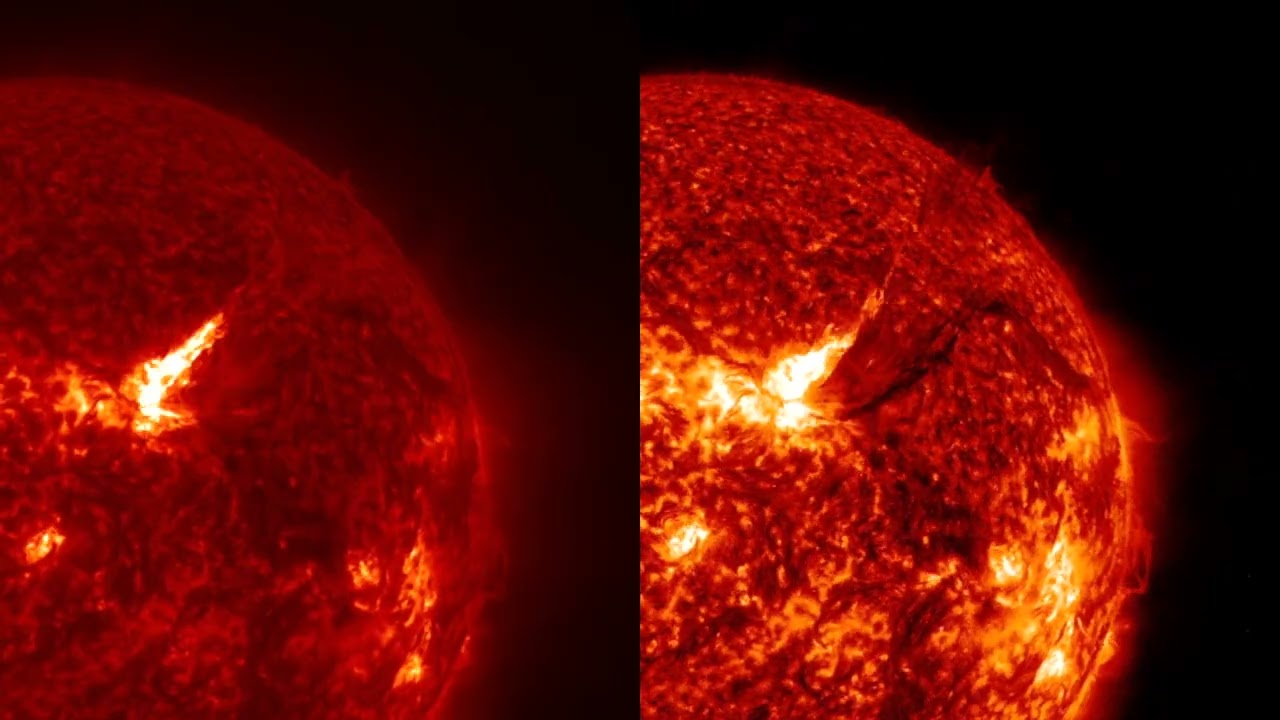
Solar Flares and CMEs at Earth - More Likely | S0 News June.3.2026
SpaceWeatherNewsS0s
2K views•2026-06-03



