Neutron stars are incredibly dense stellar remnants formed when massive stars collapse after supernova explosions, with cores between 1.4 and 2.16 times the sun's mass; they possess extreme properties including a million-degree surface temperature, gravity strong enough to bend light, and magnetic fields up to a quadrillion times stronger than Earth's, while their interiors contain exotic matter states like nuclear pasta and possibly quark-gluon plasma, and they generate heavy elements like gold and uranium through collisions that create kilonova explosions.
Install our extension to search inside any video instantly.
The Bizarre Science of Neutron StarsAdded:
All structures of the universe, or at least many of them, can be explained by our current science with observations and proof. But when it comes to neutron stars, science starts to get confused and bizarre. Things get really weird when stars die, and scientists from the 20th century did a great job of trying to understand all of this using literally just a pencil and paper. This is the neutron star.
Neutron star is simply a combination of the words neutron and star. Nothing too impressive at first glance. But if we take a closer look at the word neutron, we start to see why the science behind neutron stars is so extreme. Before the discovery of neutrons, scientists knew that atoms consisted of a dense nucleus surrounded by electrons. However, the nucleus makeup was not fully understood.
In 1920, Ernest Rutherford speculated about a neutron particle that could account for the missing mass in the nucleus. He proposed the existence of a neutron, which he thought was a proton and an electron bound together. At first, physicist Frederick and Irene Joliot-Curie, Marie Curie's daughter and son-in-law, bombarded beryllium with alpha particles and observed an unusual highly penetrating radiation. They initially thought it was high-energy gamma rays. But in 1932, James Chadwick, a British scientist, was having a fascinating discovery. This would start a great revolution in the way we see the universe and our surroundings. Chadwick at the Cavendish Laboratory, University of Cambridge, decided to investigate further. He doubted that the radiation was gamma rays as its behavior didn't match.
Through careful analysis of the energy and momentum of the protons, Chadwick showed that the radiation could not be gamma rays. Instead, it must consist of a neutral particle with a mass similar to that of a proton. He had discovered the neutron. Chadwick's work even earned him the 1935 Nobel Prize in Physics.
The discovery of the neutron completed the modern understanding of the atom's nucleus, composed of protons and neutrons. Neutrons were largely studied at the time to produce nuclear power. In the after the neutron was discovered by James Chadwick in 1932, neutrons were used to induce many different types of nuclear transmutations. With the discovery of nuclear fission in 1938, it was quickly realized that if a fission event produced neutrons, each of these neutrons might cause further fission events in a cascade known as a nuclear chain reaction. These events and findings led to the first self-sustaining nuclear reactor and the first nuclear weapon. But despite nuclear power, the discovery of neutrons was also fundamental for other later discoveries. In 1967, while working at the University of Cambridge, Jocelyn Bell Burnell and her adviser Anthony Hewish were studying interstellar radio signals.
Using a large radio telescope, Bell Burnell noticed a series of periodic radio pulses coming from a fixed point in the sky, repeating every 1.3 seconds.
This was the first detection of a neutron star, and it was a pulsar. At the end of this video, we will see that neutron stars divide into even stranger types, each with even more bizarre characteristics.
And what exactly generates a neutron star?
Stars exist because of a fragile balance.
The immense mass of hot plasma is pulled inward by gravity, squeezing matter so tightly that atomic nuclei fuse.
Hydrogen turns into helium, releasing energy that pushes outward counteracting gravity. As long as this balance holds, the star remains stable. But fuel doesn't last forever. Medium-sized stars like our sun expand into red giants when they run out of hydrogen, burning helium into carbon and oxygen before eventually becoming white dwarfs. For more massive stars, the star collapses by its own gravity and the iron core heats up.
Heavier elements fuse in rapid succession >> [music] >> and when there is a significant presence of iron in the core, indicating an exhaustion of internal energy, the core will not be able to support the weight of the outer layers, causing these layers to collapse, crashing internally.
The entire star implodes with outer layers crashing inward at nearly a quarter of the speed of light. The collapse slams into the iron core, sending a shock wave outward. The star also detonates in a supernova, outshining entire galaxies. If the remaining core is between 1.4 and 2.16 times the sun's mass, the Tolman-Oppenheimer-Volkoff limit, it becomes a neutron star. Stars more massive than the dwarf limit collapse into a black hole. Let's consider a neutron star. Most of neutron stars are a million times the mass of Earth, but only 25 km wide. Its gravity is immense. Light bends around it, revealing both its front and parts of its back. Its surface blazes at a million degrees compared to the sun's mere 6,000. Let's look inside a neutron star. Even though these collapsed giants are technically stars in many ways, they're also like planets with solid crusts over a liquid core. The crust is unbelievably hard. The outer layers are made of iron left over from the supernova crushed into a crystal lattice with a sea of electrons flowing through it. Deeper down gravity compresses the nuclei bringing them closer together.
Protons merge into neutrons until we reach the base of the crust. Here things get really weird. The nuclei are so tightly packed that they begin to touch each other. Protons and neutrons rearrange into bizarre shapes, long cylinders, thin sheets like cosmic spaghetti and lasagna.
Physicists call this nuclear pasta.
Nuclear pasta is so dense it may be the strongest material in the universe.
Basically, unbreakable pieces of it can form mountains just centimeters high but many times the mass of the Himalayas.
Beneath the pasta we reach the core.
Matter is squeezed so hard that protons and neutrons might dissolve into a sea of quarks, a quark-gluon plasma.
Some quarks may even turn strange forming strange matter, an entirely new state of existence. Or maybe protons and neutrons just stay as they are. No one knows for sure. That's why science exist. But let's zoom back out into space. When neutron stars first form they start spinning very fast. Some spin dozens or even hundreds of times per second. This rapid rotation creates pulses as their immense magnetic fields generate beams of radio waves that sweep across space.
We call these pulsars and about 2,000 of them are known in the Milky Way. Their magnetic fields are the strongest in the universe, up to a quadrillion times stronger than Earth's. The most extreme ones are called magnetars until they eventually calm down. If two neutron stars orbit each other they slowly lose energy by emitting gravitational waves.
ripples in space-time itself. Over time, their orbits decay until they finally collide in a spectacular kilonova explosion. When this happens, the conditions become so extreme that new heavy elements are forged not by fusion, but by neutron-rich matter breaking apart and reassembling. Only recently we've learned that this is where most of the universe's heavy elements come from: gold, platinum, uranium, and many others.
Stars don't just have to die to create elements, they have to die twice over millions of years.
These newly forged atoms mix back into the galaxy. Some end up in clouds of gas and dust bound together by gravity to form new stars and planets, repeating the cycle. Our solar system is one example. The remains of ancient neutron stars are all around us. Every piece of technology we use, every part of our modern world, was built from elements created in these violent deaths.
If you want more videos like this, subscribe to the channel. See you next time.
Related Videos

Spiral Galaxy NGC 3370 from Hubble | NASA APOD 2025-11-05 #Shorts
galaxygallery
938 views•2026-05-30

SOMETHING inside the SUN is CHANGING
RaysAstrophotography
1K views•2026-06-03

There May Be A Giant Hole In The Universe... And We Might Be Inside It | The Cosmic Ledger Entry 015
TheCosmicLedger
145 views•2026-05-31

Captured the Blue Moon (with a twist) 🌙✨ #space #bluemoon #telescope
realAstroExplorer
674 views•2026-06-01

The Map We Sent to the Stars in 1977 — Why Scientists Now Regret It
TheAncientRecord7
183 views•2026-06-03

Is this a copy of our galaxy? Discover Galaxy M81!
UniverseDocumentaries-cc4mb
995 views•2026-05-31

10 Planet Where a Black Hole Replaces the Sun
cosmicexplorer-EN
147 views•2026-06-02
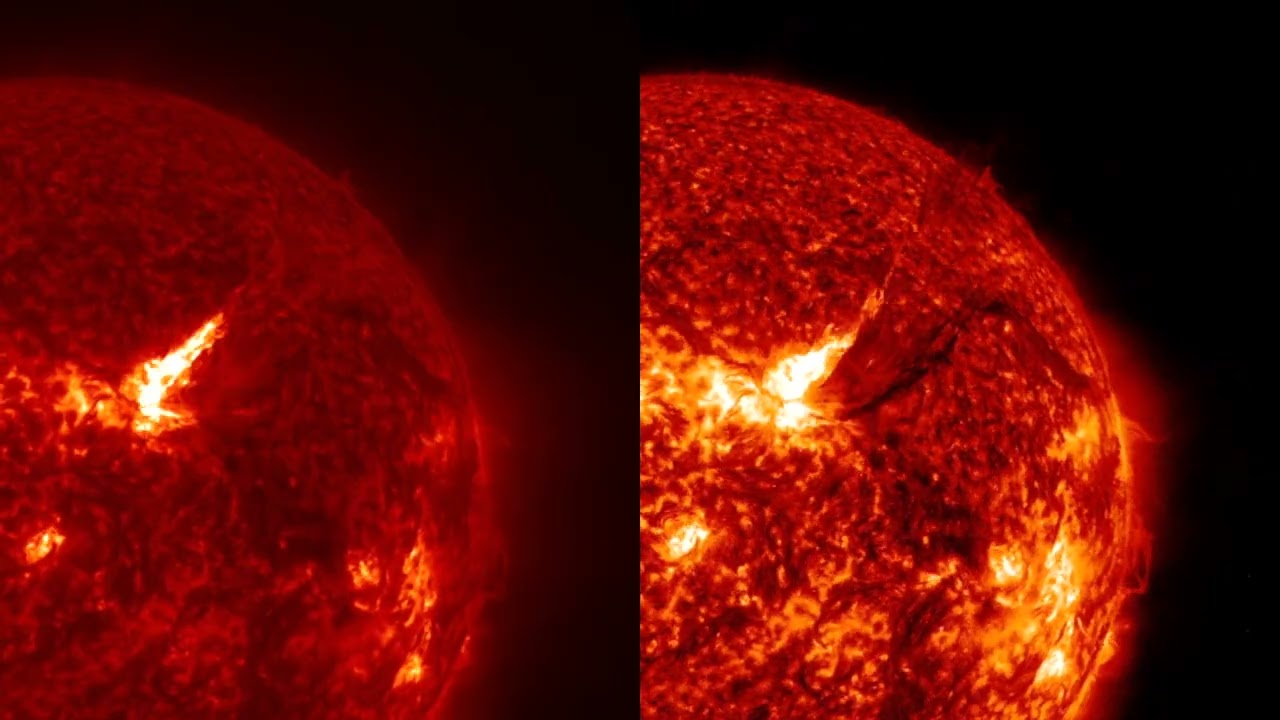
Solar Flares and CMEs at Earth - More Likely | S0 News June.3.2026
SpaceWeatherNewsS0s
2K views•2026-06-03



