This video presents Falak, an autonomous space rover developed by Mind the Cloud team from Alexandria University for the European Rover Challenge. The rover features a rocker-bogie suspension system with six DC motors for terrain mobility, a custom-designed PCB with Nvidia Jetson Orin Nano for autonomous navigation, and a 3-DOF robotic arm with a drill mechanism based on Archimedes' screw principle for simultaneous drilling and sample collection. The software architecture integrates ROS 2 middleware, computer vision models, and a behavior tree mission planner to enable autonomous operation in harsh Martian-like conditions.
Install our extension to search inside any video instantly.
Mind Cloud | ERC 2026 VideoAdded:
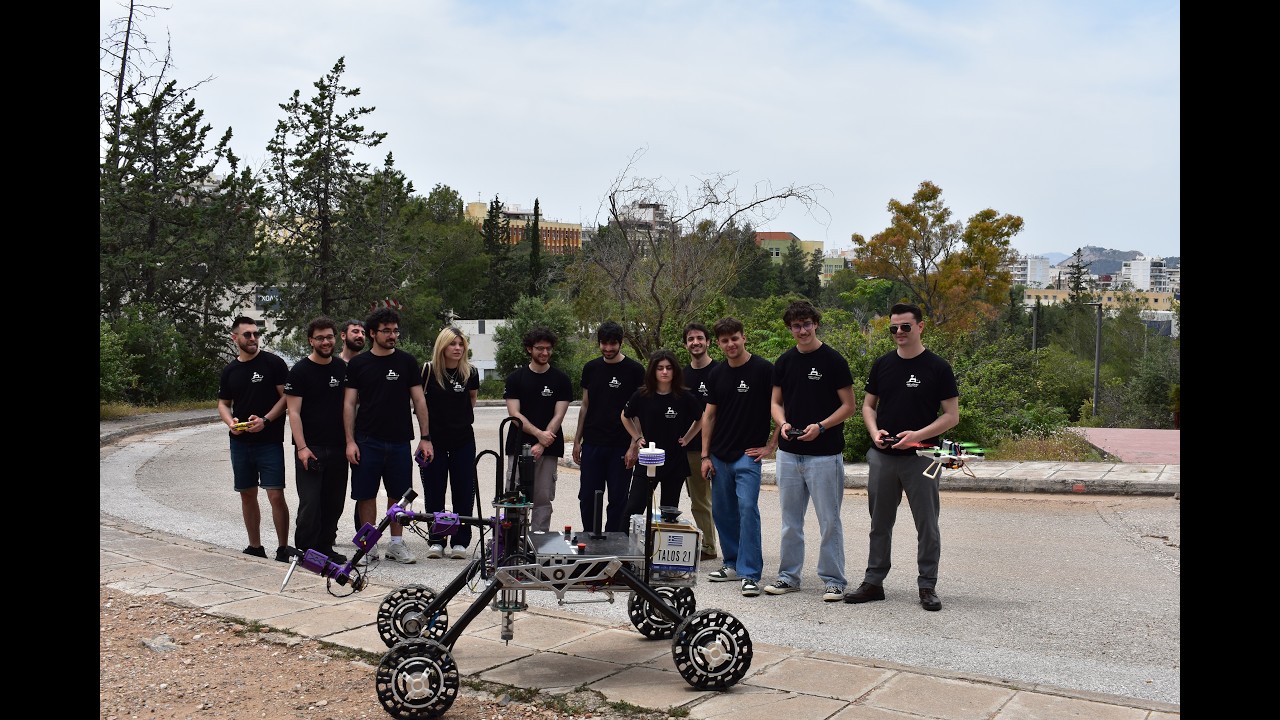
[music] >> Hello, I'm Zeyad the chairman of Mind the Cloud team from Alexandria University and we are here today with our rover family.
As we get ready for the European Rover Challenge. Our journey began in 2016 founded with a vision to push the boundaries of engineering.
Mind the Cloud has spent the last decade proving itself in both national and international stages.
From the URC competition and the rigorous ERC remote [music] edition.
Our adaptability has driven us to compete in diverse challenges including the Mine Sweepers competition and the Metal Monster competition.
Beyond pure robotics, we are deeply engaged in the broader innovation community. Proudly participating in premier national events like the Ebda Festival held by the Ministry of executing at this level requires more than just passion. It requires elite organization starting from the chairman and two vices. And their job is to manage two sub-teams. The technical sub-team and the non-technical sub-team.
The technical sub-team has electrical and mechanical. Electrical has software and hardware.
And the non-technical sub-team has PR [music] and media. Here in Mind the Cloud we are driven by practical engineering and we are participating in the European Rover Challenge because we want to push our technical limits on such a big stage.
Ultimately we want to put the electrical design and autonomous systems to the test against the extreme harsh conditions of the of the Martian.
Using this competition as the ultimate proving ground to learn, adapt and innovate alongside the best minds in the global space robotics community. Behind every successful rover is a mechanical system designed to survive harsh terrains, carry electrical systems and perform with precision. [music] We are the mechanical sub-team responsible for transforming ideas into fully functional rovers. Our design process began with identifying cross requirements and competition limitations. Through research, brainstorming, CAD modeling and a lot of simulation, prototyping, and testing, we we transformed our ideas into Falak.
Let's divide Falak into three main parts. First, chassis.
The chassis is built from 20 by 20 V-slot aluminum profiles, providing structural rigidity, high strength-to-weight ratio, easy reconfiguration, and efficient housing for batteries and electronics, enabling easy access for maintenance. The second part is suspension system.
Falak utilizes a rocker-bogie suspension system, consists of two rocker arms, each connected to a wheel, and a bogie with two wheels with a central differential bar for passive self-balancing over uneven terrains.
The rocker-bogie suspension keeps all six [music] wheels in continuous contact with the ground, ensuring maximum grip, even weight distribution, and high stability. Finally, the driving system.
Falak has six DC motors with 23 Newton meter torque and 120 RPM, each connected to an off-road wheel, providing high traction over slopes [music] and ability to move in harsh conditions.
>> Building an autonomous rover requires a robust electronic backbone. Our hardware system is engineered to handle complex data and harsh environments seamlessly.
Maximize efficiency. We custom-designed our printed circuit board from scratch using Altium Designer. Utilizing a robust four-layer PCB design, ensure clean signal routing, reliable power handling, and the precision engineering accrued the board. Power start at our high-capacity battery back, feeding directly into our custom power distribution board. This PDB safely regulates and delivers stable voltage to every critical subsystem. For intelligence, an Nvidia Jetson Orin Nano serves as the brain, processing high-bandwidth data from our lidar, cameras, [music] and custom-designed IMU sensor.
The Jetson sends commands to our STM microcontrollers, >> [music] >> which manage the core low-level control loops and signal our heavy-duty motor drivers to execute precise physical motion.
From raw power management to intelligent autonomous control, our hardware system is fully integrated and built to explore, and we are ready for the next mission.
>> Our rover's software system is divided into three main departments.
Communication, artificial intelligence, and autonomous navigation. All working together to ensure reliable and efficient mission execution.
Communication team focuses on maintaining stable and secure connectivity between the rover, the base station, and external interfaces during missions, spanning up to a 200 m radius.
To achieve this, we use Zeno as our ROS 2 middleware system, enabling lightweight, fast, and dependable data exchange across the entire system. On the AI side, our team develops and integrates advanced computer vision models that enhance the rover's environmental understanding, object detection, and helping the autonomous navigation system.
These models help the rover better interpret its surroundings and respond intelligently to dynamic conditions.
>> The autonomous navigation team is responsible for enabling the rover to safely and efficiently move through complex terrain with minimal operator intervention.
Our navigation pipeline follows the perception, planning, and control framework. The perception layer allows the rover to understand both its position and the surrounding environment using sensor fusion, height maps, and obstacle detection systems.
Using this information, the planning layer generates the safest and most efficient traversable path, while the control layer ensures smooth and accurate trajectory tracking during motion execution.
To coordinate our rover subsystems during autonomous missions, we also implemented a behavior tree mission planner that manages task execution and system-level behaviors in a modular and scalable manner.
>> For our rover mission, we designed a custom quadcopter to serve as eyes of the rover for area scanning. We selected an X configuration for the frame to ensure high maneuverability and to keep the propellers out of the camera screen.
To optimize the strength-to-weight ratio, we ran a detailed stress analysis using SolidWorks. We integrated weight weight reduction pockets in low stress areas. This reduced the mass while maintaining the maximum structural strength.
Finally, the entire frame is 3D printed using ABS material, allowing our drone to guide our rover safely. We set up a complete drone simulation and a control pipeline using ArduPilot, SITL, and Python.
First, we installed and configured the ArduPilot simulator. Then, we launched the virtual quadcopter environment with a live map and MAVProxy console.
After that, we connected our Python application to the simulated drone using PyMAVLink. Establishing real-time MAVLink communication through heartbeat synchronization.
We then built a custom UI interface, allowing us to send commands like arm, takeoff, land, move the drone [music] in any direction, and to any predefined point. Finally, we integrated live telemetry feedback, including position and speed monitoring, creating a functional ground control prototype that can later be extended into ROS 2 integration and autonomous navigation systems.
Regarding our robotic arm system, that consists of 3 degrees of freedom, rotation of the base, elbows, and shoulders, and using our end effector that also consists of 3 degrees of freedom, the end effector can grab, interact with balance, and the collect them. In the design phase, we used SolidWorks software to design and use topology and other tools to ensure the design is lightweighted and cost-effective. In the manufacturing phase, we selected oil as a durable material that can withstand the high stresses like aluminum sheets. To conclude, our robotic arm is suited for harsh environment like the Martian environment.
>> Our robotic arm is controlled entirely through ROS 2. We send goals using either MoveIt or our custom design script. A buffer system plan, and then commands are sent to our controller, which drives the servers in real time and sends joint state feedbacks at 100 hertz. The system's communication is flexible, supporting both Wi-Fi [music] and wired UART communication, both switchable at launch. We have validated the full pipeline from gold to physical motion. Our next step is integrating camera within the system and driving the arm using camera detected points.
>> The drill collecting mechanism is designed to handle both drilling and sample collecting at the same time. The drill moves up and down using a lead screw mechanism, allowing it to reach up to a 30 cm below the ground. During drilling, the rotating auger carries the sand upward, while the cylinder around it keeps the sample contained while moving up, until it finally reaches the third container [music] at the top of the cylinder, based on the Archimedes' screw principle. So, instead of drilling first then collecting separately, the whole process happens together using the same mechanism.
>> [music] [music] [music]
Related Videos
Beyond Robotics | European Rover Challenge 2026
beyondrobotics
189 views•2026-06-01

Beatbot Sora70: JetPulse Technology and AI obstacle avoidance and navigation!
DroidModderX
26K views•2026-06-02

Tesla FSD 14.3.3 Hits Phoenix Streets - FIRST LOOK
anthonystesla
114 views•2026-05-29

Elon Musk Just Revealed Fremont Line for Optimus Gen 3 Mass Production
TheAINexusOfficial
180 views•2026-05-30

人機一体「零式人機 ver.2」 子ども企画【おもしろ発見!モビリティー】 #乗り物 #automobile #robot #shorts
KyodoNews
1K views•2026-05-28

China’s New Luna AI Robot Looks Shockingly Human...
NextGenHumanoids
850 views•2026-05-28

Reachy Mini: the $300 open source robot you can actually hack — Andres Marafioti, Hugging Face
aiDotEngineer
662 views•2026-05-29

柔軟指×AI画像処理食品の仕分け作業システム!#柔軟指 #ロボット #自動化 #製造業をもっと盛り上げたい
KiQ_Robotics_Corp.
113 views•2026-05-28



