This content elegantly transforms complex neurobiology into a meditative narrative, proving that high-level science can be both intellectually stimulating and functionally restorative. It successfully bridges the gap between cognitive theory and sleep hygiene without diluting the profound mystery of the mind.
Install our extension to search inside any video instantly.
What Happens to Your Consciousness When You Dream? Relaxing Facts To Fall Asleep To
Added:Something in you already knew tonight was the right time for this.
Right now, as you close your eyes, something is already shifting. Something science has only recently begun to map.
Each night, the part of you that thinks and wonders doesn't switch off. It moves somewhere entirely different.
It enters territory philosophers have debated and neuroscientists are still charting. Where does awareness go when the body lets go? That question lives at the edge of every dream you've ever had.
Let the weight of today lift. Whatever you carried in, it can rest here. Your mind is already loosening what it held so tightly.
Welcome to Sleepy Science Facts.
And what comes next has been running beneath you all along. Every night, your awareness crosses a threshold that science has not yet fully [music] mapped. The moment you move from wakefulness into sleep, your brain's electrical signature shifts from the fast, busy rhythms of active thought into the slower, rolling waves of relaxed awareness.
But consciousness doesn't vanish, it transforms.
Studies using brain monitoring show that [music] coordinated neural activity continues across all sleep stages, including the ones we once assumed were the deepest silence of the mind. The question isn't whether awareness is still present. It's what awareness becomes when the body is no longer its only anchor and where it goes from there. The sleeping brain is not a quiet brain. During REM sleep, the stage most associated with vivid dreaming, your emotional center runs at near waking levels of activity.
The amygdala, the brain's core for emotional response, shows intensity during dreaming that rivals or exceeds full wakefulness.
You are not resting from emotion when you dream.
You are in a very measurable sense living inside it more fully than your waking mind usually allows.
Human beings spend approximately 2 hours per night in the dream state. Over a 75 year lifespan that amounts to roughly 6 years spent inside a world the brain builds entirely from within. These are not passive experiences.
Brain imaging research shows that the visual areas of the brain activate during dreaming in the same way they do during actual seeing. Your brain cannot distinguish between perceiving the world and dreaming it. To your neurons, the dream is not a representation.
It is happening. The word consciousness has no single agreed upon scientific definition.
And that isn't a failure of science.
It is a clue about the depth of the question. Some researchers define it as self-awareness.
Others define it as integrated information, the capacity of a system to have experiences that cannot be reduced to its individual parts.
The fact that science cannot yet fully define what consciousness is makes every dream you have ever had a data point in the oldest open investigation.
Humanity is running. Before you enter full sleep, you pass through a state called hypnogogia.
The threshold between waking and dreaming. In this in between zone, you may hear your name call.
see soft geometric patterns or feel the sensation of falling.
Brain recordings show [music] that during hypnogogia, the slow rhythms of early sleep and the lighter waves of relaxed wakefulness coexist.
The brain hasn't committed to either state yet. Ancient philosophers considered this the most honest hour of the day. Modern sleep scientists study it for what it reveals about the architecture of awareness itself.
Sleep occurs in cycles lasting approximately 90 minutes, each containing distinct [music] stages.
Light sleep, deeper sleep with bursts of neural activity [music] called sleep spindles, slowwave deep sleep, and REM. During the deepest stage, your body performs its most intensive physical repair, releasing growth hormone, supporting immune function, replenishing tissue. And during REM, your mind does something entirely different. It runs simulations.
Your brain in REM is not resting.
It is rehearsing, replaying, and rebuilding your experience of being alive.
Sleep spindles, brief bursts of synchronized brain activity lasting 1 to 3 seconds, are directly linked to memory consolidation.
These rapid waves, generated through a dialogue between the phalamus and the cortex, appear to function as gatekeepers.
They protect the sleeping brain from waking while simultaneously moving information from short-term into long-term storage.
Research suggests the more sleep spindles you generate in a single night, the more likely you are to retain what you learned the day before.
While you rest, your mind is filing. The phalamus, a small paired structure at the brain center, acts as the main relay station for sensory information during waking life. During deep sleep, it partially disengages, drawing the senses inward. But during REM, the phalamus reactivates.
This time with no external signal feeding it, it begins generating its own stream of experience, sending it upward to the cortex as if it were real sensory input. This is why dreams feel as vivid as waking life. The same hardware is running. Only the source of the data has changed.
Lucid dreaming, the state [music] of being consciously aware that you are dreaming while the dream continues, has been scientifically verified.
In 1975, researcher Keith Hearn first recorded pre-arranged [music] eye signals from a dreaming subject.
Steven Leersge at Stanford later replicated and expanded this work in controlled sleep laboratory conditions, confirming that a person can maintain voluntary awareness inside the dream state. What this demonstrates [music] is that consciousness can be present in two modes at once, both dreaming and observing without either [music] canceling the other out. What the first nine facts suggest is that consciousness doesn't go dark during sleep. It migrates.
It releases its grip on the sensory world and begins generating experience [music] from within. The question at the heart of this journey, what does it mean to be somewhere that has no physical location has already begun opening? The rest of these facts are about what inward means.
how deep that [music] territory goes and whether it holds more than the waking mind is normally equipped to recognize.
The default mode network, a system of interconnected brain regions that activates when you are not focused on a specific external task, is sometimes called the brain's resting state, but it is anything but restful.
During mind wandering, self-reflection and dreaming, this network shows high coherent activity.
It appears to be the seat of the narrative self, the ongoing story the brain tells about who you are and what your life means.
During sleep, it doesn't power down. It takes the stage.
Ancient cultures across the world treated dreaming as a form of direct perception.
Not imagination, not symbol, but a genuine mode of encounter with something real. The Egyptians built dream temples.
The Greeks practiced [music] incubation sleep at healing sanctuaries.
Indigenous cultures across the Americas and Africa held community dream councils.
While modern science doesn't endorse supernatural interpretations, it recognizes what those traditions were tracking with remarkable accuracy.
That the dreaming mind operates differently from the waking one, not deficiently, but distinctly.
That much is now supported by decades of neuroscience.
Rats dream.
This was shown in 2001 by Matthew Wilson and Kenway Louie at MD who recorded the activity of hippocample neurons as rats ran a maze. Then recorded those same neurons firing during subsequent sleep in the same sequence at the same relative timing.
The rats were replaying their waking experience during REM sleep. This memory replay during dreaming has since been confirmed in birds, primates, and humans.
Dreaming is not a quirk of human complexity.
It appears to be a feature of any nervous system complex enough to accumulate and process lived experience.
The brain chemical acetylcholine plays a central role in generating REM sleep and the experience of dreaming. During REM, specific neurons in the brain stem fire intensely, sending activating signals upward through the brain. At the same time, the systems that depend on serotonin and norepinephrine go quiet.
This chemical shift is part of what makes the dreaming brain distinct.
The mind is active, but the critical self-monitoring functions that depend on those quieted systems are muted. The result is a form of consciousness that accepts [music] everything it encounters without questioning whether any of it should be possible. The experience of time in dreams does not follow waking rules.
Research suggests that most dreaming occurs in something close to real time.
A dream that feels like hours may span only minutes, but the distortion is less extreme than popular accounts suggest.
What does change is the texture of time itself.
Without the external cues of light, sound, and schedule, the dreaming mind experiences duration differently.
Less like a sequence of events and more like a depth, a place you are inside of rather than moving through. Blind individuals who have been blind since birth do not experience visual dreams, confirming that visual dream content is drawn from memory and experience, not from a separate mechanism.
But these individuals do dream vividly with rich sound, touch, smell, and emotion.
This tells researchers something fundamental. [music] Dreaming is not primarily a visual phenomenon. It is an experiential one.
The brain reconstructs the full texture of felt life, whatever that means for a given person's history, and runs it as if it were live. During REM sleep, the brain stem generates a state of voluntary muscle paralysis.
This is a protective feature. It prevents you from physically acting out the movements that occur in your dreams.
The result is that every night while your mind generates a complete inhabited world of experience, your body lies still, consciousness and body are in the most literal biological sense, temporarily [music] decoupled.
The experience runs fully. The physical world is held in place. When this REM paralysis fails, a condition called REM sleep behavior disorder.
People physically enact their dreams, kicking, shouting, leaping from bed.
This confirms that the separation between the dreaming mind and the acting body is a deliberate actively maintained feature of sleep, not a default state.
And it reveals something worth pausing on. Without that mechanism, your dreaming self and your physical self would be indistinguishable from the outside.
Every night, your nervous system chooses [music] to keep them apart. The evidence for something functionally similar to dreaming exists across a remarkable range of species.
Sephalopods, octopuses, and cuttlefish show rapid color changes and eye [music] movements during what appears to be a sleep phase, suggesting dreamlike neural processing in a creature whose last common ancestor with humans [music] lived over 500 million years ago. If something like dreaming emerges independently in animals so distant [music] from us, it may be less a specialization and more a fundamental property of any sufficiently complex nervous system. During REM sleep, the brain's emotional processing centers are especially [music] active, and what they appear to be doing is sorting.
Rather than simply replaying emotion, the dreaming brain [music] seems to be tagging experiences by their significance, strengthening memories of what mattered and gently releasing what didn't.
Anxiety dreams, which are among the most commonly reported across cultures, may reflect this sorting process at its most active.
The mind working hardest on what it hasn't yet filed. The dream that disturbs you may be the one doing the most useful work. The philosopher Thomas Nagel asked what it is like to be a bat, arguing that consciousness is irreducibly subjective, that no amount of objective neuroscience [music] can capture what experience feels like from the inside.
This hard problem of consciousness, as David Charas later named it, is why dreaming poses such a deep scientific puzzle. We can map every neuron that fires during a dream. We can trace the chemistry, timing, and sequence.
But the felt quality of the dream, the specific private [music] texture of what you experienced remains inaccessible to any instrument.
What happens to consciousness when you dream is in part a question that only you can answer from within it. Sleep and creative problem solving are deeply connected.
A landmark study by Olrich Vagnner at the University of Lubec in 2004 demonstrated that participants who slept between sessions of working on a mathematical problem were nearly three times more likely to discover a hidden shortcut than those who stayed awake.
separately.
Research by Erin Wamsley and colleagues at Harvard published in Current Biology in 2010 found that participants who reported dreaming about a navigation task during a nap showed dramatically greater performance improvement than those who napped without dreaming of the task. The dream wasn't a side effect. The dream was doing the work. Sleep researchers have identified what is called prospective memory consolidation.
The way the sleeping brain not only stores past experiences but preconfigures the mind for future ones.
During sleep, the hippocampus and preffrontal cortex engage in a quiet dialogue that appears to prepare the mind for anticipated future challenges.
The brain is not only archiving what happened yesterday.
It is rehearsing what might happen tomorrow.
Your dreaming mind is in some measurable sense already living a few steps ahead of you. Many documented creative breakthroughs have been attributed to the threshold state between sleep and waking. The story of August Coule discovering the ring structure of benzene after dreaming of a snake eating its own tail has been widely repeated.
Though historians note the account may be partly embellished.
Dmitri Mendelaf reportedly glimpsed an arrangement of the elements in a dream.
Though the details are disputed, Paul McCartney has consistently described hearing the melody of yesterday complete on waking. These accounts, whatever their precise accuracy, point to something neurologically real.
The dreaming brain makes connections.
The critical waking mind tends to filter out. The machinery is now clearly visible. But what runs on it is the deeper question still ahead.
Consciousness during sleep is not absent.
It is altered, shifted from a sensory receiving mode to an internally generative one. Running on the same hardware with different chemistry and a different source of input.
It processes emotion, rehearses experience, consolidates memory, and sometimes produces creative synthesis unavailable to the waking mind. But the mechanics [music] are only the beginning. What this machinery is capable of and what it reveals about the nature of awareness itself is where the territory ahead begins.
for a [music] moment. Let the facts settle like sediment in still water.
You've been hearing about the mind that runs while the body rests.
And right now, that's already beginning.
The machinery we've been describing.
Telamus, hippocampus, amygdala.
It's already preparing your next hours without asking your permission.
You don't need to understand it. You only need to let it run. The part that wonders where awareness goes. It's already moving toward the answer.
Non-local consciousness is a theoretical framework proposing that awareness is not generated exclusively by the brain.
that the brain may instead function as a receiver or filter for a form of consciousness that exists in some sense independently of it. This is a minority position in mainstream neuroscience but a persistent one supported by serious researchers including Nobel laurate Sir John Eckles and physicist David Bow. The framework is not mysticism.
It is a scientific hypothesis attempting to account for aspects of conscious experience that current brain-based models have not yet fully explained.
The filter theory of consciousness was first proposed by Henry Bergson in 1896 and later developed by Aldis Huxley. The core argument is that the brain's primary job is not to produce consciousness, but to restrict it, to narrow an otherwise vast field of possible experience down to what is useful for physical survival.
Under this model, dreaming represents a partial lifting of that restriction.
A state in which the brain's gatekeeping function loosens and a wider range of experience surfaces.
The dream is not less than waking life.
By certain measures, it may be more.
Near-death experiences share a remarkably consistent structure across cultures, languages, and historical periods.
A sense of leaving the body, moving through a dark space, encountering a brilliant light, meeting deceased relatives, a profound peace, a life review. These features are reported not only by western subjects but by individuals in India, China, indigenous communities in the Americas and medieval Europe well before any shared cultural framework for them existed. The consistency is what demands scientific attention independent of any interpretation placed on it. The aware study awareness during resuscitation led by doctor Sam Parnia at the University of Southampton and continued at New York University investigated whether consciousness could persist during cardiac arrest.
Cardiac arrest produces complete sessation of measurable electrical brain activity within 20 to 30 seconds.
Several participants reported coherent, detailed awareness of events occurring around their bodies, including specific details later verified by medical staff.
The study did not resolve the question definitively, but it produced findings that researchers across the field have described as deserving serious further investigation.
The brain during cardiac arrest is by all conventional measures offline.
No cerebral blood flow. No detectable electrical activity.
The standard model of consciousness would predict [music] that experience is impossible in this state. And yet Corent detailed experiences have been reported from exactly this window across hundreds of documented cases.
Dr. Parnia has noted that even a single verified case of consciousness during confirmed brain inactivity would require a fundamental revision of our understanding of what consciousness is and where it resides.
Whatever the mechanism, the question has earned the attention it is receiving.
The Dutch cardiologist Pim Vanl published a landmark prospective study in the Lancet in 2001 following 344 cardiac arrest survivors.
Of these, approximately 18% reported some form of near-death experience.
Crucially, the study controlled for anesthesia, carbon dioxide levels, and psychological factors. Vanl concluded that the standard neurological model was insufficient to explain the data and proposed that consciousness may under certain conditions function independently of brain activity.
The study remains one of the most cited pieces of evidence in the field and one of the most carefully designed shared death experiences in which people present at the bedside of a dying person report having a partial or full neardeathlike experience themselves have been documented by hospice physician Raymond Moody and researcher William Peters. These occur in individuals who are not dying, not under anesthesia, and experiencing no physiological crisis.
They report briefly entering what seems to be the perceptual field of the person who is dying. The mechanism has no agreed upon explanation in current neuroscience and the phenomenon continues to be documented across hospice care settings worldwide.
Children who report near-death experiences are particularly significant to researchers because they have had less cultural exposure to n d e narratives and less time to construct an explanatory framework.
Pediatrician Melvin Morse documented cases of children as young as three and four, describing detailed experiences during near-death events, including accounts of events occurring outside the room where their body lay. Because these children had no script to follow and [music] no cultural framework for such reports, their testimony is considered among the highest quality primary data in the field. Electromagnetic field theories of consciousness propose that the brain's neural activity [music] generates a coherent electromagnetic field and that this field rather than the individual neurons is the seat of conscious experience.
Physicist John Joe McFaden at the University of Surrey developed what he calls the conscious electromagnetic information theory arguing that consciousness is an emergent property of the brain's electromagnetic field not of any individual cell or circuit. Under this model, consciousness has a physical substrate that is not identical to the neural tissue itself and that could in principle operate differently when that tissue is compromised.
The phenomenon recurs too consistently to be explained away and too gently to be frightening. Quantum theories of consciousness have been proposed by physicist Roger Penrose and anesthesiologist Stuart Hamarof.
Think of neurons less like simple electrical wires and more like intricate instruments.
Penrose and Hamarof suggested that tiny protein structures inside neurons called microtubules might conduct quantum processes that connect conscious experience to something deeper than ordinary biology.
Their framework called orchestrated objective reduction is proposed and remains highly contested within the scientific community.
But it represents one of the most serious attempts to locate consciousness at a level of physical reality more fundamental than classical brain chemistry alone. And it is taken seriously enough to have generated significant ongoing research. Terminal lucidity, a sudden unexpected return of full cognitive clarity in patients with severe brain damage. Dementia or coma shortly before death has been documented in medical literature since the early 19th century.
patients with advanced Alzheimer's disease who have not recognized family members for years and whose cortical tissue is severely degenerated have been reported to speak coherently, express love and say goodbye within hours of death. This event for which no mechanism has yet been identified suggests that consciousness can be present in a full and recognizable form even when the brain tissue thought to generate it is largely destroyed.
Out of body experiences are not limited to near-death contexts.
Research suggests that approximately 5 to 10% of the general population has experienced at least one during their lifetime during extreme fatigue, high fever, or the threshold between sleep and waking.
Neurologist Olaf Blanca [music] at the E PL in Switzerland has shown that electrical stimulation of a specific region near the back of the right hemisphere can induce out of body-like sensations in conscious patients including the felt sense of floating above the body and observing it from above. This suggests the brain contains a mechanism for generating the experience of being located elsewhere.
What it does not yet tell us [music] is whether that mechanism only simulates the experience or whether it points to something about how consciousness is normally anchored in the first place. In dreaming, the normal felt sense of inhabiting a body becomes fluid.
Sometimes a dream body feels fully present. Sometimes the dreamer [music] observes themselves from outside.
Sometimes there is no body at all. This variability in the dream's body map may reflect the same loosening of the self-location mechanism that surgical stimulation studies have revealed where the sense of being here in this body in this location turns out to be something the brain actively constructs rather than passively receives.
The boundary between being in the body and observing it from outside is thinner than daily life makes it [music] feel.
The pineal gland, the small structure that regulates melatonin and helps govern the sleepwake cycle, has attracted significant research interest because of proposals that it may produce the compound D MT indogenously.
DMT is among the most powerful psychedelic substances known, producing experiences that research subjects consistently describe as encounters with something that feels more real than ordinary waking life.
Rick Straman's clinical research at the University of New Mexico published in 1994 documented that subjects [music] administered D. MT reported experiences strikingly similar to near-death accounts. Whether the pineal gland produces endogenous D MT in quantities sufficient to affect consciousness has not yet been confirmed.
And the hypothesis remains an active area of investigation.
By this point, the landscape has shifted in a specific way. We began with the cellular mechanics of sleep. Spindles, neurotransmitters, brain structures, and have arrived at the edge of something harder to map.
evidence that consciousness under certain conditions may operate in ways the standard [music] brain-based model doesn't fully account for. The data doesn't ask us to abandon careful thinking. It asks us to follow it honestly, including into territory where the familiar borders between the waking brain, the dreaming mind, and whatever lies beyond them begin to look less fixed than they did at the start. If you find yourself still here, still awake enough to wonder that curiosity you feel about what consciousness truly is, about what you are beyond what you can see and measure. That's exactly what this video is exploring with you. The questions deepen from here. Equals equals chunk two anchor equals equals the philosopher Maurice Malo Ponti spent his career arguing that consciousness is not a thing that lives inside the body.
It is something that exists in and through the body's encounter with the world. Body and awareness are not two separate things. They are one ongoing relationship.
And yet dreaming, near-death reports, and certain meditative states all describe moments when this ordinarily inseparable relationship appears to loosen. Whether that loosening represents a genuine shift in where consciousness resides or a change in how the brain models its own location remains one of the most genuinely open questions in the science of mind.
Studies of advanced meditators, practitioners with tens of thousands of hours of training in traditions such as Tibetan Buddhism have given neuroscientists some of their most striking data.
Research at the University of Wisconsin found that during deep meditative states, experienced practitioners could sustain high levels of synchronized neural activity that are not seen in non-meditators.
Particularly in the frequency range associated with conscious integration, the meditating mind doesn't empty. It fills with something the ordinary busy mind is too occupied to notice.
Atonsium in these states becomes a tool rather than a habit. The Tibetan Buddhist tradition contains one of the world's most detailed systematic accounts of consciousness [music] during sleep and dying.
The practice of dream yoga, maintaining awareness [music] through every stage of sleep, including the deepest stages where most people experience a complete gap in memory, has been documented in sleep laboratory studies of Tibetan monks whose brain recordings during deep sleep show signatures inconsistent with the typical absence of experience.
Whatever [music] these practitioners have cultivated over decades of practice, it appears to involve something the standard sleep model does not fully describe.
The Bardo Todd doll known in the west as the Tibetan book of the dead compiled in the 8th century describes in detail the states of consciousness that according to Tibetan teaching arise following physical death. It is structured as a guide for navigating these states.
A series of increasingly subtle levels of awareness that the dying and recently deceased are said to pass through.
Researchers working across traditions have noted that the territory described in this text bears close resemblance to states reported during near-death experiences and in certain deep meditative encounters across cultures that had no access to the Tibetan source material.
One leading theory proposes that consciousness works like a broadcast.
The brain runs many separate systems in parallel. [music] vision, memory, emotion, attention, each largely unaware of the others.
Consciousness arises when information reaches enough of those systems at once.
Bernard Bars developed [music] this global workspace theory in the 1980s and Stannislast Dehaney later expanded it with neuroiming evidence.
When the broadcast is active, you are aware. When it narrows during deep sleep, the signal weakens.
What stays open is whether that means consciousness is gone or whether it has moved somewhere the broadcast cannot reach.
Awareness isn't a lamp switched on. It's a room that only exists when enough doors open simultaneously.
Another framework measures consciousness mathematically.
Neuroscientist Julio Tenoni at the University of Wisconsin proposed that consciousness corresponds to a specific property of a system. The degree to which that system generates information that cannot be reduced to the sum of its parts. He calls this property fi. A simple thermostat has nearly zero fi.
A compl human brain has very high fee. By this measure, awareness isn't something granted to a few. It runs on a continuum and every integrated system [music] has some amount of it. You have always been somewhere on that continuum.
Right now, as sleep draws closer, the measure of your integration is quietly shifting.
Anesthesia awareness.
Being conscious during surgery despite receiving general anesthesia affects approximately 1 to two patients per thousand procedures.
According to established clinical estimates, most reported cases involve a vague formless sense of presence without pain.
But a subset involves full conscious experience, memory formation, and in some cases lasting distress.
What makes this phenomenon significant is not its frequency, but its mechanism.
How anesthetic agents suppress consciousness is not fully understood.
Which means that what exactly is being suppressed, the biological thread of felt experience remains precisely the open question.
What is suppressed is not simply the brain's activity.
It is somehow the thread of you.
Psychedelic compounds such as psilocybin and D MT produce states of altered consciousness that share structural features with certain dream states and near-death reports.
Dissolution of the boundary between self and world. Intense emotional processing.
access to autobiographical memory in new forms and what subjects consistently describe as a reality that feels more fundamental than ordinary waking experience.
Research at John's Hopkins, New York University and Imperial College London has found that psilocybin induced experiences produce lasting changes in personality, mood, and sense of meaning. Effects that parallel those reported by near-death survivors.
The overlap in what people describe across these different contexts is increasingly difficult to set aside. The default mode network, the same system involved in dreaming and self-reerential thought, is strongly suppressed by psilocybin.
Brain imaging studies show that this suppression correlates directly with the dissolution of ego boundaries that subjects report.
And here is the counterintuitive finding.
Suppressing the default mode network produces not a blank experience but a richer, more intensely meaningful one.
This is consistent with the idea that the network in its normal operation is not generating consciousness so much as managing it. constraining the scope of awareness to what serves the operational self. When that constraint loosens, awareness doesn't shrink.
It expands.
We have traveled far enough now to see the shape of the territory. Sleep produces not an absence of consciousness, but a transformation of it. evidence from near-death research, from neuroscience, from oncient contemplative traditions, and from psychedelic studies all converges on a similar possibility.
That the brain's role may be as much to limit awareness as to create it, and that dreaming is one of the regular nightly states in which that limitation partially lifts.
The second half of this journey follows what happens when it lifts further into the deepest levels of sleep into the edge of existence and into what it might mean for whatever is here. Listening right now you've been sitting with the biggest question a mind can hold. Not with dread but with the kind of stillness that arrives when something finally has your full attention.
The body is already quieter.
>> The breath is already longer.
>> Whatever you are, when the thinking stops, >> it's here. It has always been here. Let the breath go slower. Let the body be heavier than thought. The breath knows the way from here. Dream content is not random.
Analysis of thousands of dream reports by researchers at the University of California, Santa Cruz, has established that dreams are deeply continuous with the concerns, relationships, and emotional life of waking experience.
The most common characters in dreams are people the dreamer knows.
The most common settings are familiar places.
>> The most common emotions are anxiety, >> curiosity and joy. Dreams are not escape from the self. They are the self running without the filter. The content of dreams is shaped by culture.
Studies comparing dream reports across different societies find consistent differences.
Members of collectivist cultures more often dream of social harmony and group identity.
Members of individualist cultures more often dream of personal achievement and conflict.
These differences mirror waking cultural values in measurable ways.
The dreaming mind is not a culture-free zone. It is speaking in the symbolic language of everywhere you have ever lived. Recurring dreams.
Dreams that replay the same scenario across months or years are reported by approximately 60 to 75% of adults.
Recurring nightmares are associated with unresolved emotional material.
trauma, grief, or persistent anxiety.
Researcher Antonio Zadra has demonstrated that systematic rehearsal of alternative dream outcomes during waking hours can significantly reduce the frequency and distress of recurring nightmares.
A [music] technique called image rehearsal therapy.
The nightmare in this framing is not something inflicted by the brain. It is a communication the mind keeps sending until it is received.
Research by psychologist Rosalind Cartwright at Rush University found that people who successfully processed the emotional weight of a difficult life event during the night as measured by tracking dream content showed greater improvement in mood and functioning the following day than those who did not engage with the material in their dreams.
She called this the overnight therapy effect.
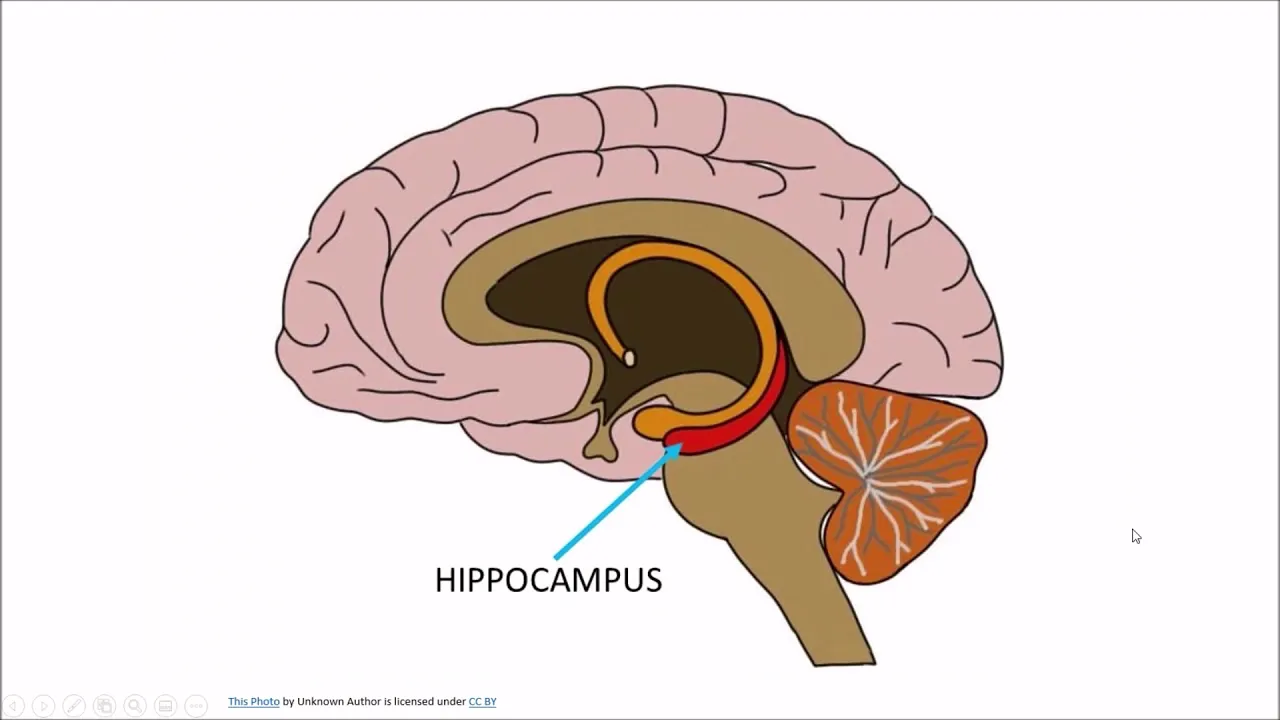
>> The sleeping brain is not neutral about your emotional life. It has something like an opinion and it works on your behalf whether you know it or not. The hippocampus, a structure shaped like a seahorse.
Deep in the medial temporal lobe is the primary structure for forming new episodic memories.
During waking life, it encodes experiences into short-term storage.
During sleep, particularly during the transitions between deep sleep and REM, it replays those memories and transfers them for long-term storage across the cortex.
This process is why sleep deprivation so consistently impairs memory. The consolidation doesn't happen during studying.
It happens while you rest quietly without your involvement.
Neuroiming studies have found that brain regions used during original learning reactivate during subsequent sleep.
Research by Ken Pala and colleagues at Northwestern University demonstrated that playing specific sounds associated with learned material during sleep enhanced memory consolidation for those items. A technique called targeted memory reactivation.
The sleeping brain, in other words, can be gently guided toward the material it most needs to process.
What you learned and what the sleeping mind revisits are not entirely separate events.
The glimpmphatic system, a waste clearance network discovered by Mike Nedagard at the University of Rochester in 2013, operates almost exclusively during sleep. During this time, brain cells change their configuration, allowing cerebrros spinal fluid to flow through the spaces between them and flush out metabolic byproducts, including proteins associated with Alzheimer's disease. Your brain doesn't simply rest at night. It cleans itself.
Evidence for this clearance process in humans continues to develop and researchers consider it one of the most significant functions of sleep yet identified.
Insufficient sleep is one of the most consistently documented risk factors for Alzheimer's disease.
A study by Shokri Kajjori and colleagues at the National Institutes of Health published in P N A S in 2018 found that even a single night of sleep deprivation produced a measurable increase in beta amalloid accumulation in the brain particularly in the regions most affected in early Alzheimer's.
This is not a statistical abstraction.
It is a visible molecular change that occurs in one night. The glimpmphatic systems work is not optional.
The cleaning happens during sleep or it doesn't happen. The relationship between sleep and creativity is well established.
The 2004 study by Olrich Vagnner at the University of Lubec found that participants who slept between problem-solving sessions were nearly three times more likely to discover a hidden shortcut than those who stayed awake. The shortcut was always there in the structure of the problem. The sleeping brain was simply better at finding it because the associations it makes during sleep are looser. wider and less constrained by the rules the waking mind imposes on itself.
Many artists, scientists, and composers have described experiences [music] of creative material arriving fully formed from sleep or the threshold state just before waking. The felt quality of these experiences, the sense of receiving something rather than constructing it, recurs across cultures and centuries with remarkable consistency.
Whether this reflects the unconstrained associative processing of the dreaming brain or something more remains an open question.
What is not in question is the phenomenology itself.
The dreaming mind regularly produces work that surprises the waking mind that receives it. The experience of deja vu, the uncanny feeling of having lived through a present moment before appears to originate in a brief mismatch [music] between the brain's familiarity signal and its recognition system. The feeling of having been here before fires slightly before the context for it assembles.
Some researchers note that deja vu experiences are more common after sleep deprivation and near the hypnogogic threshold.
The border between the dreamed and the lived is less fixed than it normally feels.
Hypnic jerks. The sudden muscle spasms that sometimes occur as you fall asleep, producing a sensation of falling are experienced by approximately 70% of people. They likely arise [music] during the transition between the motor active state of wakefulness and the inhibited motor state of sleep. A brief misfire as one operating mode hands control to another. Even the journey into sleep is not seamless.
The brain negotiates its own surrender.
Sleep is not uniform across a lifetime.
Newborns sleep up to 18 hours per day with roughly half of that in REM. By adulthood, total sleep time shortens and REM comprises about 20 to 25%.
In later life, deep slowwave sleep often diminishes significantly.
This arc, from the infant's near total immersion in the dream state to the elers's gradual return toward wakefulness, may track something about the ark of identity itself.
The young brain building its architecture in the most sleepintensive years before the shape of the self has fully formed.
A rare condition called fatal familial insomnia has shown scientists what happens when the brain progressively loses its ability to enter sleep. As the condition advances, the systems that sleep normally maintains, immune regulation, hormonal balance, neural repair begin to fail in sequence.
What the disease reveals through clinical observation rather than experimental design is that sleep is not a passive state the body enters when it has nothing better to do. It is a biological necessity as fundamental as nutrition.
There is no known substitute and no other process that replicates what sleep does for the brain. In the ark of this journey, something has accumulated from the cellular, the glimpmphatic system, the neurotransmitter shifts, the spindles. We have moved toward the experiential, the cultural and the existential.
What the evidence suggests taken together is that consciousness during sleep is not doing less than waking consciousness in important ways. It may be doing more integrating, healing, reaching toward connections.
The waking mind constrained by its own filters could not make alone. The possibility at the center of this video that dreaming moves awareness beyond the body's usual limits is not mysticism.
It is where the data followed honestly has been pointing something you've been holding. Some deep question about what you are, what continues, what persists.
It's been with you this whole hour.
And you can feel it softening now. Not because the question has been answered, but because the asking has become its own kind of knowing. The science [music] has been speaking about you. About the version of you that runs when the monitoring stops, about the version that cleans and heals and creates and sometimes touches something the waking mind would have said was impossible.
What the science has been pointing toward is almost here and the body already knows it. Sleep and memory consolidation involve active reconstruction, not passive storage.
Each time a memory is retrieved, whether in waking life or in dreaming, it re-enters a state of vulnerability in which it can be modified before being restored.
The memories you process in dreams are not fixed records.
They are living material.
The sleeping mind doesn't just file. It edits.
What you wake with is not always identical to what you carried in.
Neuroscientist Antonio Damasio has proposed that the self is fundamentally a story the brain tells about itself.
updated continuously through the tagging of each memory and [music] decision with an emotional signal from the body.
During dreaming, these markers are revisited, felt again, and sometimes reframed.
The story of who you are is being quietly revised while you sleep. Your identity is not something you wake with intact and unchanged.
It is something sleep actively helps to reconstruct.
Psychologist Ernest Hartman at Tufts University proposed that the central image of any dream reflects the dreamer's dominant emotional concern at that time. He called this [music] the contextualizing function. The mind takes something unresolved, [music] an emotion without a shape, and embeds it in a narrative, giving it a location and a form. The most vivid dreams [music] tend to occur when the most emotionally urgent material is unresolved.
The dream is the mind's attempt to make form out of what has none yet. It is not avoidance.
It is encounter.
The persistent accumulation of data from terminal lucidity, cardiac arrest consciousness, and shared death experiences has pushed a number of serious researchers across neuroscience, cardiology, and philosophy of mind toward a question they [music] did not expect to be asking.
What if the relationship between consciousness and the [music] brain is not one of production but of filtering?
What if the brain narrows an otherwise larger field of awareness down to what is useful for physical survival and under certain extreme conditions.
That narrowing temporarily relaxes. No consensus has formed around this question. But the pressure to ask it keeps returning from multiple independent directions.
In the data, research has found that certain marine mammals, seals, dolphins, some whales sleep with only one hemisphere of the brain at a time, keeping the other half alert enough to continue swimming, breathing, and monitoring for threats.
In some penguin species, a similar alternating pattern has been documented.
The boundary between sleeping and waking is not as absolute as the experience of a single body suggests.
Consciousness, it appears, is capable of being present and absent simultaneously in different parts of the same system at the same moment.
The study of consciousness has increasingly moved toward a research program that insists on including firsterson reports as scientific data, not merely as noise to be controlled for. This approach associated with neuroscientist Francisco Varela holds that a rigorous science of consciousness must take subjective experience seriously as an object of study.
Every person who wakes from a vivid dream and pauses to ask what just happened is in this framework participating in one of the oldest investigations humanity is running. The question is not separate from you. You are the primary instrument.
The brain's construction of time is not a measurement. It is a creation.
Trauma survivors frequently report time slowing dramatically at the moment of greatest threat. Dreamers report wildly variable subjective durations for experiences that span only seconds.
This suggests that the time you experience is always the time your mind builds moment by moment from the speed and intensity of processing occurring within it. In dreaming where that processing runs free, time becomes something you are inside rather than something moving past you. In dreaming, the separation that waking cognition maintains between thinking about something and experiencing it dissolves entirely.
In a dream, there is no gap between imagining an ocean and feeling the weight and cold of salt water. Every thought arrives with its full sensory texture, colors, sounds, physical sensations, and emotions together as a unified whole. This is not a defect in dreaming.
It may be a closer approximation to the underlying unity of experience that the waking mind by necessity keeps divided.
The philosopher and scientist William James writing in 1902 described what he called knowetic experiences, states of consciousness characterized by a felt sense of receiving genuine knowledge of something more fundamental than ordinary life. He observed that such states share four qualities.
They are transient, passive, difficult to describe and carry a quality of illumination of having learned something real. These qualities are reported not only in mystical traditions but in the highest intensity dreaming states in near-death experiences and in psychedelic sessions.
The experience of knowing without being taught recurs across every context in which consciousness is given unusual freedom to operate. What the science has been building toward can now be stated plainly.
Dreaming may not be a reduced version of waking awareness.
It may be a version in which the ordinary constraints the brain places on experience are loosened allowing a wider and more integrated form of awareness to emerge.
The brain does not simply produce consciousness.
It also manages it, narrows it and gates it. When sleep lifts the gate, what is revealed may be closer to the full range of what consciousness can do, including forms of experience the waking mind for good evolutionary reasons normally does not access.
Dreaming may be the body setting consciousness free. That possibility that dreaming is liberation rather than reduction is not new.
Every culture that has left records developed a relationship with the dream as meaningful access to something unavailable in waking life. The Irakqua Confederacy considered community members dreams a source of collective guidance.
Mesopotamian dream books dating to 2000B.
CE compiled interpretive frameworks for common dream images across vastly different contexts.
The same intuition persists.
The dreaming mind reaches somewhere the waking mind does not. Think of reality as an ocean. What we see and touch is the surface.
The physicist David Bow called that surface the explicate order.
Observable phenomena that emerge from a deeper underlying field he called the implicate order in which space, time, matter and consciousness are not yet separate from one another. The dreaming mind by loosening its grip on the surface may in Bow's terms be moving toward that deeper field. The deepest level of experience and the deepest level of reality may for bone be the same place.
In 2019, researchers using highdensity brain recording found that specific patterns of neural activity during REM sleep corresponded to identifiable dream content, allowing them to partially predict what a dreamer was experiencing from outside the dream. Participants who dreamed of faces showed face- specific neural signatures.
Those dreaming of movement showed motor cortex activation.
The dream is not invisible. [music] It leaves coherent structured traces.
It has an architecture that corresponds point for point to an inner world as real to the brain as the outer one. The great Islamic philosopher Iban Cena known in the west as Avisenna wrote in the 11th century that the soul during sleep is partially freed from the body and becomes capable of a form of perception that transcends ordinary sense.
He described this in the physiological language available to his era. But the underlying observation is consistent with what modern researchers describe as the loosening of sensory gating and the opening of internal processing during REM. Avisenna was tracking the same phenomenon that neuroscience is still circling that sleep releases something. What it releases and where it goes [music] remains the living question. People who have been held in long-term solitary confinement, one of the most psychologically severe conditions documented, have reported that the capacity for vivid dreaming sometimes provides a form of continuity that helps sustain something like an inner life when the outer world has been almost entirely removed.
The dreaming mind given a body deprived of all normal stimulus generates its own world with social interaction, sensory texture and emotional complexity.
The dream is not a byproduct of normal experience.
It is a source of experience in its own right. In the Adva Vanta tradition, the state of deep dreamless sleep is not experienced as mere absence.
It is described as a form of pure, undifferentiated awareness, present and still without content or object.
Modern neuroscience would [music] describe this period as slowwave sleep with minimal cortical activity.
Whether these two descriptions are capturing the same thing from the inside and the outside is one of the most genuinely interesting open questions at the intersection of contemplative science and the neuroscience of consciousness.
Kristoff Kau, among the world's most respected researchers on the neural foundations of consciousness, spent much of his career working within the assumption that consciousness was entirely a product of brain computation.
In his later work, including the 2019 book, [music] The Feeling of Life Itself, he moved toward a position he acknowledged as close to pans psychism, the view that consciousness may be a fundamental property of physical systems [music] rather than an emergent phenomenon that appears only above a certain threshold of complexity.
This shift was not a departure from evidence.
It was a response to it.
The binding problem in neuroscience asks how the brain creates a unified [music] seamless moment of experience from billions of separate processes firing in different locations at slightly different times.
How do you experience this moment, this sound, this sensation, this thought, this feeling as one thing rather than as a fragmented collection of parallel events? No consensus solution exists.
The binding problem remains among the deepest unsolved questions in the science of mind and its dissolution in certain sleep states and its modification in dreaming may reveal more about its nature than any waking state can. Studies of the long-term effects of near-death experiences document a consistent cluster of changes in those who have them. Across research by Kenneth Ring, Pim Funlom and Bruce Grayson at the University of Virginia, survivors report reduced fear of death, increased compassion, decreased materialism, enhanced sense of meaning, and a deepened but often less institutional spiritual orientation.
Whatever form of consciousness was operating in those moments encountered something the person does not subsequently doubt. The changes are not minor. They are recalibrations of what matters.
Psychiatrist and consciousness researcher Stannislav Grath over five decades of work with thousands of subjects in non-ordinary states documented what he called transpersonal levels of experience.
states in which individuals reported dissolving individual identity and briefly participating in something larger before returning and reintegrating across subjects who had no prior exposure to each other's accounts. The territory described showed consistent structural features.
Whatever these states are accessing, whether they represent a genuine expansion of consciousness or a specific form of brain generated experience, they constitute one of the most systematic bodies of phenomenological data on consciousness at its edges.
Steven Leer's research at Stanford on lucid dreaming demonstrated [music] that trained practitioners could conduct pre-arranged experiments from inside the dream state. including controlled tests [music] of time perception, deliberate memory formation, and intentional modulation of dream content, verified simultaneously by physiological measurements in the sleep laboratory. [music] What this shows is that consciousness can be simultaneously asleep and awake, present in the dreamed world, and aware that it is the dreamer. These two modes of consciousness are not mutually exclusive.
They can coexist in the same moment. The hospice and paliotative care literature has documented what researchers call [music] end of life dreams and visions in dying patients.
In a study by Christopher Kerr and colleagues at the Center for Hospice and Paliotative Care in Buffalo published in 2014, 88% of terminally ill patients reported meaningful dreams or visions in the final weeks and days of life. These were not disoriented hallucinations.
They were described as deeply comforting, often featuring deceased relatives offering reassurance.
Patients frequently reported [music] that these experiences felt more real than waking life. They recur across cultures, age, and condition, and they consistently move toward peace. Cultures that maintain close integration with the natural world have often built cosmologies in which the dreaming state is considered a normal mode of access to a dimension of reality that is present but not ordinarily visible. The jukorpa of Australian Aboriginal culture sometimes called the dream time is not a past event or a mythology in the western sense.
It is an everpresent ground of being most accessible in certain non-ordinary states of awareness, including dreaming. That an entire cosmology could be built around the depth and reliability of what dreaming offers is. Whatever one makes of its metaphysical claims, a testimony to how seriously some of the world's oldest cultures have taken what happens when sleep arrives.
Neuroscientist Andrew Newberg at Thomas Jefferson University has spent decades imaging the brains of people having deep religious and mystical experiences.
He has found that the deepest reported moments of unity when subjects describe dissolving into a larger hole, losing the boundary between self and world, correspond to decreased activity in the region of the brain responsible for constructing the sense of self as a bounded separate object in space.
When this region quiets, the felt sense of being separate diminishes.
This same region shows reduced activity during deep dreaming.
The experience of being larger than the body may have a specific and temporary neurological address.
What feels from the inside like the most private dimension of experience.
The question of what you are beyond what you can point to or name turns out to be the same question that some of the most careful scientists of the last century pursued from the outside.
The convergence of neuroscience.
Physics and contemplative science on this single question is not accidental.
It is the mark of a question that is real. You are not alone in asking it.
Historical records suggest that before artificial light and the pressures of industrial schedules, human sleep was naturally divided into two periods, separated by an hour or two of quiet wakefulness at night. Historian a Roger Ekersh documented in research published in 2001 and his 2005 book at days close hundreds of references in pre-industrial writing to first sleep and second sleep as ordinary experience.
The interval between them was used for prayer, reflection, and frequently noted the vivid recall and quiet contemplation of dreams.
The consideration of what dreaming reveals was once [music] built into the architecture of rest. The average person will have approximately 100,000 dreams in a lifetime.
Most will dissolve within minutes of waking.
The architecture of this forgetting is partly chemical. The low levels of certain neurotransmitters during REM reduce the signal strength of memory formation, making dream memories exceptionally fragile.
But some dreams persist for decades, so vivid, so emotionally resonant that they shape the texture of a life. What the mind chooses to keep from the enormous volume of nightly experience is not random.
It may be worth attending to. Some people can direct their dreaming towards specific unsolved problems, technical, personal or creative, and find that sleep produces genuine progress.
The method is simple.
Review the problem thoroughly before sleeping. Hold it lightly as you drift off and record whatever arises on waking. This does not always work, but it works often enough across enough documented cases that the phenomenon is real. The dreaming mind is available as a collaborator.
It works differently than the waking mind and it sometimes finds what the waking mind has been unable to reach.
The deepest stage of sleep. Slowwave sleep characterized [music] by long synchronized delta waves is the stage most associated with physical restoration.
Immune function and the consolidation of factual memory.
It is also the stage most disrupted by stress, alcohol, and the natural process of aging. And it is the stage in which the body appears from the outside, most completely at rest, breathing slowed, face expressionless, muscles fully released.
Inside that apparent stillness, the brain is performing its most intensive organizational work. The deepest rest is the most active.
Some researchers propose that consciousness is a model. The brain constructs a representation of reality from prior experience and incoming sensation.
And what we experience is always this model, never the world directly.
Dreaming and waking then differ not as real versus unreal, but as a model updated by live data versus one running freely on its own. Both are constructions.
The dream is simply the one where the external feed is off and the mind shows you what it carries.
The experience of waking from a vivid dream and not knowing for a disorienting moment which world you are in. That brief suspension of certainty is more than a curiosity.
The brain in that instant cannot immediately determine which of its two [music] primary operating modes generated the experience it is currently in. Both feel equally real to it. Both generate genuine conscious experience.
That momentary confusion reveals something worth holding. The boundary between the waking self and the dreaming self is not as fixed as daily life makes it feel. You cross it every night.
Sometimes coming back you can feel exactly how real the other side was.
The contemplative traditions that have studied consciousness most systematically, Tibetan Buddhism, certain strands of vanta, Sufi and Christian mysticism converge on a similar observation that the ordinary waking self, however convinced of its own solidity, is not the deepest or [music] most fundamental form of awareness available to a human being. They differ [music] about what lies beneath it, but they agree that sleep and the threshold states surrounding it are among the most natural, regular windows onto something that is ordinarily hidden by the activity of daily life. The laboratory and the tradition rarely in agreement on metaphysics keep pointing to the same door.
Consciousness is the most intimate thing any being has ever encountered.
It is literally the only thing you have ever directly experienced.
Everything else, the world, other people, your own body is known through and as consciousness.
This is not a philosophical abstraction.
It is a phenomenological fact and it means that every night when the structures through which you ordinarily encounter the world are loosened, you are not moving further from what is real. You are moving closer to the ground of it. The question of what happens to consciousness at death remains scientifically open. The working assumption of most neuroscientists that consciousness is entirely produced by the brain and ceases with it is reasonable and in many contexts well supported. But the data this journey has followed, terminal lucidity, near-death consciousness, shared dying experiences, end of life visions, and the convergence of ancient and modern accounts of awareness at its edges is enough to say with scientific honesty that the question is not settled. The assumption carries more certainty than the evidence has yet earned. What happens to your consciousness when you dream? It migrates inward. It loosens the structures that define you as separate and bounded.
It repairs, consolidates, creates, and sometimes touches territory the waking mind can only approach from the edges.
That dreaming is a mode where consciousness moves beyond the body's ordinary limits is not proven. But it is not dismissed by the data either. You are not only what waking thought can hold. You are also what you become when the deeper processes run that is running now. The territory we cross tonight did not resolve neatly and it was never going to. What it did was widen. We moved through the cellular facts of sleep, spindles, neurotransmitters, the glimpmphatic flush, through the dreaming mind's work of processing emotion and consolidating memory, and then into the harder territory.
Near-death accounts, terminal lucidity, shared dying experiences, ancient contemplative maps that arrived at the same coordinates as modern neuroscience from a completely different direction.
Fact 75 stated it clearly. The brain may be as much a gate on consciousness as a generator of it. Fact 100 makes it personal.
Whatever you are, it runs deeper than the waking day reveals.
The part of you that has been listening to this, the part that recognizes the question and has always recognized it was never only the waking mind.
It was the whole of you wondering what it is. If tonight opened something, if you found yourself genuinely curious about the science of consciousness, about what happens in those threshold states, about the territory your awareness enters every single night, there is more waiting for you on this channel. Someone close to you might be carrying the same question. These are the kinds of videos worth sharing with people you care about.
Sleep well and keep wondering.
Somewhere in your brain right now. The shift is already beginning. Thealamus quieting. Norepinephrine dropping. The first long delta waves forming at the edges of awareness.
You don't have to do anything with what tonight gave you. The questions can rest, too.
Let your entire being dissolve into the deep interior of sleep. The same territory the last h 100 facts were mapping. The same place you arrive every night. Dreaming may be consciousness setting itself free. And you are already moving toward it. That interior opens now slowly. The way a room fills with light before the sun has risen.
The breath you are taking is the same breath that carries a thousand creatures into their own forms of rest tonight.
Each one carrying experience through the dark in the only vessel it has. Let yours slow. Let the body be completely held by wherever it rests.
The transition is already underway.
Not a crossing but a deepening. The waking world growing quieter. The inner world opening wider.
The dream science to fall [music] asleep too playlist has been following this question across many hours.
What you are and what you become when the ordinary limits are set aside.
The next video carries it further.
That video is waiting whenever you are ready. And if the last thing waking thought holds is the possibility that you are more than the waking day can contain, let that be enough. Good night. Patient one. The night knows what to do with you. Dream science keeps running while you sleep.
Yes.
Related Videos
8:08
Neuroscience
What is neurodegeneration?
TheSheekeyScienceShow
3K views•2019-08-19
57:35
Neuroscience
IPL - Ruth Empson "Mind the Gap"
otagouniversity
251 views•2019-07-08
14:01
Neuroscience
How our body shapes our mind | Pancho Tolchinsky | TEDxNapoli
TEDx
2K views•2019-12-05

1:00:02
Neuroscience
Impact of Early Life Deprivation Danielle Stolzenberg Marcus Pembrey Bruce McEwen
uctv
4K views•2019-12-01
10:32
Neuroscience
β-Caryophyllene for Parkinson’s: Protecting Dopamine & Easing Symptoms
parkinsonsdiseaseeducation
6K views•2025-08-09
20:44
Neuroscience
New Insights from Inside the Brain with Rodrigo Braga, PhD
NUFeinbergMed
421 views•2025-04-14
9:57
Neuroscience
Highlights for dystonia • 2025 MDS Congress
movedisorder
145 views•2025-10-27
58:17
Neuroscience
Animal Welfare Synergy Series: Dr Tom Smulders on hippocampal neurogenesis
costactionlift
135 views•2025-07-14
Trending

13:25
Business
Playstation NO DISC/NO BUY Fight Is Over...
DavidJaffeGames
4K views•2026-07-23

22:40
Business
Steam and Xbox Just Dropped The Hammer On PlayStation
OhNoItsAlexx
9K views•2026-07-23

16:52
Anthropology
Americans Confused in Australia for 17 Minutes Straight
IWrocker
17K views•2026-07-23

20:36
Business
SuperBike Factory Has Gone... What's Next for the Motorcycle Industry?
thatbikersimon
11K views•2026-07-22