Kelly’s "accidental" breakthrough is a masterclass in how elite scientists turn sheer persistence into a narrative of serendipity. It reminds us that even the most sophisticated drug discovery still relies as much on a stroke of luck as it does on decades of academic rigor.
Install our extension to search inside any video instantly.
How This Scientist Accidentally Discovered A Drug For Some Neurodegenerative Diseases
Added:[music] >> Jeff, it is great to be here with you in the HP garage, which a lot of people describe as the the birthplace of Silicon Valley. It's an icon of American innovation. And in that spirit, I'd love to ask you what you've had a long career in the life sciences and in designing drugs and making incredible discoveries.
What's the birthplace of your interest in the life sciences? What got you into your career?
>> You know, when I I was a kid, I worked on a farm a lot and I think that was really useful in kind of learning how to fix things and kind of figuring out how they worked. But to be perfectly honest, I wasn't one of these kids that grew up envisioning to be a scientist, right? Um but um I had I had the privilege of going to uh State University of New York College at Fredonia, not a particularly distinguished place, I suppose, but um great scientific program and I was in their chemical engineering program, started taking organic chemistry, and I loved it. And the person running the course said, "Hey, you should do research. I have just the guy to do it with, a young assistant professor." And you know, I loved it.
So, that was kind of the beginning of it all, I would say.
>> Got you. And you know, you've had a lot of, you know, amazing discoveries over the years. But if you had to, you know, pick your favorite child, what What about your work? What discovery?
What What thing about it would would you hope kind of defines your legacy and what people think about?
>> I I suppose the the discovery that we made that has the biggest impact is we had the privilege of discovering the first drug that slows down uh a so-called amyloid or neurodegenerative diseases. It's These are diseases of protein conformation and misassembly and um we had a hypothesis that these diseases were conformational in nature and that maybe you could discover a small molecule that would inhibit or prevent that shape change and that turned out to work and so uh it was a long journey and you know some certainly some setbacks along the way, but it was a lot of fun.
>> Yeah, and and um which disease did that impact? What what what problem did you solve?
>> So, the diseases are called transthyretin amyloidosis. They're likely the third most prominent neurodegenerative disease behind Alzheimer's and Parkinson's and like Alzheimer's and Parkinson's, there's um inherited forms and there's sporadic forms. And the sporadic form of transthyretin amyloidosis causes uh congestive heart failure ultimately and that's the clinical trial that we did with the drug.
>> Yeah.
And um you know, since you since you discovered that drug, um I know that it's it's a blockbuster. Is that what we call it when we in the health care journalism uh field? How many patients has that impacted? How many people have have seen their lives lengthened because of that drug?
>> There are about 75,000 people right now taking tafamidis or Vyndamax and we we also repurposed um a nonsteroidal anti-inflammatory drug from Merck for people who don't have availability or can't afford that drug and there's probably an equal number of people on that generic um stabilizer, as we call it.
>> So, um and I'm curious when you when When think about that and you think about that impact, how does it feel to know that your work is literally affecting and and and saving people's lives?
>> It It took a long time to really dawn on me, to be perfectly honest. And I I think that was That was a good thing and that we're still hungry and we want to we know we'd love to make another medicine, but every once in a while, I get a call from a patient and it's it's really incredible, I would say, just to hear, "Hey, a week ago, I you know, I started taking your drug or and I already feel better, right?" So, that's that's, yeah.
>> So, uh you you mentioned the discovery process of this. I I'd actually like to dig a little bit deeper into it. So, um what is it that that's uh causing these amyloid diseases? Like, why do they happen to some people and not others? Like, what's kind of the key issue there?
>> Yeah, it's it's it's a great question.
The short answer is we don't know precisely.
I mean, in the hereditary diseases, we have a much better understanding of those because mutations compromise the integrity of the protein shape and that allows them to undergo shape changes faster or more readily and that process of aggregation drives a bunch of biological processes that aren't normal and over a decade, that ultimately leads to demise of tissue that can't easily regenerate, like the nervous system.
>> So, it's actually changing, like, you have normal, you know, molecules in your body and we're changing the shape, so they get stuck or they get or or they don't interact the way they're supposed to or things like that?
>> All of the above, actually. I mean, you know, proteins function because of their shape and the juxtaposition of functional groups on on their surface. And so, when they're not in the right shape, they can't engage biological pathways they're not supposed to.
>> Got you.
>> And or compromise the likes of membrane integrity, which kind of defines the the function of a cell.
>> Yeah.
And I know that your work helped to kind of uncover these shape changes, you know, uh not just for uh the disease you mentioned, which I'm not going to try to pronounce, but >> [laughter] >> but it has implications for for other things as well. And I'm curious if you could talk a little bit more about um how that how your work has kind of shaped the understanding in different in different aspects of uh health as well.
>> Yeah. I I think it's now generally perceived that protein conformational changes are the basis of neurodegenerative {slash} amyloid diseases.
>> Yeah.
>> And you know, there there are two kinds of proteins that ultimately end up misassembling in these diseases. There are those that initially adopt a really well-defined shape for their function, and there are those that are conformationally more flexible, probably also for their function.
>> Right.
>> And those are a little more demanding targets pharmacologically, but we're starting to learn how to drug those, too.
>> Got you. So, one time you don't want your mind to be flexible.
>> [laughter] >> Exactly.
>> So, um so, I I'm curious, you know, when we're talking about these proteins in these incredibly complex systems in biology, um how did you make this discovery back then? Like, what what equipment What was the key tool that kind of enabled you to understand And I understand these changes are happening on like the microscopic level in molecules that have like hundreds of atoms. It's not You know, if you think of water as H2O, that's three. So, you know, we're talking about hundreds, thousands of atoms, lots of different um connections. How do you even uncover that understanding in the first place?
>> Uh it's a great question, and the short answer is by accident. I mean, I I was a post-doctoral fellow at the Rockefeller University, kind of sitting in the library looking for a protein whose structure was so-called beta sheet rich that I could study.
>> Mhm.
>> And there was a title in one of these papers of amyloid, and I started in reading those papers, and literally after a couple of days days I would I decided I need to work on this. And moreover, after, you know, a week or so, I envisioned that maybe these are conformational diseases, and that wasn't exactly how people were thinking about them at the time.
>> Yeah, I think it's interesting, you know, in in the life sciences in particular, I feel like a lot of discovery is serendipitous or accidental like that. I mean, we we have antibiotics because uh we we we left the bread out too long, right? So, >> [laughter] >> so, you know, how important is serendipity and and kind of being free-flowing in making these kinds of discoveries?
>> I think it's it underpins probably 95% of discoveries, right? But you you have to be well enough trained and have the right mentality so that when your experiment fails or doesn't come out the way you envision it to result, you you have at least the creativity to think about, well, my god, maybe I discovered something way more interesting than I was looking for.
>> Yeah.
Well, I I think that leads to an interesting place cuz we're in an era of science right now where we're able to measure >> Yeah.
>> almost everything and track things, and we have software that can, you know, uncover these patterns and connections.
Um but the side effect of that is I feel like it forces a lot more order and structure and discipline. And so how do you maintain the integrity of the data, which I think has a lot of potential to uncover new things and design new drugs while still allowing for serendipity and creativity. How do we strike that balance?
>> Yeah, it's a great question. I mean I mean I I would say you know things like DNA sequencing and protein sequencing by mass spectrometer are very precise. But the truth is many of the measurements that we make in biomedicine are much less precise. And so they're generally open to interpretation and um redoing the experiment multiple times to be confident that the answer you think you got is really what is true.
>> And then kind of speaking of that work, uh what what are you what's your work focus on now? What what kind of gets you excited to be working on and and trying to discover?
>> So the the majority of neurodegenerative disease patients don't have mutations that we know of that drive their pathology. Those are the so-called sporadic patients.
>> Mhm.
>> And we hypothesize that those individuals don't quite have the same capacity to degrade misshapen proteins that those people who live a long life healthy life will have.
>> So if I can interrupt, so it that would be like taking care of the like my body is taking care of if I if I get a screwed up protein, it knows to get rid of it. And some and some folks maybe that's maybe the trash collectors are a little lazier >> Absolutely. That's precisely correct description. So you know, in everybody the folding of some proteins is pretty inefficient. It can be as low as 50% efficiency. So, we have the proteasome and the lysosome to expert trash collectors to take out the trash. And there's growing evidence that in aging um in some individuals those pathways get compromised. And so, the misshapen proteins start to accumulate and hence the risk goes up.
>> Got you. That's really That's really interesting. And so, um are there ways that we can kind of impact the effect of aging in that regard? Can we get, you know, our our trash collectors get on the ball, stop taking afternoon naps, and, you know, doing their thing?
>> Sure. So, I mean, that's what my group is focused almost entirely on now is to try to understand how we can more efficiently take out the trash. So, we we work on a pathway called the autophagy-lysosome pathway. But there are probably an equal number of groups working on the proteasome, which is another way to take out the protein trash. And so, I I think ultimately we'll have drugs that affect both pathways. And hopefully, unlike the medicines we have now, where particular molecule targets a particular protein preventing its shape change, hopefully more efficient garbage collectors will be useful for multiple diseases.
>> Yeah, no, I think that's interesting because, you know, I think one of the gaps that I see when when looking at health care is that we're starting to get really good at expanding people's life spans, but those last years aren't always like great years. They're they're the quality of life suffers.
Um you, you know, cognitive impairments, physical impairments, and I think what's interesting with the work you're describing is that maybe we can not only expand, you know, life span, but quality of life span. And I'm curious if that's how you're thinking of it as well.
>> Absolutely. We we think about health span.
>> Mhm.
>> You know, can we extend the healthy period of someone's life? And if you could extend that effectively indefinitely to death, that would be the ultimate pharmacological solution, I think.
>> Kenneth, speaking of looking for those solutions and being future-reaching, I know that um AI has really kind of gotten into the biological sciences, you know, the last few years. I mean, really longer than that, cuz I mean, Recursion's been around for uh since the beginning of the 21st century. Um and I took my first bioinformatics course in the '90s. So, you know, it's been around, but there's been a lot of advances in the last few years, especially with like AlphaFold, for example, which won the Nobel Prize and um how do you see AI impacting your work right now?
>> I I'm absolutely confident that AI will have a continuously or increasing impact on the efficiency of >> Mhm.
>> biomedical research. Yeah, it's interesting that you mentioned AlphaFold because the structural biology database is probably one of the most accurate databases that exist in science. And the reality is there aren't many of those. And I have a really good friend who runs a large research organization in Germany, and he basically told me that he won't even let his investigators start doing uh artificial intelligence strategy now on, you know, hospital data because it's so lousy.
>> Yeah.
>> So, we'll get there, though. And AI will have a dramatic impact. I mean, it's starting to be used in drug discovery and elsewhere.
>> Yeah.
Yeah, and and I think to your point, that is something I hear a lot in healthcare, is that like the the AI the the potential capability is enormous, but the real gap is we don't have enough information to train the models on so that they actually know what they're doing. Um in in your lab or working with your colleagues, how do you approach that?
Like are you collecting data in new ways to to help train those systems? Is it really affecting your day-to-day at all right now? How does that data gap kind of impact?
>> That's a great question. I mean, we're I do think it's really important to think carefully about how to create the highest quality data set and then deposit it publicly somewhere.
And I mean, for example, right now we're trying to do that in the context of a phase three clinical trial we're running where our hypothesis is that protein stability is again responsible for this disease and then quantifying stability in enough patients with very exacting analysis to to ultimately be able to predict when a patient shows up from their sequence whether they're likely to develop the disease or not.
>> Yeah.
And I'm you know, to that end which I think is interesting, I think there's also a potential trap in that you're going to be biased towards data that's easy to define.
And how do you but discovery doesn't always happen in the cuz if it was easy, we would have already discovered it, right? So, how do you balance like getting the data we need to to build these tools but also knowing that there's valuable information that might be hard to describe, hard to define.
>> I mean, almost everything we do is data-based.
>> Right.
>> And I I think one of the great things about AI is it's forcing all of us to think about how to make our data more accessible and of higher quality.
And of course, tools like Claude and the like >> Yeah.
>> you know, allow people like me who can barely spell AI to use it and very effectively sometimes where you don't think of a hypothesis.
>> Mhm.
Um and I'm curious beyond AI, are there other things in life sciences that you know, your your group isn't working on but maybe your colleagues are that you're tracking or that you think is exciting or maybe you might even want to move into?
>> Yeah, I I our increasing understanding of the immune system will be profoundly important in human medicine. Many diseases of aging are based on overzealous responses of the immune system. And of course all the reprogramming of the immune system to treat cancer has tremendous progress and there's already been some amazing data, human clinical data coming out of those studies. So, I'm really optimistic that both in neurodegenerative diseases and cancer and probably infectious diseases, too, you know, the next uh 20 years will be pretty productive.
>> Um also throughout your career, um you've been involved, I mean obviously you helped create a drug that that blockbuster drug and you've worked with other drug companies. Um how do you see the relationship of academia and drug companies and and you know, what have you learned from them, I guess that maybe has helped guide your work, too?
>> Yeah, I I always tell my fellow academicians that if you know, if if the pharmaceutical companies think your idea is great, then you're probably not working on something hard enough, right? I mean, you you really want to be pushing the frontiers and that's what we're supposed to be doing in academia for my perspective and pharma's really good at it taking ideas that have been through proof of concept and making them much more efficient and they're the best in the world at doing clinical trials cuz >> they they can afford to do right-sized trials.
>> Right.
And uh I'm curious too um as you're you know uh have had a such a a long great career, you've had a lot of post-grads and and other ingredients students and and undergraduates come through your lab and and come through the school.
Um what lessons do you impart to them you learn in your career that you hope they can avoid learning the hard way?
>> I mean, I think for academic academia, the most important thing is picking a scientific challenge that if you're successful in uncovering it, will really change how the community thinks about science. And that's probably the most important thing I try to impart on trainees. The technical learnings they're going to get, right? But a lot of scientists don't think hard enough about problem selection.
>> Mhm.
>> How do you How do you define a good problem What's a good How do you know what a good problem is or how to pick a good problem?
Yeah, it's I I mean, I try to impart that from case studies to graduate students and post-doctoral fellows. Just take a dozen people who've been really successful and kind of dissect what problem they decided to work on, how did they do it, and what was the impact, and it it's kind of like one of those things if it's a great idea, you'll know it when you see it, but we have to be a little bit more precise than that, and we try, but I'm not sure we've gotten all the way there.
>> Got you.
And then um you know, just one last thought as we're we're sitting here again in this kind of like icon of of American innovation.
Um and we're here to celebrate 250 years of the United States. Um when it comes to innovation and science, what does the American dream mean to you?
>> Uh I mean, I I think it's the bedrock of the United States economy.
That is that people who aren't necessarily entrepreneurs or college educated can go get training and be innovative and create a new industry like came out of this garage, which is absolutely incredible, right? I mean I I I really believe in that concept and I also believe that we can't we have to compete with other countries that are starting to be really competitive in terms of their innovation with us.
Um especially in the pharmaceutical industry.
>> And what do you think, you know, what would you advise that we do to help kind of protect that spirit of innovation for the next 250 years?
>> I I'm a big fan of long-term investments. Education, training, and making sure that we invest enough so that we have really innovative people coming out of the pipeline creating new industries that we we can't even think about today.
>> Great. Well, Jeff, thank you so much for your time and your insights. I really do appreciate it. Thank you.
Related Videos
51:25
Biotechnology
EAStalk “Electrochemical sensors as a platform for improving Animal Welfare” with Dr Sofia Teixeira
euraquaculture
176 views•2025-06-20
10:06
Biotechnology
Cesare, son of San Mauro (eng)
AkuOutdoorFootwear
608 views•2016-02-03

0:47
Biotechnology
Why Gen Z is Taking Creatine (It's NOT for Muscle Growth)
Michealhealth
830 views•2026-04-22

43:57
Biotechnology
Guillaume Durin - Catch and Release - Extraction and Purification of NGS Grade DNA and RNA from FFPE
Labroots
851 views•2015-01-27
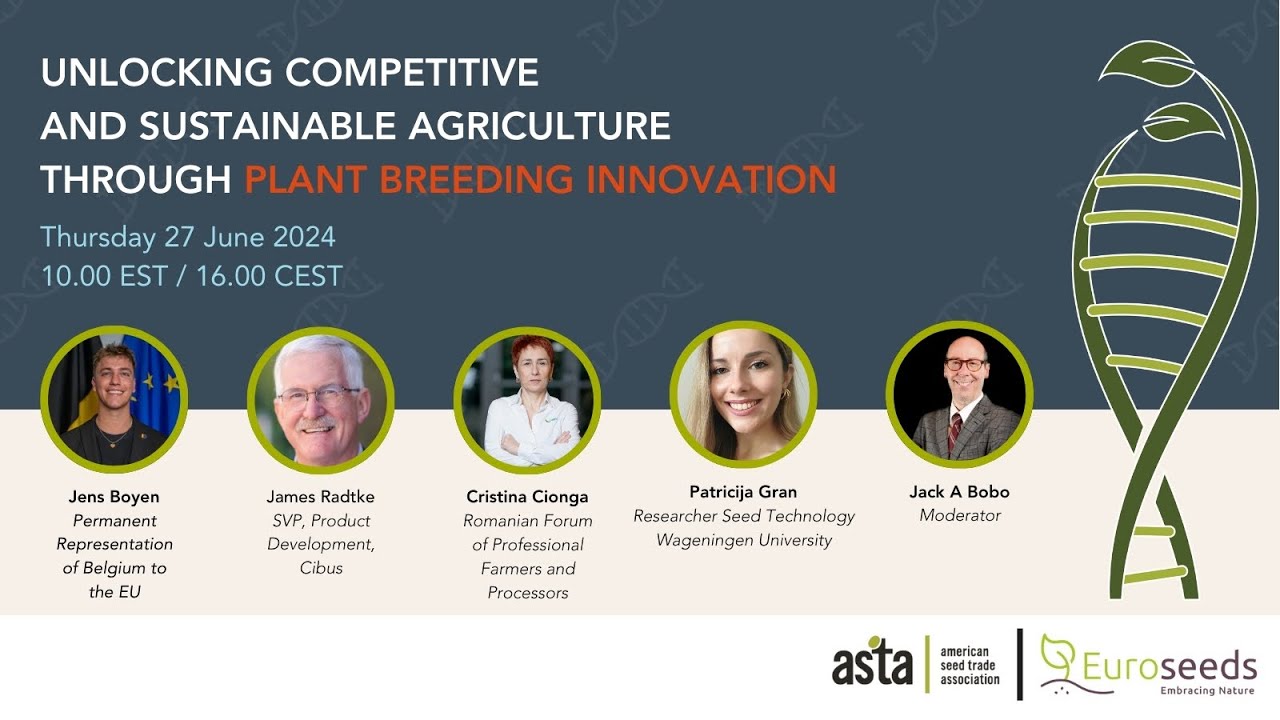
1:13:59
Biotechnology
Webinar: Unlocking Competitive and Sustainable Agriculture Through Plant Breeding Innovation
americanseedtradeassociati3281
319 views•2024-06-28
2:08
Biotechnology
AI in neurology: predicting protein structure
VJNeurology
622 views•2023-07-06

2:42
Biotechnology
Stevia Innovative technologies for cost effective and sustainable production of Reb M
ingredionemea201
207 views•2023-03-14

2:27
Biotechnology
Biological Effects of Radiation
CDC
551K views•2015-08-27
Trending

13:38
Law
WOW! Judge TURNS THE TABLES on Trump in His OWN $10B LAWSUIT!!!
MeidasTouch
197K views•2026-07-23

13:25
Business
Playstation NO DISC/NO BUY Fight Is Over...
DavidJaffeGames
4K views•2026-07-23

22:40
Business
Steam and Xbox Just Dropped The Hammer On PlayStation
OhNoItsAlexx
9K views•2026-07-23

16:52
Anthropology
Americans Confused in Australia for 17 Minutes Straight
IWrocker
17K views•2026-07-23