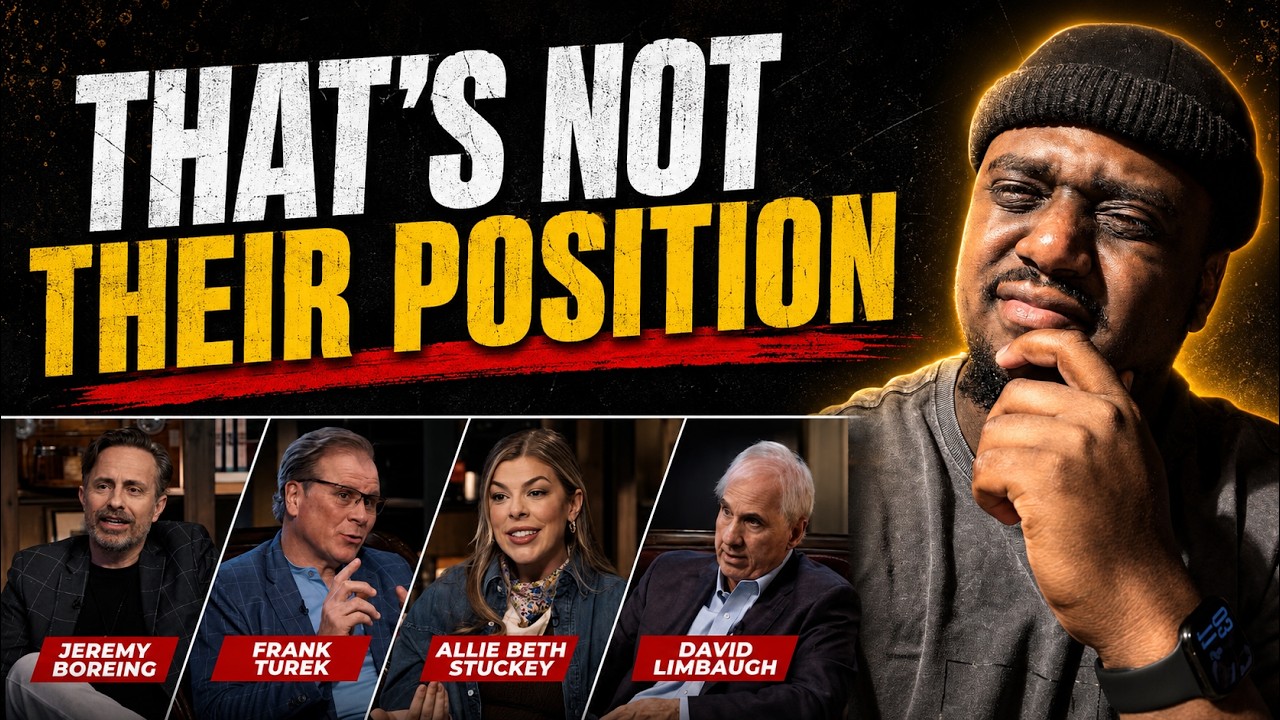
This debate explores fundamental differences between Mormon and Christian views of God's nature, focusing on whether God can fall from exaltation, whether God was once a mortal man, and how divine sovereignty relates to human free will and moral responsibility. The discussion examines competing theological models including the infinite regress problem, creation ex nihilo versus eternal matter, and the implications of God's character for understanding suffering, evil, and salvation.
Installez notre extension pour rechercher instantanément dans n'importe quelle vidéo
Mormon Apologist Pushes BACK on Christian Doctrine of God | Christian vs Mormon DebateAjouté :
So, you could be like in a celestial kingdom, and then [music] choose to not not follow the law and become that bad god.
>> The Well, you wouldn't be a god anymore, right? Our We have a doctrine [music] that says that god can cease to be god.
So, theoretically, yes, could you fall from your exaltation? Theoretically, [music] absolutely.
>> What if Heavenly Father did like cease to be god? Like that's >> Sure, yeah. Our scripture's very explicit about that. It says It says he can. It's possible. Absolutely.
>> What? But, how do you know he didn't?
>> Well, because we're still here. He holds everything together.
>> So, if you're a if you're a god and you fall, your reality that you created or whatever is gone?
>> Theoretically, sure.
>> It's gone?
>> Theoretically, yes.
>> So, let's just walk through. So, when I when I teach evangelism or I I teach the How do we share the gospel? You know, we walk through basically four different words. Um God, man, Christ, response.
So, let's just walk through like the differences when we use these terminologies. Because I think I think we can agree that we use the same terms, but we use them very differently.
Um so, let's talk about God. Like in the Latter-Day Saint church, who is God?
>> He is our father. Yeah, we we reject the perfect being theology that came out of the neo-Platonism of the 5th century that said God is the greatest conceivable being, right? From from the Greek uh philosophy that turned God into it from our point of view turned God the Father into, you know, immaterial, you know, still a personal being, but this immaterial, spaceless, matterless being, right? Um and we can talk about the Trinity and how our issues with that.
But, we would reject that whole notion that we would say came out of that that later non-apostolic age to try to allow the gospel to become more palatable to the Greeks that they were trying to proselyte to. And we would accept Our Our position would essentially be God has revealed his nature through modern revelation, that he has restored what he actually is. And that is that he ontologically, there's no gap between us and and God. We would say that.
Um to put it in simple terms, like God is a human.
Like he's a like he's not again this like omnipresent like thing or force or whatever you might however you might describe it. He's actually a person.
>> And he was a sinful person at one point or is still or how does that work?
>> Yeah, some people believe that. Um, there are different models.
>> Who still makes mistakes or >> Um, no. We I would say I would be comfortable saying that all Latter-Day Saints who know anything about our doctrine I I've never heard of that any I've never heard anyone say that God today is sinful. But there are some theories that came out of some of the later um, sermons of Joseph Smith like months before he died where some people believe that he was once a man just like we were in in not in a non-exalted state.
>> That's the famous couplet from Lorenzo Snow. As God now is or as man once as man as God now is man once No, what what's the couplet?
>> As man now is God once was. As man may yet become.
>> Yeah. I'm like, what? [laughter] Why can't I say this? I I wrote it.
>> So so there are different competing camps theologically on you know, what that looks like. What's the origin of God?
>> Yeah.
>> Um, but unfortunately the church doesn't have a set doctrine on that. So you'll you'll see competing models.
>> But you would see how that would be like to me very shocking to hear like God made mistakes. God At least at one point sin because my you know, our our view of God in scripture and again, we you the question is what is scripture? You know, that's a whole whole another conversation, but I think about like 1 John um, well, it's the book of 1 John.
God is light and in him is no darkness at all. You know, that he's pure light that that actually like moral law is actually based on his character. You know, the reason why lying is wrong is because because God by nature is a God of truth. The reason why unfaithfulness is wrong is because God by nature is a God of faithfulness. The reason why hatred is wrong is because God by nature first John says God is love. You know, and so that like hearing oh God was once a sinful man is like quite shocking to like what we would consider to be the Old and New Testament presentation of God.
>> Sure. Yeah, no I have I mean it's just as shocking as you saying that God is immaterial spaceless timeless matterless to us. It's like the two models can't overlap at all. And so I don't I don't see why um cuz I I You've heard probably heard of infinite regress.
>> The infinite regress Yeah, like where did this all start?
>> Yeah, God did it God have a God without a God or is he the first God or is there a finite regression?
>> And that's that's why like God's eternality is like and it's the it's the Genesis view that in the beginning whatever, you know, beginning of creation like God just was like time is a construct that he made.
Creation is >> Yeah, we wouldn't say that that's in the book in in the Genesis >> All right, I've heard you say you you regret you you did not my creation ex nihilo, but you know, I read like Psalm 33:6 and it says, you know, by the word of your mouth the heavens were made and by the or by the by by your word the heavens were made and by the breath of your mouth the the host of heavens were filled, you know.
>> but my position would be that you're imposing third maybe even fourth century doctrine from the councils and the on the apostolic age into the text. Like when the text was written it didn't mean >> So you're saying that's Greek thought?
>> Uh yes, potentially.
>> So let's talk about that for a second because we're on the topic of of God.
So Greek thought neo-platonic thought. So Plotinus he was very much into obviously Plato.
Plato had a view that actually we were all pre-existent, right? And Plato's view was that we go through this state of I think the word is um upon No, what is the word?
It's the it's the word for like the Greek word for like forgetting.
Um we go through this like veil where we forget our memories and then we have to relearn and ascend back to Godhood, um which to me actually sounds a lot more aligned with >> Yeah, but the the Latter-Day Saint conception of doctrine and how it came about was not influenced by Platonic ideas at all.
>> Right, but you have to see the similarities of like pre-existence. And in fact, Plato believed that um the world was not uh that that the world was basically like matter that already existed, which is also the Latter-Day Saint view of the world. So, I actually view >> And and the early church's view is that matter is eternal. Justin Martyr believed that, that God fashioned out of by the early church fathers.
>> like like Acts 17, like nobody nobody made God, but God made all the universe, you know.
>> Yeah, I struggle with going to particular passages because it ends up being your interpretation versus mine and our paradigms and our axioms will basically dictate where that could where we go with that, right?
>> But I think So, like in the beginning, God created, right? That's like >> what's that word though? What's that Hebrew word?
>> Yeah, I mean I I don't have the the Hebrew in front of me right now, but >> That's bara.
>> Yeah.
>> And it means to fashion out of existing matter. Yeah, the concept of creation from nothing didn't exist in the ancient Israelite concept. So, I've heard a lot of like Catholics in particular say that oh, well, you know, God says this in the Bible and then it's like he's like building on it and eventually we can come to know what he meant back then.
And I would reject that. I don't know right, the the scriptures are not written by God. I don't know if you hold that position. Sometimes I hear people say that. We I I think it's objectively true that scripture even my own scripture, it's written by people, right? Who we would say are inspired of God. So, like for example, um there are some people who will say that that Sola Scriptura is taught. I'm just giving you an example of another one like this. Some people say Sola Scriptura is taught in the Bible.
And it's like how could the biblical authors write about Sola Scriptura when Sola Scriptura didn't exist in their minds when they were writing the Bible?
Like like 2 Timothy 3:16, people quote that all scripture is God-breathed, right? And a lot of people will point to that and say, "See, that's Sola >> God created the world.
>> but I think the response is and kind of what I'm getting at is there may be overlaps in worldviews. I'm not saying that's the problem.
>> Yeah.
>> Saying the problem is when it's actually influenced by that rather than God's revelation. Because my position would be that God revealed a pre-existence or a veil of forgetfulness, where I don't see that in the early church them claiming God is telling us, rather they're appealing to the common metaphysics or philosophy of the day. Like they're tailoring it to them. Like they're letting it influence the church. And that kind of gets into the topic of like the policy, right?
>> John 1, I think about like this cuz you just I think the one of the my favorite terms in theology is theology is like the perspicuity of scripture, so the clarity of scripture, right?
>> totally reject that.
>> So, you know, like God is love.
>> Yeah, what does that even mean?
>> I mean, we know what it doesn't mean that God's not hate, you know? So, >> Yeah, but what what you can start like >> you can start unpacking like that's what I'm saying, it's like like God is creator, like Jesus is the author of life. Like these aren't like and that's how Jesus is referred to in the book of Acts. So, you can like take these terms and it's like you know, like they're it's not as confusing as we make it to seem. There are I'm not going to say that all of scripture is equally clear, but what I >> But who gets who gets to determine what's clear and what's not if we disagree on the passage?
>> if I say Jesus died on the cross.
>> Mhm. Yeah, but but did his humanity die or did his divine divineness or godhood die? It's like you start to get into these questions where it's like it's actually not as clear as we think it is.
>> But I think like God as creator communicates like God made the world, you know, God and like even John chapter 1 says that nothing existed apart from the word like creating and then Colossians 1 that you know Jesus is the image of the invisible God and all things were created like through him and for him.
>> we believe that too.
>> But all things like visible and invisible like that's why >> in that time period doesn't mean it's actually like invisible like we think of invisible like have you ever played Halo?
>> Dude, I love Halo.
>> Did you play Halo?
>> Yes, absolutely.
>> Well, okay.
>> I'm 31. Are you Are you 30?
>> Yeah.
>> So Halo >> Halo Halo 3 >> Okay, Halo 3 is great. Yeah.
>> But you know when you you >> Whoa.
This is now a Halo debate.
>> [laughter] >> Halo 2 is the best Halo.
>> Halo 2 is great.
>> Come on.
>> I We should We should do a whole 'nother episode.
>> Oh, I know.
>> Let me do an analogy. When you're playing Halo and like there are these like on the maps there are these different spheres. One of them's red for like an overshield. And one of them's blue. And what does the blue one do?
>> The can The invisible >> Camo, yeah. Turns you invisible in the way that we think about it.
The ancient people even in the first century the first century followers of the way when they said invisible they they didn't mean camouflaged. Right?
They didn't mean like you can't see it.
They meant like like like if it was in front of you couldn't see it. That's not what they meant. They meant like the God who is in heaven.
Like That's what I'm saying is like we can we can put these definitions or or how we think of words into these ancient texts and it's basically appropriating our view of the word or our use of the word and putting it back on them. And you can probably think of different ways that people do that and they abuse scripture.
But I So when you talk about the invisible God I not sure how you intended to use that but I would say that that's not necessarily talking about like God is immaterial. I don't know if that's how you intended it.
>> Yeah, I mean I I I would hold a view you know that God is God is spirit John chapter 4 and that those who worship him worship him in spirit and truth. But you know what I think is is unmistakably clear that in scripture is is that is these terms like righteous, these terms like holy, these terms like be perfect as your father in heaven is perfect uh in Matthew chapter 5 uh that God is light and in him is no darkness. Like you don't have to be a Greek or Hebrew scholar to say, "Hey, these plain teachings are God is a perfect being."
Like he's righteous uh and he's Like you can't say be perfect if if God has sinned in the past, you know what I mean?
>> Well, no, it depends on what the word perfect means.
>> Well, that to All right, that's a good question. But perfect means to have like no mistakes on your track record, right?
So >> No, no, I don't believe that at all.
>> Like if I got a perfect grade on a test, what does that mean?
>> [clears throat] >> It doesn't mean you didn't make mistakes in the past. It means you >> But it means I got But it means on that test I had no mistake. So if I had a perfect If I had a perfect life, that means in my lifetime there were no mistakes. And I don't think you could say that of God if he had >> I'm not defending that God sinned necessarily. But But if I if I was If you're going to put that on me and I you're going to put me on on the on the debate, I would argue that the word perfect means whole, right? complete.
And so on that definition, that's what I'm saying like >> But he keeps like when Jesus comes he keeps the law perfectly. So in the sense it's a moral perfection, right? It's a It's a never transgression.
>> saying that God the Father has been morally perfect forever. I don't have a problem saying that.
>> But that's that's not the teachings of all Latter-Day Saints, right? That that he was like us. And what does it mean to be like us? We make mistakes.
>> I'm saying. Some people may hold that and I think they're all are soft to that, but but they could easily be persuaded otherwise, right?
>> But when you talk about the doctrine of like exaltation like we can become perfect, right? Like God is God the Father is perfect, so we can become perfect. Like that's It's impossible to become perfect in your lifetime if if in your life your lifetime you have made mistakes.
>> think you're going to be perfected in Jesus Christ?
>> I don't think that I my life will always have a perfect track record because my life >> that. I'm saying will you become perfect?
>> I believe in the doctrine of glorification that our bodies will be made new and that our hearts will be made new so that we're fully responsive >> not going to be made perfect to the Holy Spirit. My life span, my life history will always have a track record.
>> yeah, I'm not asking about that. I'm asking about what's the final product?
Is it a perfect product or >> The final product is a glorified product, which just means that that you have a body that no longer subject to decay, and you're no longer you have a heart that no >> wouldn't call it perfect.
>> You no longer desire sin. You did you it's a heart that beats after God.
>> a lot of people would call that perfect.
>> That perfect in the sense of I desire God and his and his fullness where I did not before, because God has glorified he's transformed me from the inside out to now desire the perfect. But if you're talking about Greg's lifetime like Greg as a as a life form, you know, let's just go there. Like it would be inaccurate to say that Greg as a life form is is perfect because Greg as a life we're just going back to where we started like abuse, you know, verbal manipulation like all these things like that would not be appropriate word for me.
>> Totally. And I think like I said, you can reasonably hold that God is sinless.
Absolutely.
Or has as a lot of descent you can hold >> but if he's like us, right? Then >> Yeah, but Jesus was like us too, though, right? In every way but without sin.
Yes, but that's the question is when Lorenzo Snow did the couplet of as man now is God once was? In a way I would say that all Christians believe that, right? That he condescended, that he became like us, he became human.
Right? So what did Lorenzo Snow exactly mean by that? I think I guess we'd have to ask him. Um but I think you could you could easily interpret that to mean that God was on an earth, if you want to call it that, with us. But that's where the debate is, right? That's the infinite regress versus the monarchical monotheism. Has God always been exalted and now is he super exalted or was he at one time like us or was he like a savior? There's lots of different theories. Hm, so yeah, and and our church is way less concerned about the origin of God than it is with us keeping covenants or or looking to God or submitting to Jesus Christ.
>> Yeah, I just think why it's such a big deal because it's because, you know, if God is like us and was as and has capacity for sin, then that means he's in need of redemption himself, you know, and that's that's a problem. And >> Well, can I push you on that a little bit?
>> Absolutely.
>> Do you believe that God can sin?
>> So, I believe that he is incapable of sinning. I would say that.
>> So, our struggle with that >> Because he's because he's the standard of morality.
>> Yes, could I understand it? Our struggle with that though is if you say that God is incapable of sinning, you're telling me that God does not free will.
That God can only do >> according to his nature.
>> Yes, that's like it's like the robot, right? If I program a robot, it can only do according to its nature. The thing about us is that we can act out of accordance with our nature, right? I don't I don't know like we talked about if you're reformed, they would say that we can only act in accordance with our nature and we're either enslaved to sin or enslaved to God. I don't know if you hold that in total depravity, I think like that. Uh those doctrines, but I would I would totally reject that. I would say we actually can do things that are out of our nature. Now, I can't fly.
>> So, would you say God God can sin?
>> He can, but he chooses not to. Yeah, our God has free will is what we would say.
>> Yeah, but then that that breaks like he's no longer the standard, you know what I'm saying? Like if if he can sin if like >> He can, but he doesn't, so he's still the standard. Again, just like an atheist would struggle to be a Latter-day Saint, I understand why a Protestant Sola Scriptura believing Christian >> or Evangelical Protestant would have a hard time becoming a Latter-day Saint.
Like >> I would say it's actually impossible to become a Latter-day Saint if you hold certain presuppositions, right? Like uh I mean, Sola Scriptura is probably the biggest one or if you want to hold to the Trinity, right? You can't really I guess you you could pri- very privately be a Trinitarian and be a Latter-day Saint, but it would go totally against everything that we teach, right? And so, my my point is that I I understand when you say like, "Oh, well, that's a problem." I'm like, "Yeah, I understand from your position, absolutely."
But, then all of your positions are problem for me because my my doctrine, essentially, right?
>> Well, yeah, I do want to address like the robot thing. It's It's not It's not um It's It's not a robot, you know, cuz I believe in in a glorified state, you know, I like do you believe like in glory?
>> I don't know what you mean by that. Like >> in any any of the kingdoms, the telestial, terrestrial, or celestial, like will people be able to sin or be evil? Like if someone ascends into being a god, can they be an evil god?
Is that possible?
>> No, like I said, each kingdom, as far as the doctrine goes, in Doctrine and Covenants 88, says that each kingdom has a law. And that if you're in that kingdom, you will live according to that law.
>> So, you don't have free will?
>> Oh, you do, cuz you can choose to not.
Like the people will, but they they have the opportunity or the choice.
>> So, you could be like in a celestial kingdom and then choose to be not not follow the law and become a bad bad god.
>> The Well, you wouldn't be a god anymore, right? Our We have a doctrine that says that god can cease to be god. So, theoretically, yes, could you fall from your exaltation? Theoretically, absolutely.
>> What if Heavenly Father did like cease to be god? Like that's >> Sure, yeah, our scripture's very explicit about that. It says It says he can. It's possible, absolutely.
>> What But, how do you know he didn't?
>> Well, because we're still here. He holds everything together.
Yeah, but we If he was to fall, we probably would all cease to exist. He holds all things together.
>> So, if you're a if you're a god and you fall, there's your reality that you created or whatever.
>> Theoretically, sure.
>> It's gone.
>> Theoretically, yes.
>> That's so That's crazy.
>> it's the same idea as if like I asked you like, "Can god lie?" You'd say, "Well, like no, he can't." Right? And like like that's just how it is. Like And that's what I'm saying, theoretically like And I guess I guess it doesn't work one-for-one because you would say god cannot lie.
But, I will say like >> And I would say that's not a weakness.
That's not That's not like an inhibitor in the sense of well God is is weak because you know, it's like that that is a strength.
>> Hey, if you've made it this far, you are an evangelism warrior. Thank you so much. Hey, I want to let you know about this amazing opportunity that has come up. My channel has blown up unexpectedly and with that, on top of that, God has also provided 6 months of editing costs to be able to hire an editor so I can put out these videos weekly and help you with evangelism content that trains you and inspires you to share the gospel.
But, here's the thing, I only have enough funding to do this for the next 6 months. So, if you would like to help come alongside this channel to support me beyond 6 months, I need about $2,500 a month to do this. None of this money is going to me, it's all going to my editor and it's so that I can put out evangelism content weekly. As you know, editing is the most time-consuming portion of YouTube and I'm just not willing to put aside my care for the flock and the attention that the sheep need in order to run a YouTube ministry.
So, if you would like to see my content continue beyond this 6 months, please consider becoming a channel member today. If not, then I will just post when I can post, but I would love to continue to do these videos and help you proclaim Christ. Thank you so much and God bless you.
>> You know, that like to be only of truth is actually a superpower, you >> Well, that's like >> It's like you only have the ability to hit home runs, you know? Like that's not a weakness, that's a strength.
>> know, I don't know if I totally agree with that. Maybe I'd say it differently, like if uh something or a being cannot do otherwise, like is it worthy of any praise at all?
Like I understand your position that God is the standard of all goodness, right?
And he's worthy of praise, but it's like if he couldn't do it otherwise, like there's no like merit to that.
>> But >> God is only doing that which is in his nature. It's like a robot >> But I I disagree because I go in a fallen world where everything's broken, you know, my heart longs for something beautiful and pure and perfect and holy and righteous. And I'm like, "Oh my goodness, behold God, he is that pure light." And like, he is like he in all of his attributes is so wondrous and so mighty to be praised that like it's like it's like a moth drawn to a flame. Like I just want I just want I just want to be around that pure light, you know? If that light has flaws of of their of its own, you know, or if that light can fall and go out, you know, it's not the steadfast rock that I thought I thought that light was, you know? But that's how God describes himself as a a steadfast immovable rock, you know, from from everlasting to everlasting, I am God.
Malachi, I the Lord do not change.
Malachi 3:1. You know, so it's like if he can fall, like that just makes me so, you know, like that's that's really scary and depressing.
>> No, but the idea is that he won't, right? So, practically it's the same cuz I would agree with you. Like and that's my point is if if God fell, theoretically in our doctrine, like we would know immediately because like the plan would fall apart. Like it cannot be orchestrated without a perfect God or a sinless God or however you want to say it. Like a complete exalted being.
And so, >> But then he doesn't have free will if he cannot, right?
>> but he chooses not to. That's the whole idea. And I would I would agree with you that that's actually your position my understanding of your position is that because God I would say because your God cannot do otherwise, it's kind of like to be honest and again, I don't know how reformed you are and and how you accept the the doctrines of Tulip and their salvation doctrines, but it really in my in my estimation and and what I can tell, it seems like the credal view of God actually logically leads to Calvinism. That if God is all sovereign, if he's unbound, if he can do anything he wants, if he knows the future, then it does seem like they use predestination. I don't know if you believe in predestination.
>> Yeah, I believe in God God's sovereign from beginning to end, right?
>> Okay, do you believe he chose who was going to go to hell and who was going to go to heaven?
>> So, you know, he's in charge of the story from beginning to end, right? So, he exists on a transcendent level. You know, you look >> are reformed.
>> You look at >> That's what I'm getting.
>> Well, I would call myself a compatibilist because I do think there's a misunderstanding of reformed in this hyper-Calvinistic view that, you know, there is no moral agency among men, where I believe, you know, God's judgment is just because we willingly chose. But, at the same time, God is transcendent and he's in charge of the story from beginning to end. And that's perplexing. You Anyone hearing this is like, "That's insane. How do the two those two things fit together?" A compatibilist says, "I don't quite know, but I do know that scripture teaches both sides of the coin that God is sovereign from beginning to end, >> Sure.
>> but we're also morally volitional creatures that are responsible for our sin." And you see that with Judas, right? Like, when Peter preaches about Judas, he's like, "Who God predestined, you know, to to to to to fall like as he fell as he was pre- uh predestined to do." And or or I'm sorry, when Peter was preaching in in Acts chapter 2, uh he he's preaching to the Jews like, "As you you were predestined to do to nail Jesus to the cross like that he was the lamb slain before the foundation of the the world." But, it's so interesting because then they're cut to the heart and then they repent. So, you have these two things. It's like, "Okay, God was sovereign over Jesus going to the cross and being crucified cuz he had to.
Otherwise, the atonement wouldn't have wouldn't have tak- taken place."
>> Mhm.
>> Yet, the same people who nailed him to the cross are responsible for nailing him to the cross, you know? And so, you know, how those things to fit, you know, I would just surrender and say, you know, my finite mind does not understand, but I I would have to recognize that scripture teaches both sides.
>> But, do do you believe that God picks and chooses who goes to heaven and hell even on your compatibilist >> Yeah, yeah, he's so like nothing there like I would agree with like what R.C.
Sproul said I think it's R.C. Sproul that no atom is out of place in God's universe that everything is that he's sovereign over everything.
>> Did you watch the James White and Jacob Hansen >> I did and yeah, I got kind of spicy with the whole like, so babies and did God predestine rape, you know, like all the >> you believe that? Do you believe that God predetermined all those things?
>> So, like I think it's helpful to talk about it in terms of like let's not make this abstract. Like let's take like I'll just be personal and vulnerable for a second. You know, my own suffering. So, my wife and I, we have been going through a story of infertility for 7 years, you know, and it's been painful, you know, like and infertility is a unique struggle because you know, it's not like year after year after year.
It's more like month after month after month after month. So, you know, 7 times times 12, you know, it's like 84 punches in the face, right? And um you know, we we go why in the world? We know like based on who God is that he knits life, you know, in the womb that he can he can speak life with a word, you know, but for whatever reason in his in his sovereign providence like he has chosen, you know, not to do this. But we don't question his character, you know, we long for this, but we don't question his character. We would say he's doing this. We are going through this suffering for some good and I've seen how it like has changed us and how it's caused us to cling to him in new ways and to to root our faith in him and it's like that's an uncomfortable thing to say. God has ordained this suffering for us.
But I can see how that suffering has been good for us, you know, and I I think about James, you know, where it says count it all joy uh brothers when you go through trials and and how and how they change you, you know, and um >> What what is the By the way, I >> I'm sorry. That's that's I'm sure very difficult.
>> I didn't mean to cut you off.
>> No, no, I just but I just I didn't want to be abstract in suffering, you know, and and you could go to the rape instance um a part of what I've done with my a ministry that I work with Ingrid North where we filmed testimonies. We actually filmed the story of a of a woman who was raped and impregnated in her rape and everyone was telling her you got to abort that child and she said she really wrestled with it, you know, cuz she's like I'm when I see this child, you know, I'm going to be reminded of my rape. She decided to keep the child.
That child, her name is Ella Grace, became her pride and joy. And she says like this life is good, you know, it came about through evil means, but there's a God who's sovereign over this from beginning to end. And you think about like Joseph's story, right? When Joseph was in When Joseph was in Egypt, you know, the the language of Joseph was that God sent him to Egypt. Well, how did God send him to Egypt? Through brothers who like were wicked and who sold him into slavery.
And it's And And then Joseph says this beau- this line that's so perplexing, what man intended for Asia, God intended for good.
>> Okay, can Can I ask you a question about that? This is a huge like concern of ours. Like if God is all powerful and unbound, can do anything he wants, if if if this is exactly how he wants it to be, wou- would you say that those people going to hell were un- were necessary to bring about some greater good? Or like why have hell at all when you can have it however you want? Does that make sense? Like >> Yeah.
>> see like, "Oh, this person's going to hell, but like during their life they helped a lot of people go to heaven."
It's like, "Okay, I can I can maybe see that." But is that how you view it? Or why why hell if God can do anything?
>> Yeah, I mean, I think the that God is putting on display his attributes, you know, and that he's a God of both >> that kind of sick?
>> And he's a >> To send someone to hell to display your attributes?
>> Well, God is God is righteous, you know, and he shows that he does not tolerate sin and that he's also a God of grace, you know. So, I really think like what is the biblical story? That the same God who is a God of justice is also a God of grace. And yeah, he God is putting these things on display. I do think that's tough to wrestle with, you know, and I'm not I'm not getting around that. Um that those difficult questions because it gets personal. You think about people we love who aren't following Christ.
>> just it makes me question his omnibenevolence. Like how can you be all good if you can prevent people from going to hell, but you don't want to.
Like, that seems incompatible from from our view.
>> I'm but I'm curious if your view on God so in the so in like the Latter-Day Saint view of God, if if someone's being raped, like can God intervene? Can he stop that?
>> In some instances, yes. We would say God is bound by eternal law, but we all agree, we believe in this pre-mortal existence that we agree to come to a place of injustice. And God says, "Hey, there are sometimes where I may be able to intervene, and there are other times where I'm actually not able to intervene." So, I don't have >> So, is it kind of like enter at your own risk type thing?
>> It's like >> Absolutely.
>> It's like the crossbones, like caution tape, like >> It's like, "Hey, you're going to go down there, and I'm going to send my son, and you're going to have an opportunity to be redeemed, but while you're down there, some very horrible things may happen." And again, he may be able to intervene on some cases, and he may not on other cases.
>> What about like what binds him on >> Reality. Yeah.
>> What can >> We would we would hold the view >> like why this rape but not that rape, you know?
>> Yeah, that's a good question. We don't know. Yeah, we we definitely don't have like God telling us this is why I could intervene or this is why I couldn't, but we would just hold the model of God that is limited. We wouldn't say we'd say he's bound.
>> Yeah.
Yeah, I don't I don't um So so it it makes like Let me just clarify this.
When somebody gets raped, if God is not able to intervene, he permits it to happen, but it's because he cannot do otherwise. And the reason I struggle with the creedo God is because he can do otherwise, and he chooses not to. And again, I guess you could soften that by saying, "Well, that rape is going to bring about something really good." But what if it doesn't? What if it brings about, you know, their death? Or what if it brings about them going to hell? What if what if somebody Like, do you believe that like somebody who never heard of Jesus Christ like will still go to hell even if they've never heard of him?
>> So, I would >> Because that causes a lot of implications, you know, for these situations.
>> 100% Yeah, I would I would hold the view that people do not go to judgment for rejecting the gospel. They go to judgment for rejecting the creator who they knew existed no matter to it.
>> It's according to Romans 1. Yeah, okay.
So, every person Do you hold the position that every person who's ever died without confessing Jesus Christ is in hell?
>> Um so, every person who has died apart from faith in the God who made them, yeah, would go into judgment. Yeah, cuz it's always been salvation's always been by faith, you know. Obviously, um you know, Christ wasn't immediately crucified following Adam and Eve, you know, day two after the garden, but, you know, God immediately This is what's amazing in Genesis 3:15, right after the fall, God promises a Messiah, right?
That the seed of the woman will come and will crush the head of the serpent. And I believe that anyone who has faith in that Messianic promise, you know, um that that salvation has always been by faith >> if they've never heard? What if they're in North Korea and their government doesn't allow them to hear of Christianity?
>> Well, that's where you That's where you surrender yourself to God's sovereignty.
And And by God's grace, people do the gospel I mean, it's amazing.
>> get to people.
>> We'll hear amazing stories, for sure.
>> a lot of people, even if there's just one who never heard of them, who God never reached out to them, who's in hell, right?
>> Right. But, my my my concern is to, you know, is to give people the truth, you know, with the life that God has given me and let let rest my head on the sovereignty of God to do, you know, I He is a God who I That's why I love the book of Revelation, you know, cuz it promises how this ends, that he's a God who redeems. Heaven is not going to be one nation, you know. It's going to be He's going to be a God who redeems from every tongue, every tribe, and every nation, you know. I want to be faithful to do my part in that call, you know. I don't think God really I don't think he really calls us to, you know, uh wrestle with these big moral things that regarding, you know, is God a monster if if he's in charge and people go to hell.
I think God calls us to trust in his character regardless, like that he is good, right? He doesn't call us He doesn't call us to question the why, he calls us to question the who, you know. And he he does who he does proclaim himself to be that he is a good God, you know. I think we would agree with that that he he calls himself a good God.
>> Yeah, I'm not questioning God's goodness. I'm questioning your interpretation of his character and like how he interacts with the world. Like for example, um are you comfortable saying that all I just I'm just thinking like these are really hard situations, but they are they are prevalent in our world. These happen all the time every day probably.
Unless unless you're going to say that God saves every aborted baby, I I I question like what's the purpose of creating a soul if you're just going to send it to hell. Right? And here's how I usually say it. Like >> Yeah.
>> if you have to accept Jesus Christ in this life to be saved and a baby in the womb isn't able to do that because they can't speak. Maybe it's before they, you know, have vocal chords or whatever. Unless you want to say that like, you know, before they got aborted God went into their brain and like convinced them and then now they're saved.
But I've asked some some Calvinists, not that you're would call yourself Calvinist, but I've said does God have to save all babies and they're like absolutely not. I'm like you believe that God could send an aborted baby to hell? And they're like absolutely. And it's like how is that a fair and just good by any definition of the word other than just saying, well, it's good because he does it. That's what James White said. He said you can't question my God, but my God does all these seemingly terrible things and I'm just supposed to accept that they're good on what standard, right?
>> Yeah. Well, I think I think, you know, it's it's we've got to be we've got to I love what what one theologian says, you know, we've got to whisper where God whispers. We've got to say silent where God is silent and we've got to shout where God shouts, you know, and on matters of abortion what happens to babies that that perish, you know, I mean, there are there are teachings on all sides of the aisle on this, you know, you could go like super hyper Calvinistic, you know, or total super total depravity like every aborted baby goes to hell, you know, you'll hear that be out there. You'll hear, you know, >> you know which one is right? In Protestantism, how do you know?
>> problem is is like is we on that we don't know, you know, like I've heard John MacArthur's argument. He wrote a whole book on it called Safe in the Arms of God.
>> be okay if God sent all aborted babies to hell? Like would you worship him?
>> I don't it whatever God I would have to say whatever God if God is the God who's who is of pure light which I believe he is according to John, you know, which I it's questionable whether whether the latter-day saint you know, God is that way whether he's always had a moral >> We have a different morally exception.
>> Absolutely.
>> track record but I would say that you know, I rest my head on like God is good and that he is the author of life and it's like This is this is You could push this illustration in in in bad way so you know, I'm I know I'm going to realize this illustration will fall short but it's it's just that an illustration like God exists on a transcendently different level, you know, he's I believe in a transcendent God, you know, he's he's not bound by anything other than himself, you know.
>> Sure.
>> that he created all things, he created time and that he exists on a on a categorically different level, you know, so if I went and I did in vitro fertilization and I said I'm going to discard all these embryos which are human lives from the from the the moment of conception and I said I have the right to do that because I made them.
No, you didn't. Like ultimately we recognize God made these human lives.
Like he he has a right of authorship and ownership that I do not have, you know, and that's why the the disregard of innocent human life is sin, right? It's murder. Um same thing with abortion.
Abortion is murder. Um Unless God does it then it's not.
>> Well, God exists he can judge, right?
And he does, right? We would agree he judges, right? I mean when when God when God sends the Assyrians into I mean let's let's go to to your book Nephi, right? Nephi, right? The whole idea is that I'm just rereading this so you >> First Nephi?
>> It's kind of first yeah, first Nephi, you know, um I've read I read the Book of Mormon a long time ago and people are in my ring cam video like you don't have a fresh understanding of it. It means you didn't read it. I was like okay, I'll read it again, you know, so you know, the the you know, Lehi you know, gets this vision that Babylon you know, Babylon is is coming and its judgment towards Israel. Like and people are going to die in Babylon and because of the Babylonians and they do. So, God has the right to judge and he has the right to take human life if you because he's the author of life and he's I mean he says in numbers that I kill and I make alive. I wound and I heal and none can stay back my hand. He exists on a on a transcendentally different level, you know, and so that's that's where we have to say like the that's why I don't like I don't like Latter-day Saint doctrine on God because it likens him too much to us, you know, and it creates every word and takes it too far, you know, like father, you know, he he really becomes like a celestial parent us, you know, who had like celestial relations with heavenly mother.
>> I'm going to ask God, why didn't you make me love the light? Well, God's going to reveal you this is where you chose to love the darkness and you're going to be morally responsible for that. What I'm going to say is it was up to you to regenerate me and you chose not to do that. Why didn't you regenerate me?
Vidéos Similaires

BSA Goldstar - I gave up! And why animals beat humans!
thebingleywheeler
102 views•2026-05-31

3 Dreams That Changed Philosophy Forever
mommyplus24
731 views•2026-05-31
I Cringed Watching These Protestants Critique Catholicism
jaynijackson
458 views•2026-06-05

Scholar Explains: WHAT IS A GNOSTIC?
fightbackpodcast
965 views•2026-05-31

Why Allah Created Marriage? The True Purpose of Marriage in Islam | By Hamza Yusuf
Noblelessons
471 views•2026-06-05

When They Ignore You, Do This Instead | Stoicism
ZenithWisdom-e3k
615 views•2026-05-31

Why Pure HEDONISM Is IRRATIONAL
qnaline
12K views•2026-05-31

What If We Were Wrong About Aliens? 👽 #shorts #music
crynsmile7
306 views•2026-06-02



