Anton Petrov provides a lucid synthesis of complex molecular dynamics, turning a counterintuitive breakthrough into a profound exploration of water's essential anomalies. It is a masterclass in making high-level thermodynamics both accessible and intellectually stimulating.
Install our extension to search inside any video instantly.
Shocking Confirmation That Liquid Water Is Two Separate Substances
Added:Hello wonderful person. This is Anton, and today we're going to be discussing some somewhat unusual discoveries about something that we use every single day, liquid water. Something that we take for granted, but something that scientists are actually only now truly beginning to understand. And so, despite the fact that it covers 2/3 of the surface of the planet and is basically the foundation of life, in reality, it turns out that water seems to be much much stranger than what we were initially taught back at school. And that's because while we usually think of water as having three phases, specifically solid ice, the liquid state, and the gas state, the reality seems to be a lot more complex and much more unexpected. And that's because in a recent study, scientists found even more compelling evidence that liquid water may actually exist in two different liquids disguised as one. So, basically, it possesses a kind of a dual identity. And as a result, this might explain why water in general is so strange compared to other liquids and why it possesses different effects that's usually absent from anything else. While also, obviously, explaining why it's a requirement for life. But to understand why this is so huge and to also understand what's actually happening here, I first wanted to also remind you that we already know that water can create a lot of really bizarre states of ice. As a matter of fact, at least 21 types of different ice that exists in a lot of other places outside of planet Earth. You can learn about some of the recent discoveries in some of the videos in the description. But here, even the liquid water is actually just a little bit strange. And that's because most liquids follow predictable rules. So, basically, here, as they get colder, they normally get denser with, for example, something like ethanol basically turning into ice and sinking to the bottom. But as you might have learned at school, water is a bit of a rebel. Water ice floats on top of liquid water, and water itself seems to reach maximum density at approximately 4° C.
And so, as it gets colder and as it freezes, it actually expands, thus lowering the density and allowing the ice to float on the surface. Naturally, as you can imagine, this is one of the main reasons life was able to establish itself on planet Earth and was even able to survive for so long because even during some of the most extreme events on the planet, there were times where ice shelf on top would protect life underneath, preserving it for millions of years. But, that's just the weird fact number one. The second fact is also its surface tension. And so, here, aside from mercury, water also has the highest surface tension of any known liquid, which, of course, refers to that elastic-like skin on top of the water that allows it to resist any external forces. But, it also allows water molecules to attract and stick to one another, and allows things like, for example, water droplets to assume spherical shapes. As a matter of fact, one of the reasons why so many insects can literally walk on top of the water is because of this very high surface tension. And we also know that water has an extremely high boiling point for such a small molecule. But, in reality, it would take me like an hour to go through all of these facts because there are over 70 known unique properties for water and specifically liquid water that distinguish it from almost any other liquid we've discovered so far. And while for years scientists were trying to figure out why. Why is liquid water so unique and so strange? Once again, because if we explain why it's so strange, it might help us understand why life needs it, and, of course, possibly help us understand if life can exist somewhere out there. And while initially a lot of researchers suspected that many of these anomalies might actually happen because liquid water is not just some kind of a simple uniform liquid. And instead, it might be a complicated relationship between at least two different molecular structures. Or at least that's what some of the initial explanations tried to suggest. But then, a few years back, we actually had some of the first evidence coming out of a study involving different temperatures inside the liquid water. And so here, a team from Oxford University discovered that between approximately 40 to 60°C, liquid water seems to actually flip its state. And so at this specific temperature range, several physical properties like refractive index and even electrical conductivity, and of course surface tension, seem to abruptly change. Or basically here, it's as if water is trying to decide which of two liquids it wants to be. And this was quite unexpected because we normally think of a phase transition as something more dramatic, like boiling or freezing.
But here, water still remains liquid. It just starts to behave as a slightly different substance.
You can actually learn more about this particular discovery in one of the videos in the description. And following this initial discovery, scientists started to refer to these as two different types of density liquids, high-density liquid or HDL and low-density liquid or LDL. And so in the high-density version or structure A, the molecules are disordered and packed tightly together. Whereas in the low-density version, structure B, they form a more locally favored open structure that usually takes up more space. And while as far back as 2017, scientists from Stockholm University even used X-rays to try to study some of these supercooled water, or basically water that is still liquid even though it should be freezing, and found evidence that at room temperatures, water is actually in constant fluctuation between these two density forms. It's two simple liquids with a very complicated relationship. But, it got even more interesting with this most recent study you can find in the description. Here, scientists from City University of Hong Kong and several other institutions tried to analyze all of this using deep learning analysis in order to analyze millions of data points from various water simulations with the focus being a kind of a map of how different molecules seem to shift from a more dense arrangement to a more loose arrangement. In other words, they wanted to understand if there are these two dense states, what exactly are they doing and how are they interacting? And here the discovery was that these two states seem to be interconvertible, meaning that they're constantly turning into each other, going between the high density to low density states at all times. But, even more surprising was how they switch. Most of the time, if a water molecule wants to change from the tight packing to a loose packing, it has to climb over a large energy barrier.
But, in some very specific conditions, like when it's extremely cold or under a lot of pressure, it seems to get new paths and can easily jump from one state to the other almost right away, which shows us that liquid water is definitely much more complex and much more active than we thought. So, essentially here, water molecules seem to have these very strange pathways in how they switch from one state to the other without needing or expanding too much energy. With this study also being important because previous studies mostly focused on the supercooled water, but this study now suggests that these two states seem to exist in all liquid water independent of temperature. And this would definitely explain why it has so many unusual behaviors. With a slightly different study from UC San Diego in 2025, trying to discover if maybe there's some kind of a critical point or some kind of a specific temperature and pressure where the distinction between these two states becomes very obvious. And their estimates suggest that there might be a point at 198 Kelvin but 1250 atmospheres of pressure. So we're all basically relatively cold and highly pressurized conditions. And so it looks like at this point, liquid water is still liquid water but it starts to exhibit these extreme oscillations going between the high density and the low density state with a much higher amplitude than in normal Earth conditions. And while we cannot find these conditions here on Earth, there's a very high chance that this potentially exists inside some of the moons and maybe some of the planets both in our solar system and beyond. As a matter of fact, these types of pressures and also these types of temperatures might be quite common in most of the icy moons orbiting Saturn and Jupiter. Which I guess brings us to that next question. So why does this matter and what are the implications?
Well, the most obvious implication is on trying to figure out how life started and why life seems to require water.
Especially because we know that when life did start on Earth, our planet was much warmer and while most of the water present here might have been in that other liquid state, there's just not as common anymore. And so by having slightly different parameters such as different surface tension and even different conductivity, it might have helped early life to create the necessary biological components which might be difficult to do today. In other words, there's a very high chance that it's actually not just liquid water but specific type of a liquid water that's actually required for life to start. And since the hydrogen bonds that give water its shape are also the same bonds that are used in DNA and proteins, trying to understand two states of water will help us understand how cells function and how these two types of water potentially affect living organisms today. But, this also has a lot more implications for that ultimate search for life outside of planet Earth. And that's because knowing that water behaves differently at different temperatures, we basically have to start rethinking the habitability of other planets, while also rethinking on what we think happens inside various moons, because by having more extreme versions of that water in these extreme conditions, it might actually produce entirely different effects that we cannot explain right now. And so, for all we know, maybe the pressurized cold water inside Europa is actually way more conductive for the existence of life compared to anything we have on Earth. Or, maybe vice versa.
Maybe by having such an extreme version of liquid water, it makes life impossible anywhere except for planets similar to Earth. In other words, maybe it means that just having liquid water is no longer enough. It also has to be the right type of liquid water. And well, honestly, it is a bit shocking to admit that the most abundant substance on the planet and the most abundant substance inside you and me is still actually one of the biggest mysteries in modern science, which is really ironic because we went from thinking that we understand it approximately 100 years ago and basically thinking that water is just three simple phases, solid, liquid and gas, to now realizing that it seems to contain dozens of different ice states. It can also become very bizarre type of plasma. And even the liquid water in this case seems to be in two separate states at all times. Which means that we'll definitely come back and discuss this more in some of the future videos once there are some additional discoveries and some explanations. Until then, thank you for watching. Subscribe. Come back tomorrow to learn something else. Support the show on Patreon where you can find additional videos, videos without any ads and can DM me directly, or by joining a channel membership that grants you early access. You can also support the show by buying the the person t-shirt in the description below. Stay wonderful. I'll see you tomorrow and as always, bye-bye.
>> [music]
Related Videos
5:56
Chemistry
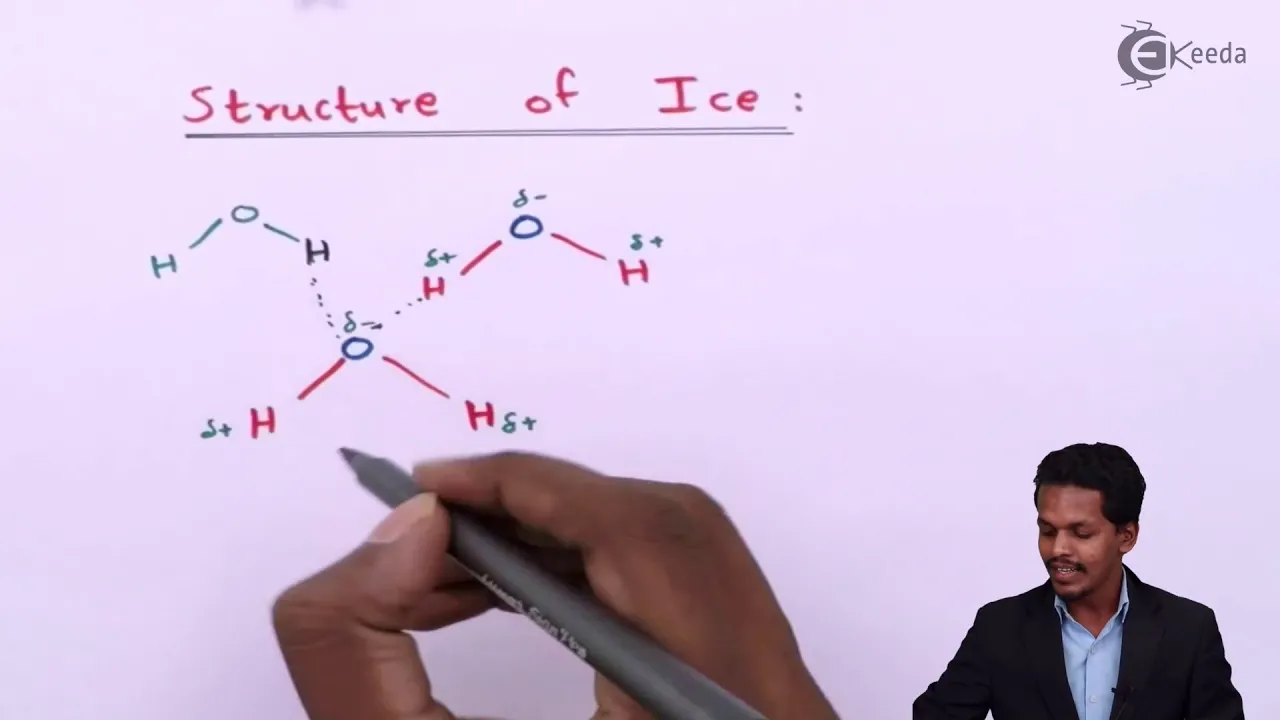
Structure of Ice - Hydrogen - Chemistry Class 11
Ekeeda
50K views•2019-05-06
45:56
Chemistry
2019 O Levels revision - O Levels Combined Chemistry 2018 revision
acescorers3110
646 views•2019-10-29
6:56
Chemistry
Study Organic Chemistry with Lluís: Total Synthesis of Vilmoraconitine
NROChemistry
2K views•2025-01-09
1:08
Chemistry
How to Write the Formula for Tin (II) sulfate
wbreslyn
11K views•2019-02-26
18:46
Chemistry
Why “Chemical-Free” is a Lie | Exposing Chemophobia
PaleBlueThoughts
978 views•2023-10-13

1:55
Chemistry
OCl2 Lewis Structure (Dichloride monoxide)
geometryofmolecules6271
5K views•2022-03-28

3:31
Chemistry
Lets Talk About Peacock Ore! Are Those Colors Natural?!
YeOldeRockShop-com
14K views•2021-03-09
2:42
Chemistry
Use of strontium in daily life
Viveksirmotivation
599 views•2022-01-18
Trending

13:25
Business
Playstation NO DISC/NO BUY Fight Is Over...
DavidJaffeGames
4K views•2026-07-23

22:40
Business
Steam and Xbox Just Dropped The Hammer On PlayStation
OhNoItsAlexx
9K views•2026-07-23

16:52
Anthropology
Americans Confused in Australia for 17 Minutes Straight
IWrocker
17K views•2026-07-23

1:19:25
Biology
LIVE NOW! Cellular Structure and Functions | Complete Cell Biology Lecture | Anatomy & Physiology
MukhtarAliyu-t7m
387 views•2026-07-23