This video brilliantly reframes our earliest memory loss as the necessary price for a high-speed cognitive upgrade. It turns a biological void into a testament to the brain's ruthless efficiency in prioritizing learning over storage.
Install our extension to search inside any video instantly.
Why Can't You Remember Being a Baby?
Added:Somewhere there is a photo of you as a baby. Someone is holding you. They are laughing and you remember absolutely none of it. Think about that for a second. You spent years as a child. You learned to walk, to talk, to love the people around you. You had birthdays and tantrums and entire afternoons that felt enormous. And almost all of it is gone.
Not blurry, not faded, just gone as if it happened to someone else. You probably assume the answer is simple. A baby's brain is too undeveloped to record anything. So there was never a memory to lose. But the real answer is far stranger. Your infant brain was not a blank tape. It was recording constantly in vivid detail, forming powerful memories every single day. The memories were real. Something erased them. And scientists are only now beginning to understand what. Let's start with what actually happens. For most people, the earliest memory you can reach lands somewhere around age three or four. Before that line, there is a wall. Psychologists have a name for that wall. They call it infantile amnesia, and it means the near total loss of memories from the first years of life.
Sigman Freud coined the term over a century ago, and he assumed those memories were buried by shame or repression. He was wrong about the cause, but he was right that something deliberate seemed to be happening. For a long time, the assumption stuck. Babies forget because babies can't really remember. It felt obvious. How much thinking can a creature that can't hold its own head up really be doing? The trouble is, when scientists finally tested it, that obvious answer fell apart completely. The person who broke it was a researcher named Carolyn Roie Collier. In the 1960s, she designed one of the most elegant experiments in the history of psychology, and she did it partly to soothe her own fussy newborn.
She tied a ribbon from a baby's ankle to a colorful mobile hanging above the crib. When the baby kicked, the mobile danced. Within minutes, infants as young as 2 months figured out the trick and started kicking like mad to make the world move. Here is the part that changed everything. Days later, she brought the same babies back and showed them the mobile without the ribbon, and they kicked. They remembered. A two-month-old, an age we assume is pure fog, had stored a specific memory of a specific object and held onto it for days, even weeks. So, the old story was simply false. Infants form longlasting, detailed memories all the time. Which leaves us with a much harder question.
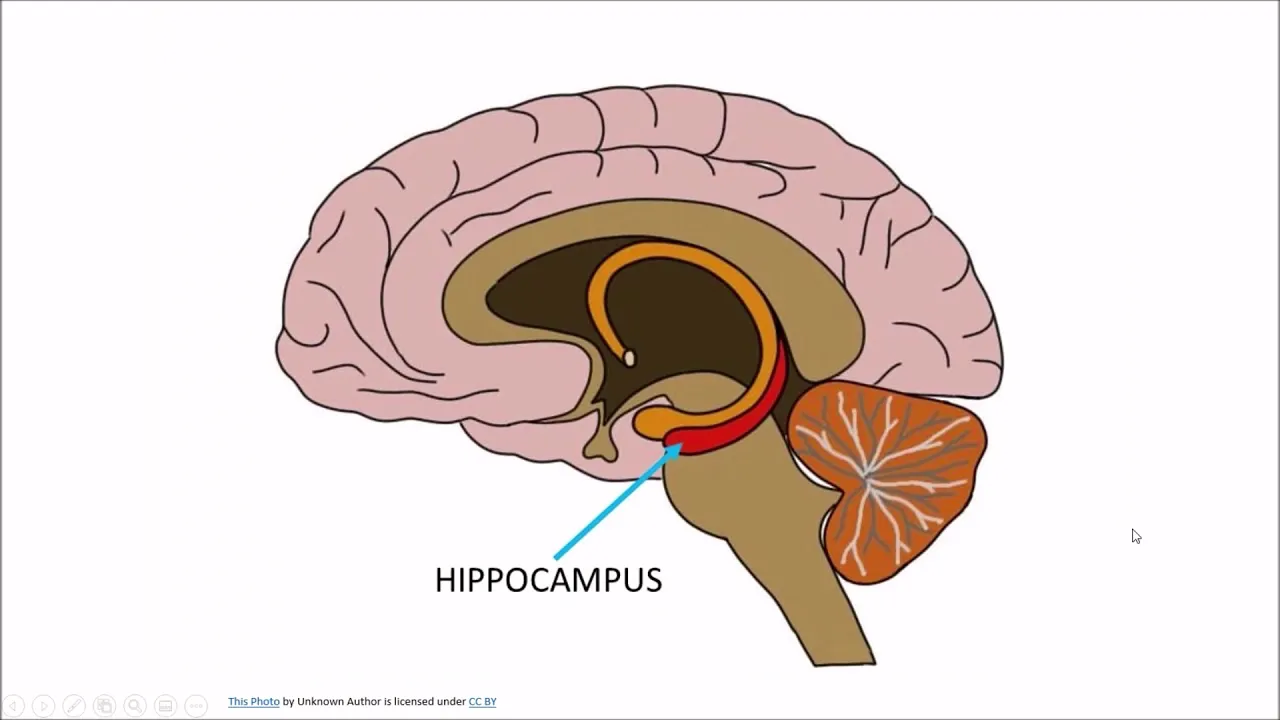
If the memories are really there, why can't you find a single one? This is where it gets unsettling. The memories don't fade gently with time the way you might forget a phone number. Something more active is going on. To see it, you have to look inside a tiny region buried deep in your brain, curled like a seahorse on each side. It's called the hippocampus, and it is the part of your brain that stitches raw experience into a lasting, retrievable memory. Without it, moments happen and then vanish. The hippocampus is the scribe that writes your life down. And in a baby, that scribe is working in the middle of a construction site. A neuroscientist named Patricia Bower spent decades chasing this. She did something painstaking. She recorded young children describing recent events, a trip to the zoo, a birthday, and then she followed those same children for years to watch exactly when the memories disappeared.
What she found is haunting in its precision. Young children genuinely remember their early experiences. They can tell you about them clearly. But somewhere around age seven, those early memories start dropping away in large numbers. Like a building quietly demolishing its own lower floors. The forgetting isn't slow decay. It arrives on a schedule. Why would a brain be built to destroy its own past? For that answer, we have to go to the mice. Two scientists, Paul Franklin and Sheena Joselyn, suspected the culprit was something that sounds like it should help you, not hurt you. New brain cells.
In a baby, the hippocampus is exploding with growth, manufacturing fresh neurons at a furious pace. This process even has a name, neurogenesis, which simply means the birth of new neurons. We tend to think more brain cells must mean a better brain. But Franklin and Joselyn wondered if all that frantic new construction was the very thing wiping the memories out. Picture the hippocampus as a city of wiring where each memory is a specific path through the streets. Now imagine bulldozers rolling in every day to build new roads, ripping up old intersections to lay fresh ones. The new wiring is wonderful for learning, but every old path it cuts through is a memory losing its route.
The connection is still buried somewhere in the rubble. You just can't get to it anymore. To test this, they did something clever. In infant mice, whose brains are flooded with new neurons, they slowed the neuron growth down. And the mice held onto their memories far longer than they should have. Then they did the reverse. In adult mice, whose memories are normally stable, they cranked the neuron growth back up to baby levels. And those stable adult memories started crumbling. As Joselyn put it, they could make a memory last much longer in infant mice simply by dialing the new neuron growth back down.
Sit with what that means. The reason you can't remember being a baby may be the exact same reason you were such a fast learner as a baby. The flood of new brain cells that let you absorb a language, a face, a whole world in months was also quietly paving over each memory as you made it. Your forgetting wasn't a flaw in the machine. It was the price of the machine working so well.
But the brain is only half the story.
Because the wall of forgetting doesn't fall in the same place for everyone. And that fact points to something the bulldozers alone can't explain. A psychologist named Chiang noticed a strange pattern. She asked adults from different cultures to dig up their earliest memory, and the answers split along a line. People raised in the United States tended to reach back to around age 3 and a half. People raised in China on average couldn't get back nearly as far, their first memories landing months later. Same human brain, same neurogenesis, different walls. So, what moved the wall? The answer seems to be language and specifically the way the adults around you talked about the past.
American parents, Wang found, tend to reminisce in an elaborate story-shaped way. What did you see? How did it feel?
What did you think? They build the child into the hero of a little narrative. In other families, the past is discussed more briefly and more practically, less as your personal story and more as shared routine. And the children steeped in those rich youentered stories ended up with earlier, more detailed first memories. Why would talking matter so much? Because a memory you never put into words is far harder to keep.
Language is what lets you file an experience as a story with a U at the center of it. A story you can pull off the shelf and replay later. Before you had words, every event was just sensation, vivid but unfilable. This is part of why the wall sits where it does.
Your earliest years happened before you had the language to turn moments into stories your future self could find. The bulldozers were tearing up the roads, yes, but you also hadn't yet learned how to draw the map. So put the whole picture together. You were never an empty vessel. As an infant, you saw, learned, and remembered with astonishing power. But your hippocampus was a city under relentless construction. New neurons paving over old paths as fast as you laid them. And you didn't yet have the language to save the most precious experiences as stories. Between the bulldozers and the missing words, your first years were written in a code your adult self can no longer read. Here is the strangest part of all. Those vanished years were not wasted. They were the most important years you will ever live. In that lost window, you learned to trust or to fear. You absorbed the rhythm of your mother tongue. You built the deepest, most unshakable patterns of who you would become. You remember none of it, and yet you are made almost entirely of it.
Think about that the next time someone you love does something that comforts you or unsettles you for reasons you can't quite name. That feeling is older than your oldest memory. It's a message from the version of you that lived through everything and saved none of it.
A self you can never meet but can never escape. So no, you can't remember being a baby. But somewhere there is a photo of you, someone holding you laughing.
You don't remember the moment. And yet that moment is still in you. In every reflex and every fear and every quiet sense of being loved or alone, the memory is gone. The person it built is reading these words right
Related Videos
8:08
Neuroscience
What is neurodegeneration?
TheSheekeyScienceShow
3K views•2019-08-19
57:35
Neuroscience
IPL - Ruth Empson "Mind the Gap"
otagouniversity
251 views•2019-07-08
14:01
Neuroscience
How our body shapes our mind | Pancho Tolchinsky | TEDxNapoli
TEDx
2K views•2019-12-05
1:00:02
Neuroscience
Impact of Early Life Deprivation Danielle Stolzenberg Marcus Pembrey Bruce McEwen
uctv
4K views•2019-12-01
10:32
Neuroscience
β-Caryophyllene for Parkinson’s: Protecting Dopamine & Easing Symptoms
parkinsonsdiseaseeducation
6K views•2025-08-09

20:44
Neuroscience
New Insights from Inside the Brain with Rodrigo Braga, PhD
NUFeinbergMed
421 views•2025-04-14
9:57
Neuroscience
Highlights for dystonia • 2025 MDS Congress
movedisorder
145 views•2025-10-27
58:17
Neuroscience
Animal Welfare Synergy Series: Dr Tom Smulders on hippocampal neurogenesis
costactionlift
135 views•2025-07-14
Trending

13:38
Law
WOW! Judge TURNS THE TABLES on Trump in His OWN $10B LAWSUIT!!!
MeidasTouch
197K views•2026-07-23

13:25
Business
Playstation NO DISC/NO BUY Fight Is Over...
DavidJaffeGames
4K views•2026-07-23

22:40
Business
Steam and Xbox Just Dropped The Hammer On PlayStation
OhNoItsAlexx
9K views•2026-07-23

16:52
Anthropology
Americans Confused in Australia for 17 Minutes Straight
IWrocker
17K views•2026-07-23