Brown’s results demonstrate that ecological restoration is not a luxury, but a highly efficient business model that outperforms industrial chemical dependency. He successfully transforms soil health from a scientific abstraction into a practical blueprint for agricultural resilience.
Install our extension to search inside any video instantly.
LUNATIC FARMER SPEAKS:Added:
Oh yeah.
Little better.
It's all it all.
Lord, Heat. Heat.
Turn.
Heat. Heat.
Data.
Heat.
Hallelujah.
God.
Mother.
D.
Oh.
Yeah, la.
Mercy.
>> Good evening, sir.
>> Hello.
>> Welcome, boys and girls.
>> I saw the thing come up, so I said I'm going to join him.
>> Um, I just watched this video that's coming up here, boys and girls, from the from Joel Saladan. Do you know Joel Saladin?
>> That's probably a name that I've heard on here before.
>> He's a farmer.
>> 75% of America's Okay.
>> He's a farmer.
>> Yeah, he's a farmer. You know anything about farming?
>> Some basics, but I've never farmed before myself. No.
Well, sir, there's money in it.
And uh most people believe that farming is there's a big old wall around it and you can never get into it. Right.
>> Okay.
>> But um there's not a big wallet. You just have to change the way you think about farming. You see, there's a bunch of farmers across the country that just farm on one acre.
>> Ah, >> one acre.
One acre. And they they generate $100,000 a year in vegetables.
>> Wow.
>> But I don't have an acre.
All right. will knock on your neighbor's door and say, "Oh, I see you got a backyard. Do you mind if I farm it?" And you can have all the vegetables you want even before I harvest.
And then he's got a quarter acre. So then you knock on the next neighbor's door. He's got a quarter acre, the next neighbor's door, and you can get an acre.
It's everywhere, dude.
Land is everywhere. You just have to know what to do with it. So, if you want to learn how these farmers turn one acre and $100,000 a year, I'll give you a Jiffy Jiffy course right now.
And I'll tell you the story of Singing Frogs Farm.
They have eight acres and they were >> Do I get any peanut butter with that jiffy?
They were doing regular farming just like you know the old-timers and they had eight acres and the best they could do in a good year was $35,000 per acre.
So they weren't making very much money.
Well, one day on the singing frogs farm their tractor broke and they didn't have any money to fix it.
So out of desperation they did a little research and discovered something called no till farming.
You know what tillage is?
>> It has to do with uh when you have that tool and you dig on the ground a little bit kind of >> rough it up a little bit, >> right? You turn the soil, right?
So because their tractor broke, they had to think in a new kind of way. do some homework and out of desperation they discovered there's a whole bunch of people out there doing no till farming and and typically speaking these no-ill farmers will do $100,000 in a year on an acre.
Now what's the difference between tractor farming which is tillillage and what these guys are doing in their big backyard?
Well, let me put my screen up so you can see my hand movements. When you have a a farm, a tractor, you make a row that's this big and you plant on the row. You've seen rows of crops, right?
>> Yeah.
>> And you've got a space between the rows that's this big. You're wasting space.
The no till farmer makes a bed that's this big. It's 36, maybe even 40 inches long wide.
They get more in the ground than a rowcropper. They're planting in beds.
Get it?
Already you're increasing your possibilities here.
And with a tractor farmer, they typic the the tractor itself doing tillage ruins the soil.
So you you you can only get one crop in a growing season because you've you hacked away at the soil because when you do tillillage, you are disturbing the life of the soil. You've got worms in there and microbes and nematodes and and all kinds of critters in the soil and when you plow it up you're disturbing their home and their apartment building and their connectivity and whatever. So you you wreck them.
But when you do no till farming, you encourage them to grow and multiply. And the more lovely biology you have in the soil, the bigger your plants grow.
And then with the no tail guys doing this no till business, they their soil is fertile enough that they will sometimes get three crops out of one season.
three times the productivity from the as opposed to the the tractor guy. Plus, you got wide beds, so you're you're you're making more use of space. So, maybe that's three times more on that.
So, you're doing six times more productivity.
Anyway, these these guys over at Singing Frogs Farm and you can go over to their channel and you can go over to their website and they're really helpful. They they put a lot of effort into educating people as well.
They went from 35,000 a year per acre to about a 100,000 per year per acre by doing no till and um so land is everywhere. It's easily accessible. It just takes a little gumption to get out there and do it together. So I'll tell you another big secret about these small farmers.
They have learned that the most important thing to grow is not carrots, tomatoes, beans, pumpkins. No, the most important thing to grow is your customer list.
You grow your customer list and your customers will love you and take care of you because you're in touch with them.
You're communicating with them on a regular basis.
And let's say you make the foolish decision to grow tomatoes and you reach out to all of your customers on your customer list that you grew. One time I had this farmer call me for marketing advice, you know, and he he was just barely making it and he had all these problems and I had to preach this very same gospel to him, you know, and he would go to the farmers market and I I told him, you don't go to the farmers market to sell vegetables. You go there to collect names and addresses so you can contact people because not everybody is going to buy from you on that day at the farmers market, but they just might buy from you on Wednesday.
Will you deliver? Do they know that? Can they come by to your your farm on Wednesday? But you got to you got to get their name and address. They are your business, not tomatoes. So, you decide to grow tomatoes and then you send out a an email or regular letter to your customer list and say, "Hey, I'm thinking of growing tomatoes." And they say, "I don't want to. I want I want butternut squash." So, now you know what to grow.
Your customer list is your livelihood.
Get me?
>> Oh, yeah.
>> So, the most important thing to grow is your customer list. Anyway, so a lot of these guys are doing $100,000 a year. There's one guy I know of named Connor Creekmore.
Yeah, Connor Creekmore. He's in upstate New York. He does $300,000 per year per acre.
And he doesn't screw around just by growing any old thing. He only grows the things that are easy, the easiest to pick and harvest and that he knows will sell.
and he's strictly in it for the cash flow, not for the beauty or for the exercise or for the the challenge. He doesn't want any challenge. He just wants the cash flow. And on an acre, he he is producing over $300,000 per year, growing vegetables, harvesting them, the easy kind like tomatoes. He runs them up a pole in a certain kind of way so that they're easy to pick. And then he takes them into New York City and sells them to his customers.
Anyway, oh yeah, so uh you uh I had a talk with David before, boys and girls, and uh he needs some cash. go ahead and put your email or your contact information in the in the chat so they can uh figure out how to deal with >> I may have to log back in depending on how this works on my phone, but I I'll go I'll go grab that link real quick.
>> Okay. So, uh, do you want me to wait to play Joel Saladin because you need to hear this, Bucky?
And he can't answer.
Rachel, Poopy Pants, love always.
And Whitney, good old Whitney.
Anyway, so uh we're gonna listen to >> Can you hear me? Can you hear me? Okay.
Yeah. So, I'm back now. So, let me um let me get the um >> All right. We're going to start this video.
>> Okay.
>> And you can listen, right? Because this video is for you.
>> Oh, boy. That's awesome. Uh where do I do I put it in the comment area? Is that where I need to put it?
>> Either the private comment or and I'll put it over in the public comment and >> Okay.
>> So, that will help you.
>> There we go.
>> Here we go. Here we go, boys and girls.
This is Joel Saladin. He has 400 or 500 acres in Virginia and he is um he is a great spokesman for thinking in new ways about farming and farm productivity.
And uh and when most farmers across the country with big farms who use tractors and combines and all that heavy equipment, they might make $300 per year per acre, but it works for them because they have a thousand acres, right?
But they do. And the reason they only make $300 per year per acre is because they're selling into the commodity market, which means technically they're kind of selling their crops to Walmart and Costco, right?
But Joel has 400 acres and he doesn't sell to Walmart and Costco. He sells to his own customer list. His customers come to him. Sometimes he works out a deal to deliver stuff to them if they buy enough product like $3,000 worth of drop off material so that it's a you know he's worked out systems for himself but he instead of making $300 per year on a,000 acres he only has four or 500 acres but he still does but $4,000 per acre per year anyway. So he's a good egg and and he's helped a lot of people understand the dynamics of farming and you know anyway so this is an interview with him and Glenn Beck and I got to keep an eye on the uh thing because Glenn Beck might be real pnicity. I might get a copyright warning.
So >> before you press play, uh since you uh gave me the grace to uh share that link, let me just let people know what it it's involved with. I'm just I'm in between two apartments. Uh I draw uh disability and I get government help with uh with my rent and uh I'm going into an apartment that's not fully government and so I have to come up with the deposit. the government will be helping me with my rent, but I I'm just having to come up with the deposit to get in there, plus the moving expenses to make sure that everything gets moved in there since everything is currently in storage. So, uh so so that's what that's what that's about. It's a and so so that way everybody knows.
>> All right. Now, this video is for you.
Listen up, David. Are you ready?
>> I'm here, buddy.
>> On your mark, get set, go. 75% of America's food is convenience food. We we we watch cooking shows, but we don't cook. You know, never has a culture been so technosophisticated, gadgetized in our culinary kitchens, but not used it.
And so, so 75% of our and this is this has literally been an epiphany for me in in literally in the last 12 months. I have preached all my life to I do a lot of urban stuff, you know, um urban foodie, you know, presentations and and stuff. And what can I do? I always say, "Get in your kitchen. The best thing you can do is get in your kitchen, get real food, you know, get get a butternut squash, peel it, and fix it, cook it, you know." Um, and and I've realized I've become a don that that horse left the stable. Americans are I hope we will eventually, but right now the answer is not get in your kitchen because we are so far removed from our kitchens now that that when I say get in your kitchen, it's um it's offensive to the average person.
They don't know how to boil an egg.
>> I know.
>> And and >> Okay. And now, boys and girls, again, this is Joel Saladin.
Do a search after the show later on, tomorrow, next day, do a search for Joel Saladin and watch anything and everything you can by him and you'll be blessed.
>> And so, um, so instead of being offensive, what we need to do is say, "Okay, you're getting convenience food.
We need you to be able to get good convenience food. A chicken pot pie does not have to have MSG and glycerin in it or red dye 29 or whatever it is they put in. Okay. A good chicken pot pie can be made in your kitchen with nothing like that and frozen and it's wonderful. And I love chicken pot pies or a kiche or shephardd's pie or any of these convenience type foods can be made like this. I speak Glenn I speak at to thousands maybe hundreds of thousands because there are a lot of homestead festivals around the country and these are big you know four five six 7 thousand people >> and these are small holders you know they might have 5 10 15 20 acres >> they would love to make a living on their farm >> okay so right now our farm supplies a local restaurant with chicken that they make a chicken pot pie it's on the menu polyface pastured chicken pot pie it's their signature dish comes in a wonderful little cast iron skillet you know oh it's just fabulous They take a $20 chicken and turn into $45.
>> Okay. Now, if we take off 205 of that because it's a restaurant and say I could do that and make because I'm not I don't have a waitress. I don't have, you know, all the overheads. So, I I can make $200 worth of pot pies out of that.
>> That's a tfold $20 chicken $200. Okay.
So, we cover an acre with 600. We move them every day. Chickens across the pasture. They're they're in little, you know, floorless shelters to protect them from predators. Move them across the pasture every day. And in 600 birds cover one acre, you know, in the course of several weeks that they're out there.
These are meat chickens, not bird, not lang chickens. And and so if you had two acres and you could raise 1,200 of these, and you could sell chicken pot pie to your neighbors as a convenience food, you could take those 1,200 chickens times 200 is $240,000. You can make a living on two acres selling a convenience food straight out of your home kitchen >> and a really good living >> a good living if we had a food a food emancipation proclamation.
The problem is farmers, entrepreneurial farmers who are ready to value add. You know, these are not these are not commodity farmers. The these are are are people I mean some big farmers, little farmers, all in between that view themselves as entrepreneurs as opposed to just, you know, raising corn for the man. All right. Um, I run in there are thousands and thousands and thousands of them around this country that are ready to access their neighborhoods with well-made unadulterated convenience food, but it's but it's illegal.
>> Here's the here's the push back on that.
The reason why they'll say, "Well, no, >> because you got you got to check for safety. You got to make sure those kitchens are clean. You got to make sure XYZ." And to some degree, that's true.
You don't I mean, there are going to be people that are doing really nasty stuff. They're always So, how do you solve it?
>> So, you solve it. You solve it by limiting it to direct sale. In other words, I can't sell this to Walmart. I can't sell it to a third party. You and I have to as two consenting adults exercising freedom of choice for our microbiome. We should be able to engage in a food transaction of providence without asking the government's permission.
>> Yeah, that's absolutely right. there. I mean, we what good is it to be able to assemble, pray, preach, um if if we if we can't choose our body's fuel to give us the energy to go pray, preach, and assemble. I mean, it's such a fundamental human right. I mean, we talk about human agency. My ultimate agency is is I mean, it's more it's more intimate than the act of marriage. Okay?
And so, being able to choose that, >> what what gets in so safety, here's the thing. All the other thing, all the other parts of our of our culture uh where there's hazardous material, you know, like drugs, prescription drugs, whatever.
>> The prohibitions are are across the board. You can't use it. You can't give it. You can't uh give it away. You can't take it. You can't sell it. It you can't buy it. You can't sell it. You can't give it away. You can't All right.
Except in food. In food, I can give you a pot pie. You can feed it to your friends all day. Perfectly safe.
What is it about exchanging money that suddenly turns it from a a benevolent thing to a hazardous substance? I can give you a glass of milk. In fact, you can get you can I can give you can feed it to your children.
In fact, you can buy it. I just can't sell it. Nobody ever gets taken to court for buying illegal food. Who gets taken to court is the farmer or the the value adder who who who produced it, who created it.
So, so the the ultimate hypocrisy of this is that all other hazardous substances that can go between our lips, the prohibition >> is everything >> is everything but food it's only on the seller. And so it's not about safety. I mean they will say it's about safety. I mean go >> but but but but ultimately if you start drilling down it's actually about controlling market access. And so what we have right now is we have a real problem in American agriculture in our aging farmer. Our farmers are now 60 years old. In the next 15 years, that's one five 15 years. Half of all America's agriculture equity will change hands.
That's never happened in any civilization in peace. It's only happened in conquest. You know, the Huns come in and take over Rome. The Polynesians. Okay.
>> But I can make the case that is happening. that it is the industrial farmer that has made conditions so bad that the young farmers, the ones who are watching their mom and dad, >> they work this hard, barely make it every year. Yeah.
>> I don't want to work like that.
>> Yeah. Well, the pro the problem is that when when old people can't get out or when young people can't get in, old people can't get out.
>> Yes.
>> And so these farmer >> Okay. Uh let me interrupt him. Um now I'm pretty familiar with Joel Saladin.
I've read several of his books and so and listened to many of his lectures.
So, uh, since there are old people getting out of the farms, they can't farm anymore. They're too old. They're 60, 70, 80 years old and they've got adult children who are already established as lawyers and accountants and uh, executives and they don't want to go back to the farm. But if you had the vision and knew what to do, if you were trained by Joel or any of the other uh far farmers in this farming movement, you could approach a farmer with a large spread, couple hundred acres or more, and say, "Listen, I know your kids don't want you to don't want to um they don't want to come back here and farm. They just soon sell uh sell the farm and turn it into condos, right?"
and that would break the farmer's heart because he's put so much of his life into this farm. There are people who work out a deal with the farmer and they set it up and basically turn it over to this young fellow who wants to farm it. So, it is within the realm of possibility. You don't need a bazillion dollars to buy a farm. You can lease it.
You can uh take it over with his permission, work out a contract. uh you can put it in a land trust and you know I mean there's lots of different ways to approach the situation and you don't need a bazillion dollars to do it.
Just need a little bit of vision and guts to get out there and try it. That is for large farms. As I said before, there's land everywhere and you all you need is an acre to do the no till style farming and a good customer list and you can do up to $100,000 a year in vegetables, but he can't say everything in this 12inut interview. Get it? Continue to age. Um and >> you're right. Um the ultimate we we hear the word, you know, regenerative farming now over and over and over again. Well, you know, when somebody asks me about regenerative farming, you know, they're thinking soil and earthworms and all that stuff. My first reaction is, is it attractive to young people?
>> Does your third generation farmer?
>> I'm I'm Well, I'm second generation. Our son now is third generation. He operates it. But it doesn't have to be family.
>> I mean, we have I mean, we run a very formal um stewardship and apprentichip program uh on our farm. And uh we just had we just had 135 applicants for 11 spots. And these and these are Americans. They're not I mean I don't want to get down that rabbit trail, but but the these are many times college educated, articulate, sharp, well spoken.
>> And a lot of these young people, they they get five, six years into their Dilbert cubicle career >> and suddenly they're sitting there, you know, at their screen and they're looking and said, "Man, I really would rather be out running that zeroturn mower with the landscape crew at the corporate headquarters." and they start yearning for something that's that's visceral that they can touch. We had a had the most amazing we had a guy come from from Chase Manhattan Bank. He worked in the belly of the beast in New York. He came as an apprentice >> and he came in one day for supper and he was almost in tears. He was visibly you know moved. I said what you know what's the deal? He said well he said he said my career has been working you know at this uh cubicle with you know three team members. One's in Tokyo, one's in Shanghai, one's in London and me and we build these, you know, we build these electronic uh, you know, whatever skeleton, you know, financial skeletons in cyerspace, push a button at the end of the day, it goes who knows where. And we do the same thing tomorrow, tomorrow.
And he said, "Today, you know, with the team, we built a Millennium Feather."
Um, that's what we call our portable laying laying structure, Millennium Feather, named after the Millennium Falcon in Star War. And I knew you'd like that. And, uh, the Millennium Feather. And uh he said he said we we worked on it all day and we pounded nails, we cut boards, we you know we put the screws in and he said and he just got all tear he said and tomorrow he said and my team we we talked we joke I could see them we could we could touch we we held things for each other and tomorrow morning I'm going to wake up and go out there and it's still going to be there. Mhm.
>> And he was just, you know, and and and this tactile tactile visceral encounter with life.
>> Nothing nothing has meaning anymore or substance. And it's that is only going to get worse. Nothing.
>> That's right.
>> And I I know I I bought my ranch when I was in New York City and I just wanted to get out of the city. And what I didn't realize the first day we were there, we started a campfire, sat around the campfire and there's no light pollution there. And uh the campfire started to die down. And we all sat there as a family. We looked up at the sky and we did what I had done in years.
Wow, we are small, are we? When you're living in the cities, you don't see the moon. All you see are things that man has created, especially New York City.
And you don't have those. And then >> I didn't have to talk to my kids about, you know, how the birds and the bees were. They saw the cattle, okay? They saw the animals. They know exactly, right? They know exactly what is happening. Um, you know, it's just that that experience.
Yeah. My, >> you know, my son who really does not like to work hard, works hard on the ranch and every time he says, "I feel so good."
>> Of course you do.
>> That's right.
>> Because you're working. You're creating something with your own hands and it's real and you're worn out at the end of the day.
>> I like that. It goes it definitely goes a lot along the lines of the various things that I have been either reading, viewing or studying or being a part of over the last couple of decades now, ever since I really started getting serious with my health. and and so um so I like hearing that there are people that are they're they're wanting to go out and farm and you got these farmers that are looking for people to take over the farms and that's that that's that that's really nice. That that that that definitely sounds like uh you know it could be uh quite a profitable exchange for both of them. That that's definite.
>> Yeah. Uh, love always says his dad sold off some uh apartment buildings and moved to Minnesota and bought a farm and lost everything.
There's a lot to learn and and I don't know when he did this, but uh I if you spend plenty of time online on YouTube, you don't have to get out of your living room yet.
You can learn all kinds of no till farming techniques for smaller properties like 1acre. And you can even watch uh the bigger farmers like Gabe Brown and uh Greg Judy and Will Harris and Joel Saladan who have larger acres, 500 to a,000 acres and they also do no till, but they don't do it with a shovel. They turn their cattle into the grass management thing. Instead of a lawnmower, they use the cattle as a grass management thing and they sell beef. And they get much more money for grass-fed beef than than the guy who's doing regular commodity cowboy stuff by holding them all in a fence so they're they're kneede in their own poop. You know what I mean?
>> So, love always. Um yeah there's a lot of mistakes to be made but there is a lot of education that is happening now regarding proper farming methods proper management methods and um husbandry and so forth.
So just because far I mean farmers are all always losing their but uh people eat three times a day. Somebody's got to feed them and we can't leave it up to Bill Gates to make lab grown meat.
>> I'd be I'd be I'd be very uh wondering how long he had been in the apartment industry before he decided to do that.
Uh because that reminds me of uh Kiasaki's story about his own dad who had been a teacher for a long time and had been in government employee for a long time and then when he got out of it, he tried to do a a small business and and and just fell flat on his face over and over again and and and went broke because of it. uh because he did not have the experience with it. So it makes me wonder if maybe that dad had been in the apartment business for a long time and because he did not have any experience as a farmer, he just went and sold all his apartment stuff instead of continuing to get the uh uh uh passive income from it and uh and fell flat on his face while he was trying to learn how to farm.
Mhm.
>> Now, uh now, uh uh I don't know if that's exactly the case, and there there there may be, you know, differences and everything, but that just it just strikes me as very similar to what happened with Kiasaki's dad. Um I'm sure there's more much more to the story than what he said. So, so here is Gabe Brown.
Let me uh rearrange the screen.
Gabe Brown and talk to you about my five key points of building a healthy soil. The first is the least amount of mechanical disturbance possible. And I'm doing that in a no till situation. I realize organic producers are going to till some. Just make your tillage minimal.
This slide was put together and it really illustrates the destruction of tillage.
This this farmer had a forested area and he cleared part of that area, farmed it intensive tillillage, monoculture soybeans for 17 years. And look what happened. That that's a direct a picture of the forested area soils and then the field that he cleared. What you see is a decrease in organic matter from 4.3 down to 1.6% with 17 years of tillage.
I wish I would have had the foresight back in 1991 when I bought that place to archive some of the soils because I'll guarantee you they look like the soils on your right there. They were compacted. There was no life in them. As I said, we were down to less than 2% organic matter. We had taken the life out of those soils.
No till is a big part of that. And uh no till will work anywhere in the world there's production agriculture. I've seen it. it works and it's key to building healthy soils.
The other thing that's key is to take advantage of the natural things that occur in healthy soils until soils and one of those is microisal fungi and I'm not a scientist so I'm not going to get real in depth with that but we don't take advantage of the natural processes that occur in our soil. Microisal fungi will form a symbiotic relationship with the roots and what it more or less is doing is it's extending the system the the root network of that plant. So that's plant is able to gather and store nutrients and water from a much bigger area. Well, when we till we destroy this. If we have untilled soils and promote healthy soils, we're going to get more microisal fungi and we're going to be t able to take advantage of that.
And I'll show you some pictures coming up of just how important that is. The other thing microisal fungi can do when it when it gets into that host plant's roots, it'll prevent pathogens and nematodes from entering that root cell wall. So we can actually decrease the amount of fungicides etc that we have to put on our crops because we're taking advantage of this natural ecosystem process.
The other thing microisal fungi does is it starts soil formation. Think back to that picture I showed there with the 17 years of tillage in soybeans. There's no soil aggregates in that picture. The soil aggregates are being destroyed.
microisal fungi secretes a glue called glomealin and that glomelen then is the sticky substance that starts soil formation. So the picture on the left there that's soil particles being formed due to the glomealin secreted by microisal fungi.
Here's what our some of our soils look like today after 21 years of no till and everything else I'm going to talk to you about today. But notice that soil aggregation.
That's what we want soils to look like.
Soils should look like black cottage cheese, full of carbon, full of pore spaces and that aggregation.
Microisal fungi do a lot of things. They improve aggregate stability. They build so soil carbon. They improve the water use efficiency. And they increase the efficiency of nitrogen, phosphorus, and sulfur. And if we're adding especially phosphorus to our farming practices, that's actually detrimental to microisal fungi.
Ways to increase it, reduce or eliminate chemical use, reduce or eliminate tillage, reduce or eliminate synthetic fertilizers, and have a living plant root in the ground as long as possible.
These are things we can accomplish both in our perennial systems and in our annual cropping systems. It can be done and I'm going to show you how we've done that. In 2003, I was fortunate Dr. Chris Nichols there. She did some of the original work in the on the when Glen was discovered by Dr. Sarah Wright. She was a grad student under Dr. Sarah Wright. Dr. Nichols came to the ARS lab in Mandan, North Dakota. 2003 she came out to my place, looked at what I was doing, and she said, "Gabe, you've come a long ways, but your soils will never be sustainable unless you remove your synthetic fertilizer inputs." And I thought, "Wow, how can I farm without synthetic fertilizer?" So for the next four years, we did split trials on our operation. We took fields and half the field would use synthetic fertilizer, the other half we would. All four years, the non-fertilized tracks were equal to or greater in yield than the fertilized tracks. So, we haven't used any synthetic fertilizers on our operations since 2008. How has that affected our yield? Our yields are over 25% higher than the county average. Am I the highest in the county? No. Am I the most profitable? Yes. Simple as that. But you have to get your soils healthy first.
And I'm I'm in no way standing here to tell you to immediately eliminate synthetic fertilizer. You're going to have a disaster if you do. You need to It's like a drug addict. You need to wean it off slowly. But once you build that that population of soil biology, build that healthy microisal fungi population, you will be able to drastically reduce your synthetic fertilizer inputs. Okay. The second principle of a healthy soil is armor on the soil surface. Look at perennial native range always cover.
>> Now, uh let me tell you something that you might not be aware of. If you have to buy synthetic fertilizer, that's an expense.
Get it?
As long as you're spending money, you're making less.
But if you don't have to buy synthetic fertilizer and you use a no till system on your farm, small farm or big farm, you don't have to have that expense going out of your pocketed all the time. Bare soil is a detriment to soil health. I think back to my father-in-law telling me, the more you work the soil, the better it is. That is not the way nature works. Where in nature do you find bare soil? only where there was a catastrophic event or where man imposed his will on it.
This is what happens when we till. This is eastern Colorado just this past January. You'd think it was back out of the 30s and out of the dust bowl. Not so. You would have thought we would have learned something in the past 80 plus years. Evidently, we haven't.
Last Father's Day, my son said, "Dad, for Father's Day, I'm going to take you.
They're having a soil health tour." This is what we took a picture of on that soil health tour. It was an operation with tillage. I don't see much soil health in that photo.
This is what it looks like on our operation. That's a seated field. We want armor on the soil surface. We want that soil covered at all times.
Here's a crop, a cover crop emerging through that armor on the surface. How are weeds going to germinate there? I'm able to save on herbicides because we have that armor. Weeds aren't going to germinate through that, but the crop does just fine. That residue also buffers our heat. Now, we can get hot.
Not as hot as you get here in southern Idaho, but we can get pretty hot in August. That heat is detrimental to soil life. Here, we had a we had a tour out on our place and we stuck this thermometer in uh on on your left.
That's where the cover crop is. It was almost 100° outside that day and that thermometer registered 87.6° on bare soil 107°.
That 20° temperature difference is huge.
What's the effect of temperature on soil life and on and on plant growth. At at 70° soil temp, 100% of the moisture is used for growth. Once we get to 100°, only 15% of that is used for plant growth. So go back to this photo. In other words, if I don't have armor on the soil surface, my plants aren't going to produce. They're not going to grow anymore. But where I have armor, I'm still getting growth out of my plants.
That equates to dollars in my pocket. If we get much hotter than that, we start affecting soil biology. And soil biology is the key driver for the nutrient cycle that's going to provide our plants the nutrients. We need to keep those soil temperatures down. The other thing is you have armor on the soil surface and you'll have this. You'll have a lot of biology. There's more microorganisms in a teaspoon full of healthy soil than there are people on this world. Think about that. Yet, how often as producers do we think about feeding that soil biology? How often do we think about protecting it, keeping armor on the soil surface? We need to do that. That's the residue brushed away in the cover crop.
I know it's hard to see here, but that's solid earthworm castings. When we bought that farm in 1991, I tell people I could never take a day off and go fishing because you wouldn't find an earthworm on the whole farm. Last spring, we did earthworm counts. 12 in, 12 in, 2 in deep. We were averaging over 60. That's a lot of earthworms. I never transplanted any. Didn't bring any in.
They came on their own. Build it and they will come. But you have to provide the home for them first.
Third principle of building a healthy soil is diversity. Look at true native rangeand. This photo here is so from one of our native rangeand pastures. And I I I tell people I bought that land number of years ago. I bought it for two reasons. Number one, because it was true, healthy native range that hadn't been disturbed. My son teaches range management at the local community college. He brought his class out to this particular paddock and in two hours they counted over 140 different species of grasses, forbes, and legumes. That's diversity. If we have that type of diversity in a healthy native range, why don't we have it on our crop land? The other reason I bought this pasture was simply because with that many rocks, I'd never be tempted to break it up.
In 2006, I had the opportunity to speak at a conference and this gentleman was there, Dr. Adam Caligari from Brazil.
Dr. Caligari is the world's foremost authority on cover crops. He works for the United Nations traveling all over the world. He's worked in 65 different countries. And he said two things to me at that conference that really stuck out. He said, "You give me 2 in of rainfall a year, 200 in or anywhere in between, and I can grow you a cover crop." Well, that told me I can do it in my drier environment. The other thing he said is that cover crops are meant to be seated in multiecies combinations. And I got thinking, duh, I've been using these two and three-way mixes. Dr. Caligari was talking about seven and eight and 10way mixes. Think back to those native perennial ecosystems. What do you find?
You have find tremendous diversity. I needed to get that into my crop land. So I was at that time I was on the local uh soil conservation district board and we had some plot land located only a mile south of my farm and we decided to test Dr. Calgari's wisdom there and we were going to take and seed monoculture cover crops strips of them and then at the end we'd mix all these species together and seed a diverse polyulture and see what happened. Now that winter was extremely dry in North Dakota. We didn't have a lot of snow. So we seated these these monocultures and this poly culture into very dry seedbed the middle of May.
These photos then here's the plot with the cover crop growing. These photos were taken July 31st. We had less than an inch of rain on these crops. You can see the monoculture of turnipss was dead. These were about approximately an acre plot each. Then you move over to the next acre and there was the radish that was dried up and dead. And you keep going down the line until you get to the diverse polyulture.
Same soils, same seeding date, everything was the same. Look at the difference.
Amazing. And that was about a 10 species mix. In other words, here they clipped it. We we over tripled dry matter forage production where we had the multiecies combination.
So what's happening? How can that be?
For all our lives, we've been told that you have to seed these monocultures, otherwise it's going to compete for moisture. That's not the way nature works. Dr. Nichols explained it best.
Not only do the fungi and she's talking about the microisal fungi provide for the needs of one plant but the fungal hy pipeline connect to multiple plants thus supplying the nutrition and moisture requirements of all the plants. So in other words if we would seed multiecies that microisal fungi is going to transfer nutrients and it's going to be a benefit to all the plants. Think of it this way. The rooting systems, the roots on different plants, they have different root types, different root depth.
>> All right. Did you hear that, boys and girls? If you mix a lot of plants together, you have to water less because they kind of work with each other.
And in my own small little backyard, I don't pull any weeds unless the weeds are stealing sunshine from my plants.
But everybody thinks that the weeds will steal water. No, they steal sunshine if they get too big. So, if they get too big, then I cut them back or pull them up and and drop them right where they are.
Chop and drop.
But uh you want to disturb the soil as little pos as possible. You want to have you never want to to have bare soil.
If you have bare soil, cover it over with what? A tarp, straw, leaves, cardboard. You don't want to have bare soil. And in his case, he he doesn't put cardboard all over his thousand acres.
He he sews another cover crop even before he harvests the crop he wants. So that you know this there's always something growing in on his property.
>> I like this >> bringing nutrients and moisture from different areas of the soil profile.
Spend a lot of my time talking in the Midwest and this is what I see in the Midwest. Monoculture of corn, monoculture of beans.
Remember this photo? What happens to soils under monocultures?
Monocultures are a detriment to soil health. There is no doubt about it. If they weren't, then why in nature don't we find monocultures?
So, this is what it's evolved to. And I'm jumping ahead that, you know, I didn't get to this point overnight. It took a lot of years of trial and error.
My son and I have a few sayings on our operation. One of them is that we want to fail every year.
Um, love always.
Uh, he says farms in the Midwest are supposedly having a 40% bankruptcy rates right now and fertilizer is very difficult to get right now. Yes, maybe those very same farmers should listen to Gabe Brown because Gabe doesn't buy fertilizer and he's not close to bankruptcy. He's doing all right.
>> I like the notion about how the worth earthworms just came on their own.
>> Uhhuh.
>> I like that.
>> If we don't fail at something, we're not trying enough new things. Fail every My son and I have a few sayings on our operation. One of them is that we want to fail every year. If we don't fail at something, we're not trying enough new things. So, I've tried a lot hundreds of different combinations over the years, but we've gotten to the point where we no longer seed monocultures. In the upper left there, that's oats with clover growing in it, cool season grass.
Upper right is a mix of cool season broad leaves, uh, sewn as a polyulture.
The lower left, that's corn with hairy veetch in it, warm season grass along with a cool season, uh, legume. And in the lower right, that's actually sunflowers, warm season broadleaf with over 20 species of cover crops growing with it. We're trying to mimic nature.
We don't do monocultures anymore on our operation. I mentioned we have 2,000 acres of crop land on our operation.
the all we try and get a cover crop on all 2,000 acres every year either before a cash crop, along with a cash crop like this case, or occasionally after the cash crop. But we want something growing at all time. Here's a close-up picture of that oats. We no longer use any synthetic fertilizers. As I mentioned, we haven't used pesticides or fungicides since before the turn of the century.
There's no need when you get a healthy soil. Nature will take care of those symptoms if you allow her to. Here's what it looks like close up. We seated three types of clover along with the oats. We can typically get our yields are of oats are in the 95 to 115 bushels without fertilizer. And when you're talking our land values, uh that's pretty profitable. We we can make significant profit at that. The beauty of it is we straight combine the oats off. We got that living cover. All those legumes just explode. Fixed nitrogen can provide grazing for our livestock if we so desire.
The fourth principle, living root in the ground as long as possible. That's where cover crops come in. And I think of cover crops as a diverse mix that enhances the life and the function of the soil because we're really feeding all that soil biology. We're promoting that microisal fungi.
You use cover crops to design them for what you don't have. You know, there's a big cover crop craze going on throughout the country. And I've seen a lot of disasters with cover crops because people don't plan properly. What are you trying to accomplish with that cover crop? Are you trying to increase organic matter? Are you trying to put uh armor on the soil surface? Are you trying to improve water infiltration? And the list goes on and on. But before you start planting cover crops, you have to decide and determine what's my resource concern. What is it I'm trying to do? We have 2,000 acres of crop land. I honestly don't know how many fields. I haven't added it up, but we designed cover crop mixes specifically for each field because the resource concern will usually vary from field to field. So for instance, if you have the resource concern of a compaction layer, then you're going to use cover crops such as this is a a daicon radish. And if you look down in that soil profile, there was a compaction layer down about 12 in.
Notice that radish. It tried growing down in the ground, hit that compaction layer, it comes back above ground till it gets enough energy to poke its way through.
Radishes are also a nitrogen storage tank. So, we use them in combination with legumes to sequester and store nitrogen for the next crop. Then, that's my fertilizer storage tank right there.
These radishes can get really large if you grow them, seed them a little later in the year. If you seed them in the spring, they're going to bolt and shoot a seed head and they won't produce that big tuber. But, they can get really big.
This system that I'm talking with you about today can take place anywhere in the country and it I've got producers all over the world that are using this model and Joel will talk about it later today too to produce a healthy ecosystem. This picture is of David Brandt, a friend of mine near Columbus, Ohio. David has been a no tiller since 72, cover crop since 78. 2011 here, 225 bushel corn, zero synthetic inputs, zero herbicides, zero pesticides, zero fungicides. That's profitable. David likes to brag about the big radishes he grows. Him and I always have a contest, so I brag about my turnups.
This is a partial list of the cover crops we grew on our ranch here this past year. Don't pay any attention to the species because that's going to that's going to vary from area to area, but pay attention to what I've got here.
I've got some species in all four crop types, warm and cool season, broad leaves and grasses. I'm using the cover crops to get diversity into my annual cropping system to build soil health.
And that's what it's about. We're trying to we're trying to address those resource concerns and build soil health.
So, I question the rationale of some things. My neighbor's not here today, so I can talk about him. Uh, I've been on that farm since 1983. His farm is directly across the road there from me.
Every fall, he goes out and digs this local spot. Has done it every fall for 31 years.
This is a photo taken June 15th of 2009.
I took it off the front deck of my house. The uh local weather service was forecasting a major rainfall event, which for us means anything over half an inch. But I took this photo. It started raining at 6:30 in the evening and by 12 midnight we had had 13.2 in.
This is a photo of the neighbors dug area 3 weeks later. Still had water sitting there. And this happens every year.
This photo here is my crop land directly across the road from his immediately following. We had 4/10 more inch of rain the next day. Immediately following that 13.6 in of rain. Do you see any erosion there? Now I've got a little bit of bare soil in the foreground here where we it did when you get that much rain, it's going to move a little of that residue away.
Jay Fear, our district conservationist, came out and took these photos and he says, "Here's a photo of the soil that day, the morning after 13.6 in." Jay makes the claim you could have drove a floater truck or any type of equipment off over that field that day without ruting it up. Look at the soil aggregation. If you have those water infiltration pores, you're going to take that water down. Then you're going to hold it in the soil profile for when you need it.
I mentioned when I started out in 1991, we could infiltrate a half of an inch per hour. 2011, the last time NRCS come out and tested my soils, we can infiltrate over 8 in an hour. Now, I've never seen it rain 8 in an hour. It's not how much moisture you get, it's how healthy are your soils. Can they infiltrate it and can they hold it and store it? That's what it's about.
The fifth thing, animal impact.
The the fifth principle of building a healthy soil. I own this newspaper, The Prairie Farmer from 1871, and it depicts the bison and the the wolves following the bison, keeping them moving. How were soils formed? Soils were formed in conjunction with herbivores.
Why don't we have that in agriculture today?
We had these large herds of bison etc. moving across the plains. And then we also had the local animals, the rabbits, grasshoppers, all these insects.
They were taking this forage, the biomass, and cycling it through.
Animals are an important part of a healthy ecosystem. Today, it's not uncommon to drive for thousands of miles and not even see a fence, let alone an animal.
Why have we removed them from the ecosystem and then we expect our soils to be healthy?
Not going to happen.
2007, I was speaking at a conference in Brandon, Manitoba, and I got done speaking and I had this guy in my face telling me that, "Boy, you see what I'm doing?" And that is Neil Dennis from up there in Canada. Neil's the mob grazer who who puts up to a million head of livestock on an acre. I thought I was high stock density running two to 300,000 pounds live weight per acre till I met Neil. Well, that next spring then I immediately I went up there and viewed his operation to see what he was doing.
And the thing that amazed me is when we dug down in his soils, he was building more top soil quicker than I was. And that bothers me because I don't like to be second fiddle, you know. But the important thing was that I could take a lesson from Neil and I knew immediately that Neil was doing this on perennial pastures and I understood that. But I needed to get more animal impact onto my crop land. That was the missing link in building soil health further on my crop land. So this is our ranch today. This isn't quite all of it, but the light blue areas are crop land.
The light green areas are tame grass pastures. In other words, it was tilled at one time and now is seated back to perennials. And then the yellow area is our perennial pastures. I mentioned we had three pastures starting out. We now have over a 100 permanent pastures, but an infinite number of smaller ones. When we took over that operation, we could run 65 cow calf pairs and about 35 yearlings. Today we're running uh 350 cow calf pairs, 4 to 800 yearling and grass finished cattle, plus some other livestock I'll talk to you about. But why I wanted to show you with this map is to show you that we're able to integrate all three of these, the perennial natives, the perennial uh tame grass pastures, and the crop land. We integrate them all and graze livestock on all of them. Now, one of the easiest ways to get started into grazing animals on crop land is with fall seated bianials. This photo was taken here in early October. We had we had just harvested a crop and then went in there and seated. In this case, it's a combination of winter trite, uh, a forage, winter wheat, Harry veg, sweet clover, and there's some radish in there. And it's just poking through the ground there in October, even though we froze many, many, many times before that. So what we'll do then we'll let that go and then the next spring we'll mob graze high stock densities on these highcarbon bianials and we build very small paddocks. This photo I'm just using for illustration was taken on some tame grass pasture but we'll go out there and I don't care if you even have one animal you can do high stock density grazing just make your area small enough that's all there is. So we'll go out there in the morning and we'll roll up the previous day's paddock. Set up the the new days. Takes about an hour. We'll use these bat latches in the lower left.
Bat latches are little solar powered gate opener. That's a bungee cord attached to them. We punch the time in.
We want that to open and then the livestock move themselves the rest of the day so we don't have to be there. So when we're using this as a tool and that's all mob grazing is is it's a tool just like no tail is a tool. Cover crops are a tool. These are all tools, but we'll use that to address our resource concern. And in this particular case where we're mob grazing these these fall seated bianuals, our resource concern is trying to get more armor on the soil surface. So, we let that go that in order that uh uh cover crop get to a higher carbon state. Now obviously for gain if we wanted maximum gain on the livestock we'd graze it you know when it's more immature but we want the higher carbon state there the batlatch just opened and in this particular photo there's about 675,000 pounds of live weight per acre that are moving on to the next break and there is what we're left with that solid mat of carbon on the soil surface the armor that's going to protect that soil We only want the livestock to eat about a third of the above ground biomass. What happened when the herds of bison were moving across the Great Plains? Were they eating everything? No. They were trampling way more than they were eating. But it's that biomass on the soil surface that causes nutrient cycling its armor to protect the soil, preventing from the temperatures rising.
It's preventing from wind erosion and doing all these healthy things that occur in a healthy ecosystem.
>> Ace. Then what we can do, this is a photo just three days later. So we were great.
>> Yes.
>> This is very very fascinating for sure.
I I I I like I like this so far and and and the the fact that he brought the animals in is so profound because that's really one of one of the things that like you hardly ever hear talked about in regards to farming and in regards to organic and non GMO and that kind of stuff. you don't never hear about the impact that the animals have. So that's very very profound that he mentions that. Uh um I'm going to have to go because I need to uh get a couple things done before I can settle down for the night.
Uh would you uh make sure uh to uh send me uh bo both this link and the previous link? And I don't know if you got some more links you're going to show tonight, but uh if you I would I would love to uh rewatch these on my own uh and be able to share the specific links with some other people that I know.
>> Sure.
>> Yeah, I I would greatly appreciate that.
Uh, in the meantime, if I can uh put my link up on the comment area real quick again um before departing. So that way anyone wants to help me out with my uh deposit and moving expenses uh I will greatly appreciate it. people can do 25, 50, 100, whatever, whatever best works for you and um enough people do it and it all adds up. So, definitely appreciate it.
>> See you later, alligator.
>> All right, man. I appreciate you, Ace.
Uh, this is definitely a different show than what I'm used to from you. And quite frankly, I I wouldn't mind talking more about health stuff on your show if you if you if if if you're up for it cuz this is this is a nice change of pace. I think I think it's I mean it all ties together because it's all God and it's all how God's designed things. But I just I just think this is really good conversational stuff right here. Yeah, >> this is good. So, u u if I wasn't already already up all day and tired right now and everything, I'd probably stay up a little bit longer with it. So, >> thanks for stopping by.
>> All right, big hugs. Love you, bro. God bless.
>> This at a higher carbon state, it it was already starting to form a seed head.
So, when we run those livestock on there, they trample it and it's going to die. and then I don't need a herbicide and I can go in there immediately and seed again. Now, our window growing season is not very long. I don't have time then to get a cash crop established, but I can certainly get another cover crop established in there, which is what we do. In this particular case, we're going in with a very diverse mix. It's during the warm time of the year, so we're primarily going to use warm season species. Sorghum, sedan, millet, sunflowers, cowpas, soybeans, that type of thing. I still add in some cool season species just because in case we get one of these cold fronts blowing through, which which can happen, we'll have something that's able to cope with those temperatures. But look what I'm doing with this amount of diversity. I'm really accelerating biological time. If I would seed these as monocultures, it would take me 20 years to accomplish what I am able to do in one year. Here's the seed just poking up through the soil surface. Notice that aggregation there.
I don't like this photo. There's too much bare soil. But it does show it does show how all these seeds seated together at the same depth do just fine. They come up and and grow just fine together.
We're optimizing solar energy collection with these diverse cover crops. If you have a monoculture grown out there, how many leaf sizes and shapes do you have?
>> One.
No matter what direction that sun is from this field, I'm going to be harvesting solar energy. And that's what it's about for us as producers. We want to capture that soil energy, sequester it as carbon, and start the nutrient cycle, feed soil biology.
So, if we get any moisture at all, this photo was taken with about 2 in of moisture on it, and we can get some really good growth. Remember, my soil temps are kept lower. I don't evaporate down as deep. I My soils are much more efficient water use wise than other soils. Then we have a lot of options with that cover crop. We tend to grass finish things.
So, we can we can turn some animals onto that warm season cover crop and grass finish. When we do that, we do not run near as high a stock density because we're shooting for maximum gain. We want those livestock gaining two and a half pounds a day and they'll do it on these warm season mixes. Or we can let it go and just let it continue to sequester carbon and to build biomass.
And that's what it looks like then after a frost.
Remember extend the growing season. I used to think that you know our our average last frost in the spring is miday, first one comes in the fall, early September. I thought that narrow window was my growing season. As we've gotten a healthier soil, the biology in the soil keep the soil temperature warmer. We can easily grow species up until Thanksgiving most years. Now, this year with the cold we've had, we're probably done for the year.
Here's how we convert most of our cover crops to dollars, though. We used to cave in February and March, which is the reason I have no hair because it just doesn't work in North Dakota. We now cave in late May and June out on grass.
We leave the calves on the cows all winter out there grazing and they do just fine. The beauty of these cover crops is you can add so many different species and you can balance their rations. This calf here is eating Harry Veetch. Harry Vetech in December will still be 18% crude protein. Their nutritional needs are met by the cover crop. Why in the world would I want to go put up hay, spend dollars? You know, we have a motto on our operation. We want to sign the back of the check and not the front. It's a pretty good motto.
It leaves a lot more in your pocket.
It does. It works good. It's a lot of fun, too. Allows me to come to Idaho when I when I should be could be homework, feeding hay. I'll tell you a little story with this here. This fall uh we had a father son, they had heard about our operation, traveled up for a tour and they were explaining their operation to me. They ran a thousand cow calf pairs and then they backgrounded the calves and they said, "Well, we got two hay machines. We put up hay. Uh we got three bailers. We got two semiis to haul that hay home and then in the winter we start four tractors every day to feed those thousand cows and their calves." And they turned to my son and they asked him, "Well, what's your day like?" And he says, "In the winter." And he says, "Well, I usually get up and make some coffee and then I sit in the recliner and watch TV." He says, "My biggest problem is I wear out too many recliners.
Last year we wintered 350 cow calf pairs. We started a tractor once.
Animals have four legs for a reason. We don't need to provide them with a bed and breakfast. Let them find it on their own." And they prefer to do that. I honestly believe they're happier doing that than if we would confine them. When we start confining animals, we start causing more problems. And they can do it when it's real cold. That's not muskox. That's 350 cow calf pairs grazing cover crops at over 40 degrees below zero. Actually felt a little sorry for my son as I sat in the pickup and he walked out and took this picture. But but you know, they're doing just fine and they survived just fine. Now, part of the problem is you got to make sure you have the type of cattle that can withstand those conditions. But we do by letting nature make the selection.
Then what we're able to do when we trample all that residue onto the soil surface, and remember when we're grazing in the winter, it's just like in the summer, we don't want to those livestock to eat all that. We want to trample residue, but we can build top soil. This photo here, see where the blue lines are? That's the residue, the cover crop we trampled three years later. That's about 3 in of new top soil that we're building. Now, I'm not going to call it all top soil. It's biomass also. It's organic material laid down on top. But we're able to accelerate soil formation by using the principles of nature.
Here's what I like to say. one/3 for the critters above ground, 2/3 for those below ground. That's what it looks like in the spring. Then after we grazed one of these cover crops, we have that armor on the soil surface protecting the soil.
I'm going to show you the fallacy of the current production model. Now, this particular f field here, we went and took standard NPNK soil test. I know that's too small to read, but in the upper left, it says pounds of nitrogen in the top 10 in of soil uh top, excuse me, 2 ft of soil profile is 10 pounds.
How many bushel of corn crop can you get off 10 lbs of N?
Not much, I heard. I'll show you what I can do on 10 units of N. Here we are planting into that residue. When I say I'm a no tiller, I'm a no tiller. On the left is planted. On the right is not. I don't use trash whippers. That's way too much tillage. Don't use roll markers.
Too much tillage. Okay. We don't want to disturb that armor. We want that protection there. Here's photos. Then I plant corn about May 15th. Here's June 16th, July 1st. Where's the residue? I'm not out there cultivating, I'll tell you that.
Where's the residue going? Here's a photo of that same corn crop then at tassling time. Dr. Ray Ward at Kernney, Nebraska. He owns Ward Labs. Him and I are friends. Uh he used to think what I was doing was a bunch of hogwash. So he came up himself then and took these leaf tissue analysis of that corn. Every single nutrient he tested for was sufficient or above. I didn't add anything. We don't put on anything. We don't use foli.
No. no uh amendments of any kind, certainly no synthetics. So, I went from that soil test that showed I only had 10 units of N to a leaf tissue analysis that shows everything supplied that that plant needs. Where does it come from?
There's what that field looked like in the fall. Then all that residue is gone.
It's consumed by soil life. I'm embarrassed to this photo. That's bare soil. That's why I grow. This was taken back in '09. That's why I grow hairy veetch and other clovers with my corn now because I don't ever want anyone seeing bare soil on my operation. Not going to say it doesn't happen, but I'm certainly going to try my hardest to prevent it from happening.
There's what we did. Now, county average in in Burley County, North Dakota is just under 100 bushels. We got 142 bush of corn crop without adding any. No fertilizers, no pesticides, no fungicides, no herbicides on this field.
My cost to produce a bushel of corn, market it, everything is $144 on this crop here. $144 a bushel. Today's corn price, I can still make money. We don't take part in government programs anymore. No crop insurance. I don't want to be encumbered by that and I don't want to be on government welfare. So I just refuse to take part in government programs. Now we can produce more at a lower cost in this type of production model. There's no doubt about it.
The soil is alive if our management allows it to be. We have to start looking at healthy ecosystems and look at what the soil needs instead of what the plant needs. Soil without biology is just geology. The reason that soil test didn't work is it only took into account the chemical and physical properties of the soil. It did not take into account all the biology that I have in my healthy soils.
This gentleman here, Dr. Richard Haney at Temple, Texas has developed a new soil test that I think will really help link the conventional production model into the more biological production model. You send a soil test in there and Dr. Haney is measuring things like water extractable organic carbon which is what the biology eats and he's able to extrapolate and determine how much nutrients can you get out of your soil due to the biology, the chemical and the physical properties. This new soil test will revolutionize soil testing in North America. There's no doubt in my mind it's being used. There's like six labs now. Ward Labs is one of them that that does this soil test. cost about $50 to do a test, but that'll be the link that can show producers how much they can start cutting back on their synthetics if they are using synthetics.
Now, what about livestock onto soils?
You know, the impact of livestock on crop land. For years, I was told, Gabe, your system's going to crash. You're going to run out of phosphorus and potassium. Nitrogen is a no-brainer.
Above every acre of of land, we have about 34,000 tons of atmospheric nitrogen. I don't know why anyone would want to write a check for nitrogen when it's free. All you got to do is plant legumes. It it it just makes no sense to me. So, we're not going to pay attention. Over on the left, that's nitrogen. We're not going to pay much attention to that. What this is here is this is comparing two of my fields. They both have been no tilled a long time.
They both have had very diverse crop rotations. They both have had cover crops. The only difference is the green barred field has had livestock integration two of the past six years.
Nitrogen's about the same there, 86 to 90 lbs. The second bar there is inorganic phosphorus. In other words, what's available to the plant? We jumped from 65 lbs to 239 lb.
Now, how did that happen? You know, those livestock didn't bring any phosphorus with them. But what this shows is the importance of herbivores grazing on the land because they're grazing a living crop. That crop then cover crop is able to secrete more root exodates, break down more of that organic phosphorus so it can cycle through to the plants. Nature had this all figured out for thousands of years just that we forgot about it with our stupid industrial farming model. We need to get back to the principles of nature.
The third bar there is potassium. Same thing, significant increase when we start following the principles of nature. Nature takes care of all this. It's so much more fun not having to write a check for this stuff. Now, you know, now I'm not going to tell you that there's not areas where there's blatant deficiencies in a nutrient. And you're not going to get this overnight, but I know one thing. There's thousands of producers using this model all over the world. It'll work anywhere.
We've had visitors to our operations from all 50 states and 16 foreign countries. Now, I've had groups from South Africa and England and Denmark and Australia who are all doing the same thing. I haven't found anywhere in the world where there's production agriculture that this model won't work because it's it's simply the model that nature provided.
My son took this photo a few years back and I just love it. That's our cattle in the foreground. That's the neighbor in the background, which is going to put more dollars in your pocket. Here's a young man who first heard uh Ray Archeletta and I speak four years ago.
Michael Thompson down in Kansas. His dad was pretty hesitant and he says, "Well, Michael, I'll tell you this much. We'll take that field. I'm going to farm half of it my way. You farm half of it your way." This is after four years. Look at the difference in soils. That's Michael's on the left. That's his father's half of the field on the right.
Which one has more carbon? Which one has higher organic matter? Which one has more soil life? Which one has more aggregation, more infiltration? That's an amazing photo. We can change soils in a very short time with diversity, animal impact. It works.
We've seen a real upward trend in organic matter levels on our operation.
I mentioned we were we were less than 2% when we started. We're 5.3 to 6.1% now.
And this has taken me a lot of years to learn all these things. I'm a slow learner. But guys like Michael who try things a lot faster than I did, they're going to make even more rapid advances.
Now, what's the value of that?
Take a look at organic matter levels and then you can start extrapolating out the amount of nitrogen, phosphorus, potassium, sulfur in your soils. A 1% organic matter soils has about $751 per acre of those nutrients in it. my 5% organic matter soils. I'm over $3,700 of nutrients in there. Back when I used to use have you have to use a banker. I went to him and I said, "I want to put that on my balance sheet." And he said, "Well, I can't do that." And I said, "Why? You allow Joe to prepay fertilizer, put it on there." He says, "You got a point. Now I no longer use a banker and it's a lot more fun."
Now in your dry environment here I'm going to run through this little analogy the importance of water holding capacity of soils.
When I started out I have silt lom soils. So the middle column there less than 2% organic matter. I could only hold a little under 2 in of moisture per foot of the soil profile. So in a 4ft soil profile I could hold a little under 8 in of water. Today I'm well over 5% I can hold over 20 in of water. We only get 15 in on the average per year. I can hold all the moisture that falls on our operation. It's not how much moisture you get, it's how much you use. Two weeks ago, I was in southeastern Missouri in the Delta region. They get over 50 inches of annual precipitation and they're applying 50 in plus of irrigated water to produce 200 bushel corn. Well, I put together a slide. I showed you my yields. I'm producing about nine just under nine and a half bushels of corn per inch of water.
They were producing barely two. I showed them I said if you had my water use efficiency, you'd produces be producing 950 bush of corn, right? Very inefficient system they have. It doesn't make sense. They cannot compete production-wise with what we can do with healthy soils.
Okay, so for 1% organic matter in the top 6 inches of the soil profile, you'll hold about 27,000 gallons of water.
These are approximately okay. There's a few variables in there. So in 1993 when I started our 5,000 acre ranch, we could hold 256,500,000 gallons of water. That sounds like a lot, but today we can hold over 810 million gallons of water. That's huge.
Think of the ramifications.
Now, let's carry that out even further.
Understand there's a reservoir called Hubard Reservoir near you. It's 4,60 acre feet. It'll hold about 1 bill322,955,000 gallons of water. At the rate we're improving our organic matter on our farm, we're going to be over 10%. pretty soon. In other words, our 5,000 acre ranch will hold more water than the Hubard Reservoir Bill. That's the potential each of you as producers has.
I don't care what scale you're talking about. Whether you're talking about a quarter acre urban vegetable farm or whether you're talking a large ranch, the water holding capacity is up to you.
Don't blame it on drought or how much rainfalls.
We all have the ability to change our soils.
Soil carbon then is the key driver for the nutritional status of plants and it is the key driver for moisture holding capacity. In other words, soil carbon is the key driver for farm profit. Any farm you go on, that's going to be the key driver for farm profit. All living things are based on carbon. We have to start thinking of our operations in terms of carbon.
I'm going to show you now just if you don't think I'm crazy by now, I'm going to prove it to you. Okay, me and David Brandt who I showed you a picture of and Gail Fuller down in uh Kansas, we have a contest every year to see who can do the craziest thing. Well, I got thinking about cover crops and then I got thinking about my garden and first I'll talk a little bit about I had some potato growers there and they said, "Gabe, it's all well and good you what you're doing, but we're potatoes growers. we can't do at no till. So, I thought about that one winter. So, this is my no- till potatoes. We lay down a little uh layer of compost and you can see the potato seed. We just lay it on top. Then, we fire up a tractor, roll a round bail of alalfa hay over it, come back in the fall, peel back the alalfa hay, and there's our potatoes. We can do it no till.
It's easy. It works good. You got to be a little careful of the thickness of the hay. Potatoes aren't going to be quite as large, but it's sure a lot easier to pick potatoes this way. And they're clean and they're healthy. Now, what I did for the garden was we just took we took 30 species of vegetables, 20 species of annual flowers, 20 species of cover crop seed, mixed them all together, put them in the drill, and seated 30 acres. That's our garden. It was absolutely fantastic. The wife had asked me, "What do you want for supper?"
or whatever I tripped over, that's what we eat in in the middle there. That's the potatoes we harvested. You know, we're dry land, don't have any water, you know, any moisture to uh to irrigate with, but we don't have to because we're taking advantage of the the biology in the soils and the natural ecosystem in the soils, the microisal fungi moving those nutrients and that water works fantastic. We took all we wanted and then donated the rest to needy families and and it's a good project. Then after that, we ran the grass-finish beef on there. We ran the poultry on there.
Worked extremely well. We're stacking enterprises.
Bandana Shiva said this. In nature's economy, the currency is not money, it is life. So think of what I was doing when I had this 70 species mix. I'm adding as much life as possible to those soils. I I had as much biological impact on those soils in one year as it would if I would have it would have took 70 years if I would have planted them all as monocultures.
We're accelerating biological time.
That's all we're doing on our operation.
Then it's about feeding the whole. We want to feed everything. We don't look at everything as independent. One of the things we do is we spend a lot of time paying attention to insects on all the cover crops and annual crops we grow. We want species flowering at all times because they're going to attack attract both the pollinator insects and the predator insects. I mentioned that I haven't used an insecticide since before the turn of the century. There's no need because we give a home to all the predator insects.
They're going to take care of all the pests. Good friend of mine, Dr. Jonathan Lungren, he's an entomologist at ARS in Brookings, South Dakota, told me this.
For every one insect species that's a pest, there's 1,700 that are either beneficial or indifferent. So, as producers, we're focused on killing that one pest.
Meanwhile, we're killing everything else that could take care of that one pest.
Makes absolutely no sense. sign the back of the check, not the front.
We also have to focus on the life in the soil, all that biology that's in the soil, because that's what drives nutrient cycling. We also have a tremendous amount of wildlife on our operation. We're located now in city jurisdiction. The city of Bismar's one of the fastest growing metropolitan areas in the US. We have a huge wildlife population on our ranch. the wildlife knows where they have a healthy home.
Now, I'm not going to get into livestock uh very much today. I'm going to speed through this on account of time, but but on our operation, we run 350 cow calf pairs. We have 4 to 800 stalker cattle along with grass-finish beef and then we also have a U flock and we're raising grass-finish lambs. We run these together to try and mimic the native ecosystem. What it was, you know, there's no longer bison where we're at. My neighbors would get upset if bison were drinking out of their swimming pool. So, I got to I got to mimic that how I can. So, we have cattle. We have sheep. We have broilers.
Now, we're limited a little bit. There is no slaughter facility in North or South Dakota. So they limit us to 999 broilers, which is about as many as my son can talk his mom and dad into helping him butcher. But but we run those broilers then out on these cover crops. Works extremely well. I laugh today. People are talking about uh the high price of calves, you know, and they're getting $350 a pound for cals.
My son gets $5 a pound for broilers. You know, that is the most profitable enterprise on our operation right now.
He also has layers. This is Paul's version of Joel's eggmobile. Paul takes these old stock trailers and he tears the floor out of them, puts wire mesh in them, an Sbox, and we pull them around where we have the grass finished animals and they take care of the fly problems.
Spread that that cattle manure out.
Works fantastic. It's taking advantage of what would occur in a natural ecosystem. We also have pastured pork.
We pharaoh our own and then then raise the pigs out and sell pastured pork.
We we produce a lot of grain. We prefer to market it through the hogs, a little bit through the chickens. Most of our grain gets sold to other producers who want to buy healthy grains. We've been non-GMO now for six years, seven years, something like that. We're not certified organic simply because I don't believe I should have to pay somebody to certify what I already know. We prefer to selfcertify.
Our ranch is open to our customers at all times. They can come and anytime they want and see what we're doing. What we're trying to do with all these species then is to harvest different levels of energy. You know, uh, Pete made a point about feeding nine billion people by the year 2050. In this type of a production model, it is absolutely no problem. I'm producing cash grains and I've got all these different other enterprises on top of that. I will produce way more calories per acre than any standard conventional production model of monocultures. There's no way they can produce as many calories per acre as I can. Feeding the world is no problem if we change our mindset.
So what we're doing on our operation is we're stacking all of these enterprises.
And you know there's an infinite number of possibilities out there. And I know Joel will talk a lot more about that. I could care less really what happens to the price of individual commodities. As I mentioned, I was speaking in Missouri a couple weeks ago. Boy, those boys are tied into the price of corn and beans. I said, 'If you have a system that has multiple enterprises, doesn't matter. We're always going to have something that's profitable because we're taking advantage of the efficiencies of nature.
We al we as producers must also remember that we are in the business of producing nutrition.
Our decisions greatly affect human health. You know, the United States spends more on healthcare than any other country in the world. Yet, we're the 42nd healthiest country in the world.
We're first in cancer, ADD, ADHD, Parkinson's, Alzheimer's, autoimmune diseases, obesity, and the list goes on and on. Why is that? I'm not going to blame it all on producers, don't get me wrong, but we as producers have to take our share of the blame for that. We have to start focusing on producing nutrition instead of just yield.
Here's a photo my son took. That's our pastured egg on the right. That's a conventional store one on the left. You analyze those ones, you're going to be amazed at the difference. That's one thing we're really focused on our operation now is tying soil health into human health. We're starting to do a lot of nutrient testing of the products we're producing so we can back up that statement.
In North Dakota, there was only three processing plants in the state. The waiting list to get an animal processed was over a year. So a group of us got together and we opened this meat processing facility in January. So now we have our own abattoire where we can process. That way we can direct market all of our products. So we're direct marketing. We're trying to direct market everything we produce on our operation.
That's our own uh trademark logo, nourished by nature. That's because that's what we're trying to do. We're trying to buy provide nutrition to people through the natural ecosystems.
Here's our meat trailer. This we're direct marketing to consumers. We thought we were pretty isolated in Bismar, North Dakota there. We can't even begin to keep up with demand right now. It we never expected the onslaught that we received. There's nothing more gratifying than handing somebody a steak. They give you $20 a pound and they thank you for it. That is a good feeling. you know, I can live with that.
So, here's what we've done on our operation. Starting on the left in 1993, we had shallow soils, 1.7% organic matter. We started to no till. Then we in ' 95, we started to diversify the cash crop rotation. We noticed an uptick in our organic matter. 1997, we really started focusing on cover crops and how do we get cover crops on all of our crop land acres? another jump in soil health.
2006 then we really started planting the multiecies cover crops and then we started adding mob grazing and integrating all these different livestock species on the land. Each one of those things we did we saw a marked improvement in the health of our land in the health of the ecosystem in the water holding capacity. And now here in 2013, we uh we have a plot of land that we've now risen to 11.1% organic matter using these principles.
It's we can improve soil health much much faster than we used to think possible. It's just a matter of following the principles of nature.
If you have healthy soil, you're going to have clean water. You're going to have clean air. You're going to have healthy plants, healthy animals, and healthy people. And that's what it's about on our operation. How do we produce a healthy ecosystem and equate it to healthy humans? So with that, there's my contact information. Feel free to contact me or my son at any time. Uh we'll be happy to visit with you.
Well, wasn't that special?
Okay, one more uh thing. Uh this is for backyard growing.
Let's see what we got here.
I know this is going to be hard to believe, but if you are building raised beds because you think that your soil is just too bad to grow in, you're missing the full picture. I've chatted with hundreds of home gardeners at this point across the world and the number one thing that I hear people say is my soil is bad. And it's not even that it's the number one thing, it's the thing.
Everyone says it. My soil's too sandy.
It's hard clay. It's compacted. Low in organic matter. It's rocky. The list goes on. Can I let you in on a secret?
If you think that you're special because you have bad soil, you're wrong. You're special because you're you. And you can absolutely change bad soil into good soil. Not just can, you need to. We all need to. We have to stop this trend of giving up on soil just because we think that it's bad. And if you will bear with me through a little bit of discomfort, I'll explain why we need to and how we can. Welcome back to the channel. By the way, if you're new here, I am Taylor and I help home gardeners turn their yards into self- sustaining and regenerative growing environments. And one of the ways that I do that is by providing gardening resources to you. And I recently moved all of these resources over to my free community. Plus, we've added a bunch of bonus goodies that you can check out. You can hit the link in the description or scan the code on the screen if you want to get access to those and learn a bit more about how we do what we do. Cassidy and I got our start gardening six years ago when we moved into our house. And over the course of a few years, we tried many different gardening techniques. We built raised beds and experimented with a lot.
And eventually, we decided to turn our entire struggling lawn into a garden. To give you a little bit of context, we live in the Spokane, Washington area.
And if you're familiar with the state, you might be thinking of Seattle as the major city in Washington. Happens to be where I grew up. Seattle gets an average of 150 days of rain and an average of 38 inches per year, which makes it a fairly naturally green, lush environment that's excellent for growing plants. However, if you start traveling east from Seattle, you quickly hit the Cascade Mountain Range. And if you happen to be a raincloud, that means that you stop in your tracks. If you look at a climate map of the state, you'll see that the west side of the mountains contains a good amount of greenery. And the east side, where we live, is less known for such landscape. A brief window in our geographical history reveals that thousands of years ago near the end of the last ice age, massive flood waters came charging through, originating near Missoula, Montana, carving out valleys and cliffs along eastern Washington and sweeping away hundreds of feet of top soil and forever reshaping the landscape of the state. Now, this was great news for the future farmers of the Yakma, Walawala, and Wamit valleys. But it left Spokenite farmers between a rock and a chunk of basult. All this is to say, when we set out to build our dream garden, we weren't working with cream of crop soil. It's sandy and rocky without much else. But after having trialled and errored over and over again, we finally figured it out. And now much of the space on this channel is given to highlighting some of the techniques that we've picked up along the way to hopefully save you some of the heartache and some of the triing and erroring.
Now, something that we could have done to skip the line, so to speak, would have been to ignore the native soil and instead fill our backyard with raised beds. Now, for us at the time, that wouldn't have been financially feasible.
But were I to go back in time with all of the money needed to do so, I actually wouldn't. And that's because of the change in perspective rebuilding our soil from scratch has given me. I said earlier that I think it's important that we understand why and how we need to change our soil. our mindset rather on soil. But before we get into the why and the how, I want to clarify that I'm not asking you to get rid of your raised beds. And I'm not asking you to stop building any raised beds. Raised garden beds absolutely have their place. They can bring a nice aesthetic. They can help you grow a lot of plants in a an area that would be otherwise impossible to do. So, they can make it a little bit easier on the back by not having to bend down to the ground so much. And there are other benefits. What I'm really talking about is the limiting belief that because your soil is a certain way right now, it means that your only option is to put in raised beds so that you can grow your veggies and your flowers. But let's zoom out to the bigger picture here. Raised bed gardening has become so common place, so broadly accepted as the standard way of doing things for home gardens, at least in the US especially, that I think we've lost a deep sense of connection to the earth that most humans have had for most of human history. And I know that sounds very dramatic. What can I say? I'm a dramatic person. But what I mean by that is that people for most of human history took care of the soil and saw it as essential for life. Humans have had millennia of experience growing crops for food. And before that, there's lots of evidence of people cultivating the land and treating the soil in ways that can be described as holistic ecosystem management. And the raised bed, as convenient and legitimately useful as they can be, can also be a way of ignoring a crucial responsibility. Over the past century, as well manicured lawns and white picket fences surged in popularity, the felt need to steward the soil itself has plummeted. The raised garden bed is one of the symptoms that emerged as a sign of a greater illness.
Now, I want to pause here again and say that none of this is meant as a condemnation of raised beds. Raised beds have many benefits. Please do not leave a comment trying to justify yours. I'm not scolding you. If we were growing in a smaller space, I'm sure that we would actually have more raised beds. My critique here is more on the greater illness that I just mentioned. And that illness is an ancestral amnesia. We've become accustomed to environmental devastation because we've whitewashed the landscape and collectively forgotten what it was supposed to look like. And instead, we've opted for this strange system of resource management that looks more like we're making bad trades than a game of Settlers of Katan. To install a house in a new residential lot, we start by clearing out trees and wildlife, wiping away top soil and flattening the ground. And then we bring in lawn mats and roll them across barren yards and get them on a nitrogen IV drip to make sure that they stay green. And then if as a homeowner you like the idea of growing some plants, you can buy back some of that lumber that was chopped down to make way for the house, set it up so that you can fill it with soil that was stripped away and then fertilized it with compost that was made out of the yard waste that you get rid of so the city can compost it and sell it back to you and boom, you're an organic home gardener. We've compartmentalized our lives so completely that I think that a lot of people genuinely don't even know what soil is. A lot of people don't even know where their food comes from. And I don't even mean what farmer grew or raised their food. I think that a lot of people I know that a lot of people don't even quite know what food is. That it's something that's grown and raised and then harvested and prepared. I'll link to an article titled Do Not Underestimate the Ignorance of the American Eater. And you can read that if you want to get a little bit depressed.
It's easy to not think about when you grow up without any connection to the land. And with that disconnection, it makes sense that gardening would become a novelty, a hobby. Now, I'm not suggesting that everyone should be a farmer or even a gardener, but it does something to you when you engage with the soil. Soil that you've personally restored, when you grow your own plants in that soil and then harvest them to enjoy. Someone recently commented on a video that I made saying, "Fun fact, it's far cheaper to buy your vegetables in the store." And this is obviously true if you only factor in the time that it takes to set things up to be able to grow initially. The amount of effort that we're putting in to even just converting our previous garden back here into a flower farm, not to mention cleaning up the debris that has built up over several years of neglect from our renters that lived here while we were away. It's a huge amount of labor. But when you set things up the right way and you set up systems that help you sustain your garden over time, you certainly save a lot of money. Nearly everything is more expensive if you only count the initial upfront investment. But there are two other points that this perspective misses. One is that when you grow your own food, you can be exactly sure what went into growing that food.
That's the main benefit of raising our chickens the way that we do following Korean natural farming feeding protocols. We're actually able to lengthen their digestive tract, allowing them to absorb more nutrients from their feed, and then we can feed them the optimal chicken diet and not have to worry about what kind of stuff is going into their eggs. With the price of eggs right now and the quality of eggs that we're producing, I've actually done the math after calculating the costs of making our own feed, and we're saving somewhere in the range of $3 a dozen.
Again, there's the initial investment that you make where they don't lay eggs for the first months of their life. But our chickens eggs are the highest possible quality. Now, the second point that you miss when you only think about the dollars and cents behind your labor and input is that many things and certainly gardening are more about connection and fulfillment than they are strictly about productivity. And of course, we want our gardens to be productive. we need them to produce something otherwise something is going wrong. But life is not all about productivity. It's not all about efficiency. And I think that we can easily miss the incredible universe of life contained right here on Earth in the soil under our feet. And that's part of the reason why Cassidy and I are on this sort of mission to reawaken that awareness, that awe and meaning within the infinite complexity of soil. No pun intended, but it grounds you. Maybe there was a little bit of a pun intended. Now, if you're still watching through my philosophical ramblings, thank you for hanging in there with me.
But you also might be asking what can be done. And again, that's the task of much of the work on our channel. But I want to highlight three things that as a home gardener, you can do to not just protect, but build your soil, especially home gardeners who are looking out at a lawn that needs to be maintained and babyed and wishing that they could have something different. To start, what is ideal soil? Well, the textbook definition would sound something like 40% clay, 40% sand, and then 20% combination of silt and organic matter.
Given it's not super compacted, this is going to give you something that supplies nutrients, provides drainage, structure, and proper water retention ability so that when you go to plant, the plant has all that it needs. Now, if what I've heard from talking with many gardeners over the years is actually true and indicative of what the majority of people experience, this type of perfectly balanced soil probably does not exist in your yard. But why is that exactly? Well, there are many potential factors. For us, our area was the victim of a natural climate event. For your area, similar things might have also happened and maybe other things have happened. But at some level, it likely comes down to one or more of these three things. Number one, the soil has been recently or even chronically disturbed.
Number two, the soil has been left bare.
And number three, the soil has been left unplanted. If the soil has been disturbed recently, and especially if it's been repeatedly disturbed, a number of things can happen. And disturbance basically refers to either tillage or compaction. And tillage can result in compaction if improperly done. For example, if it rains heavily right after you've tilled, you can run a huge risk of the soil clumping and creating hard compaction. When you till, you break up naturally formed soil aggregates that fungi and bacteria helped to glue together. And these are creating a delicate but powerful structure that gives plant roots the support and the leeway to be able to firmly plant themselves. Compacted soil does this in a different way. It greatly restricts microbial mobility in the soil. And so plant roots obviously suffer the same fate. When it comes to bare soil, a similar set of problems arise. One, bare soil leads to compaction as well since when rain hits bare soil, there's nothing to soften the blow. And that force carries soil particles downward into the earth. Two, microbial activity near the surface of the soil is greatly diminished. And in some cases, it can be killed off entirely just because it gets so hot when the sun is beating down on it. And three, bare soil tends to fill up with weeds because weeds, in case you didn't know, are nature's defense mechanism for the soil. Native weeds, invasive weeds are their own thing, but native weeds are simply plants that have adapted and evolved to remediate and remmineralize and cover poor soil in your area. One of the ways that they're saving the soil is simply by creating a covering. Which brings us into factor number three for why your soil may be sketchy or may have ended up in a sketchy place. When soil has no plants in the ground, it loses a lot of its ability to house microorganisms simply because that root exidate exchange is not happening anymore. Plant roots also help build soil structure, especially when they're left in the ground after the above ground part of the plant has been harvested. Those roots that's stored a ton of carbon are left in the ground and then the microorganisms can then feed on that carbon for months or even years afterward. And these are not original ideas of mine. I got these from the wonderful Jesse Frost, Farmer Jesse, and his book, The Living Soil Handbook.
But essentially, what we want to do then is to reverse each of these things. And the inverse of soil disturbance is that we stop tilling each year. We don't drive heavy equipment or vehicles on the soil or even try to walk on the soil that we're trying to grow in because even foot traffic compresses the soil over time. Not disturbing the soil also means that we do what I just mentioned with plant roots. We leave the plant roots in the ground. Cut your plants to the base right at the soil surface and then leave the roots in the ground rather than pulling them up all the way because you're not going to eat the root unless you're growing it for the tuber obviously, but the microbes will eat the roots. Obviously, spraying harsh chemicals on the soil is another way of disturbing it. So if we can take those out or better yet replace them with beneficial natural inputs like jadon microbial solution your soil is going to be in a much better place. When it comes to factor two bare soil the inverse of that is obvious but still often overlooked. Cover your soil. This is one of the simplest ways to protect soil and even to build soil depending on what you're covering it with. For certain parts of our yard right now, we are installing garden beds or as we're installing garden beds or waiting to get our rows in, we've opted for spreading tarps. And this is in part to stifle the weed growth, but it's also just to protect the soil while we're getting ready to plant into it. We're sort of removing the need for weeds to cover the soil. We've had these tarps for three years now, and they've held up really well. We'll probably continue to use them over the years. Plastic is obviously one of the least ideal ground covers because it doesn't feed soil biology at all and it is probably leeching a small amount of microplastics into the soil. That said, it is really, really effective at mass covering soil and taking care of weeds. And it makes it so that we can just roll it off, fold it up, and reuse it when we next need it. Tarps are great options for large areas. You can kill an entire lawn in one summer if you do it right. and then that grass will decompose under the tarp and you're on your way to building healthy soil. Other ways to keep the soil covered though come in the form of organic mulches. Things like straw, hay, wood chips, dried leaves, grass clippings. Of course, any organic material is going to be great for covering your soil with so long as it's free of herbicides and hasn't been treated with chemicals. And I only say that because the last time that we were at Home Depot, we saw three options for wood chip mulch. black, red, and brown.
All dyed. Guys, don't be buying dyed mulches, please. And no rubber mulches either. Untreated organic mulches feed soil biology. They protect the bare soil from compaction when it rains. They help preserve and retain water in the soil.
Crazy important. For the third factor, unplanted soil. The inverse is obvious.
Keep the soil planted as much as possible. For example, if you prep a garden bed for planting, maybe you've killed off the grass, you've spread a mulch over the top of the soil. Great.
But the next step is to keeping that soil alive and actually building healthy soil is getting plants in the ground so that that root exit date exchange can happen. And any plant will do this. But cover crops especially are great here.
They're cheap seed to buy and you can cover ground quickly by just broadcasting them. I highly recommend the spring manure mix from Johnny's, but if you've got another source that'll probably work great as well. Cover crop mixes are often designed to hit multiple components of soil building. So legumes are going to help fix nitrogen in the soil. Other crops are going to help generate a lot of above ground biomass.
And then when you go to terminate your cover crops, you leave it all in place and again the microbes come in, decompose the organic matter, increase their population in the soil, and then you're ready to plant your food crops or your flowers. So, let's say that you're looking at your yard and you want to grow more, but you feel stuck with your poor soil and you feel like your only option is just to build more raised beds and buy in soil. Consider an alternative soil treatment plan. You could till up your lawn, sew a cover crop, terminate it, and tarp it to let everything decompose in place. You could set your chickens loose on the cover crop to help build up some extra nitrogen and naturally till up your soil. If you don't have a hard pan compaction layer, you could skip the tillillage step. You could pay someone a small delivery fee to send over a truckload of their horse manure and add that to organic matter to your soil. You can use indigenous microorganisms to bring incredible soil biology in that will help you improve nutrient cycling in your soil. The options are extensive. You just have to act on it. Now, if you are struck by something that I said in this video and you want to start transforming your soil, your garden into a thriving, resilient, and self- sustaining growing space, I would love to help you personally. It can be hard to find people willing to help on a personal level because frankly, there's a lot of complexity to building healthy soil and building in resilience, especially, but I know that some of you are looking at your yard and wishing you could do more with it. You can. And if you'd like me to work with you to do that, you can hit the link in the description or scan this code on the screen and find a time to meet with me and see if the Natural Garden Reboot program would be a good fit for you. I look forward to hearing from you.
>> If you're looking to learn a little bit more before diving all the way in and you want to get some ideas on other ways that you can improve your soil, you'll want to check out our natural gardener guide to homemade soil amendments next.
Thank you for watching and we'll see you in the next one.
Okay, boys and girls, thank you for stopping by. Hope you um got a lot of good ideas out of these little uh talks.
Grace to you and bye for now.
Related Videos

Taking $10,000 Cash To Green the Driest Barrio in Bolivia
LeafofLifeEarth
528 views•2026-05-29
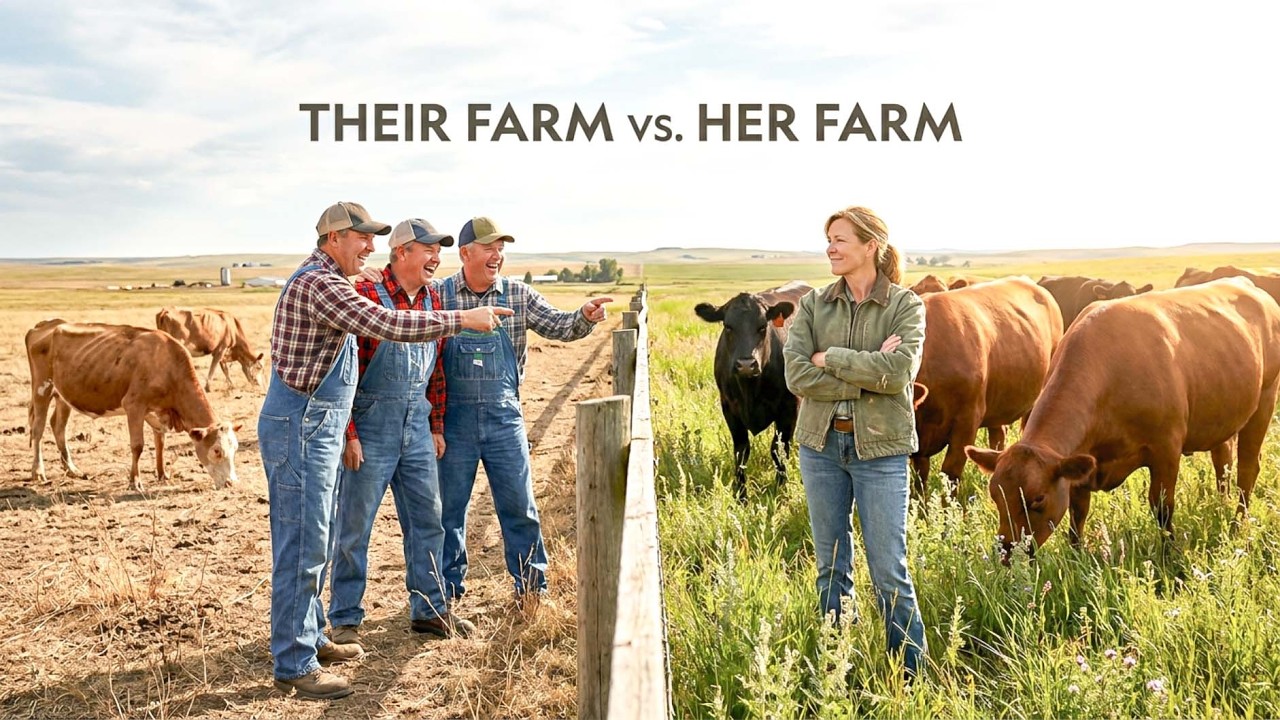
They Laughed When She Let the Weeds Grow Between the Fences — Then Her Cattle Outweighed Every Herd
BackroadHarvest
117 views•2026-05-28

Mozambique RELEASES AFRICA'S MOST DANGEROUS ANIMAL - After 2 Months, The Results Shock Scientists
SimpleDiscovery24
541 views•2026-05-29

Cute Seals Spotted On Remote UK Island | Our Tiny Islands
Channel4OnTour
141 views•2026-05-29

The Bay Poisoned by Mercury #shorts
harmedino
289 views•2026-06-01

Calgary Flood Watch Day 4 🚨 Bow River Not Expected to Peak Until Tomorrow
RealtorDhirYYC
103 views•2026-06-01

This Jamaican Pond Has A Deadly Reputation
MyEyesAreYours-i3s
656 views•2026-05-28

You must see this..My narrowboat journey continues to the end of the Bridgewater canal..#945
NarrowboatWill
2K views•2026-06-03



