Dr. Ayenan turns complex breeding science into a practical survival kit for African farmers, proving that real intellectual power lies in field results rather than just academic papers. This is a rare, pragmatic blueprint that successfully prioritizes market-driven impact over the usual ivory tower abstractions.
Install our extension to search inside any video instantly.
Dr. Mathieu Ayenan: Early Wins and Lessons from the World Vegetable Center’s Okra Breeding Program
Added:[ Music ] >> Hello, good morning, and welcome to the International Plant Breeding Seminar Series, hosted here at NC State in Raleigh, North Carolina.
We have the pleasure to have with us Mathieu Ayenan from the World Vegetable Center in Benin, talking about his responsibility as an okra breeder for Sub-Saharan Africa.
Mathieu is a vegetable breeder at the World Vegetable Center in Benin, with a career in food and nutrition security through genetic improvement.
He specializes in developing climate-resilient vegetable varieties for small farmers in Sub-Saharan Africa.
Joined the World Vegetable Center in 2021 and has led variety trials, supported seed systems development, and seed producer capacity building, and has collaborated with national programs on variety release and registration.
He has served as a vegetable breeder in the Center since 2024, focusing mainly on okra, but also on tomatoes in different capacities.
Okay. So before joining the World Vegetable Center, Mathieu conducted research on breeding and system development across several crops, including cowpea, pigeon pea, soybean, and rice.
He got his PhD from WACCI in Ghana.
And welcome, Mathieu.
I'm going to stop sharing here and give you the floor to share.
Go ahead. Please, if you can get in the chat and tell us where you're joining from.
And also, through the Mathieu's presentation, please post your questions there.
Thank you.
It looks good, Mathieu.
You can go ahead and start.
>> Okay. Thanks, Carlos, and thanks, Brandon, for the, I mean, early interaction in putting this together.
From time to time, I attended some of the seminars, and I'm happy to be the one presenting today on early wins and lessons from the World Vegetable Center Okra Breeding Program in Sub-Saharan Africa.
So yeah.
For those of you who are not very familiar with the World Vegetable Center is an international agricultural research institution, which mandates with the vision of healthier life, more resilient livelihood through greater diversity in what we grow, but also in what we eat.
And we are proud to hold the largest public sector vegetable gem class, not only in terms of accession, but also improved varieties for various vegetables serving farmers across the globe, but more specifically in Asia and in Sub-Saharan Africa.
So in Africa, we have presence in so many countries.
And we don't only do breeding, of course.
I mean, the breeding program.
But we also have other activities on nutrition, social sciences, and good agricultural practices, let's say, across the vegetable value chain.
So this afternoon or this morning, depending on where you are connecting from, we'll be talking about okra, okra in sub-Saharan Africa.
And sometimes ago, I chanced on this book from Chris Smith, Okra is The Seed to Stem Celebration.
And yeah, there are some quotations or quotes in there, and some of them got my attention.
And one is getting to know Okra.
And Okra has been like the awkward girl no one but her family thought had any talent.
I don't think so.
But just look at okra now.
So it's also revealed how global the crop is becoming, from traditional vegetable to global vegetables.
And if you don't know it, it's easy to hate it.
So for those who are not familiar with okra yet, don't hate it.
Just get to know it, and you will love it.
And lastly, in short, okra represents true nobility.
The next time you hear people say it's herbaceous, hairy, and spineless, I urge you to punch them right in the nose.
I will not advise the last sentence, but definitely do something to defend okra.
So this is starting on a very lightweight note.
On a serious note, okra is what we consider as a hiding treasure or golden green goat, for those who like goats, and in such a way that, I mean, all the plant parts are usable, from the fruit to the leaves and other parts.
The immature pods, as the video colors show earlier, I mean, as introduction to this seminar.
You can see the diversity of the uses that we have for okra: sauce, soup, salad, as confessionary pickle.
And the mucilage is extracted and has so many pharmaceutical and industrial application.
The seeds, it has potential for oil.
It can be used to substitute coffee for those who want caffeine-free coffee.
And it's also a flower for cereal, to fortify cereal flour.
And there is a recent publication putting together a number of nutrient-dense products, not only vegetable but also animal source products.
And surprisingly, probably to many, the dry okra rank as the top product in terms of nutritional value score.
If you want to know more about how this was calculated, you can easily get this from the paper and the link below.
But this definitely shows the potential of the crop in terms of nutrition and in terms of economies, especially for smallholder farmers and also other value chain actors, especially processors and marketers along the okra value chain.
Definitely, I mean, despite those potential and the treasure that Okra hosts, we still have issues in terms of improvement and broader adoption.
So some of these limitations, we have issue with diversity of sources of tolerance or resistant to various diseases.
We have the genetic nature of the crop itself.
This has been emphasized over the last few years.
But with the experience we are gaining on the crop, definitely, we think it's not -- it's complex.
It's not deployed.
So it has its own challenges.
But there are crops with, I believe, more complex genome, which has made a lot of -- where a lot of progress has been made, especially in terms of genomics.
So then we have to embrace and invest more to get okra in that space as well.
And screening and breeding capacity, these are challenging.
Insecure funding.
On and off breeding.
We can't have a sustainable breeding program if there is no secure funding.
And we'll see WorldVeg has gone through some of this cycle of on and off breeding on okra.
But we believe the stat we have now is the right one, and it will last and also generate lasting impact.
In terms of broader adoption issue with viruses, pest and disease, pests, especially Jassids.
Cold susceptibility, low yield, and weak seed systems.
We can't over emphasize the potential, I mean, the importance of having the right delivery architecture in terms of seed to move from the breeding program to farmers.
And these are broader.
We conducted a survey two years ago.
Maybe some of the breeders may be in this seminar.
And eight breeding program across Africa responded, some with, I mean, not full-fledged programs, but at least conducting some kind of activities on okra.
And these were some of the limitations they also identify across those eight programs.
Limited access to funding.
That's critical.
Access to storage facilities, breeding capacities, and others.
So this, definitely, limitations are rampant.
And a focus in a zoom here on the seed system is quite variable.
Usually, when we talk about it, it looks like there are one-seed system for sub-Saharan Africa or for many countries is quite diverse, even within countries.
So we conducted a survey in West Africa.
That was one year ago, including Mali, Nigeria, and Benin.
And we noticed that in Mali, for instance, roughly 75% of the farmers we surveyed were using seed from agro dealers or from locally produced certified seed, which is encouraging.
In Nigeria, it's lower than 10%.
And yeah, it means -- it can be perceived as a challenge, but it's also an opportunity, which means if we are able to make the right investment and develop the markets, there is still a lot of market share to be gained here for seed companies and for our programs.
We have, on the markets, excellent materials in the long segment.
But when it comes to short and medium market segments, which have the highest market share in West Africa, we still have issue in having the right varieties for the season and for the growing system and also the market.
And by the way, West Africa has roughly more than 90% of okra production in Africa, Nigeria being the second largest producer worldwide behind India, and followed by Mali.
So those two major players are in West Africa and showing the potential of the crop.
And variety turnover, very low, especially for the public programs.
In the private space, private seed companies have been developing varieties, putting them on the market.
But in the public space, this is very low.
And this is just an example here.
When you go to the Nigeria Seed Portal, you will see three varieties of okra release.
And they were registered in 2000, 1993, 1996, but developed or released in 1973 and '89.
That's quite some time.
And you'll be surprised, Clemson, which was developed in 1930s at the University of Clemson in the US, is still one of the major variety in many countries in Sub-Saharan Africa.
And I think that's quite some time, 1930.
So we definitely need to do something.
It's definitely a good variety, but we need to work hard to get him a safe retirement.
That's needed.
Yeah. Now zooming or coming to WorldVeg, what are we doing as an institution to address some of these constraints?
Considering the importance of the crop, this was recognized.
And as I said earlier, because of issues on funding, it has been on and off.
So the first program was established in Niger through a collaborative project between ICRISAT and WorldVeg.
It ran from roughly three years, 2007 and 10.
And yeah, it stopped there.
And in 2014, the program was revamped, this time around in Cameroon, and it ran for only two years, and it was discontinued.
But yeah, since 2023, we started rekindled the program again, this time around based in Benin in West Africa.
And I think so far we have almost broken the record in terms of longevity.
But I don't think we have to stop.
In the next three four years, we need to do to sustain the program.
And this, you will see in my subsequent slide the strategy we are putting down to sustain it, not make it an on and off program, having a sustainable program like our tomato pepper program, which has never been discontinued.
And the objective of the program that was rekindled here in 2023 is to develop high-performing varieties tailored to the need of farmers, processors, and end users.
So maybe it's worth clarifying this.
We do have another program based in Asia, which is in our regional center in Thailand, [inaudible].
But this program I will be focusing on in this presentation is purely the one based in Benin, developing variety for sub-Saharan Africa.
So this is the strategy we put together last year, a little bit more than last year, but it was published last year, which has, at its core, capacity strengthening in okra breeding and seed production, because we believe if we don't have the right human, I mean, the skill, then we can, despite resources and anything available, we can make much progress in a sustainable way.
So this is really at the core and the heart of the strategy.
And then we have four other components around that core component on capacity building, which has to do with market intelligence, very critical to support decision making.
And that's where we do all the market segmentation, development of PPPs, close interaction with market actors.
We also have leveraging genomic resources for trade discovery.
And anything we can do to leverage technologies to accelerate breeding, that's also a very critical and development of an integrated okra seed system for Africa.
We do recognize the plurality of the seed system, so we are not pushing by force to a formal system, but definitely having an integrated system that accounts for the specific context where we are operating, whether we have to be more on the formal side or semi-formal or integrated.
That's something we work on with the local partners.
And finally, very critical is resource mutualization among programs, institution, because this is not a job WorldVeg, our program alone can do.
We definitely need to partner with others and leverage our various strengths and also having a regional variety trial network, which will definitely give our varieties online more visibility in terms of adaptability across agroecology.
So those are the core components.
And in my subsequent slides, I will try to break down each of these components, what are we currently doing, what is coming up, and what others can join us to do in a more efficient way.
So the first, I mean, I will not start by the hard, which is the capacity building, but start by the market, which is very critical here.
So we recognize this, and we have conducted a number of studies across West Africa, but also other regions in Africa to map trade preferences of okra value chain actors.
I mean, as we can expect, farmers are more inclined or more -- their preference is toward more productivity and disease resistance, so protecting the yields.
Of course, presenting as such might be misleading.
They did cite or list other consumer traits like food quality as well.
But in terms of priority, they put more emphasis on disease resistance, number of food per plants, and other productivity trait.
And traders and consumers were also consulted, putting more emphasis on high viscosity, the fruit quality in terms of freshness, color, and also tenderness.
Viscosity here, maybe I will break it down, is definitely related to misled content and is in West Africa.
Let's say this trait is really specific to West Africa consumers.
When I interact with people in Eastern Africa or elsewhere, this doesn't come as a priority trait.
But in West Africa, regardless of the variety, if it's not -- the mucilage content is not high, people will not pick it.
And I've witnessed a situation where people will cook their soup and throw it away, because it's not -- the mucilage content is not high.
So it is very critical.
Beyond those formal surveys and empirical evidences that we have in terms of variety preferences, we also conducted multi-stakeholder workshops.
And those multi-stakeholder workshops involve farmers, consumer processors, researchers, seed producers.
Very important.
We did that in Ghana, Benin, Nigeria.
And that has provided us a unique opportunity in terms of validating the market segment or identifying new market segments, but more importantly to refine the target product profiles that serve for us as blueprints in our breeding activities to guide, and okay, are we on track or not, which become -- this target product profile become a promise that we make to stakeholders in terms of development of varieties, where our variety should be as close as possible, as close as possible, and as we can to those product profiles.
So it's very important.
And it was -- those interaction also goes beyond the immediate benefit in terms of having those blueprints, but also, it create and foster interaction among stakeholders, which we believe is very critical for us in terms of success and sustainability.
Putting together all those steps, the empirical evidences, the workshop we conducted, we came up with a number of market segments, ranging from short to long, reddish and smooth and turbular.
The reddish and smooth and turbular market segment are rather niche markets in Africa.
They are not very popular.
But there is still niche for those type of varieties in some countries.
But the three major market segments are the medium market segment, short and long pods.
And as you can see here, I mean, East Africa, the long pod in East Africa is more slim.
The mucilage content, I mean, doesn't necessarily need to be high.
But in West Africa, it should be.
And our program, we have activities on the long segment, but our effort now is really to focus more on the shorts and medium segments, which is where the market, I mean, improved varieties on the market is a little bit lagging behind.
And that's also the feedback we got from our partners, the seed companies, who, already, most of them have good material in the long segment, but really would like to have more of these short and medium segments.
Those are the segments just put down here a product profile for the short market segment.
When we say short market or short pod market segments, it's basically fruit length less than six centimeters.
And yeah, we have the different trait categories in terms of plant type, consumption trait, yields, abiotic and biotic, sorry, abiotic and biotic traits, and production and multiplication trait, which is also critical for seed companies, because there has been instances where varieties were developed, but the seed production is low, which has -- the immediate implication is the cost for farmers or just a simple rejection of the variety by seed companies.
So we factor this in our breeding activities to ensure we don't only satisfy farmers, consumers, processors, but also seed companies who are the bridge between us and the impact, the impact here being farmers and consumers.
Sorry. So for each of the traits, we have scales, we have minimums called trait requirements, and whether the trait has to be improved or not.
So the essential traits basically can be improved or considered as a threshold trait.
Some of them are threshold.
That means our effort is only to maintain the level we have already reached those, which are under active improvement are those we are actively targeting for improvement in our programs.
And the nice to have is, if you have it in your variety, it may give you a competitive advantage.
But if you don't have it, your variety will still compete or be viable on the market.
Yeah. So those are, in terms of segmentation profiles, we also open our eyes to discuss, as I said earlier, with other programs and say, okay, what are some of the traits are you focusing on.
And for abiotic traits, of course, droughts come, I mean, was listed by all the program, followed by heat and cold tolerance, only by one program.
But yeah, I will tell you later why that is still important in Okra, which is a warm season crop.
And it usually doesn't perform well under 20 degrees Celsius.
So horticultural traits, earliness, pod traits and pod color, mucilage content, and harvesting duration, very critical here.
And biotic stresses, tolerance to okra leaf curl, okra yellow vein mosaic, Jassids, and others.
I mean, this really aligned with what we also identified through the various interaction we had, meaning we are on the right track.
And the implication is we can easily share materials with all these programs for testing, for using the various, either as parent or direct evaluation and release across the various country.
So this alignment is important.
I was talking about pods earlier.
And we had a very, I mean, it's not a shock, but it's not far from that, last year with some of our products, where we have same trial in Benin, which is in a low land and high land in Arusha in Tanzania around June.
And that was a very cold period in Tanzania.
So you can see the temperatures.
Here, the minimum is below 15 degree, and the average is around 20.
And the average in Benin during the same period was around 25.
So what's happened is the trial in Tanzania, I mean, in terms of development, even the fruit were deformed.
You barely recognize the variety that you are used to.
So that really puts us on the edge that this is becoming an important stress, not only in Eastern Africa.
I mean in Eastern Africa, I don't think we should call it stress, because this has a normal season for pods, period.
But if we want to expand or extend the growing season, it means we definitely need to do something around cold tolerance for farmers to be able to grow this crop under even cooler conditions.
And in West Africa, during Harmattan, which is also a cooler season, especially in the Sahelian country and the northern part of coastal countries like Nigeria, Benin, Ghana, and Cote d'Ivoire, we have a cooler season between October or November, November and February, which also limit farmers, I mean, reduce the window of okra production for farmers.
And we believe if we can put more emphasis on this, we can expand the season and help farmers grow under cooler conditions.
So that's in terms of market what we have gathered.
And now moving to trade discovery, what we are doing, and what is coming.
So in terms of trade discovery, we are basically into identifying sources of tolerance to various diseases and pests and abiotic stresses.
So one of the diseases here is okra leaf curl virus, caused by begomoviruses.
It can be one virus or a complex of virus.
And we have started screening.
We screen on the station.
We also screen on farm with farmers.
And yeah, definitely, you can see, I mean, we have been able to identify sources of tolerance or resistance to the disease.
And those sources are now being used to develop population for breeding activities.
But one constraint we have here is -- the incidence of the disease is only -- it's very pronounced in offseason, running from October to April in the coastal part of West Africa.
And that limit our screening season.
So we are now in the process, I mean, developing those mapping population to develop markers.
That can help us accelerate the building process.
Even when we are not in the disease season, we can still do market assistance selection team to move quickly in the program.
So beyond what we are doing, those training were focusing more on agroecologists in Benin.
We also were -- we're interested in assessing the diversity of the begomoviruses infecting okra across Africa.
So we collected samples from various countries, analyzed them, and fully sequenced 44 of the samples, 12 as part of the okra yellow crinkle isolate, 32 cotton leaf curl Gezira virus.
By the way, when we did all the identification using existing primers or home design primers, we were not able to identify or amplify the initial leaf curl virus, which is more predominant in Asia.
At this stage, I will be cautious.
I will not necessarily say it's not present in Africa.
But we're looking at the extents of our collections, and also the number of samples we have is not really predominant here.
I may say that for now.
Because those primers were able to amplify symptomatic sample from Asia, but not from our sample.
Even though the symptoms look alike in terms of petiole twisting, leaf curling, we haven't identified the leaf curl virus.
So what we also observe is co-infection of samples by both viruses, the okra yellow crinkle virus and cotton leaf curl Gezira virus, which means if we want to build durable resistant against this begomovirus, we need to target both viruses, otherwise, we may be in trouble.
And another important pest, which we are targeting here, is the Jassids which is leafhopper.
It's become a major okra pest worldwide.
I observe it everywhere I go, including the United States.
It was in Florida, and it's also a serious problem there.
And facing this problem, farmers usually, at least in our context, will rely mostly on pesticide for the management of the pest.
And increased use of pesticide, we all know the implication or the consequences on consumer health, farmers' health, and also the environment.
So developing resistance or tolerant varieties is definitely the way to go to limit the incidence or severity of the pests on okra.
Understanding the mechanisms of tolerance.
We are working around that, identifying sources of tolerance.
So doing this, we are screening a diverse gene pool, including from esculentus, caillei, manfaat, and moschatus.
And this activity is underway as well.
And drought as abiotic stress.
As you may see, that's the focus of, I mean, all the programs have this as important threat.
And why? Because most of the okra is still grown under rain-fed condition.
And when you are under rain-fed condition, you are definitely subject to dry spell.
This may happen at any point in the season.
So the approach we are using is quite systematic, I mean, in terms of integrated, looking both at the above ground phenotyping with drone and using multispectral cameras.
But also, we look into the root system architecture phenotyping, which is mediating a lot of responses in terms of droughts in okra.
So yeah. Sorry.
Okay. Good.
So basically, that's what is going on right now in terms of trade discovery, identify sources of tolerance and all this stuff.
And sources have already been identified for some of the biotic or abiotic stresses.
And we are deploying them right now in the program.
And to do this, we really need to optimize the breeding, the okra breeding pipeline.
And this is the breeding process from Excellence in Breeding, which is used across all the CG Center's breeding program, which also is adaptable to what we do in vegetables.
So the pipeline, basically, the trade discovery, those are kind of pre-breeding activities.
But the focus on the optimization here is mostly on the -- once we initiate our crosses, early testing, late testing, and on-farm verification.
So across all these four components, there are action that we are taking to optimize our pipeline.
So the optimization here, when we look at our very famous breeder equation, we are targeting the t, the denominator of the of the equation, so reducing cycles through various techniques.
I will present that in the next slide.
Also, improving on our experimental design, data collections through digitalizations and analytics.
We are moving to ABS Enterprise Breeding System, which is also breeding management system from the CG.
And this will really help us to standardize the way we do our data collections and move our crosses from one stage to another.
So anything that we are doing here is more on optimizing or increasing our heritability and also decreasing the cycle per year.
On the crossing, sorry, on the crossing side, we are more than 90% in terms of crossing stresses rates.
There are some genotype which are not compatible.
And those genotype, definitely, you don't get anything.
So we are also looking into that and say, okay, is this the difference on chromosome level that can lead to that, even within what we think is [inaudible], because a lot of chromosome is still needed to really classify some of the gem plants.
But when you say compatible gem plant, we are more -- we can reach more than 90%.
And selection at early stage for diseases, that can be easily observed when we are moving to the latest stage, focusing more on the target product profile traits, but also involve seeds or variety release committee at the very early stage of our process, so they know that something is happening.
We don't wait until the end before surprise them with the variety and say, "Okay, you guys need to register."
So if they are aware, the processes can move faster.
So we are also thinking of can we, through the use of rapid generation advancement for okra, can we reduce considerably the time what we are currently experiencing?
We can have three to four generation a year, yeah, roughly three, from seed to seeds, as we are moving population, not all of them are early.
But with the RGA, we can reach probably four to five.
It might be very optimistic.
But it's something we are currently settling, I mean, to test and see how it will go.
So quickly, you can see here, usually when we hear optimization, we'll be looking at, okay, highly quantitative stuff in terms of moving equation here and there.
But anything that we can do at our level as breeder to increase our numerator of our equation, decrease the breeding cycle is part of the optimization process.
Right? So here, in a traditional setting, depending on rainfall, you have not more than two seasons in a year.
It can take you more than five years before you get to your variety with combination of irrigation and screen houses for our crosses, what we are doing now.
In the fourth year, you can at least submit your application for a variety release.
Saying release may be very optimistic, because once you submit, you don't have much control on what happen later.
So at least you can submit your application.
And we think the RGA is still -- we haven't -- we are still developing the protocol to test it.
So that's why I put it in this color.
Still aspirational, but we think something is also doable here to be able to fast track.
But what will also bring in speed in the process, as I said earlier, is the integration of marker, market assisted selection for disease resistance, for quality assurance and quality control in the breeding process.
And for this, we currently have some genotyping activities ongoing.
But the ultimate goal would be to get snip arrays that we can in the low, medium, and high density that we can routinely use in our program for various activities.
So as we optimize, what are we doing with the optimization?
So currently, population development is ongoing.
Both for biparental and multi-parental population, focusing on short and medium segments.
And then on the side, we have also advanced line which we advanced from pedigree selection, which are currently in preliminary trial, with promising line, which combine excellent horticultural traits and food quality in alignment with the target product profiles.
So I mentioned two, I mean, the program that have been on and off at least two times, one in Niger and one in Cameroon.
There has been some lines developed from those programs, which we -- and also from our program in Thailand, which we quickly introduce for trials here in West Africa and also in Eastern Africa to see the adaptability and also acceptability by the market and why we are doing this through participatory variety trials.
And this is going on very well, very good feedback from farmers, but also from the market.
Some of the farmers who received the seed, we have a set of trials on station.
And the best one selected by farmers were pushed on farm.
And farmers are hosting or leading these trials, and some have started selling the foods and give us feedback from the market.
Excellent feedback so far.
So in the near future, some of these varieties will definitely be released.
And from a previous project, we have released some of the variety from the other two programs, which make a good transition to this slide.
So talking about release, those were released last year in Benin, nine varieties.
And the seed production is already ongoing in Benin.
And also, we have a partner, a seed company partnering with us in Ghana, which is producing some of the seeds.
So it's not only varieties in catalog but also in the farmers' hands, which is part of what we will call wins for a three to four years old program.
We also do a lot of capacity strengthening.
We believe we can't make a lot of progress or impact if local seed companies are not empowered to produce seeds to serve the communities they are in.
So we do a lot of capacity strengthening.
We have a structured program in vegetable seed production and seed business centered around seven modules, including -- okra is included in the crop.
So we do this, we are doing this in various countries.
And those companies already pushing or positioning the seed on the market are part of those we have trained.
Beyond what is done locally, we are also thinking more global and strategic partnership here is very critical.
So we set up an okra working group, which gather national agricultural research institution and also seed companies, global players in okra seed industry.
You have Advanta.
You have others which are involved.
So the main purpose of this working group is to assess them as a community of practice and exchange materials, discuss challenges, find common and joint solution, mutualize resources, as I said earlier, and also plan and implement regional trials.
It's also an excellent opportunity for the various program to scale materials across geography and with minimal resources.
It's going well, and it's something we are really proud of.
Of course, a lot of efforts still need to be made to ensure the commitment of all the partners is -- that all the partners are really committed, so we can continue moving on as a community of practice.
And we have our famous Africa Vegetable Breeding Consortium, which is purely private sector oriented.
The working group is open to public institution, but the AVBC is purely private companies oriented, which we have every year a workshop and feed demonstration of our best materials, not only on okra but on all the vegetables we breed for at WorldVeg, tomato, pepper, pumpkin, [inaudible], and others.
So we showcase the best one, and we take it.
Depending on the size of the company, they can take those lines directly for further evaluation and release.
And some company with strong R and D department will take the genetics in use at either experience in the hybrid breeding program or threat, I mean, source of threat in the pipeline.
So yeah, if you want to know more about AVBC, just scan the QR code, and you'll know more.
This year, the workshop will be held in Benin in September.
So if someone has a seed company here, you are still welcome to join.
And there is a non-membership fees, which is very small, I believe.
So we have also other research priorities.
This opens the chapter for our kind of perspective and what we are also willing to collaborate with others.
So other research priorities include the integration of value-added traits into our breeding activities.
Last week, we were holding a feed day.
And a farmer, he raised his hand.
He was asking a question.
It's okay, if you want to promote these crops, or you want us to use improved varieties to increase our productivity, and there is no value addition, it will not work.
If it's only for fresh consumption, whether for home or getting into the market, it will not work.
And we definitely agree with him.
And we have already anticipated this.
That's why we are thinking of value addition.
And value addition cannot come just in silos.
It should be also guided by variety, I mean, at least work with breeders to ensure the processors have the right varieties for the various uses.
And just an example here, if you want the okra for drying either the wool, I mean, the slice pod to make powder, color retention and sensory quality after drying can be very critical.
And not all the varieties will give you those kind of attributes, which means we, as breeders, we can work around what we have as materials to make sure we supply this kind of materials, oil seed content, coffee.
Substitutes today for coffee.
We'll be looking more at the heat, the seed yield, and other attributes, and also oil profile for aroma and fatty acid for flavor.
So those are some of the things we are really interested in.
And this cannot happen if -- there is a key trait that needs to be really backing up all these, which is mechanization traits in terms of plant architecture and roots, root architecture, because if you want to industrialize or at least go to light scale to meet the need of processing industry, definitely, we need -- we can't be harvesting every three days, like we do for fresh market.
But we need to mechanize.
And being able to keep your plant steady and not destroy it while your machinery is operating has to do with the architecture of the roots system, which will be more, I mean, deeper and stronger.
So those are some of the things.
And mucilage content for industrial use is equally important in pharmaceutical food industry, in the chocolate industry.
It has a high potential.
And yeah, the breeding for okra for adaptation to diverse cropping system, which kind of resonate with the seminar we had last week, in terms of breeding for intercropping.
We are also looking at something around this in okra, mostly using evolutionary breeding, working closely with farmers, sharing some of our segregating population with them for them to test or not test, I mean, grow, select from the growing cropping system.
So those are some of the areas we are exploring.
And some will start soon.
There are some key lessons learned here.
Not many of them, but they are very critical if you want to make lasting impact, or at least set the things right.
So setting the structure.
I would have said system, not only structure, but setting the system right is very critical for sustainable success.
So having our data management system is not optional.
Without this, we have been turning around and getting a lot of errors, mistake in what we are doing.
So we are happy we are deploying the EBS in the program.
So that's very important.
Market intelligence, we can't over emphasize it.
It does require proper segmentation, clear the target product profile.
And once that is done right, we are sure that whatever we develop will be meeting the needs of stakeholders.
And not only the end users, but one of our direct partners for sustainability are the seed companies.
And that translates to the third point.
Engagement with seed companies is very critical for scaling, access to market information, but also getting the support.
At times, they don't want to do some of the work we do, but they are ready to put some dollars on the table to support this, as long as they can see the benefit.
So if we can prove and we show -- we are showing that already that we can provide excellent materials, then we can be also pulling some funding from the side, not only depending on public funding, which is becoming very scarce, as we all know.
So those are some of the lessons, some early wins in terms of release varieties, engagement, working the Okra Working Group, engagement with stakeholders and seed companies and also some seed that are already hitting the market.
On this note, I would like to acknowledge our donors for the program and long-term strategy donor to the World Vegetable Center.
And most of this work has also been done, of course, with the support from the Vision for Adapted Crop and Soil, and support from the UK, I mean, FCDU.
Okay. So this is the team.
I'm happy.
I'm grateful for the support of my colleagues.
This is only the core team.
We do have other colleagues working with us.
And thanks for listening.
And if there are questions -- >> Thank you so much, Mathieu.
>> You want to stop sharing?
>> Okay.
>> Yeah. Well, thank you.
I just want to, before we get into the question, wanted to point a couple of things from your Slide 4.
I think you probably need to include the use of fresh leaves as a vegetable, because there's potential use for okra, and also the use of the stems for fiber production.
I happen to be working in kenaf, but I know that okra has also as good a quality of fiber as kenaf or hemp.
Okay. So yeah, also pointing out that Mathieu is participating in an ad hoc group that we have called Mucilage in Malvasia.
We're interested here at NC State on jute mallow, which is a relative of okra.
So Mathieu and others are representing the okra feeling that informal group.
Okay. As Mathieu indicated, mucilage has a lot of potential, not only for medicinal purposes or for packaging drugs, for example, for colon cancer, but also as a functional ingredient.
He mentioned the part of chocolate industry.
But here, we are trying to make a broader use of mucilage coming from malvasia as egg replacement and also as gluten-free formulations.
Okay. So nice working with you, Mathieu, on this.
We have a few questions here.
Well, quite a few questions.
Excellent presentation, by the way, Mathieu.
Very well organized.
So one of the questions is, are you considering any efforts on gene editing or genetic transformation?
>> Yeah, thanks.
That's tat's a good question.
We met in last February in Nairobi, and it came to the table for our team.
Yes, we have -- we developed recently a framework, especially on jassids.
And we did put that as part of the options.
But personally in the program, Carlos, I may say it's not a priority now.
We still need to set things up, you know.
Currently, we have two genomes which are fully sequenced, one from one team and one from a Dutch team.
I think one is coming -- others are coming from UC Davis or your university.
So I think we just need to set other things right, having routine marker used, and we -- >> There are so many low-hanging fruits in crops like this that it will be, I don't know, I think that you have to set priorities, which process to face first.
And I think in okra, as in many other crops, you can do a lot before you think about, ok, can we use gene editing as an alternative.
Okay? Another question that is very interesting, because I thought about this, if the prevalence of this virus is so important, particularly some of the viruses that are known to be transmitted by seed, how do you develop systems, not only seed production systems, but germplasm sharing systems that ensure that you're not spreading the viruses?
>> Yeah, thanks, Carlos.
And will I say fortunately, unlike in Solana seed, especially tomato, where a lot of the virus are still transmitted, so far, the one documented in okra, at least from my recent readings and also interaction with other breeders are not seed transmitted.
But it doesn't mean, you know, all what we say is also limited to the extent of what we know for the moment.
So I guess with more research, we may have -- we may end up finding some of those things.
But currently, we don't have that issue.
But we do do some quick processing like water, hot water treatment, quick one to the soil, the embryo, or the seed, before shipping some of the seed.
I mean, we also look at the phytosanitary requirement for okra shipping.
They are very light across the countries.
It's one of the lightest we have in our crop.
Tomato, you need to do some extensive testing treatment before shipping okra.
So it also mean at the regulatory level, they understand that most of these are not seed transmuted.
But we need to explore more.
>> Sounds good.
One question relates to your target of shorter to medium size pods.
And the question that is posted, are those preferences coming from consumers or from farmers?
And also, what is the consequence in yield if you breed for smaller pods?
Does it result in lower potential or not?
>> Yeah. Usually, I mean, these requirements are coming from farmers and dictated by consumers in the market, of course.
So what we have noticed is those short pod okra in terms of number of pod per plant usually is lower.
And it has yield penalty.
But we believe it's not only because it's just short that it's like that.
It's just because the investment in terms of improving this type has not been very huge as compared to a long pod segment.
You know, the long pod segment is also called the Asian okra or Asian segment and a lot of investment, especially from the Indian Agricultural Research Institute and also privacy companies have been made in this segment.
So the shorts and medium is becoming hot things for them now, especially those who want to get into the West Africa market.
And I believe with the investment we are making and collaboration that we can definitely improve the heat of the shots.
The medium, we have excellent promising material in the medium, I mean, giving you at least 30 foot per plant, not far from the long pod segment.
So that's what we are currently experiencing.
So I will not say it comes directly with the heat penalty, but we will break that.
>> Yeah. I want to relay one final question.
It's about, you mentioned, pollen incompatibility.
Sometimes it may be an issue.
How do you overcome that?
>> We haven't, personally, in our program, overcome that yet.
We have good crosses and compatible crosses between esculentus and caillei.
That's especially when we use esculentus as female and caillei as the male.
We don't have issue there.
The issue we have is when you are with moschatus and also with manfaat at times.
There are groups in India which has used the doubling of the chromosome with cortisone to be able to overcome that constraint.
So that's something we haven't explored yet, because currently, we have a lot on our plate.
But these are tools that have been used in other programs, like doubling the chromosome to restore fertility for wild crosses.
>> Well, Mathieu, it's been a pleasure.
It's been a great, great presentation, man.
It's amazing.
Okay, thank you so much.
And I look forward to keep our interaction and to meet again sometime soon.
Okay? For those of you that participated today, I appreciate -- we appreciate a lot of your participation.
We invite you for next Thursday at the same time.
We're going to have Dr. Dorcas Ibitoye from the National Horticultural Research Institute in Nigeria talking about market intelligence in cultivar development, a broader approach to improving variety adoption.
I encourage you to attend.
Dorcas is one of the key breeders in Nigeria developing materials for a lot of vegetables and including bananas.
Okay. So thank you so much.
And I will see you next week.
Thanks. And have a nice weekend.
Okay? Goodbye.
Goodbye, Mathieu.
>> Yeah. Bye-bye.
Related Videos
51:25
Biotechnology
EAStalk “Electrochemical sensors as a platform for improving Animal Welfare” with Dr Sofia Teixeira
euraquaculture
176 views•2025-06-20
10:06
Biotechnology
Cesare, son of San Mauro (eng)
AkuOutdoorFootwear
608 views•2016-02-03

0:47
Biotechnology
Why Gen Z is Taking Creatine (It's NOT for Muscle Growth)
Michealhealth
830 views•2026-04-22

43:57
Biotechnology
Guillaume Durin - Catch and Release - Extraction and Purification of NGS Grade DNA and RNA from FFPE
Labroots
851 views•2015-01-27
1:13:59
Biotechnology
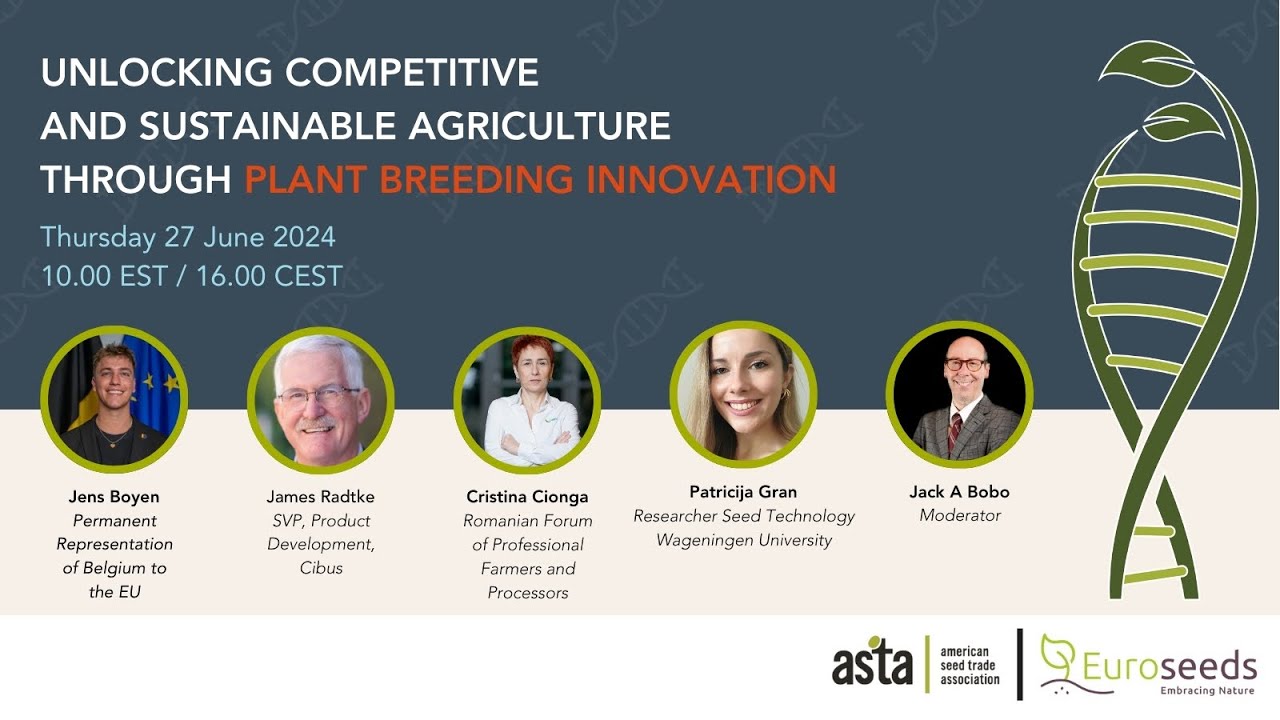
Webinar: Unlocking Competitive and Sustainable Agriculture Through Plant Breeding Innovation
americanseedtradeassociati3281
319 views•2024-06-28

2:08
Biotechnology
AI in neurology: predicting protein structure
VJNeurology
622 views•2023-07-06
2:42
Biotechnology
Stevia Innovative technologies for cost effective and sustainable production of Reb M
ingredionemea201
207 views•2023-03-14

2:27
Biotechnology
Biological Effects of Radiation
CDC
551K views•2015-08-27
Trending

13:38
Law
WOW! Judge TURNS THE TABLES on Trump in His OWN $10B LAWSUIT!!!
MeidasTouch
197K views•2026-07-23

13:25
Business
Playstation NO DISC/NO BUY Fight Is Over...
DavidJaffeGames
4K views•2026-07-23

22:40
Business
Steam and Xbox Just Dropped The Hammer On PlayStation
OhNoItsAlexx
9K views•2026-07-23

16:52
Anthropology
Americans Confused in Australia for 17 Minutes Straight
IWrocker
17K views•2026-07-23