This video presents the GT Rover Team's Fatih rover, a next-generation robotic platform designed for the European Rover Challenge 2026, featuring a carbon fiber composite chassis with rocker suspension and airless wheels for rough terrain mobility, an STM32 microcontroller with PID algorithms for precise motion control, ROS 2-based software architecture with Gazebo simulation, dual-layer network communication for reliable teleoperation, a five-axis robotic arm with worm gear mechanisms for manipulation tasks, and a scientific payload combining atmospheric sensors, pH analyzers, and a drilling system for geological exploration and habitability assessment in simulated Mars environments.
Install our extension to search inside any video instantly.
GTU ROVER | ERC 2026 Final VideoAdded:
Hello from Turkey. We are GT Rover [music] team, proudly representing Gebze Technical University. We are excited to introduce Fatih, our next generation robotic platform.
>> Engineered and optimized to meet high operational standards of the ERC 2026 [music] competition.
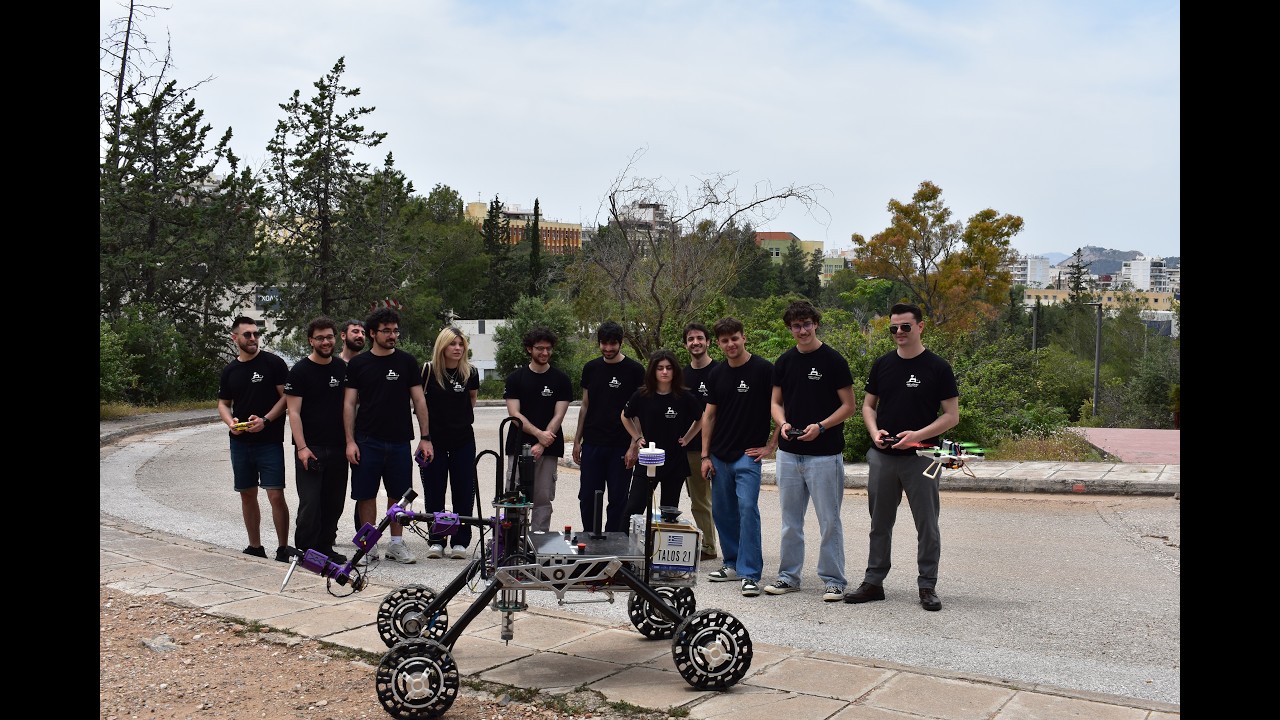
>> Since 2020, our mission has focused on accumulating advanced space robotics and engineering knowledge to maximize field efficiency. Our organization brings together [music] 40 qualified students structured into five sub-teams: mechanics, electronics, software, science, and business.
>> Our primary objective this year is qualified and compete in the European Rover Challenge 2026. As young engineers driven [music] by Turkey National Space Program and future lunar mission, we aim to bench test our technological innovation [music] and expand our field expertise.
>> The mobility system is designed to reduce vibrations and shocks in rough terrain, ensuring a smooth and safe drive. The chassis is made of 2.5 mm thick carbon fiber composite material.
The composite panels were manufactured using the vacuum infusion method and precisely cut using water jet technology. They were then assembled using aluminum brackets. The battery pack is mounted under the chassis to keep the center of gravity centered and to protect the batteries from external influences. The rover has been fully optimized for driving on rough terrain using a rocker suspension system. The four airless wheels used on the rover are specially designed, each measuring 27 cm in diameter and 10 cm in width, and they enhance the rover's drive comfort by absorbing vibrations. [music] The rover has a total length of 95 cm, a wheelbase of 70 cm, and weighs approximately 56 kg.
>> In the unforgiving [music] conditions of Mars simulations, the mechanical strength must be guided by an advanced control [music] intelligence. At the core of our drive team, an STM32 microcontroller processes movement commands with high-speed [music] precision, while RoboClaw 2x45 motor drivers channel power to the wheels.
Equipped [music] with AMT103V incremental encoders on each wheel, we capture real-time velocity and positioning data with millisecond [music] accuracy. By processing this live data through our custom-developed PID algorithms, we achieve seamless starts, smooth declarations, [music] and fluid navigation dynamics.
>> The entire rover is orchestrated by a ROS 2 based software architecture. Every subsystem has its own dedicated package with nodes, primitive files, and launch files, allowing each component to be developed, tested, and upgraded independently. Before any package is deployed to the real rover, it is first validated in a Gazebo simulation environment.
>> For teleoperation, we use two parallel control pads. The first is a joystick, one for driving, one for arm control, publishing realistic commands directly to ROS 2 topics, which are received by the Jetson Orin. The second pad is a React-based web GUI connected through ROS bridge. It requires no ROS 2 installation. It runs on any laptop. Our ground station uses multiple laptops on a network switch, each with a dedicated role: cameras, arm control, task management.
>> For autonomous navigation, we use IMU, wheel encoders, and the ZED visual odometry through an extended Kalman filter. This feeds our submap for real time slam, which now to use a rough path plan and obstacle avoidance. During the traverse subtask, the rover navigates fully autonomously, no way defeat, no GNSS sent to the ground station.
>> Our land mission demands an unyielding power source with an uncompromising approach to the system safety. Driven by a robust six-series configuration 24 volts 32 amp hour battery, our rover comfortably sustains over an hour of continuous high-load operation on a single charge. To guarantee absolute structural safety, our hardware emergency stop utilizes a heavy-duty automotive relay backed by a blade fuse, providing an instantaneous, reusable mechanical break in the power line. As a secondary security layer, we integrated a software level kill switch. To perfect this architecture, we rely on custom-developed electronics. From our battery management system and voltage regulators to our custom point-to-point routed carrier boards for microcontrollers and power distribution, we maintain total control over our hardware and our system.
>> In remote operations, a rover is only as capable as communication link. To guarantee unbroken control, we engineer fail-safe multi-layer network architecture.
>> We utilize a 2.4 GHz network equipped with Rocket M2 routers and 120 degree sector antennas operating alongside a high-speed 5 GHz network. This robust setup guarantees ultra-low latency, seamlessly translating operator inputs into instantaneous movement at distances well beyond 100 m. To achieve total visual dominance and eliminate blind spots, we strategically deploy three different camera technologies: IP, USB, and a dedicated 5.8 GHz FPV. Our 5 GHz band is connected directly into the Jetson Orin, exclusively handling critical telemetry, movement, and payload commands. Conversely, the 2.4 GHz network is routed through our network switch solely for IP video streams.
>> A five-axis robotic arm was utilized [music] to execute the manipulation tasks. A DC motor with an L-type gearbox was implemented on the first axis featuring a 1:30 [music] ratio self-locking worm gear mechanism for motion transmission.
>> On the second axis, a cycloidal gear mechanism with a 1:36 reduction [music] ratio is used to reduce backlash and minimize efficiency losses caused by friction. The movement of the third axis is provided by a worm gear system integrated into the DC motor.
Operational safety is ensured by the worm gear self-locking mechanism.
Actuation of the fourth and fifth axis is achieved by differential [music] wrist mechanism featuring powder bed fusion printed gears.
Soil sampling and manipulation tasks [music] are performed by a specialized gripper actuated by a DC motor and worm gear mechanism.
>> [music] >> The use of TPU-lined fingers ensures a secure and high-friction grip. The structural connection between axes consists of carbon [music] fiber tubes, while the joint interfaces are constructed primarily of aluminum. The final assembly yields a robotic arm weighing [music] 30 kg with a total reach of 1.2 m.
>> To drive our robotic arm, we utilize three RoboClaw 2x45 controllers.
>> In complex manipulation tasks, through dexterity, requires a highly optimized and elegant electronic architecture. All drivers seamlessly [music] interface with our Jetson Orin computing unit over a single shared UART [music] line. By pairing this clean architecture with continuous encoder feedback and precise PID tuning, we eliminate mechanical jitter and achieve [music] millimeter-perfect positioning.
>> For the drilling subtask, GT Rover presented a reliable and fully automated aerial platform.
>> With a take-off weight of approximately 3 kg and a 6,000 mA hour battery, our unmanned aerial vehicle ensures a 10-minute flight time carrying a Raspberry Pi camera as its primary vision payload. While utilizing commercial-off-the-shelf components like the Pixhawk and actively monitoring telemetry via mission planner, all hardware integration and MATLAB Simulink-based algorithms were executed entirely by our team.
>> Furthermore, the system is fully protected with an integrated fuse and a master circuit breaker to ensure hardware safety.
>> Moving on to flight dynamics, >> [music] >> the drone takes off smoothly, maintaining full stability across all six axes, up, [music] down, left, right, forward, and backward before safely landing.
>> Safety is a strict [music] priority. We can instantly trigger an autonomous emergency landing via a dedicated switch on the RC. [music] >> The drill system is designed to collect soil samples from depths of 16 cm below the surface. [music] The system consists of two primary >> stages. In the first stage, the drill tip is reached through vertical movement. In the second stage, the auger makes [music] contact with the surface and ensure the preservation of the soil sample within its surrounding nutrient >> The container system, which operates in conjunction with the drill system, is mounted beneath the chassis. The system, which is moved out from under the rover using a linear actuator, contains two containers equipped with internal weight sensors. The lift system located under the chassis prevents contamination and ensure the safe transport of the samples. The liquid collection system comprises a two-component structure consisting of a peristaltic pump model and a leak-proof container produced by FDM technology. The pump is mounted on the chassis. One end of the pump is secured to the tip of the drill mechanism, while the other end of the tube is connected to the leak-proof container on the chassis. The container is fitted with an O-ring seal to ensure leak-proofing. A pH meter is integrated to the leak-proof container to provide real-time pH measurements of the collected liquid.
>> Whether the arm is executing >> highly sensitive operations like flipping switches and pressing buttons on a control panel, our electronics guarantee smooth, highly responsive manipulation.
>> Extracting precise scientific data in the field demands highly synchronized and resilient electronic architecture.
>> At the heart of our onboard laboratory is a decentralized architecture powered by ESP32 microcontrollers, configured as one master and two slaves. This setup efficiently distributes processing tasks, aggregating all vital sensory data before streaming it to our >> central Jetson Orin. This robust electronic framework is responsible for the complete control and data acquisition of our payload. It seamlessly drives and monitors our entire suite of scientific instrument, including atmospheric sensor, load cell, the core drilling mechanism, and the pH meter. This module actively controls our core drilling mechanism, providing rapid response to remote commands.
>> For the ERC 2026 mission, our scientific objective centered on geological exploration and habitability assessment within the Hellas Planitia region.
>> We conducted a detailed analysis using orbital data sets, scientific literature, and digital mapping tools, including JMARS, Mars Trek, and Google Earth Pro to identify key exploration zones. Based on this analysis, we developed a mission-specific geological map to guide our exploration strategy and optimize rover traversal. [music] >> To evaluate our primary scientific objectives, our science payload combines atmospherical and soil analyses with contamination-aware sampling strategies.
[music] We continuously monitor methane, carbon monoxide, and carbon dioxide concentrations to investigate local environmental conditions. While integrated pH analyzers provide insights [music] into the chemical properties of collected material.
>> By comparing surface and subsurface samples obtained through our drill system, we aim to identify meaningful compositional differences.
Related Videos
Beyond Robotics | European Rover Challenge 2026
beyondrobotics
189 views•2026-06-01

Beatbot Sora70: JetPulse Technology and AI obstacle avoidance and navigation!
DroidModderX
26K views•2026-06-02

Tesla FSD 14.3.3 Hits Phoenix Streets - FIRST LOOK
anthonystesla
114 views•2026-05-29

Elon Musk Just Revealed Fremont Line for Optimus Gen 3 Mass Production
TheAINexusOfficial
180 views•2026-05-30

人機一体「零式人機 ver.2」 子ども企画【おもしろ発見!モビリティー】 #乗り物 #automobile #robot #shorts
KyodoNews
1K views•2026-05-28

China’s New Luna AI Robot Looks Shockingly Human...
NextGenHumanoids
850 views•2026-05-28

Reachy Mini: the $300 open source robot you can actually hack — Andres Marafioti, Hugging Face
aiDotEngineer
662 views•2026-05-29

柔軟指×AI画像処理食品の仕分け作業システム!#柔軟指 #ロボット #自動化 #製造業をもっと盛り上げたい
KiQ_Robotics_Corp.
113 views•2026-05-28



