McKay skillfully translates complex neurobiology into a compelling narrative about the subjective nature of experience. However, the leap from predictive processing to emotional healing feels more like a well-branded marketing pivot than a rigorous scientific conclusion.
Install our extension to search inside any video instantly.
Is Reality Even Real? | How Your Brain Constructs the World You Experience [PT.2]
Added:Hey everyone, we are back with part two of Isality Even Real before you watch this episode. You have to go watch the one before it. So, if you didn't watch part one of is reality Even Real, don't watch me. Just turn me off. Go back to the other one or or pause me. Don't listen to me. Whether you're watching or listening, just go back. Trust me, because I'm quite literally picking up where I left off on the last one. I'm not going to go back and fill in any gaps. I'm not going to bring you along for the ride. So, just do us all a favor. go back and listen to the one right before it. You're welcome. We were talking at the end of our last episode about how things like color and sound are processed by our brain and they aren't as objectively real as we want to believe they are. So, we've uncovered something fairly remarkable. Color isn't there isn't one way to perceive color.
It's actually something that is quite literally constructed. And similarly, touch is also something that's constructed. A great example of this would be tickling to one person might feel one way and that same exact physical touch might register as something very different to somebody else. Those of you that have ever taken break method, you know how I personally feel about tickling, but because of this particular trigger for me, I'm actually not ticklish. I have rewired my response to tickling. So, I could quite literally be tickled and feel nothing. Is it a form of dissociation? Yeah, probably.
But nonetheless, I've rewired my response to tickling. So the same exact touch to one person might make them giggle. Hey, maybe even pee themselves.
But me, I would be totally dead pan.
Similarly, and in the same vein is pain.
Pain is something that is highly constructed by a person and their brain pattern type. In last episode, we talked about how your early childhood experiences around how your parents engaged your pain inform how much pain you feel later. I have the data to show that parents who coddled pain and sickness, those particular people as they age experience more pain. Those of us whose parents didn't coddle them, we've found that experiencing pain doesn't get us anything positive. So a lot of times we detach from it and we ignore it. So another way to wrap this all up with a bow is to say that our awareness emerges through layers of interpretation and that it is not based on anything objective. Add on top of this predictive processing and we arrive at a realization that can feel fascinating but also wildly unsettling.
So this naturally raises a pretty big question. If reality passes through so many layers of interpretation before it actually reaches your awareness, why do we feel so certain about what we're perceiving and it feeling objective? Why do two people look at the same exact situation and become convinced that their interpretation is the correct one?
The answer has everything to do with attention. Every second of every day, your brain is receiving an overwhelming amount of incoming information.
The visual system alone takes in vastly more data than you could even consciously process. In fact, some studies have concluded that we may process up to 90 to 99% of information and filter it out of our awareness. So now let's add in sounds, smells, bodily sensations, memories, emotions, social cues, environmental information, internal thoughts, intrusive thoughts.
The amount of information becomes impossible to manage consciously. If your brain attempted to process every single piece of information equally, you would be completely overwhelmed. One might argue you would trend toward psychosis or paranoia. Instead, the brain solves this problem through being highly selective. Your reality becomes filtered before it even reaches your awareness. So, the question becomes, how does the brain decide what deserves your attention? And of course, then what gets ignored? One of the systems involved in this process is the reticular activating system, often referred to as the RAZ.
The RAZ helps regulate attention and determines which pieces of information are brought into your conscious awareness and which things disappear into the background. Most people have experienced this phenomenon without realizing it. You decide to buy a particular car and suddenly you see that car everywhere or a woman becomes pregnant and suddenly notices that pregnant women are everywhere. Someone becomes more interested in a particular business opportunity and all of a sudden you see that that business opportunity popping up all around you. The world itself hasn't changed. What your attention is now drawn to has changed.
The information was already present, but your brain filtered it out because it wasn't relevant to you. This realization is important because it reveals that awareness is selective. We are not experiencing reality as we think we are all at once. We're experiencing the portion of reality that our brain has decided in that moment matters. The implications of this become much larger when we notice things that move beyond things like cars or emotional experiences. For example, someone who's recently experienced a betrayal may start to notice signs of dishonesty everywhere. Someone who feels insecure may become highly sensitive to criticism. Someone who feels rejected may become increasingly aware of the social cues that may confirm exclusion.
The brain is constantly scanning for information that supports what you've already considered feels important.
Attention in this way becomes a spotlight. Whatever falls inside of that spotlight starts to feel like reality.
The process becomes even more interesting when we examine how the brain determines what deserves our attention in the first place.
Neuroscientists often refer to this as the salience network. Several structures contribute to this process. They include the anterior insula and the anterior singulate cortex. Together they help evaluate significance.
They help answer questions like what matters? What deserves my attention?
What should be remembered? What requires my action? The salience network functions like a highlighter. Imagine reading a book and highlighting certain passages. That's precisely what the salience network does. Over time, the highlighted sections begin to stand out.
And because of this, they appear more important than everything around them.
And emotion functions similarly. Fear highlights, anger highlights, shame highlights, and the brain begins treating emotionally significant information as more relevant than something that might be neutral. This means that two people can witness the exact same event while paying attention to completely different aspects of what occurred. One person might only focus on the criticism. Another person might notice the encouragement. one notices the risk and the other might see that as an opportunity. In this case, neither person is necessarily experiencing the fullness of objective reality. They're just simply attending to different parts of it. And the portions that feel the most significant become the reality that they experience. And in this way, if perception is imperfect, memory should help us recover what actually happened.
Right?
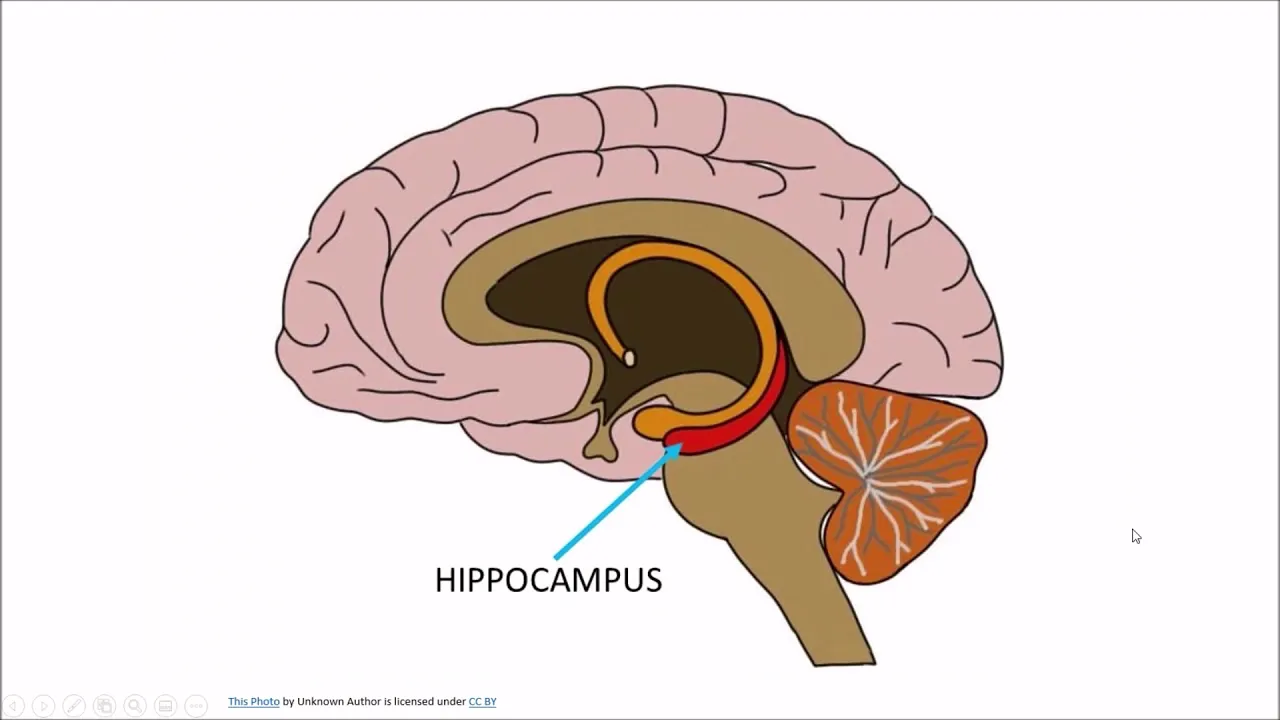
The only problem is that memory doesn't function like a objective video recording. Memory is also a reconstruction that is very much derived through emotional salience. Every time you recall a memory, the brain actively rebuilds it. This is why you may remember something and start to question yourself, was it exactly like this? Did I remember it like this last time? How come this feels different? The hippo campus helps coordinate this process by bringing together information shared across multiple neutral systems. Current emotions influence the reconstruction process and your current beliefs influence how you're perceiving the reconstruction itself. New experiences will also influence the reconstruction.
The result is a memory that feels incredibly convincing while remaining completely inflexible and fallible.
Think about how often siblings disagree about what happened during their childhood. Two people can grow up in the exact same household, share the same exact events, and tell dramatically different stories about what actually happened, and both may be coming from a place that is totally sincere with the intention of being honest. And both simultaneously may feel really confident in their recollection of the events.
Yet, each memory has been filtered through a different nervous system, a different emotional landscape, and certainly a different interpretation of the events. So then we know memory doesn't preserve reality itself. Memory preserves the meaning that you associated to it. This is one of the reasons that certainty itself can become so dangerous. Remember how on podcasts I've told you you can pursue truth or you can pursue healing. But you can't p pursue both at the same time. Naturally, if you are truly trying to rewire and heal, you have to somewhat let go of the pursuit of the truth because you will never know for sure. you cannot go back and roll back the tape. The confidence that you attach to a memory is not at all evidence of accuracy. It's just evidence of the reticular AC activating system at work. And often it reflects how many times the story has been reconstructed and key here reinforced by new things that you do. The more often you repeat the story, the more familiar it becomes. I just want to take a pause here. In my work with brain pattern mapping, the people that have two very specific brain pattern types that are highly conflictprone, highly over represented in cluster B disorders and therefore experiencing psychological mechanisms like deflection, projection, splitting, blameshifting, etc. are highly nostalgic. There's a reason for this.
The more nostalgic you are, the more you're actively replaying the memory or the story, the more you're also adding your own emotional influence and meaning and distortion into those memories. That is not by accident.
Something that feels familiar might feel like the truth, even if the important details shift over time. And I know each one of you listening or watching to this has had that experience. I swear last time I said the bicycle was blue. Why am I saying it was purple? Was it blue or was it purple? Why can't I remember? Am I a liar? This is a totally normal process. When you are trying to recall a memory that was constructed and not actually based on objective reality as perception, attention and memory interact, another process starts to emerge.
The brain actually starts to create stories. Human beings are naturally oriented around meaning making. We rarely experience events in isolation.
We instinctively try to organize them into a narrative. And for those of you that have followed this podcast and know about my work with Break Method, it is one of the primary reasons I am against narrative-based therapy. Narrative-based therapy as a whole is wildly unproductive until you know what someone's underlying brain pattern type is. So that you understand what formula is distorting their perspective of the narrative.
When we're talking about narrative construction, something happens and the brain asks the question why. A person doesn't text back. The brain asks why.
Why didn't they text me back? And what do you do? You start to fill in the gaps. You formulate assumptions. You try to anticipate what's going on in their head. Another way of saying this is you likely project. A partner can become distracted. And again, your brain's going to seek to answer why. Maybe a business deal falls through. And again, instead of waiting and sitting in the discomfort of not knowing, most human beings will construct a meaning or a reason of why. And this is entirely based on assumption. This process involves multiple brain systems including regions associated with self-referential thinking like the default mode network. These systems help create our sense of identity and our ongoing narrative about ourselves and how we fit into the world. The stories that they generate can become incredibly powerful. A delayed text message becomes evidence that you're always rejected. A difficult conversation becomes evidence that you're a failure or that no one will ever understand you. A disagreement becomes evidence that your life is doomed and you will just end up alone.
A mistake in the same way might become evidence that someone is fundamentally flawed. Once you let that story take hold, the brain starts to search for additional information that supports this.
The story in turn is influencing your attention and your attention influences the memory. The memory reinforces the story and in this way the cycle becomes self- sustaining. This is why it is a loop and this is why in break method we refer to this as the golden arches of doom which will surely only make sense to you if you've seen that lecture slide before. What began as a singular interpretation gradually starts to feel like the fabric of reality itself.
Relationships provide one of the clearest examples of how your perception shapes your experience. I want you to imagine that your husband or wife walks through the door after a long day and says, "Hey, how was your day?"
These words are pretty simple. For many brain pattern types, this would not involve any additional subtextual layers. And yet, and yet there are many brain pattern types that will give more weight to projection subtext gaps that you're filling in above and beyond their actual words. So, while this these words may feel very straightforward, the interpretation can vary very dramatically. One person might hear care, interest, and connection. Another might hear obligation. Another might hear distraction or maybe a level of criticism hidden beneath the surface.
Another might barely even notice the interaction at all. I'm one of these. I take people with their actual words and honestly that's caused a lot of problems for me because a lot of people don't mean what they say. Conversely, I say what I mean and then people decide that I meant something else that was somehow hidden underneath my words and I didn't mean that at all. I meant what I said.
And I'm I think firmly we can only be responsible for what we do, what we say, and how we show up in in objective reality. All the other things that we do with assumption and adding on meaning and subtext, it's all based on assumption. None of that's real. And when you act as if that's real and you fill in those gaps for somebody else, that is the root of most conflict that we experience in human nature.
Each person's brain contributes to its own history, formulates expectations, memories, and of course, predictions.
And this is one of the primary reasons that communication seems to be so difficult for human beings. People often assume that they're arguing about reality when they're actually arguing about somebody's interpretation.
Both individuals feel like they're responding to what actually happened, but in many cases, they're responding to what happened plus how your nervous system added on interpretation and meaning. The conversation is no longer occurring between two people. It's occurring between both of your past histories and your personal narratives.
One of the most fascinating consequences of perception is that subjective experiences rarely feel subjective in the moment. They feel objective. An anxious person rarely says, "My nervous system is interpreting this as dangerous." Although, by the way, that is one of the most freeing things you can start saying out loud and to yourself. The danger feels obvious. A jealous person rarely says, "My interpretation may be influenced by my insecurity." Like, can you imagine how your life would change if you did that instead? You noticed the jealousy and you said that instead of, "Oh my god, I can't believe she would xyz." The conclusion to you in that moment, I get it. It feels obvious. The rejected person in this case rarely if ever says, "My past experiences may be shaping my perception of this and maybe you aren't rejecting me." Because the rejection feels so obvious.
And this is one of the reasons that self-awareness is so difficult. And by the way, not necessarily a pathway to healing. The brain presents interpretations as reality. The experience arrives in your mind and consciousness fully formed.
>> [music] >> Your brain isn't broken. It's running an old code. Break method is a system that maps [music] your neurological patterns, decodes your emotional distortions, and rewires your behavior fast. No talk therapy spiral. No getting stuck in your feelings. [music] Just logic-based rewiring in 20 weeks or less. Head to breakmethod.com and see what your brain is really up to.
>> [music] >> Very few people are able to pause long enough to ask how much of what just originated is coming from their real verifiable external world versus how much is originating from your emotional interpretation itself. By the way, these are all things that we teach people to do in break method. And this is one of the things that sets you free.
And this is maybe the most important question a human being can ask themselves. The moment we begin examining perception and we create a space where we're looking at the error between what we've perceived and what the objective verifiable evidence looks like. Everything changes. It allows us to become curious instead of reactive.
It allows us to question our assumptions instead of defending them vehemently. It allows us to recognize that our experiences may feel real while our interpretation is incomplete and possibly flawed.
So by now a larger picture I'm sure is emerging for you. Reality exists. I agree with that. The external worlds exist. The third dimension like this table, this microphone, it exists.
Events occur, conversations happen, relationships unfold. But at the same time, every human being experiences these events, these people, these situations through a filter run through your nervous system and it's predicting, highlighting, interpreting, assigning meaning. All of which takes you very far away from objective reality.
So that means while reality may be shared, our experience of it almost never is. 10 people can sit down at the same meeting and they can walk away with very different versions of what happened. Just like two siblings can grow up in the same home and have two very different experiences of what childhood was like. Experiences are individualized and because they're individualized, they are subjective and often distorted.
Once this realization starts to sink in, my hope is that another question would naturally emerge. If perception is shaped by attention, memory, emotion, and prediction, what happens when the system itself becomes distorted?
What happens when fear starts to hijack your system and shape your attention?
What happens when trauma starts to shape your prediction?
What happens when shame starts to shape your entire identity? What happens when emotional pain starts influencing perception itself? These questions take us directly into selfdeception. a topic we talk about all the time on this show, emotional distortion and one of the most important conversations that we can have about the human experience.
Understanding how perception becomes distorted may be the key to understanding everything from relationship conflict to anxiety, depression, addiction, and eventually what we call mental illness. Throughout these two shows, we've established something important. While reality exists, our experience of reality is filtered through our nervous system. And that is constantly selecting, interpreting, predicting. And we've now gone very far away from objective reality. But now we arrive at perhaps the most important question that I'm going to ask of you this episode. What happens when the systems responsible for constructing our experience of reality become distorted?
This is where the conversation stops becoming primarily about neuroscience and becomes something that is deeply personal. Every human being carries fears, insecurities, emotional wounds, assumptions, and expectations. And over time, they influence what you notice, what you remember, and what you expect.
And the most fascinating part about selfdeception is that these distortions rarely feel like distortions. They feel like reality. An anxious person doesn't wake up thinking today my nervous system is going to exaggerate threat all day long. Maybe it would if you've done a lot of work. Still, that understanding doesn't solve the problem. The world is just going to feel more dangerous. You are going to feel hypervigilant. A person struggling with rejection sensitivity as an example also doesn't wake up thinking today my past experiences are going to influence my interpretation of social situations.
Rejection simply feels like it's everywhere.
Someone consumed by shame doesn't consciously decide to see themselves as defective. The conclusion arrives in a way that feels automatic. It feels based on evidence in their external world. By the way, if you listen to my episode on the psychology of shame, there's probably an underlying mechanism that you are prioritizing to make sure you get to that shame stimulus. And this is one of the reasons that self-deception is so challenging to identify.
The brain doesn't announce that it's distorting reality. It just does it. And the worst part of this for you is that it disguises itself as the truth.
Fear provides one of the clearest examples of this. Fear is an extraordinary survival mechanism.
Without it, would we survive? Probably not. Our ancestors certainly would not have survived. Fear directs our attention toward potential danger. It prioritizes becoming aware of potential threats. It also prepares the body for action on a very real physical biochemical level. Yet, the same system that protects us could also influence our perception in ways that become increasingly disconnected from baseline reality. Consider someone walking home alone at night. Their attention will naturally narrow. It's dark. Sounds seem louder. Ambiguous movements might attract your attention. You're more likely to take notice of shadowy figures in case it's a person. neutral information actually starts to take on greater significance and maybe your heart starts pounding. Something that wouldn't have bothered you during the daytime when you're surrounded by people on the street suddenly start to matter a whole lot. That is your nervous system shifting into a state of heightened awareness. This response can be incredibly useful when there's genuine danger.
But I now want you to imagine that same system is turning on in your interpersonal relationships.
A delayed text message can become a warning sign. A brief change in someone's voice tone might become evidence that a conflict is about to happen. A distracted expression becomes evidence that you're about to be rejected or abandoned.
In this way, the nervous system is still doing exactly what it was designed to do. It is identifying potential threats and attempting to prepare you for them.
The challenge is that emotional threats are far more subjective than physical threats. The brain begins filling informational gaps with prediction.
Prediction often feels like certainty.
The process becomes even more powerful when we start to examine the influence of trauma. Trauma is not simply a one singular painful memory. Trauma often alters the way future experiences are interpreted. A person who repeatedly experienced betrayal may become highly sensitive to dishonesty. A person who experienced abandonment may become highly sensitive to distance or inconsistency. A person who grew up in a state of chaos may have developed a nervous system that remains constantly prepared for instability. Years later, the original environment may no longer exist. Yet, the prediction is still active. The nervous system continues scanning for evidence that supports what it already expects is going to happen.
And this is one of the reasons that trauma becomes a self-reinforcing loop.
The prediction influences your perception. Perception influences your behavior. Behavior influences your outcomes. Outcomes reinforce the original prediction. The person feels as though they're responding to reality when in many cases they're deeply entrenched in a self-fulfilling prophecy.
The same process can be at root in jealousy. Jealousy often begins with uncertainty and scarcity. The brain encounters incomplete information and immediately starts to search for explanations.
Human beings are remarkably uncomfortable with uncertainty. The brain prefers an explanation, even if it's an inaccurate one, because the brain prefers safety and consistency over ambiguity.
And I want to draw your attention to something very important. The issue is not that your emotions are fake. Your emotions are real. The biochemical response that you are having feels real, and it is real. The biochemical response is happening, but it's happening in response to a perception that might not be real, which is why I have such an issue with this. Feel your feelings. You have to let your feelings take over.
Everyone's personal story is truth to them. Can you see what a trap that is?
The only way to the other side is to be willing to step back and see the error in our prediction so that we can see if what we're predicting has caused an emotional response that's actually not warranted right now. When we can do that, we actually free ourselves biochemically and we literally free our mind. That is how you get rid of intrusive thoughts and mental chatter.
When a person can learn the distinction between feeling an emotion and automatically assuming that that emotion is real and valid, you quite literally get set free. And one of the greatest challenges that exist for a human being is that emotional states often carry conclusions with them. The feeling and the interpretation get fused together in something that you don't know how to separate from. And the stronger that emotion feels, the more convincing your interpretation derived from that state feels. And this is where your brain's predictive nature becomes incredibly important.
Remember that the brain is constantly attempting to anticipate what comes next.
It generates expectations before your conscious awareness actually catches up.
This is why you can have a conversation with somebody and they can repeat back what they think you said to them and you're like, "Hold up. I didn't say anything like that." Their brain predicted it and filled in those gaps before they were even listening to you.
In many cases, maybe they're not even able to listen to you. When strong emotions are involved, those expectations shape perception itself. An anxious person predicts danger. A rejected person predicts exclusion. The prediction influences your attention and attention influences your interpretation. The cycle becomes self- sustaining and impossible to get out of unless you are willing to look at the error itself. And more importantly, what is the source of that error? What is the actual root cause?
This is the reason that emotional dysregulation becomes so powerful.
Disregulation doesn't just change how you feel. That changes what you notice.
It changes what you remember. And it changes what you expect forever more unless you correct it. Over time, your entire reality can be hijacked by a pattern like this.
And the deeper you explore human behavior, the more difficult it becomes to separate perception from emotion.
This is one of the reasons that so many conflicts feel impossible to resolve.
This distinction is what sits at the heart of our issue with self-awareness.
Self-awareness is not the ability to observe reality perfectly. It's the willingness to question how you're interpreting reality. It's the willingness to recognize, is there something that is distorting my perception that if corrected could make me free?
And this brings us to what I think is the most important idea in the entire episode. Selfdeception occurs when an interpretation becomes familiar and so emotionally convincing and so constantly reinforced that it doesn't feel like an interpretation at all. It just feels like the truth. And for many of you that are trapped in this sequence, you are not consciously lying. I don't hold anything against you when you're stuck in this. I've had horrifi horrifying experiences with people who I can see are deeply imshed in self-deception and even if their behavior is hurtful to me, I can still try to take a deep breath and have empathy for how painful it must be to be stuck in that level of distortion. They are experiencing a version of reality that is constructed through all the layers we've been talking about. And it is extraordinarily difficult to separate yourself from when you're inside of the system. And the longer you're in the system, the more certain that you feel it's the truth.
The more you push into this, the more you eventually have to arrive at a bigger question. If our perception is constructed, and if emotions influence our interpretation, and if memory is reconstructed, and if attention is selective, and if selfdeception can be indistinguishable from reality itself, how do I even know what's real? Mind melt. Right? This is the moment that we call reality vertigo and break method.
And I do not think you can get to a healed state without facing this head-on. And it is incredibly uncomfortable. And many people's brain pattern types will cause them to avoid going into the cognitive dissonance because it will feel like your brain is quite literally melting. And by the way, that's exactly why we're doing this episode. Because you deserve to be free, don't you? I would love that for you. I would love that for humankind. If we could all do that, I think our world would look pretty different.
So the question becomes, how do you separate your perception from reality?
How do you start to distinguish between something subjective and objective? And perhaps most importantly, does objective truth even exist?
These are the kinds of questions that have occupied philosophers, theologians, scientists, thought leaders for millennia. And to explore them, you have to be able to zoom out from the brain itself and step into some of the ideas that have plagued humanity for centuries.
Let me ask you a question. Have you ever noticed how you can know something is unhealthy and still do it anyways? You know you shouldn't react that way in an argument. You know that habit isn't good for you. You know that that thought pattern is irrational. And yet somehow your brain runs the same loop again.
This is where a lot of personal development goes wrong. Awareness alone doesn't change the brain. Repeated behavioral input does. Your brain changes through neuroplasticity through the pathways you strengthen with action, not just awareness. And that is exactly why I created Renew Your Mind. This program sits at the intersection of neuroscience, behavioral rewiring, and biblical teaching around the command to renew your mind. Inside this program, I walk through what's actually happening in the brain when patterns form, why your prefrontal cortex shuts down under emotional pressure, and how specific behaviors activate areas like the anterior midsulate cortex, which is responsible for resilience, discipline, and the ability to push through discomfort. But the most important thing we talk about is pattern opposition.
Because if you want a new life, you can't keep feeding the same neural pathways that created the old one.
Scripture says, "Be transformed by the renewing of your mind." But most people were never taught how to actually do that. Renew your mind gives you the framework to begin interrupting destructive patterns, strengthen your ability to regulate emotion, and builds the emotional resilience that is required to become a new creation. If you've ever felt like your reactions, habits, or emotional patterns are running your life instead of the other way around, this program was built for you. Renew Your Mind can be accessed at stan.store/busygold.
Some of these include Plato's cave, consciousness itself, how what is it?
How is it constructed? What is simulation theory? The observer problem, the double slit experiment. We know the world that we experience is filtered through layers of biological processing.
We've learned about sound and touch and pain and memory and how attention is selective. But this naturally leads us to one of the oldest questions humanity has asked itself. If our experience of reality is constructed, how much of reality are we actually seeing? And is reality even real?
Long before neuroscience existed, long before we had technology like brain scans, long before even the invention of modern psychology, philosophers were asking themselves these questions. And one of the most famous examples comes from Plato. More than 2,000 years ago, Plato described a thoughtful experiment that remains astonishingly relevant today.
Imagine a group of prisoners and they've spent their entire lives inside of a cave. They're unable to turn around.
They can look at the wall. They can look in front of them. Behind them burns a fire.
Between the fire and the prisoners, people walk back and forth carrying various objects. The prisoners can't see the fire. They can't see the people.
They can't see the objects. They can only see the shadows cast on the wall.
For the prisoners, their only reality is conceptualized of shadows on the wall.
It's all they've ever known. Now imagine that the prisoner escapes for the first time. He sees the fire. Then he sees the objects that cast the shadows against the fire. Eventually he leaves the cave and he sees the outside world for the first time. Suddenly he realizes that everything he once believed was real was only a partial representation or an abstraction of something much larger.
When he returns to tell the others, they reject this explanation. The shadows still feel more real than his own story.
Plato's question never really had anything to do with caves. It was all about perception. And it was about the possibility that what feels obvious may be a very limited representation of our true experience and concept of reality.
When you think about everything that we've discussed so far, I think Plato's story starts to feel remarkably modern and timeless. each of us attempting to understand our reality through the information available to us which we know is limited and subjective and individualized.
The question becomes are we willing to examine the limitations of these interpretations?
And the deeper you explore perception, the more you encounter the mysteries that might even be stranger.
Who exactly is experiencing all of this?
Scientists will describe neurons firing.
They can identify networks communicating with each other. They can measure electrical activity. They might even be able to map regions of the brain that are connecting with each other. But what remains surprisingly difficult to explain is why those processes are accompanied by a subjective experience.
Why is there something that feels like you?
Why does red look red? Why does music feel beautiful to one person and harsh to another?
Why can love feel meaningful or it can feel harsh and scary? And the question is often referred to as the hard problem of consciousness.
The challenge is not explaining the how of the processing. It's explaining how the information processing somehow translates to a subjective experience.
By now you're probably thinking, "Well, Bizzy, this is probably where the soul spirit comes in." And believe me, I agree with you. It's a hard thing to quantify when you're talking about the realm of natural sciences.
At some point, we know that matter becomes awareness. And at some point, electrical activity becomes experience.
At some point, a collection of cells starts to ask questions about its own existence. Right? It's one of the first processes of differentiation that we go through when we're a baby. When we start to realize, I am distinct from my sibling. I am different from my mom and dad. A boy is different from a girl. How do we become sentient? And despite all of our scientific advances, we still have no idea really how this happens in a concrete way.
The mystery of consciousness itself has led people in a vast number of directions. And some like to approach it through neuroscience, others through philosophy, and others are cool with it just remaining a mystery. I tend to be much more of the camp, and I talked about this in my very last lecture of Renew Your Mind. I understand as a believer personally, a believer of Jesus Christ of Nazareth, I understand what I see to be fundamental pieces of the truth of who he is, what he is, why he came here, and why human beings are here, and what our purpose is. Outside of those fundamental truths, I'm okay with so many other things being a mystery. I don't feel like I have to know. I've let go of that a long time ago.
So, for me, I don't feel like I have to fit those mysteries into a specific box or paradigm. I'm okay with doing my digging and feeling somewhat reasonably settled, but knowing fully, I may never know. But some of you aren't like that. Some of you do want to know the truth. So, let me share with you one more concept that might additionally melt your mind. Have you ever heard of simulation theory? I've taught a whole lecture on how I think simulation theory proves God, but we'll put a pin in that one. Maybe I'll post that later. That was from many, many years ago.
Simulation theory is often misunderstood because it's represented, I think, in the most sensationalized way possible.
You always think about it relevant to kind of like a a game and somebody coding a game, etc. We think about it in kind of a dystopian technological way.
and most people hear the phrase and immediately start to think about elaborate conspiracy theories. The idea of it actually is much more philosophical.
The modern version of simulation theory became widely discussed after philosopher Nick Bostonramm proposed a thought experiment known as the simulation argument. Boston suggested that one of three possibilities is likely true. Either advanced civilizations never survive long enough to develop incredibly sophisticated simulations, or advanced civilizations do survive, but have little interest in creating simulations of their ancestors.
Or advanced civilizations eventually create enormous numbers of simulations, in which case simulated beings could potentially outnumber other biological beings.
This argument does not claim that we are definitively living in a simulation. The argument simply asks the question, if simulations became sufficiently advanced, would we know the difference between reality and a simulation?
I just want to take a pause here. I have always been kind of anti-VR. And by the way, like very much still am. But I will say when I was in Miami for some podcast interviews a couple maybe like a month ago, I took my son Zev with me and he loves VR and all that stuff. And I took him to an indoor amusement park and I finally begrudgingly agreed to do a couple of these VR games with him. The part of it that is so disconcerting to me is how quickly you can actually sync with the new reality. There were a few times I had to take off the goggles because I could feel myself panicking. It's actually far too easy once all of your senses are taken over by this virtual reality. It is far too easy to completely slip off that edge. We did one game where you like sit in something and it moves you and there's all these things happening while you have the goggles on. That was the one where I had to keep taking the goggles off cuz I was like this is this is too much for me. When you do something like that, you realize it's not that much of a stretch that this potentially could be a simulation.
And we are effectively avatars. If you've ever seen the movie Avatar, we don't really understand our soul spirit in a tangible science-based way. We don't understand how that works with consciousness and our physical body avatar. We don't definitively know those things. I think a lot of people have great theories. I feel like I have some great hypotheses, but we don't know. And when you put on VR goggles and you do something like that, you realize pretty quickly like, woo, that is disconcerting. That actually could be real.
So whether simulation theory is correct is much less something that matters to me. The reason that I think people find simulation theory compelling is that it points us to a deeper uncertainty. How much of our reality are we experiencing directly versus how much is projected and and constructed?
What's fascinating is that neuroscience actually gives us a pretty complete version of this answer. Every brain is continuously generating an internal model of reality. Your experience of color is generated within your nervous system. Your experience of sound is generated inside of your nervous system.
Your experience of meaning is generated within the nervous system. So in a very real sense, every human being is already living inside a neurological model of reality. So in essence, you are living in a simulation. Reality exists.
Yeah. The brain generates a representation of it though and that representation becomes what you experience. Simulation theory simply just pushes this further and perhaps expands it over a longer period of human history. The same thing happens when we start to look at modern physics, especially quantum mechanics. Quantum mechanics is frequently used to justify all sorts of claims that it was never intended to support. People hear terms like the observer effect or the uncertainty principle or quantum fields.
Then they conclude that thoughts directly create reality.
The actual science of this though is extremely complex and much more interesting than that. Quantum mechanics reveals that reality behaves in ways that challenge our intuitions. At microscopic scales, matter behaves differently than our everyday experiences would suggest. Probability also plays a very fundamental role here.
Uncertainty is not built into the system. Particles and waves do not always behave in the way our common senses would predict. The lesson here is that reality may be far stranger than we're even able to perceive of right now in this moment. And the truth is the deeper we look, the more humility has to become necessary. Again and again, science continues to reveal the same pattern. We thought the Earth was the center of the universe. Plot twist. It's not. Human perception is not a perfect representation of reality. Memory is not a recording. Emotion is not based on objective truth. And your observer has some pretty significant limitations.
And perhaps the greatest of all the limitations is the experience of certainty itself.
Certainty creates an illusion that we've reached the end. We've arrived. And curiosity keeps that conversation open.
And this is where all of these ideas start to converge. Plato's cave, consciousness, simulation theory, quantum mechanics. Human beings are attempting to understand reality through a very limited perceptual system.
So the question is, do you treat it as the infallible system that it surely is, or are you walking around daytoday treating it as absolute truth?
Do you assume that your experience is reality itself?
Do you recognize that your experience may be actually one layer at least removed from what actually is?
If perception is subjective and our experience is constructed, if interpretation shapes our reality, and if certainty is misleading, does objective truth still exist? I think this is why so many people eventually arrive at a pretty profound crossroads.
Some conclude that if everything is subjective, then therefore nothing can truly be known. And in a way, I feel like that somewhat mimics my you can pursue truth or you can pursue healing, but you can't pursue both at the same time. Others go the other way and they become increasingly rigid and cling even harder to needing certainty. I think that neither approach fully addresses the depth of the problem.
So the real problem becomes how can we hold these two ideas simultaneously?
Can our perception be limited and truth can also exist? By the way, I do believe that truth exists. I think for me this is where I have a very deep and important understanding of the Bible that is critical to the framework of how I see the world. And that's not through some legalist religious perspective.
I in fact I would say I've constructed and deconstructed and constructed and deconstructed again. So it's certainly not coming from a paradigm of religiosity or legalism.
But for me the paradigm of the Bible helps me understand these two truths are separated on different dimensions.
And when we can understand the relationship between these two ideas, I think you end up embarking on a deeper meaning of what it means to be human. So the question I want you to think about is how do you move to align yourself more closely with the truth rather than step into the distortion? Because that is ultimately what's happening to most of you day in day out.
When we get to our next episode, which is certainly an episode I've been really excited about for a really long time, we're going to be starting off at this question, formulating a hypothesis, and pulling that string from there. Because if we're trying to ponder, does truth exist? Is reality even real? Eventually, we have to get ourselves to a place where we're willing to ask a question.
What is mental illness?
>> [gasps] >> And if we can figure out what is the mechanism of mental illness, can that be corrected? And can we correct that in a way that allows these two simultaneous truths to exist?
That's where we're going to catch up on our next episode. What is mental illness? I hope you will join me as we unfold these building blocks and ask ourselves some challenging questions.
So, I hope that this episode didn't melt your brain in a negative way.
Ultimately, we are going somewhere.
We're building the building blocks to get to, I think, one of the most important episodes I've ever done about what is mental illness. And obviously, I'm speaking from a place of hypothesis, and I will bring receipts. And I'm also perfectly comfortable with knowing that our our best guess may be all we ever have, and we have to organize around that place. So, I hope that you will come with me and share this podcast with somebody who needs it. And I'll see you guys next week.
Related Videos
8:08
Neuroscience
What is neurodegeneration?
TheSheekeyScienceShow
3K views•2019-08-19

57:35
Neuroscience
IPL - Ruth Empson "Mind the Gap"
otagouniversity
251 views•2019-07-08

14:01
Neuroscience
How our body shapes our mind | Pancho Tolchinsky | TEDxNapoli
TEDx
2K views•2019-12-05
1:00:02
Neuroscience
Impact of Early Life Deprivation Danielle Stolzenberg Marcus Pembrey Bruce McEwen
uctv
4K views•2019-12-01
10:32
Neuroscience
β-Caryophyllene for Parkinson’s: Protecting Dopamine & Easing Symptoms
parkinsonsdiseaseeducation
6K views•2025-08-09
20:44
Neuroscience
New Insights from Inside the Brain with Rodrigo Braga, PhD
NUFeinbergMed
421 views•2025-04-14

9:57
Neuroscience
Highlights for dystonia • 2025 MDS Congress
movedisorder
145 views•2025-10-27

58:17
Neuroscience
Animal Welfare Synergy Series: Dr Tom Smulders on hippocampal neurogenesis
costactionlift
135 views•2025-07-14
Trending

13:38
Law
WOW! Judge TURNS THE TABLES on Trump in His OWN $10B LAWSUIT!!!
MeidasTouch
197K views•2026-07-23

13:25
Business
Playstation NO DISC/NO BUY Fight Is Over...
DavidJaffeGames
4K views•2026-07-23

22:40
Business
Steam and Xbox Just Dropped The Hammer On PlayStation
OhNoItsAlexx
9K views•2026-07-23

16:52
Anthropology
Americans Confused in Australia for 17 Minutes Straight
IWrocker
17K views•2026-07-23