This video offers a lucid explanation of how neurogenesis and hippocampal development prioritize brain architecture over early memory retention. It effectively illustrates that while our infancy is consciously forgotten, it remains biologically etched into our subconscious identity.
Install our extension to search inside any video instantly.
Why You Can't Remember Being a Baby
Added:Imagine this, someone places a photo in front of you. It's your first birthday.
You're smiling. There's a cake on the table. Your parents are laughing.
Balloons float above your head. Everyone in the room remembers that day, except one person, you. You were there. You saw everything with your own eyes. You heard every voice. You felt every hug. And yet, it's completely gone. Not blurry, not faded, gone. Now, think about how strange that really is. You can remember a conversation from last week. You might even remember your first day at school, your favorite childhood toy, or the house where you grew up. But, your first birthday, your first steps, the first word you ever spoke, the moment you learned your mother's face, nothing.
It's as if the first 3 years of your life were erased from existence, but they weren't. Those years shaped almost everything about who you are today. Your personality, your fears, your language, your emotional habits, even the way your brain understands the world. The most important years of your life are also the years you can never remember. Why?
For over a century, scientists believed childhood memories simply faded with time. That explanation sounds reasonable. After all, old memories disappear. But, it turns out that's not what happens. The truth is far stranger.
Your brain wasn't failing to store memories. It was building itself. And, in the process, it sacrificed your earliest experiences so that a better memory system could emerge.
Understanding why reveals one of the most fascinating mysteries of the human brain. Imagine trying to write an entire novel while the pages are still being printed. Every sentence you finish is suddenly rearranged because new pages keep appearing. That's something like what your infant brain is doing. When you're born, your brain already contains around 86 billion neurons, but those neurons are far from organized. Over the first few years of life, your brain creates millions of new connections every second. Scientists estimate that during early childhood, more than 1 million new neural connections can form every second. It's one of the fastest periods of development anywhere in nature. Your brain isn't simply learning, it's wiring itself. Roads are being built, old roads disappear, entire neighborhoods are redesigned overnight.
Imagine trying to remember where you parked your car while someone keeps moving every street in the city. The information isn't necessarily lost. The map itself keeps changing. This is why babies learn so quickly. Watch a 1-year-old for a single day. They recognize faces, they learn sounds, they experiment with objects, they watch people constantly. Every experience teaches something new. To an adult, opening a door isn't interesting. To a baby, it's a scientific experiment. What happens if I pull? What happens if I push? What happens if I let go? Their curiosity isn't endless because they're trying to be clever. It's because their brain is collecting the rules of reality itself. Gravity, balance, language, faces, emotions, cause and effect.
Everything adults take for granted must be discovered from scratch. In many ways, babies are the greatest learners our species has ever produced. But here's the strange part. Even though babies won't remember these experiences later, they absolutely do remember them in the moment. If you repeatedly show a 6-month-old the same toy, they quickly recognize it. If someone smiles at them every day, they learn that face. If a sound predicts food, they'll anticipate it. So, babies clearly have memory. The question isn't whether they can remember, it's why those memories disappear. The answer lies inside a tiny structure buried deep within your brain.
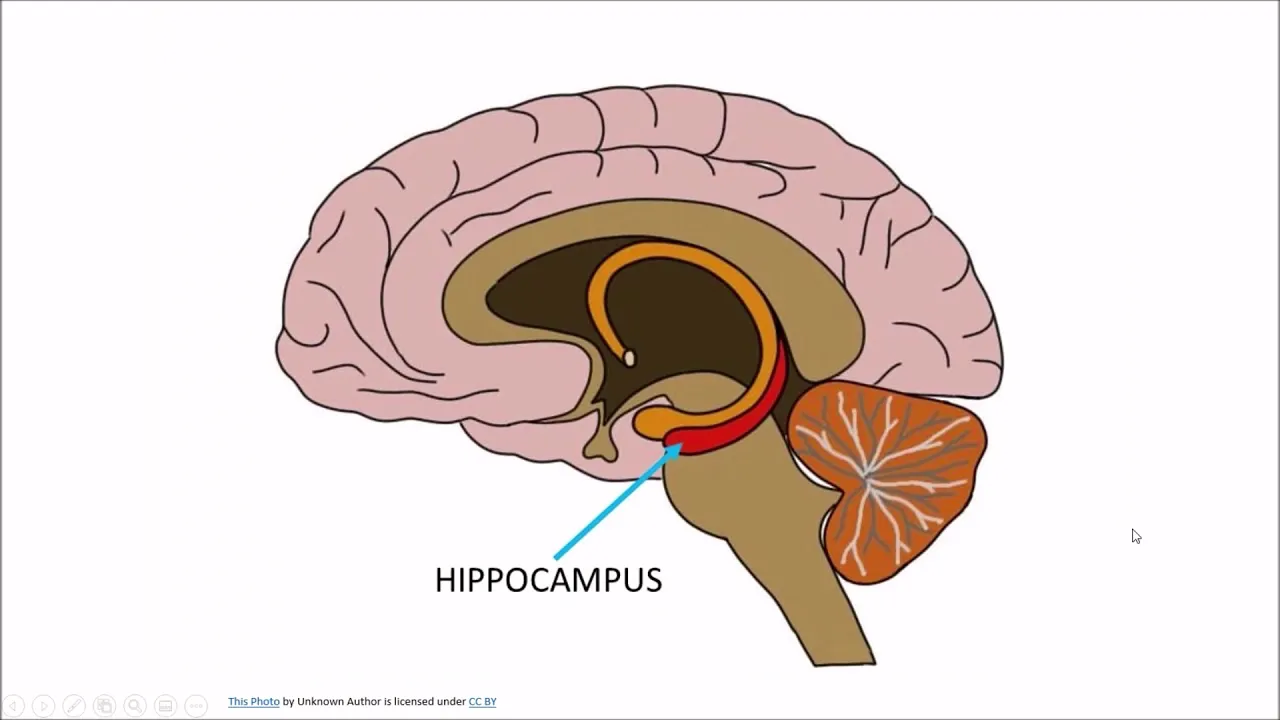
It's called the hippocampus. Think of it as your brain's librarian. Every important experience arrives at the library. The librarian decides what should become a long-term memory, but in babies, the librarian is still under construction. The hippocampus continues developing throughout early childhood.
It works well enough to help babies learn, but it isn't yet mature enough to organize memories in the way adult brains do. Imagine building a giant library while people are already trying to check out books. Books are constantly being moved, shelves are unfinished, labels keep changing. The information exists, the organization doesn't. Then something even more surprising happens.
During infancy, your brain produces enormous numbers of brand new neurons.
For many years, scientists believed humans stopped growing brain cells after birth. Today, we know that isn't true.
Parts of the brain continue creating new neurons, especially early in life. This process is called neurogenesis.
At first, that sounds wonderful. More brain cells should mean better memory, but experiments with animals revealed something unexpected. When neurogenesis is extremely high, older memories become harder to preserve. Imagine carefully arranging dominoes across the table.
Now, imagine someone keeps adding hundreds of new dominoes every minute.
Soon, the original pattern begins changing. Not because it was wrong, because the entire system is expanding.
Some neuroscientists believe this constant remodeling helps explain infantile amnesia, the inability to remember our earliest years. Ironically, the very process that allows babies to learn so rapidly may also erase the memories formed during that time. Your growing brain chooses flexibility over permanence, language also plays a surprisingly important role. Think about one of your strongest memories. You can probably describe it with words. You know where it happened, who was there, what people said. Words help organize experience. Before children develop language, experiences are mostly stored as sensations, warmth, cold, fear, comfort, movement, sound. They experience life fully, but they lack the narrative structure adults use to preserve memories. Imagine watching a movie without subtitles, chapter titles, or character names. You would still experience every scene, but years later telling the story would be much harder.
Language gives memory a filing system.
Before that filing system exists, experiences are much more difficult to retrieve later. Yet, your early years never truly disappear. You may not consciously remember learning to walk, but your muscles do. You don't remember learning your first language, yet you speak it effortlessly. You don't remember learning whether the world felt safe, but your emotional brain often carries those patterns for decades.
Psychologists distinguish between explicit memories, the ones you can consciously recall, and implicit memories, which shape behavior without conscious awareness. Your earliest years are filled with implicit memories.
They're invisible, but incredibly powerful. They influence trust, stress responses, relationships, confidence, even your reactions to unfamiliar situations. The memories may be inaccessible, their effects remain.
Perhaps that's the greatest illusion of childhood amnesia. We assume forgotten means unimportant. In reality, the opposite may be true. The years you can't remember helped build the person who remembers everything that came after. They taught your brain how to recognize love, how to understand language, how to navigate the physical world, how to connect with other people.
Long before you formed your first lasting memory, your brain was quietly writing the instruction manual for the rest of your life. And maybe that's why those memories were never meant to be revisited. They weren't stored as stories. They became part of the storyteller. The first years of your life weren't erased. They became you.
Related Videos
8:08
Neuroscience
What is neurodegeneration?
TheSheekeyScienceShow
3K views•2019-08-19
57:35
Neuroscience
IPL - Ruth Empson "Mind the Gap"
otagouniversity
251 views•2019-07-08
14:01
Neuroscience
How our body shapes our mind | Pancho Tolchinsky | TEDxNapoli
TEDx
2K views•2019-12-05
1:00:02
Neuroscience
Impact of Early Life Deprivation Danielle Stolzenberg Marcus Pembrey Bruce McEwen
uctv
4K views•2019-12-01
10:32
Neuroscience
β-Caryophyllene for Parkinson’s: Protecting Dopamine & Easing Symptoms
parkinsonsdiseaseeducation
6K views•2025-08-09
20:44
Neuroscience
New Insights from Inside the Brain with Rodrigo Braga, PhD
NUFeinbergMed
421 views•2025-04-14
9:57
Neuroscience
Highlights for dystonia • 2025 MDS Congress
movedisorder
145 views•2025-10-27
58:17
Neuroscience
Animal Welfare Synergy Series: Dr Tom Smulders on hippocampal neurogenesis
costactionlift
135 views•2025-07-14
Trending

13:25
Business
Playstation NO DISC/NO BUY Fight Is Over...
DavidJaffeGames
4K views•2026-07-23

22:40
Business
Steam and Xbox Just Dropped The Hammer On PlayStation
OhNoItsAlexx
9K views•2026-07-23

16:52
Anthropology
Americans Confused in Australia for 17 Minutes Straight
IWrocker
17K views•2026-07-23

20:36
Business
SuperBike Factory Has Gone... What's Next for the Motorcycle Industry?
thatbikersimon
11K views•2026-07-22