This partnership marks a critical transition from trial-and-error laboratory screening to deterministic physics-based simulation, potentially solving the long-standing efficiency crisis in drug development. It effectively reframes the search for new medicines as a high-speed engineering challenge rather than a game of biological chance.
Install our extension to search inside any video instantly.
SandboxAQ CEO on Nvidia deal: Creates screening tool to help drug developers identify candidates
Added:Joining us now to discuss in a CNBC exclusive [music] is Sandbox AQ CEO Jack Henry. Jack, welcome back. It's good to have you. Tell us about this this new partnership.
>> Uh very excited about this Nvidia partnership. It's being announced today.
We're breaking news here on Squawk on the Street uh at Bio. Bio is the 20,000 person conference in San Diego focused on the biopharma industry. We're really excited about this partnership because it allows uh drug companies, biotech companies, and medical centers and researchers to use a combination of BioNeMo, which is a really strong platform from Nvidia for the biopharma market, and AQ state. AQ state is a large quantitative model from uh Sandbox AQ, and it really helps drug researchers, drug discoverers figure out in particular whether a drug will work against the GPCR. That's the protein that you go for in Ozempic, in Mounjaro.
In fact, Sarah, more than 30% of all new drugs that are going in front of the FDA are focused on this target in the body, GPCR, and that's where we're focused in this partnership of Nvidia and Sandbox AQ.
>> So this is new. We've never been able to do anything like this before?
>> Um the it took literally over a decade decades in some cases to hit this target before, and that led to Ozempic, that led to Mounjaro. Now there's a whole new class of drugs that want to hit this target, and with this virtual screening tool, instead of taking years to decades in the laboratory, we can do this in weeks and months to screen for the kind of molecules known as ligands that will actually bind to the GPCR protein. Uh what's new about this is not only can we figure out whether it will bind and how it will bind, but also whether it's going to turn on on the protein or turn that protein off. In the case of Ozempic, you want to turn it off so that you control hunger uh in the case of diabetes as well. In other cases, you may actually want to turn it on. And so those are agonists and antagonists. And this is a breakthrough between Nvidia and their BioNeMo platform and our AQ state, one of our quantitative models.
As you know, we really have to go beyond language models if we want to tackle the biggest problems in medicine.
>> So how how who will use this? The any biotech company?
>> Yeah, biotech companies, quite a number of companies will be at Bio, and Nvidia will be announcing some of the companies that are already starting to use this combination. Drug companies, researchers in the academic setting will also be using it. It's downloadable.
People can start to use it. The combination of AQ state from Sandbox AQ and BioNeMo. And the reason why this is so novel is that these are physics-based models.
Uh Jensen has often talked about AI for the real world, physical AI. This is part of that ballgame where we're not talking about training on language, we're talking about training on the actual science and physics of our world.
That's what delivers this new breakthrough announced today.
>> There's a really interesting piece this week on the tape, Jack, about Lilly. And David Ricks points out there only have been like 4,000 publicly approved drugs, but Lilly alone has more than 3 million failed drugs. So it seems like there's so much just I mean, low-hanging fruit once you can get this space infused with technology.
>> Carl, that's exactly correct. The reason why it's been so difficult in drug discovery is that it takes so long to synthesize each potential new candidate drug, test it in a laboratory. Now we can move to virtual screening and testing, but with models that are really high fidelity with our bodies, with the receptors in our actual human physiology. This is really a fundamental new way of discovering drugs, not just cutting down on time, but Carl, to your point, moving away from drugs that will not work, that won't have the binding affinity, uh that won't have the right mechanism of action to ones that do. Uh really excited to announce this today with Nvidia.
>> I mean, you you work with all sorts of enterprises, Jack, in all different industries, from the oil and gas industry to the consumer industry, and and increasingly biotech and healthcare.
Is this Is this the biggest, most promising sector, do you think, for you in terms of how technology changes the way we have innovation?
>> biotech and healthcare is really exciting, big impact on humanity, big sector, big TAM, of course.
I and Lilly and many others uh starting to use these kinds of tools, but also, let's look at material science. We just announced uh in the last week uh the award of the CHIPS Act uh to Sandbox AQ a $500 million uh this takes the same kind of tools, it's the same REACT platform from Sandbox AQ that underpins the work we're doing with Nvidia on bio. Same platform, now focused on the chip sector, on making sure that we can develop and produce semiconductors in the United States of America. And that means that we've got to have battery chemistry that's novel, that doesn't use sources from overseas. It means magnets, it means catalysts, and it also means the breakdown of PFAS. PFAS, Sarah, as you know, are those forever chemicals that are the byproduct of semi production. If we're going to scale semis production in America, we've got to have a way of breaking those down, and our platform has been proven to make that happen. So, really glad to see that $500 million award from the CHIPS program of the Department of Commerce to Sandbox AQ specifically focused on material science. So, I would say that both bio, biopharma, and these kinds of targets like GPCR really expansive areas now for new molecules, new drugs to help us with all the diseases that face humanity, but also now looking at material science, specifically in semiconductors, batteries, magnets, and PFAST breakdown, which is fundamental to our environment and to scaling these industries.
Related Videos
51:25
Biotechnology
EAStalk “Electrochemical sensors as a platform for improving Animal Welfare” with Dr Sofia Teixeira
euraquaculture
176 views•2025-06-20
10:06
Biotechnology
Cesare, son of San Mauro (eng)
AkuOutdoorFootwear
608 views•2016-02-03

0:47
Biotechnology
Why Gen Z is Taking Creatine (It's NOT for Muscle Growth)
Michealhealth
830 views•2026-04-22

43:57
Biotechnology
Guillaume Durin - Catch and Release - Extraction and Purification of NGS Grade DNA and RNA from FFPE
Labroots
851 views•2015-01-27
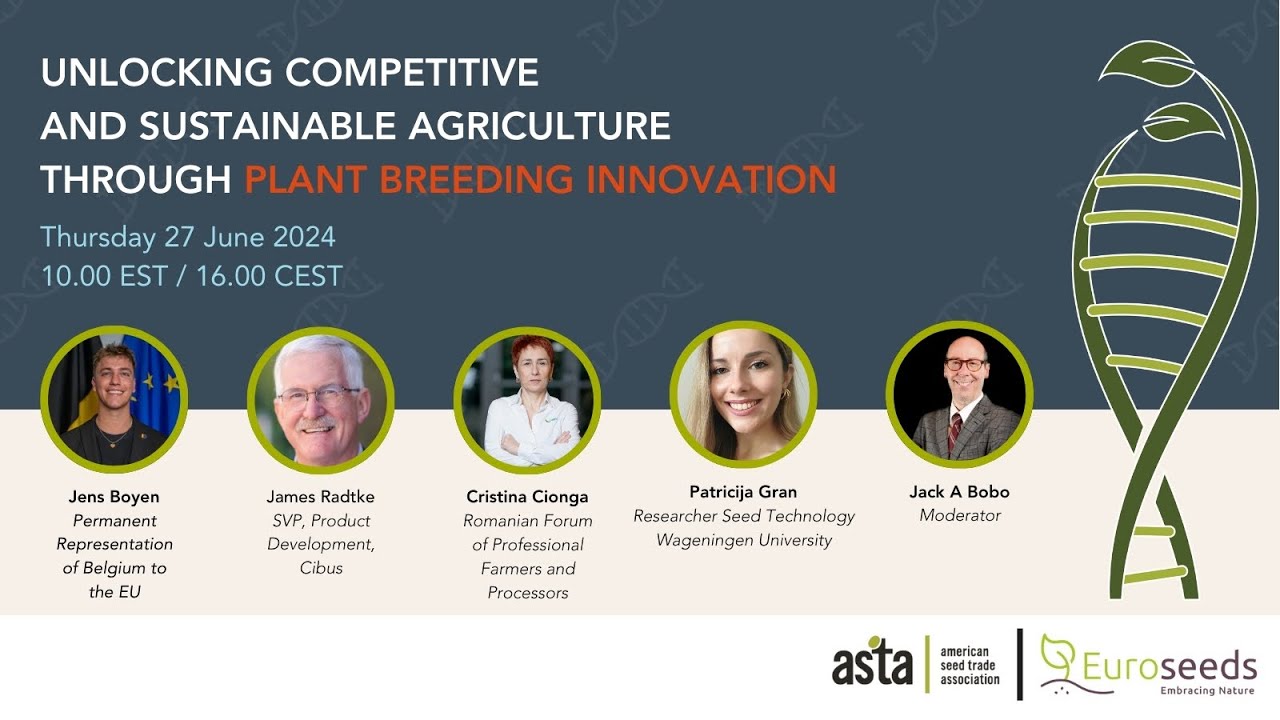
1:13:59
Biotechnology
Webinar: Unlocking Competitive and Sustainable Agriculture Through Plant Breeding Innovation
americanseedtradeassociati3281
319 views•2024-06-28

2:08
Biotechnology
AI in neurology: predicting protein structure
VJNeurology
622 views•2023-07-06
2:42
Biotechnology
Stevia Innovative technologies for cost effective and sustainable production of Reb M
ingredionemea201
207 views•2023-03-14

2:27
Biotechnology
Biological Effects of Radiation
CDC
551K views•2015-08-27
Trending

13:38
Biology
Gremlin Arrives… While Dorothy May Takes Another Step Forward
The-moons
10K views•2026-07-23

13:25
Business
Playstation NO DISC/NO BUY Fight Is Over...
DavidJaffeGames
4K views•2026-07-23

16:52
Anthropology
Americans Confused in Australia for 17 Minutes Straight
IWrocker
17K views•2026-07-23

15:34
Political Science
FURIOUS Raskin CORNERS DOJ over Trump DARK PAST!!!!
MeidasTouch
237K views•2026-07-23