The US-Iran framework agreement has created significant tension in US-Israel relations, as Israeli politicians including far-right cabinet members criticize the deal for potentially compromising Israeli security interests, prompting Vice President JD Vance to rebuke Israeli critics by warning them not to alienate the US, which he characterized as Israel's 'only powerful ally' at this moment.
Install our extension to search inside any video instantly.
Could Vance's rebuke of Trump's Iran deal critics signal a shift in US-Israeli ties? | DW News
Added:The US Iran agreement is now in force.
The deal does call for ending military operations on all fronts, including in Lebanon. Although Israel has not promised to withdraw from Lebanon and is not part of the agreement, Israeli politicians say the deal is bad for Israeli security. Well, Washington has not reacted nicely to their criticism.
Vice President JD Vance signaled that critics should be more careful what they say.
>> Donald J. Trump is the only head of state in the entire world who is sympathetic to the nation of Israel at this moment in time and he happens to be the head of state of the world superpower. If I was in the cabinet of the Israeli government, I might not be attacking the only powerful ally that I have anywhere left in the entire world.
>> So where does this leave USIsraeli relations? For more, I'm joined by Natan Saxs, senior fellow at the Middle East Institute who specializes in US and Israeli foreign policy. Natan, good to have you with us.
>> Pleasure to be with you. Thanks for having me.
>> So JD Vance saying there that Donald Trump is the only head of state sympathetic to Israel, which isn't really true. But let's let's go to his focus here, which is basically the message, don't attack your best friend in the schoolyard, especially when your best friend is also the toughest kid in class. How unusual is this kind of language between the US and Israel?
>> It's unusual. It's not unprecedented, but it is very unusual. And it's extremely unusual from the Trump administration towards the Netanyahu government. So, we have seen clashes in the past. We can go all the way back to 1975 with very harsh words from President Ford and um Secretary of State Kissinger towards Israel through Reagan and begging through George HW Bush and the Israeli leadership. But this is a different case here. Uh what JD Vance is saying is not completely accurate, but there's a kernel of truth there. The United States is standing with Israel at a time when Israel's standing in the world has taken a precipitous drop. And Netanyahu has brought Israel to to genuine isolation that we haven't seen in many years, in fact decades, with the sole and extremely important exception being the United States headed by Trump.
So there's a real moment of tension, but the backdrop of it is this isolation of Israel and yet this very close alliance until this moment with Donald Trump. It is a dramatic moment in that regard. And this these tensions are very notable.
>> Could the US really cut Israel loose over comments from Israeli cabinet members?
>> I don't think so. And of course cutting loose, it depends what that means. In some regards, the Israelis uh the Israeli leadership and especially the commentariat that is associated with Netanyahu in his camp already feel that that has happened that Trump has essentially um set aside Israeli security interests and moved on trying to cut his losses, open the streets of Hormuz Hormuz and move on regardless of Israel's security concerns. And of course, there are some fundamental differences in interest here. Israel, for Israel, Hisbala is not far away and it's not going away. Okay, it's not disappearing just because it's inconvenient. The question of Hisbala attacks on Israel and Israeli incursion now into Lebanon, that is going to stay with Israel for a long time, even if the United States can't afford to look elsewhere. But this can still become much worse of course for Israel. Donald Trump is known for being lavishing with his friends and certainly Israel has gotten very very close support, unprecedented support in the past war with a joint war, something we've never seen in the past. But he's of course also well known for being able to turn on someone he he believes is unloyal, disloyal or someone who turns on him.
And so the Israelis are very covetous of the carrots of the relationship with Trump but very fearful of the sticks and with good reason.
>> Let's talk about the alliance specifically with Netanyahu because JD Vance emphasized that he was not criticizing Netanyahu himself. Netanyahu meanwhile came out to emphasize that US-Israeli relations are vital in his words despite a lot of dissatisfaction in Israel. I'm I'm just wondering Natan, what do you think is going on in Netanyahu's mind right now?
Netanyahu is in between a rock and a hard place. He's led Israel now in over two and a half very bloody years of war and as I mentioned before also precipitous decline in Israel standing in the world against enormous opposition in what he thinks is a war of liberation from the Iranian threat. The ring of fire as the Iranians call it around Israel with Hisbala but of course also Hamas which started this whole war and all that with elections in Israel coming uh and with this very tenuous relationship with Washington. So he's very fearful of losing support from Trump. Fearful both in geostrategic strategic terms but also domestic political terms. It's very important for him to be able to portray to Israelis that he's the one who can deal with Trump more effectively than anyone in the opposition. At the same time, the disappointment in his own camp with this deal is profound. In fact, throughout Israel, not only on the right wing, is quite profound. And so he finds himself in a very difficult situation. Not for the first time. And I think one of the top priorities for him right now is to make sure that Donald Trump who has spoken about Netanyahu in recent weeks using the f-word many times that Donald Trump is not too angry and can forgive what Nathan what Trump probably sees as different interests as Netanyahu sometimes stretching it going alone. Uh that Trump can see Nathaniel still in his camp and we've heard some words of that in recent days that perhaps the rift is not as bad as it could be. But that is a very serious concern for Netanyahu, a very important one.
>> What what other signs of this rift are are you seeing though?
>> Well, at the at the surface level, we see the rhetoric. We see the rhetoric from JD Vance, who is not was never a big fan of Israel and is not really a champion of the relationship with Israel. Well, we've also seen from Donald Trump, who's been extremely close to the Netanyahu government and has promoted Israeli interest both in his first term and now in his second, culminating again with this very dramatic step of actually going to a joint war, something the US has never done. and from him. We've heard the f-word multiple times, but also criticism, not just in style, but in substance on Israeli attacks in Lebanon, especially criticizing just this week that um Israel should not be taking down a whole apartment building just because they're going after one person. So, very tangible critiques and even saying that perhaps Syria should take care of Hzbalah, something which Syria of course is not interested in doing, but saying that they might be able to do a better job than Israel. So real frustration with with actual uh policy not only on the on the style but more fundamentally this agreement thisou with Iran means uh at a very important geostrategic level the United States preferring uh its own interests and global interests understandably so I should say and opening the states of Hormuz which has enormous implications for the global economy over the stated goals that Trump and Netanyahu had in going into this war this big gamble uh which at best would have brought in their mind would have brought regime change in Iran but at the very least would have dealt very concretely with a nuclear issue with proxies in the region like Hisbala with the ballistic missiles and now we hear Trump saying that Iran needs to have ballistic missiles because Saudi Arabia and others have them uh there's nothing about Hisbalah in the agreement and even the nuclear issue which Trump has spoken of so many times even that is postponed to negotiations that are supposed to end within 60 days But that could be 60.
That could be also 100, 600. We don't know how long that will actually be.
>> Right. You're mentioning the the nuclear agreement. There are a lot of things that many people in Israel, especially politicians, are not happy with, especially concessions to Iran that are in this deal, which Israel is not a part of. I want to I want to talk a little bit about uh the the tone of the relations though between these countries and and how much trust there is at this point. JD Vance also shared more criticism of Israel in an interview he did with the New York Times. He said, "I find this whole freakout in Israel a little bit odd because I think that it comes from a place of mistrust and I think that America has earned the trust of that region in the world."
Natan Vance seems to think that Israel doesn't trust the US at this point. Is he right?
No, I think he's wrong. I think Israelis by and large trust the United States very much, but they do correctly see that the United States has different interests. And of course, it does. Um, what they really do not trust is Iran.
And this agreement uh seems to to hinge on Iran's declaration or reiteration of things that said in the past that it will never pursue a nuclear weapon. The Israelis believe that they have shown concrete evidence that Iran had pursued nuclear weapons in the past and of course are extremely fearful that they will do so in the future. And if you recall, Trump withdrew from the JCPOA, the joint comprehensive plan of action that Obama signed with Iran uh with the idea that Israel very much supported that the deal was not strict enough uh that even if Iran abided by the deal and that Iran would not abide by the deal uh in the long term. And this is now replaced after all these years and and now a bloody war, in fact, more than one. And we're seeing not much more but a declaration from Iran that it will not pursue nuclear weapons. So the Israeli mistrust is profound, but it is but I think Vice President Vance is wrong.
It's not actually mistrust in the United States. its mistrust in Iran and a belief that the United States has essentially turned to other interests which is something not unexpected and not something that Netanyahu should be surprised about that at the end of the day those who would have Israel's interest closest to heart would be Israel and the United States although taking an enormous effort um with Israel now of course has other interests also in mind the difference is very real I'll add one more point which is then the United States Israel is still much more popular in the United States than it is elsewhere. But even in the United States, its popularity has declined dramatically. That doesn't mean, however, that there is the same kind of antagonism that you can see towards Israel in many other parts of the world.
And um in the American body politic, although there is a lot of anger towards Israel and especially towards Netanyahu, there is still a large swath of American the American public that would be loathed to betray Israel completely if if one would use those terms or to disregard Israel's security interests.
So, it's still very far from that.
Although the direction of movement and where Israel stands in public opinion is very clear and very negative from the Israeli perspective.
>> Let's bring in some voices from Israeli politics, particularly the far-right cabinet members, Itamar Ben, the the security minister and finance minister Betal Smotri. These are two of the most vocal critics of the deal between the US and Iran and they were named specifically by JD Vance in his New York Times interview. Let's listen to what they said a couple of days ago.
>> The agreement with Iran is a bad agreement for Israel and for the entire free world.
>> The security of the citizens of the state of Israel is above all else. A sovereign state is not a contractor for any superpower. It is not bound by agreements that block its ability to protect its people.
>> Natan, I think it's worth mentioning once again that Israel is not actually signing this agreement, but that Iran says it expects Israel to stop fighting and withdraw from Lebanon. The US, however, is signaling it will not push Israel to pull out of Lebanon. So, can Israel stay at war now while the US stops fighting? And what does that mean for the deal as a whole?
>> There are real limits. Part of what's happened under this Israeli coalition, uh, which includes these two gentlemen from the very extreme far right, is that Israel has in a sense given America, um, a veto on a lot of Israeli actions.
America always had a lot of influence over Israeli actions, but now the very close association in the past war and also the dependence on the United States given the very long war since October 7th, 2023 means that the United States really has an enormous say. Of course, Donald Trump is by nature also someone who does not have enormous respect for the sovereignty of another country. He wants things to be done the way he wants them to be done. In Lebanon, it is complex in the sense that uh Israel will not want to cross the United States on the agreement with Iran. It will not want to bring down the agreement if it were blamed to be doing so. However, it cannot and it will not ignore um Hisbala attacks in Israel which continued even until the day of the signing. And in this regard, even the centrist Israelis will find themselves very much torn between the desire to play along very nicely with the United States always, but also to defend Israeli civilians in the northern communities in northern Israel. And that's even in the center, let alone the the far right wing. And as I mentioned, these two individuals are from the very far right. And they're also facing elections. So they want to sound more hawkish than ever, which always was extremely hawkish.
>> Right. You say these are and they are the the hardest right members of the cabinet but we have been seeing discontent with the US Iran deal from different parts of the Israeli political spectrum. Just briefly how much can we gauge how broad this dissatisfaction is?
>> This dissatisfaction is very broad and it's not only in coalition it's even in the opposition. It's partly for the sake of the elections. this is an opportunity for the opposition uh to claim that Netanyahu has not achieved any of his goals which is obviously true and that this war in a sense was a fiasco from the Israeli perspective given where it's ending at least for now uh and this is an opportunity for them in an electoral time Israel will go to elections either in September or in October this year so we're really gearing up to elections now but it is also genuine Israelis are very split on some issues the Palestinian issue for example there are real differences between Netanyahu and certainly between the extreme right-wing of these two individuals uh and the opposition in Israel. On Iran, there's much less of a difference. On Iran, Israelis are much more united in a fear of Iran and a belief that Iran uh is out to get Israel in many different ways.
And in part, this is simply something they've learned from experience, not only on October 7th, but for decades before that, especially with Hisbala in Lebanon. And in this regard, Israelis are quite united in deep disappointment with this agreement and in fear of what it might mean. Uh some of them of course point the finger at Netanyao and uh his strategy that has brought Israel to this. In his camp they would say otherwise and and they are indeed turning the finger towards the United States which is part of why we're seeing Vice President Vance react the way he does. For the right-wing it is an awkward moment. They want to claim that this is a failure which all Israelis believe but on the other hand want to uh save the safe face of their own government point to the United States uh instead and that is for Israel of course is a very complicated moment because the United States is such an important ally a pillar of Israeli national security.
>> Let's bring in another statement by JD Vance. The last one after those two far-right Israeli ministers we heard a moment ago criticized the agreement.
Vance fired back. He said, "What is your exact proposal? You are a country of nine million people. You can't just kill your way out of solving every single national security problem that you have."
Natan, I'm just wondering in total, why is JD Vance talking about this so much right now? What is he trying to accomplish here with Israel?
>> Well, I think there's two things going on. One is a prickliness of the administration that and of the president uh who have zero tolerance towards criticism of the president of course and JD Vance is voicing that. But there are two other things happening as well. JD Vance became the face of this and that could be to his detriment. It's something that in the United States there are also many critics of this agreement especially in the Republican party and JD Vance of course is setting his eyes on 2028 when he may run for president. uh if this is perceived as a very weak agreement, which it is among many Republicans, uh it could hurt him of course being the chief negotiator.
And secondly, he to begin with is not a fan like Trump is or many others of the very close relationship with Israel as we've seen under President Trump. He opposed the war as many as others did in the administration as well. And he has always believed much more in a classic sort of America first and first and almost and and last as well much more than Trump who of course ran on America first and the MAGA kind of mantle but has also been very active in foreign policy and has now gone to another war in the Middle East something which America first MAGATypes uh said they would never do. JD Vance is much more in that camp. And so I think his anger towards Israel and his words about Israeli strategy since October 7th now, which seems to rely only on power and lacking with the diplomatic side, I think this is also genuine. So it's genuine. It's political for him personally and I think it's also a reflection of how the administration sees criticism about President Trump from any quarter and especially from one like Israel.
>> We've been giving a lot of time here to JD Vance. I want to play a clip of President Trump though where he gave some some mixed praise for Israel at the G7 in France. Let's listen to that before we talk more.
>> We've had an amazing partnership. He's been an amazing prime minister. We have a little dispute over Lebanon. And I say you can do a little softer touch, BB.
You don't have to knock down a building every time somebody walks into it that's from Hezbollah.
Natan, do you see any signs that Trump is actually ready to keep up the pressure on Israel to end fighting in Lebanon, or was this just a throwaway comment?
>> Well, it's a it it might be a throwaway comment, but is it is a significant one.
It's about tactics. And attached to that was also criticism of the fact that Israel didn't finish the job with his that is taking too long. And he uh he said perhaps Syria should do it. Um and these are very pointed criticisms. You know, Trump is someone who likes wins.
He likes success, quick wins, especially much less known for patience, for long long policy. And once the victory in Iran did not come quickly and since the victory in in Lebanon is not coming for Israel quickly, he seems to be losing patience with it. And I think that is telling. It does not mean necessarily that he will force Israel to end the fighting in Lebanon so long as the threat from continues. And there is absolutely no sign that Husbala is going to disarm as it's supposed to do under Lebanese law or that Lebanon will be able to have its sovereignty over its whole territory. There will continue to be a very powerful militia, Iranianbacked militia in Lebanon. And in that regard, we can expect an Israeli confrontation not only for months to come, but for years to come. It hopefully will eb. hopefully civilians will be able to go back to their homes and the fighting will will stop. But the basic standoff between them will continue. How Trump feels about about this seems to be mixed. He does not like the images of the fighting, the images of displaced people in Lebanon. He does not like that this never ends. But on the other hand, he has been quite consistent with the idea that Israel has the right to defend itself on its borders and that this is sort of below the radar. I'd sum it up as if Lebanon were alone, if this were just about Lebanon, I imagine he would back Israel in its fight against since it's Israel and Beirut essentially would agree on what the right endame would be, Lebanese sovereignty, not Hisbala sovereignty.
But since this is part of the broader Iran issue, his interests are far bigger. And for him, the Iran deal is much bigger and he may indeed impose on Israel at least for a while a ceasefire, perhaps some withdrawals in sake of something that for him is much bigger and that's the deal with Iran. on the opening of the straits of Hormuz relief to the global economy.
>> Natan Saxs, thanks so much for talking to me.
Related Videos
126 .bikey6
mikey.bikey6
572 views•2026-06-16

Tamil Nadu Assembly | "இருமொழி கொள்கை பின்பற்றப்படும்" | Governor Arlekar | 2 Language Policy
News18Tamilnadu
558 views•2026-06-18
Rep
RobSmithOnline
3K views•2026-06-15
Cross-Voting Hits INDIA Bloc As NDA-Backed Nathwani Wins Jharkhand Seat, ZPM Makes Rajya Sabha Debut
cnnnews18
283 views•2026-06-19
WHILE TRUMP BEGGED CHINA FOR HELP — CHINA WAS SECRETLY ARMING IRAN BEHIND HIS BACK
Frumreporttwo
219 views•2026-06-18

The U.S. Iran 14 Point Memo of Agreement... What's REALLY Happening...
J.S.Candid
4K views•2026-06-17
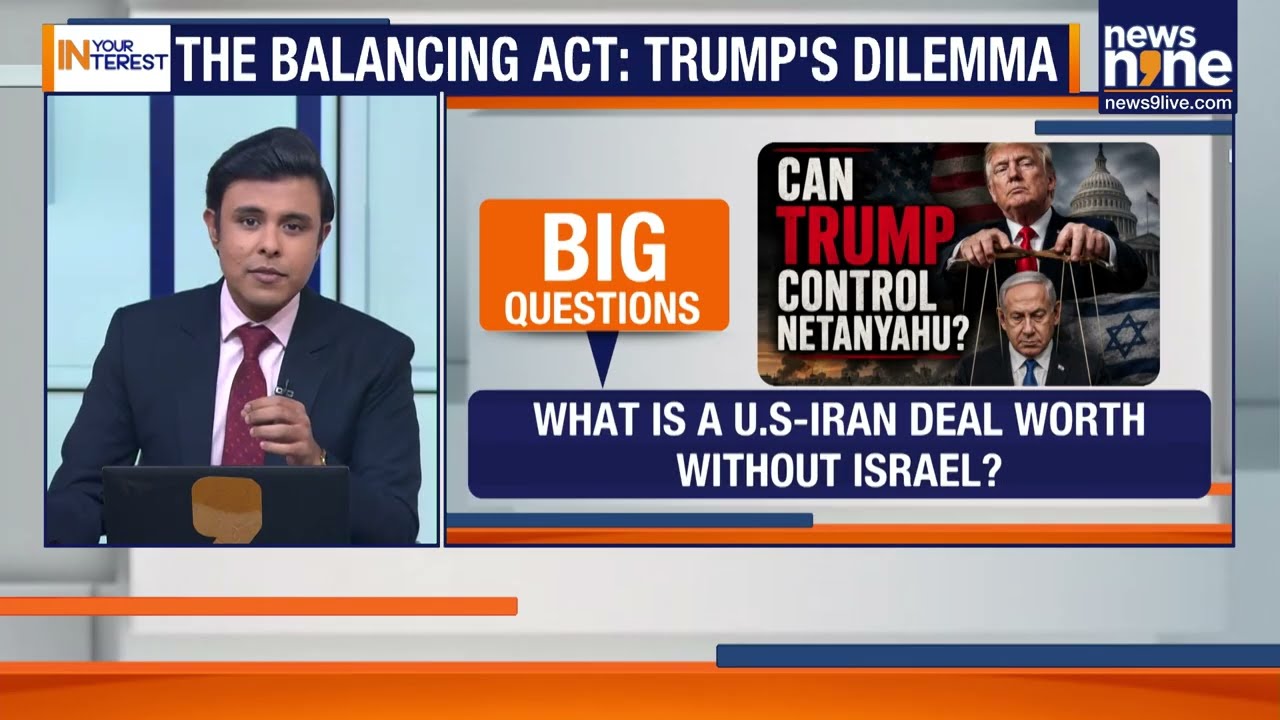
Israel Says 'NO' to Trump's Iran Deal | Peace Deal or Middle East Powder Keg?
NEWS9LIVE
365 views•2026-06-15

Iran emerges stronger, Israel more isolated after war, analysts warn
aljazeeraenglish
65K views•2026-06-14



