In international diplomacy, nations often pursue their own security interests even after signing agreements, using political pressure, media influence, and strategic positioning to shape outcomes, as demonstrated by Israel's efforts to influence the US-Iran deal while maintaining its unilateral security options.
Install our extension to search inside any video instantly.
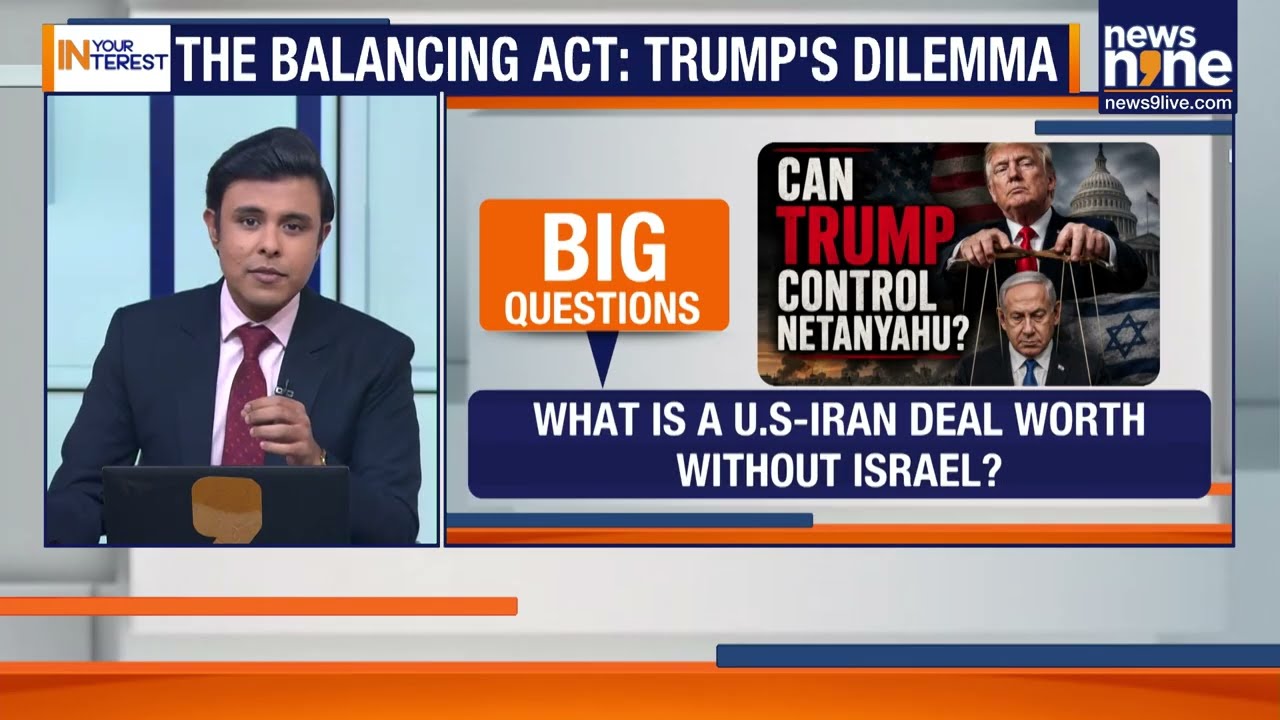
Why Is Israel Still Fighting US-Iran Deal After It Was Signed? Inside Netanyahu's Washington Plan
Added:Revealed reports suggest that a jealous Prime Minister Netanyahu has been working on a behind-the-scenes plan to shape President Trump's Iran deal, using every available lever of influence to try to bend the agreement closer to Israel's long-standing security demands.
Far from giving up after the apparent diplomatic breakthrough between the United States and Iran, the Israeli leader appears determined to stay in the game, signaling that he intends to keep pressing Washington even as the new framework takes shape. According to these accounts, Netanyahu's strategy now leans heavily on media allies and sympathetic lawmakers in Washington, seeking to generate political pressure, frame the public narrative, and sway congressional opinion against any terms he sees as too soft on Tehran. At the same time, Netanyahu has declared that Israel is not bound by the Iran-US memorandum of understanding, drawing firm red lines on Lebanon and making clear that, regardless of the deal, Israel reserves the right to act unilaterally against threats from Hezbollah or Iranian proxies. [music] Israeli Prime Minister Benjamin Netanyahu is reportedly still working to influence the contours of the final US-Iran agreement, determined to shape its outcome even as the framework moves forward. His efforts have continued despite President Donald Trump already signing a memorandum of understanding with Tehran, signaling that the Israeli leader does not view the interim document as the final word on Iran policy. Under the terms of the memorandum, the agreement has triggered a 60-day negotiation window between Washington and Tehran, during which both sides are expected to hammer out a comprehensive final pact. Netanyahu is said to believe that Iran will ultimately refuse to accept meaningful, enforceable limits on its nuclear program, a conviction that fuels his skepticism and his determination to press for tougher conditions. According to coverage by CNN, the Israeli leader is actively trying to shape the debate inside Washington D.C. over the emerging deal, seeking to influence how American policymakers and the public perceive its risks and benefits. Reports say the Prime Minister is working through conservative media figures and pro-Israel lawmakers in Congress, leveraging long-standing relationships to amplify criticism and raise doubts about the agreement's terms. Prominent pro-Israel podcaster Mark Levin has denounced the deal as a slush fund for reconstruction, arguing that the financial components risk empowering Tehran rather than constraining it.
Netanyahu is also expected to lobby friendly senators directly to voice concerns and push for stricter oversight, using Capitol Hill as an additional line of pressure on the Trump administration as negotiations with Iran continue. Republicans angrily condemned President Trump's interim [music] deal with Iran as a mistake, arguing that the pact contains concessions that could embolden Tehran and that [music] the administration moved too quickly without securing ironclad guarantees or congressional oversight. The administration [music] hailed the 14-point memorandum of understanding as a major win, intended to end the 110-day [music] conflict, presenting the agreement as a diplomatic breakthrough that prioritizes de-escalation and the rapid return of stability [music] to a volatile region.
Republican Senator Bill Cassidy said, "Quote, Reagan is rolling over in his grave.
Iran's nuclear ambitions were not curbed, and they have learned that threatening the Strait [music] of Hormuz works and will undoubtedly leverage it in the future. Now, Iran gets to build brand new infrastructure under this deal.
Before the war, the Strait was open.
Iran was being crushed by sanctions, and 13 service members were still alive.
Now, 13 Americans are dead.
>> [music] >> Families have paid billions at the pump.
Sanctions will be lifted, and the bombing has stopped. This is the worst foreign policy blunder in decades."
Unquote.
Trump administration officials [music] emphasized the downblending of enriched uranium as an important safeguard, claiming that converting higher enriched material into forms less suitable for weapons reduces [music] immediate proliferation risks and serves as a verifiable confidence-building measure.
But critics counter that Trump's Iran deal accomplished less than the 2015 [music] nuclear agreement negotiated under President Obama, saying the interim pact lacks the long-term, legally binding restrictions, and intrusive verification mechanisms [music] that defined the earlier accord.
Another prominent Republican, Senator Ted Cruz, described elements of the pact [music] as ill-advised and urged that further details be disclosed and scrutinized, warning that without greater transparency [music] and stronger enforcement measures, the agreement could prove dangerous rather than stabilizing.
Republican Senator Ted Cruz said, [music] and I quote, "What has been released so far suggests that, unfortunately, the president is getting, [music] I think, very poor advice when it comes to this deal. History teaches that giving billions of dollars to theocratic lunatics who want to murder us is a bad idea." Unquote. Although some Republicans who previously backed military strikes on Iran are now shifting to support the peace framework, their changed stance reflects a calculation that a structured agreement could better protect US interests than an open-ended conflict. Several prominent GOP figures, including Lindsey Graham, have indicated that the deal could be beneficial, suggesting that if the framework is properly enforced and tightened, it may offer a realistic path to de-escalation and regional stability.
A major point of contention in the agreement remains the section dealing with Lebanon, where unresolved issues about Hezbollah and cross-border attacks have made this track particularly sensitive for both Washington and Jerusalem. The memorandum of understanding calls for an immediate and permanent ceasefire on all fronts, including Lebanon, setting an ambitious goal to halt hostilities across multiple theaters at once. However, the agreement does not spell out how such a ceasefire would be enforced or how armed proxies would be disarmed, restrained, or deterred, leaving key enforcement mechanisms vague and open to dispute.
Netanyahu has reportedly told Trump that Israel does not consider itself bound by these terms, insisting that Jerusalem retains full freedom of action against threats on its northern front regardless of what Washington and Tehran sign. The Israeli prime minister has also declared that security zones in Gaza, Lebanon, and Syria will be maintained, signaling that Israel intends to preserve forward defensive positions and deterrent postures despite the new framework.
Defense Minister Katz has reinforced this line by saying Israeli forces will remain in the security zones for unlimited time. Underscoring Israel's readiness to sustain an extended deployment if leaders deem it necessary for national security. Meanwhile, US Vice President J.D. Vance has publicly criticized Netanyahu for attempting to undermine or derail the deal, accusing the Israeli leader of crossing a line by trying to sabotage a US-led diplomatic initiative aimed at ending the war.
>> I want to talk back to the Lebanon area for a second.
There's a report [clears throat] in Axios that Netanyahu is fuming over this. He doesn't Israel doesn't feel bound to the MOU as it relates to Lebanon. If as you mentioned your frustration with Israel strike Israel striking in Beirut hitting apartment buildings, if that continues could it torpedo the deal? And what would the US's response be to a broader war in Lebanon involving Israel as well?
>> Yeah, well, I don't want to get into hypotheticals that could torpedo the deal because I think the president's expectation is that all of our friends, the Israelis, the Arabs in the region, we're going to work together and actually see this deal to completion.
Now, I saw the Axios report uh you know, that that that that Netanyahu is fuming.
That's not reflective of the conversations that I've had with him, but maybe he's saying something to somebody else that he's not saying to me. What I will say, and this does bother me, is that you have seen people within Bibi's cabinet who have come out and attacked the deal and in some ways very personally attacked the president of the United States. And I guess my message to them would be twofold. Number one, Donald J. Trump is the only head of state in the entire world who is sympathetic to the nation of Israel at this moment in time. And he happens to be the head of state of the world's superpower. If I was in the cabinet of the Israeli government, I might not be attacking the only powerful ally that I have anywhere left in the entire world.
And the second message I would give to to of those cabinet members, Bibi to his credit has not gone down this path, but to some of these cabinet members in Israel who are attacking the president of the United States, the other thing that I would say is that over the last 3 months, >> [clears throat] >> 2/3 of the defensive weapons that have protected your homeland have been built by American hands and paid for by American tax dollars. The problem for Israel is not Donald J. Trump, and anybody in Israel who thinks their biggest problem is the president of the United States needs to wake up and smell the reality of the situation that country is in. Thank you all.
>> We are standing today in Gush Etzion on the main road between Jerusalem, the eternal city, and Hebron, the city of the patriarchs. Here, on this good mountain between the ancient stone and the olive tree, between the spirit of the Bible and the spirit of heroism of our generation, the generation of victory, we say once again, the people of Israel have returned home, and we will remain here forever because this is our land. It is ours. We have returned to the place from which we came, to the road on which our forefathers walked.
And therefore, today, the government of Israel is granting Highway 60 the name it deserves, the Bible Road. This is not just a road paved with asphalt. It is a road paved with memory, with faith, with promise. Highway 60 leads from the Negev to the Galilee, but in fact, it leads much, much farther. It leads from our forefather Abraham to the soldiers of the IDF.
From the generations of the Bible to the generations of the future. It passes through the places where the great story of our people was written. Every such place, without exception, is not just a point on the map. It is a chapter in in identity. It is proof that we are an ancient people renewing its national life in its historical homeland because the Bible road is the root of our existence. Here, pioneers are building today as I have just seen. Here, pioneers are building the chapter of the rebirth of the people of Israel in its land. We are here, ladies and gentlemen, my friends, by virtue of the truth. This is our land. This is our heritage. This is our way. Throughout the generations, our people, just as this road does, have known ups and downs. We have faced many challenges and we have prevailed over them. In a war of rebirth, we achieved tremendous accomplishments against the axis of evil of Iran and its proxies. We pushed away from us the danger of immediate annihilation and had we not acted in the two mighty operations with the boldness of a lion and roar of the lion with determination, daring, and supreme heroism by our fighters and our pilots. Iran would today have nuclear bombs for our destruction, but we did not let them. At that time, too, we broke the axis of evil, the choke ring that Iran tried to tighten around us. We are gripping Hamas in Gaza where we hold more than 60% of the territory of the strip and in Lebanon we have pushed the threat of a ground invasion away from our communities and shattered Hezbollah's missile power. There is still work to be done in both places, but we have done tremendous work. True, the struggle is not yet over and additional challenges still lie ahead of us and these require from us cool-headedness, steadfast defense of our security interests, and at the same time, preservation of the important connection with our American friends who fought at our side, shoulder to shoulder, and we greatly appreciate this. We will continue to steer our path with wisdom and prudence. We will preserve the achievements of the government. We will preserve the achievements of the war. These are the achievements of the entire people of Israel. Just as we restored security and prosperity to the communities around Gaza, so we will restore security and prosperity to the communities of the north. This requires maintaining the security zone in southern Lebanon. This requires that we do not leave there as long as Israel's security needs require it. Because that zone separates Hezbollah from our citizens and our communities. And in a broader perspective, we will continue to adhere to the supreme goal that has guided us and has guided me through most of my adult life. Iran will not have nuclear weapons. And as long as I am prime minister of Israel, this will not happen. With unity of purpose, we will guarantee our existence and our future.
We will do this with head held high, with firm standing and with patience.
Our path, the path of the people of Israel, began thousands of years ago.
And with God's help, it will continue from the Bible to eternity, the eternity of Israel.
>> Later, in an interview with the New York Times, Vance slammed what he called a weird panic and freak out inside Israel's political system over the terms of the Iran deal. The US vice president said many Israeli officials wrongly assume Iran will get economic benefits without changing any behavior, as if sanctions [music] relief comes with no strings attached. Vance insisted that's not how the deal is written, arguing that sanctions will remain or snap back if Iran continues funding terror groups or refuses to shift course on regional aggression.
Vance said, and I quote, "There is this weird panic almost in the Israeli system.
They assume everything good for Iran will happen without behavior changes.
That's not how the deal is written.
What is your exact proposal? You're a country of 9 million people.
You can't just kill your way out of solving every single national security problem that you have. Unquote.
Related Videos
126 .bikey6
mikey.bikey6
572 views•2026-06-16

Tamil Nadu Assembly | "இருமொழி கொள்கை பின்பற்றப்படும்" | Governor Arlekar | 2 Language Policy
News18Tamilnadu
558 views•2026-06-18
Rep
RobSmithOnline
3K views•2026-06-15
Cross-Voting Hits INDIA Bloc As NDA-Backed Nathwani Wins Jharkhand Seat, ZPM Makes Rajya Sabha Debut
cnnnews18
283 views•2026-06-19
WHILE TRUMP BEGGED CHINA FOR HELP — CHINA WAS SECRETLY ARMING IRAN BEHIND HIS BACK
Frumreporttwo
219 views•2026-06-18

The U.S. Iran 14 Point Memo of Agreement... What's REALLY Happening...
J.S.Candid
4K views•2026-06-17
Israel Says 'NO' to Trump's Iran Deal | Peace Deal or Middle East Powder Keg?
NEWS9LIVE
365 views•2026-06-15

Iran emerges stronger, Israel more isolated after war, analysts warn
aljazeeraenglish
65K views•2026-06-14



